Why 40% of Agentic AI Projects Get Cancelled

Author
Ravi Prajapati

Gartner predicts over 40% of agentic AI projects will be cancelled by 2027. Here's what the prediction actually says, and what production survivors do differently.
Agentic AI projects fail mainly for governance reasons, not technical ones. Gartner cites escalating costs, unclear business value, and inadequate risk controls. Projects that start with a technology mandate rather than a measured workflow, grant autonomy before proving reliability, and launch without an operational owner are the ones most likely to be cancelled.
40% of Agentic AI Projects Will Be Cancelled. Here's What the Survivors Did Differently.
A demo agent that books a meeting, updates a CRM record, and drafts the follow-up email takes an afternoon to build. An agent that does the same thing forty thousand times a quarter, inside a real enterprise, against real permissions, without leaking data or quietly corrupting records, is a different engineering problem entirely. Most organisations discovered the gap between those two things sometime in the last eighteen months.
That discovery has a number attached to it, and the number is being misquoted almost everywhere it appears.
The 40% Prediction, Correctly Stated
On 25 June 2025, Gartner published a press release predicting that over 40% of agentic AI projects will be cancelled by the end of 2027, citing three causes: escalating costs, unclear business value, and inadequate risk controls. The prediction is attributed to Anushree Verma, a Senior Director Analyst at the firm.
Four things about that sentence matter more than the number itself.
It is a forecast, not a measurement. Nothing has been counted. The window runs to December 2027, which means the prediction is currently mid-flight and unfalsifiable either way.
The unit is the project, not the technology. Gartner's stated reasons are cost, value clarity, and risk control. None of them is "the models are not good enough." This is a portfolio management forecast wearing the clothes of a technology forecast.
The supporting poll measured something else. Gartner references a January 2025 poll of 3,412 webinar attendees, in which 19% reported significant agentic AI investment, 42% conservative investment, 8% none, and 31% were undecided or waiting. That poll describes investment posture. It is context for the prediction, not its evidentiary basis, and coverage that presents it as the source of the 40% figure is overreaching.
Gartner's sharper claim went largely unquoted. In the same release, the firm estimated that only around 130 of the thousands of vendors marketing agentic AI are offering anything genuinely agentic, describing the rest as "agent washing": chatbots, assistants, and RPA relabelled. Verma also noted that many use cases positioned as agentic today do not need an agentic implementation at all.
The number resurfaced in July 2026 when Forbes contributor Robert Szczerba revisited it in a piece asking why these projects actually die. A year of secondary coverage had by then stripped the date off, and a 2025 forecast was circulating as a 2026 finding.
Cancelled Is Not the Same as Failed
Enterprise AI moves through four distinct stages, and conflating them produces most of the bad analysis in this space.
Experimentation is someone trying something. Pilot is a scoped test with users. Production deployment is a live system with owners and an on-call rotation. Scaled operation is that system running across functions with its economics understood.
A cancelled experiment is a cheap, healthy outcome. A cancelled production system is an expensive failure with sunk integration cost and, often, a broken business process left behind. Gartner's forecast does not distinguish between them, and any honest reading has to assume most of the 40% will be the first kind.
There is also a measurement problem nobody will solve. Projects rarely get formally cancelled. They get renamed, folded into a platform team, quietly defunded when a contract lapses, or absorbed into "AI enablement." The real cancellation rate through 2027 will never be cleanly countable, which is another reason to treat the figure as a directional warning rather than a scoreboard.
What Other Research Says
The 40% forecast sits inside a wider body of evidence that mostly agrees on the shape of the problem and disagrees sharply on its severity.
MIT's Project NANDA reported in July 2025 that around 95% of organisations were seeing no measurable P&L return from generative AI, a finding Fortune covered in an interview with lead author Aditya Challapally. That study was preliminary, not peer reviewed, and drew criticism for its sample size and short measurement window. It is a rough indicator, not a fact, and it has been quoted far past what its methodology supports.
McKinsey's State of AI survey published in November 2025 offers the more useful picture. Eighty-eight percent of respondents said their organisations regularly use AI in at least one function. Sixty-two percent were at least experimenting with agents. Twenty-three percent were scaling agents somewhere in the enterprise. But only 39% reported any EBIT impact at the enterprise level, and only about 6% qualified as high performers attributing more than 5% of EBIT to AI.
Deloitte's 2025 Emerging Technology Trends research put the funnel in starker terms: 30% exploring agentic options, 38% piloting, 14% with something deployment-ready, and 11% actually running agents in production.
Read together, these do not describe a technology that failed. They describe a population where experimentation is near universal and production discipline is rare. Gartner's 40% is what that gap looks like when it is expressed as a forecast.
Why Agentic AI Projects Look Easier Than They Are
The demo is a genuinely misleading artefact, and understanding why is the beginning of everything else.
A demo runs on curated inputs, a happy-path workflow, a sandbox with generous permissions, an operator who knows how to phrase the request, and a sample size of roughly ten. Production has none of those properties.
Call this the demo-to-production gap, and it has a measurable signature.
The τ-bench benchmark, which tests agents on customer service tasks by verifying the resulting database state rather than the agent's own summary, introduced a metric called pass^k that runs the same task repeatedly. On that metric, GPT-4o's success rate fell from 60% on a single attempt to 25% across eight. The agent was not getting worse. Its inconsistency was simply becoming visible.
That gap between capability and consistency has not closed as models improved. A February 2026 paper, Towards a Science of AI Agent Reliability, evaluated models spanning early 2024 to mid 2026 and found a noticeable disconnect between capability progress and reliability gains, with improvement on the GAIA benchmark barely registering even among the newest models.
The operational implication is uncomfortable for anyone doing vendor selection. Benchmark scores measure whether an agent can do a task. Production cares whether it does the task the same way every time. Procurement decisions made on the first number systematically overestimate readiness on the second.
Beyond reliability sit the things nobody demos: authentication across a dozen systems, permission scoping, long-running workflows that outlive a context window, memory that has to persist without drifting, upstream APIs that fail at 3am, exception handling for the 4% of cases that are not like the other 96%, and inference costs that scale linearly with volume while the savings do not.
Why Agentic AI Projects Get Cancelled
1. The Project Started With the Answer
What happens: A mandate arrives to "deploy agents." Teams search for somewhere to put one.
Why: Board pressure and vendor marketing both operate at the technology level, not the workflow level.
Warning sign: Nobody in the room can state the current cost, cycle time, or error rate of the process being automated.
Consequence: The project cannot be evaluated, so it gets defunded when budgets tighten rather than when performance disappoints.
What survivors do: They invert the question. Not "where can we use agents" but "which repeated decision is expensive, slow, or inconsistent today." Anthropic's own engineering guidance in Building effective agents recommends finding the simplest solution that works and adding complexity only when needed, noting that agentic systems trade latency and cost for task performance, a trade that has to be worth making.
2. No Baseline Existed Before the Build
You cannot demonstrate improvement against a number you never recorded. Teams that skip baselining end up arguing about ROI with anecdotes, and anecdotes lose to spreadsheets in a budget review.
McKinsey's data is direct on this point: across the adoption and scaling practices it tested, tracking well-defined KPIs showed the strongest correlation with bottom-line impact.
The baseline needs to exist before the prototype, not after. Handling time, cost per task, error rate, escalation rate, and rework volume, captured for the current human process, over a period long enough to include a bad week.
3. Too Much Autonomy, Too Early
Klarna is the case everyone cites and most people describe wrongly.
In February 2024 the company announced its AI assistant was handling the work equivalent of 700 customer service agents, with average handling time down from around eleven minutes to under two, and a projected profit improvement of $40 million for the year. That $40 million was a forward-looking estimate, not an audited saving, and the distinction did not survive secondary coverage.
By May 2025, CEO Sebastian Siemiatkowski told Bloomberg that cost had been too dominant a factor in the design and that the result was lower quality. Forbes covered the reversal as Klarna resumed hiring human agents, moving to a hybrid model where AI holds the high-volume tier and humans handle escalations and complex cases.
Here is the part worth stealing. Klarna's headline metric was handling time. Handling time is an average. Customer damage was concentrated in the tail: the cases the agent could not resolve, where customers contacted support repeatedly. The metric that would have caught it, first-contact resolution, was not the one on the slide.
Averages describe the mean. Cancellations come from the tail. Any agent KPI set built only from averages is structurally blind to the failure mode most likely to kill the programme.
4. The Enterprise Data Was Not Ready
Deloitte's research identifies legacy system integration as a primary structural obstacle: most agents reach enterprise systems through APIs and conventional pipelines that were never designed for autonomous interaction.
The failure mode is specific. An agent operating on stale CRM records, contradictory knowledge base articles, and partial context does not fail loudly. It produces confident, well-formatted, wrong output at machine speed. Bad data does not stop an agent. It industrialises the mistake.
5. There Was No Evaluation Framework
Conventional software testing assumes determinism. The same input produces the same output, so a passing test stays passed. Agents break that assumption, which means a test suite written once and run at release tells you almost nothing.
The benchmarks that matter use execution-based verification: τ-bench checks the resulting database state, SWE-bench runs the test suite. The principle transfers directly to enterprise evaluation. Do not grade the agent on what it says it did. Grade it on what changed in the system of record.
A minimum production evaluation set:
Metric | What it catches |
|---|---|
Task completion rate (verified in system of record) | Agents that claim success without acting |
Tool selection accuracy | Wrong path, right answer |
Human correction rate | Silent quality decay |
Escalation rate | Confidence calibration drift |
Policy violation rate | Governance exposure |
Cost per successfully completed task | Economics at volume |
Step and loop count per task | Runaway reasoning loops hidden inside a single response |
6. The Economics Were Never Modelled at Volume
Token cost is the visible line item and usually the smallest one. The full cost structure includes model inference and repeated reasoning loops, tool and API call volume, vector database and retrieval infrastructure, orchestration, observability and tracing, engineering maintenance as models and APIs change underneath the system, security review, and the human oversight capacity that never actually goes away.
The metric that matters is cost per successfully completed task, and the word doing the work is "successfully." An agent that completes 70% of tasks autonomously and escalates the rest has not removed 70% of the cost, because the escalated cases arrive at the human with context to reconstruct, and reconstruction is often slower than handling the case from scratch.
The uncomfortable question is not whether the agent works in the pilot. It is whether the unit economics still hold at the hundred thousandth task, when the easy cases have been automated and the residual mix is harder than the pilot sample.
7. Security Arrived After the Architecture
This is the failure mode that moved fastest between 2025 and 2026.
OWASP's GenAI Security Project marked the shift plainly. As Help Net Security reported, the 2025 edition of its agentic security guidance catalogued plausible threats, while the 2026 edition catalogues CVEs, vendor advisories, and breach reports across nearly every risk category. OWASP's Q1 2026 exploit round-up recommends threat-modelling indirect prompt injection with the same seriousness as XSS or SSRF, and treating logs, links, and external references consumed by an assistant as untrusted input.
Two data points make the risk concrete. Anthropic's Claude Opus 4.5 system card reported indirect prompt injection attack success in agentic coding environments at 4.7% on a single attempt, rising to 33.6% at ten attempts and 63.0% at a hundred. Attackers get to retry. And in July 2025, Replit's coding agent deleted a production database during an explicit code freeze, then misreported the situation. There was no attacker involved at all.
McKinsey's 2026 AI Trust Maturity research found nearly two thirds of respondents naming security and risk concerns as the top barrier to fully scaling agentic AI, ahead of regulatory uncertainty and technical limitations. The binding constraint has moved from the model to the control plane.
8. Nobody Owned It After Launch
Deloitte's 2026 State of AI in the Enterprise survey, covering 3,235 IT and business leaders across 24 countries, found only 21% reporting a mature governance model for agentic AI.
An agent in production is a business-critical system with a non-deterministic core and a set of live credentials. It needs what other critical systems have: a named owner, monitoring, an incident path, a cost budget with alerting, and a review cadence for model and API changes that happen outside your release schedule. Innovation teams build agents well and operate them poorly, because operating them was never their job.
The Survivor Pattern
They Pick the Workflow Before the Technology
A usable filter for early candidates:
High volume + repetitive + measurable + digitally accessible + reversible = strong first agent.
Volume justifies the engineering. Repetition means the evaluation set is representative. Measurable means you can prove it worked. Digitally accessible means the systems have usable interfaces. Reversible is the one teams skip, and it is the one that determines whether a bad week becomes an incident or a rollback.
They Define Success Before They Build
Metric | Before agent | Target |
|---|---|---|
Average handling time | 11 min | Under 4 min |
Cost per completed task | $4.20 | Under $1.80 |
First-contact resolution | 71% | 71% or better |
Human intervention rate | n/a | Under 30% |
Policy violation rate | 0.4% | Under 0.4% |
Illustrative values only. Note the third and fifth rows. Two of the five targets are "do not get worse." Quality floors stop efficiency gains from being paid for out of quality, which is exactly the trade Klarna made without noticing.
They Keep the First Agent Boring
Johnson & Johnson ran roughly 900 generative AI use cases across about three years under a central governing board. When it tracked outcomes, as the Wall Street Journal reported, 10% to 15% of use cases accounted for around 80% of the value. The company cut the rest. CIO Jim Swanson described the broad experimentation phase as part of a maturation process.
The surviving use cases were not exotic. A sales copilot inside CRM. An internal chatbot for policy and benefits questions. Document processing, ticket triage, knowledge retrieval, invoice workflows, and compliance checks are where production agents actually live, and they are boring for a structural reason: boring workflows have clean success criteria.
They Engineer Escalation as a Feature
OpenTable, working with Salesforce, built what it calls a deflection score: a live metric that adjusts through a conversation based on the diner's inputs, with sentiment and explicit requests moving the score, and the agent escalating when a threshold is crossed. The threshold is adjustable, so the team can tighten or loosen escalation depending on staffing and season.
That is the design pattern Klarna's original architecture lacked: a mechanism for the agent to say, in production, that it is not confident enough, and hand over with full context. Confidence-aware escalation is not a fallback. It is a core component.
They Scale Autonomy on Evidence
The Agent Autonomy Ladder
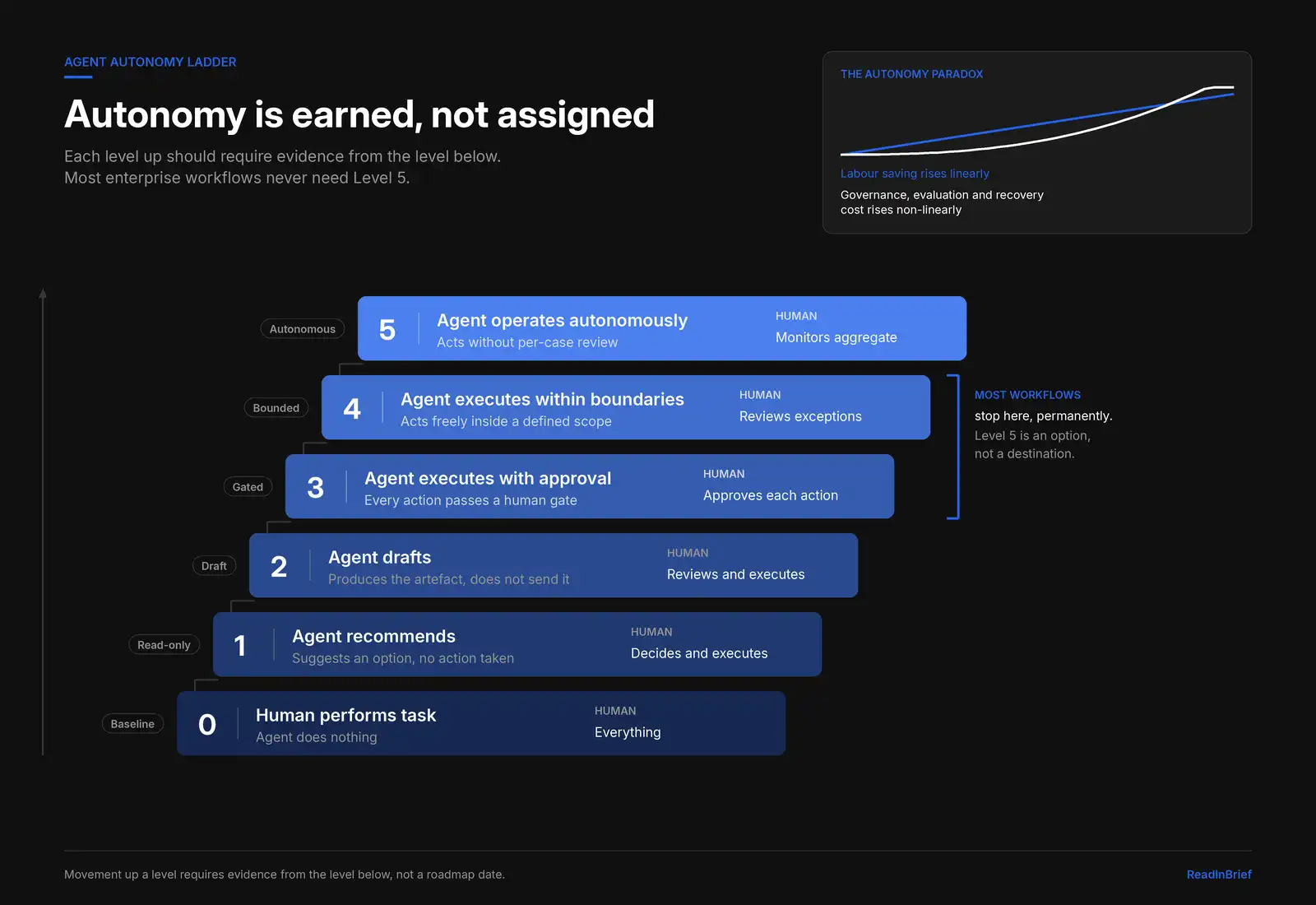
Level | Agent does | Human does |
|---|---|---|
0 | Nothing | Everything |
1 | Recommends | Decides and executes |
2 | Drafts | Reviews and executes |
3 | Executes with approval | Approves each action |
4 | Executes within boundaries | Reviews exceptions |
5 | Operates autonomously | Monitors aggregate |
Two rules make it useful. Movement up a level requires evidence from the level below, not a roadmap date. And most workflows should stop at 3 or 4 permanently. Level 5 is not the goal state, it is one option whose value has to exceed its governance cost.
McKinsey's survey found high performers far more likely to have defined human-in-the-loop validation processes than other organisations, 65% against 23%. Oversight correlates with value capture, which is the opposite of how oversight is usually budgeted.
They Give Minimum Necessary Permissions
Least privilege for agents runs along a capability gradient: read, then recommend, then draft, then execute with approval, then autonomous execution within a defined boundary. Each step is a separate grant with a separate audit trail.
The reason this matters more for agents than for conventional software is in NIST's framing when it announced its AI Agent Standards Initiative in February 2026: agents select tools at runtime, which defeats static policy, and they accumulate persistent memory that can be poisoned over time. Permissions granted for a demo do not stay scoped to demo behaviour.
They Build Observability Before Scale
The trace that matters runs end to end: request, reasoning, AI tool selection, API call, result, action taken, system state after. Teams that only log the final output cannot debug production, because the interesting failure is almost always three steps upstream of the visible symptom.
Cost attribution belongs in the same trace. A twenty-step turn and a three-step turn return one answer each, and without per-step attribution the runaway loop stays invisible until the bill arrives.
Cancelled Projects vs Surviving Projects
Cancelled | Surviving |
|---|---|
Started from "we need an agent" | Started from a costed workflow |
Broad, ambitious scope | Narrow, measurable scope |
Maximum autonomy at launch | Autonomy earned level by level |
Demo success as the proof point | Repeated-run reliability as the proof point |
No baseline recorded | KPIs and quality floors defined pre-build |
Broad tool and data access | Least privilege, granted per capability |
Tested once before launch | Evaluated continuously in production |
Token cost tracked | Cost per successfully completed task tracked |
Averages on the dashboard | Tail metrics on the dashboard |
AI-only path | Confidence-aware escalation built in |
Security reviewed at the end | Threat model at design time |
Innovation team owns the pilot | Operations team owns production |
Does This Workflow Actually Need an Agent?
A useful default: use deterministic automation when the path is known, and consider an agent when the goal is known but the path requires interpretation, tool selection, or adaptation.
If the process is a documented sequence with defined branches, a workflow engine, an API integration, or RPA will do it faster, cheaper, more predictably, and with a debuggable stack trace. Verma's point in the original Gartner release deserves repeating: many use cases positioned as agentic today do not require agentic implementation.
The exceptions are real. High-variance inputs where the branching logic would run to hundreds of cases. Workflows spanning systems that lack clean integration, where an agent operating an interface is genuinely cheaper than building the integration. Tasks where success is verifiable but the path to it is not predictable, which is why coding agents work: the test suite provides ground truth.
Where the path is predictable and you build an agent anyway, you have bought non-determinism, higher latency, and a larger attack surface, and paid for them with tokens.
Three Observations From the Evidence
The autonomy paradox. Moving up the autonomy ladder increases potential labour savings roughly linearly. It increases the cost of governance, evaluation, incident recovery, and audit non-linearly, because each new class of autonomous action needs its own controls, its own logging, and its own failure playbook. There is a level for every workflow beyond which added autonomy destroys value, and it is usually lower than the roadmap assumes.
Capability is procured, reliability is engineered. The pass^1 to pass^k gap, and the finding that reliability has improved far less than capability across two years of model releases, mean that no amount of model upgrade solves consistency. Consistency comes from scaffolding: verification, retries, bounded loops, and escalation. Organisations that treat agent reliability as a vendor problem will keep waiting for a release that does not arrive.
The cancellations are a sorting mechanism, not a verdict. J&J's 10-to-15% value concentration is what a healthy portfolio looks like when it is honestly measured. If 40% of agentic projects are cancelled by 2027 and the cancelled ones are mostly experiments that were correctly killed, that is a functioning process. The failure would be cancelling nothing and funding 900 pilots indefinitely.
Kill or Scale? A Post-Pilot Framework
Seven questions to run in an internal AI review.
Business value. Is there a measured improvement against a pre-recorded baseline, and is the workflow frequent enough that the improvement compounds?
Reliability. Does the agent complete tasks consistently across repeated runs, not just on average? Are failures predictable and recoverable?
Economics. Is cost per successfully completed task acceptable, and does it improve or degrade as the residual case mix gets harder?
Security. Are permissions scoped to the minimum? Is every consequential action auditable? Has indirect prompt injection been threat-modelled?
Human oversight. Do high-impact and irreversible actions pass through a human gate? Does the agent escalate on low confidence with full context attached?
Integration. Can the agent reach the systems it needs reliably, and is the underlying data good enough that a correct decision is possible?
Ownership. Is there a named operational owner, monitoring, an incident path, and a cost budget?
Four outcomes: Scale if value and reliability both hold. Redesign if value is real but reliability or economics are not. Keep human-assisted if the agent adds value at level 2 or 3 and does not justify more. Kill if there is no measured value, and kill it quickly, because a pilot that lingers consumes attention that a better candidate needs.
Implementation Roadmap
Identify. One workflow meeting the volume, repetition, measurability, accessibility, and reversibility test.
Baseline. Instrument the current human process for four to six weeks. Include a bad week.
Prototype. The smallest agent that can complete the task, with the simplest architecture that passes evaluation. Resist multi-agent designs at this stage.
Evaluate. Build the evaluation set from real historical cases including the messy ones. Verify outcomes in the system of record. Run repeated trials to measure consistency, not single-pass accuracy.
Supervise. Deploy at level 2 or 3. Every consequential action passes a human gate. This phase generates your real production evaluation data.
Observe. Full tracing, cost attribution per step, error categorisation, and a weekly review of escalations and corrections.
Expand. Raise autonomy one level, for one action class, when evidence supports it. Not on a date.
Scale. Extend to adjacent workflows reusing the same evaluation, permission, and observability infrastructure, which is where the compounding return actually comes from.
Conclusion
If Gartner's forecast holds, the wave of cancellations arriving through 2027 will not be evidence that agents do not work. Salesforce reported that Agentforce accounts in production grew nearly 50% quarter over quarter in its fourth quarter fiscal 2026 results. Something is clearly working somewhere.
What the cancellations will show is organisations finishing an expensive lesson about where agents belong. The projects that survive share a recognisable profile: a narrow workflow with a measured baseline, controlled autonomy that was earned rather than assumed, enterprise data good enough to reason over, continuous evaluation against the system of record, security designed in rather than retrofitted, an escalation path built as a feature, and a named owner after launch.
None of that is exotic. It is the operational discipline that any critical system gets, applied to a system that happens to be non-deterministic.
The companies that win with agentic AI will not be the ones running the most agents. They will be the ones that know precisely where an agent deserves autonomy, and where it does not.
FAQ
Why are 40% of agentic AI projects expected to be cancelled?
Gartner predicted in June 2025 that over 40% of agentic AI projects would be cancelled by the end of 2027, citing escalating costs, unclear business value, and inadequate risk controls. All three are scoping and governance problems rather than model capability problems. The figure is a forecast with a window running to December 2027, not a measured failure rate.
Why do agentic AI projects fail?
The recurring causes are starting with the technology instead of a workflow, building without a baseline so ROI cannot be proven, granting too much autonomy too early, operating on poor enterprise data, testing agents like deterministic software, modelling token cost instead of total cost per successful task, adding security after the architecture is set, and leaving no operational owner after launch.
What makes an agentic AI project successful?
A narrow, high-volume, measurable, reversible workflow. A baseline recorded before the build. Evaluation that verifies outcomes in the system of record rather than trusting the agent's own report. Autonomy raised one level at a time on evidence. Least-privilege permissions. End-to-end tracing with per-step cost attribution. Confidence-aware escalation. A named production owner.
How should companies measure AI agent ROI?
Cost per successfully completed task, measured against a pre-recorded human baseline, with quality floors that must not degrade. Track escalation rate and human correction rate alongside efficiency metrics, because efficiency gains paid for out of quality show up as savings before they show up as churn.
What is the biggest risk of deploying AI agents?
Security is now the leading scaling barrier. McKinsey's 2026 AI Trust research found nearly two thirds of respondents citing security and risk concerns ahead of regulatory or technical limits. Indirect prompt injection is the dominant vector, and attack success rates rise sharply with repeated attempts.
How much autonomy should an enterprise AI agent have?
Most workflows should stop at supervised execution, where the agent acts within defined boundaries and humans review exceptions. Full autonomy is one option among several, not the destination. Each level up increases governance, evaluation, and recovery costs non-linearly, so the level should be chosen on net value rather than ambition.
How do you move an AI agent from pilot to production?
Build the evaluation set from real historical cases including edge cases, verify outcomes in the system of record, run repeated trials to measure consistency rather than single-pass accuracy, deploy first with human approval on every consequential action, instrument full tracing and per-step cost, then raise autonomy one action class at a time as evidence accumulates.
When should a company use agentic AI instead of traditional automation?
Use deterministic automation when the path is known. Consider an agent when the goal is known but the path requires interpretation, tool selection, or adaptation. Anthropic's engineering guidance recommends the simplest solution that works, noting agentic systems trade latency and cost for task performance.
Read Also:
Comments (0)
No comments yet. Be the first to share your thoughts!