Agentic Commerce Protocol: Product Discovery, Metadata, and Payment Flows Explained

Author
Ravi Prajapati

Learn how agentic commerce protocols connect AI product discovery, structured metadata, checkout, and secure payment flows, with practical examples.
An agentic commerce protocol provides a structured way for AI agents, commerce platforms, merchants, and payment services to communicate during shopping and purchasing. Depending on the protocol, this can include product discovery, access to structured catalog data, cart creation, checkout, payment credential handling, and order management.
The shift is important because finding a product and completing a purchase are two different technical problems. An AI agent might identify a suitable product from a catalog, but it also needs reliable pricing, current availability, clear purchase options, and a secure way to complete a transaction with the customer's authorization.
Two important developments illustrate this direction. OpenAI's Agentic Commerce Protocol (ACP) defines interactions between buyers, AI agents, and sellers to support programmatic checkout. Google's Universal Commerce Protocol (UCP) is an open standard designed to support commerce journeys spanning discovery, purchase, and post-purchase operations. They address related problems, but they are not the same protocol. OpenAI ACP documentation and Google's UCP documentation describe their respective approaches.
For merchants, ecommerce platforms, and developers, the practical question is not simply whether to adopt an agentic commerce protocol. It is how to make product information understandable to AI systems, connect that information to reliable inventory and checkout services, and preserve customer consent and merchant control throughout the transaction.
This guide explains how the components fit together, what the major protocols do, and how businesses can evaluate their readiness for agentic commerce.
What Is an Agentic Commerce Protocol?
An agentic commerce protocol is a set of defined interfaces, data structures, and interaction rules that enables AI agents and commerce systems to exchange information and carry out purchasing-related actions.
Instead of relying entirely on an agent to navigate webpages as a human would, a protocol can provide structured operations for retrieving product information, creating a checkout session, updating an order, or communicating payment-related information. The precise operations depend on the protocol and its implementation.
For example, OpenAI's ACP is designed to support programmatic exchanges between buyers, AI agents, and sellers. The documented approach allows an agent to interact with a merchant's checkout while the merchant retains its existing backend and payment-processing arrangements. Read the ACP introduction.
Google's UCP takes a broader commerce-lifecycle approach. Its documentation describes standardized interactions covering discovery, consideration, purchasing, and order management, with integration options for existing retail infrastructure. Read Google's explanation of UCP.
The common objective is interoperability. A merchant should not need to build an entirely different purchasing system for every AI interface that wants to interact with its products. A shared protocol can reduce the amount of custom integration required, although merchants still need to implement supported capabilities and meet the requirements of individual platforms.
How agentic commerce differs from conventional ecommerce
Traditional ecommerce typically asks customers to search a website, review product pages, select variants, add items to a cart, and complete checkout.
Agentic commerce can move some of those steps into a conversation or delegated workflow. A customer describes a need, an AI agent evaluates available products, and the agent may help assemble a cart or initiate a purchase through an integrated commerce system.
Conventional ecommerce | Protocol-enabled agentic commerce |
|---|---|
Customers navigate product pages and filters. | AI agents can query structured product information through supported integrations. |
Customers manually compare product attributes. | Agents can compare attributes against stated preferences and constraints. |
Customers move through a website's checkout interface. | Supported integrations can expose programmatic checkout operations. |
Payment authorization follows the merchant's existing checkout process. | Agent-initiated flows can coordinate payment credentials, authorization, and merchant processing through supported mechanisms. |
Order status is usually checked through a merchant account or notification. | Integrated systems can expose supported order-management operations to an agent or consumer interface. |
These differences are not absolute. Many existing ecommerce systems already use APIs, structured catalogs, saved preferences, and automated checkout. Agentic commerce builds on those capabilities by making them accessible through AI-driven interactions and standardized interfaces.
How Agentic Commerce Works: From Product Discovery to Payment
An agentic commerce workflow connects several systems that must exchange consistent information. The following sequence is a conceptual example, not a claim that every protocol implements every step in exactly this order.
1. The customer describes a shopping goal
The customer gives an AI agent a natural-language request.
For example:
"I need noise-cancelling headphones for international travel, under $250, with multipoint Bluetooth and at least 25 hours of battery life."
The agent converts the request into criteria that can be used to evaluate products. Those criteria might include price, product category, technical specifications, availability, delivery constraints, and customer preferences.
The quality of the outcome depends on whether the system can translate the request into meaningful attributes and verify those attributes against trustworthy product data.
2. The agent discovers relevant products
The agent searches an available product catalog, commerce feed, API, or other supported source. Depending on the integration, it may retrieve product listings, variant details, offers, and availability information.
Discovery is more useful when the source exposes structured, current information rather than relying entirely on unstructured descriptions.
A product that matches a keyword but is unavailable, incompatible with the customer's requirements, or offered at an outdated price should not be treated as a valid recommendation.
3. The agent evaluates product metadata
The agent compares the retrieved products against the customer's constraints.
For the headphone example, it needs to distinguish between:
Advertised battery life and tested battery life, if both are provided.
Standard Bluetooth connectivity and multipoint support.
The base product and a specific color or regional variant.
A listed price and the current price for the selected variant.
A product that is generally available and one that is available for delivery to the customer's location.
The agent should not assume that missing attributes are satisfied. If a product's metadata does not establish multipoint support, the system should seek additional evidence or communicate the uncertainty.
4. The customer selects a product and confirms the purchase
After presenting suitable options, the agent may prepare a cart or initiate a supported checkout flow.
The checkout system must establish the actual items, variants, quantities, shipping information, applicable discounts, taxes, and final price. Any material change should be communicated before purchase authorization.
A recommendation is not the same as purchase consent. The customer may authorize a specific transaction, or a system may operate under previously defined spending and purchasing permissions where the applicable implementation supports them.
5. The payment flow verifies authorization
Payment handling depends on the protocol, payment provider, merchant, and applicable security controls.
A transaction may require a supported payment credential, authentication, authorization, and communication with the merchant's payment processor. The AI agent should not be treated as automatically entitled to unrestricted access to a customer's payment details.
The integration must establish what the customer authorized, which transaction the authorization covers, and what happens if the amount or order changes.
6. The merchant processes the order
Once the required checkout and payment conditions are satisfied, the merchant's systems can process the order and return its status.
Depending on the integration, supported operations may also include order updates, fulfillment information, cancellations, or returns.
The merchant remains responsible for its applicable order-management, consumer-protection, tax, refund, and fulfillment obligations. A protocol does not remove these responsibilities.
The central technical principle: product discovery, product data, checkout, payment authorization, and order management must work together. A failure in any one component can make the entire shopping experience unreliable.
Why Product Metadata Matters to AI Shopping Agents
Product metadata is structured information that describes a product, its variants, commercial offer, and relevant attributes. It can include a product identifier, brand, model, dimensions, compatibility, price, availability, shipping options, and other category-specific details.
For agentic commerce, metadata helps an AI system determine whether a product actually satisfies a customer's requirements.
Consider a customer searching for a laptop with 32 GB of RAM, a specific processor, and a price ceiling. A product description that says "high-performance laptop" is not sufficient to verify those requirements. Structured attributes make the comparison more precise.
Essential metadata fields for agentic commerce
Metadata field | What it helps the agent determine |
|---|---|
Product ID or SKU | Which product or catalog record is being referenced |
Product name and brand | What the item is and who makes it |
Product category | Which types of products it belongs to |
Product description | The item's purpose and distinguishing features |
Technical attributes | Whether it meets the customer's requirements |
Variant ID | Which size, color, configuration, or model is selected |
Price and currency | What the offer costs |
Availability or inventory status | Whether the product can currently be purchased |
Offer validity | Whether a price or promotion remains applicable |
Shipping and fulfillment information | Whether the item can be delivered or collected under the required conditions |
Product URL or image | Where the product can be examined or identified |
Returns and warranty information | Which applicable post-purchase terms should be considered |
Not every product category requires the same fields. A hotel booking needs dates, occupancy, availability, cancellation conditions, and fees. A laptop needs hardware specifications. A clothing product needs size, color, material, and fit information.
Merchants should therefore design metadata around the decisions customers make, rather than publishing a generic collection of attributes for every product type.
Structured data, product feeds, and protocol metadata are different
These concepts overlap, but they serve different functions.
Structured data is information organized into defined fields. On websites, Schema.org vocabulary can help describe products and offers in a machine-readable format.
Product feeds are structured catalog records supplied to shopping platforms or other systems. They may contain identifiers, prices, availability, product descriptions, images, and variant information.
Protocol metadata and payloads describe the data and operations exchanged within a particular integration. A protocol may define required fields, object relationships, capabilities, and the format for requesting or returning information.
These mechanisms are complementary rather than interchangeable. Publishing Product structured data does not automatically implement ACP or UCP, and implementing a commerce protocol does not guarantee that a merchant's catalog is accurate.
Merchants should consult the relevant specifications and platform requirements instead of assuming that one markup format satisfies every integration.
Useful starting points include Google's product structured data documentation, Schema.org Product, and the OpenAI commerce developer documentation.
A practical product metadata example
The following is an illustrative record, not an actual merchant listing:
{
  "product_id": "HEADPHONE-001",
  "name": "Wireless Noise-Cancelling Headphones",
  "brand": "Example Audio",
  "category": "Headphones",
  "attributes": {
    "noise_cancellation": true,
    "multipoint_bluetooth": true,
    "battery_life_hours": 30
  },
  "offer": {
    "price": 199.99,
    "currency": "USD",
    "availability": "in_stock"
  }
}
This record is useful because it separates individual attributes from descriptive copy. An agent can compare the listed battery life against a 25-hour requirement and evaluate the stated price against a $250 budget.
However, the record is not sufficient for a real transaction. A production system must also establish whether the information is current, whether the correct variant is selected, and whether the offer remains valid at checkout. The example's availability field is illustrative and is not a universal protocol field.
Metadata quality problems that undermine product discovery
Merchants should pay particular attention to five recurring problems.
Inconsistent identifiers: The same variant appears under different IDs in different systems, making it difficult to connect discovery results to the correct checkout item.
Missing attributes: Important specifications exist only in marketing copy or are not supplied at all.
Stale prices and inventory: The catalog says an item is available, but the live commerce system cannot fulfill it at the displayed price.
Ambiguous variants: A parent product is available, but the specific size, configuration, or color requested by the customer is not.
Unclear commercial terms: Shipping fees, subscription conditions, renewal terms, return restrictions, or other material details are missing or difficult to verify.
A useful operational rule is to treat catalog data as a source of discovery information, while using the appropriate live commerce service to confirm transaction-critical details before checkout.
Agentic Commerce Payment Flows Explained
Agentic commerce payment flows coordinate the transition from a customer's purchase decision to a transaction that the merchant can process.
The main challenge is to enable useful automation without removing customer control or weakening the security controls surrounding payment credentials and authorization.
OpenAI's ACP documentation describes interfaces for checkout and secure credential relay. Google's UCP describes a modular commerce architecture that supports payment handlers and interoperability with related payment standards. Visa's Intelligent Commerce documentation also describes payment credentials, authentication, controls, and protections for AI-initiated transactions. These are related developments, not evidence that every implementation uses the same payment mechanism.
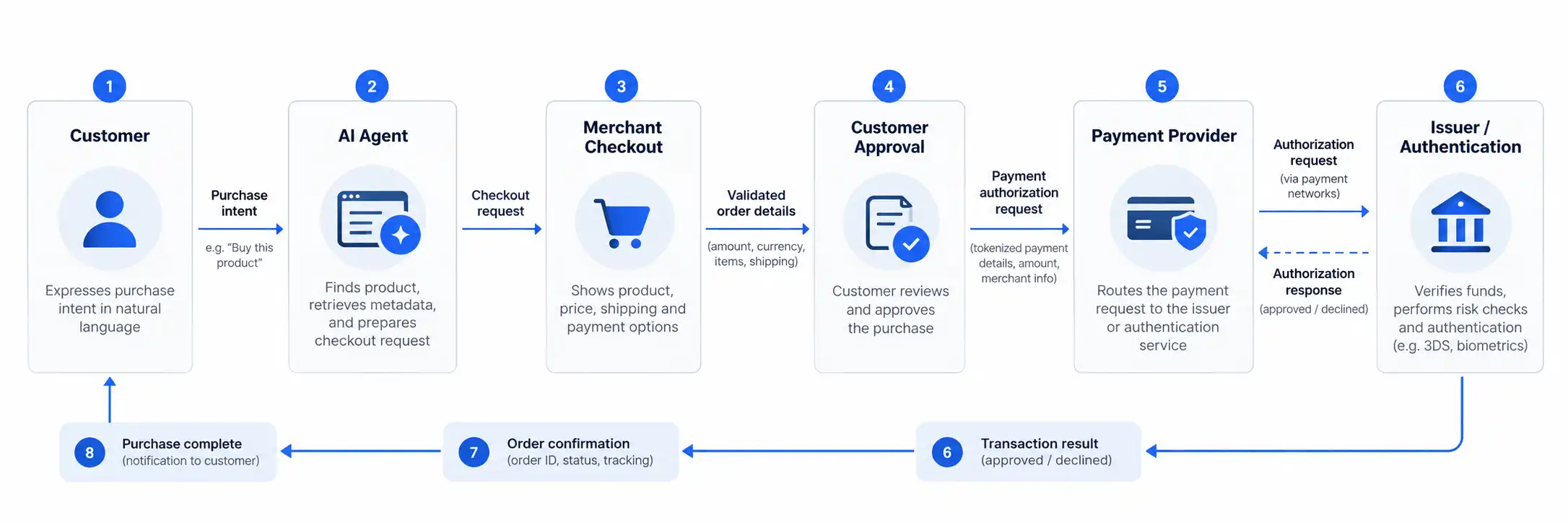
A typical payment flow
A simplified agentic commerce transaction may follow these stages:
Purchase intent: The customer chooses an item or authorizes the agent to act within a defined scope.
Checkout creation: The merchant or integrated checkout service creates a session containing the selected products and applicable purchase details.
Order validation: The system checks the selected variants, inventory, pricing, fees, and fulfillment requirements.
Payment method selection: The customer or supported integration selects an eligible payment method.
Credential handling and authentication: The payment system follows the applicable credential, identity, and authentication requirements.
Authorization: The payment provider or issuer evaluates the transaction under its rules and controls.
Order confirmation: The merchant receives the relevant transaction result and updates the order state.
Customer communication: The system communicates the result, including any failure, additional action, or confirmation required.
This is a conceptual model. Actual API calls, authentication requirements, payment states, and the order of operations depend on the selected protocol and payment provider.
What secure agentic payments require
Explicit purchase authorization: The system must establish whether the customer approved the transaction and what that approval covers.
Least-privilege access: Agents should receive only the permissions necessary for the task. Product discovery should not automatically grant unrestricted payment capabilities.
Protected credentials: Sensitive payment information should be handled through the appropriate payment infrastructure, rather than exposed unnecessarily to model context or application logs.
Transaction limits: Where supported, spending limits, merchant restrictions, and other purchase conditions can constrain what an agent is allowed to do.
Clear change handling: If the price, quantity, shipping terms, or selected product changes materially, the system needs an appropriate revalidation or approval mechanism.
Auditability: Merchants should be able to investigate which instructions, checkout details, authorization events, and transaction results led to an order.
Failure recovery: A timeout or missing response must not be interpreted automatically as a successful or failed payment. The implementation needs a reliable way to reconcile transaction state and prevent duplicate purchases.
These safeguards are not optional details to add after launch. They are central design requirements for any system that lets software initiate purchasing actions.
ACP vs. UCP: What Is the Difference?
The Agentic Commerce Protocol and Universal Commerce Protocol are both intended to improve how AI-driven shopping systems interact with commerce infrastructure. Their documented scopes, integration contexts, and implementation details differ.
The following comparison summarizes their stated roles based on official documentation.
Area | Agentic Commerce Protocol (ACP) | Universal Commerce Protocol (UCP) |
|---|---|---|
Primary focus | Programmatic exchanges supporting purchases between buyers, agents, and sellers | A common commerce interface spanning discovery, consideration, purchase, and order management |
Official documentation | ||
Catalog and discovery | OpenAI's commerce documentation covers structured catalog data and relevant product discovery | UCP explicitly describes discovery and commerce capabilities across supported shopping surfaces |
Checkout | Defines programmatic checkout interactions | Supports standardized commerce operations, including checkout |
Payment integration | Includes payment-related interfaces and credential relay in the documented specification | Uses a modular payment-handler approach and is designed to work with related payment standards |
Merchant infrastructure | Designed to let sellers retain existing backend and payment-processing arrangements | Designed to integrate with existing retail infrastructure while preserving merchant control |
Implementation focus | Supporting compatible AI-to-merchant purchasing interactions | Standardizing commerce interactions across participating platforms, businesses, and payment providers |
This is not a feature-by-feature certification matrix. Exact capabilities, eligibility, and deployment status must be verified against the relevant version of each specification and the merchant's intended platform.
A merchant choosing between implementations should first identify its target shopping surfaces, required operations, existing infrastructure, and payment constraints. It should then evaluate the applicable protocol documentation and integration requirements.
How UCP relates to AP2, A2A, and MCP
Agentic commerce uses several technical standards that solve different problems.
Universal Commerce Protocol (UCP): Defines common interfaces for commerce operations, including supported discovery, checkout, and order-management capabilities.
Agent Payments Protocol (AP2): Addresses payment-related trust and authorization requirements for agent-initiated transactions.
Agent2Agent (A2A): Supports communication and collaboration between AI agents.
Model Context Protocol (MCP): Provides a standardized way for AI applications to connect with tools and external context.
Google's UCP documentation describes compatibility with AP2 and integration options involving A2A and MCP. That does not mean these standards are interchangeable or that every implementation requires all of them. Their relevance depends on the architecture and supported capabilities. You can check Google's UCP technical overview.
A practical way to evaluate an architecture is to ask four questions: How does the agent discover the product? How does it interact with commerce operations? How is the purchase authorized? How does the merchant verify and fulfill the resulting order?
The answers identify the capabilities the integration actually needs.
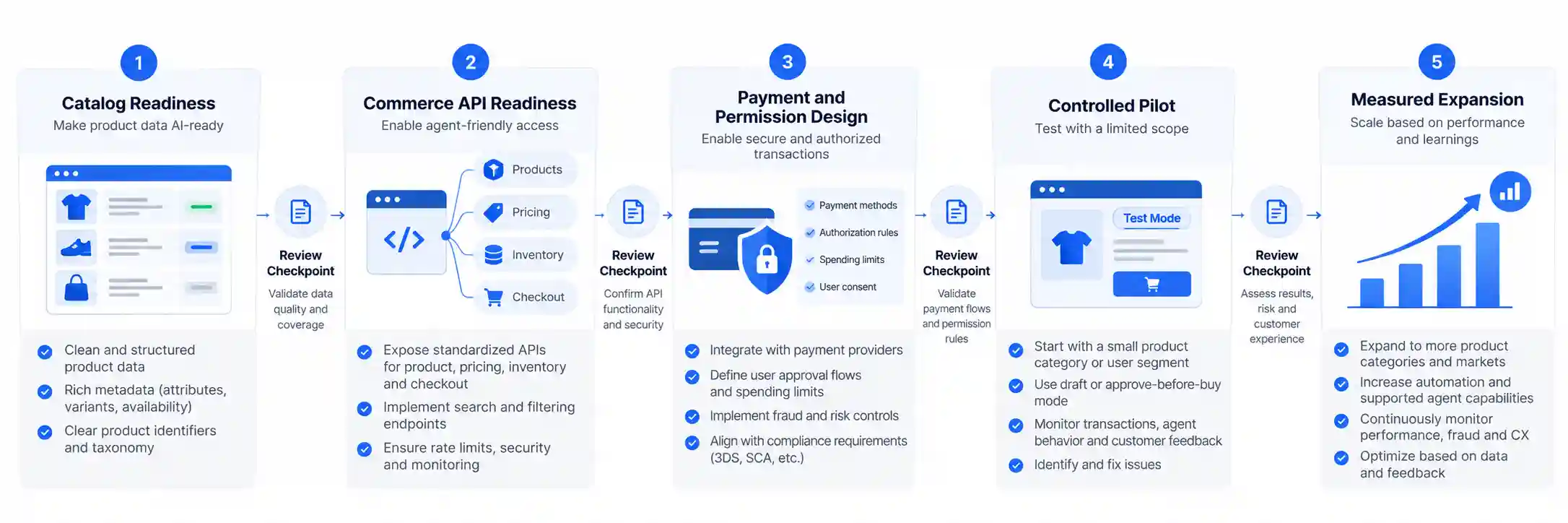
How Businesses Can Prepare for Agentic Commerce
Businesses do not necessarily need to replace their ecommerce platform to begin preparing for agentic commerce. A more practical starting point is to improve catalog quality, establish reliable commerce APIs, and identify the purchasing operations that can safely be exposed to supported agents.
Step 1: Audit product data
Review product identifiers, variant relationships, prices, inventory, technical attributes, shipping details, and return policies.
Identify which fields are missing, inconsistent, duplicated, or frequently outdated. Prioritize attributes that directly affect product selection and purchasing decisions.
Step 2: Establish a reliable source of truth
Determine which system owns each important value.
For example, a product information management system may own descriptive attributes, while an inventory service owns stock availability and a pricing service owns the current offer. The architecture should define how these systems are synchronized and which service is authoritative when values conflict.
Step 3: Make commerce operations accessible
Evaluate whether your existing systems can expose the operations required by the chosen protocol, such as product retrieval, variant validation, cart creation, checkout, order status, or cancellation.
Use the protocol's actual specification to determine which operations are required. Do not build endpoints merely because another integration exposes them.
Step 4: Design payment permissions and safeguards
Define the permitted purchasing scope, approval requirements, authentication mechanisms, transaction limits where available, and handling of sensitive credentials.
Document how the system behaves when authorization fails, a payment times out, or the order changes after the initial approval.
Step 5: Test complete customer journeys
Test more than the successful purchase path. Include unavailable products, expired discounts, invalid addresses, changed prices, payment declines, duplicate requests, timeouts, cancellations, and refunds.
Check that the system communicates uncertainty accurately and does not represent an unconfirmed transaction as a completed order.
Step 6: Measure business and technical outcomes
Track metrics that reflect the quality of the complete experience, such as:
Product discovery accuracy.
Percentage of required catalog attributes populated.
Product-to-checkout price consistency.
Checkout completion rate.
Payment authorization and failure rates.
Duplicate order incidence.
Order cancellation and refund rates.
Customer support contacts associated with agent-led purchases.
These are recommended operational metrics, not published benchmarks. Establish a baseline before deployment and evaluate changes using comparable traffic and transaction conditions.
What Agentic Commerce Protocols Cannot Solve on Their Own
A protocol can standardize communication, but it cannot make unreliable source data accurate or guarantee that every purchase will succeed.
Inaccurate product data remains inaccurate
If a merchant publishes the wrong dimensions, outdated price, or incorrect compatibility information, a standardized interface may distribute that error more consistently. Data ownership, validation, and synchronization remain the merchant's responsibility.
Standardization does not guarantee universal compatibility
An open specification can reduce integration friction, but real-world interoperability still depends on supported features, implementation quality, platform requirements, version differences, and commercial arrangements.
Merchants should not assume that implementing one protocol makes every AI shopping platform compatible with their store.
Payment security requires more than a protocol
Payment security also depends on identity verification, credential protection, fraud controls, merchant configuration, payment-provider behavior, and appropriate authorization policies.
A protocol's security design is only one component of the complete system.
AI agents can misunderstand customer intent
An agent may interpret an ambiguous request incorrectly, select an unsuitable product, or overlook a constraint. Reliable systems need validation rules, clear customer communication, and an appropriate confirmation step before consequential actions.
Adoption and availability vary
Protocol documentation and product announcements establish that a technical approach exists, not that every feature is available to every merchant in every country.
Google's merchant guidance, for example, describes UCP-powered checkout as limited to eligible markets and participating merchants. Availability should be checked against current official documentation before implementation planning. Google Merchant Center's UCP guidance.
Frequently Asked Questions
What is an agentic commerce protocol?
An agentic commerce protocol defines how AI agents, merchants, and related services exchange information and execute supported commerce operations. Depending on the specification, these operations can include product discovery, checkout, payment-related interactions, and order management. The purpose is to make agent-driven purchasing more structured and interoperable than relying exclusively on browser navigation and custom integrations.
How does agentic commerce product discovery work?
An AI agent interprets a customer's request, retrieves product information from available catalogs or supported APIs, and compares product attributes against the customer's requirements. Reliable discovery depends on accurate product identifiers, meaningful attributes, current offers, and validation of important details such as availability and variant compatibility.
Why does product metadata matter for AI agents?
Product metadata gives AI systems structured information that can be compared and validated. Attributes such as dimensions, compatibility, model number, price, and availability help an agent distinguish between products that merely sound relevant and products that actually satisfy a customer's constraints. Missing or outdated metadata can lead to poor recommendations and failed checkout attempts.
What is the difference between ACP and UCP?
OpenAI's Agentic Commerce Protocol focuses on programmatic interactions that support purchasing between buyers, AI agents, and sellers. Google's Universal Commerce Protocol provides a common interface for commerce journeys that can span discovery, checkout, and order management. They address overlapping problems but have different specifications, implementation contexts, and integration requirements.
How do agentic commerce payment flows work?
A typical flow involves purchase intent, checkout creation, order validation, payment method selection, required credential handling and authentication, payment authorization, and order confirmation. The actual sequence depends on the protocol and provider. Secure implementations must preserve customer consent, protect credentials, handle failures, and verify transaction status before treating an order as paid.
Does implementing an agentic commerce protocol guarantee that AI agents will recommend my products?
No. A protocol can make supported product and purchasing operations accessible, but it does not guarantee product recommendations, rankings, citations, or sales. Product relevance, catalog accuracy, platform eligibility, integration quality, customer requirements, and the AI platform's own selection mechanisms can all affect whether a product appears in a particular experience.
Do merchants need to replace their existing eCommerce platform?
Not necessarily. Both ACP and UCP are designed to support integration with existing commerce infrastructure, although the work required depends on the merchant's systems and target use cases. A business may need to improve product feeds, expose additional APIs, adapt checkout, or implement new security controls without replacing its entire eCommerce platform.
Is structured data enough to prepare for agentic commerce?
No. Structured data can help describe products to search engines and other systems, but it does not by itself provide every operation needed for agentic purchasing. Merchants also need reliable product and offer data, supported integration interfaces, transaction validation, payment security, and order-management capabilities.
How can businesses measure agentic commerce readiness?
Businesses can assess catalog completeness, identifier consistency, API coverage, price and inventory accuracy, payment authorization controls, failure recovery, and order reconciliation. A controlled pilot can then measure discovery accuracy, checkout completion, payment failures, duplicate orders, cancellations, and support issues before wider deployment.
Conclusion: Treat Agentic Commerce as a Connected System
Agentic commerce protocols provide a foundation for connecting AI-driven product discovery with structured product data, checkout, payment authorization, and order management. Their value comes from defining reliable ways for separate systems to communicate, not from eliminating the need for accurate data, sound security, or careful implementation.
For merchants, the first step is to make product information complete and trustworthy. The next is to expose the required commerce operations through a supported integration, establish clear payment permissions, and test the complete purchasing journey.
ACP and UCP are important examples of this emerging infrastructure, but businesses should choose an implementation based on their target platforms, required capabilities, and operational constraints rather than assuming that one protocol fits every use case.
The strongest preparation is practical: build a reliable product catalog, keep commercial information current, preserve customer control, and make every transaction verifiable from discovery through fulfillment.
Comments (0)
No comments yet. Be the first to share your thoughts!