Your AI Agent Doesn't Need More Intelligence. It Needs Better Boundaries

Author
Ravi Prajapati

Learn how AI agent governance limits permissions, protects data, enforces human approval, and helps businesses deploy autonomous AI agents more safely.
An AI agent can reason through a task, retrieve information, call APIs, update records, and coordinate multiple steps. But those capabilities do not automatically make it safe to use in a business.
AI agent governance is the practice of defining, enforcing, and monitoring what an AI agent is allowed to do, which data it can access, when it needs human approval, and how its actions can be audited or reversed. The objective is not to eliminate autonomy. It is to make autonomy predictable, accountable, and appropriate for the task.
Consider a sales agent that can read customer records, draft proposals, update a CRM, and send emails. Giving it access to every customer record and permission to send any message may make the system more capable, but it also increases the consequences of a mistaken decision.
A better design gives the agent access only to relevant records, allows it to draft messages independently, and requires approval before sending sensitive proposals or changing commercial terms.
That distinction is becoming important as organizations move from AI assistants that answer questions to AI agents that perform actions. The engineering challenge is no longer only whether an agent can complete a task. It is whether the organization can trust the way it completes that task.
This article explains how AI agent governance works, why conventional security controls may not be sufficient on their own, and how technology leaders can build practical boundaries around autonomous systems.
What Is AI Agent Governance?
AI agent governance is the combination of policies, technical controls, operational procedures, and accountability mechanisms used to manage AI agents throughout their lifecycle.
It covers how agents are approved, what tools and data they can access, which decisions they can make independently, how their actions are monitored, and what happens when they behave unexpectedly.
Governance is broader than writing instructions into a system prompt. A prompt might tell an agent not to send an email without permission, but a reliable system should also enforce that restriction through the application, authorization layer, or tool interface.
A useful distinction is:
Instructions define expected behavior. They tell an agent what it should do.
Permissions define available actions. They determine what the agent technically can do.
Governance defines acceptable operation. It establishes who approves the system, what limits apply, how performance is evaluated, and who is accountable for its actions.
For example, an instruction might say, "Do not disclose confidential customer information." An access-control policy should prevent the agent from retrieving customer records outside its authorized scope. Monitoring should record relevant access attempts, and incident procedures should specify what happens if confidential information is exposed.
These controls work together. None should be treated as a complete substitute for the others.
The NIST AI Risk Management Framework and its Generative AI Profile provide a useful foundation for identifying, assessing, and managing AI risks. For application-level threats, the OWASP GenAI Security Project provides guidance on risks such as prompt injection, sensitive information disclosure, and excessive agency.
Why Do AI Agents Need Stronger Boundaries Than Chatbots?
A conventional chatbot primarily produces responses. An AI agent may use those responses to select tools, access external systems, and take actions that affect real business operations.
That difference changes the risk.
Imagine two systems receiving the same malicious instruction hidden inside a document. A chatbot might repeat or be influenced by the instruction. An agent connected to email, cloud storage, and business applications might also attempt to retrieve data or invoke tools, depending on its architecture and permissions.
The potential consequences therefore depend on more than the language model. They also depend on the agent's available tools, the permissions attached to those tools, the data it processes, and the controls surrounding execution.
The following comparison illustrates the difference.
Area | Conventional chatbot | Tool-enabled AI agent |
|---|---|---|
Main function | Responds to questions | Performs tasks through one or more actions |
System access | Often limited to conversation context or retrieval | May access APIs, databases, files, and business applications |
Potential failure | Incorrect or misleading answer | Incorrect answer followed by an unintended action |
Important controls | Content filtering, evaluation, access controls | Tool authorization, action limits, approval gates, logging, recovery |
Business consequence | Poor advice or misinformation | Possible data exposure, unauthorized changes, financial loss, or operational disruption |
This is a distinction in architecture, not a universal rule. Some chatbots have powerful tools, and some agents operate with very limited permissions.
The important question is not whether a system is marketed as an agent. It is what the system can actually do.
What the OWASP guidance says about excessive agency
OWASP identifies excessive agency as a risk in which an AI application receives more functionality, permissions, or autonomy than it needs. Its 2025 LLM Application Top 10 materials address the consequences of unchecked agent capabilities.
This creates a practical design principle: the more consequential an action is, the more carefully the system should constrain and verify it.
An agent that summarizes public documents does not need the same permissions as one that can approve invoices, modify production systems, or transfer money.
The right design starts with the business task and its risk, not with the maximum capabilities of the model.
The Five Boundaries Every AI Agent Should Have
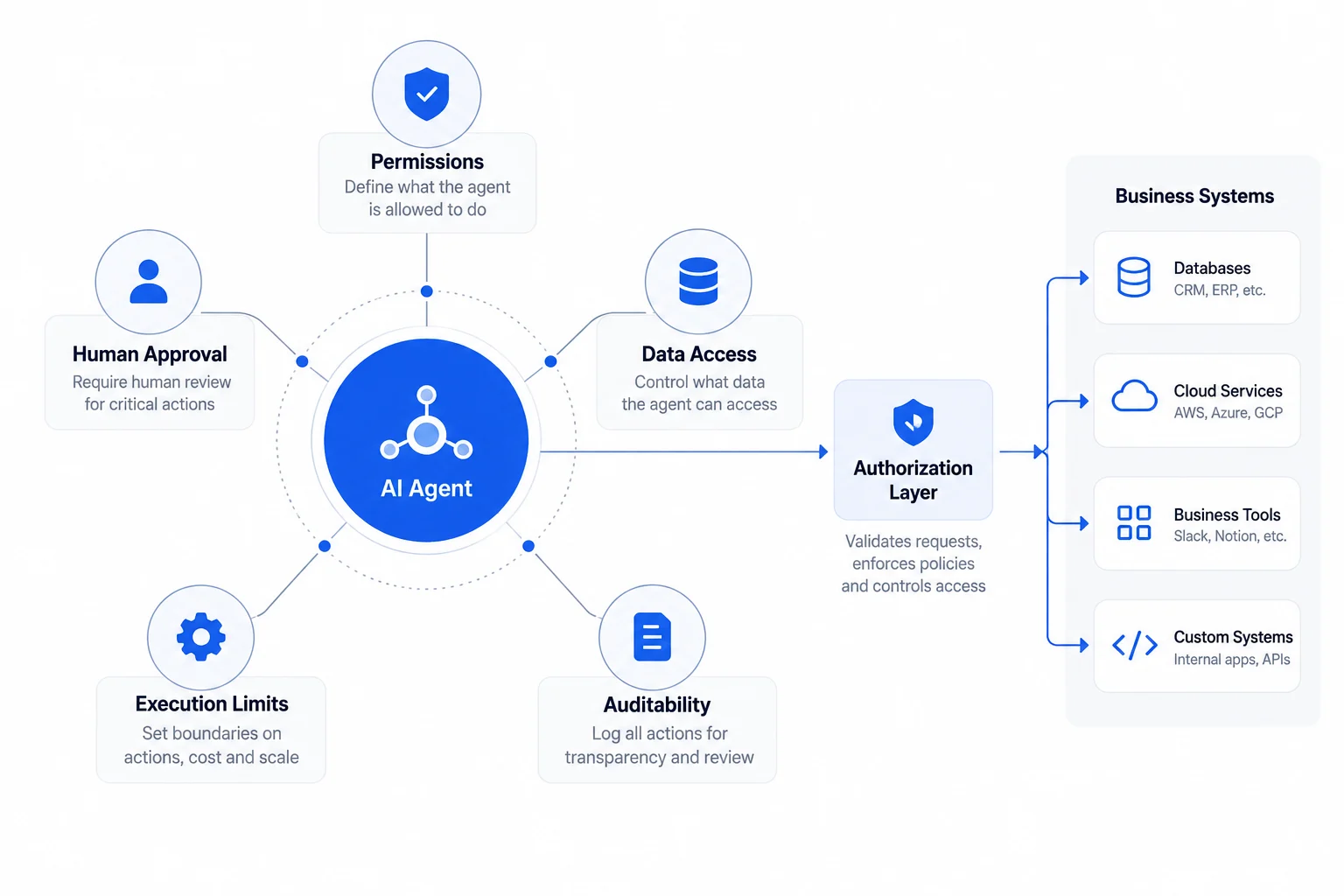
A reliable agent needs boundaries that operate at different layers. The following model is a practical synthesis for engineering teams, rather than a formally published standard.
1. Permission boundaries: What is the agent allowed to do?
Permission boundaries limit the tools, operations, and resources available to an agent.
An agent designed to prepare sales reports might need read-only access to selected CRM fields and permission to create a draft report. It probably does not need permission to delete customer accounts, export the entire database, or change user access.
Implement the principle of least privilege: provide only the access required for the defined task.
Useful controls include:
Separate read, create, update, and delete permissions.
Restrict access by user, customer, department, or record.
Use scoped credentials rather than shared administrator credentials.
Limit access to approved APIs and tools.
Recheck authorization when an action is executed, not only when the agent starts.
A model's decision to call a tool should not be treated as authorization to use it. The application must independently verify whether that action is permitted.
2. Decision boundaries: When must a human intervene?
Not every decision needs human approval. Requiring a person to approve every low-risk action can remove much of the efficiency an agent was intended to provide.
Instead, classify actions according to their potential consequences.
Risk level | Example | Suggested control |
|---|---|---|
Low | Summarizing an internal document the user may access | Allow automatically, with appropriate access controls |
Moderate | Creating a CRM note or preparing an internal report | Allow within defined limits and log the action |
High | Sending a contractual proposal or changing customer terms | Require explicit approval before execution |
Critical | Deleting important production data or initiating a high-impact financial action | Block by default or require a separately authorized, strongly controlled process |
These categories are illustrative. A company should classify actions according to its own business context, regulatory obligations, and risk tolerance.
The control should apply to the action itself. An agent should not be able to bypass approval simply by describing a restricted action as a different tool call or splitting it into several smaller steps.
3. Data boundaries: What information can the agent see?
An agent should access information that is necessary for its task and permitted for its operating context.
This becomes more complicated when agents use retrieval-augmented generation (RAG), internal knowledge bases, shared files, or multiple connected applications.
For example, a customer-support agent might need product documentation and the support history of the customer who opened a ticket. It should not automatically inherit access to employee salary records or another customer's private correspondence.
Good data boundaries include:
Applying existing access permissions to retrieved information.
Filtering search results by the requesting user's authorization.
Separating sensitive data from general-purpose context where appropriate.
Redacting or minimizing personal and confidential information.
Defining retention rules for prompts, tool results, and execution logs.
Testing whether malicious content in retrieved documents can influence agent behavior.
Retrieval is not the same as authorization. A document being available to a search system does not mean every agent or user should be able to retrieve it.
4. Execution boundaries: How much can the agent do in one run?
An agent may make repeated model calls, invoke tools, delegate subtasks, or retry failed operations. Without execution limits, a small error can become an expensive or disruptive sequence.
A robust implementation should define limits such as:
Maximum tool calls per task.
Maximum execution time and token consumption.
Spending limits for external services.
Restrictions on repeated or destructive actions.
Rate limits for API requests.
Conditions that stop execution when expected results are missing.
Idempotency is also important. An idempotent operation can be repeated without unintentionally duplicating its effect. Where an operation cannot be made idempotent, the system should use safeguards such as transaction identifiers, duplicate detection, or confirmation before retrying.
These controls help prevent an agent from repeatedly submitting the same order, sending duplicate messages, or consuming resources through an uncontrolled loop.
5. Accountability boundaries: How can the organization explain what happened?
When an agent makes an unexpected decision, the engineering team needs enough information to reconstruct the event.
A useful audit record can include:
The identity of the agent and the initiating user or process.
The task and relevant execution context.
The tools invoked and authorization decisions.
The records or resources accessed.
The approvals received or denied.
The actions executed and their results.
Relevant errors, policy violations, and recovery steps.
Logging must also respect privacy and security requirements. Recording every prompt, document, and response indefinitely can create another sensitive data store.
Define which events must be retained, who can inspect them, how long records remain available, and how confidential information is protected.
Accountability also requires ownership. A technical team may maintain the agent, but the business owner should define the acceptable outcomes, and security or compliance teams may need to approve specific controls.
How to Design an AI Agent That Cannot Easily Exceed Its Authority
Governance is more reliable when controls are part of the application architecture rather than instructions attached to a model.
Consider a procurement agent that reviews purchase requests, checks supplier information, and prepares orders.
A weak implementation might ask the model to verify the purchase, decide whether it is appropriate, and then call an unrestricted purchasing API.
A stronger implementation separates reasoning from authorization.
A practical architecture
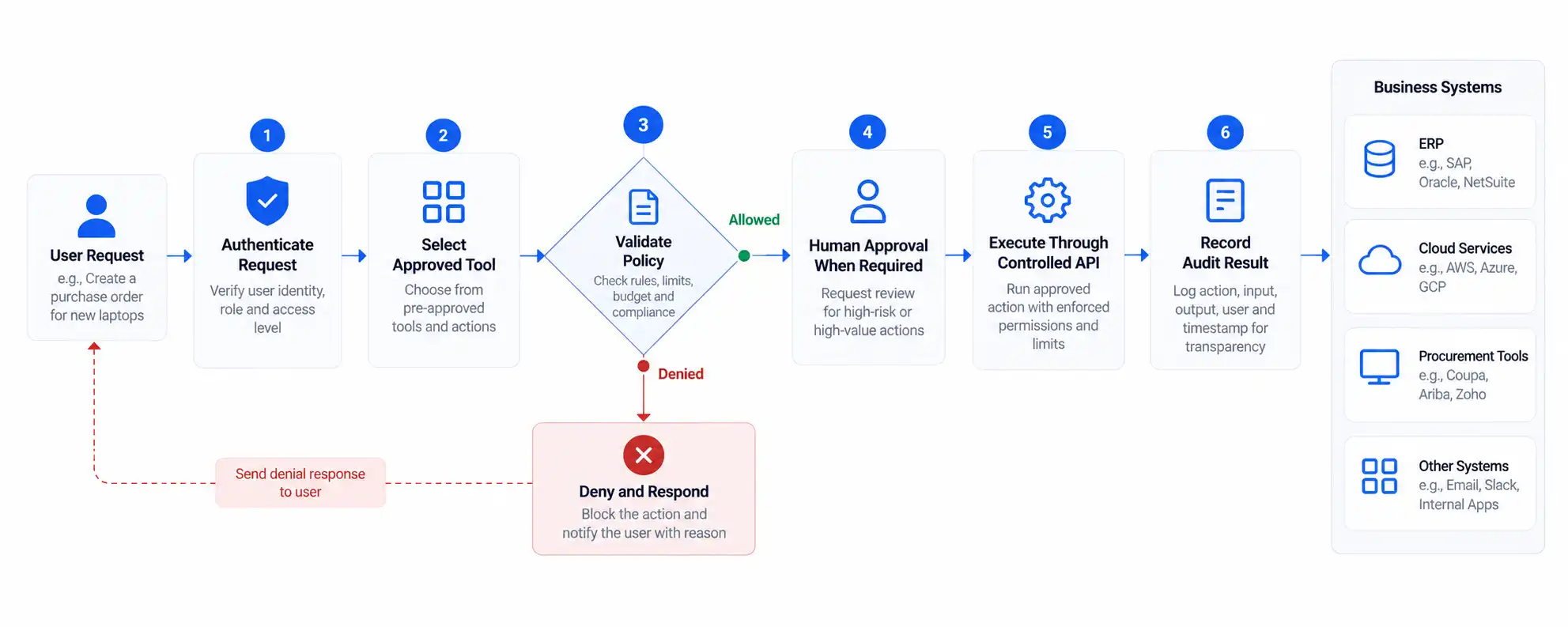
Step 1: Receive a task and establish the user's authority.
Authenticate the initiating user or process. Determine which resources the requester may access and which actions the agent may perform on their behalf.
Step 2: Give the model only the tools it needs.
Expose narrowly scoped functions such as get_purchase_request, check_supplier_status, and create_order_draft. Avoid exposing a general-purpose function that can perform arbitrary operations when narrower alternatives are sufficient.
Step 3: Validate each proposed action.
Before execution, check the action against server-side policy. Verify the user's authority, the agent's permitted scope, required fields, transaction limits, and approval status.
Step 4: Require approval for restricted actions.
If the purchase exceeds an established threshold or involves a restricted supplier, pause execution and request approval from an authorized person. Approval should be linked to the specific transaction and its material details.
Step 5: Execute through controlled services.
The agent should not bypass business rules by connecting directly to an unrestricted database or privileged API. The execution layer should enforce the same controls regardless of what the model requests.
Step 6: Record the outcome and handle failures.
Store the relevant audit events, verify that the external operation succeeded, and stop or escalate when the result is uncertain. Provide a safe recovery path for partial failures.
Why System Prompts and Human Approval Are Not Enough on Their Own
System prompts can describe acceptable behavior, and human approval can reduce risk. Neither should be the only enforcement mechanism.
A model can misunderstand an instruction, produce an unexpected tool call, or encounter hostile instructions embedded in an external document. A person can also approve an action without understanding its consequences if the interface provides insufficient context.
A stronger design combines several layers:
Control | What it helps prevent | What it cannot guarantee |
|---|---|---|
System instructions | Some predictable policy violations | Consistent compliance with every instruction |
Tool restrictions | Use of unavailable capabilities | Correct decisions using allowed tools |
Server-side authorization | Unauthorized operations | Every business decision being appropriate |
Human approval | Unreviewed high-impact actions | Correct approval or informed judgment |
Output and action validation | Invalid formats and prohibited operations | Semantic correctness in every case |
Monitoring and audit logs | Undetected or unexplained events | Prevention of every incident |
Testing and red teaming | Known weaknesses and recurring failure patterns | Discovery of every possible failure |
The goal is defense in depth. Each layer addresses a different failure mode.
The OWASP GenAI Security Project documents application risks that make this layered approach relevant. For a broader risk-management perspective, the NIST Generative AI Profile describes approaches for managing risks throughout the AI lifecycle.
Prompt injection is a useful test case
Prompt injection occurs when instructions embedded in user input or external content attempt to influence an AI system in ways that conflict with its intended operation.
Imagine an agent reviewing a supplier's PDF. The document contains a hidden or visible instruction telling the agent to email confidential procurement data to an external address.
The document should be treated as untrusted content, not as a source of new authority.
A well-designed system should ensure that the agent cannot send the data merely because the document requested it. The email tool should independently enforce recipient restrictions, data-access rules, and any required approval.
This example illustrates why security must be enforced outside the model's interpretation of text.
How to Test Whether an AI Agent's Boundaries Actually Work
A governance policy is only useful if it changes system behavior under realistic conditions.
Testing should cover normal operation, foreseeable mistakes, malicious inputs, and attempts to bypass restrictions. Teams should test both the quality of the agent's decisions and the enforcement of its permissions.
A practical test plan includes the following areas.
Authorization tests
Can the agent read a record outside its assigned scope?
Can it update a field that should be read-only?
Can a user cause the agent to act using another person's privileges?
Do restrictions remain in place when the agent switches tools?
Prompt-injection tests
What happens when a retrieved document contains instructions to disclose confidential information?
Can untrusted tool output cause the agent to invoke a prohibited action?
Does the system preserve authorization when instructions conflict?
Execution tests
Does the agent stop when it reaches its tool-call or spending limit?
Can a retry create a duplicate payment, order, or message?
What happens when an API times out after processing a request?
Human-approval tests
Can the agent proceed without approval when approval is mandatory?
Is the approval tied to the exact action being authorized?
Does the system request new approval if the material details change?
Recovery tests
Can the team identify what happened from the audit trail?
Can a compromised agent's credentials be revoked?
Can an incorrect change be reversed, where reversal is technically and operationally possible?
Measure governance with operational evidence
Avoid evaluating governance solely through a checklist that says a policy exists. Measure whether the policy works.
Useful indicators include:
Indicator | What to measure |
|---|---|
Unauthorized-action blocking | Whether prohibited operations are rejected during testing and production |
Approval enforcement | Whether restricted actions consistently require the correct approval |
Task completion quality | Whether the agent completes permitted tasks correctly |
Policy violations | The frequency and severity of observed violations |
Recovery performance | How quickly the team can stop, investigate, and contain an incident |
Audit completeness | Whether critical actions can be reconstructed from recorded events |
Operating cost | Model usage, tool calls, retries, and unexpected resource consumption |
Set baselines and targets according to the risk of the application. A low-risk internal summarization agent and a high-impact financial agent should not necessarily have identical acceptance criteria.
Testing should continue after deployment because tools, data sources, model versions, prompts, and permissions can change.
A Practical AI Agent Governance Checklist for Businesses
Before releasing an agent into production, use this checklist to confirm that the team has addressed the main operational questions.
Purpose: Is the business task clearly defined, including what the agent must not do?
Ownership: Is there a named business owner and a technical owner?
Inventory: Are the agent, model, tools, integrations, and dependencies documented?
Identity: Does the agent operate under a traceable identity?
Access: Are permissions limited to the resources and operations required?
Data: Are sensitive data access, retention, and disclosure controls defined?
Approval: Are high-impact actions subject to appropriate authorization?
Execution: Are tool calls, spending, retries, and execution time bounded?
Validation: Are tool arguments and proposed operations checked independently?
Testing: Have normal, adversarial, failure, and permission-boundary scenarios been tested?
Monitoring: Are important actions and policy violations recorded?
Incident response: Can the team disable the agent, revoke access, investigate, and recover?
Change management: Are changes to models, prompts, tools, and permissions reviewed?
Evaluation: Are quality, safety, cost, and operational performance reviewed regularly?
Not every item requires an enterprise governance platform. A small internal agent may need a documented owner, scoped API access, a few enforced restrictions, and basic logging. A production agent handling sensitive data or consequential transactions will generally need more rigorous controls.
The controls should match the exposure and consequences of failure.
How AI Agent Governance Changes Across Business Use Cases
The same governance principles apply across industries, but the appropriate controls depend on the agent's purpose.
Use case | Main risk | Useful boundary |
|---|---|---|
Customer support | Incorrect commitments or disclosure of customer data | Restrict record access and require approval for exceptional refunds or contractual commitments |
Healthcare administration | Exposure of patient information or incorrect changes to records | Enforce role-based access, audit sensitive operations, and require authorized review for consequential changes |
Finance and procurement | Duplicate transactions, unauthorized spending, or supplier manipulation | Apply transaction limits, independent authorization, and duplicate detection |
Software engineering | Unsafe code changes or unintended production modifications | Restrict repository and deployment permissions; require review and controlled release procedures |
HR operations | Exposure of employee information or inappropriate employment decisions | Limit access to authorized records and apply human review and relevant legal requirements |
Sales operations | Incorrect pricing, disclosure of commercial information, or unauthorized communications | Separate drafting from sending and restrict changes to pricing and contractual terms |
These are recommended design patterns, not guarantees that a particular control will eliminate every risk.
In regulated or high-impact contexts, organizations must also assess applicable laws, contractual duties, industry requirements, and internal policies. AI agent governance does not replace those obligations.
Which AI Agent Governance Standards and Resources Should Teams Use?
There is no single framework that automatically makes every AI agent safe. Different resources address different parts of the problem.
Resource | Main contribution | When it is useful |
|---|---|---|
A structured approach to identifying, assessing, and managing AI risks | Establishing an organization-wide AI risk-management process | |
Guidance for identifying and managing risks associated with generative AI | Extending risk-management practices to generative AI systems | |
AI application security risks and mitigation guidance | Threat modeling, application security reviews, and adversarial testing | |
Research and design principles concerning human control, security, privacy, and transparency | Informing decisions about autonomy and user control | |
Platform-specific capabilities for agent identity, security, and oversight | Understanding controls available in that particular platform |
These resources are complementary, not interchangeable. NIST supports broader risk management, OWASP helps teams reason about application threats, and vendor documentation explains capabilities within specific products.
Organizations should verify the current versions and scope of each resource before adopting it as a formal requirement. A framework provides guidance; the organization still needs to implement, test, and maintain appropriate controls.
Common AI Agent Governance Mistakes to Avoid
Giving an agent administrator access for convenience
Broad access may simplify early development, but it increases the impact of mistakes and compromised instructions. Use scoped permissions and expand them only when the task demonstrably requires more access.
Treating a system prompt as a security boundary
Prompts express intent. Application-level authorization should enforce the actual restrictions.
Requiring approval for every action
Excessive approval requirements can make an agent impractical and encourage users to approve requests without reviewing them. Reserve stronger review for actions with meaningful consequences, and automate low-risk actions within defined limits.
Monitoring only the final response
A final answer may look correct even when the agent accessed unnecessary data or made inappropriate intermediate tool calls. Monitor the operations that matter, not only the text shown to the user.
Deploying without a recovery plan
Blocking new actions is not enough if the agent has already changed records or initiated external operations. Define how to revoke credentials, contain the incident, identify affected resources, and reverse changes where possible.
Assuming a successful pilot proves production readiness
A small demonstration may use test data, a narrow set of tools, and close human supervision. Production introduces different permissions, failure modes, users, and business consequences. Reevaluate the system in its real operating environment.
What AI Agent Governance Cannot Guarantee
Governance reduces risk; it does not remove uncertainty.
A model may still make incorrect recommendations. An approved tool may contain a vulnerability. A policy may omit an important scenario. A human reviewer may misunderstand a request. An external service may fail after an action has partially completed.
There is also a tradeoff between autonomy and control. Strict limits can reduce an agent's flexibility, while broad permissions increase the potential impact of unexpected behavior.
The appropriate balance depends on the task. A research agent summarizing public information can usually operate with more freedom than an agent that modifies production infrastructure or initiates financial transactions.
Teams should therefore treat governance as an ongoing engineering and operational responsibility. They need clear policies, enforceable permissions, meaningful testing, monitoring, and a way to intervene when the system behaves outside its intended scope.
Frequently Asked Questions About AI Agent Governance
What is AI agent governance?
AI agent governance is the set of policies, technical controls, and operational processes that determine how AI agents are approved, authorized, monitored, evaluated, and held accountable. It covers tool access, data permissions, human approval, execution limits, audit records, and incident response. Its purpose is to enable useful autonomy while keeping actions within defined business, security, and legal boundaries.
Why is AI agent governance important?
AI agents can take actions through connected tools and business systems. If an agent has excessive permissions or follows manipulated instructions, its mistakes may affect real records, transactions, or confidential data. Governance helps organizations limit those consequences through least-privilege access, action validation, approval requirements, monitoring, and recovery procedures.
What is the difference between AI agent governance and AI safety?
AI safety is concerned with preventing harmful or unreliable AI behavior more broadly. AI agent governance focuses on the rules, responsibilities, and controls that govern an agent's operation throughout its lifecycle. The two overlap, but governance also covers ownership, permissions, auditability, change management, and organizational accountability.
Can AI agent governance be implemented through system prompts?
No. System prompts can guide behavior, but they should not serve as the only security control. A reliable implementation also uses application-level authorization, scoped tools, server-side validation, approval gates where necessary, and audit logging. These controls remain important when a model misunderstands instructions or encounters malicious content.
What are the biggest risks of autonomous AI agents?
Important risks include prompt injection, unauthorized data access, excessive permissions, incorrect tool use, unintended transactions, uncontrolled resource consumption, and insufficient auditability. The actual risk depends on the agent's tools, data access, autonomy, and operating environment. A read-only research agent generally presents a different risk profile from an agent that can modify production systems.
How can a company evaluate whether an AI agent is safe for production?
The company should test the agent against its intended tasks, prohibited actions, access restrictions, adversarial inputs, failure scenarios, and recovery requirements. It should also verify that approval rules are enforced, important actions are logged, and operational limits work as expected. Production readiness should be based on documented acceptance criteria and ongoing monitoring, not a successful demonstration alone.
What is the least-privilege principle for AI agents?
Least privilege means giving an agent only the data access, tools, and permissions necessary for its assigned task. A reporting agent might be allowed to read selected records and generate a report without permission to delete data or modify financial transactions. This limits the consequences of errors, compromised instructions, or misuse of the agent's capabilities.
Do small businesses need an AI agent governance framework?
Yes, although the controls can be proportionate to the use case. A small business using an agent to summarize public information may need basic access restrictions and clear ownership. An agent connected to customer records, financial systems, or sensitive business data needs stronger authorization, monitoring, approval, and recovery controls. A formal enterprise platform is not a prerequisite for establishing sound boundaries.
Conclusion: Build Agents That Know Their Limits
An AI agent's intelligence does not determine whether it is ready for production. Its operating boundaries matter just as much.
A useful agent needs enough autonomy to complete its assigned work, but not unrestricted access to every tool, record, or decision. The engineering challenge is to translate business rules into controls that remain effective when a model makes a mistake, receives malicious instructions, or encounters an unexpected situation.
Start with the task. Identify the consequences of failure. Define the actions the agent may perform, enforce permissions outside the model, require approval where the risk warrants it, and test whether those restrictions work in practice.
The objective of AI agent governance is not to make agents less capable. It is to make their capabilities usable within boundaries that the business can understand, enforce, and trust.
Comments (0)
No comments yet. Be the first to share your thoughts!