AI Agents for Singapore Accounts Payable: Automating Invoice Processing and Exception Handling

Author
Ravi Prajapati
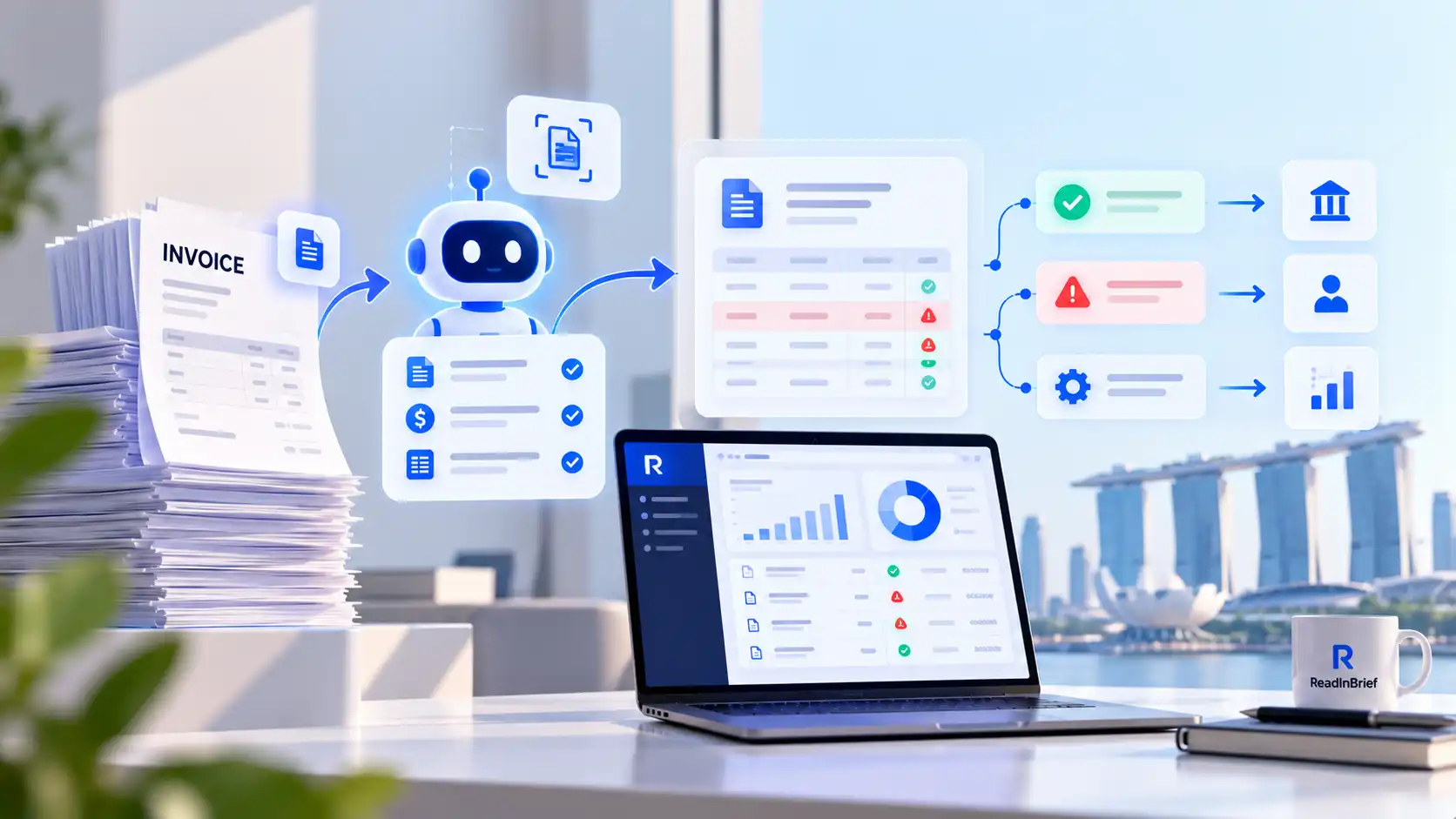
Learn how AI agents automate accounts payable in Singapore, handle invoice exceptions, support InvoiceNow workflows, and improve finance operations.
Accounts payable (AP) teams in Singapore deal with more than entering invoice details and paying suppliers. They must match invoices with purchase orders and delivery records, investigate discrepancies, manage approvals, maintain accurate financial records, and support tax-related reporting requirements.
These tasks become more difficult when invoices arrive in different formats, supplier details change, purchase orders contain outdated information, or payments require additional approval.
AI agents for accounts payable can help businesses manage these workflows by extracting invoice data, checking it against business rules, identifying exceptions, gathering supporting information, and preparing actions for review. Depending on the system and permissions, an agent may also update records or move an invoice through an approved workflow.
The business value is not simply faster invoice entry. It is the ability to handle routine work more consistently while helping finance teams focus on discrepancies, financial controls, and decisions that require human judgment.
Singapore provides an important context for this technology. Its nationwide InvoiceNow network enables businesses to exchange structured electronic invoices using the Peppol framework. The Inland Revenue Authority of Singapore (IRAS) is also implementing the GST InvoiceNow Requirement in phases, making invoice data management and digital finance workflows increasingly relevant to local businesses.
However, InvoiceNow and AI agents are different technologies. InvoiceNow supports electronic invoice exchange and the submission of invoice data to IRAS under the applicable requirements. AI agents can add intelligence and workflow automation around invoice processing, validation, exception handling, and related financial operations.
This guide explains how AI agents can support accounts payable in Singapore, which invoice exceptions they can handle, how they fit into existing accounting systems, what businesses should consider before implementation, and how to evaluate whether the investment makes sense.
What Are AI Agents for Accounts Payable?
AI agents for accounts payable are software systems that use AI to interpret invoice information, evaluate tasks against defined rules, retrieve relevant information, and carry out or recommend actions within an accounts payable workflow.
Unlike basic automation that follows fixed instructions, an AI agent may interpret different invoice layouts, use contextual information, investigate a discrepancy, and determine which permitted step should happen next.
For example, an agent might receive a supplier invoice, extract the invoice number and amount, compare the details with a purchase order, identify a price mismatch, retrieve the relevant purchase information, and prepare an exception report for the accounts payable team.
The agent does not automatically have authority to approve or pay the invoice. Those actions depend on the system's permissions, business policies, and approval controls.
Oracle's official Payables Agent documentation describes capabilities including invoice capture, data extraction, exception handling, adaptive learning, invoice completion, and anomaly detection. This is an example of how AI-assisted accounts payable capabilities are being implemented in enterprise financial software, not evidence that every AI agent provides the same functions.
AI agents vs traditional accounts payable automation
Traditional automation remains useful for repetitive, predictable tasks. AI agents add value when the workflow requires interpretation, contextual investigation, or decisions about the next appropriate step.
Capability | Traditional automation | AI agents for accounts payable |
|---|---|---|
Invoice data extraction | Uses templates, OCR, or predefined mappings | May interpret different layouts and field relationships using AI |
Validation | Applies configured rules | Can apply rules and interpret supporting context |
Duplicate detection | Matches defined invoice fields | May combine duplicate checks with contextual anomaly detection |
Invoice exceptions | Routes exceptions according to predefined conditions | May investigate exceptions, gather information, and recommend next steps |
Supplier queries | Sends predefined messages | May draft contextual responses using approved records |
Learning | Often requires manual rule or template changes | Some systems learn from reviewed corrections and processing outcomes |
Approvals | Routes tasks through configured approval rules | Can prepare recommendations or trigger permitted workflow actions |
Payment execution | Uses configured payment processes | Should remain subject to explicit permissions and financial controls |
These categories overlap. Many modern finance platforms combine conventional automation, machine learning, document recognition, workflow rules, and agent-based capabilities.
The practical question is not whether a system is labelled an AI agent. It is whether the system can resolve the specific invoice problems your finance team encounters, within acceptable accuracy and control limits.
Why Accounts Payable Teams in Singapore Should Evaluate AI Agents
1. InvoiceNow is changing the electronic invoicing environment
InvoiceNow is Singapore's nationwide e-invoicing network, introduced by the Infocomm Media Development Authority (IMDA) in 2019. It uses the Peppol framework to enable businesses to exchange invoices in a structured digital format.
According to the official IMDA InvoiceNow overview, businesses can use InvoiceNow-ready finance or accounting solutions to send and receive electronic invoices.
Structured electronic invoices can reduce the need to manually interpret information from PDFs, scanned documents, and email attachments. However, they do not eliminate every exception. Businesses may still encounter incorrect invoice details, mismatched purchase orders, disputed quantities, approval delays, and inconsistent supplier records.
AI agents can complement electronic invoicing by helping process available invoice data and investigate exceptions that remain after an invoice enters the finance system.
2. GST InvoiceNow requirements make data readiness important
IRAS is introducing the GST InvoiceNow Requirement in phases.
According to the official IRAS GST InvoiceNow Requirement guidance, the published schedule includes:
Implementation date | Businesses covered under the published schedule |
|---|---|
1 November 2025 | Companies that register for GST voluntarily within six months of incorporation |
1 April 2026 | New voluntary GST registrants, regardless of incorporation date or business structure |
1 April 2028 | New compulsory GST registrants and existing GST-registered businesses with total annual supplies of S$200,000 or less |
1 April 2029 | Existing GST-registered businesses with total annual supplies of S$1 million or less |
1 April 2030 | Existing GST-registered businesses with total annual supplies of S$4 million or less |
1 April 2031 | Existing GST-registered businesses with total annual supplies above S$4 million |
These dates reflect the published phased schedule and should be checked against current IRAS guidance when planning implementation. Business eligibility, exclusions, and individual implementation dates matter.
The GST InvoiceNow Requirement is a regulatory requirement to submit relevant invoice data through the specified network and solutions. It does not require businesses to deploy AI agents.
Nevertheless, businesses reviewing their finance systems may also want to assess whether AI-assisted validation, exception management, and workflow automation could improve their operations.
3. Manual exception handling can consume finance team capacity
Invoice processing becomes more complicated when employees must switch between accounting software, procurement records, email conversations, delivery confirmations, and supplier portals.
Consider an invoice that does not match a purchase order. An employee may need to locate the original order, verify the delivered quantity, contact procurement, obtain a corrected document, and update the invoice status.
An AI agent can potentially collect the relevant records, compare the values, identify the discrepancy, and prepare the case for review.
This does not mean every exception can be resolved automatically. It means employees may spend less time gathering information and more time making the decision that actually resolves the problem.
What Invoice Exceptions Can AI Agents Handle?
Invoice exceptions are situations that prevent an invoice from proceeding through the normal processing workflow. They may arise from incorrect data, missing documents, commercial disagreements, policy violations, or technical issues.
The following are practical use cases for AI-assisted accounts payable.
1. Purchase order and invoice mismatches
A purchase order (PO) specifies what a business agreed to buy, while the supplier invoice requests payment for the goods or services supplied.
An exception occurs when the invoice differs from the purchase order in an important field, such as quantity, unit price, item description, or total amount.
Example: A Singapore-based manufacturer orders 100 components at S$50 each. The supplier sends an invoice for 100 components at S$55 each.
The invoice total is S$5,500, while the purchase order total is S$5,000, excluding any applicable tax or other charges.
An AI agent could:
Extract the invoice line items.
Retrieve the relevant purchase order.
Compare the quantities, unit prices, and totals.
Identify the S$500 discrepancy.
Check whether an approved purchase order amendment exists.
Prepare an exception summary for the procurement or finance team.
The agent should not approve the higher amount simply because it can explain the discrepancy. The authorized team must determine whether the additional cost is valid.
2. Missing purchase orders or supporting documents
Some invoices arrive without a purchase order number, delivery receipt, contract reference, or other supporting information required by the business.
An AI agent can search permitted systems for matching supplier names, amounts, dates, purchase records, or contract references. If it finds a likely match, it can attach the supporting information or present the candidate record for confirmation.
If the necessary evidence is unavailable, the agent can prepare a request for the missing information and route the invoice to the appropriate person.
This is particularly useful when information exists in multiple systems but employees must search for it manually.
3. Duplicate invoices
Duplicate invoices can occur when suppliers resend documents, invoices arrive through multiple channels, or employees accidentally upload the same file twice.
A system can compare invoice numbers, supplier identifiers, amounts, dates, and other available attributes to identify potential duplicates.
An AI agent may investigate similar records and explain why an invoice appears to be a duplicate. However, similar invoice details do not always prove duplication. Credit notes, corrected invoices, recurring charges, and legitimate split invoices can create apparent matches.
The appropriate response is to flag potential duplicates and apply the organization's review rules before blocking or approving payment.
4. Incorrect supplier details
Invoices may contain outdated supplier addresses, inconsistent legal names, missing identifiers, or bank details that differ from the organization's approved records.
An agent can compare the invoice with existing supplier master data and flag differences.
Changes to payment instructions require particular care. A compromised email account or fraudulent invoice can contain convincing instructions to change a supplier's bank account.
An AI agent should not treat an invoice or email as sufficient authority to change payment details. Such changes should follow an independent supplier verification process and the organization's established approval controls.
5. Tax and GST-related discrepancies
An invoice may contain an unexpected GST amount, missing information, or a tax treatment that does not match the available transaction records.
An AI agent can help identify these differences, compare relevant fields, and prepare a case for finance review.
However, tax treatment depends on the nature of the transaction, supplier status, supporting documents, and applicable rules. AI-generated findings should not replace professional tax judgment.
Singapore businesses should refer to IRAS invoicing requirements and applicable guidance when configuring validation rules.
6. Delayed invoice approvals
Invoices can remain pending because an approver is unavailable, the assigned department is incorrect, or the supporting information is incomplete.
An agent can monitor the invoice's status, identify the pending approval, send reminders according to company policy, and escalate overdue tasks.
For example, an invoice awaiting departmental approval could trigger a reminder after the configured time limit. If it remains pending, the system could notify the designated alternate approver, provided the workflow permits that escalation.
This can improve visibility without removing the approval requirement.
7. Unusual invoice amounts or suspicious patterns
AI-assisted anomaly detection can identify invoices that differ from expected patterns, such as an unusually large amount, a new combination of supplier and bank details, or a repeated invoice number.
Oracle's Payables Agent implementation documentation describes configurable anomaly controls for conditions including unexpected currencies, unusual amounts, remittance-bank-account locations, and potentially fraudulent combinations of invoice attributes.
These alerts are investigative signals, not proof of fraud. Finance teams must examine the transaction history, supporting documents, and supplier information before deciding how to proceed.
How AI Agents Fit Into a Singapore Accounts Payable Workflow
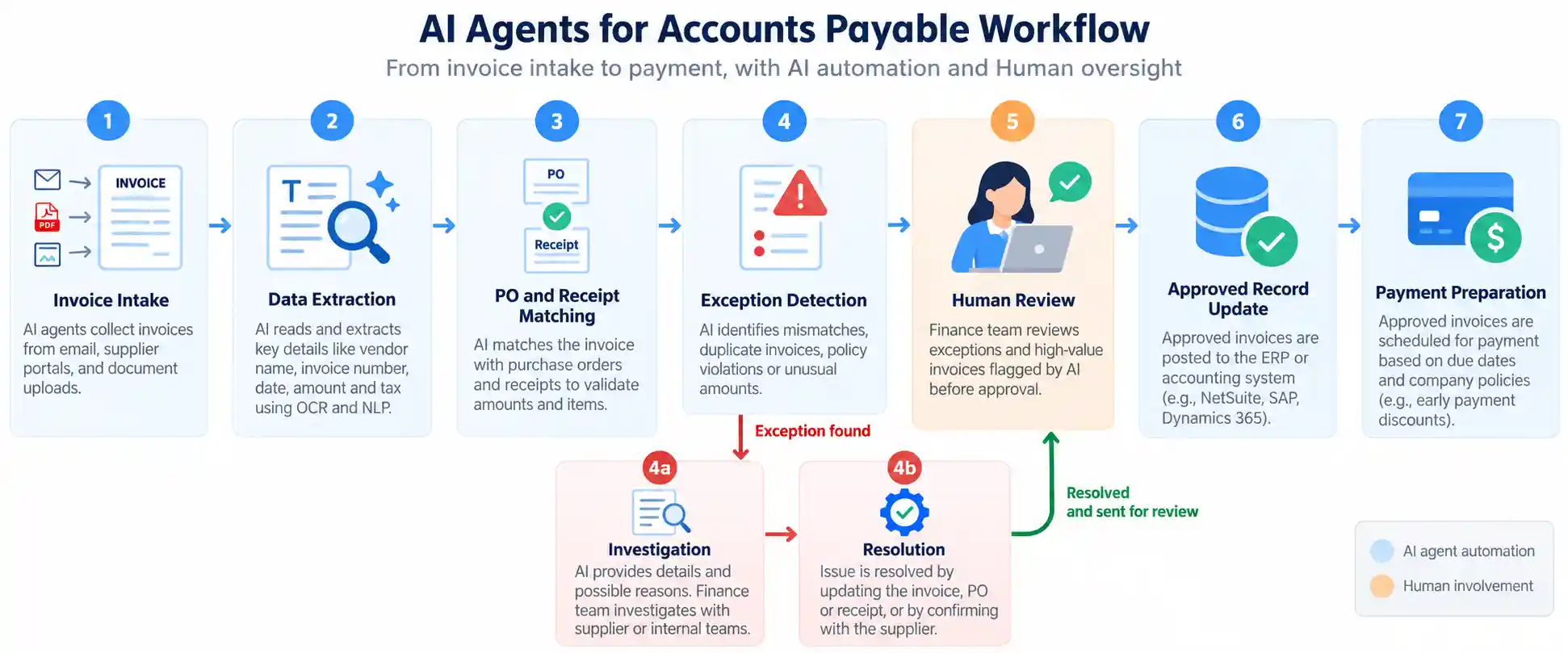
A useful implementation connects invoice intake, validation, exception handling, approval, and payment preparation.
Step 1: Receive the invoice
The system receives invoice data from supported sources, which may include InvoiceNow, accounting software, supplier portals, email, or document uploads.
The intake method matters. Structured e-invoices provide data in a defined format, while PDFs and scanned documents may require document recognition and extraction.
Step 2: Extract and validate invoice information
The system identifies fields such as:
Supplier name and identifier.
Invoice number and date.
Purchase order reference.
Line-item descriptions.
Quantities and unit prices.
Net amount and applicable tax.
Total amount and payment terms.
The system then checks the information for missing values, inconsistencies, and policy violations.
Step 3: Match the invoice against business records
Where applicable, the system compares the invoice with purchase orders, goods-received records, contracts, supplier records, and previous invoices.
This step can identify differences that require investigation before the invoice moves forward.
Step 4: Classify and investigate exceptions
Invoices that pass the configured checks may proceed to the next stage. Exceptions can be classified according to their type, such as missing purchase order, price mismatch, duplicate risk, or missing supporting document.
An AI agent may retrieve additional records, summarize the issue, and recommend the next action.
Step 5: Route the case to the right person
The workflow assigns exceptions to the appropriate team, such as procurement, finance, the budget owner, or the supplier management team.
Clear ownership is important. An agent that identifies an issue but cannot route it correctly may simply create another queue of unresolved tasks.
Step 6: Record the decision and update the workflow
After an authorized person reviews the issue, the system can record the decision, preserve relevant evidence, and update the invoice status.
Where permissions and integration allow, the system may carry out approved follow-up actions.
Step 7: Prepare the invoice for payment
Invoices that satisfy the required checks and approvals can move into the organization's payment process.
Payment execution should remain subject to appropriate authorization, segregation of duties, bank controls, and fraud prevention measures.
InvoiceNow vs AI Agents: What Is the Difference?
InvoiceNow and AI agents can complement each other, but they solve different problems.
Area | InvoiceNow | AI agents for accounts payable |
|---|---|---|
Main purpose | Electronic invoice exchange using a structured digital network | Intelligent processing, investigation, and workflow assistance |
Primary role | Transmits e-invoice data between connected systems | Interprets available information and helps perform defined tasks |
Data format | Structured electronic invoice data under the supported framework | May process structured data, documents, records, and contextual information |
Exception handling | Depends on the connected solution's capabilities | May identify, investigate, summarize, and route exceptions |
Tax reporting | Supports invoice-data submission under the GST InvoiceNow Requirement | May assist with data checks and preparation, depending on the implementation |
Approval workflows | Depends on the finance solution | May assist with routing and permitted workflow actions |
Human oversight | Depends on business processes | Needed where decisions require judgment or authorization |
A business does not necessarily need a separate AI agent to use InvoiceNow. Nor does adopting an AI agent automatically make a finance system InvoiceNow-ready.
Organizations should evaluate both their electronic invoicing obligations and their internal process requirements before selecting a solution.
How to Choose an AI Accounts Payable Solution in Singapore
The right solution depends on invoice volume, system complexity, the number of exceptions, existing finance software, and the level of control required.
1. Start with your current accounts payable process
Map how invoices enter the business, how they are validated, who approves them, and why they are delayed.
Collect baseline information on processing times, common exception types, manual interventions, and the number of invoices requiring rework.
Without this baseline, it is difficult to determine whether AI is addressing the main problem.
2. Check compatibility with existing accounting software
Determine whether the solution integrates with your ERP, accounting system, procurement platform, supplier database, and payment workflow.
Review APIs, available connectors, data formats, authentication, audit logging, error handling, and synchronization requirements.
For Singapore businesses subject to the GST InvoiceNow Requirement, also verify that the relevant invoicing solution and integration arrangements support the applicable IRAS submission requirements.
3. Evaluate invoice recognition and matching accuracy
Test the system using actual or appropriately anonymized invoices that represent the business's supplier base.
Include structured e-invoices, PDFs, different layouts, foreign currencies where relevant, credit notes, missing references, and complex line items.
Measure both correct processing and incorrect approvals. A system that processes invoices quickly but misses material discrepancies may create more risk than value.
4. Examine exception-handling capabilities
Ask the provider to demonstrate how the system handles:
Missing purchase orders.
Price and quantity mismatches.
Potential duplicate invoices.
Incomplete supporting documents.
Unexpected tax fields.
Changes to supplier details.
Unusual payment instructions.
Failed integrations and rejected invoices.
A meaningful demonstration should show the supporting evidence, explain the proposed action, and make it possible for an authorized employee to review or reject the recommendation.
5. Review security and financial controls
Check role-based permissions, segregation of duties, audit trails, data retention, encryption, vendor access, and the handling of sensitive financial information.
An AI agent should have only the permissions necessary for its assigned tasks. It should not gain unrestricted authority to modify supplier bank details, approve payments, or override accounting controls.
6. Calculate the total cost of ownership
Consider more than the subscription or API price. Implementation may require integration work, data cleanup, configuration, testing, employee training, ongoing monitoring, and changes to existing processes.
A suitable business case compares these costs with measurable improvements in processing effort, exception resolution, error rates, and payment operations.
7. Run a controlled pilot
Start with a limited set of suppliers, invoice categories, or exception types.
Compare the results with the existing workflow. Review incorrect classifications, missed discrepancies, processing delays, and the number of cases that still require manual intervention.
Expand the implementation only when the pilot demonstrates that the system performs reliably within the organization's risk and control requirements.
How Much Can AI Agents Reduce Accounts Payable Costs?
There is no universal cost-saving figure for AI accounts payable agents. Results depend on invoice volume, current automation, exception frequency, supplier diversity, integration complexity, and the amount of human review required.
Businesses can build a more reliable estimate using their own operational data.
For example, consider a hypothetical scenario in which a company processes 5,000 invoices each month.
Assume that manual processing currently requires an average of 10 minutes per invoice.
Monthly invoice volume: 5,000.
Average manual processing time: 10 minutes.
Total processing effort: 50,000 minutes, or approximately 833 hours per month.
If a proposed system reduces average human effort by 30%, the potential time released would be approximately 250 hours per month.
This is an illustrative calculation, not a forecast or a guarantee. It assumes that the 30% reduction is measured across the stated workload and that the released time can be used productively. Implementation costs, exception review, supervision, and ongoing operating expenses must also be considered.
The more useful business case is based on the actual effort removed from each stage of the workflow, not a vendor's headline automation percentage.
Risks and Limitations of AI Agents in Accounts Payable
AI agents can make errors, misinterpret documents, retrieve the wrong records, or recommend inappropriate actions. These risks are especially important when financial transactions and tax records are involved.
Incorrect data extraction
A system may misread an invoice number, amount, date, or tax field. Validation rules and reconciliation checks should catch material errors before an invoice advances.
False anomaly alerts
Legitimate transactions may look unusual because of seasonal purchases, one-time contracts, or supplier changes. Excessive false alerts can create additional work for finance teams.
Fraud and unauthorized changes
An invoice or email may contain fraudulent payment instructions. AI-generated summaries should never replace independent verification for sensitive supplier or banking changes.
Poor source data
Inconsistent supplier records, incomplete purchase orders, and inaccurate delivery data can reduce the quality of automated decisions. Data cleanup and clear ownership remain essential.
Overreliance on AI recommendations
Employees may be tempted to accept recommendations without checking the underlying evidence. Organizations should establish review requirements for high-value transactions, ambiguous cases, tax-related decisions, and other sensitive exceptions.
Regulatory and record-keeping responsibilities
Automation does not transfer a business's tax or record-keeping responsibilities to the software provider. IRAS states that GST-registered businesses must retain relevant records for at least five years, subject to applicable requirements. See the official IRAS record-keeping guidance.
Businesses should ensure that records, approvals, supporting documents, and transaction histories remain accessible for review.
What Should Businesses Measure After Implementing AI Accounts Payable Agents?
Track operational outcomes rather than relying on the number of tasks the AI system claims to automate.
Metric | What it measures |
|---|---|
Invoice processing time | Time from invoice receipt to the defined processing milestone |
Exception resolution time | Time required to resolve a flagged invoice issue |
First-pass match rate | Share of invoices that pass defined matching checks without correction |
Manual intervention rate | Share of invoices that require employee intervention |
False-positive alert rate | Share of alerts that reviewers determine were not genuine exceptions |
Missed-exception rate | Share of material exceptions that the system failed to flag in the evaluated sample |
Duplicate detection performance | Ability to identify duplicate invoices without incorrectly blocking legitimate transactions |
Approval cycle time | Time between submission for approval and the recorded decision |
Cost per invoice | Total relevant operating costs divided by invoices processed |
Audit completeness | Whether required transaction evidence and approvals are retained and retrievable |
Define each metric consistently before comparing results. For example, invoice processing time can mean time to initial validation, approval, or payment readiness. These are different milestones and should not be mixed.
For higher-risk workflows, use a manually reviewed sample to measure both missed exceptions and incorrect alerts. A system that flags many issues may appear effective while still missing the discrepancies that matter most.
Frequently Asked Questions
1. What are AI agents for accounts payable?
AI agents for accounts payable are software systems that use AI to interpret invoice data, check business records, identify exceptions, and perform or recommend defined workflow actions. Depending on the implementation, they may support invoice extraction, purchase order matching, anomaly detection, supplier queries, and approval routing.
2. Can AI agents automate invoice exception handling?
Yes, AI agents can help identify discrepancies, retrieve supporting records, summarize issues, and route cases to the appropriate team. Some systems can resolve selected exceptions under predefined rules. Complex discrepancies, disputed charges, suspicious payment instructions, and other high-risk cases may require human review and approval.
3. What is the difference between InvoiceNow and AI accounts payable automation?
InvoiceNow is Singapore's electronic invoicing network based on the Peppol framework. It enables connected businesses to exchange structured invoice data and supports the GST InvoiceNow Requirement. AI accounts payable automation focuses on processing, validating, analyzing, and managing invoice workflows. The technologies can complement each other.
4. Are AI agents mandatory for GST InvoiceNow compliance in Singapore?
No. The GST InvoiceNow Requirement concerns the submission of invoice data through the specified InvoiceNow network and solutions according to IRAS's phased implementation schedule. It does not require every business to deploy AI agents. Businesses should verify their individual implementation date and compliance obligations directly with IRAS.
5. Can AI agents integrate with existing ERP and accounting systems?
Some AI accounts payable solutions integrate with ERP and accounting platforms through native connectors, APIs, or other supported interfaces. Compatibility depends on the systems involved, available data, access permissions, and the integration design. Businesses should verify the specific connector and test the workflow before deployment.
6. How do AI agents detect duplicate invoices?
They can compare invoice identifiers, supplier details, amounts, dates, and other transaction attributes to flag potential duplicates. More advanced implementations may also consider contextual relationships between records. Because legitimate corrections and recurring charges can resemble duplicates, flagged invoices should be evaluated using appropriate business rules.
7. Are AI accounts payable agents safe for financial operations?
They can support financial operations when deployed with appropriate permissions, validation, monitoring, and approval controls. They should not receive unrestricted authority to change supplier bank details or execute payments. Organizations should test the system for errors, protect financial records, and preserve auditable evidence of important actions.
8. How should a company measure the ROI of AI accounts payable agents?
Measure the change in processing effort, exception resolution time, error rates, manual intervention, and cost per invoice. Compare these outcomes against the implementation and operating costs. Use a controlled pilot and consistent baseline metrics rather than assuming that a vendor's advertised automation rate will translate directly into savings.
Conclusion
AI agents for Singapore accounts payable can help businesses move beyond basic invoice digitization toward more intelligent processing and exception management.
Their practical value lies in handling repetitive checks, retrieving supporting records, identifying discrepancies, preparing exception summaries, and routing work to the right people. They can reduce manual effort when the underlying data, integrations, and business rules are reliable.
InvoiceNow provides an important foundation for electronic invoice exchange, while AI agents can add workflow intelligence around the finance processes that use that data. The two should be evaluated separately and designed to work together where appropriate.
For businesses considering implementation, the best starting point is a clearly defined accounts payable problem. Identify the exceptions that consume the most time, establish baseline performance, test a limited workflow, and measure the results.
AI should support accurate financial operations, not bypass the controls that make those operations trustworthy.
Comments (0)
No comments yet. Be the first to share your thoughts!