AI Agents for Saudi Construction RFI and Submittal Management

Author
Ravi Prajapati

See how AI agents can streamline construction RFI and submittal management in Saudi Arabia, with practical use cases, risks and implementation guidance.
Construction teams working on complex projects must coordinate drawings, specifications, technical questions, material approvals, consultant responses, and contractor submissions. When these records sit across email threads, spreadsheets, document repositories, and project management platforms, teams can struggle to find the right information and keep decisions moving.
AI agents for construction RFI management in Saudi Arabia can help teams retrieve relevant project information, prepare requests for information (RFIs), check submittals against specified requirements, identify missing documents, and route work for review. Their value depends on access to reliable project records, clear approval rules, and integration with existing construction systems.
An AI agent is not simply a chatbot that answers questions about a drawing. A well-designed agent can carry out a defined sequence of tasks, use approved tools, check the results, and escalate uncertain cases to a qualified person. However, it should not independently approve engineering changes, certify material compliance, or make contractual decisions without the appropriate authority.
This distinction matters for construction projects in Saudi Arabia, where project owners, consultants, main contractors, specialist subcontractors, and suppliers must coordinate information across multiple parties.
Saudi Vision 2030 identifies digital transformation and economic diversification as national priorities. Its National Transformation Program also describes initiatives supporting the Kingdom's digital economy. These priorities provide broader context for digital construction initiatives, but they do not establish that every Saudi project currently uses AI agents.
This article examines the practical opportunities, limitations, architecture, and implementation decisions involved in adopting AI agents for RFI and submittal management.
What Are AI Agents for Construction RFI and Submittal Management?
AI agents for construction RFI and submittal management are software systems that use AI models, project documents, workflow rules, and approved integrations to help complete defined construction information-management tasks.
They may search drawings and specifications, compare a proposed material against documented requirements, draft an RFI, identify incomplete submissions, or prepare a review package for an authorized professional.
The term agent refers to the system's ability to perform multiple connected steps, rather than generating a single response. The exact level of autonomy depends on its design and permissions.
For example, a document assistant might summarize a specification section when asked. An RFI agent could search the specification, retrieve related drawings, locate similar closed RFIs, draft a question, attach references, and send the draft to a coordinator for review.
These are different levels of automation, and they should not be treated as interchangeable.
AI agents vs. chatbots vs. workflow automation
Capability | Chatbot | Rule-based automation | AI agent |
|---|---|---|---|
Answer a question about a document | Yes, if connected to relevant information | Usually limited | Yes, with retrieval and verification |
Follow fixed approval rules | Limited | Yes | Yes, through integrated rules and tools |
Search several sources to complete a task | Sometimes | Only if explicitly configured | Can coordinate multiple searches |
Draft an RFI using project context | Possible | Template-based | Can retrieve context and prepare a draft |
Handle unclear or conflicting evidence | May produce an unreliable answer | Often stops at predefined conditions | Can flag uncertainty and request human review |
Approve engineering changes independently | Not appropriate | Not appropriate without valid authorization | Should not be granted this authority by default |
An AI agent does not automatically have better reasoning or more reliable data than a chatbot. Its practical advantage is the ability to coordinate a controlled workflow across systems.
Why RFI and Submittal Management Is a Suitable AI Use Case
An RFI is a formal request for clarification when project information is missing, unclear, inconsistent, or insufficient for the work to proceed confidently. A submittal is a package of information, such as product data, samples, shop drawings, or technical documents, submitted for review against project requirements.
Both workflows involve substantial document handling and coordination.
Autodesk's official RFI workflow documentation describes processes for drafting, submitting, reviewing, answering, and closing RFIs. Its RFI AI Agent documentation also documents an existing capability that searches project specifications and closed RFIs to help users decide whether a new RFI is necessary.
This is an important distinction: AI-assisted RFI management is already available in at least one established construction software platform. A business evaluating a custom solution should therefore identify the gaps that existing tools do not address before commissioning new development.
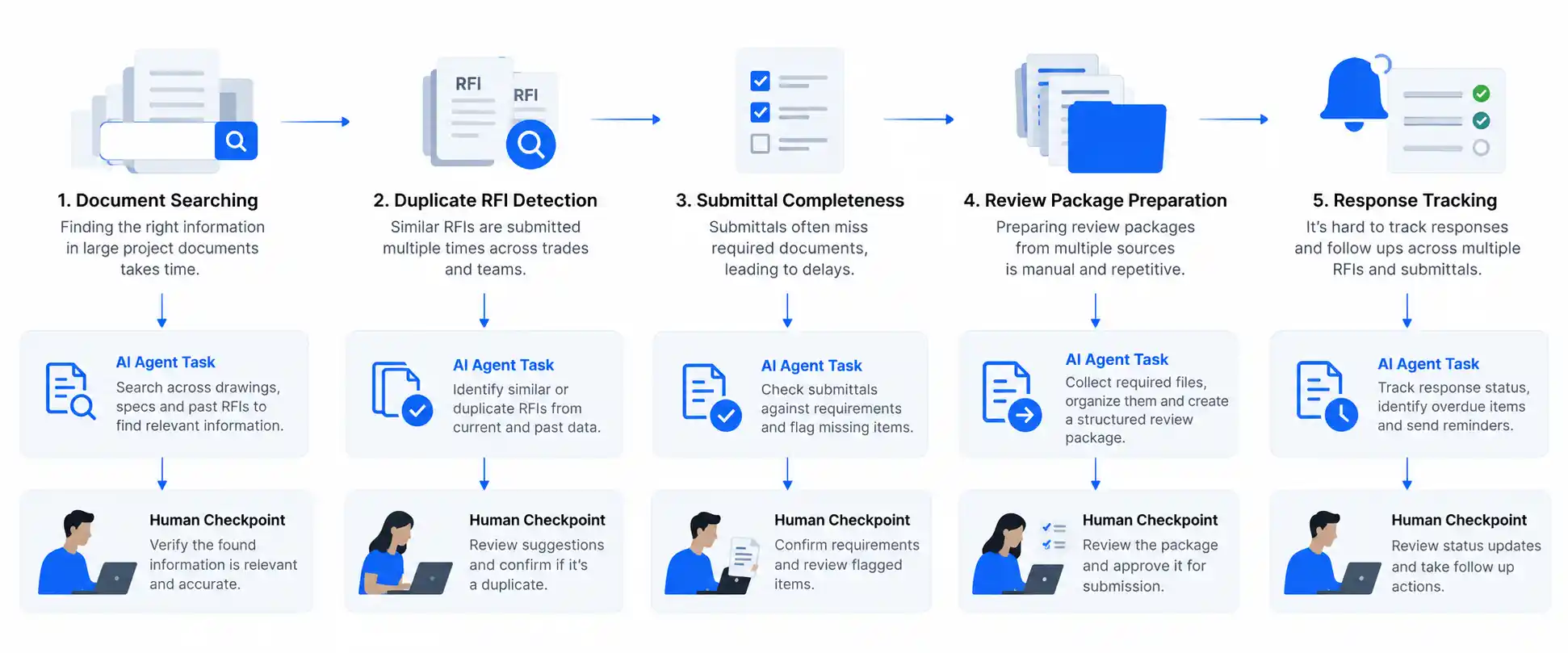
Five workflow problems AI agents can address
1. Finding the right project information
A coordinator may need to search architectural drawings, structural specifications, approved material submittals, meeting minutes, and previous RFIs to understand one issue.
An agent can retrieve potentially relevant records and present their source locations. This can reduce manual searching, although the result depends on document quality, indexing, permissions, and version control.
2. Identifying potential duplicate RFIs
Similar questions may arise in different areas of a large project. An agent can compare a new question with previous RFIs and identify likely duplicates or earlier resolutions.
It should recommend whether an existing answer appears relevant, not automatically reject a new RFI when the location, revision, or contractual context differs.
3. Checking submittal completeness
A submittal package may be missing a required datasheet, test certificate, sample, drawing reference, or revision identifier. An agent can compare the package with a configured checklist and flag missing items before formal submission.
4. Preparing review packages
An agent can collect the relevant specification clauses, drawing references, submitted product data, and previous comments into one review package.
The reviewer still determines whether the evidence supports approval.
5. Tracking unanswered questions and dependencies
An agent can identify overdue or unanswered RFIs, summarize their stated schedule or cost impacts, and prepare reminders for the responsible team.
It should not claim that a delayed response caused a specific financial loss unless the project records support that conclusion.
How an AI Agent Can Process an RFI
Consider a hypothetical Saudi commercial construction project where a contractor identifies a discrepancy between a ceiling coordination drawing and the mechanical services drawing.
The contractor needs clarification before installing the affected services. The agent should help assemble the evidence, but it should not decide which drawing takes precedence unless the approved project rules explicitly establish how that question must be handled.
A controlled workflow could follow these steps.
1. Receive the issue
The site engineer submits a description, location, relevant drawing numbers, and supporting photographs or documents.
2. Retrieve project evidence
The agent searches approved drawings, specifications, revision records, related submittals, and closed RFIs.
3. Check for conflicts and duplicates
It identifies potentially inconsistent documents and similar historical questions, including their revision dates.
4. Prepare an RFI draft
It drafts a neutral question, lists the evidence, and identifies unresolved details without inventing a technical answer.
5. Route for authorized review
A project coordinator verifies the draft. An authorized user decides whether to submit it and selects the appropriate reviewer.
6. Track the official response
The system records the status, response, references, and next action in the project workflow, subject to permissions and integration capabilities.
The workflow's key design principle is separation between preparing information and making an authorized project decision.
For example, if the agent finds that an older drawing indicates one dimension and a newer drawing indicates another, it should show both references, identify their revisions, and flag the discrepancy. It should not silently choose one.
How AI Agents Can Check Construction Submittals
Submittal review is another potential use case, especially where teams repeatedly compare supplier documentation with project specifications.
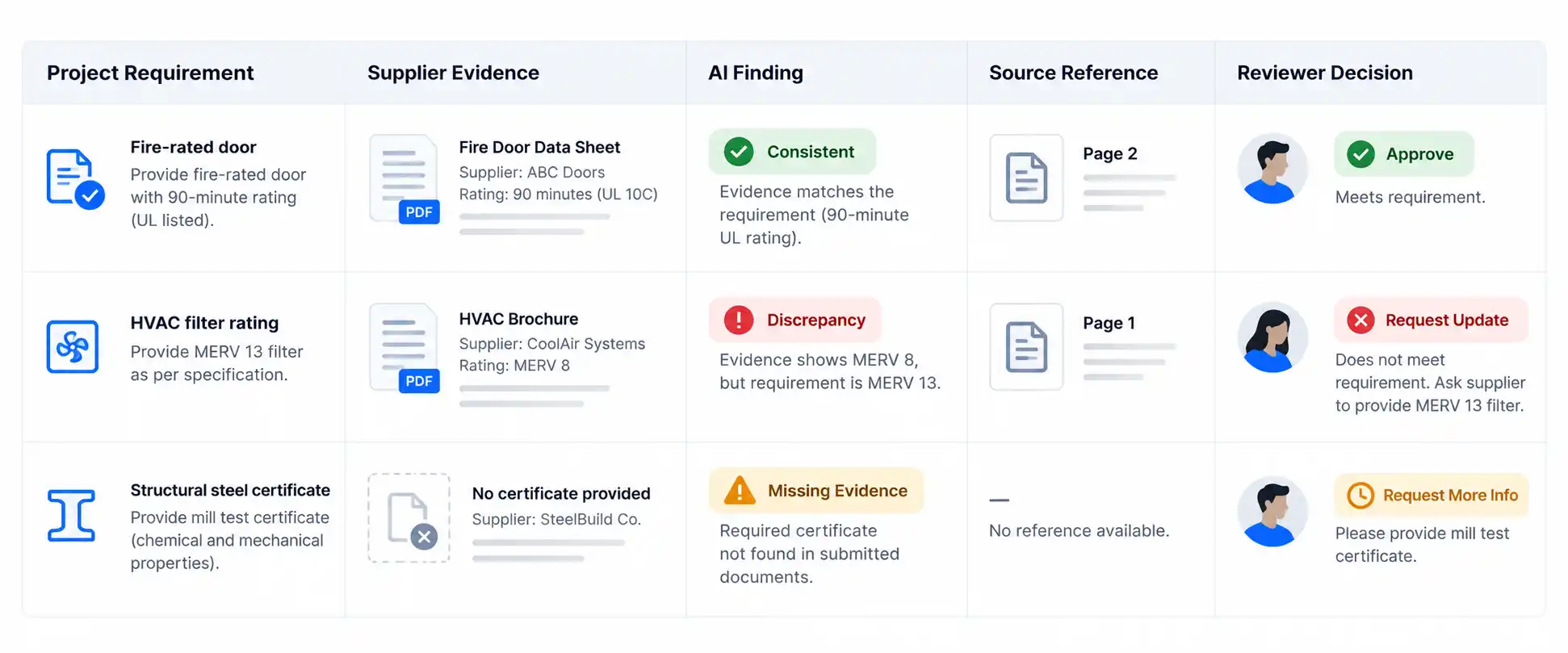
Suppose a subcontractor submits a proposed fire-rated door assembly. The project specification defines particular performance, certification, dimensional, and hardware requirements.
A submittal-checking agent could:
Identify the relevant specification section and approved revision.
Extract the requirements that apply to the proposed assembly.
Retrieve the manufacturer's submitted datasheets and supporting certificates.
Compare each requirement with the available evidence.
Flag missing information, apparent mismatches, and requirements that need specialist interpretation.
Prepare a review checklist with references to the source documents.
The output should distinguish between three states.
Review status | Meaning | Next action |
|---|---|---|
Evidence appears consistent | The submitted information appears to match the documented requirement | Authorized reviewer verifies the evidence |
Potential discrepancy | The documents appear inconsistent or a requirement may not be met | Technical reviewer investigates |
Insufficient evidence | A required document, value, or certificate is missing or unclear | Request additional information |
An AI-generated “match” is not the same as an approved submittal. A document may contain a matching value but still be unsuitable because of an omitted condition, invalid certificate, incorrect product variant, or incompatible project requirement.
The agent should retain evidence for each finding, including the relevant document, revision, page, specification clause, and extracted value where available.
Which AI Agent Capabilities Should Construction Companies Evaluate?
A commercial evaluation should begin with the workflow that causes the most friction, rather than the number of AI features a vendor advertises.
Construction firms may already use a common data environment, project management platform, document management system, or building information modelling (BIM) tools. A new agent should work with the existing information architecture wherever practical.
The following capabilities form a useful evaluation checklist.
Capability | What to look for | Why it matters |
|---|---|---|
Project document retrieval | Search by project, discipline, document number, revision, and content | Helps prevent answers based on irrelevant or outdated records |
RFI assistance | Duplicate detection, contextual drafting, related-document retrieval | Supports preparation without replacing formal review |
Submittal checks | Configurable requirements and evidence-linked findings | Makes preliminary review more consistent |
Workflow integration | Approved APIs, status updates, notifications, and task routing | Reduces duplicate entry between systems |
Access control | Project-level permissions and role-based access | Prevents unauthorized disclosure or changes |
Audit trail | Records of sources, outputs, edits, approvals, and actions | Supports investigation and accountability |
Uncertainty handling | Escalation when evidence conflicts or is missing | Limits the impact of unsupported answers |
Evaluation and monitoring | Measured accuracy, error tracking, and human feedback | Helps determine whether the system is suitable for production |
Should a company buy an existing platform or build a custom AI agent?
The answer depends on the gap between its requirements and the features already available.
Decision factor | Existing construction platform | Custom AI agent |
|---|---|---|
Standard RFI workflow | Often the more direct starting point | May duplicate existing functionality |
Integration with established project records | Depends on supported platform features | Can be tailored to available APIs and data structures |
Company-specific approval logic | May be limited by configuration options | Can support custom rules if requirements are well defined |
Multiple disconnected systems | Depends on available connectors | Can orchestrate systems where authorized interfaces exist |
Initial implementation effort | May be lower when the required feature is included | Usually requires additional design, integration, testing, and maintenance |
Ownership and control | Depends on vendor capabilities and contract terms | Offers more design control but also more operational responsibility |
Autodesk documents an RFI AI Agent that searches specifications and closed RFIs, as well as AI-assisted RFI drafting. This means companies considering a custom solution should test those capabilities against their actual workflow before building a competing feature.
A custom solution may be justified when the company needs cross-platform retrieval, specialised submittal checks, project-specific approval rules, integrations unavailable in its current software, or a consistent workflow across several systems.
The decision should follow a documented gap analysis, not a general assumption that custom AI is always more capable.
What Architecture Does a Construction RFI Agent Need?
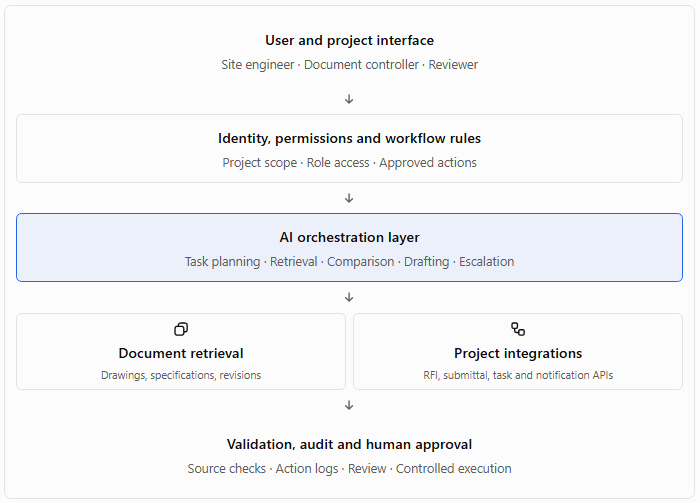
A reliable agent needs more than a language model and a prompt. Its architecture should combine document access, retrieval, workflow orchestration, permission enforcement, and traceable actions.
Essential components
Document ingestion and version management. The system must identify the current approved document and preserve the relationship between revisions. Optical character recognition (OCR) may be needed for scanned PDFs. Drawings and tables can require additional processing beyond extracting plain text.
Retrieval-augmented generation (RAG). RAG retrieves relevant project records and supplies them as context to the language model. It can help ground answers in source material, but it does not guarantee correctness. Retrieval quality, document permissions, revision filtering, and source citations all require testing.
Workflow orchestration. This component coordinates tasks such as searching, comparing, drafting, validating, and routing a request. It should use predefined rules for decisions that require deterministic behaviour.
System integrations. The agent may need to read from a project platform and write approved updates back through supported APIs. Actual integration options depend on the software, licensing, permissions, and available interfaces.
Audit and evaluation. Every consequential result should retain enough information to reconstruct what the agent accessed, what it proposed, which checks were performed, and who authorized the action.
The NIST AI Risk Management Framework and its Generative AI Profile offer useful guidance for identifying and managing AI risks. They are general risk-management resources, not construction-specific certification requirements.
How to Implement AI Agents on a Saudi Construction Project
A phased implementation is usually more defensible than deploying autonomous agents across every project workflow at once.
Phase 1: Select a narrow, measurable use case
Start with a task such as finding related RFIs, checking whether a submittal package is complete, or preparing a draft RFI with relevant source references.
Avoid combining engineering design decisions, contractual interpretation, financial approvals, and document management in the first release.
Phase 2: Audit the project data
Identify where drawings, specifications, RFIs, submittals, and review comments are stored. Establish which records are approved, which are obsolete, and how revisions are identified.
If critical information exists only in unstructured emails or poorly scanned documents, improve its organization before expecting consistent agent performance.
Phase 3: Define permissions and boundaries
Specify which users can view project records, create drafts, submit RFIs, assign reviewers, and close issues. Make the agent's permissions no broader than necessary.
For the first pilot, the agent should normally prepare drafts and recommendations while a human performs formal submission and technical approval.
Phase 4: Test against historical project records
Use a representative set of previously handled RFIs and submittals. Compare the agent's results with the documented outcome and expert review.
Include ordinary cases, duplicate questions, conflicting revisions, missing attachments, ambiguous terminology, and cases where the correct action is to stop and ask for clarification.
Phase 5: Run a controlled pilot
Deploy the workflow with a limited group of users and a defined project scope. Compare its output with the existing process and collect feedback from document controllers, site engineers, and reviewers.
Phase 6: Expand only when the evidence supports it
Extend the system to additional disciplines or projects when it demonstrates acceptable performance, appropriate access controls, traceable decisions, and a sustainable operating cost.
How should success be measured?
Measure operational outcomes rather than the number of AI-generated documents.
Metric | What it measures | How to interpret it |
|---|---|---|
Time to prepare an RFI | Effort required to produce a review-ready draft | Compare equivalent requests before and after the pilot |
Duplicate detection precision | Proportion of flagged duplicates that reviewers confirm are duplicates | Low precision creates unnecessary review work |
Submittal checklist accuracy | Agreement between agent findings and expert-reviewed results | Track missed requirements as well as false alarms |
Source traceability | Share of consequential findings with usable supporting references | Missing references should trigger investigation |
Human correction rate | How often reviewers materially change the agent's output | Examine the types and severity of corrections |
Unauthorized action rate | Actions performed without required permission or approval | The target for prohibited actions should be zero |
Total cost per processed item | Software, integration, model, review, and maintenance costs per item | Compare the full process, not model usage alone |
A pilot should establish a baseline before introducing AI. For example, if a team records its current RFI preparation time and then measures the same task under the assisted workflow, it can estimate the change without relying on a vendor's generic productivity claim.
No specific time savings or accuracy percentage should be assumed in advance.
What Risks Should Saudi Construction Companies Address?
The main risks are not limited to incorrect AI-generated text. They also include outdated documents, unauthorized access, incorrect workflow actions, and confusion over who is accountable for a decision.
1. Incorrect technical interpretation
A model may confuse similar products, omit a condition, misread a drawing annotation, or cite a specification that does not apply to the relevant location.
Control: Require source references, revision checks, explicit uncertainty handling, and qualified technical review.
2. Outdated or conflicting documents
An agent may retrieve an old drawing or a superseded submittal that appears relevant to the question.
Control: Maintain document status and revision metadata, filter retrieval using project rules, and flag unresolved conflicts instead of silently selecting a source.
3. Data privacy and confidentiality
Construction records can contain commercially sensitive drawings, supplier pricing, contract documents, and personal information. Sending these records to an external AI service may introduce contractual, security, or regulatory concerns.
Control: Review vendor data handling, retention, access, hosting, and subcontractor arrangements before integration. For projects involving personal data, assess applicable obligations under Saudi Arabia's Personal Data Protection Law and related regulations, using current official legal materials and qualified advice.
Project confidentiality and data residency requirements may also arise from contracts or sector-specific obligations. They should be assessed for the actual project rather than assumed to apply uniformly to every construction record.
4. Unauthorized actions
An agent with unrestricted write access could submit an incomplete RFI, alter a record, or route an issue to the wrong party.
Control: Use least-privilege permissions, approved action lists, confirmation gates, idempotent API operations where appropriate, and auditable action logs.
5. Prompt injection in documents
An uploaded document can contain instructions intended to manipulate an AI system. A model should treat document contents as evidence to analyse, not as permission to change its operating rules or bypass access controls.
Control: Separate instructions from retrieved content, validate tool calls, enforce permissions outside the model, and test malicious or unexpected document inputs.
6. Unclear accountability
An AI-generated recommendation may influence a technical or contractual decision even when no person explicitly approves it.
Control: Define who owns the RFI, who may issue the official response, who approves a submittal, and who is responsible for correcting an error. Record AI involvement where appropriate.
When Should a Company Avoid a Custom AI Agent?
A custom agent may be unnecessary when the current construction platform already supports the required workflow, the document collection is too inconsistent to produce dependable results, or the expected benefit does not justify integration and maintenance costs.
Companies should also avoid autonomous technical decisions when the agent cannot establish reliable source evidence, when contractual authority is unclear, or when a mistake could affect structural integrity, fire safety, regulatory compliance, or other safety-critical outcomes.
A simpler search interface, document classification system, or rules-based checklist may solve the problem at lower cost and with less operational risk.
The right objective is not to use the most autonomous technology available. It is to improve a defined business process while maintaining the controls that the process requires.
Frequently Asked Questions
1. What are AI agents for construction RFI management in Saudi Arabia?
AI agents for construction RFI management are software systems that retrieve project documents, identify relevant specifications and previous RFIs, draft clarification requests, and support routing and tracking. Their capabilities depend on the project data and system integrations available. They can assist construction teams, but formal technical decisions and contractual approvals should remain with authorized professionals.
2. Can AI agents automatically create construction RFIs?
Yes, an AI agent can prepare an RFI draft and, where supported and authorized, create a record through a project system's interface or API. However, drafting and formal submission are different actions. A safer implementation checks required fields, attaches source references, and requires an authorized user to verify and submit the request.
3. Can AI check construction material submittals against project specifications?
AI can compare extracted supplier information with documented requirements and flag apparent matches, discrepancies, and missing evidence. Reliability depends on document quality, revision control, and how clearly the requirements are expressed. A qualified reviewer must verify the findings before a submittal is accepted or rejected.
4. Is it better to buy construction AI software or build a custom agent?
Buy or configure an existing platform when it meets the workflow requirements and integrates with the project's records. Consider custom development when there is a demonstrable gap, such as the need to connect multiple systems or enforce specialized review rules. Compare total implementation and operating costs before deciding.
5. How can AI agents integrate with Autodesk Construction Cloud or other project management systems?
Integration depends on the platform's supported APIs, permissions, licensing, and available data models. An implementation may retrieve approved documents, search RFI histories, prepare drafts, and update authorized records. Teams should verify the supported interfaces and access requirements for their specific product and subscription before planning development.
6. What are the main risks of using AI for construction document control?
The main risks include incorrect interpretation, outdated source documents, incomplete submittal checks, data exposure, unauthorized actions, and insufficient audit records. Controls should include source-linked answers, revision-aware retrieval, role-based access, human approval, and testing against historical project records.
7. How should construction companies measure the ROI of an AI agent?
Measure the change in preparation time, review effort, duplicate detection quality, error rates, and total cost per processed item. Include integration, model usage, human verification, maintenance, and training costs. Compare the assisted workflow with a documented baseline and avoid attributing savings to AI without measured evidence.
8. Are AI agents suitable for large Saudi infrastructure and building projects?
They may be suitable for specific information-management tasks on large projects, provided the system can handle document volume, access restrictions, revision history, and cross-team workflows. Project complexity alone does not establish suitability. A limited pilot should demonstrate reliable performance before the system is expanded.
Conclusion: Start With a Controlled Workflow, Not Full Autonomy
AI agents can support Saudi construction RFI and submittal management by connecting document retrieval, requirement checking, draft preparation, and workflow tracking. The strongest starting points are tasks with clear inputs, repeatable procedures, accessible source records, and measurable outcomes.
Existing construction platforms already offer some AI-assisted RFI functions, so custom development should begin with a documented gap analysis. Companies should then test the proposed workflow against real project records, enforce permissions outside the language model, and retain human control over technical and contractual decisions.
The business case is straightforward: use AI to reduce avoidable information-handling work, while preserving the evidence, accountability, and professional judgment that construction decisions require.
Comments (0)
No comments yet. Be the first to share your thoughts!