AI Agents for Logistics in the Netherlands: Exception Handling

Author
Ravi Prajapati
Explore AI agents for logistics in the Netherlands, from shipment delay detection and exception handling to automated customer updates, integrations and implementation.
AI Agents for Logistics in the Netherlands: Automating Exception Handling and Shipment Updates
AI agents can help logistics companies in the Netherlands detect shipment exceptions, investigate delays, coordinate routine follow-ups, and prepare customer updates without requiring employees to manage every step manually. Their value depends on more than the AI model: reliable shipment data, access to transport systems, clear decision rules, and appropriate human oversight determine whether the technology can improve operations.
For Dutch freight forwarders, road transport operators, container logistics providers, and third-party logistics companies, the most practical starting point is a controlled exception-management workflow. Rather than attempting to automate an entire supply chain, businesses can use AI agents to identify what has changed, assemble the relevant information, recommend the next action, and execute approved tasks.
The distinction matters. A chatbot that answers tracking questions is not necessarily an AI agent, and an automated notification triggered by a tracking event does not require an autonomous AI system. Companies evaluating AI agents for logistics in the Netherlands should establish which activities require reasoning across multiple systems and which are better handled by conventional automation.
Why Dutch Logistics Companies Are Relevant Candidates for AI Agents
The Netherlands has a substantial maritime and inland freight infrastructure, making shipment coordination an important operational use case for digital technology.
According to Eurostat's December 2025 report on EU maritime freight, the Port of Rotterdam handled approximately 397 million tonnes of freight in 2024, retaining its position as the EU's largest maritime freight port by this measure.
The country is also important for inland waterway freight. Eurostat reported that the Netherlands accounted for 42.2 billion tonne-kilometres of inland waterway freight transport in 2024, alongside Germany's 43.4 billion, together representing 70.5% of EU inland waterway transport.
These figures do not establish how many Dutch logistics companies use AI agents or how much money such systems save. They do, however, illustrate the scale and multimodal character of the environment in which shipment information must move between organisations.
A single international shipment can involve a shipper, freight forwarder, shipping line, terminal, customs intermediary, inland carrier, warehouse, and consignee. Each participant may hold a different part of the operational picture.
A delayed container might require a freight forwarder to confirm the vessel's revised arrival, check terminal availability, review the collection appointment, contact a trucking partner, and notify the customer. The challenge is not necessarily the absence of information. It is the time required to collect, reconcile, interpret, and communicate it.
AI agents can help coordinate these activities when the relevant systems expose reliable data and authorised actions.
What Are AI Agents in Logistics?
AI agents are software systems that use an AI model to interpret a task, gather relevant information, select from available actions, and work towards a defined outcome. Depending on their design, they may call APIs, retrieve records, use approved tools, or request human approval before making a change.
In logistics, an agent might receive a shipment exception, retrieve its current status, compare it with delivery commitments, identify missing information, draft an update, and recommend a recovery action.
Three approaches should be distinguished:
Approach | How it works | Appropriate use |
|---|---|---|
Rules-based automation | Executes predefined actions when specified conditions occur | Routine status notifications, deadline alerts, fixed escalation rules |
AI assistant or chatbot | Answers questions or generates text based on available information | Tracking enquiries, internal operational questions, drafting communications |
AI agent | Coordinates information retrieval and approved actions to complete a task | Investigating exceptions across systems, preparing recovery workflows, coordinating follow-ups |
These categories can overlap. An agent may use rules-based automation for predictable steps and an AI model to interpret unstructured messages or decide which investigation step is appropriate.
The commercial question is not whether an agent is more advanced than a chatbot. It is whether the additional reasoning and coordination justify the integration, operating, and governance costs.
How AI Agents Can Handle Shipment Exceptions
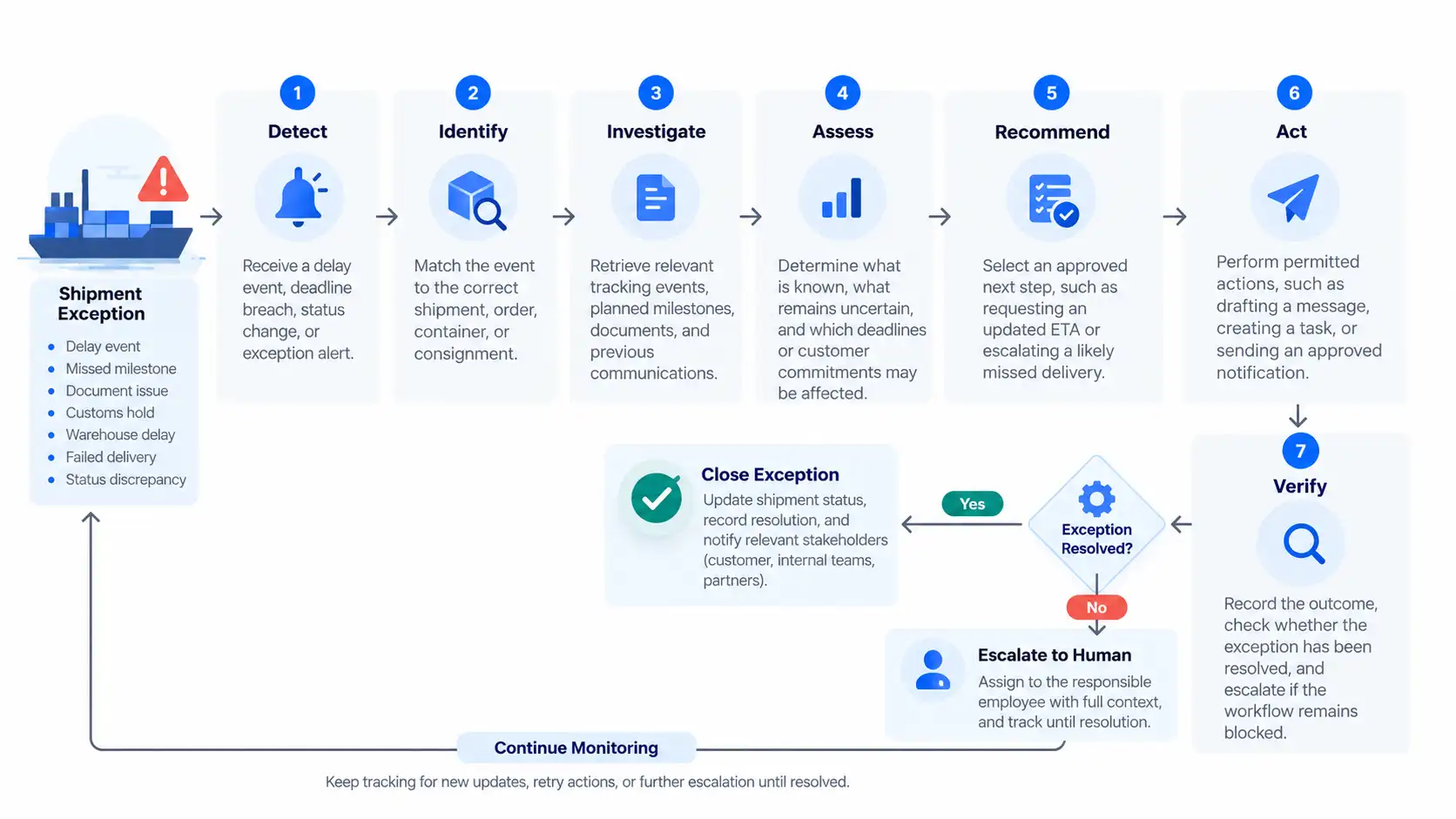
A shipment exception occurs when an event or condition threatens the expected movement, handling, documentation, or delivery of freight.
Examples include missed collection slots, late vessel arrivals, incomplete transport documents, unexpected warehouse delays, customs holds, failed delivery attempts, and discrepancies between a carrier's status and the transport management system.
An AI agent can support exception handling through a controlled sequence.
Detect: Receive a delay event, deadline breach, status change, or exception alert.
Identify: Match the event to the correct shipment, order, container, or consignment.
Investigate: Retrieve relevant tracking events, planned milestones, documents, and previous communications.
Assess: Determine what is known, what remains uncertain, and which deadlines or customer commitments may be affected.
Recommend: Select an approved next step, such as requesting an updated ETA or escalating a likely missed delivery.
Act: Perform permitted actions, such as drafting a message, creating a task, or sending an approved notification.
Verify: Record the outcome, check whether the exception has been resolved, and escalate if the workflow remains blocked.
The process should not assume that an AI model can independently resolve every problem. Some exceptions require a carrier's confirmation, customs clearance, a terminal decision, a revised customer commitment, or a commercial negotiation.
The agent's role is to reduce unnecessary manual investigation while making unresolved decisions visible to the responsible employee.
Six Practical AI Agent Use Cases for Dutch Logistics Operations
1. Automated Shipment Delay Investigation
A tracking alert provides evidence that something has changed, but it may not explain what the change means for the delivery commitment.
An AI agent can combine available carrier events, planned milestones, customer deadlines, and previous updates to prepare a concise exception summary.
For example, a freight forwarder handling an inbound container through Rotterdam could use an agent to:
Retrieve the latest available vessel and container status.
Compare the reported arrival with the planned arrival.
Check whether an inland collection appointment is already scheduled.
Identify which information is missing before a recovery decision can be made.
Prepare an internal summary with the relevant evidence and recommended follow-up.
The example is illustrative, not a documented deployment or a claim that any particular Portbase service currently provides this agent functionality.
The agent should distinguish a confirmed delay from a possible delay. If a carrier has not published a revised arrival time, the system should report the uncertainty rather than inventing an ETA.
2. Proactive Shipment Updates for Customers
Customer service teams often spend time answering repetitive questions about delivery status, expected arrival, and the reason for a delay.
An agent can prepare updates using approved shipment records and verified events. It can identify affected customers, retrieve relevant commitments, and draft communications using the organisation's preferred language and tone.
For a Dutch logistics provider serving customers across Europe, this could support English, Dutch, German, and other languages where the underlying system has been appropriately configured and tested.
A safe communication workflow should separate information retrieval from message delivery.
Routine, verified status changes may qualify for automatic notifications.
Material ETA changes may require an authorised employee to approve the revised commitment.
Conflicting tracking records should trigger investigation rather than a confident customer-facing answer.
Financial, contractual, or liability-related statements should follow established approval policies.
The objective is to make updates more timely and consistent without creating a new source of inaccurate promises.
3. Carrier and Partner Follow-Ups
When a shipment is delayed, employees may need to contact a carrier, terminal, warehouse, or transport subcontractor to establish the next step.
An AI agent can prepare a targeted request using information already available in the transport system. It can include the shipment reference, last confirmed milestone, outstanding question, and required response deadline.
If connected to authorised communication tools, the agent might send routine enquiries, track replies, and attach responses to the shipment record.
More complex cases should remain under human supervision. A carrier's response may be ambiguous, a proposed alternative may involve extra costs, or a recovery option may conflict with the customer's delivery requirements.
An agent can organise the evidence and recommend an action, but commercial authority should remain with the person or policy responsible for the decision.
4. Missing Documents and Data Discrepancies
Logistics exceptions do not always begin with a physical delay. They can arise because information is missing or inconsistent.
A shipment record might contain an incorrect reference, an absent delivery instruction, a mismatch between an order and a transport document, or an incomplete set of required fields.
An AI agent can compare relevant records, extract information from supported document formats, identify discrepancies, and request missing information from the appropriate party.
For example, it might flag that a booking reference in an email differs from the reference stored in the TMS, rather than silently choosing one.
Document checks should use deterministic validation rules wherever possible. The AI model can help interpret unstructured text, but required fields, reference formats, and other strict business constraints should be validated by software designed for that purpose.
Customs and regulated transport documentation require particular care. An agent should not infer missing declarations or treat an incomplete document as compliant simply because the surrounding information appears plausible.
5. Exception Prioritisation Across a Logistics Control Tower
A logistics control tower needs to distinguish urgent disruptions from routine operational noise.
An AI agent can assemble relevant signals into an exception queue, explaining why each shipment may need attention.
Potential prioritisation inputs include:
Time remaining before the delivery commitment.
Whether the latest milestone is confirmed or estimated.
The operational impact of the disruption.
Whether a shipment is blocked by missing information.
Whether a previous escalation remains unanswered.
The availability of a practical recovery option.
The agent can recommend which cases should be reviewed first, but the organisation must define the priority rules and test whether recommendations consistently reflect operational needs.
A high-value shipment is not necessarily the most urgent shipment, and a model should not infer commercial importance from incomplete customer data.
A useful interface presents the underlying facts, the reason for the priority, and the next recommended action. A ranked list without explanations offers limited support to an experienced operations team.
6. Multimodal Coordination Between Road, Sea, and Inland Waterways
Dutch logistics operations can involve several transport modes and different organisations responsible for individual milestones.
An exception in one leg can affect later activities. A changed vessel arrival may affect terminal collection, inland transport, warehouse planning, and the customer's receiving appointment.
An AI agent could identify these dependencies by retrieving available milestone data and comparing the revised schedule with downstream commitments.
For example, if a container's expected availability changes, an agent might flag that the planned truck collection needs to be checked before the delivery window is missed.
It should not automatically cancel a truck booking or arrange a replacement unless the relevant systems support the action and the organisation has explicitly authorised it.
This use case is especially dependent on shared data quality. If partners do not provide timely events or if shipment identifiers cannot be matched reliably, the agent cannot reconstruct an accurate end-to-end view on its own.
What Dutch Logistics Infrastructure Means for AI Agent Integration
The Netherlands already has digital infrastructure for exchanging freight information. AI agent projects should build on this environment where access is available, rather than assume that every partner operates through a single system.
Portbase and the Port of Rotterdam
The Port of Rotterdam Authority's Port Community System overview describes Portbase as a platform that supports information exchange across port logistics processes. The system serves different participants in the supply chain, including freight forwarders and port authorities.
The Port of Rotterdam Authority has also described security measures for digital information sharing through its Secure Chain initiative. The initiative introduces additional authorisation controls into container-release processes.
For an AI agent project, these developments highlight two important requirements: reliable access to relevant logistics information and explicit authority to perform an action.
The existence of a port community platform does not mean an external AI agent automatically has API access, permission to read every shipment record, or the ability to execute operational transactions. Those capabilities must be verified with the relevant platform provider and participating organisations.
Connected Trade Network
In January 2026, the Port of Rotterdam Authority announced the implementation phase of the Connected Trade Network, a data-sharing initiative involving Portbase and inland terminal partners.
The initiative is intended to support standardised, secure, and efficient information exchange in container logistics.
For organisations considering AI agents, this is relevant as an example of work on the underlying data-sharing environment. It is not evidence that the network itself supplies autonomous AI exception handling.
The broader lesson is that agent performance depends on the operational infrastructure underneath it. Better data exchange can create more useful inputs for an agent, but the agent still needs an appropriate integration, decision policy, and verification process.
How to Choose Between an AI Agent and Conventional Automation
Not every logistics workflow benefits from an AI agent. A useful buying decision begins with the variability of the task, the number of systems involved, and the consequences of an incorrect action.
Workflow | Best starting point | Why |
|---|---|---|
Send an update when a verified status changes | Rules-based automation | The trigger and response are predictable |
Alert an employee when a delivery deadline is approaching | Rules-based automation | Clear thresholds are easier to test and audit |
Summarise a carrier's free-text delay explanation | AI assistant or agent | Unstructured text requires interpretation |
Investigate a delay across several systems | AI agent with controlled tools | The task requires multiple information-retrieval steps |
Compare shipment records and flag inconsistencies | Rules plus AI-assisted extraction | Deterministic checks can validate extracted information |
Negotiate a rate or accept a costly recovery option | Human-led decision with AI support | Commercial judgement and authority are required |
A hybrid architecture is often the most practical approach. Rules handle predictable conditions, AI models interpret variable information, and humans approve actions with material operational or financial consequences.
The goal should be to automate the necessary work with the simplest reliable system, not to maximise the number of tasks assigned to an agent.
What an AI Agent for Logistics Should Look Like Technically
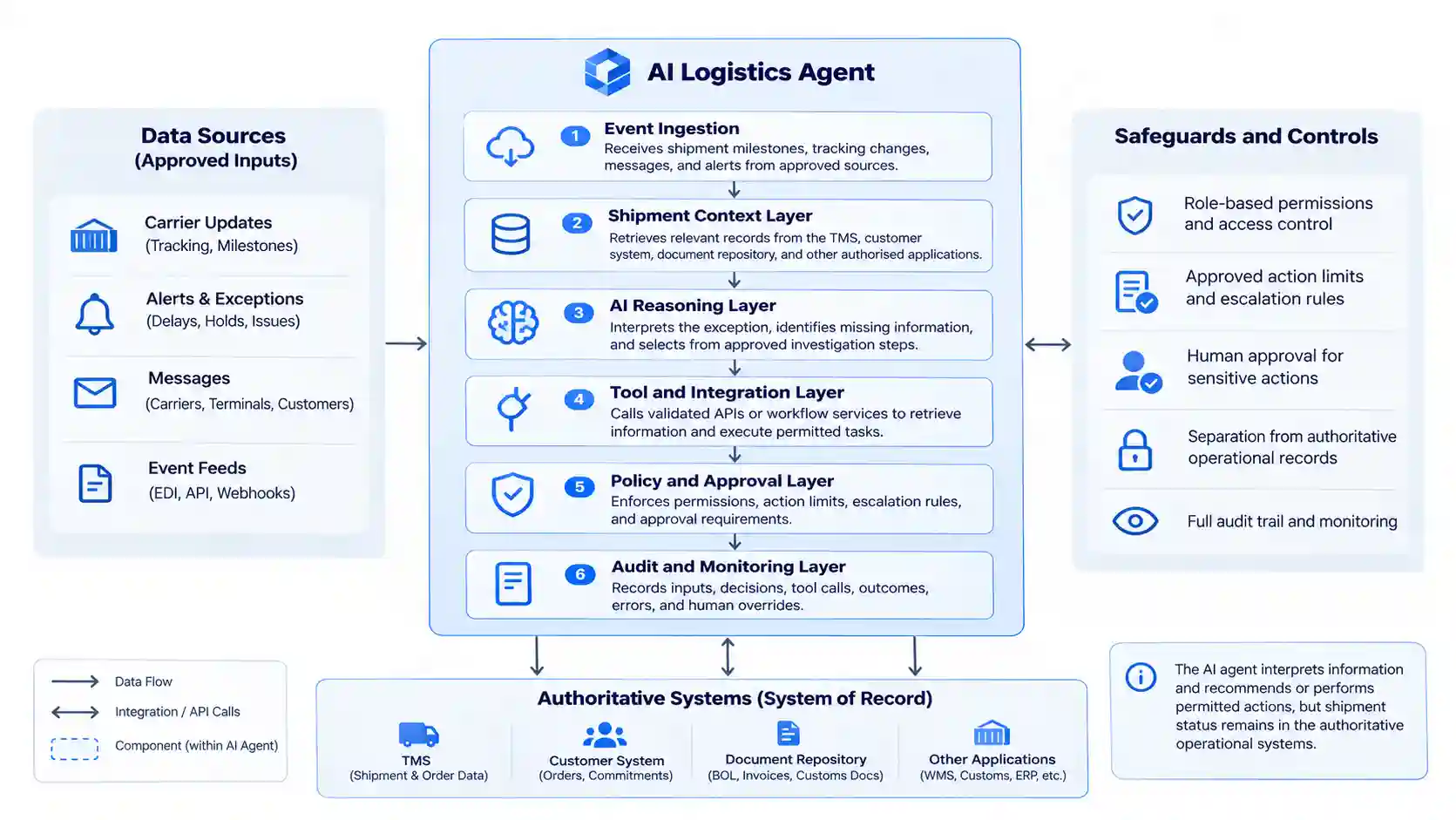
A production-ready implementation generally needs more than a language model and a chat interface.
A typical architecture contains six components:
Event ingestion: Receives shipment milestones, tracking changes, messages, or alerts from approved sources.
Shipment context layer: Retrieves relevant records from the TMS, customer system, document repository, and other authorised applications.
AI reasoning layer: Interprets the exception, identifies missing information, and selects from approved investigation steps.
Tool and integration layer: Calls validated APIs or workflow services to retrieve information and execute permitted tasks.
Policy and approval layer: Enforces permissions, action limits, escalation rules, and approval requirements.
Audit and monitoring layer: Records inputs, decisions, tool calls, outcomes, errors, and human overrides.
The AI component should not be the source of truth for shipment status. Authoritative operational systems should remain responsible for the records they own.
For example, an agent may interpret a carrier message and recommend a revised delivery estimate, but the underlying ETA should be recorded as confirmed only when the appropriate source or authorised process supports that status.
This separation helps prevent plausible-sounding AI output from becoming an operational fact.
How to Evaluate AI Agents for Logistics in the Netherlands
Vendors should be assessed using representative shipment exceptions and measurable operational outcomes, not just polished demonstrations.
Measure the existing workflow first
Before a pilot, record how much time employees spend investigating exceptions, collecting information, contacting partners, preparing updates, and resolving cases.
Measure these activities separately. A solution might reduce the time required to draft an email without reducing the time needed to resolve the underlying delay.
Useful baseline metrics include:
Median and 90th-percentile time from exception detection to first action.
Employee minutes spent per exception.
Time from a confirmed change to customer notification.
Percentage of exceptions resolved within the agreed service window.
Number of unnecessary or incorrect escalations.
Accuracy of shipment matching and exception classification.
These are recommended measurement criteria, not claims about current Dutch industry averages.
Test the system against real operating conditions
The evaluation dataset should include ordinary cases and difficult exceptions, such as duplicate events, stale ETAs, conflicting carrier messages, missing references, and cases where no safe automated action is available.
Assess whether the agent can:
Retrieve the correct shipment and relevant evidence.
Distinguish confirmed facts from estimates.
Identify missing information rather than guessing.
Follow access permissions.
Choose the appropriate escalation path.
Avoid duplicate or unauthorised actions.
Recover safely from integration failures.
A successful demonstration on clean sample data does not establish production readiness.
Compare the total cost of ownership
The business case should account for implementation, integrations, model usage, monitoring, maintenance, security reviews, and ongoing human supervision.
A practical calculation is:
Net annual benefit = verified annual operating savings − annualised implementation and operating costs.
Verified savings should reflect actual changes in labour, service quality, avoidable costs, or operational capacity. Do not count every automated action as a financial saving if employees still need to review the same case or if the released time cannot be used productively.
The pilot should also identify whether improvements are sustained when exception volumes rise and operating conditions become less predictable.
Implementation Roadmap: From Pilot to Production
A staged deployment limits operational risk and makes it easier to establish whether an AI agent delivers measurable value.
Stage 1: Select a narrow use case
Choose a workflow with sufficient volume, clear ownership, available data, and a measurable baseline. Shipment delay investigation and draft customer updates are reasonable starting candidates.
Avoid beginning with an agent that can change bookings, approve additional charges, and send unrestricted external communications.
Stage 2: Map the data and permissions
Identify the authoritative source for each relevant field, including shipment references, planned milestones, actual events, customer commitments, and communication history.
Document the interfaces available for retrieving and updating records. Confirm data access, partner permissions, authentication, and retention requirements before connecting the agent.
Stage 3: Test in read-only mode
Let the agent investigate exceptions and prepare recommendations without executing external actions.
Compare its output with the decisions of experienced employees. Record incorrect shipment matches, unsupported conclusions, missing evidence, and unnecessary escalations.
Stage 4: Introduce controlled actions
Allow a small set of low-risk actions, such as creating an internal task or preparing a draft message. Require approval for actions that affect customer commitments, bookings, charges, or other material decisions.
Use explicit permissions, idempotency controls where appropriate, and safeguards against duplicate messages or repeated transactions.
Stage 5: Expand using measured results
Evaluate whether the pilot reduces operational effort without increasing communication errors or unresolved exceptions.
Expand to additional carriers, customers, transport modes, or workflows only when the relevant integrations and control mechanisms have been tested.
Maintain a rollback procedure so the organisation can disable agent actions and return to an established manual or rules-based process if quality deteriorates.
Regulatory, Privacy, and Security Requirements
AI agent deployment in Dutch logistics must account for the applicable European regulatory framework and the organisation's own contractual and security obligations.
EU AI Act
The European Commission's AI Act implementation timeline explains the Act's phased application. As of October 2026, the majority of its rules have become applicable, while certain high-risk provisions have later application dates under the amended framework.
A logistics use case should be assessed according to its actual purpose, design, and applicable legal classification. Not every AI agent used in freight operations is automatically a high-risk AI system.
Businesses should establish which obligations apply to their role as a provider, deployer, or other participant, and review the relevant requirements before production deployment.
GDPR and personal data
Shipment records and communications may contain personal data, including contact details, driver information, and identifiable employee or customer information.
The Dutch Data Protection Authority published guidance on generative AI and the GDPR in July 2026. Organisations should assess lawful processing, data minimisation, access controls, retention, transparency, and whether a data protection impact assessment is required for the proposed processing.
A practical starting point is to give an agent access only to the information needed for its assigned task and to prevent sensitive operational data from being sent to unauthorised external services.
Electronic freight information
The EU's electronic Freight Transport Information Regulation establishes a framework for electronic freight information exchanged with authorities. The European Commission identifies 9 July 2027 as the date when the Regulation will apply in full, requiring authorities to accept information shared through certified eFTI platforms.
This development is relevant to logistics data architecture, but it should not be confused with a blanket requirement to use AI agents or with automatic permission for an agent to access certified platforms.
Operational security
Agents with access to transport systems can create risks beyond inaccurate text. An incorrect booking change, unauthorised data disclosure, or repeated external message can have real operational consequences.
Controls should include role-based access, secure authentication, limited tool permissions, logging, approval gates, input validation, and procedures for disabling agent actions. External messages and documents should also be treated as potentially untrusted inputs rather than instructions that can override system policies.
What AI Agents Cannot Solve in Logistics
AI agents cannot compensate for information that does not exist, is not accessible, or is too unreliable to support a decision.
A system may explain why a container appears delayed, but it cannot guarantee a correct recovery plan when the carrier has not confirmed its next arrival time or the terminal has not published availability.
Nor does automation remove the need for relationships with transport partners. Some exceptions require negotiation, contractual interpretation, operational judgement, or a physical intervention that software cannot perform.
The technology also introduces new failure modes. An agent can select the wrong shipment, misunderstand a message, repeatedly attempt an unsuccessful action, or produce a convincing explanation based on incomplete evidence.
These risks are reasons to limit autonomy and test the complete workflow, rather than evaluating the AI model in isolation.
For many businesses, conventional automation may remain the better solution for simple notifications and predictable processes. An AI agent is most compelling when the task genuinely requires interpreting variable information and coordinating multiple authorised steps.
Frequently Asked Questions
What are AI agents for logistics in the Netherlands?
AI agents for logistics are software systems that use AI to investigate shipment events, retrieve operational information, recommend actions, and execute approved tasks. Dutch logistics companies could apply them to shipment exceptions, carrier follow-ups, missing documents, and customer updates. Their usefulness depends on access to reliable transport data, integration with existing systems, and controls that prevent unsupported or unauthorised actions.
Can AI agents automatically notify customers about shipment delays?
Yes, when the delay is supported by reliable data and the notification workflow has been appropriately configured. An agent can identify affected shipments and prepare or send approved updates. However, uncertain ETAs, conflicting records, and changes to contractual commitments may require human review. Businesses should measure both notification speed and accuracy rather than assuming that more automated messages always improve service.
Can AI agents integrate with a transport management system?
They can, provided the TMS offers an appropriate integration interface or an authorised workflow mechanism. An agent may retrieve shipment records, create tasks, or update approved fields through APIs or other supported tools. Integration capabilities vary by product and configuration, so organisations should verify permissions, supported operations, auditability, and failure handling with their specific TMS provider.
Are AI agents better than traditional logistics automation?
Not for every task. Traditional automation is generally a strong fit for predictable rules, such as sending an alert when a confirmed milestone changes. AI agents are more relevant when a workflow requires interpreting messages, investigating several sources, or choosing between approved next steps. A hybrid approach can combine rules, AI-assisted interpretation, and human approval.
How can freight forwarders use AI agents to manage exceptions?
Freight forwarders can use agents to collect shipment evidence, compare planned and actual milestones, identify missing information, prepare carrier enquiries, and draft customer updates. The agent should distinguish confirmed events from estimates and escalate exceptions that require commercial judgement or partner confirmation. A read-only pilot is a practical way to evaluate accuracy before granting permission to perform operational actions.
Are AI agents suitable for container logistics around Rotterdam?
They may be suitable for selected workflows involving container status, terminal milestones, inland transport coordination, and shipment communications. The Port of Rotterdam's digital logistics infrastructure provides relevant context, but an agent's actual capabilities depend on available interfaces, contractual access, and partner permissions. Companies should verify these requirements rather than assume that a public logistics platform offers unrestricted agent access.
What should companies evaluate before buying an AI logistics agent?
Evaluate shipment-matching accuracy, evidence quality, time saved per exception, integration coverage, escalation accuracy, permission controls, auditability, security, and total cost of ownership. Test the solution against real cases, including missing data and conflicting updates. Vendor demonstrations should not substitute for a controlled pilot using representative operational conditions.
Does the EU AI Act apply to logistics AI agents?
The answer depends on the system's intended purpose, its classification, and the organisation's role. The use of AI in logistics does not automatically make a system high-risk. Organisations should assess the applicable AI Act requirements, GDPR obligations, contractual commitments, and security controls for the specific deployment.
Conclusion: Start With Better Exception Handling, Not Full Autonomy
AI agents offer a practical opportunity for Dutch logistics companies to reduce the manual effort involved in investigating shipment exceptions and coordinating updates. The strongest initial applications are those that combine reliable operational data, repetitive investigation steps, and clear boundaries around what the software may do.
The Netherlands' established port and inland freight infrastructure makes data integration an important part of this opportunity. However, digital information exchange is not the same as proven AI agent adoption, and the existence of a logistics platform does not guarantee that a third-party agent can access or act on its data.
For decision-makers, the next step is to identify one high-volume exception workflow, establish its current cost and performance, and test an agent in read-only mode. Expand its permissions only when the evidence shows that it can improve response times and reduce manual effort without compromising shipment accuracy, customer communication, or operational control.
Comments (0)
No comments yet. Be the first to share your thoughts!