AI Code Assistant Market Size, Share & Global Forecast 2026–2035

Author
Ravi Prajapati
Description: AI Code Assistant Market size, share, growth drivers, vendor rankings and forecast to 2035, backed by GitHub, SNS Insider, Gartner and Stack Overflow data.
Overview: Software development has quietly changed jobs. A task that used to mean typing every line by hand now often starts with a prompt. This article pulls together market sizing from SNS Insider, Grand View Research, Mordor Intelligence, and The Business Research Company, developer adoption data from GitHub's Octoverse, Stack Overflow, and JetBrains, and funding data on Cursor, GitHub Copilot, Claude Code, and the rest of the field, to build the most complete public picture of the AI code assistant market available today. Where analyst firms disagree on the numbers, and they disagree a lot, this piece explains why, so you can pick the right figure for your own context instead of quoting one in isolation.
Key Takeaways
Market size estimates for 2026 range from roughly USD 5.4 billion to USD 16.1 billion, depending on how narrowly or broadly a research firm defines "AI code assistant." According to SNS Insider, the market stood at USD 4.70 billion in 2025 and is projected to reach USD 19.43 billion by 2035, at a CAGR of 15.31% from 2026 to 2035.
North America holds roughly 42% of global revenue as of 2025, per SNS Insider, with the United States alone accounting for close to 87% of North American spend.
Asia Pacific is the fastest-growing region across nearly every report reviewed for this article, with CAGR estimates ranging from about 17.5% to 38%, driven by India's developer population and China's sovereign AI push.
GitHub Copilot, Cursor, and Claude Code lead adoption and revenue, but the field is genuinely fragmented. Most engineering teams now run two to four assistants side by side rather than standardizing on one.
Developer adoption has moved past the early-adopter phase. Multiple 2025-2026 surveys put AI tool usage among professional developers between 84% and 91%, though trust in AI-generated code accuracy has actually fallen in the same period.
Enterprise investment is accelerating faster than the underlying market size suggests, with Cursor's maker Anysphere going from roughly USD 100 million in annualized revenue in January 2025 to a reported USD 2 billion by February 2026.
Executive Summary
The AI code assistant market is one of the few corners of the broader generative AI economy where paying customers, not pilot budgets, are already footing the bill. Developers were among the first professional groups to adopt large language models at scale, and unlike many enterprise AI use cases that are still stuck in proof-of-concept purgatory, AI-assisted coding has already produced companies with real, audited revenue. Cursor's parent company Anysphere reportedly crossed USD 1 billion in annualized revenue within roughly two years of launch, a pace that beat Slack, Zoom, and Snowflake, according to reporting from Tech Funding News. Microsoft has disclosed that GitHub Copilot passed 20 million users and roughly 4.7 million paid subscribers, with adoption across 90% of the Fortune 100.
According to SNS Insider, the global AI Code Assistant Market was valued at USD 4.70 billion in 2025 and is on track to hit USD 19.43 billion by 2035, growing at a CAGR of 15.31% between 2026 and 2035. That is a conservative estimate compared with some adjacent reports. Grand View Research pegs the closely related "AI code assistants" category at USD 8.5 billion in 2025 heading toward USD 42.8 billion by 2033. Mordor Intelligence's broader "AI code generation and developer assistant" market estimate is larger still, forecasting USD 16.13 billion in 2026 alone.
These numbers are not contradictions so much as different rulers measuring the same growing object. Some firms count only standalone AI coding software. Others fold in adjacent services, agentic development platforms, and enterprise consulting revenue. What all of them agree on is direction: this category is growing faster than almost any other enterprise software segment, developer adoption is now mainstream rather than experimental, and the competitive field is consolidating around a handful of well-capitalized players even as new entrants keep showing up.
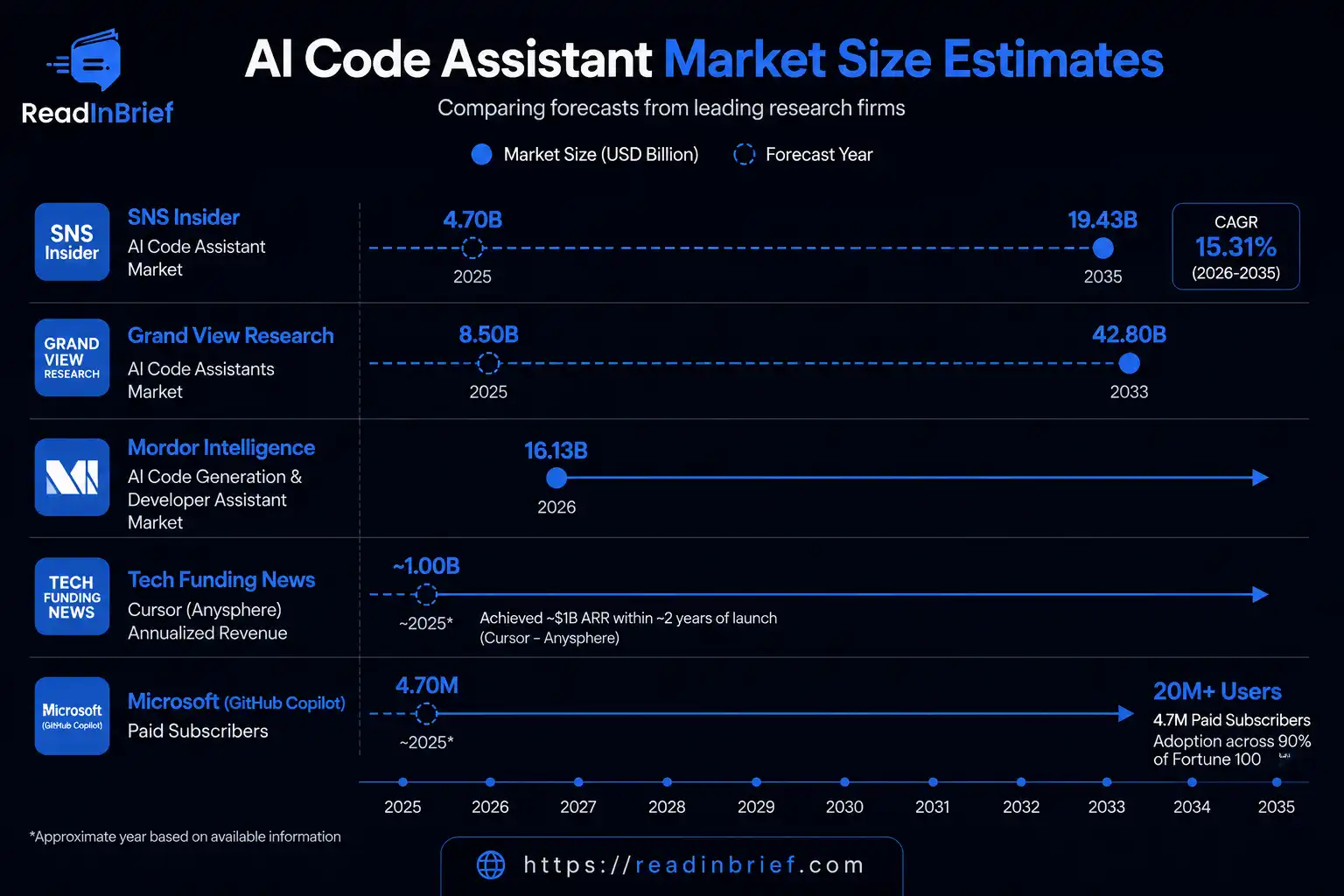
Key Insight: The wide gap between market size estimates is itself a signal. When five credible research firms produce numbers that differ by a factor of three, it usually means a market is still being defined in real time, not that the underlying growth story is unreliable.
AI Code Assistant Market Snapshot
Metric | Figure | Source |
|---|---|---|
Market Size 2025 | USD 4.70 Billion | SNS Insider |
Market Size 2026E | USD 5.42 Billion | SNS Insider |
Market Size Forecast 2035 | USD 19.43 Billion | SNS Insider |
CAGR (2026–2035) | 15.31% | SNS Insider |
Forecast Period | 2026–2035 | SNS Insider |
Largest Region (2025) | North America (42% share) | SNS Insider |
Fastest Growing Region | Asia Pacific | SNS Insider, Grand View Research |
Major Vendors | Microsoft, GitHub, Amazon, Google, JetBrains, Anthropic, Cursor (Anysphere), Codeium/Windsurf, Sourcegraph, Tabnine | Multiple |
For comparison, here is how the same category is sized by other major research firms, which helps illustrate the range a reader should expect when researching this market elsewhere.
Research Firm | Base Year Size | Forecast Year Size | CAGR | Forecast Window |
|---|---|---|---|---|
SNS Insider (AI Code Assistant Market) | USD 4.70B (2025) | USD 19.43B (2035) | 15.31% | 2026–2035 |
Grand View Research (AI Code Assistants) | USD 8.5B (2025) | USD 42.8B (2033) | 22.5% | 2026–2033 |
Mordor Intelligence (AI Code Generation & Developer Assistant) | USD 11.8B (2025) | USD 78.97B (2031) | 37.39% | 2026–2031 |
Mordor Intelligence (AI Code Tools) | USD 7.37B (2025) | USD 29.96B (2031) | 26.23% | 2026–2031 |
The Business Research Company (AI Code Tools) | USD 7.65B (2025) | USD 22.2B (2030) | 23.8% | 2025–2030 |
Intel Market Research (AI Code Assistants Software) | USD 1.11B (2025) | USD 1.61B (2034) | 5.5% | 2025–2034 |
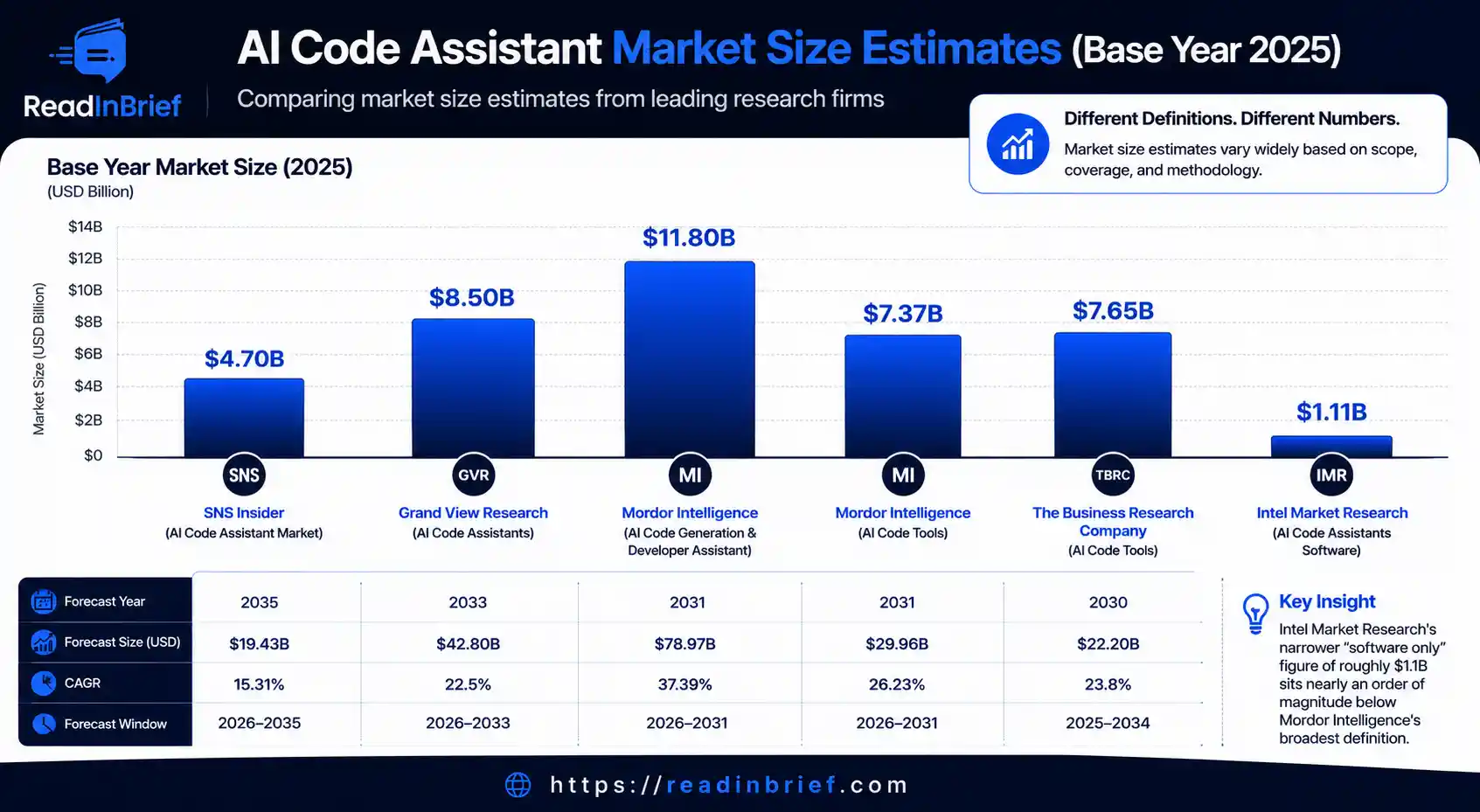
Key Insight Notice that Intel Market Research's narrower "software only" figure of roughly USD 1.1 billion sits nearly an order of magnitude below Mordor Intelligence's broadest definition. Anyone citing a single AI code assistant market size figure without specifying scope is likely to be misunderstood by anyone who has read a competing report.
What Is the AI Code Assistant Market?
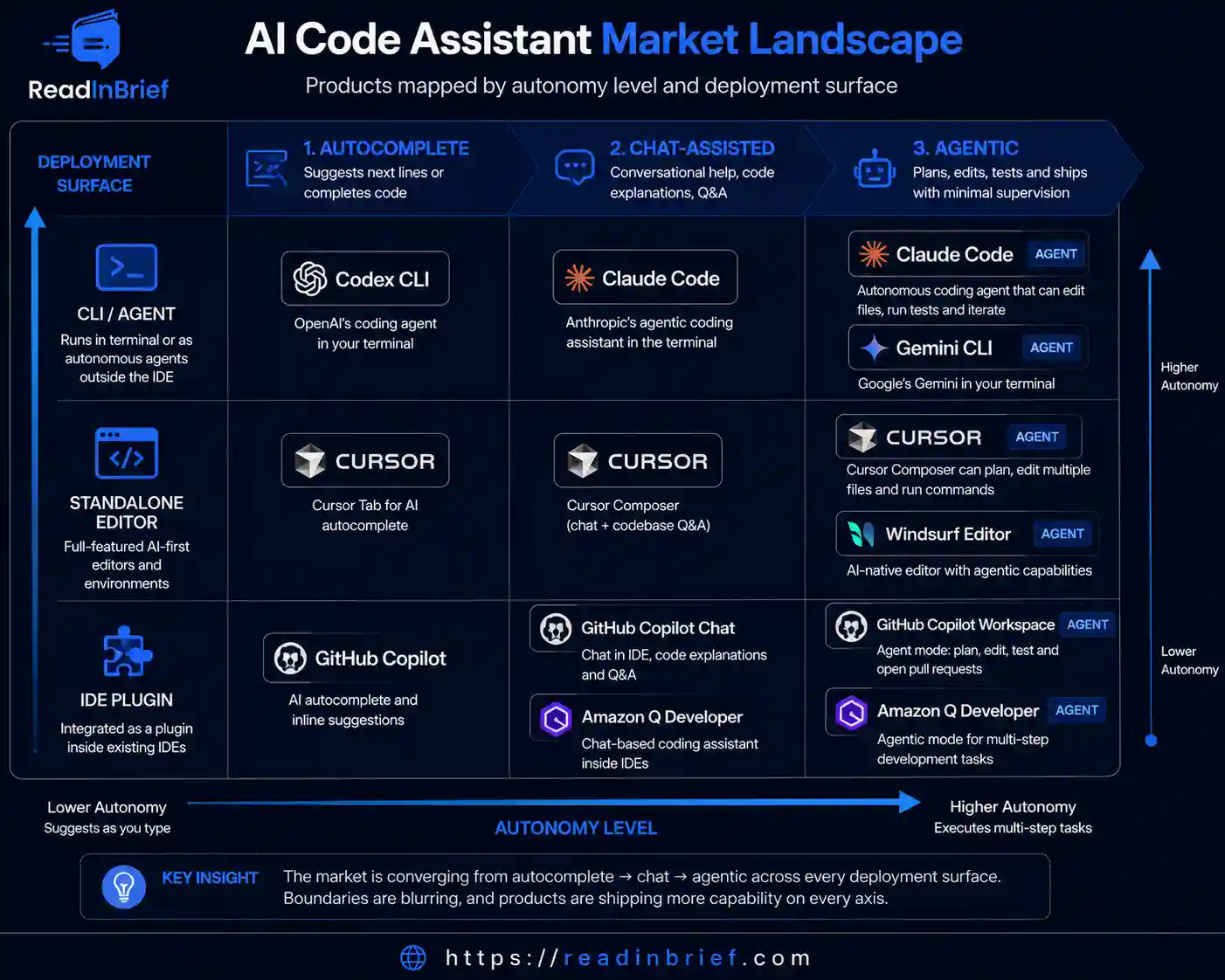
An AI code assistant is software that uses machine learning, and increasingly large language models, to help developers write, review, debug, test, and document code. That definition covers a wide spectrum of products, from a simple autocomplete plugin inside an IDE to a fully autonomous coding agent that can open a pull request on its own.
The category generally splits into a few functional buckets:
Code completion and autocomplete tools predict the next few lines or the rest of a function as a developer types. This was the original use case popularized by GitHub Copilot in 2021 and remains, per SNS Insider's segmentation data, one of the largest application areas by revenue share.
Chat-based coding assistants let developers ask natural language questions about a codebase, get explanations of unfamiliar code, or request a function be written from a description. Anthropic's Claude, OpenAI's ChatGPT and Codex, and Google's Gemini all serve this function alongside dedicated coding products.
Agentic coding tools go further. They can plan a multi-step task, edit multiple files, run tests, and iterate on failures with limited human supervision. GitHub Copilot Workspace, Amazon Q Developer's agentic mode, Cursor's Composer, and Anthropic's Claude Code all fall into this category, and it is widely considered the fastest-growing segment of the market.
Code review and security assistants scan pull requests for bugs, vulnerabilities, and style violations, either as a standalone product (Snyk, for example) or as a feature bolted onto a broader assistant.
IDE-native versus cloud-based versus standalone editors is a second axis of segmentation. Some tools live as a plugin inside Visual Studio Code or JetBrains IDEs. Others, like Cursor and Windsurf, are entire forked code editors built AI-first. Cloud-based assistants run inference on a vendor's servers regardless of where the developer's IDE sits, and this remains the dominant deployment mode, holding a 74.1% revenue share in 2025 according to Grand View Research.
Key Insight The market's internal segmentation is shifting faster than most taxonomy schemes can keep up with. A product that was "just autocomplete" in 2023 is, by 2026, likely to also offer a chat interface and some agentic task execution, which is part of why analyst firms disagree so much on where the category's boundaries even sit.
AI Code Assistant Market Size (2026)
.webp)
Putting a single number on 2026 requires picking a lane. SNS Insider's model, the primary reference for this article, puts the market at USD 5.42 billion for 2026, on its way to USD 19.43 billion by 2035. That estimate covers software tools and associated services segmented by large language models, machine learning-based models, and natural language processing technologies, across BFSI, IT and telecom, healthcare, retail, government, and manufacturing verticals.
Other 2026 estimates published this year tell a similar growth story at different scale. Mordor Intelligence's AI Code Tools Market report puts the figure at USD 9.35 billion for 2026, while its broader AI Code Generation and Developer Assistant Market report estimates USD 16.13 billion for the same year, a difference explained largely by whether services, consulting, and adjacent DevOps tooling revenue are folded in.
A separate, revenue-based lens on the market comes from looking at actual company disclosures rather than analyst modeling. Cursor's developer Anysphere reported an annualized revenue run rate of roughly USD 2 billion by February 2026, according to Bloomberg reporting cited by TechCrunch, with internal projections of more than USD 6 billion by year end. Microsoft has disclosed GitHub Copilot generating meaningful revenue inside its broader Microsoft 365 and GitHub business lines, with over 4.7 million paid subscribers as of mid-2026 reporting. Anthropic disclosed in September 2025 that Claude Code alone had already generated more than USD 500 million in run-rate revenue since its full launch in May of that year.
If just the three or four largest named vendors already represent several billion dollars of annualized revenue between them, the broader analyst estimates in the USD 9 billion to 16 billion range for 2026 look more plausible than the narrower USD 1 billion to 5 billion estimates, at least for total addressable spend across tools, seats, and inference. The tighter estimates likely reflect a stricter definition limited to dedicated "code assistant software" license revenue, excluding platform-bundled features and agentic development spend.
Suggested Visualization: A stacked bar chart showing disclosed or estimated 2026 annualized revenue for GitHub Copilot, Cursor, Claude Code, and Amazon Q Developer next to the total market size estimates, to show what share of the analyst totals the known top players already represent.
Key Insight Bottom-up company revenue figures and top-down analyst market sizing are starting to converge, which is itself useful evidence that this market has moved past the phase where analyst estimates were mostly speculative.
AI Code Assistant Market Forecast (2026–2035)
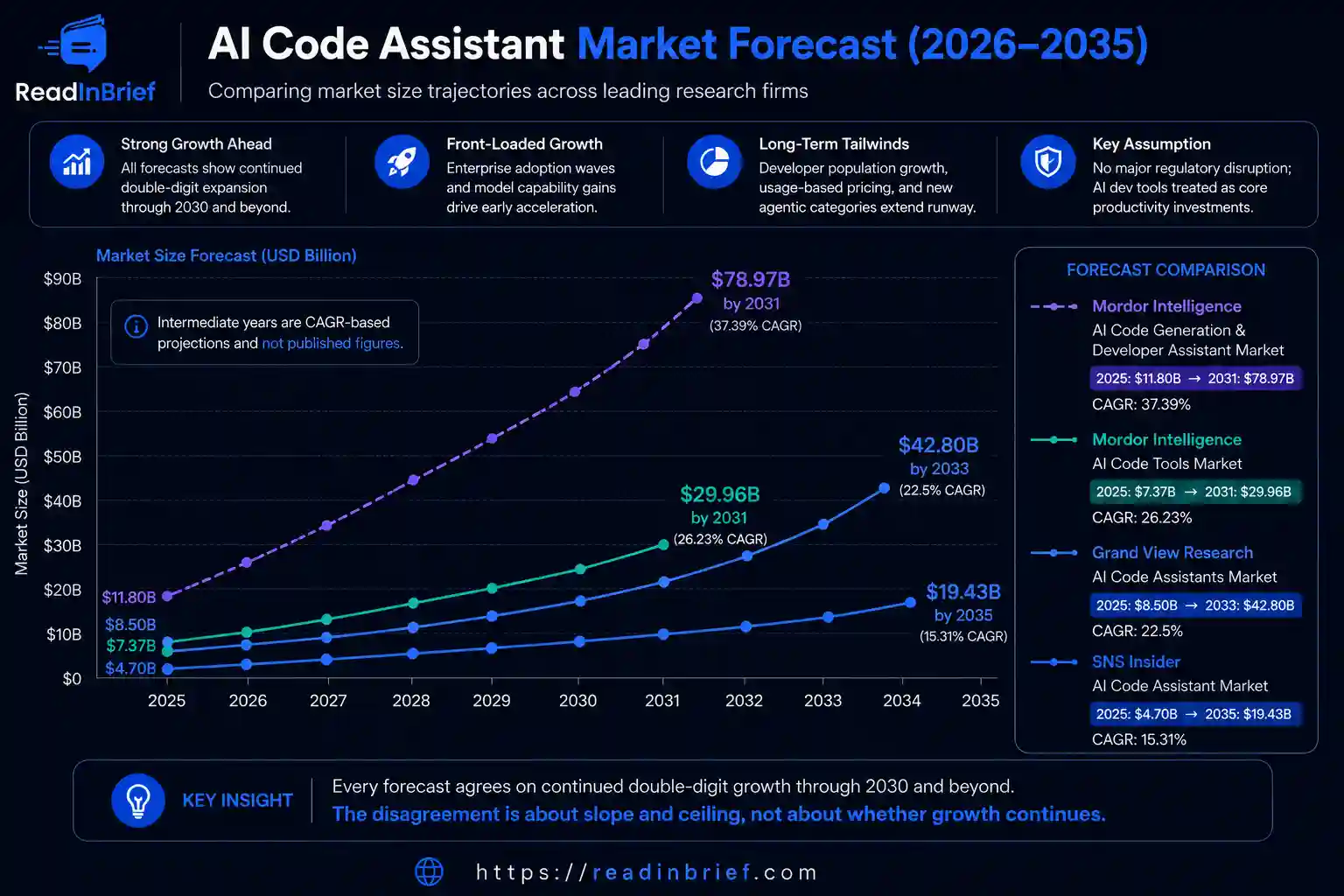
Under SNS Insider's central forecast, the market grows from USD 5.42 billion in 2026 to USD 19.43 billion by 2035, implying the market roughly quadruples across the decade even at a comparatively modest CAGR of 15.31%. Growth is not expected to be linear. Early years in the forecast window should see faster percentage growth off a smaller base, with the rate naturally compressing as the market matures and approaches saturation among large enterprises in developed markets.
Why growth front-loads:
Multiple reports point to two forces stacking in the early forecast years. First, enterprise procurement cycles that started with pilot programs in 2023 and 2024 are converting into multi-year contracts in 2025 and 2026, creating a wave of recognized revenue. SNS Insider notes that global AI code assistant adoption surged 50% in 2025 alone, with 75% of enterprises integrating these tools into cloud-native DevOps pipelines. Second, foundation model capability keeps improving fast enough that each new model generation creates fresh upgrade and expansion motivation among existing customers, a dynamic SNS Insider describes as "compounding commercial momentum."
Why growth eventually cools:
As the installed base of large enterprises and professional developers saturates, especially in North America and Western Europe, growth increasingly has to come from expanding the total developer population (a slower-moving number), from usage-based pricing capturing more of each developer's workflow, or from genuinely new product categories like fully autonomous software agents that do not yet have an established price point.
Core Market Assumptions
Enterprise software budgets continue treating AI development tools as a productivity line item rather than a discretionary experiment, consistent with reported enterprise productivity gains of roughly 45% and bug reduction of about 35% cited in SNS Insider's analysis.
Foundation model pricing for code-focused inference continues to fall on a per-token basis even as usage volume rises, keeping gross margins for vendors from collapsing entirely, though several reports note vendors like Cursor still operate with structurally thinner margins than typical SaaS businesses due to third-party model costs.
No major regulatory intervention forces a slowdown in enterprise AI adoption, though the EU AI Act and similar frameworks are expected to shape product design rather than halt adoption, per SNS Insider's European market analysis.
Developer population growth, GitHub alone added 36 million developers in 2025 according to its Octoverse report, continues to expand the addressable market independent of AI-specific adoption trends.
Year | Estimated Market Size (SNS Insider basis, USD Billion) | Approximate YoY Growth |
|---|---|---|
2025 | 4.70 | — |
2026 | 5.42 | 15.3% |
2028 | ~7.2 | ~15% avg |
2030 | ~9.6 | ~15% avg |
2032 | ~12.8 | ~15% avg |
2035 | 19.43 | ~15% avg (compounded) |
Interim years are illustrative interpolations at the reported 15.31% CAGR and are not independently published figures from SNS Insider.
Key Insight Every forecast reviewed for this piece agrees on one thing that matters more than the exact dollar figure: none of them show the market plateauing before 2030. The disagreement is entirely about slope and ceiling, not about whether growth continues.
AI Code Assistant Market Share
By Vendor
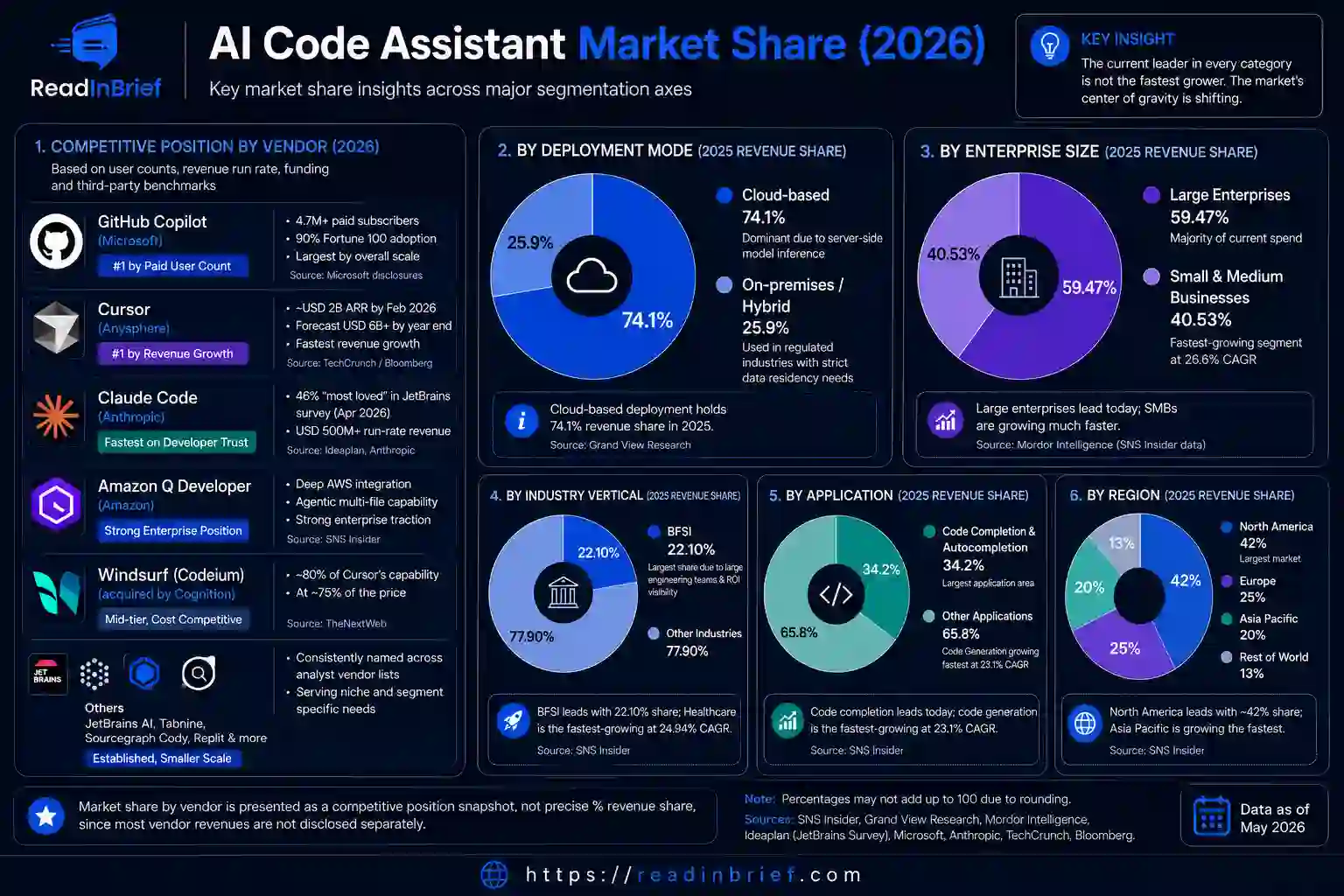
Exact vendor-level revenue share is not publicly disclosed by most companies, since Microsoft, Amazon, and Google report Copilot, Q Developer, and Gemini Code Assist revenue inside larger business segments. Based on available user counts, funding disclosures, and third-party benchmarking cited across multiple 2026 reports, a rough competitive ordering by scale looks like this:
Vendor | Approximate Position (2026) | Basis |
|---|---|---|
GitHub Copilot (Microsoft) | Largest by paid user count | 4.7M+ paid subscribers, 90% Fortune 100 adoption, per Microsoft disclosures cited by multiple outlets |
Cursor (Anysphere) | Largest by revenue growth rate | ~USD 2B ARR by Feb 2026, forecast USD 6B+ by year end, per TechCrunch/Bloomberg reporting |
Claude Code (Anthropic) | Fastest-growing on developer trust metrics | 46% "most loved" in JetBrains April 2026 survey per Ideaplan; USD 500M+ run-rate disclosed by Anthropic |
Amazon Q Developer | Strong enterprise/AWS-native position | Agentic multi-file capability, per SNS Insider |
Windsurf (Codeium, acquired by Cognition) | Mid-tier, cost-competitive positioning | Reported ~80% of Cursor's capability at ~75% of price, per TheNextWeb |
JetBrains AI, Tabnine, Sourcegraph Cody, Replit | Established but smaller relative scale | Named consistently across analyst vendor lists |
By Deployment Mode
Cloud-based deployment dominates, holding a 74.1% revenue share in 2025 according to Grand View Research, reflecting the reality that most modern AI coding tools depend on server-side model inference regardless of local IDE integration. On-premises and hybrid deployment remains a meaningful minority segment, concentrated in regulated industries with strict data residency requirements.
By Enterprise Size
SNS Insider's underlying data and corroborating reports suggest large enterprises hold the bulk of current spend, roughly 59.47% of AI code tools revenue in 2025 per Mordor Intelligence, but small and medium businesses are the fastest-growing segment, expanding at a CAGR approaching 26.6% in the same report, aided by simple per-seat SaaS pricing that lowers the barrier to entry compared to earlier enterprise software categories.
By Industry
BFSI (banking, financial services, and insurance) led industry vertical spend with a 22.10% share in 2025, according to SNS Insider, reflecting the sector's large software engineering headcount and direct return-on-investment calculation. Healthcare is the fastest-growing vertical, forecast at a 24.94% CAGR, driven by clinical software and digital health platform development.
By Application
Code completion and autocompletion represented the largest application area at 34.2% share in 2025, per SNS Insider, though code generation is forecast to grow fastest at 23.1% CAGR as agentic tools expand what "generation" actually means, from single functions to entire features.
By Region
North America led with roughly 42% of global revenue in 2025, followed by Europe at approximately 25%, Asia Pacific at 20%, and the rest of the world making up the remaining 10% to 13%, according to figures reported by SNS Insider.
Key Insight The pattern across nearly every segmentation axis is the same: the current leader is not the fastest grower. Large enterprises lead but SMBs grow faster; North America leads but Asia Pacific grows faster; code completion leads but code generation grows faster. That consistent pattern suggests the market's center of gravity is genuinely shifting, not just diversifying at the margins.
Historical Market Evolution
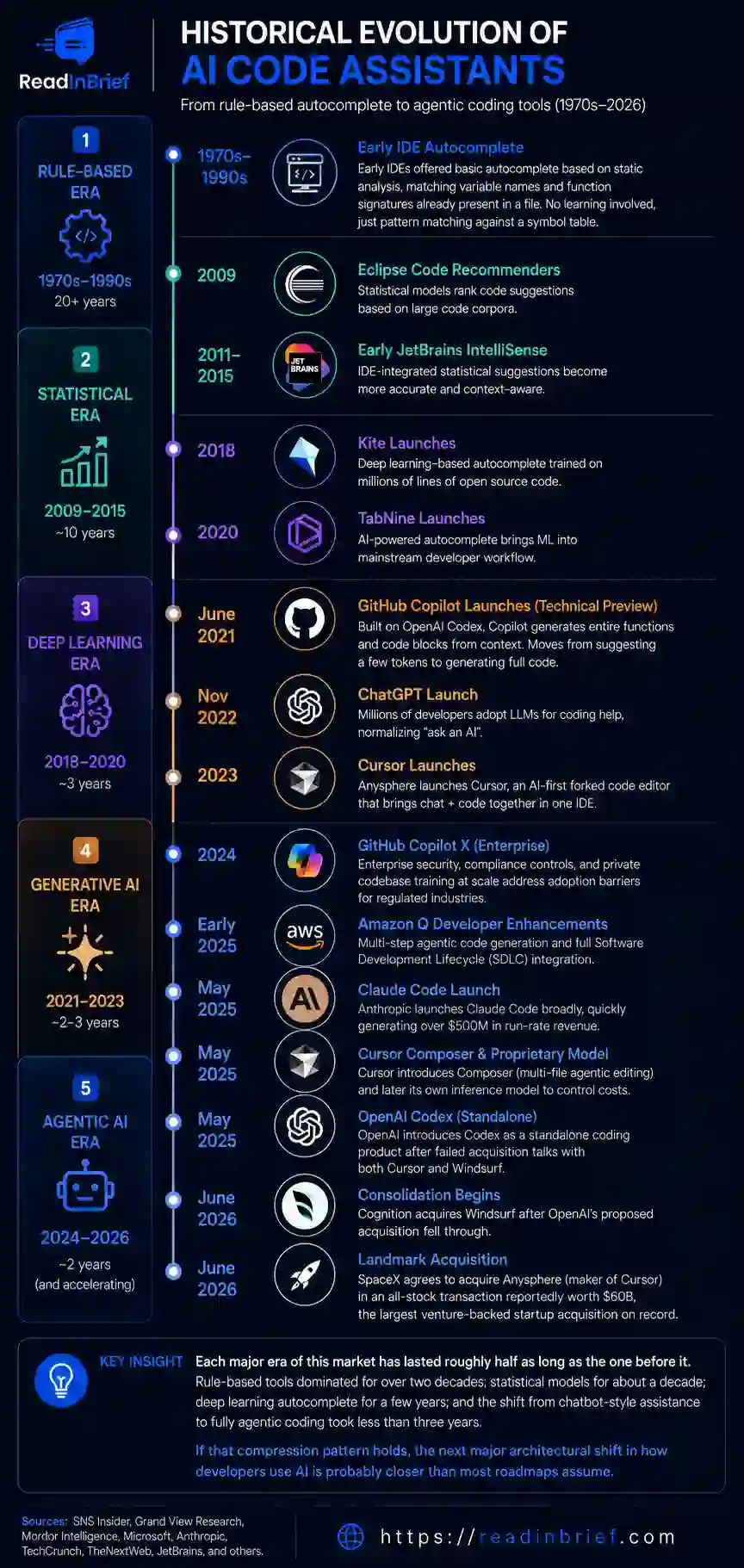
The road to today's agentic coding tools did not start with ChatGPT. It started decades earlier with much humbler ambitions.
1970s-1990s: Rule-based autocomplete
Early IDEs offered basic autocomplete based on static analysis, matching variable names and function signatures already present in a file. There was no learning involved, just pattern matching against a symbol table.
2009-2015: Statistical and IDE-integrated suggestions
Tools like Eclipse Code Recommenders and early JetBrains IntelliSense used statistical models trained on large code corpora to rank suggestions, a meaningful step up from pure rule-based matching but still far from generative.
2018-2020: Machine learning enters the IDE
Kite and TabNine (before its rebrand to Tabnine) launched deep learning-based autocomplete tools trained on public GitHub repositories, offering the first taste of AI-assisted, rather than merely statistics-assisted, coding.
June 2021: GitHub Copilot launches in technical preview
Built on OpenAI's Codex model, a descendant of GPT-3 fine-tuned on public code, Copilot was the moment AI code assistance went mainstream. It moved from suggesting the next few tokens to generating entire functions from a comment or a function signature.
2022-2023: The chatbot wave
ChatGPT's late 2022 launch pulled millions of developers into using general-purpose LLMs for coding help even without a dedicated tool, informally establishing "ask an AI" as a normal part of the development workflow. Anysphere, the company behind Cursor, was founded in 2022 and launched its AI-first forked code editor in 2023.
2024: Enterprise-grade expansion
Microsoft and GitHub launched Copilot X, adding enterprise security, compliance controls, and private codebase training, addressing the adoption barriers that had kept regulated industries like banking and healthcare on the sidelines, according to SNS Insider's account of the launch.
2025: The agentic turn
Amazon enhanced Q Developer with multi-step agentic code generation and full software development lifecycle integration. Anthropic launched Claude Code broadly in May, quickly generating over USD 500 million in run-rate revenue. Cursor introduced Composer, its own multi-file agentic editing mode, and later its own proprietary inference model to control costs. OpenAI introduced Codex as a standalone coding product in May after failed acquisition talks with both Cursor and Windsurf.
2026: Consolidation begins
Cognition acquired Windsurf after OpenAI's proposed acquisition fell through. In a landmark deal announced in June 2026, SpaceX agreed to acquire Anysphere, the maker of Cursor, in an all-stock transaction reportedly worth USD 60 billion, described by industry trackers as the largest venture-backed startup acquisition on record.
Key Insight Each major era of this market has lasted roughly half as long as the one before it. Rule-based tools dominated for over two decades; statistical models for about a decade; deep learning autocomplete for a few years; and the shift from chatbot-style assistance to fully agentic coding took less than three years. If that compression pattern holds, the next major architectural shift in how developers use AI is probably closer than most roadmaps assume.
Key Growth Drivers
Developer shortages
Mordor Intelligence's AI Code Generation and Developer Assistant Market report points to a projected 40% deepening of the global developer shortage in 2026, pushing enterprises toward tools that raise output per engineer rather than requiring proportional headcount growth.
Enterprise AI adoption more broadly
As enterprises build organization-wide AI governance, procurement, and security frameworks for AI in general, code assistants benefit from riding along inside budgets and approval processes that already exist for other AI initiatives.
GitHub Copilot's normalization effect
With 90% of the Fortune 100 already using Copilot and 80% of new GitHub developers turning it on in their first week, according to GitHub's own Octoverse 2025 report, AI-assisted coding has become the default onboarding experience for a new generation of developers rather than an optional add-on.
Large language model capability jumps
Context windows have expanded from roughly 8,000 tokens in early models to well over 200,000 tokens in current-generation systems, per SNS Insider's technology analysis, allowing assistants to reason about entire codebases instead of single files, which meaningfully improves suggestion quality and multi-file refactoring accuracy.
Software productivity pressure
Enterprise deployments have reported measurable outcomes, cited by SNS Insider as a 45% productivity improvement and a 35% reduction in critical bugs across multi-language software projects, giving CFOs and CTOs a concrete return-on-investment case rather than a speculative one.
Cloud-native development
The dominance of cloud-based deployment, holding roughly three-quarters of market revenue per Grand View Research, aligns naturally with how modern software teams already build and ship, lowering integration friction for AI tooling.
DevOps and CI/CD automation
GitHub Actions alone processes billions of workflow runs monthly, and AI code assistants are increasingly wired directly into these pipelines for automated testing, code review, and deployment gating, rather than functioning as a standalone writing tool.
The low-code and no-code movement's adjacent influence
While AI code assistants target professional developers rather than citizen developers, the broader cultural shift toward lowering the barrier to building software has made AI-assisted development feel like a natural next step rather than a disruptive one.
Key Insight Developer shortage and productivity ROI are doing most of the heavy lifting in enterprise procurement decisions right now, but the long-run driver that analysts consistently underweight is onboarding normalization. A developer who learns to code with an AI assistant from day one is unlikely to ever consider working without one, which builds a durable demand floor independent of any productivity metric.
Market Challenges
Security
Mordor Intelligence's AI Code Generation and Developer Assistant Market report notes that nearly half of AI-generated code fails its first security review, a statistic that should give pause to any organization treating AI-generated output as production-ready by default.
Compliance
Regulated industries, particularly BFSI, healthcare, and government, face genuine uncertainty about how AI-assisted development interacts with existing compliance frameworks, audit trails, and change management requirements built for human-authored code.
Code quality variability
SNS Insider's restraint analysis flags that many organizations' code quality governance processes were never designed to evaluate AI-generated code at volume, creating integration friction even where the underlying productivity gains are real.
Licensing and intellectual property concerns
Uncertainty about the copyright status of AI-generated code, and about training data provenance for the underlying models, remains a meaningful adoption barrier in legal departments that have not yet developed clear internal guidance, per SNS Insider.
Hallucinations
Despite rapid model improvement, AI assistants can still generate plausible-looking but incorrect code, non-existent library functions, or subtly broken logic, a risk that grows rather than shrinks as assistants take on more autonomous, less human-supervised tasks.
Vendor lock-in
As enterprises invest in private, codebase-trained models, the resulting personalization creates a genuine switching cost, which SNS Insider frames as a business opportunity for vendors but which enterprise buyers should recognize as a real strategic risk when negotiating contracts.
Privacy
Sending proprietary source code to a third-party model provider for inference raises data handling questions that many enterprises are still working through, particularly across jurisdictions with strict data residency rules like the EU.
Open-source concerns
The rise of AI code assistants has also raised questions within open-source communities about whether AI-generated contributions dilute code review quality or introduce licensing conflicts when models trained on open-source code produce output for commercial products.
Trust erosion despite adoption growth
Perhaps the most counterintuitive finding across recent survey data: trust in AI-generated code accuracy among Stack Overflow respondents actually fell to 29% in 2025-2026, down 11 percentage points from 40% the year before, even as raw adoption climbed, according to aggregated survey data compiled by Digital Applied.
Key Insight The adoption-versus-trust gap is the single most important tension in this market right now. Developers are using these tools constantly while trusting them less, which suggests usage is currently driven more by competitive and organizational pressure to keep pace than by full confidence in output quality, a dynamic that tends to be unstable over the medium term.
Opportunities
Small and medium businesses
SMBs represent the fastest-growing enterprise size segment, expanding at roughly 26.6% CAGR according to Mordor Intelligence, as usage-based and per-seat pricing models make AI coding tools accessible without the procurement overhead of legacy enterprise software.
Healthcare
The fastest-growing industry vertical at a 24.94% CAGR per SNS Insider, driven by clinical software development, digital health platforms, and the sector's particular need for the zero-defect code quality that AI-assisted review and testing features can help support.
Finance
BFSI already leads industry vertical spend, and continued growth is expected as trading systems, risk management platforms, and payment infrastructure modernization projects lean further into AI-assisted development to compress delivery timelines.
Government
The February 2025 U.S. executive order on AI use in federal software development, noted in SNS Insider's regional analysis, is creating public sector adoption momentum that most market models had not fully priced in even a year ago.
Education
As AI-assisted coding becomes the default learning experience for new developers, per GitHub's Octoverse data showing 80% first-week Copilot adoption among new users, educational institutions and coding bootcamps represent an underexplored distribution channel for vendors willing to offer meaningful student pricing.
Cybersecurity
Security and compliance-focused AI coding assistants are the fastest-growing tool functionality segment at a 26.83% CAGR, according to Mordor Intelligence, reflecting demand for automated vulnerability detection layered directly into the development workflow rather than bolted on afterward.
Developer education and upskilling
As agentic tools take over more routine coding tasks, a parallel market opportunity is emerging around teaching developers how to effectively supervise, prompt, and verify AI-generated code, a skill set that barely existed as a formal discipline three years ago.
Key Insight Government adoption is the opportunity most likely to surprise forecasters over the next three years. Public sector software budgets move slowly, but once a jurisdiction commits to AI-assisted development as policy rather than pilot, the resulting multi-year contracts tend to be larger and stickier than typical enterprise deals.
Regional Analysis
North America
North America holds the largest share of the global market, approximately 42% of total revenue in 2025, according to SNS Insider, with the United States representing roughly 87.4% of North American revenue. That dominance rests on the region's dense concentration of software companies, the world's largest professional developer community at roughly 4.4 million developers, and the headquarters presence of GitHub, Amazon, Google, Microsoft, JetBrains, and Anthropic. Canada contributes an estimated 12.6% of regional revenue, anchored by tech hubs in Toronto, Vancouver, and Montreal.
Europe
Europe represents roughly a quarter of global market revenue, shaped by a genuinely different regulatory environment than North America. The EU AI Act's governance requirements and GDPR's data processing obligations create a more structured, compliance-forward adoption path, according to SNS Insider's analysis, rather than a barrier to growth outright. Germany leads European revenue at approximately 22.3%, driven by SAP's AI development tool investment and the country's concentration of software-intensive industrial enterprises. The UK, France, and the Netherlands follow as significant secondary markets, with JetBrains' European headquarters lending the continent an unusually technically sophisticated developer base.
Asia Pacific
Asia Pacific is the fastest-growing region across virtually every report reviewed for this article, with CAGR estimates ranging from about 17.5% (SNS Insider) to nearly 38% (Mordor Intelligence's broader AI code generation market model). India leads regional revenue at approximately 32.6%, home to the world's second-largest developer population at roughly 5.8 million professional developers, according to SNS Insider, concentrated in its globally significant IT services industry. China's growth is shaped more by sovereign AI initiatives and domestic model development than by adoption of Western vendor tools. Japan, South Korea, and Southeast Asia round out a region where enterprise digital transformation spending is compounding with rapid developer population growth.
Middle East
The Middle East is a smaller but fast-developing market, with the UAE accounting for roughly 38.4% of regional revenue, driven by Dubai's Smart Dubai technology investment programme and the DIFC's active fintech software development ecosystem, per SNS Insider.
Latin America
Brazil leads Latin American revenue at approximately 44.2% of the regional total, supported by a large and growing developer community and an active fintech sector with strong development velocity requirements.
Africa
Africa remains the smallest regional market in absolute terms but is included in most forward-looking analyst models as a long-run growth market, tied to broader digital transformation and cloud computing investment across the continent, with South Africa and Nigeria most frequently cited as leading national markets.
Region | Approx. Global Revenue Share (2025) | Growth Outlook |
|---|---|---|
North America | 42% | Steady, mature |
Europe | 25% | Moderate, compliance-shaped |
Asia Pacific | 20% | Fastest-growing globally |
Middle East & Africa | ~7% | Early stage, high potential |
Latin America | ~6% | Early stage, fintech-led |
Key Insight Asia Pacific's growth story is really two separate stories wearing one label. India's growth is developer-population-driven and plugs directly into Western vendor ecosystems, while China's is largely insulated by sovereign model development. Treating "Asia Pacific" as a single addressable market for a Western vendor significantly overstates the realistically reachable opportunity.
Competitive Landscape
OpenAI
OpenAI's Codex, originally the model underlying the first version of GitHub Copilot, was relaunched as a standalone coding product in May 2025 after acquisition talks with both Cursor's parent Anysphere and Codeium (Windsurf) failed to close. OpenAI's strength lies in foundation model capability and its enormous consumer and developer mindshare through ChatGPT, though as a standalone coding product it competes directly against tools built by companies that were once its customers and, in Cursor's case, its own portfolio investment through the OpenAI Startup Fund.
GitHub (Microsoft)
GitHub Copilot remains the market's largest player by paid user count, with 4.7 million paid subscribers and adoption across 90% of the Fortune 100, according to Microsoft's disclosures. Its core strength is distribution: Copilot ships as a near-default feature for the 180 million-plus developers already on GitHub, and 80% of new developers activate it within their first week, per GitHub's Octoverse 2025 report. Recent product direction has focused on Copilot Workspace, its agentic multi-file development feature, and continued private codebase training for enterprise customers through the Copilot X expansion.
Microsoft
Beyond GitHub, Microsoft embeds AI coding assistance across Visual Studio, Azure DevOps, and its broader Microsoft 365 Copilot ecosystem, which itself reportedly reached 15 million seats. Microsoft's strategic advantage is bundling: enterprise customers already paying for Microsoft's productivity suite face minimal incremental friction adopting Copilot for code.
Google's Gemini Code Assist has been expanded with enhanced context awareness across the full Google Cloud development ecosystem, according to SNS Insider's 2025 developments summary. Google's advantage is deep integration with its own cloud infrastructure and the underlying Gemini model family's rapid capability improvements, though it trails GitHub and Cursor in independent developer mindshare surveys.
Anthropic
Claude Code launched broadly in May 2025 and had already generated more than USD 500 million in run-rate revenue by September of that year, according to Anthropic's own disclosure. Independent survey data cited by Ideaplan found Claude Code rated the "most loved" tool among developers in a JetBrains April 2026 survey, at 46% compared to Cursor's 19% and Copilot's 9%, even though it trails both in raw user count. Anthropic's positioning centers on model quality and reliability for complex, multi-step coding tasks rather than sheer distribution scale.
Amazon
Amazon Q Developer, AWS's entrant, was substantially enhanced in 2025 with multi-step agentic code generation, automated test generation, and full software development lifecycle integration, according to SNS Insider. Its core advantage is native integration with the AWS ecosystem, appealing to the large population of enterprises already running production workloads on Amazon's cloud infrastructure.
JetBrains
JetBrains brings AI assistance natively into its long-established IDE suite (IntelliJ IDEA, PyCharm, WebStorm, and others), leveraging decades of developer trust in its tooling. JetBrains' own developer surveys, cited throughout this article, are also among the most frequently referenced third-party data sources in the broader market, giving the company an unusual dual role as both a vendor and a research source.
Replit
Replit has positioned itself around browser-based, beginner-friendly and rapid-prototyping development, reporting that 85% of Fortune 500 firms now use its workspace in some capacity, according to Mordor Intelligence's market report, a notable claim given Replit's origins as a hobbyist and education-focused platform.
Codeium / Windsurf
Codeium, later rebranded around its Windsurf product, built an agentic coding editor competitive with Cursor, described by reviewers cited in TheNextWeb's coverage as delivering roughly 80% of Cursor's capability at about 75% of the price. After a proposed USD 3 billion acquisition by OpenAI fell through, Windsurf was acquired by Cognition in July 2025, reshaping competitive dynamics in the agentic coding editor segment for the remainder of the year.
Tabnine
One of the longest-running names in the category, Tabnine has focused on enterprise privacy and on-premises deployment options, positioning itself as an alternative for organizations wary of sending proprietary code to cloud-based inference endpoints.
Sourcegraph
Sourcegraph's Cody assistant differentiates through context-aware codebase indexing at scale, aimed squarely at large enterprises with sprawling, multi-repository codebases that generic assistants struggle to reason about coherently.
Cursor (Anysphere)
Cursor is arguably the defining growth story of this market. Founded in 2022 by four MIT students, Anysphere forked Visual Studio Code to build an AI-first editor rather than shipping a plugin, launched Cursor in 2023, and became, according to Tech Funding News, the fastest B2B software company ever to reach USD 1 billion in annual recurring revenue, outpacing Slack, Zoom, and Snowflake. Anysphere raised roughly USD 3.3 billion across five funding rounds between 2023 and late 2025, reaching a USD 29.3 billion valuation at its November 2025 Series D. By February 2026, annualized revenue reportedly hit USD 2 billion, with the company targeting more than USD 6 billion by year end. In November 2025 Cursor launched its own proprietary inference model to reduce dependence on third-party providers like Anthropic and OpenAI and improve gross margins. In April 2026, SpaceX acquired exclusive collaboration rights and an option to buy Anysphere outright for USD 60 billion, an option SpaceX exercised in June 2026 in what industry trackers describe as the largest venture-backed startup acquisition on record, aimed at bolstering SpaceX's own autonomous coding capabilities.
Windsurf
See Codeium above; after Cognition's acquisition, Windsurf has continued operating as a distinct competitive brand within the agentic coding editor category, competing directly against Cursor on price and simplicity.
Vendor | Category Strength | Notable 2025-2026 Development |
|---|---|---|
GitHub Copilot | Largest paid user base, deepest distribution | Copilot Workspace agentic expansion |
Cursor (Anysphere) | Fastest revenue growth in category history | Acquired by SpaceX for USD 60B (June 2026) |
Claude Code (Anthropic) | Highest developer satisfaction scores | USD 500M+ run-rate within months of launch |
Amazon Q Developer | Deepest AWS-native integration | Multi-step agentic SDLC capability added |
Windsurf (Cognition) | Cost-competitive agentic editor | Acquired by Cognition after OpenAI deal collapsed |
Google Gemini Code Assist | Google Cloud-native integration | Expanded context awareness across GCP |
JetBrains AI | Deep IDE trust and install base | Source of widely cited developer surveys |
OpenAI Codex | Frontier model access, consumer mindshare | Relaunched standalone May 2025 |
Key Insight The SpaceX-Anysphere deal is the moment this market stopped being a contest purely between AI labs and started becoming a contest for who controls the developer tools layer more broadly. A rocket company buying a code editor for USD 60 billion only makes sense if autonomous coding is viewed as foundational infrastructure for autonomous everything else.
AI Code Assistant Adoption Statistics
Statistic | Figure | Source |
|---|---|---|
Developers worldwide who have adopted specialized AI coding tools | 74% (early 2026) | WebStudioLabs analysis |
Developers actively using any AI coding tool | 97% | WebStudioLabs, citing recent industry study |
Teams using GitHub Copilot | 83% | WebStudioLabs |
Teams using Claude Code | 63% | WebStudioLabs |
Professional developers using AI tools daily (2025) | 51% | Aggregated survey data, Digital Applied |
DX Q4 2025 survey adoption rate (85,350 developers, 435 companies) | 91% | DX AI-Assisted Engineering Impact Report |
New GitHub developers using Copilot within first week | 80% | GitHub Octoverse 2025 |
Developers relying on at least one AI coding assistant (JetBrains 2025) | 62% | JetBrains, cited via Poster.ly |
Enterprises with AI code assistants in cloud-native DevOps pipelines (2025) | 75% | SNS Insider |
Year-over-year growth in AI code assistant adoption (2025) | 50% | SNS Insider |
Trust in AI-generated code accuracy (Stack Overflow, down from 40%) | 29% | Digital Applied, aggregated survey data |
Key Insight Every credible 2025-2026 survey, regardless of methodology, now places developer adoption above 70%, and most above 84%. At this point, asking "will developers adopt AI coding tools" is no longer a meaningful market research question. The active question has shifted entirely to which tools, for which tasks, and under what governance.
Developer Productivity Statistics
Statistic | Figure | Source |
|---|---|---|
Reported enterprise productivity gain after AI code assistant adoption | 45% | SNS Insider |
Reduction in critical bugs across multi-language projects | 35% | SNS Insider |
Range of productivity lift for common coding tasks | 20% to 55% | Ideaplan, citing multiple studies |
Early mover productivity gains reported (Mordor Intelligence) | 20% to 45% | Mordor Intelligence |
AI-generated code failing first security review | Nearly 50% | Mordor Intelligence |
Average pull request review time change (partly Copilot-assisted) | 4.5 hours down to 3.2 hours | Skillademia, citing GitHub/Microsoft data |
Rounds needed to build a standard UI component (Cursor benchmark) | 2 rounds (vs. 3 for Windsurf, 5 for Copilot) | TheNextWeb, March 2026 benchmark |
Key Insight The productivity numbers and the security numbers need to be read together, not separately. A 45% productivity gain paired with a near-50% first-pass security failure rate suggests the real productivity story is not "AI writes finished code" but "AI writes a fast first draft that still requires disciplined human review," a nuance that gets lost whenever these statistics are quoted in isolation.
Enterprise Adoption Statistics
Statistic | Figure | Source |
|---|---|---|
Fortune 100 companies using GitHub Copilot | 90% | Multiple sources citing Microsoft disclosures |
Organizations using GitHub Copilot | Nearly 140,000 | Getpanto, citing Microsoft earnings calls |
GitHub Copilot paid subscribers | 4.7 million+ | Multiple 2026 reports |
Microsoft 365 Copilot seats disclosed | 15 million+ | Mordor Intelligence, citing Microsoft investor relations |
Fortune 500 firms reportedly using Replit's workspace | 85% | Mordor Intelligence |
Enterprises integrating AI code assistants into DevOps pipelines | 75% | SNS Insider |
BFSI share of AI code assistant industry vertical revenue (2025) | 22.10% | SNS Insider |
Large enterprise share of AI code tools revenue (2025) | 59.47% | Mordor Intelligence |
Key Insight The gap between 90% Fortune 100 Copilot adoption and 140,000 total organizations using the tool globally shows how top-heavy enterprise adoption still is. The largest companies moved first and fastest; broad mid-market enterprise adoption is still the growth phase ahead, not behind.
Investment Trends
Venture and strategic capital has poured into this category at a pace matched by few other software segments in recent memory.
Company | Round / Event | Valuation | Date |
|---|---|---|---|
Anysphere (Cursor) | Seed | Undisclosed (OpenAI Startup Fund-led) | Oct 2023 |
Anysphere (Cursor) | Series A | USD 400M | Aug 2024 |
Anysphere (Cursor) | Series B | USD 2.5–2.6B | Dec 2024 |
Anysphere (Cursor) | Series C | USD 9.9B | Jun 2025 |
Anysphere (Cursor) | Series D | USD 29.3B | Nov 2025 |
Anysphere (Cursor) | SpaceX collaboration/option deal | USD 60B option | Apr 2026 |
Anysphere (Cursor) | SpaceX acquisition (all-stock) | USD 60B | Jun 2026 |
Windsurf (Codeium) | Acquired by Cognition (after OpenAI deal collapsed) | ~USD 3B (prior OpenAI bid) | Jul 2025 |
Claude Code (Anthropic) | Run-rate revenue disclosure | USD 500M+ run-rate | Sep 2025 |
Total disclosed funding into Anysphere alone across its five priced rounds exceeds USD 3.3 billion, according to figures compiled by Stockanalysis.com, not counting the SpaceX transaction. Investors across these rounds include Thrive Capital, Andreessen Horowitz, Accel, Coatue, Benchmark, the OpenAI Startup Fund, Founders Fund, Nvidia, and Google, alongside individual investors including Stripe's Collison brothers and Google's Jeff Dean.
Key Insight The speed of Cursor's valuation climb, from an USD 8 million seed round to a USD 60 billion acquisition in under three years, has no clean precedent in enterprise software history. It compresses what used to be a decade-long path to a strategic acquisition into a timeframe that is genuinely difficult for traditional venture return models to plan around, and it is likely to pull forward investment timelines across the rest of the category as competitors and investors race to avoid being left behind.
Open Source Trends
Open source activity is both a leading indicator and a direct beneficiary of AI code assistant growth. According to GitHub's Octoverse 2025 report, the platform hosted 630 million total repositories by the end of the reporting year, including 121 million new repositories created in 2025, with 1.13 million public repositories now importing a large language model SDK, itself a marker of how deeply AI development has penetrated the open-source ecosystem. Public/open-source projects made up 63% of all repositories on the platform, according to figures compiled by Getpanto, even as private repository activity, at 81.5% of contributions, dominates day-to-day developer time.
AI-related repositories, spanning machine learning, deep learning, and LLM tooling, grew 65% year over year according to Skillademia's analysis, with Python and Jupyter notebooks continuing to dominate that category. Perhaps the most striking open-source trend documented in Octoverse 2025 is what GitHub developer advocate Andrea Griffiths calls a "convenience loop": TypeScript's 66% year-over-year surge to become GitHub's most-used language by monthly contributors, overtaking both Python and JavaScript by August 2025, is directly attributed to AI coding assistants performing better with statically typed languages, since type information gives large language models useful guardrails. That preference, in turn, generates more TypeScript training data, further improving AI performance on the language, in a self-reinforcing cycle.
Key Insight The TypeScript convenience loop is one of the clearest pieces of evidence available that AI coding assistants are not neutral tools sitting on top of existing developer preferences. They are actively reshaping which languages and frameworks win, which means language and framework maintainers who want to stay relevant now have a genuine incentive to optimize their ecosystems for AI legibility, not just human readability.
Developer Survey Insights
Three primary sources dominate developer-reported sentiment on AI coding tools: GitHub's Octoverse, JetBrains' annual developer ecosystem survey, and the Stack Overflow Developer Survey, supplemented increasingly by engineering intelligence platforms like DX.
The Stack Overflow Developer Survey, fielded between May 29 and June 23, 2025, found that 51% of professional developers use AI tools daily, with 47.1% of all respondents (including non-professionals) reporting daily use, up sharply from 76% reporting any use at all in 2024, according to figures aggregated by Digital Applied. Critically, the same survey line documented trust in AI accuracy falling to 29%, down from 40% the prior year, a decline of 11 percentage points even as usage climbed.
JetBrains' own developer ecosystem data, cited in an April 2026 survey referenced by Ideaplan, found Claude Code rated the most-loved AI coding tool at 46%, ahead of Cursor at 19% and GitHub Copilot at 9%, a striking divergence from the raw usage rankings where Copilot and Cursor lead by volume. JetBrains' broader 2025 figures also found 62% of developers relying on at least one AI coding assistant.
DX's Q4 2025 AI-Assisted Engineering Impact Report, drawing on a sample of 85,350 developers across 435 companies, found the highest adoption figure of any major survey at 91%, though this sample skews toward organizations that had already invested explicitly in engineering intelligence tooling and are therefore likely to be further along the adoption curve than the average developer population, a caveat Digital Applied's aggregated analysis is careful to flag.
Across these surveys, engineers report running multiple tools simultaneously rather than standardizing on one. Ideaplan's data found 70% of engineers use two to four AI coding tools at once, with a common pattern being Cursor for general editing paired with Claude Code for more complex, multi-step tasks.
Survey Source | Sample Basis | Headline Adoption Figure |
|---|---|---|
DX Q4 2025 | 85,350 developers, 435 companies | 91% |
Stack Overflow 2025 | Global developer respondents | 76% any use; 51% daily among professionals |
JetBrains 2025 | Global developer ecosystem survey | 62% relying on at least one assistant |
GitHub Octoverse 2025 | New GitHub developer cohort | 80% Copilot use in first week |
Key Insight The gap between "most used" and "most loved" tools is the most actionable insight in the survey data. Copilot wins on distribution because it ships inside a platform developers already use. Claude Code wins on satisfaction because developers who deliberately choose it, rather than defaulting to it, tend to be solving harder problems where output quality matters more than convenience. That distinction matters enormously for anyone trying to forecast where switching behavior goes next.
Industry Use Cases
Healthcare
AI code assistants are increasingly used to accelerate clinical software development, medical device firmware updates, and health data platform construction, with the sector's demand for near-zero-defect code driving above-average adoption of AI-powered code review and automated testing features, per SNS Insider's vertical analysis.
FinTech
Financial technology firms use AI coding assistants across trading system development, fraud detection pipeline construction, and payment infrastructure modernization, benefiting from the BFSI sector's already-dominant 22.10% share of vertical market revenue.
Retail
E-commerce and retail organizations apply AI code assistants to rapidly iterate on personalization engines, inventory management systems, and seasonal scaling infrastructure, where development velocity directly affects revenue capture during peak shopping periods.
Manufacturing
Industrial software teams, particularly in Germany's software-intensive manufacturing sector highlighted in SNS Insider's European analysis, use AI assistants for industrial automation code, IoT device firmware, and supply chain software integration.
Education
Educational technology platforms and coding bootcamps increasingly build AI-assisted development directly into curricula, reflecting GitHub's finding that 80% of new developers already activate Copilot in their first week regardless of formal instruction.
Government
Following the February 2025 U.S. executive order on AI in federal software development, government agencies are beginning to formally integrate AI code assistance into public sector software delivery programs, a use case that was largely absent from market models just two years ago.
Gaming
Game studios use AI coding assistants for procedural content generation code, gameplay scripting, and the extensive tooling layer that sits behind modern game engines, an application area that tends to get less analyst attention than enterprise software but represents a meaningful developer population.
Startups
Early-stage companies are disproportionate adopters of agentic coding tools like Cursor and Claude Code, since small teams have the most to gain from productivity multipliers and the least legacy codebase friction to work around, a dynamic reflected in Cursor's customer base and its unusually fast path to unicorn status.
Key Insight Startups and large regulated enterprises are adopting AI code assistants for almost opposite reasons: startups want raw velocity with minimal governance overhead, while enterprises want governed velocity with heavy audit and compliance controls layered on top. Vendors trying to serve both segments with a single product tier are increasingly splitting their offerings rather than trying to force one product to satisfy both.
Future Trends Through 2035
From suggestion to autonomy
The clearest through-line across every report reviewed for this article is the shift from AI assistants that suggest code a human then accepts or rejects, toward agentic systems that plan, execute, test, and iterate on multi-step development tasks with progressively less human supervision. SNS Insider frames this as the market's "most transformative near-term commercial evolution," and pricing models are expected to shift accordingly, moving away from simple per-seat subscriptions toward outcome-based or usage-based pricing tied to tasks completed rather than tools accessed.
Private, codebase-trained models become standard
As switching costs compound with each month of accumulated private training data, enterprises are expected to increasingly treat their customized AI models as a strategic asset in their own right, not merely a vendor feature, a dynamic that SNS Insider explicitly frames as creating long-term retention advantages for whichever vendor wins the initial enterprise deployment.
Consolidation continues
The SpaceX-Anysphere deal and the Cognition-Windsurf acquisition both suggest the market is entering a phase where strategic buyers, not just financial investors, see AI coding infrastructure as core to their own competitive positioning, a trend likely to accelerate further consolidation among mid-tier standalone vendors through the rest of the decade.
Security and compliance tooling becomes inseparable from generation tooling
With security and compliance assistants already the fastest-growing tool functionality segment at a 26.83% CAGR per Mordor Intelligence, expect the distinction between "a tool that writes code" and "a tool that writes and verifies code" to largely disappear as a marketing category by the early 2030s.
Language and framework ecosystems adapt to AI legibility
Building on the TypeScript convenience loop documented in Octoverse 2025, expect language designers and framework maintainers to increasingly treat AI code assistant compatibility as a first-class design consideration, not an afterthought.
Emerging markets close the adoption gap
With Asia Pacific's CAGR estimates running well above the global average across every report reviewed, and India's developer population already the world's second largest, expect the current North America-centric revenue distribution to meaningfully rebalance by the early 2030s, even if North America remains the largest single market through the full forecast window.
Key Insight The trend most likely to be underestimated by current market models is pricing model transition. Nearly every dollar figure in this article assumes some version of per-seat subscription pricing, but if the market genuinely shifts toward outcome-based or task-based pricing for autonomous agents, the total addressable market recalculation could look very different from a simple extrapolation of current per-seat trends, potentially larger, since pricing power shifts toward value delivered rather than access granted.
Expert Insights
Sakshi Kale, an ICT research analyst at SNS Insider, characterized the market's trajectory directly: organizations investing in intelligent coding platforms, secure enterprise AI models, and autonomous development capabilities are positioned to gain significant competitive advantages as software innovation accelerates across industries, a view consistent with the productivity and bug-reduction figures her firm's report documents.
GitHub developer advocate Andrea Griffiths, discussing the platform's Octoverse 2025 findings, described the TypeScript language shift as a "convenience loop," a framing that captures a broader dynamic analysts increasingly apply across the market: AI tool preferences and underlying technology adoption are now mutually reinforcing rather than independent trends, meaning language, framework, and platform choices can no longer be forecast without accounting for AI tool compatibility.
Industry coverage of the SpaceX-Anysphere acquisition, reported by Axios AI+ and PitchBook News, frames the deal as signaling that aerospace and defense-adjacent players are entering AI tooling as a genuinely new competitive force, validating autonomous coding as strategic infrastructure rather than a narrow developer productivity feature, a framing that extends the market's relevance well beyond traditional software industry buyers.
Analysts covering Cursor's rapid ascent, including reporting compiled by ValueAddVC, note that its November 2025 Series D priced at roughly 29 times trailing annual recurring revenue, a multiple far above traditional SaaS norms of five to fifteen times but broadly consistent with frontier AI infrastructure valuations, one that the company's subsequent revenue growth had already justified within months.
Key Insight The most consistent theme across independent expert commentary, not just vendor-published analyst reports, is that this market has stopped being evaluated purely as a developer productivity tool category and has started being evaluated as strategic infrastructure comparable to cloud computing or the operating system layer itself.
Frequently Asked Questions
What is the AI code assistant market size in 2026?
Estimates vary by scope. SNS Insider puts the figure at USD 5.42 billion for 2026, while broader definitions from Mordor Intelligence range from USD 9.35 billion to USD 16.13 billion for the same year, depending on whether services and adjacent agentic development spend are included.
What is the projected AI code assistant market size by 2035?
SNS Insider forecasts the market reaching USD 19.43 billion by 2035, growing at a CAGR of 15.31% from 2026 to 2035.
What is driving AI code assistant market growth?
Key drivers include global developer shortages, enterprise AI adoption more broadly, GitHub Copilot's normalization of AI-assisted coding, rapid large language model capability improvements, measurable productivity and bug-reduction outcomes, cloud-native development practices, and DevOps automation demand.
Which company leads the AI code assistant market?
It depends on the metric. GitHub Copilot leads by paid user count with 4.7 million-plus subscribers. Cursor leads by revenue growth, reaching roughly USD 2 billion in annualized revenue by February 2026. Claude Code leads by developer satisfaction, rated most-loved in a JetBrains April 2026 survey at 46%.
What percentage of developers use AI coding tools?
Multiple 2025-2026 surveys place adoption between 74% and 91%, with the range depending heavily on sample composition and how "use" is defined, from occasional experimentation to daily professional reliance.
Is North America still the largest AI code assistant market?
Yes. SNS Insider places North America's 2025 share at approximately 42% of global revenue, with the United States alone representing roughly 87% of North American spend.
Which region is growing fastest?
Asia Pacific, across every report reviewed for this article, with CAGR estimates ranging from about 17.5% to nearly 38%, driven primarily by India's developer population growth and enterprise digital transformation spending.
How much has Cursor raised, and what happened to the company?
Anysphere, Cursor's parent company, raised roughly USD 3.3 billion across five funding rounds between 2023 and late 2025, reaching a USD 29.3 billion valuation at its Series D. In June 2026, SpaceX acquired Anysphere in an all-stock deal reportedly worth USD 60 billion.
What is GitHub Copilot's current adoption level?
Microsoft has disclosed over 4.7 million paid subscribers, roughly 20 million total users, adoption across 90% of the Fortune 100, and use by nearly 140,000 organizations globally.
How much revenue has Claude Code generated?
Anthropic disclosed in September 2025 that Claude Code had already generated more than USD 500 million in run-rate revenue since its full launch in May of that year.
What is an AI code assistant?
Software that uses machine learning, particularly large language models, to help developers write, complete, review, debug, test, or document code, ranging from simple autocomplete plugins to fully autonomous, agentic development tools.
What is the difference between AI code completion and agentic coding?
Code completion predicts the next few lines or a function as a developer types. Agentic coding tools can independently plan and execute multi-step tasks, editing multiple files, running tests, and iterating on failures with limited direct human supervision.
Do enterprises trust AI-generated code?
Trust is falling even as usage rises. Aggregated Stack Overflow survey data shows trust in AI-generated code accuracy dropped to 29% in 2025-2026, down 11 percentage points from 40% the prior year.
What percentage of AI-generated code fails security review?
Nearly half, according to Mordor Intelligence's analysis, underscoring why security and compliance-focused AI coding tools represent the fastest-growing functionality segment in the broader market.
Which programming language benefits most from AI code assistants?
Python holds the largest revenue share by programming language at 36.8% in 2025, per SNS Insider, largely due to its dominance in AI and data science work, while TypeScript has separately overtaken both Python and JavaScript as GitHub's most-used language by contributor count, a shift GitHub attributes partly to AI assistants performing better with statically typed languages.
Which industry vertical spends the most on AI code assistants? BFSI (banking, financial services, and insurance) led industry vertical revenue at 22.10% in 2025, according to SNS Insider, while healthcare is the fastest-growing vertical at a 24.94% CAGR.
Are small businesses adopting AI code assistants? Yes, and increasingly fast. SMBs represent the fastest-growing enterprise size segment, expanding at roughly 26.6% CAGR according to Mordor Intelligence, aided by accessible per-seat SaaS pricing.
What productivity gains do companies report from AI code assistants? SNS Insider cites a 45% productivity improvement and 35% reduction in critical bugs across multi-language enterprise projects, though a wider range of 20% to 55% appears across various studies compiled by other analysts.
Will AI replace software developers? None of the market research or expert commentary reviewed for this article supports that conclusion. Every source instead frames AI code assistants as productivity multipliers that shift developer time toward higher-level design, review, and supervision tasks, a pattern consistent with the still-significant human review requirements implied by the roughly 50% first-pass security review failure rate for AI-generated code.
What is the biggest risk facing the AI code assistant market? The clearest structural risk documented across sources is the widening gap between rising adoption and falling trust in output accuracy, alongside genuine unresolved questions around intellectual property, licensing, and security governance for AI-generated code at enterprise scale.
Suggested Visualization: An expandable FAQ accordion widget for the live web version of this article, structured with schema markup to support featured snippet and AI Overview eligibility.
Final Thoughts
Every market research report carries a version of the same disclaimer: numbers vary by methodology, and the future is uncertain. That is true here too, and the spread between a USD 5.4 billion and a USD 16 billion estimate for the same 2026 market is a real illustration of just how young this category still is. But underneath the disagreement on scale sits a remarkably consistent story. Developers adopted AI coding tools faster than almost any professional group has adopted any technology in software's history. Companies built on that adoption, Cursor most dramatically, have grown at a pace that breaks historical SaaS benchmarks entirely. And strategic buyers well outside the traditional software industry, a rocket company among them, now treat AI coding infrastructure as valuable enough to acquire outright rather than merely partner with.
Whatever number a given analyst firm lands on for 2035, the direction is not seriously in dispute. What remains genuinely open is which vendors end up owning the category's most valuable layer, whether that turns out to be the foundation models themselves, the agentic orchestration layer sitting on top of them, or the enterprise trust and governance infrastructure that makes autonomous code generation something a CTO can actually sign off on. That question is likely to define the next chapter of this market more than any single market size figure could.
This article synthesizes publicly available market research from SNS Insider, Grand View Research, Mordor Intelligence, The Business Research Company, and Intel Market Research, developer survey data from GitHub, Stack Overflow, JetBrains, and DX, and company disclosures from Microsoft, Anthropic, and Anysphere, current as of July 2026. Given how quickly this market is evolving, readers should verify time-sensitive figures such as funding rounds, user counts, and revenue disclosures against primary sources before citing them in formal work.
Comments (0)
No comments yet. Be the first to share your thoughts!