AI in Construction Safety Monitoring: Use Cases for Real-Time Risk Detection

Author
Ravi Prajapati
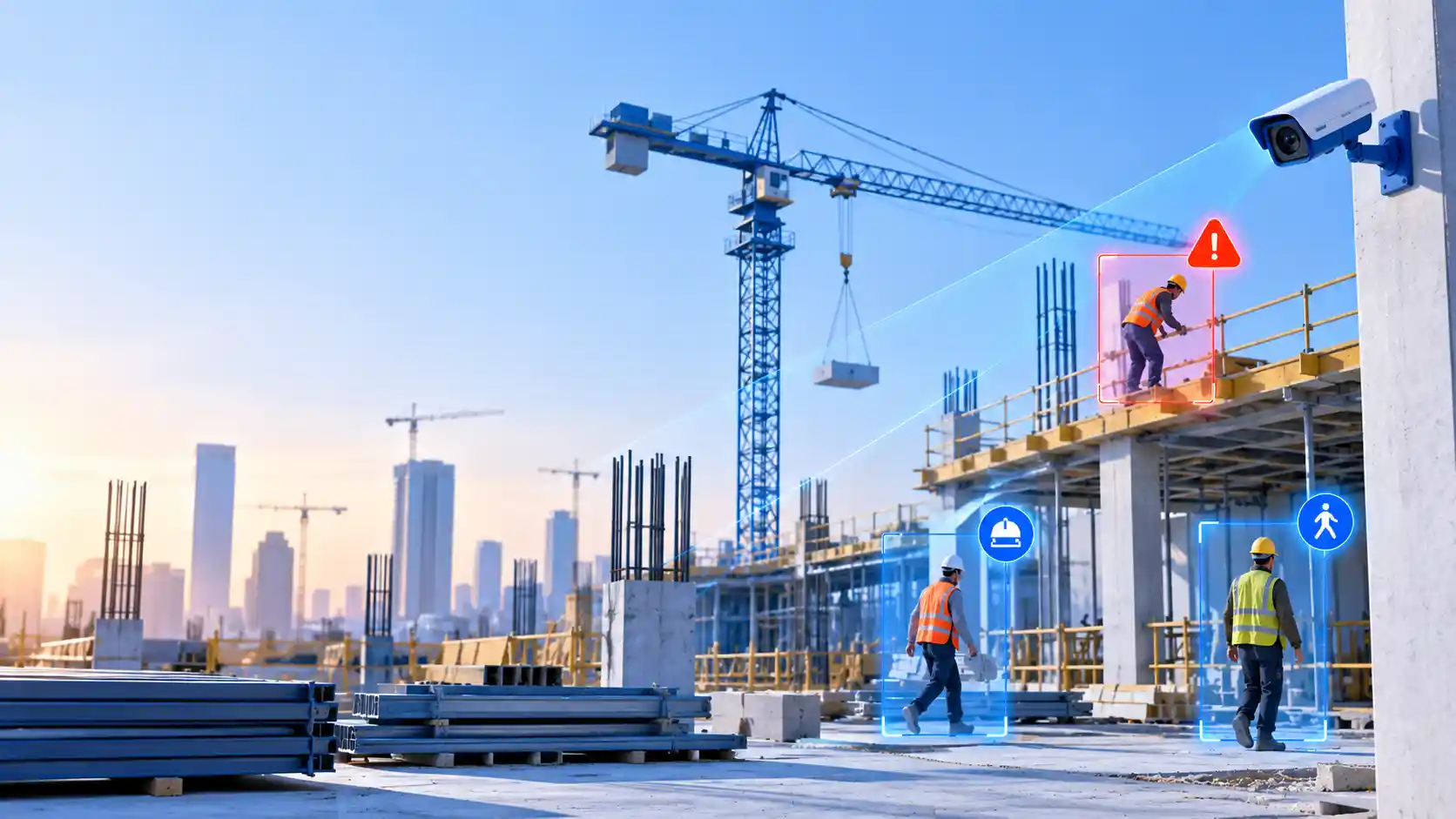
Learn how AI in construction safety monitoring detects hazards, tracks PPE compliance, identifies risks and supports faster safety decisions on site.
AI in construction safety monitoring uses computer vision, machine learning, connected sensors and other technologies to identify potential hazards, detect unsafe conditions and alert safety teams while work is underway. Applications include personal protective equipment (PPE) detection, fall-risk monitoring, worker-equipment proximity alerts, restricted-area monitoring and environmental risk detection.
The main benefit is not simply that AI can recognize a hard hat or detect a worker near machinery. It can help safety teams identify relevant events across large or complex sites, prioritize potential risks and document incidents for follow-up. Its effectiveness depends on camera placement, data quality, site conditions, alert design and how quickly people respond.
Construction companies should therefore evaluate AI as part of a broader safety management system, not as a replacement for trained safety professionals or established safety procedures.
A 2024 review published in Automation in Construction examined 153 research papers on AI applications in construction safety. It identified real-time monitoring, hazard detection and information extraction as important application areas, while highlighting challenges such as data quality and detecting objects that are partly hidden from view. Read the research review on AI integration in construction safety.
This article examines where AI can help, how real-time monitoring works, what can go wrong and how construction companies can evaluate a solution before deploying it.
What Is AI in Construction Safety Monitoring?
AI in construction safety monitoring is the use of artificial intelligence to analyze visual, sensor-based or operational data and identify conditions that may indicate a safety risk.
A system might analyze CCTV footage to detect a worker entering a restricted zone, compare visual observations against PPE requirements, or combine equipment-location data with information about worker movement. Depending on its design, it can generate an alert, create an event record or send the finding to a safety management platform.
Three technologies often work together:
Computer vision: Analyzes images and video to recognize people, equipment, objects and selected activities.
Machine learning: Identifies patterns in historical or live data to support classification, risk estimation or anomaly detection.
Internet of Things (IoT): Connects sensors, wearable devices, location tags and environmental monitors that collect information from the site.
These technologies perform different roles. Computer vision can identify a worker in a camera frame, while a proximity sensor may provide distance information. A risk model can combine relevant observations, but a human safety professional may still need to determine whether the situation requires intervention.
AI monitoring is also different from a conventional alarm. A traditional system may trigger when a sensor crosses a fixed threshold. An AI-enabled system can interpret patterns in images or multiple data streams, although its accuracy depends on the specific task and operating conditions.
How Does Real-Time AI Construction Safety Monitoring Work?
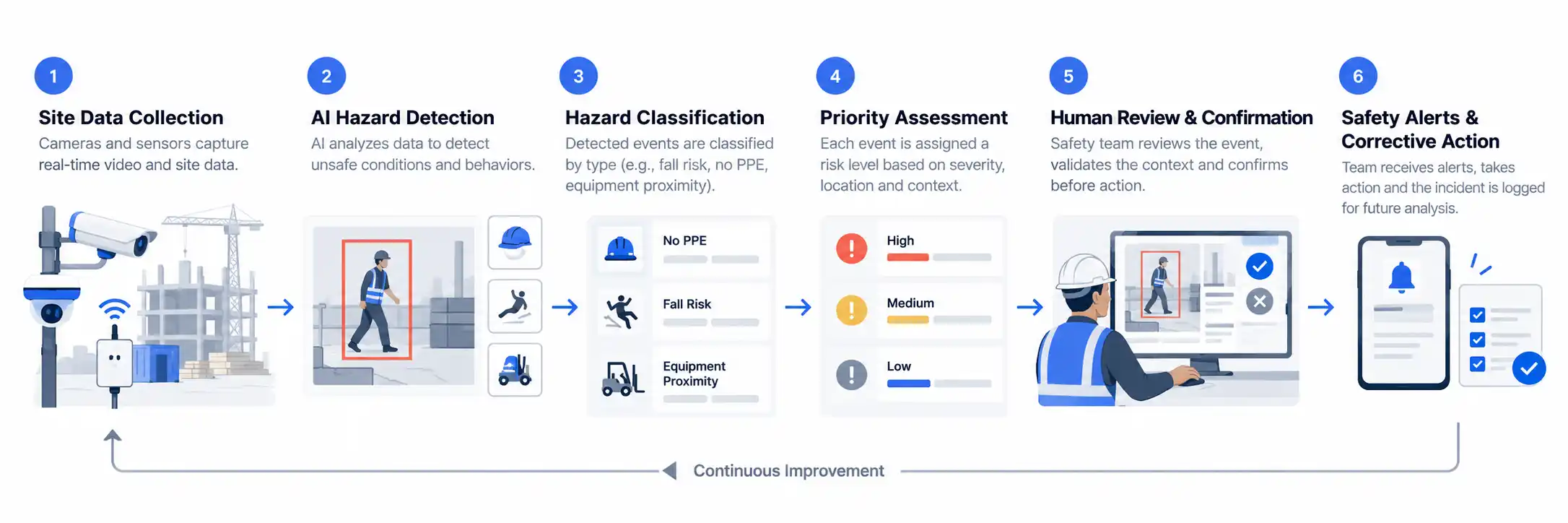
A real-time safety monitoring system typically follows six steps: collect data, analyze it, identify a potential hazard, assess its significance, notify the relevant person and record the outcome.
The exact architecture varies. Some systems process video locally on an edge device, while others send selected data to cloud infrastructure. A hybrid approach can combine local detection with centralized reporting.
Step 1: Collect data from the construction site
The system receives information from sources such as:
Fixed CCTV cameras and temporary site cameras.
Body-worn cameras, where appropriate and permitted.
Wearable devices and location tags.
Equipment proximity sensors.
Temperature, gas, noise and air-quality sensors.
Site plans, work permits and safety procedures.
The selected data sources should match the hazards the company wants to detect. A camera may help identify a missing safety helmet, but it cannot reliably measure an invisible gas concentration without suitable sensing equipment.
Step 2: Analyze the data
Computer vision models identify relevant objects or activities in video frames. Other models analyze sensor readings, event sequences or structured operational data.
For example, a vision model might detect a worker and an excavator in the same area. A second stage can estimate whether the worker has entered a defined danger zone. A system with access to reliable location or equipment data may improve this assessment.
Step 3: Identify a potential hazard
The system compares its observations against configured rules or a risk-detection model.
Examples include:
A worker appears to enter an area where entry is restricted.
A person and a moving vehicle approach one another.
A required PPE item is not detected.
An environmental sensor reports a reading above a configured threshold.
An AI finding is an indication that something needs attention, not necessarily proof that a safety violation has occurred.
Step 4: Prioritize the alert
The system can assign a priority based on factors such as hazard type, location, duration, equipment status and the rules configured by the safety team.
A potential interaction with moving heavy equipment may require a different response from a missing PPE item in a controlled area.
Risk prioritization should be validated with safety professionals. A model's confidence score is not the same as the probability that an injury will occur.
Step 5: Notify the responsible person
Depending on the system, alerts can appear in a site dashboard, mobile application, control room or integrated safety platform.
The alert should include enough context for a quick decision: what was detected, where it happened, when it occurred and what action is expected.
Step 6: Record and review the event
The system can store event timestamps, relevant images or clips, alert status, reviewer decisions and corrective actions.
This creates a record that safety managers can use to investigate recurring problems and evaluate whether preventive measures are working.
7 Practical Use Cases of AI in Construction Safety Monitoring
AI applications should be selected according to the hazards a site actually faces. The following use cases represent distinct monitoring problems, and each requires appropriate data, testing and response procedures.
1. Personal protective equipment detection
Computer vision can analyze camera footage to identify visible PPE, including hard hats, high-visibility vests and, in suitable conditions, other required equipment.
For example, a model may flag a worker entering a designated area without a visible hard hat. The system can send the relevant frame to a safety supervisor for review.
PPE detection has practical limitations. A helmet may be obscured by machinery, lighting may be poor, or a worker may be too far from the camera. A camera image also cannot establish that every item is being worn correctly or provides adequate protection.
Best suited for: Sites with clearly defined PPE requirements, suitable camera coverage and a process for reviewing alerts.
2. Fall-risk and work-at-height monitoring
AI can help identify selected conditions associated with work-at-height risks, such as a person approaching a designated edge or entering an area where fall protection is required.
Some systems use cameras to detect workers and their positions relative to defined site zones. Wearables or other sensors may provide complementary information.
However, detecting a person near an edge does not establish that the person is about to fall. Nor can a camera reliably verify every aspect of a fall-protection arrangement from a single viewpoint.
Best suited for: Work zones with identifiable boundaries, suitable visibility and clear procedures for managing access and fall protection.
3. Worker and heavy-equipment proximity monitoring
Construction vehicles, excavators, cranes and other moving equipment can create serious interaction risks for ground workers.
AI-based vision systems may detect workers and equipment in the same area and identify potentially unsafe proximity or movement patterns. Location tags and proximity sensors can provide additional information, particularly when visual conditions are poor.
The system needs to account for more than simple distance. Vehicle direction, movement, speed, blind spots and the layout of the work zone can affect the risk.
Best suited for: Sites with frequent vehicle movement, shared work zones and a need to improve awareness of worker-equipment interactions.
4. Restricted-area and hazardous-zone monitoring
Construction projects often contain areas where access depends on work permits, equipment activity or changing site conditions.
A monitoring system can compare detected movement against predefined boundaries and flag unauthorized or unexpected entry. This may be useful around excavation zones, lifting operations or areas where hazardous work is underway.
Research published in Automation in Construction in September 2025 reviewed 81 peer-reviewed studies on digital technologies for hazardous-area entry monitoring. It examined computer vision, IoT and integrated solutions, while identifying challenges associated with changing site conditions and technology deployment. Read the review of digital technologies for hazardous-area entry.
Best suited for: Projects where access restrictions change regularly and supervisors need timely visibility into entry events.
5. Environmental hazard detection
Environmental monitoring can help identify risks associated with heat, gases, dust, noise and other site conditions.
AI may analyze sensor data to detect unusual patterns, combine readings from multiple sources or help prioritize alerts. However, the underlying measurement must come from an appropriate sensor or monitoring instrument.
For example, a temperature and humidity sensor can supply readings for a heat-risk monitoring process. A gas sensor can report a measured concentration. AI can help interpret or route these readings, but a camera alone cannot establish the concentration of an invisible gas.
The US National Institute for Occupational Safety and Health (NIOSH) discusses the potential of wearable technologies for construction safety, including environmental monitoring and warnings associated with heat stress and equipment proximity. Read the NIOSH overview of wearable technologies for construction safety.
Best suited for: Sites exposed to environmental hazards where reliable sensors and established exposure-response procedures are available.
6. Unsafe activity and changing site conditions
AI systems can be trained to recognize selected activities or sequences associated with safety risks. Examples may include people entering equipment operating zones, unsafe interactions between workers and vehicles, or movement through areas where access is restricted.
Temporal analysis is important because a single frame can be misleading. A person standing near equipment may be in a safe position, while a sequence showing movement into its path may require attention.
A 2024 study on vision-based construction safety monitoring examined temporal analysis as a way to reduce false alarms caused by object misdetection and false detection. Read the research on temporal analysis for construction safety monitoring.
This does not mean temporal analysis eliminates false alerts. It demonstrates why the sequence of events can matter as much as an individual image.
Best suited for: Sites where specific, observable activities can be defined and validated against real operating conditions.
7. Incident documentation and safety trend analysis
AI can help organize safety information that would otherwise remain spread across video recordings, inspection reports, incident forms and sensor logs.
Depending on the system, it may classify incident records, extract information from reports, group similar events or identify recurring patterns.
For example, a safety manager might review whether restricted-area alerts repeatedly occur near the same equipment route or during a particular phase of work. The finding could prompt a review of traffic management, barriers, training or work sequencing.
Trend analysis is useful only when the underlying records are sufficiently accurate and comparable. A rise in recorded events could reflect better detection rather than a genuine increase in unsafe conditions.
Best suited for: Construction companies that maintain consistent safety records and want to improve preventive planning.
AI Construction Safety Monitoring Use Cases Compared
Use case | Primary data | Potential benefit | Main limitation |
|---|---|---|---|
PPE detection | Camera footage | Flags potentially missing PPE | Visibility and occlusion |
Fall-risk monitoring | Cameras, selected sensors | Identifies defined risk-zone events | Cannot predict every fall |
Worker-equipment proximity | Cameras, tags, sensors | Improves awareness of interactions | Blind spots and latency |
Restricted-area monitoring | Cameras, site-zone data | Flags unexpected entry | Boundaries and permissions must stay current |
Environmental monitoring | Environmental sensors | Helps route threshold or anomaly alerts | Depends on sensor quality |
Unsafe activity detection | Video and event sequences | Identifies selected unsafe patterns | Context and false alarms |
Incident trend analysis | Reports, logs and alerts | Supports recurring-risk analysis | Incomplete or inconsistent records |
These applications should not be treated as interchangeable. A system designed for PPE detection may not be suitable for work-at-height monitoring, and a camera-based system should not replace dedicated environmental sensors.
What Are the Benefits of AI in Construction Safety?
The value of AI monitoring comes from improving the speed, consistency and usefulness of safety information. The extent of improvement must be measured for the specific site and use case.
Faster identification of potential hazards
Automated monitoring can analyze incoming data without requiring a person to watch every camera continuously. This may help teams identify selected events sooner, particularly across large sites.
However, faster detection does not automatically mean faster intervention. Alert routing, network reliability and the availability of responsible personnel all influence response time.
Broader visibility across the site
A central dashboard can bring together alerts from multiple cameras, sensors or work areas. Safety managers may use this information to identify locations that need closer inspection.
The benefit depends on camera coverage and data integration. Areas outside the monitoring system's field of view remain outside its visual detection capability.
More consistent event records
AI monitoring can create timestamped records of detected events, reviewer decisions and corrective actions. These records may support internal investigations and safety reviews.
They should complement, not replace, required incident reporting, inspections and formal documentation.
Better allocation of safety resources
When a system distinguishes high-priority alerts from lower-priority observations, safety teams may be able to focus attention where it is most needed.
This requires reliable prioritization rules. An alert queue filled with false positives can create more work rather than reduce it.
Improved preventive planning
Aggregated event data can help identify repeated problems, such as recurring access violations or unsafe interactions in a particular work zone.
Safety professionals can use these patterns to review work methods, site layout, training or equipment movement plans. The data should inform decisions rather than determine them automatically.
AI Monitoring vs. Traditional Construction Safety Monitoring
AI monitoring and traditional safety practices serve different purposes. AI can automate parts of observation and data processing, while established procedures provide the controls, expertise and accountability needed to manage risk.
Capability | Traditional approach | AI-assisted approach |
|---|---|---|
Routine observation | Staff inspect work areas and review footage | Systems analyze selected data automatically |
PPE checks | Visual inspection by supervisors | Automated flags for human review |
Hazard alerts | Radio calls, reports or fixed alarms | Automated event alerts alongside existing alarms |
Incident records | Manual reports and footage review | Automated event timestamps and selected evidence |
Trend analysis | Periodic review of recorded incidents | Aggregation and analysis of recurring events |
Human judgment | Central to safety decisions | Still required to interpret and act on findings |
AI should not be evaluated as a simple replacement for human monitoring. The stronger approach is to combine automation with site inspections, worker participation, training, engineering controls and established safety procedures.
What Does an AI Construction Safety Monitoring System Need?
A reliable implementation requires more than a computer vision model. It needs suitable data collection, site-specific configuration, a dependable alert workflow and ongoing performance evaluation.
1. Suitable cameras and sensors
Review camera resolution, field of view, frame rate, lighting, mounting position and connectivity. Check whether cameras can capture the relevant workers, equipment and boundaries.
For environmental monitoring, select sensors designed for the hazard being measured. For worker-equipment proximity, determine whether cameras alone provide enough information or whether location tags and dedicated sensors are needed.
2. Models validated for the actual site
A model that performs well in one environment may behave differently on another construction site.
Differences in weather, clothing, equipment, lighting, camera angles and work practices can affect detection. Testing should reflect the intended site and operating conditions.
3. Rules that reflect safety procedures
The system needs accurate information about restricted zones, required PPE, operating hours, equipment routes and other relevant site rules.
These rules should be updated as the construction project changes. A monitoring system that relies on outdated site boundaries may generate misleading alerts.
4. An actionable alert workflow
Every alert category should have a defined recipient, response procedure and escalation path.
A useful alert should communicate the detected event, its location, the supporting evidence and the expected next step. Safety teams should be able to acknowledge, investigate, dismiss or escalate events with an appropriate record of their decision.
5. Integration with existing systems
Depending on the project, integration may be needed with:
Safety management software.
Incident and inspection management platforms.
Building Information Modeling (BIM) systems.
Equipment monitoring platforms.
Project management tools.
Mobile applications and notification services.
Integration should serve a clear operational purpose. Connecting every available system can increase implementation complexity without necessarily improving safety outcomes.
6. Monitoring, maintenance and human oversight
AI models and site conditions can change over time. Teams should review missed detections, false alarms, model performance, system outages and changes in operating conditions.
The NIST AI Risk Management Framework provides a voluntary framework for managing AI risks across design, development, deployment and use. Its principles are relevant when evaluating the reliability, accountability and ongoing oversight of safety monitoring systems.
How to Evaluate an AI Construction Safety Monitoring Solution
Construction companies should evaluate candidate solutions against the hazards they need to manage, not simply the number of AI features a vendor offers.
The following checklist can help structure a pilot or procurement assessment.
Evaluation area | Questions to ask | Evidence to request |
|---|---|---|
Detection performance | Can the system identify the target hazard under site conditions? | Test results from representative footage and operating conditions |
False alarms | How often does it generate unnecessary alerts? | False-positive analysis and reviewer workload |
Missed events | Which relevant hazards does it fail to detect? | Test cases covering difficult or high-risk scenarios |
Response time | How long does it take to detect, deliver and acknowledge an alert? | End-to-end latency measurements |
Coverage | Which areas, activities and conditions are monitored? | Camera coverage map and documented exclusions |
Integration | Can alerts reach existing safety workflows? | Demonstration using the intended systems |
Privacy and security | What data is collected, retained and shared? | Access controls, retention policy and security documentation |
Reliability | What happens during network or power failures? | Offline behavior, recovery and escalation procedures |
Ongoing support | How are models and rules updated? | Maintenance plan and performance review process |
Measure false alarms and missed detections separately
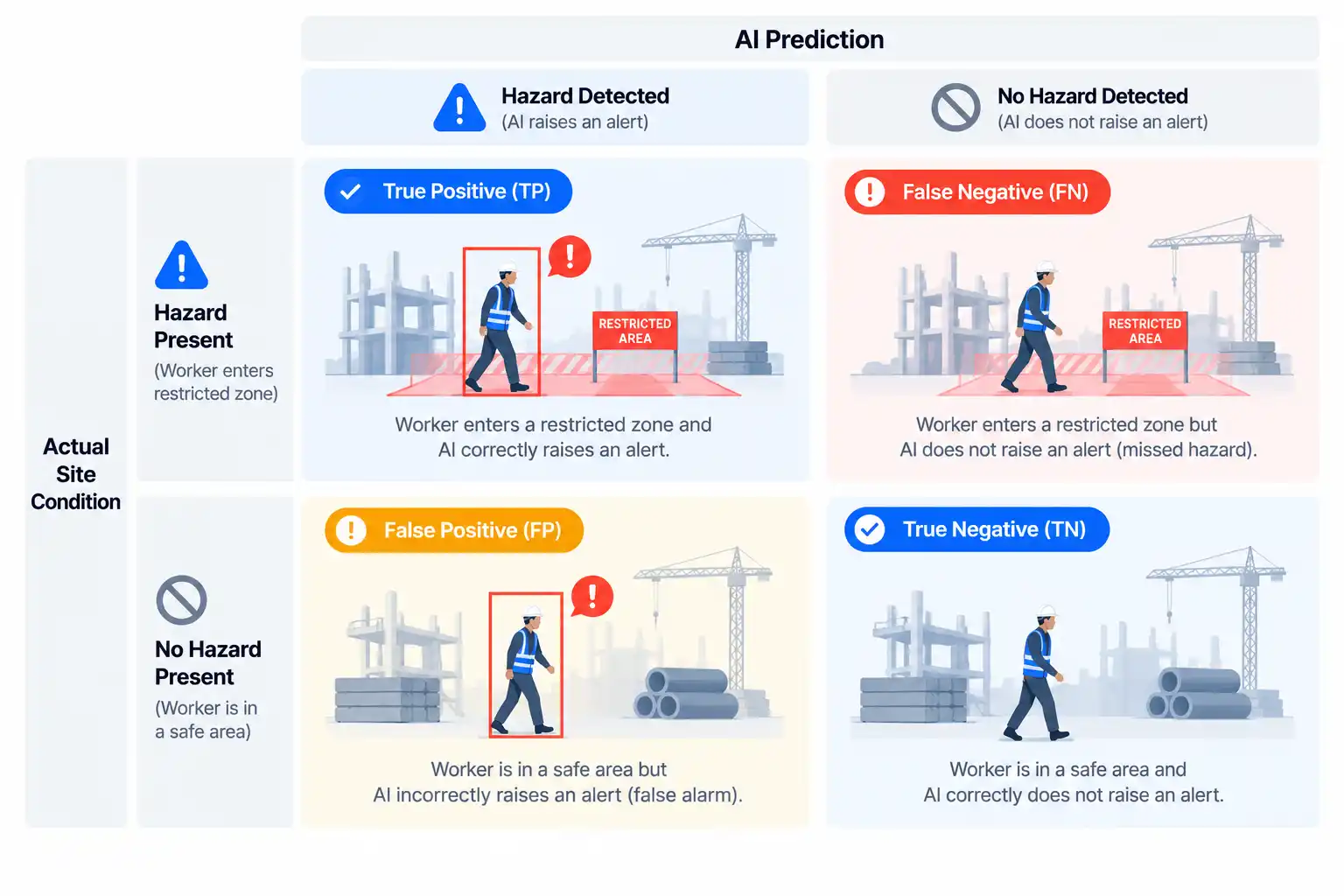
A useful pilot should track at least four outcomes:
True positives: Relevant hazards correctly identified.
False positives: Alerts generated when the target condition was not present.
False negatives: Relevant hazards that the system failed to detect.
True negatives: Cases in which the system correctly did not raise an alert.
Accuracy alone can be misleading when serious safety events are relatively uncommon. A system could classify most ordinary frames correctly while missing a small number of critical events.
For a specific hazard, precision measures the proportion of alerts that are genuine detections, while recall measures the proportion of relevant events the system identifies. Both matter, but their appropriate balance depends on the use case and the consequences of missed events.
For example, a company may tolerate a manageable number of additional alerts for a high-consequence hazard, provided the alert volume does not overwhelm the team. The acceptable threshold should be established with safety professionals and validated during the pilot.
A Practical Roadmap for Implementing AI Construction Safety Monitoring
A phased rollout allows construction companies to test the technology before depending on it for operational decisions.
Phase 1: Define the safety problem
Choose a specific problem, such as restricted-area entry, missing PPE or worker-equipment proximity.
Document how the hazard is currently detected, who responds, how incidents are recorded and where the current process falls short.
Deliverable: A clearly defined use case with measurable objectives.
Phase 2: Establish a baseline
Collect information about the existing process, including inspection frequency, alert response time, incident records and the workload involved in reviewing events.
Where possible, establish a representative baseline before introducing AI. This helps distinguish improvements caused by the system from changes in staffing, work methods or site conditions.
Deliverable: Baseline measurements and a defined evaluation plan.
Phase 3: Run a controlled pilot
Select a suitable work area and test the system against real operating conditions. Include difficult cases such as poor lighting, partial visibility, changing equipment positions and crowded work zones.
Initially, AI alerts can be reviewed by safety staff before they trigger operational decisions. This approach allows the team to assess performance without treating every prediction as a confirmed hazard.
Deliverable: Documented results covering detection quality, missed events, false alarms and response time.
Phase 4: Connect alerts to safety procedures
Define who receives each alert, how it is acknowledged and when escalation is required.
Test whether the team can respond within the required timeframe. If the system produces too many low-value alerts, improve the detection rules or workflow before expanding deployment.
Deliverable: An approved response and escalation process.
Phase 5: Expand only after validation
Extend monitoring to additional areas or hazards when the pilot demonstrates acceptable performance and operational value.
Different site types may require separate testing. A model validated on an indoor project should not automatically be assumed to work equally well on an outdoor infrastructure site.
Deliverable: A controlled rollout plan with ongoing review and maintenance.
Which metrics should construction companies track?
Metric | What it tells you |
|---|---|
Detection recall | How many relevant events the system identifies |
Alert precision | How many generated alerts represent genuine detections |
Time to alert | How quickly the system flags a relevant event |
Time to acknowledgement | How quickly a responsible person responds |
Time to corrective action | How long it takes to address a confirmed issue |
Missed-event rate | How frequently relevant events go undetected |
System availability | How consistently the monitoring service operates |
Reviewer workload | How much staff time is spent reviewing alerts |
Repeat-event frequency | Whether similar problems continue to occur |
These metrics measure different aspects of performance. Faster alerts do not prove that injury rates have fallen, and fewer recorded incidents do not necessarily indicate safer working conditions.
Companies should combine system metrics with inspections, incident investigations, worker feedback and other established safety indicators.
What Are the Limitations and Risks of AI Safety Monitoring?
AI can improve visibility, but it introduces technical, operational and governance risks that construction companies must address.
Poor visibility can reduce detection quality
Dust, rain, glare, shadows, obstructions and crowded scenes can make workers or equipment difficult to identify. Cameras may also lose coverage when the site layout changes.
Mitigation requires suitable camera placement, representative testing, maintenance and clear documentation of areas where the system cannot reliably operate.
False alarms can weaken trust
If workers and supervisors receive too many irrelevant alerts, they may begin ignoring notifications.
Teams should measure alert precision, review recurring false positives and prioritize messages according to the consequences of the underlying hazard.
Missed detections can create false confidence
A system may fail to identify an event because an object is hidden, a model does not generalize to the site or the relevant activity was not included in testing.
AI monitoring should not become the only control for a serious hazard. Engineering controls, physical barriers, inspections and established procedures remain important.
Privacy requires deliberate design
Video analytics and wearable devices can collect sensitive information about workers' movements and activities.
Companies should determine what information is necessary, who can access it, how long it is retained and whether the proposed monitoring is permitted under applicable laws and workplace agreements.
Where feasible, privacy-conscious designs can limit unnecessary identification, process video locally or retain only event-related evidence. These options must be evaluated against the actual safety requirements and legal obligations.
Cybersecurity and integration need attention
Cameras, sensors, mobile applications and connected safety platforms can create additional security dependencies.
Organizations should review authentication, access controls, encryption, software updates, network segmentation and incident-response procedures. Integration failures and outages should also have defined fallback procedures.
AI cannot make every safety decision
Some risks require context that a camera or model cannot reliably determine. A worker may appear to enter a restricted area while performing an authorized emergency task, for example.
The system needs a way for qualified personnel to review findings, correct mistakes and document decisions. AI should support the safety management process rather than replace professional responsibility.
Monitoring does not guarantee fewer injuries
AI can identify selected conditions and support faster responses, but an alert does not itself remove a hazard. Its impact depends on whether people act, whether corrective measures work and whether the system covers the relevant risk.
Construction companies should evaluate safety outcomes over time instead of assuming that installing AI will automatically reduce injuries.
How Much Does AI Construction Safety Monitoring Cost?
There is no single reliable cost for an AI construction safety monitoring system. The investment depends on whether a company adapts an existing product, integrates third-party tools or develops a custom solution.
A cost assessment should consider the full deployment, not only software development or model licensing.
Cost component | What affects the cost |
|---|---|
Cameras and sensors | Equipment quantity, specifications and installation |
AI software | Licensing, supported use cases and deployment model |
Custom development | Detection logic, dashboards and business-specific workflows |
Integration | Existing CCTV, safety software, sensors and project systems |
Infrastructure | Edge computing, cloud resources, connectivity and storage |
Testing | Site validation, performance measurement and acceptance testing |
Operations | Maintenance, model evaluation, support and ongoing improvements |
Training | Staff onboarding, procedures and alert-response training |
A project using existing cameras and a commercial monitoring platform may have a different cost structure from one requiring new sensors, specialized models and multiple system integrations.
Before requesting proposals, define the hazard, the number of monitored locations, the required response time, the data-retention policy and the expected integrations. These details make vendor estimates more meaningful.
For custom development, ask suppliers to separate the pilot cost from the cost of production deployment and ongoing support. This helps reveal whether a low initial price excludes important operational requirements.
Should You Buy an Existing AI Safety Product or Build a Custom Solution?
The choice depends on how closely existing products match the site's requirements.
Decision factor | Existing product | Custom solution |
|---|---|---|
Time to pilot | Often shorter if the site is supported | Requires design, development and validation |
Standard use cases | Suitable when supported features match requirements | May be unnecessary for common requirements |
Specialized workflows | Limited by product configuration and integration options | Can be designed around specific processes |
Existing systems | Depends on available integrations | Can target required integrations |
Maintenance | Vendor manages some or all product updates | Organization and development partner must define responsibilities |
Control over functionality | Limited by vendor capabilities and roadmap | Greater control over design and evolution |
Choose an existing product when it meets the required safety use case, performs acceptably on the site and integrates with current workflows.
Consider custom development when the organization has specific detection requirements, unusual site workflows, proprietary data needs or integration requirements that available products cannot adequately support.
A hybrid approach may also work. A company can use a commercial computer vision model while developing custom dashboards, integration services, alert-routing rules or reporting features.
Regardless of the approach, validate performance before using the system for safety-critical decisions.
Frequently Asked Questions
1. What is AI in construction safety monitoring?
AI in construction safety monitoring uses artificial intelligence to analyze camera footage, sensor readings and other site data to identify potential hazards. Applications include PPE detection, restricted-area monitoring, worker-equipment proximity alerts and environmental risk analysis. The system can notify safety teams and record events, but human review and established safety procedures remain necessary.
2. Can AI detect construction hazards in real time?
Yes, AI systems can detect selected hazards from live video or sensor data when the required data sources, processing infrastructure and detection models are suitable. Actual performance depends on visibility, sensor quality, network conditions and the hazard being monitored. Detection latency and missed events should be measured during a site-specific pilot.
3. Can AI replace construction safety officers?
No. AI can automate parts of monitoring and documentation, but it cannot reliably replace the full responsibilities of a construction safety officer. Safety professionals interpret site conditions, investigate incidents, manage corrective action, communicate with workers and oversee compliance. AI should provide additional information to support those responsibilities.
4. How does computer vision improve construction site safety?
Computer vision analyzes images or video to identify selected objects, people, activities and site conditions. It can flag potentially missing PPE, unexpected entry into restricted areas or certain worker-equipment interactions. Its usefulness depends on camera coverage, model performance and the quality of the response process.
5. What is the difference between AI monitoring and IoT-based safety monitoring?
AI monitoring uses models to interpret information or identify patterns, while IoT-based monitoring connects devices and sensors that collect and transmit data. The technologies can work together. For example, a proximity sensor may report a measured distance, while an AI system analyzes video to identify a worker's position relative to equipment.
6. Is AI construction safety monitoring accurate enough for safety-critical work?
That depends on the specific application and the evidence available for the system. A vendor's general accuracy figure is not sufficient to establish suitability for a particular site. Companies should test representative conditions, measure false positives and missed detections, evaluate response time and retain appropriate human oversight.
7. What data is required for AI construction safety monitoring?
Requirements depend on the use case. PPE and restricted-area detection generally require suitable camera footage and accurate site rules. Worker-equipment proximity monitoring may benefit from cameras, location tags or dedicated sensors. Environmental monitoring requires instruments capable of measuring the relevant conditions. The data should be sufficient to evaluate the target hazard without collecting unnecessary information.
8. How should a construction company start implementing AI safety monitoring?
Start with one clearly defined hazard, establish a baseline and select a suitable work area for a controlled pilot. Test the system against real site conditions, measure false alarms and missed events, and define how alerts reach responsible personnel. Expand only after the pilot demonstrates acceptable performance and operational value.
Conclusion: Focus on Hazard Reduction, Not Just AI Detection
AI in construction safety monitoring can help companies identify selected hazards, organize safety information and direct attention toward conditions that need review. Its value depends on the quality of its detections and the actions that follow.
The most practical starting point is a specific safety problem with measurable outcomes. A construction company might begin with restricted-area monitoring, PPE detection or worker-equipment proximity alerts, depending on its site conditions and existing controls.
From there, it should test the technology, measure false alarms and missed events, establish human-reviewed response procedures and expand only when the evidence supports doing so.
AI is most useful when it strengthens an existing safety management system. It should help people recognize and respond to risk, while trained professionals remain responsible for interpreting findings and managing safety on site.
Comments (0)
No comments yet. Be the first to share your thoughts!