Can AI Make Legacy Software Valuable Again?

Author
Ravi Prajapati
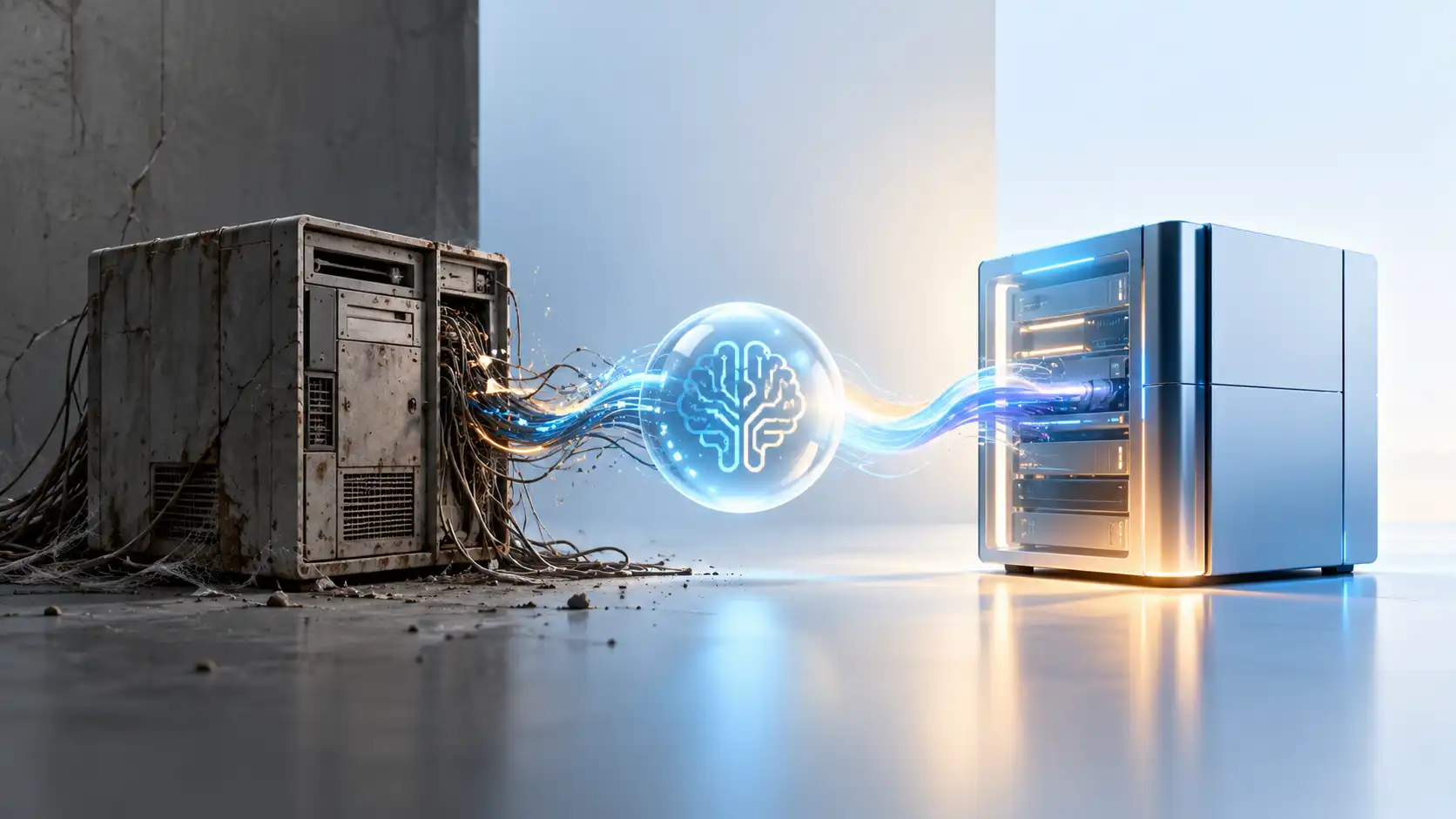
Can AI make legacy software valuable again? Explore AI-assisted modernization, practical use cases, risks, costs and when to replace old systems.
AI can make legacy software more useful, easier to maintain and less expensive to change, but it cannot automatically make every old system worth keeping. Its strongest value lies in helping organizations understand undocumented business logic, reduce the effort involved in code maintenance, connect existing applications to modern services, and modernize systems in smaller, testable stages.
For CIOs, CTOs and engineering leaders, the real question is not whether AI can rewrite old code. It is whether AI can help extract more business value from software that already contains years of operational knowledge.
That distinction matters. A legacy application may run on an outdated technology stack while still supporting critical pricing rules, customer records, financial calculations or supply-chain processes. Replacing it outright could introduce risk and require years of business logic to be reconstructed. Keeping it unchanged can also be costly, especially when changes depend on a shrinking pool of specialists.
AI for legacy systems offers a third option: understand what the software does, improve the parts that limit the business, and decide which components to retain, modernize, replace or retire.
The opportunity is real, but the outcome depends on code quality, available documentation, test coverage, system dependencies, security requirements and the business case for change. AI can reduce some of the work involved. It does not remove the need for engineering judgement.
What counts as legacy software, and why does it lose value?
Legacy software is an application, platform or system that remains in use despite limitations in its technology, architecture, support model or ability to meet changing business needs. Age alone does not make software legacy. A decades-old system can remain valuable if it is secure, reliable, maintainable and fit for purpose.
The problem usually emerges when the system becomes increasingly difficult to change.
A business may depend on an old Java application, a COBOL mainframe, a custom-built ERP, an outdated .NET platform or a database surrounded by undocumented integrations. The application may perform its original job well, but adding a new feature can require extensive regression testing, specialist knowledge and changes across tightly coupled components.
Several factors contribute to this decline.
Undocumented business logic: Critical rules exist in code rather than accessible documentation.
Technology constraints: Old runtimes, libraries or infrastructure limit compatibility, security updates and integration options.
Knowledge concentration: A small number of employees understand how the system behaves.
High change costs: Teams spend substantial time investigating side effects before modifying a feature.
Limited integration: New digital services cannot easily access the data and functions held by the legacy application.
Weak testing: The organization cannot confidently establish whether a change preserves existing behaviour.
These problems can reinforce each other. Poor documentation makes changes riskier. Riskier changes encourage teams to avoid refactoring. Avoiding refactoring increases complexity, making future changes even harder.
AI becomes relevant because many modernization tasks involve analysing existing information, identifying relationships, generating explanations, transforming code and producing tests. These are areas where AI-assisted tools can reduce manual effort, although the results still require validation.
How AI can create new value from legacy systems
AI can improve legacy software in several distinct ways. These should not be treated as interchangeable because each produces a different business outcome and requires different levels of risk.
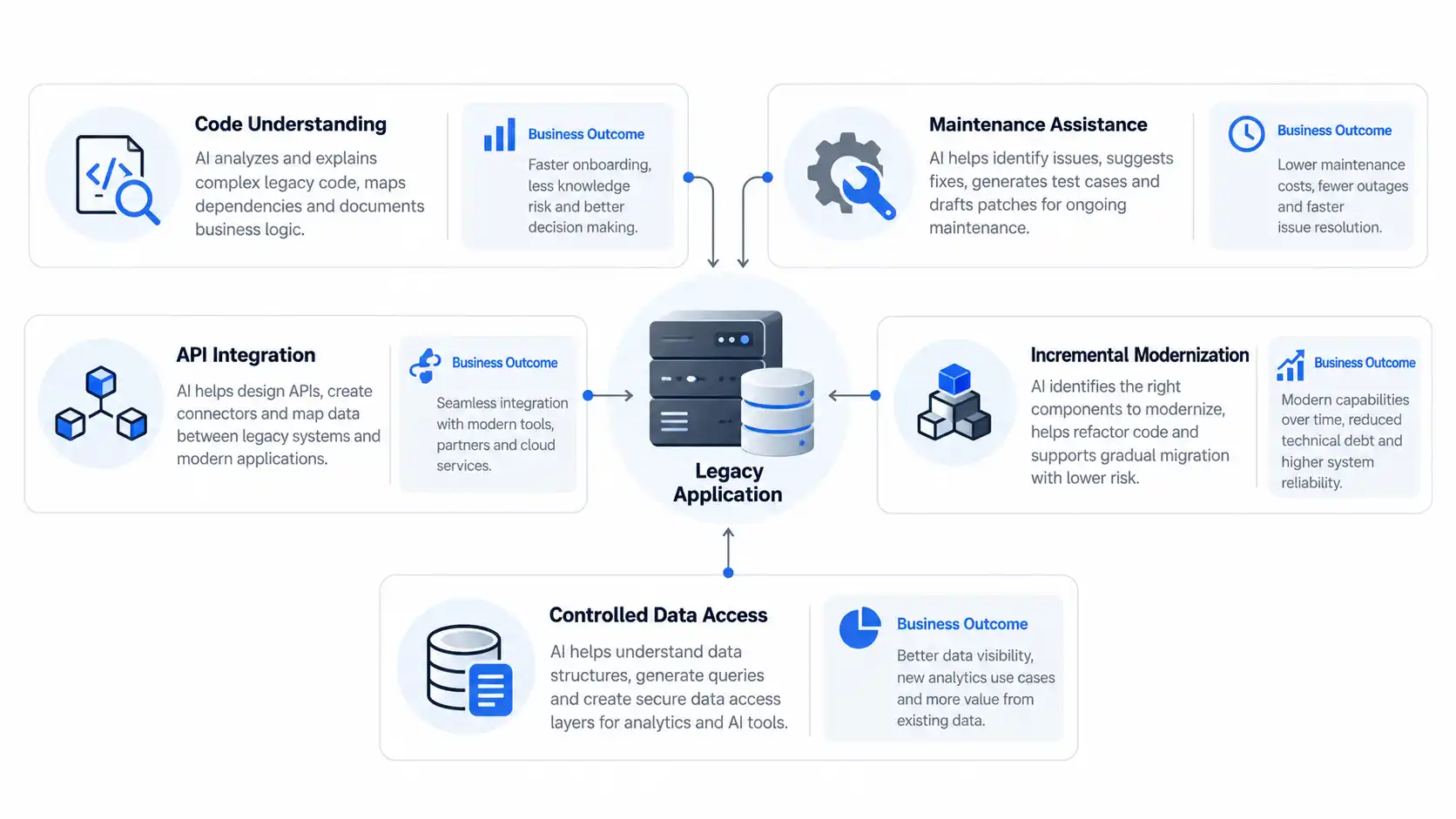
1. Recover business knowledge trapped in old code
A legacy application often contains years of business decisions that were never fully documented. Its code may determine how discounts are calculated, how a loan is assessed, how inventory is allocated or how exceptions are handled.
AI-assisted code analysis can help engineers identify functions, explain unfamiliar logic, map dependencies and draft technical documentation. Teams can use these outputs as a starting point for validating how the system actually behaves.
This is particularly relevant to mainframe modernization. Google's application modernization capabilities describe workflows for analysing legacy code, extracting business rules and preparing applications for transformation. AWS documents similar capabilities for analysing mainframe applications and generating documentation.
The important distinction is that a generated explanation is not proof of correct behaviour. A code path may depend on configuration, database state, external services or operational conventions that are not visible in a source file.
A reliable process combines AI-generated documentation with source-code inspection, interviews with domain experts, production traces where appropriate, and tests that confirm the system's actual behaviour.
Business value: Reduced investigation effort, improved knowledge transfer and a clearer basis for modernization decisions.
2. Reduce the effort involved in maintaining old code
AI coding assistants can help developers understand unfamiliar functions, propose refactoring changes, explain compiler errors, generate tests and assist with routine upgrades.
For example, an engineering team maintaining an older Java application might use AI to explain a complex method, suggest a safer decomposition and draft unit tests around its existing behaviour. Developers can then review the changes and run the application's test suite.
Specialized modernization tools go further than general-purpose coding assistants. AWS Transform documents workflows for code analysis, dependency mapping, refactoring and transformations such as framework or runtime upgrades. Its capabilities vary by workload and transformation type, so teams should verify the supported path for their own environment.
This does not mean that AI can safely refactor an entire system in one pass. Large codebases contain hidden dependencies, unusual edge cases and assumptions that may be poorly represented in the code itself.
Business value: Developers can spend less time on repetitive analysis and more time on decisions that require domain knowledge, architecture and validation.
3. Connect legacy applications to modern services
A business may not need to replace a legacy application to make its capabilities available to new products.
An existing inventory system, for example, could continue managing stock while an integration layer exposes selected functions through APIs. A new customer portal could use those interfaces without requiring the entire inventory application to be rewritten.
AI may help developers understand existing interfaces, draft API documentation, generate integration code and identify dependencies. It may also help teams create retrieval or natural-language interfaces that use approved information from existing systems.
However, putting an AI chatbot in front of a legacy system is not the same as modernising the system itself. The underlying application still needs suitable access controls, reliable data, defined business rules and interfaces that support the intended operations.
For applications that perform financial transactions or update critical records, the AI component should not bypass established authorization and validation mechanisms.
Business value: Existing business capabilities can become accessible to new channels without requiring an immediate full-system replacement.
4. Make incremental modernization more practical
Traditional modernization projects can become risky when organizations attempt to replace an entire application before delivering any new business value.
An alternative is to replace selected functions gradually while the existing system continues operating. This approach is commonly known as the Strangler Fig pattern.
Microsoft's Strangler Fig architecture guidance explains how teams can route selected functions to new services while leaving the remaining functionality in the legacy application.
AI can support this approach by helping teams analyse dependencies, identify candidate components, document business rules and draft transformation code. The architecture and migration sequence still need to be designed and tested by the engineering team.
For instance, a company might move reporting into a new service first, followed by customer notifications and then selected transaction workflows. The appropriate sequence depends on dependencies, risk and business priorities.
Business value: Teams can deliver improvements in stages, validate results earlier and avoid making the entire business dependent on a single high-risk cutover.
5. Improve access to legacy data
Legacy databases often contain valuable operational history, but the information may be difficult to access or interpret.
AI can help map database schemas, explain field relationships, draft SQL queries and build retrieval systems over approved documentation or data. In some cases, this can support natural-language search or help employees find information without learning every detail of the underlying system.
The implementation matters. A language model should not receive unrestricted access to a production database simply because it can generate SQL.
A safer design uses controlled data access, read-only permissions where appropriate, query validation, row-level authorization, audit logs and explicit approval for sensitive operations.
Business value: Better access to existing information, provided the organization preserves data quality, privacy and access controls.
AI-assisted modernization versus traditional modernization
AI does not replace the established modernization choices available to engineering leaders. It changes the amount and type of work required to evaluate and execute them.
Approach | What changes | Where AI helps | Main limitation |
|---|---|---|---|
Maintain as-is | Little or no architectural change | Documentation, troubleshooting and routine code assistance | Underlying constraints remain |
Refactor in place | Internal code structure improves | Code explanation, refactoring proposals and test generation | Behaviour must be preserved and verified |
Replatform | Application moves to a different runtime or infrastructure | Dependency analysis, configuration and migration assistance | Infrastructure changes may expose hidden assumptions |
Re-architect | Components or service boundaries change | Business-rule extraction, dependency mapping and code transformation | Architecture and data consistency remain difficult |
Replace | A new application takes over | Requirements analysis, legacy behaviour discovery and test creation | Reproducing all necessary business behaviour remains challenging |
Augment with AI | Existing capabilities gain selected AI features | Retrieval, classification, summarisation and natural-language interfaces | Data quality, access control and model errors must be managed |
No single approach is universally best. The decision depends on whether the existing system still meets business needs, how expensive it is to operate, how much risk the organization can tolerate and what outcomes modernization must deliver.
A system that processes reliable transactions but has a dated user interface may need targeted integration work rather than replacement. A system that cannot meet essential security requirements or support necessary business changes may need a deeper transformation.
What evidence tells us about AI and software modernization?
The strongest case for AI-assisted modernization comes from demonstrated capabilities and specific engineering workflows, not broad claims that AI automatically makes software better.
Three sources help establish a more balanced view.
Google Cloud's modernization tooling describes AI-assisted analysis, business-rule extraction and code transformation for legacy workloads, including Java and mainframe environments. These are vendor-documented capabilities, not independent proof that every modernization project will achieve a particular return on investment. See Google Cloud's application modernization overview.
AWS Transform documents workflows for analysing mainframe code, generating documentation, extracting business logic and refactoring applications. Its documentation also describes human input and approval during modernization. This supports the view that AI can participate in complex transformation workflows, while still requiring technical oversight. See the AWS Transform mainframe user guide.
DORA's 2025 State of AI-assisted Software Development report draws on survey responses from nearly 5,000 technology professionals and more than 100 hours of qualitative research. Its central finding is that AI amplifies existing organisational strengths and weaknesses. This is an important qualification: adding AI to a team with weak testing, poor documentation or ineffective delivery practices will not automatically resolve those problems. Read the DORA 2025 research summary.
Taken together, these sources support a measured conclusion: AI can assist with specific modernization tasks, but its overall value depends on the engineering process and the business outcome being pursued.
There is no universal percentage by which AI reduces modernization costs or timelines. Results from one vendor's workload or customer project should not be treated as a reliable forecast for another organization without comparable evidence.
When is AI for legacy systems worth the investment?
The decision should begin with the business problem rather than the availability of an AI tool.
A practical assessment considers five dimensions.
Assessment area | Questions to ask | Positive signal |
|---|---|---|
Business value | Does the application support a critical business process or valuable data? | The system remains important to current or future operations |
Change difficulty | Are routine changes slow, risky or dependent on a few specialists? | AI-assisted analysis or testing could address a measurable bottleneck |
Technical feasibility | Are source code, dependencies, configuration and test environments available? | The team can inspect and validate changes |
Risk exposure | Are security, reliability, compliance or data-integrity issues manageable? | Controls can be maintained throughout the project |
Economic case | Will the proposed improvement justify implementation and ongoing costs? | Expected benefits exceed the full cost of delivery and operation |
This assessment should distinguish between two questions.
Can AI help perform the required technical work?
Is the resulting change worth making?
A tool may be capable of translating code while the business case for translation remains weak. Conversely, a small AI-assisted documentation project may deliver meaningful value even if the application stays on its existing technology stack.
A practical decision matrix
System condition | Recommended direction |
|---|---|
High business value, manageable technical debt | Retain and improve selectively |
High business value, limited documentation | Start with discovery, documentation and test generation |
High business value, costly changes | Pilot AI-assisted refactoring and incremental modernization |
Useful capabilities, poor integration | Evaluate APIs, adapters and controlled data access |
High operating cost, poor strategic fit | Compare modernization with replacement or retirement |
Unacceptable security or reliability risks | Address the risks first; AI alone is not a remediation strategy |
This matrix is a decision aid, not a substitute for architecture, security and financial assessments. A single serious constraint, such as unsupported infrastructure or an inability to protect sensitive data, may outweigh an otherwise promising AI use case.
How to introduce AI into a legacy environment safely
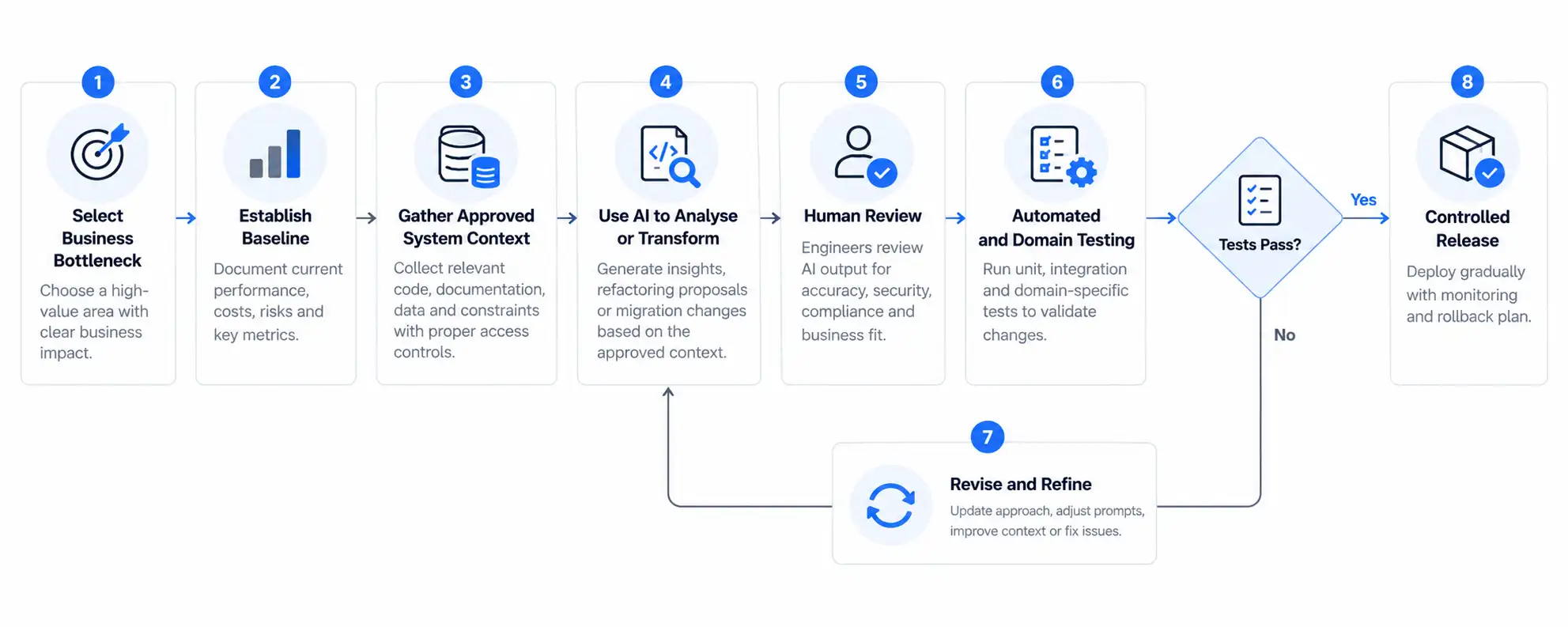
A useful first project should be narrow enough to evaluate but meaningful enough to produce evidence.
Step 1: Select a specific bottleneck
Avoid beginning with a goal such as “modernise the whole application using AI.”
Instead, choose a problem such as:
Understanding a poorly documented module.
Identifying dependencies before a framework upgrade.
Generating tests around a frequently changed business function.
Documenting an existing API.
Migrating a contained component to a supported runtime.
Define a baseline before introducing AI. Record how long the task currently takes, how much manual rework it requires, which defects occur and what approval steps are necessary.
Step 2: Establish a reliable baseline
Before modifying production code, collect the information needed to understand the system.
This may include source repositories, build instructions, runtime versions, configuration, dependency lists, database schemas, available tests, production logs and operational documentation.
The goal is not to upload everything into an AI model. The goal is to determine which information is needed, whether the team is permitted to share it with the chosen tool, and how the information can be validated.
Step 3: Choose the right AI capability
A general-purpose coding assistant may be enough to explain functions or draft tests. A specialised modernization platform may be more appropriate for dependency mapping, repeatable code transformations or large mainframe workloads.
Evaluate the tool against the actual task, supported languages and frameworks, integration with the development environment, data-handling terms, auditability and total cost.
Do not assume that a tool supports a language, runtime or transformation simply because it supports AI-assisted coding in general.
Step 4: Validate behaviour before accepting changes
AI-generated documentation, code and tests are outputs to review, not authoritative representations of the system.
A robust validation process can include:
Code review by an engineer familiar with the domain.
Unit and integration tests.
Regression tests against established behaviour.
Security and dependency scanning.
Performance and reliability testing.
Comparison of outputs between the old and modified implementations.
Rollback procedures for deployment.
For business-critical systems, teams may also need domain experts to verify financial calculations, exception handling, transaction ordering and regulatory requirements.
Step 5: Measure the result
Measure whether the intervention improved the original problem rather than counting generated lines of code or AI interactions.
Useful measures include:
Time required to complete the target task.
Engineering hours spent on investigation and rework.
Defect rate after changes.
Test coverage of the affected behaviour.
Time required to deliver a change.
Production incidents and rollback frequency.
Ongoing operating and support costs.
These measurements should be interpreted together. A faster code transformation that introduces more defects may create a net loss. A documentation project may produce value by reducing dependency on individual specialists, even if its immediate financial return is difficult to quantify.
What AI cannot fix in legacy software
AI-assisted modernization has important limits. Ignoring them can turn a promising improvement into a more expensive problem.
Missing business context
A model may explain what a function appears to do without knowing why the business requires it. An unusual rule may reflect a regulatory obligation, a customer contract or a historical exception that must remain in place.
The solution is to validate technical findings with people who understand the business process and its consequences.
Poor testing and unclear expected behaviour
If an application has limited test coverage, teams may struggle to prove that a refactored version behaves like the original.
AI can draft tests, but generated tests can reproduce incorrect assumptions or fail to cover important edge cases. Teams should validate test expectations against documented requirements, real business examples and known production behaviour.
Hidden dependencies and poor architecture
A code assistant cannot independently remove all coupling between components. A seemingly small change may affect scheduled jobs, reporting, downstream integrations, database transactions or external partners.
Dependency mapping and incremental delivery help reduce these risks, but the underlying architecture still requires deliberate design.
Security and data exposure
Legacy applications may contain sensitive personal information, credentials, proprietary code or regulated data. Sending that material to an AI service without appropriate approval can introduce new risks.
Organisations should review vendor data-handling terms, retention settings, access controls, approved deployment options and logging requirements. The NIST Generative AI Profile provides a risk-management resource for identifying and managing risks associated with generative AI.
A weak economic case
AI-assisted work still has costs: licensing, infrastructure, integration, engineering review, testing, governance and ongoing maintenance.
If a system has little remaining business value, is rarely used or can be retired safely, spending money to make it more maintainable may not be the best choice.
The right objective is not to preserve every legacy application. It is to preserve valuable capabilities while reducing unnecessary cost and risk.
Can AI make legacy software valuable again? Three scenarios
The following examples are hypothetical illustrations, not documented customer case studies.
Scenario 1: A manufacturer with an old inventory system
A manufacturer depends on a stable inventory application that is difficult to integrate with its new e-commerce platform.
Rather than replacing the inventory engine, the team uses AI assistance to document its interfaces and identify the rules governing stock updates. Engineers then create a controlled integration layer and validate its behaviour before connecting the new platform.
The potential value comes from enabling new digital sales channels while retaining proven inventory logic. It depends on whether the existing application can support reliable integration and whether its data model remains suitable.
Scenario 2: A financial services company with an undocumented application
A financial services company relies on a legacy application containing complex eligibility rules. Only a few employees understand the code.
The team uses AI to generate preliminary documentation, map dependencies and propose test cases. Domain experts verify the rules, and engineers establish regression tests before making any structural changes.
The first measurable outcome may be better documentation and reduced investigation time. A later modernization project can then use this improved understanding to make a more informed decision about which components to retain or replace.
Scenario 3: A business running an outdated internal portal
A company operates an internal portal built on an old framework. The underlying data and business functions remain useful, but the user experience limits adoption.
The team evaluates whether it can expose selected functions through secure APIs and build a new interface around them. AI assists with understanding the existing code and drafting integration components, while engineers retain responsibility for authorization, data integrity and testing.
The application becomes more useful without requiring a complete rewrite. If the underlying framework presents serious security or operational constraints, however, a broader modernization may still be necessary.
These scenarios illustrate the same principle: the most valuable use of AI may be to preserve what works while making targeted improvements where the business experiences the greatest friction.
Frequently asked questions
Can AI modernise legacy software without rewriting it?
Yes. AI can assist with code analysis, documentation, refactoring, test generation, API integration and selected feature development without requiring a full rewrite. The appropriate approach depends on the architecture and business requirements. If the existing platform has fundamental security, reliability or compatibility problems, targeted improvements may not be sufficient.
Can AI understand old programming languages such as COBOL?
AI-assisted tools can analyse and explain supported legacy code, including COBOL in specialised modernization workflows. The quality of the output depends on available source files, dependencies, configuration and business context. Teams must verify generated explanations against the actual system, especially when the application supports financial or other critical operations.
Is AI-assisted modernization cheaper than replacing a legacy application?
It can be less expensive for specific tasks or when incremental modernization avoids unnecessary replacement work, but there is no universal cost advantage. The comparison must include tooling, engineering effort, testing, integration, migration, operational costs and the remaining useful life of the application. A replacement may be more economical when the existing system no longer fits the business's needs.
Can AI reduce technical debt in legacy applications?
AI can help identify dependencies, explain code, propose refactoring, support framework upgrades and generate tests. These activities may reduce the effort required to maintain a system. However, technical debt also reflects architectural decisions, outdated processes, weak ownership and inadequate testing. AI-generated code can introduce additional debt if teams accept changes without review.
Should a company add AI features to legacy software or modernize it first?
It depends on the use case. A low-risk, read-only assistant over approved documentation may be feasible before a major modernization. An AI feature that writes financial records or makes decisions through unstable interfaces may require deeper integration, security and architecture work first. Assess the proposed capability, data access and operational risks before choosing the sequence.
How should organizations measure the ROI of AI for legacy systems?
Measure results against a baseline established before the project. Relevant metrics include investigation time, engineering effort, defect rates, change lead time, support costs, reliability and the cost of operating the modernized system. Include implementation, licensing, review, testing and governance costs. Productivity gains alone do not prove that the business case has succeeded.
When should a business retire a legacy application instead of modernizing it?
Retirement is worth considering when the application no longer supports an important business capability, its data and functions can be migrated safely, and replacement or decommissioning costs are lower than its future operating and risk costs. A system should not be modernized merely because AI tools make the work technically possible.
Is it safe to let AI modify production legacy code?
AI-generated changes should not bypass established engineering controls. Use version control, code review, automated testing, security checks, controlled deployments and rollback procedures. High-impact changes also require domain validation. The degree of oversight should reflect the consequences of an incorrect change, not just the apparent simplicity of the code.
The real opportunity is to recover business value, not preserve old code
AI can make legacy software valuable again when it helps an organization understand, maintain, integrate or modernize capabilities that still matter to the business.
The strongest starting points are often specific problems: undocumented business logic, expensive code investigation, difficult framework upgrades, missing tests or integration bottlenecks. These are concrete enough to measure and narrow enough to validate before a wider rollout.
But AI does not turn every legacy application into a strategic asset. Some systems should be modernize incrementally, some should be replaced, and others should be retired.
For technology leaders, the practical next step is to identify one important legacy application, determine where change is most difficult, and test whether AI can improve that work without compromising reliability or security. Use the evidence from that pilot to decide what to modernize next.
The value lies not in keeping old software alive indefinitely, but in making better decisions about the business capabilities it contains.
Comments (0)
No comments yet. Be the first to share your thoughts!