AI Governance Explained: Trust, Compliance, and Growth

Author
Ravi Prajapati

Regulation and innovation aren't mutually exclusive. Strong AI governance helps organizations and countries operationalize AI in ways that build trust and drive lasting success.
Quick Overview:
Who should read this guide: Business leaders, CTOs, CIOs, AI engineers, compliance officers, risk managers, startup founders, technology consultants, and government teams who are building, buying, or overseeing AI systems.
What you will learn: What AI governance actually means, why it matters right now, the core pillars and frameworks behind it, how leading companies practice responsible AI, industry-specific considerations, global regulations, and a practical step-by-step path to build your own AI governance program.
Why AI governance matters today: AI adoption has moved from experimentation to the core of business strategy. Organizational AI adoption reached 88% in 2025, according to the Stanford AI Index Report 2026. At the same time, documented AI incidents jumped to 362 in 2025, up from 233 the year before (Stanford AI Index Report 2026). Growth without guardrails is starting to show cracks. AI governance is how enterprises keep the growth and close the cracks.
Key Takeaways
AI governance is the structure of policies, controls, and oversight that keeps AI systems safe, fair, and accountable across their lifecycle.
Trust is now a measurable financial asset. PwC found that companies with the fewest stakeholder trust concerns delivered shareholder returns nine points higher than those with the most concerns (PwC, 2026).
Regulation is arriving fast. The EU AI Act imposes fines up to €35 million or 7% of global turnover for the most serious violations.
Governance gaps are common. IBM research shows 87% of organizations claim to have an AI governance framework, but fewer than 25% have fully implemented the controls behind it.
Companies with a formal AI governance board are 1.5 times more likely to be "AI leaders" who capture outsized value from AI (PwC, 2026).
Poor governance carries real financial risk. Gartner projects that "death by AI" legal claims tied to weak AI risk guardrails will exceed 2,000 by the end of 2026.
ISO/IEC 42001, the world's first certifiable AI management system standard, is becoming a practical shortcut for proving governance maturity.
Responsible AI is not a brake on innovation. PwC found AI leaders are 2.6 times more likely to say AI improves their ability to reinvent their business model.
Board-level AI literacy is still a weak spot. Deloitte-linked research shows 66% of boards have limited to no knowledge of AI, though this has improved from 79% a year earlier.
Governance works best when it is built into the AI lifecycle from day one, not bolted on after deployment.
AI has moved faster than almost any technology before it. Generative AI reached 53% of the global population within three years, a faster climb than the personal computer or the internet managed (Stanford AI Index Report 2026). Companies are no longer asking whether to use AI. They are asking how fast they can scale it.
That speed comes with a catch. Regulators are moving too. The EU AI Act is already in force, with high-risk obligations phasing in through 2026 and beyond. The NIST AI Risk Management Framework is shaping U.S. procurement standards. ISO/IEC 42001 has given the world its first certifiable AI management system. Meanwhile, boards, customers, and employees are asking harder questions about how AI decisions get made and who is accountable when something goes wrong.
This is where AI governance enters the picture. It is the set of policies, processes, and oversight structures that keep AI systems safe, fair, transparent, and compliant across their entire lifecycle, from planning to retirement.
Without governance, AI adoption carries real business risk: biased outcomes, hallucinated answers presented as fact, privacy violations, security gaps, and regulatory penalties. With governance, that same AI adoption becomes a source of competitive advantage. PwC's research shows organizations with the fewest AI-related trust concerns deliver measurably higher shareholder returns than those with the most concerns.
Trust, in other words, is not a soft topic anymore. It is a business metric. And AI governance is how you earn it.
This guide walks through what AI governance means in practice, why it matters for every function from engineering to the boardroom, the frameworks shaping the field, and a practical roadmap for building governance that supports both compliance and innovation.
Latest AI Governance Statistics
88% of organizations had adopted AI in at least one business function by 2025. Source: Stanford AI Index Report 2026, Stanford HAI (2026). https://hai.stanford.edu/ai-index/2026-ai-index-report
362 documented AI incidents were recorded in 2025, up from 233 in 2024. Source: Stanford AI Index Report 2026, Stanford HAI (2026). https://hai.stanford.edu/ai-index/2026-ai-index-report
The average score on the Foundation Model Transparency Index fell from 58 to 40 in 2025, reversing two years of improvement in model disclosure. Source: Stanford AI Index Report 2026, Stanford HAI (2026). https://hai.stanford.edu/news/inside-the-ai-index-12-takeaways-from-the-2026-report
Global corporate AI investment reached $581.7 billion in 2025, more than double the prior year. Source: Stanford AI Index Report 2026, Stanford HAI (2026). https://hai.stanford.edu/ai-index/2026-ai-index-report
The average responsible AI maturity score across organizations rose to 2.3 in 2026, up from 2.0 in 2025, yet only about 30% of organizations reached a maturity level of three or higher in strategy and governance. Source: McKinsey, State of AI Trust in 2026 (2026). https://www.mckinsey.com/capabilities/tech-and-ai/our-insights/tech-forward/state-of-ai-trust-in-2026-shifting-to-the-agentic-era
Only 28% of organizations using AI say their CEO is directly responsible for AI governance oversight, and just 17% say their board oversees it. Source: McKinsey, The State of AI (2025). https://www.mckinsey.com/~/media/mckinsey/business%20functions/quantumblack/our%20insights/the%20state%20of%20ai/2025/the-state-of-ai-how-organizations-are-rewiring-to-capture-value_final.pdf
Most organizations surveyed plan to invest more than $1 million in responsible AI initiatives in the coming year. Source: McKinsey, Insights on Responsible AI from the Global AI Trust Maturity Survey (2025). https://www.mckinsey.com/capabilities/tech-and-ai/our-insights/tech-forward/insights-on-responsible-ai-from-the-global-ai-trust-maturity-survey
Companies with the fewest stakeholder trust concerns delivered total shareholder returns nine percentage points higher over 12 months than companies with the most trust concerns. Source: PwC, The AI Trust Dividend (2026). https://www.pwc.com/gx/en/issues/technology/strong-foundations-trusted-ai.html
AI leaders are 1.7 times more likely to have a Responsible AI framework and 1.5 times more likely to have a cross-functional AI governance board than other companies. Source: PwC, 2026 AI Performance Study (2026). https://www.pwc.com/gx/en/news-room/press-releases/2026/pwc-2026-ai-performance-study.html
Only 33% of executives say their companies publicly disclose their AI governance framework, compared with 69% of employees and 66% of consumers who say such disclosure matters to them. Source: PwC, Trust in US Business Survey (2025). https://www.pwc.com/us/en/library/trust-in-business-survey.html
Organizations that deploy dedicated AI governance platforms are 3.4 times more likely to achieve high effectiveness in AI governance than those that do not. Source: Gartner (2026). https://www.gartner.com/en/newsroom/press-releases/2026-02-17-gartner-global-ai-regulations-fuel-billion-dollar-market-for-ai-governance-platforms
Global spending on AI governance platforms is projected to reach $492 million in 2026 and surpass $1 billion by 2030. Source: Gartner (2026). https://www.gartner.com/en/newsroom/press-releases/2026-02-17-gartner-global-ai-regulations-fuel-billion-dollar-market-for-ai-governance-platforms
By 2027, an estimated 40% of enterprises will demote or decommission autonomous AI agents due to governance gaps discovered only after production incidents. Source: Gartner (2026). https://www.gartner.com/en/newsroom/press-releases/2026-05-26-gartner-says-applying-uniform-governance-across-ai-agents-will-lead-to-enterprise-ai-agent-failure
Penalties under the EU AI Act can reach €35 million or 7% of global annual turnover for deploying prohibited AI systems, and up to €15 million or 3% for other high-risk violations. Source: Regulation (EU) 2024/1689, the EU Artificial Intelligence Act (2024). https://eur-lex.europa.eu/legal-content/EN/TXT/?uri=CELEX:32024R1689
Firms that invest more than 10% of their AI budget on ethics report roughly 30% higher operating profit growth and higher customer satisfaction. Source: IBM, cited in enterprise AI governance research (2026). https://evolvancemarketresearch.com/statistics/ai-governance-statistics/
What is AI Governance?
Definition: AI governance is the framework of policies, standards, roles, and controls that guide how an organization designs, builds, deploys, and monitors artificial intelligence systems. It covers everything from who approves an AI project to how the system's outputs get reviewed once it is live.
Purpose: The purpose is simple to state and hard to execute: make sure AI systems behave the way they are supposed to, do not cause harm, and stay within legal and ethical boundaries throughout their life.
Importance: As AI models make more decisions that affect people, from loan approvals to hiring to medical triage, the cost of an ungoverned mistake grows. Governance turns AI from a black box into a system that leaders can explain, defend, and improve.
Core principles: Most AI governance programs are built around a shared set of principles: accountability, fairness, transparency, privacy, security, human oversight, and continuous monitoring. These principles show up again and again across NIST, ISO, OECD, and EU frameworks, which is a strong signal that they represent genuine consensus rather than one company's opinion.
Why AI Governance Matters
Trust: Customers, employees, and regulators cannot trust what they cannot see. Governance creates the visibility that trust depends on.
Compliance: Laws like the EU AI Act are not optional guidance. They carry real financial penalties, and governance is the practical mechanism for meeting their requirements.
Risk reduction: Bias, hallucination, data leakage, and security gaps are not hypothetical. McKinsey's 2025 survey found that more than half of organizations reported at least one negative AI-related incident in the past year. Governance reduces the frequency and severity of these events.
Innovation: This is the part people miss. Governance is often framed as a brake on innovation. The data says the opposite. PwC found that AI leaders, the companies with the strongest governance foundations, are 2.6 times more likely to say AI improves their ability to reinvent their business model. Strong governance gives teams the confidence to deploy AI into higher-stakes, higher-value use cases instead of staying stuck in low-risk pilots.
Transparency: Transparency is not just a moral good. It is becoming a competitive differentiator, since most consumers and employees say they want to know how a company governs its AI, even though few companies currently disclose it.
Business growth: Companies that treat governance as core infrastructure, not paperwork, see it pay off. PwC's AI Performance Study found that 20% of companies capture nearly 74% of all AI-driven economic value, and governance maturity is one of the clearest differences between that top group and everyone else.
Core Pillars of AI Governance
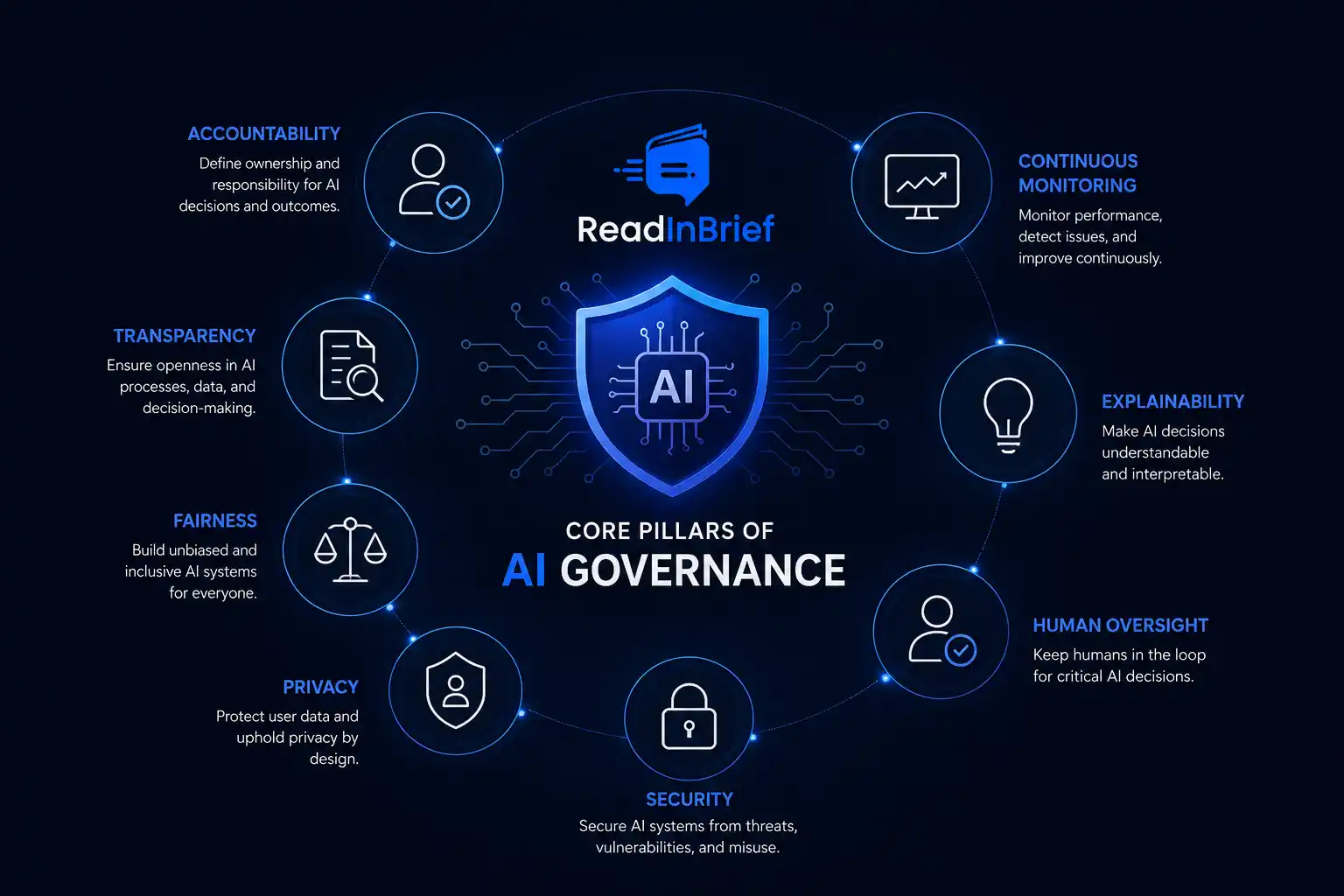
Accountability
Someone, ideally a named role or committee, owns the outcome of every AI system in production. Accountability without a name attached to it usually means no one is accountable.
Transparency
Stakeholders can understand, at an appropriate level of detail, how an AI system reaches its outputs and what data it was trained on.
Fairness
AI systems are tested for discriminatory outcomes across race, gender, age, and other protected characteristics before and after deployment.
Privacy
Personal data used to train or run AI systems is collected, stored, and processed in line with privacy law and organizational policy.
Security
AI systems, including the data pipelines and models behind them, are protected against manipulation, data poisoning, and unauthorized access.
Human oversight
A human retains meaningful ability to review, override, or stop an AI system, especially in high-stakes decisions.
Explainability
The organization can produce a reasonable explanation for a specific AI decision when asked, whether by a customer, auditor, or regulator.
Continuous monitoring
Governance does not stop at launch. Models drift, data changes, and new risks emerge, so monitoring has to run for the life of the system.
AI Governance Framework
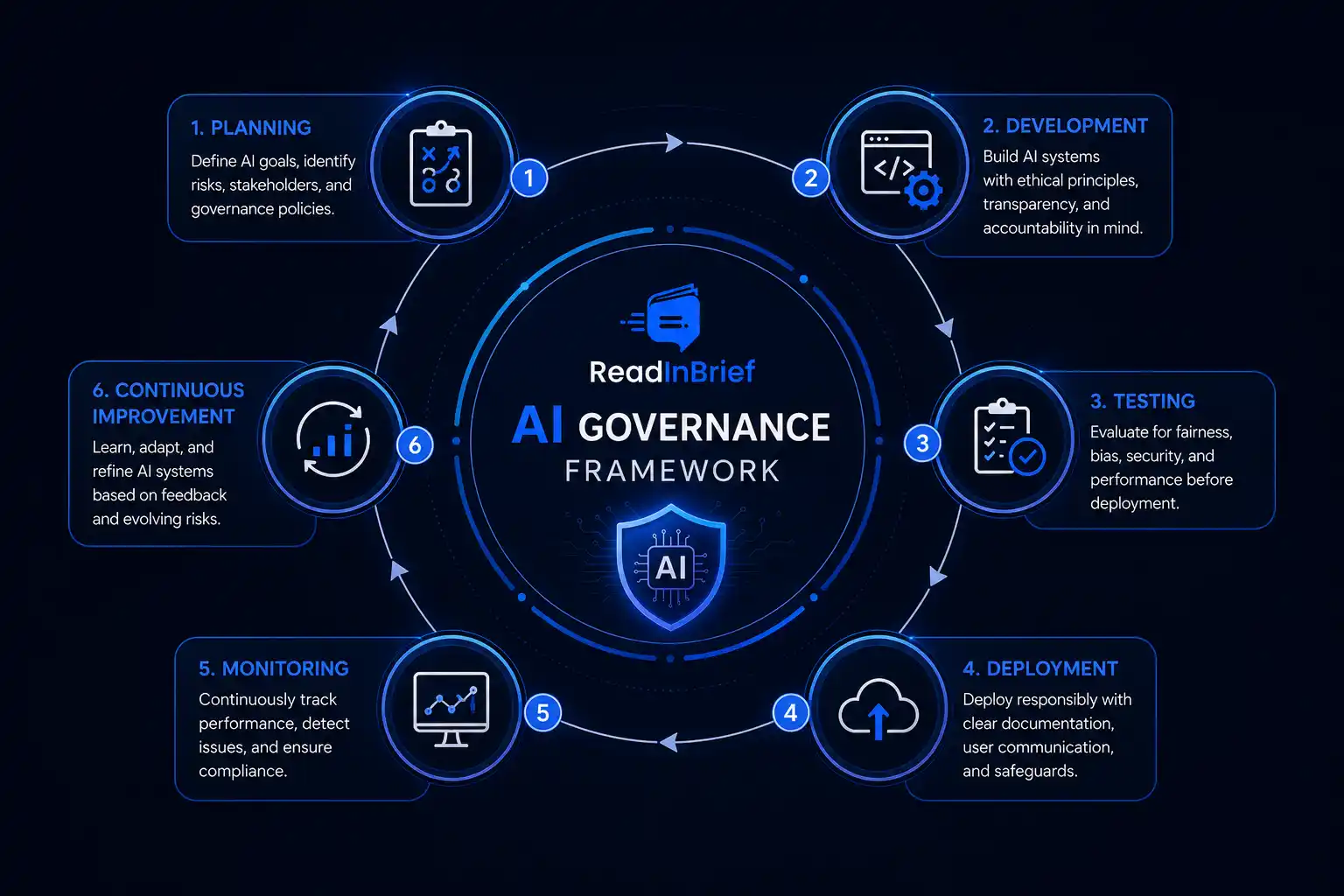
A practical AI governance framework maps onto the AI lifecycle itself. Here is how each stage works in practice.
Planning
Define the business case, identify the risk tier of the intended AI system, and get sign-off from the right stakeholders before any development starts. This is where you decide whether a system counts as high-risk under frameworks like the EU AI Act.
Development
Document data sources, model choices, and known limitations as you build. Bake fairness testing and privacy safeguards into the development process rather than treating them as a final check.
Testing
Run bias audits, security testing, and performance validation against real-world scenarios, not just clean lab data. This is also where you test for hallucination rates and edge-case failures.
Deployment
Confirm human oversight mechanisms are active, publish any required transparency notices, and register the system in your internal AI inventory before it goes live.
Monitoring
Track model performance, drift, incident reports, and user feedback on an ongoing basis. Set clear thresholds for when a system needs review or retraining.
Continuous improvement
Feed monitoring data back into governance policy. Update risk classifications, retrain models, and retire systems that no longer meet your standards.
AI Governance vs AI Ethics vs AI Compliance
Dimension | AI Governance | AI Ethics | AI Compliance |
|---|---|---|---|
Definition | Structures, policies, and oversight for managing AI across its lifecycle | Principles and values guiding what is right and fair in AI use | Meeting specific legal and regulatory requirements |
Focus | Operational and organizational control | Moral and philosophical reasoning | Legal obligation and documentation |
Scope | Enterprise-wide, ongoing | Broad, often abstract | Jurisdiction-specific, defined |
Enforced by | Internal policy and leadership | Organizational culture and norms | Regulators and courts |
Example activity | Setting up an AI review board | Debating whether an AI use case is fair | Filing a conformity assessment under the EU AI Act |
Outcome | Consistent, accountable AI operations | Shared values that shape decisions | Avoiding fines and legal exposure |
Relationship | Governance operationalizes ethics and enforces compliance | Ethics informs what governance should prioritize | Compliance is one output of good governance |
In short: ethics tells you what matters, governance tells you how to act on it consistently, and compliance tells you the legal floor you cannot fall below.
Benefits of AI Governance
Customer trust: Clear governance reassures customers their data and decisions are handled responsibly.
Brand reputation: Companies that avoid public AI failures protect years of brand equity in a single decision.
Regulatory compliance: Governance is the operational backbone that lets you meet EU AI Act, GDPR, and sector-specific requirements.
Innovation: Strong governance gives teams confidence to pursue higher-value, higher-risk AI use cases instead of staying stuck in pilots.
Competitive advantage: PwC's research shows governance leaders capture a disproportionate share of AI's economic value.
Risk reduction: Structured oversight catches bias, security gaps, and compliance issues before they become public incidents.
Better AI adoption: Employees trust AI outputs more when governance is visible, which speeds internal adoption.
Operational efficiency: A single governance framework, rather than ad hoc rules per team, reduces duplicated compliance work.
Risks of Poor AI Governance
Bias
Ungoverned models can replicate or amplify discrimination in hiring, lending, and healthcare decisions, exposing the organization to legal claims and reputational damage.
Hallucinations
Generative AI systems can produce confident, plausible, and false information. Recent testing found hallucination rates across 26 leading models ranging from 22% to 94% depending on how a false claim was framed, according to the Stanford AI Index Report 2026.
Privacy violations
Feeding personal or sensitive data into AI systems without proper controls can violate privacy law and erode customer trust.
Cybersecurity
AI systems introduce new attack surfaces, including prompt injection, data poisoning, and model theft.
Legal issues
Regulators are actively enforcing new AI laws. The EU AI Act alone carries fines up to €35 million or 7% of global turnover.
Reputation damage
A single public AI failure, whether a biased hiring tool or a hallucinated customer answer, can dominate headlines for weeks.
Financial loss
Beyond fines, poor governance shows up as wasted AI investment. McKinsey's research found the average organization only actively manages about four categories of AI risk, leaving significant blind spots that eventually surface as costly incidents.
Real-World Examples
Microsoft operates a formal Office of Responsible AI alongside internal review processes for sensitive AI use cases, reflecting a broader industry shift toward centralized oversight bodies rather than ad hoc, team-by-team decisions.
Google has published AI principles that guide internal development decisions and has built dedicated responsible AI teams that review high-risk applications before launch.
IBM ties AI ethics investment directly to business outcomes internally and has argued publicly that governance and profitability are connected rather than in tension, a position supported by its own research showing higher ethics investment correlates with higher profit growth.
Salesforce has embedded trust layers and guardrails directly into its AI products, treating governance as a product feature that customers can see and configure rather than a purely internal process.
OpenAI has published usage policies and safety frameworks for its models and has faced public scrutiny that has, in turn, pushed the wider industry toward more explicit safety commitments.
Anthropic publishes model behavior guidelines and safety research, and has taken the unusual step of building constitutional AI methods designed to make model behavior more predictable and easier to govern.
NVIDIA has invested in tools that help enterprise customers build guardrails around the AI models running on its hardware, recognizing that infrastructure providers also carry governance responsibility.
Government agencies, including the U.S. National Institute of Standards and Technology and the European Commission, have moved from voluntary guidance to binding frameworks and legislation, formalizing what used to be optional best practice.
The common thread across all of these examples is the same: responsible AI programs work best when they are visible, resourced, and tied to specific accountable teams, not treated as a slogan.
AI Governance in Different Industries
Healthcare
Governance must address patient safety, clinical validation, and strict data privacy rules, since AI errors here can directly affect human health.
Finance
Regulators expect explainable credit and fraud decisions, making explainability and audit trails non-negotiable for banks and lenders.
Education
Institutions need governance around academic integrity, student data privacy, and fair access to AI-assisted learning tools.
Manufacturing
Governance focuses on safety-critical AI in robotics and predictive maintenance, where a model failure can cause physical harm.
Retail
Governance covers personalization, dynamic pricing fairness, and responsible use of customer behavioral data.
Government
Public sector AI faces the highest transparency expectations, since citizens cannot opt out of government decisions the way they can choose a different retailer.
Legal
Law firms and legal tech vendors need governance around AI-generated research and drafting to avoid citing fabricated cases or precedent.
Insurance
Underwriting and claims AI must be governed carefully to avoid discriminatory pricing and to meet growing regulatory scrutiny of algorithmic decision-making.
AI Regulations Around the World
The world's first comprehensive AI law, formally Regulation (EU) 2024/1689. It classifies AI systems into risk tiers, unacceptable, high, limited, and minimal, and applies obligations accordingly. Penalties reach €35 million or 7% of global turnover for the most serious violations. Some high-risk deadlines have shifted under a 2026 Digital Omnibus proposal, so organizations should track the European Commission's official timeline closely.
NIST AI Risk Management Framework
A voluntary U.S. framework organized around four functions: Govern, Map, Measure, and Manage. It has no formal certification, but it increasingly shapes federal procurement expectations and appears as an affirmative defense option in some U.S. state AI laws.
ISO/IEC 42001
The first internationally certifiable AI management system standard, published in 2023. It gives organizations a structured, auditable way to demonstrate governance maturity, and it maps closely to both the NIST framework and EU AI Act obligations.
GDPR
While not an AI-specific law, GDPR shapes how organizations can collect and process the personal data that trains and powers most AI systems, making it a foundational layer of AI governance in practice.
US AI Executive Orders
Federal directives have pushed agencies toward risk-based AI oversight, while individual states, including Colorado, have passed their own AI-specific laws referencing NIST and ISO frameworks directly.
UK AI Principles
The UK has favored a lighter-touch, principles-based approach, asking existing regulators to apply cross-cutting AI principles like safety, transparency, and accountability within their own sectors rather than passing one central AI law.
How Businesses Can Build an AI Governance Framework
Step 1: Assess your current AI footprint
Build an inventory of every AI system in use, including shadow AI tools employees may have adopted without formal approval.
Step 2: Classify risk levels
Sort each system by potential impact, using a framework like the EU AI Act's risk tiers or your own internal scale.
Step 3: Define ownership
Assign clear accountability, ideally a cross-functional AI governance board with representation from legal, engineering, risk, and business units.
Step 4: Write the policy
Draft AI governance policies covering data use, model approval, human oversight, and incident response.
Step 5: Choose your framework foundation
Many organizations start with ISO 42001 for structure, layer in NIST AI RMF for risk methodology, and add EU AI Act obligations for systems touching the EU market.
Step 6: Build technical controls
Implement logging, monitoring, and audit trails so governance policy translates into enforceable technical reality, not just a document.
Step 7: Train your people
Make sure engineers, product teams, and executives understand their specific governance responsibilities, not just a general awareness of "responsible AI."
Step 8: Test before launch
Run bias, security, and accuracy testing against real-world scenarios before any system goes into production.
Step 9: Monitor continuously
Track performance, incidents, and drift after launch, and set clear triggers for retraining or retirement.
Step 10: Review and improve
Revisit your framework at least annually, since both the technology and the regulatory landscape are changing quickly.
AI Governance Best Practices
Build a cross-functional AI governance board with real decision-making authority, not just an advisory role.
Maintain a living inventory of every AI system in production, including third-party and vendor tools.
Classify AI systems by risk tier before development begins, not after.
Assign named owners for every AI system, not just a department.
Bake privacy and fairness testing into development, rather than treating them as a final gate.
Document training data sources and known model limitations for every system.
Set clear thresholds for human review of high-stakes AI decisions.
Publish an internal AI use policy that employees can actually find and understand.
Run adversarial and red-team testing before deployment, not just standard QA.
Build logging and audit trails into every AI system from day one.
Align your framework with ISO 42001 or NIST AI RMF to avoid rebuilding governance from scratch for every new regulation.
Track AI incidents formally, even minor ones, to spot patterns early.
Give employees a clear channel to flag AI concerns without fear of blowback.
Review vendor AI tools with the same rigor as internally built systems.
Communicate governance efforts externally where appropriate, since disclosure builds measurable trust with customers and employees.
Revisit governance policy at least once a year, and immediately after any major regulatory change.
Invest real budget in responsible AI, not just policy documents. Companies planning meaningful RAI investment consistently show higher maturity scores.
Common Mistakes in AI Governance
Treating governance as a one-time project instead of an ongoing operational discipline.
Assigning governance to a single person without giving them authority or resources.
Ignoring shadow AI, the tools employees adopt informally outside of IT approval.
Waiting for regulation to force action, rather than building governance ahead of enforcement deadlines.
Confusing having a policy document with having working controls, the gap IBM's research highlights between claimed and implemented governance.
Skipping bias testing on the assumption that a vendor's model is already fair.
Failing to monitor models after launch, even though drift and new risks emerge constantly.
Leaving the board out of AI oversight, when board-level AI literacy remains a documented weak spot across many organizations.
Over-restricting every AI system uniformly, regardless of actual risk, which Gartner warns can cause its own governance failures.
Not budgeting for governance, treating it as overhead rather than infrastructure that protects and enables AI investment.
Building governance in a silo, disconnected from actual engineering and product workflows.
Avoiding these mistakes generally comes down to one habit: treat governance as a living system with real owners, real budget, and real technical enforcement, not paperwork produced to satisfy an audit.
Future of AI Governance
Agentic AI: As AI systems move from answering questions to taking autonomous actions, governance needs to account for scope of access, not just accuracy. Gartner's research shows uniform governance rules applied to agents with different autonomy levels is itself becoming a common failure mode.
Autonomous AI: Expect governance frameworks to increasingly define tiers of autonomy, with lightweight controls for simple task agents and much stricter oversight for agents that can take independent, high-impact actions.
AI audits: Formal, recurring AI audits are becoming standard practice, especially for high-risk systems under the EU AI Act and for organizations pursuing ISO 42001 certification.
AI certification: ISO 42001 certification is likely to become a common procurement requirement, similar to how ISO 27001 became a baseline expectation for information security.
Responsible foundation models: As transparency scores decline among the most capable frontier models, expect growing pressure, from both regulators and enterprise buyers, for foundation model providers to disclose more about training data, capabilities, and known risks.
Synthetic data: Synthetic data offers a way to train and test models while reducing privacy risk, and governance frameworks are starting to address how synthetic data should be validated and disclosed.
AI transparency tools: Expect more automated tools that generate model cards, data lineage records, and audit trails automatically, reducing the manual burden of governance documentation.
AI risk monitoring: Continuous, automated risk monitoring, rather than periodic manual review, is becoming the expected standard as AI systems make more real-time decisions.
AI Governance Readiness Checklist
[ ] We maintain a full inventory of AI systems in use, including vendor tools.
[ ] Every AI system has a named, accountable owner.
[ ] We classify AI systems by risk level before development begins.
[ ] We have a documented AI governance policy that employees can access.
[ ] Bias and fairness testing happens before and after deployment.
[ ] Human oversight mechanisms exist for high-stakes AI decisions.
[ ] We log and audit AI system decisions and outputs.
[ ] We monitor deployed models for drift and performance issues.
[ ] We have an incident response plan specific to AI failures.
[ ] Our framework aligns with at least one recognized standard, such as ISO 42001 or NIST AI RMF.
[ ] We track applicable regulations, including the EU AI Act, relevant to our markets.
[ ] Leadership, including the board, receives regular AI risk updates.
[ ] We review and update our AI governance framework at least annually.
FAQ
1. What is AI governance in simple terms?
AI governance is the set of rules, roles, and checks an organization uses to make sure its AI systems behave safely, fairly, and legally throughout their entire life, from design to retirement.
2. Why is AI governance important for businesses?
It reduces legal and reputational risk, builds customer and employee trust, and, according to PwC and McKinsey research, correlates with stronger financial returns and faster AI value creation.
3. What is the difference between AI governance and AI ethics?
AI ethics defines the values and principles that should guide AI use. AI governance is the operational structure that puts those values into practice through policy, process, and accountability.
4. Is AI governance the same as AI compliance?
No. Compliance means meeting specific legal requirements. Governance is broader and includes compliance as one of its outcomes, alongside risk management, ethics, and operational oversight.
5. What frameworks should my organization follow for AI governance?
Most organizations build on a combination of ISO/IEC 42001 for management system structure, the NIST AI Risk Management Framework for risk methodology, and the EU AI Act for legal obligations if they operate in or serve the EU market.
6. Does the EU AI Act apply to companies outside the EU?
Yes, if the company's AI system is offered or used within the EU market, regardless of where the company is headquartered.
7. What are the penalties for EU AI Act violations?
Fines can reach €35 million or 7% of global annual turnover for deploying prohibited AI systems, with lower tiers for other high-risk violations.
8. What is ISO/IEC 42001?
It is the first international, certifiable standard for an AI management system, giving organizations a structured, auditable way to demonstrate governance maturity to regulators, customers, and partners.
9. How does AI governance reduce business risk?
It catches bias, security gaps, privacy issues, and compliance failures earlier in the AI lifecycle, before they turn into public incidents or regulatory penalties.
10. Does AI governance slow down innovation?
Evidence suggests the opposite. Companies with stronger governance foundations are more likely to scale AI into higher-value use cases and report better financial returns from AI investment.
11. Who should own AI governance inside a company?
Ownership works best as a cross-functional structure, often an AI governance board with representation from legal, risk, engineering, and business leadership, rather than a single individual.
12. What is agentic AI governance?
It is the emerging discipline of governing autonomous AI agents that can take actions, not just generate outputs, requiring controls tailored to each agent's level of autonomy and access.
13. What is the biggest mistake companies make with AI governance?
Treating governance as a policy document rather than a living operational system with real enforcement, monitoring, and named accountability.
14. How often should an AI governance framework be reviewed?
At least once a year, and immediately after any significant regulatory change or major AI incident.
15. What is the first step to building an AI governance framework?
Start by building a complete inventory of every AI system in use across the organization, including tools adopted informally by individual teams.
Conclusion
AI governance is no longer a niche compliance topic reserved for legal teams. It is quickly becoming one of the clearest differentiators between companies that turn AI into real, sustained value and companies stuck running endless pilots. The data backs this up consistently: organizations with stronger governance foundations report higher trust, better financial returns, and greater confidence to pursue transformative AI use cases rather than safe, low-value ones.
At the same time, the risks of skipping governance are real and growing. Regulators are enforcing binding rules like the EU AI Act. Documented AI incidents are rising. Boards and customers are asking sharper questions about how AI decisions get made. Organizations that treat AI governance as a genuine operational discipline, with clear ownership, real technical controls, and continuous monitoring, are the ones best positioned to earn trust and move faster, not slower.
AI governance, done well, is not a wall between your organization and innovation. It is the foundation that makes responsible, scaled AI innovation possible in the first place.
If your organization is scaling AI faster than its governance can keep up, now is a good time to take stock. Start with a simple inventory of the AI systems already running across your teams, map them against a recognized framework like ISO 42001 or the NIST AI RMF, and identify where the biggest gaps sit. Whether you handle this internally or bring in outside expertise, building AI governance now will put you in a stronger position as regulation and stakeholder expectations continue to tighten.
Comments (0)
No comments yet. Be the first to share your thoughts!