AI in Insurance Claims Triage: How Automated Prioritization Works

Author
Ravi Prajapati

Learn how AI in insurance claims triage prioritizes claims, identifies urgent cases, flags anomalies, and helps insurers improve processing with human oversight.
An insurer may receive hundreds or thousands of claims across multiple channels, including web forms, mobile apps, emails, repair estimates, medical bills, and supporting documents. The challenge is not simply processing each claim. It is deciding which claims need immediate attention, which can follow a routine workflow, and which require specialist investigation.
AI in insurance claims triage helps insurers classify incoming claims, identify potential urgency, detect missing information, and route cases to the appropriate team. It combines techniques such as machine learning, document processing, rules-based automation, and, where appropriate, natural language processing to help claims teams decide what should happen next.
The distinction matters: triage is not the same as claim adjudication. A triage system can recommend a priority or route without deciding whether a policyholder is entitled to payment. Keeping these functions separate can help insurers improve operational efficiency without handing every consequential decision to an automated system.
The National Association of Insurance Commissioners (NAIC) identifies claims handling and fraud detection among the areas where insurers use AI. The European Insurance and Occupational Pensions Authority (EIOPA) has also examined AI governance in insurance, including claims management and document processing. These sources establish the relevance of the technology, but they do not mean every insurer has achieved measurable improvements through automated triage.
This guide explains how claims triage works, which AI techniques support it, where automation is useful, how insurers can evaluate its performance, and what needs to be in place before deploying it.
What Is AI in Insurance Claims Triage?
AI in insurance claims triage is the use of artificial intelligence to assess incoming claims and recommend their next step based on factors such as urgency, complexity, completeness, potential exposure, and the need for human investigation.
Rather than treating every claim as an identical task in a queue, a triage system helps organize work according to operational rules and signals found in claim data.
For example, an insurer could use automated triage to:
Route a straightforward windshield damage claim to a standard processing workflow.
Flag a property claim involving extensive structural damage for specialist assessment.
Identify a claim with missing documents and request the required information.
Prioritize a case where a delay could create additional harm or worsen the loss.
Refer a claim with unusual inconsistencies for investigation without automatically labeling it fraudulent.
The system's role depends on the insurer's business rules, product lines, available data, and risk controls.
Claims triage vs. claims adjudication vs. fraud detection
These functions often use overlapping data, but they answer different questions.
Function | Primary question | Typical output |
|---|---|---|
Claims triage | What should happen next, and who should handle it? | Priority, queue, routing recommendation |
Claims adjudication | Is the claim covered, and what should be paid? | Coverage or payment decision |
Fraud detection | Does the claim contain signals that warrant further investigation? | Anomaly score or investigation referral |
Document processing | What information is contained in the submitted documents? | Extracted fields, classifications, missing items |
Claims automation | Which process steps can be completed without manual intervention? | Automated workflow actions |
These functions can work together, but their boundaries should remain clear. A high fraud-risk score is not proof of fraud, and a high-priority claim is not necessarily a claim that should be paid first or paid more.
How Does Automated Insurance Claims Triage Work?
.webp)
An AI-powered triage workflow typically moves through six stages, from claim intake to monitored routing. The exact implementation varies by insurer and line of business.
1. Claim intake and data collection
The process begins when a policyholder submits a claim. Information may come from a claims portal, mobile application, call center, email, or an integrated third-party system.
The insurer collects the information required for the relevant claim type. This could include the policy identifier, date of loss, incident description, estimated damage, supporting photographs, repair estimates, and contact information.
Data quality matters from the beginning. If a claim is linked to the wrong policy or a key date is missing, a downstream model may produce a misleading recommendation.
2. Document extraction and validation
Claims teams often work with information that arrives in different formats. Optical character recognition (OCR) converts text in scanned documents and images into machine-readable content. Document classification and extraction models can then identify relevant fields.
Natural language processing can help interpret free-text descriptions, such as a customer's explanation of a vehicle accident or property leak.
AI can flag missing documents, inconsistent dates, duplicate submissions, and fields that do not match the expected format. It should not assume that a document is invalid merely because it differs from a common pattern.
EIOPA's insurance-sector AI governance report discusses OCR and image-processing techniques in claims management, while also highlighting the need for appropriate governance when using less interpretable systems.
3. Urgency, complexity, and exception assessment
Once the relevant information is available, the system evaluates the claim against configured criteria.
These criteria might include:
Whether there are indicators of immediate danger or ongoing damage.
The reported severity and scope of the loss.
Whether specialist assessment is needed.
Whether essential information is missing.
Whether the claim has unusual characteristics requiring investigation.
Whether the case is approaching an applicable service deadline.
The model may produce a category, probability, score, or recommendation. These outputs should be interpreted according to what the model was trained and validated to predict.
For example, a model trained to predict long handling times does not automatically identify urgent claims. A separate urgency policy or appropriately validated model is needed.
4. Claim prioritization and routing
The triage engine combines model outputs with explicit business rules to recommend a next step.
A practical routing structure might contain four categories:
Queue | Example criteria | Suggested action |
|---|---|---|
Urgent review | Credible indicators of immediate safety concerns or rapidly worsening loss | Escalate promptly to the designated team |
Specialist assessment | Complex damage, disputed facts, or technical evaluation requirements | Assign an experienced adjuster or specialist |
Standard processing | Complete information and a familiar claim pattern | Send through the routine workflow |
Information or investigation hold | Missing documents, conflicting information, or an exception requiring review | Request clarification or refer for investigation |
These are illustrative categories, not a universal insurance classification standard. Each insurer needs to define its own thresholds, responsibilities, escalation paths, and applicable deadlines.
5. Human review and workflow execution
The triage result enters the claims management system, where staff can see the recommended queue and the reasons behind it.
A straightforward case may proceed through an established automated workflow. An exception may require an adjuster to examine documents, contact the policyholder, or commission an assessment.
Human review is particularly important when an automated recommendation could affect a policyholder's access to service, delay a legitimate claim, or trigger a consequential investigation.
6. Feedback and performance monitoring
The final stage connects operational outcomes to ongoing evaluation.
Claims teams can compare the initial recommendation with the eventual routing decision, actual handling time, documented outcome, and any human override. This information helps identify where the system works well and where it needs adjustment.
However, historical outcomes are not automatically reliable training labels. If past workflows consistently delayed certain types of claims, a model trained on those records could reproduce the same problem.
Which AI Technologies Support Claims Triage?
An effective triage system does not necessarily require a large language model. The technology should match the task, the available data, and the consequences of an incorrect result.
Technology | Role in claims triage | Main limitation |
|---|---|---|
Rules engines | Apply explicit urgency thresholds, policy workflow rules, and escalation conditions | Cannot handle every unusual situation through predefined rules alone |
Machine learning | Predict categories, complexity, potential severity, or handling requirements from historical data | Can reproduce historical errors and become less reliable when conditions change |
OCR and document AI | Extract text, classify documents, and identify missing information | Poor scans, handwriting, and unusual layouts can reduce accuracy |
Natural language processing | Classify incident descriptions and identify relevant information in claim narratives | Ambiguous wording and incomplete descriptions can lead to misclassification |
Computer vision | Analyze damage photographs and identify visual features that support assessment | Image quality, unusual damage, and context can affect reliability |
Generative AI and large language models | Summarize documents, organize case information, and explain recommendations in plain language | Can generate incorrect statements or omit important details |
Workflow automation | Move claims between queues, request information, and update connected systems | Depends on reliable integrations, permissions, and exception handling |
When should an insurer use traditional machine learning instead of generative AI?
Traditional machine learning is often a sensible starting point when the objective is to predict a well-defined outcome, such as the likelihood that a claim will require specialist review.
Generative AI is more useful when the workflow involves interpreting varied documents, summarizing lengthy case histories, or helping an adjuster locate relevant information.
A rules engine remains valuable when a decision must follow an explicit condition, such as escalating a report of an immediate safety hazard.
These technologies can coexist. An insurer might use document AI to extract claim details, a predictive model to estimate complexity, a rules engine to enforce escalation requirements, and a language model to produce a review summary.
The key design principle is to avoid using a more complex model when a simpler, more testable component can perform the task.
What Factors Should AI Consider When Prioritizing Insurance Claims?
AI-assisted triage should evaluate factors that relate to the insurer's defined operational objective. A single score is rarely sufficient to represent every dimension of a claim.
1. Urgency and potential harm
Claims involving immediate safety concerns, ongoing property damage, or urgent assistance may require faster human attention. The system should distinguish operational urgency from the expected financial value of a claim.
A smaller claim can still be urgent if a delay creates additional harm.
2. Claim complexity
Complexity may depend on the number of parties involved, conflicting descriptions, the need for specialist expertise, or the volume of evidence requiring review.
A complex claim does not necessarily have a high loss value, and a high-value claim is not always complex.
3. Estimated severity and financial exposure
Insurers may use available incident details, historical patterns, and validated predictive models to estimate potential loss severity.
These estimates can help allocate specialist resources, but they should not be treated as confirmed settlement amounts. Early estimates may be uncertain because the extent of damage or the relevant facts have not yet been established.
4. Completeness and consistency of information
A claim with missing documents may need a request for additional information. A claim with conflicting information may need clarification.
Neither condition establishes wrongdoing. The system should identify the specific issue and route it for an appropriate response.
5. Investigation indicators
Anomaly detection can identify unusual patterns, inconsistent records, or similarities to previously investigated cases. These signals may help an insurer decide which claims deserve additional scrutiny.
They are not proof of fraud. An insurer should validate the signal, consider alternative explanations, and use a documented investigation process before making consequential decisions.
6. Deadlines and operational capacity
The triage system can also consider service-level deadlines, existing queue sizes, specialist availability, and the risk of a claim waiting too long.
This is where workflow optimization becomes important. A high-priority recommendation has limited value if the assigned team has no capacity to act on it.
A sensible system separates claim urgency, expected complexity, potential loss severity, and investigation risk into distinct outputs before combining them with explicit routing rules.
That separation makes recommendations easier to explain, test, and revise.
Practical Examples of AI-Powered Claims Triage
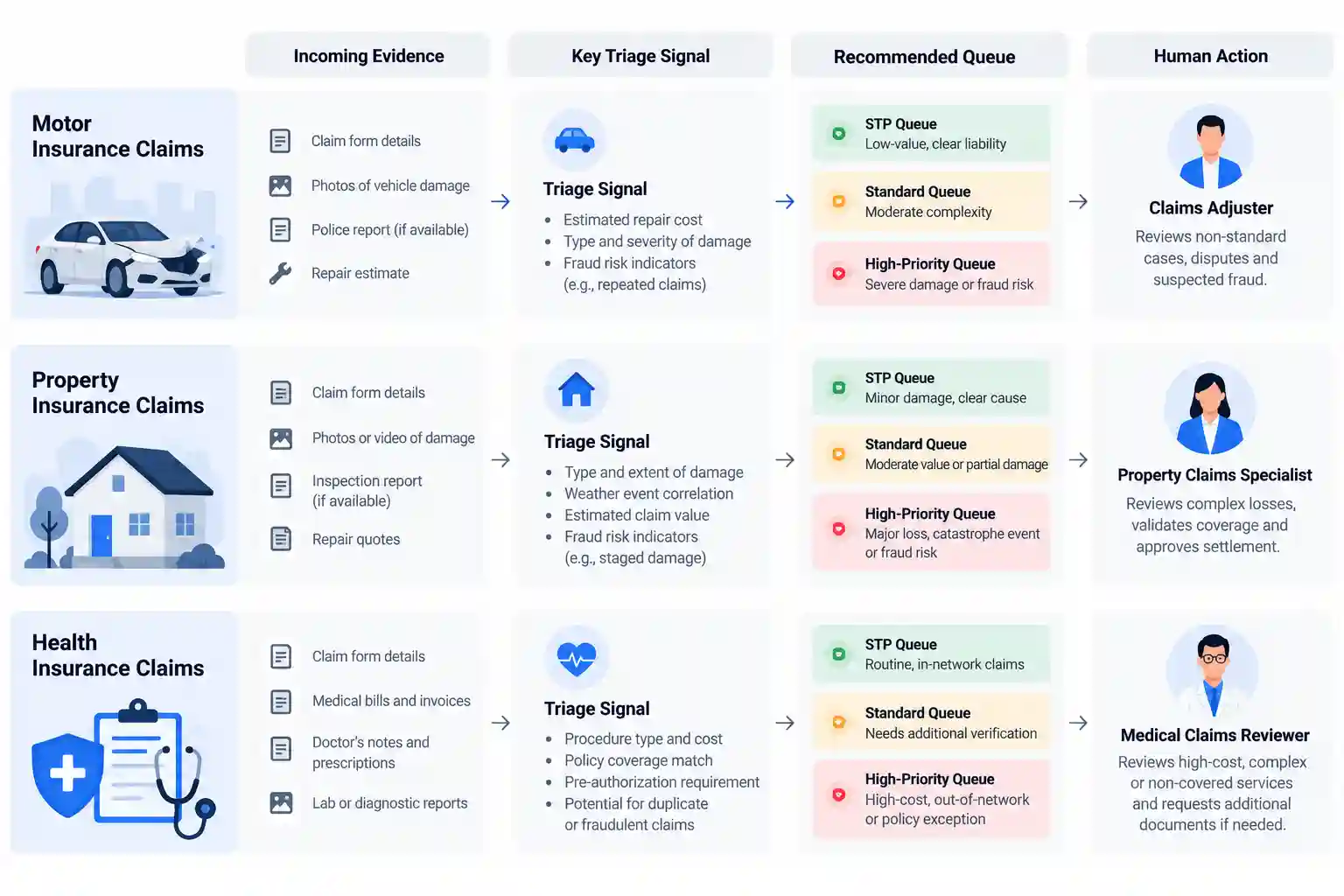
The following scenarios are hypothetical illustrations of how an insurer could implement the technology. They are not reported customer deployments or evidence of measured performance.
Example 1: Motor insurance
A customer submits photographs of a damaged windshield along with a repair estimate. Document extraction identifies the vehicle and claim details, while the workflow checks whether required information is present. If the claim meets the insurer's predefined criteria, it enters the standard assessment queue. If the photographs suggest more extensive damage, the system can recommend specialist review.
Potential benefit: less manual sorting of routine claims.
Example 2: Property insurance
A homeowner reports storm damage and possible water intrusion. The triage workflow identifies the reported ongoing damage and routes the case for prompt assessment under the insurer's urgency policy. A separate process checks whether photographs, inspection details, and supporting documents are available.
Potential benefit: earlier attention to cases where delays could worsen the loss.
Example 3: Health insurance
An insurer receives a claim with medical billing information and supporting documentation. Document AI extracts relevant fields, checks for missing information, and identifies inconsistencies for review. Any coverage assessment remains governed by the applicable policy terms and review procedures.
Potential benefit: more consistent intake and exception routing.
How Should Insurers Evaluate a Claims Triage System?
A triage model should not be evaluated only on how accurately it predicts a category. The insurer also needs to establish whether its recommendations improve the actual claims workflow without creating unacceptable risks.
A useful evaluation framework covers five areas.
1. Routing accuracy
Measure how often claims reach the appropriate queue and how frequently staff must correct the recommendation.
Overall accuracy is not enough. If urgent cases are relatively uncommon, a model can achieve high overall accuracy while missing a significant proportion of them.
Track the recall of urgent claims, the false-negative rate for critical cases, and the performance of each major claim category.
2. Time to action
Measure the time between claim receipt and the first appropriate action, rather than simply measuring the time taken to generate a score.
Useful metrics include:
Median time from submission to first review.
Time to route a claim to the correct team.
Percentage of claims handled within applicable service targets.
Time spent waiting for missing information.
Backlog size and age.
These measures help distinguish faster automated processing from genuine operational improvement.
3. Human workload and override rates
Record how often employees accept, modify, or reject the recommendation. Review overrides by claim type, reason, team, and model version.
An unusually high override rate may indicate poor model performance, unclear routing rules, missing data, or a mismatch between the model's objective and the claims team's actual needs.
A low override rate is not automatically evidence of quality. Staff may trust a system too readily or may lack the authority to challenge it.
4. Fairness and consistency
Evaluate whether comparable claims receive comparable treatment and whether error rates differ across relevant groups or claim categories.
The analysis should use appropriate, legally permissible data and account for meaningful differences in claim characteristics. A difference in outcomes requires investigation, not an automatic conclusion that the model is biased or fair.
5. Reliability and operational cost
Monitor system availability, data quality, integration failures, processing cost, and the amount of manual rework required.
A triage system that generates recommendations quickly but creates more downstream corrections may not deliver net value.
A practical measurement table
Metric | What it measures | Why it matters |
|---|---|---|
Urgent-case recall | Share of genuinely urgent cases correctly identified | Helps reveal missed urgent claims |
Routing accuracy | Share of claims assigned to an appropriate queue | Indicates the quality of prioritization |
Median time to first action | Time before a claim receives an appropriate next step | Measures operational responsiveness |
Human override rate | Share of recommendations changed by staff | Reveals possible model or workflow problems |
Rework rate | Share of claims needing corrective processing | Captures downstream errors |
Cost per processed claim | Total relevant operating cost divided by claims processed | Helps assess economic value |
Group-level error differences | Differences in model errors across relevant groups | Supports fairness and consistency reviews |
Insurers should establish a baseline before deployment and compare it with results from a controlled pilot. Where possible, comparisons should account for differences in claim mix, seasonality, staffing, and operational changes.
The objective is not to achieve the highest possible automation rate. It is to improve claim handling while keeping error rates, delays, customer impact, and operational costs within acceptable limits.
What Are the Main Risks of Automated Claims Prioritization?
Automated triage can make claims workflows more consistent, but its recommendations can also create new problems if insurers treat model outputs as objective facts.
Biased or incomplete historical data
Machine learning models learn from the examples available to them. If historical records contain inconsistent classifications, missing information, or uneven investigation practices, the model may learn patterns that reflect those practices rather than the underlying claim characteristics.
Insurers should examine training data, document known limitations, validate performance on representative cases, and monitor error differences after deployment.
False positives in fraud-related routing
A claim may appear unusual because it involves a rare event, an unfamiliar repair estimate, or incomplete information. Automatically treating such signals as evidence of fraud can lead to unnecessary investigations and avoidable delays.
A safer approach is to route unusual claims for proportionate review, record the reasons for referral, and require supporting evidence before reaching a conclusion.
Automation bias
Employees may accept AI recommendations even when the supporting evidence is weak. This is particularly concerning when a score or recommendation is presented without its limitations.
Interfaces should show the relevant evidence, distinguish missing information from negative findings, and make it practical for employees to challenge recommendations.
Privacy and security
Claims may contain medical information, financial records, photographs of private property, and personal identifiers. Insurers need appropriate access controls, data minimization, retention policies, secure integrations, and contractual safeguards for external AI providers.
Sensitive claim documents should not be sent to public AI services without an approved data-handling arrangement.
Model drift and changing conditions
Claims patterns change with weather events, repair costs, medical practices, policy changes, fraud patterns, and new customer behavior. A model that performs well during testing may deteriorate after deployment.
Monitoring should therefore continue throughout the model's operational life, with defined thresholds for investigation, rollback, retraining, or disabling automated routing.
What Does Insurance AI Governance Require?
AI governance is not just a model-development concern. It affects how an insurer selects use cases, assigns accountability, validates outputs, documents decisions, and responds to errors.
Two useful references are the NAIC Model Bulletin on the Use of Artificial Intelligence Systems by Insurers and EIOPA's August 2025 Opinion on AI Governance and Risk Management.
The NAIC bulletin sets out expectations for responsible AI use under applicable insurance laws and regulations. EIOPA's opinion explains how existing insurance-sector requirements apply to AI governance and risk management in the European Union. Their legal status and applicability differ by jurisdiction, so insurers should not assume that one document creates identical obligations everywhere.
The NIST AI Risk Management Framework provides another useful, voluntary resource for managing AI risks across design, development, deployment, and evaluation. Its four core functions are Govern, Map, Measure, and Manage.
For claims triage, these principles translate into practical controls:
Accountability: Assign owners for model performance, routing rules, and operational decisions.
Traceability: Record the model version, relevant inputs, recommendation, and action taken.
Explainability: Give claims staff enough information to understand why a case was routed or flagged.
Human oversight: Define which recommendations can be acted on automatically and which require review.
Data governance: Control access, retention, data quality, and the use of third-party data.
Monitoring: Review errors, override patterns, customer impact, and performance changes.
Incident response: Establish procedures for investigating failures and suspending problematic automation.
The required level of control should reflect the use case. Automatically classifying a document for indexing does not carry the same consequences as automatically denying a claim or delaying a payment.
That distinction is important when moving from assistance with internal operations to systems that directly influence policyholder outcomes.
How Can Insurers Implement AI Claims Triage?
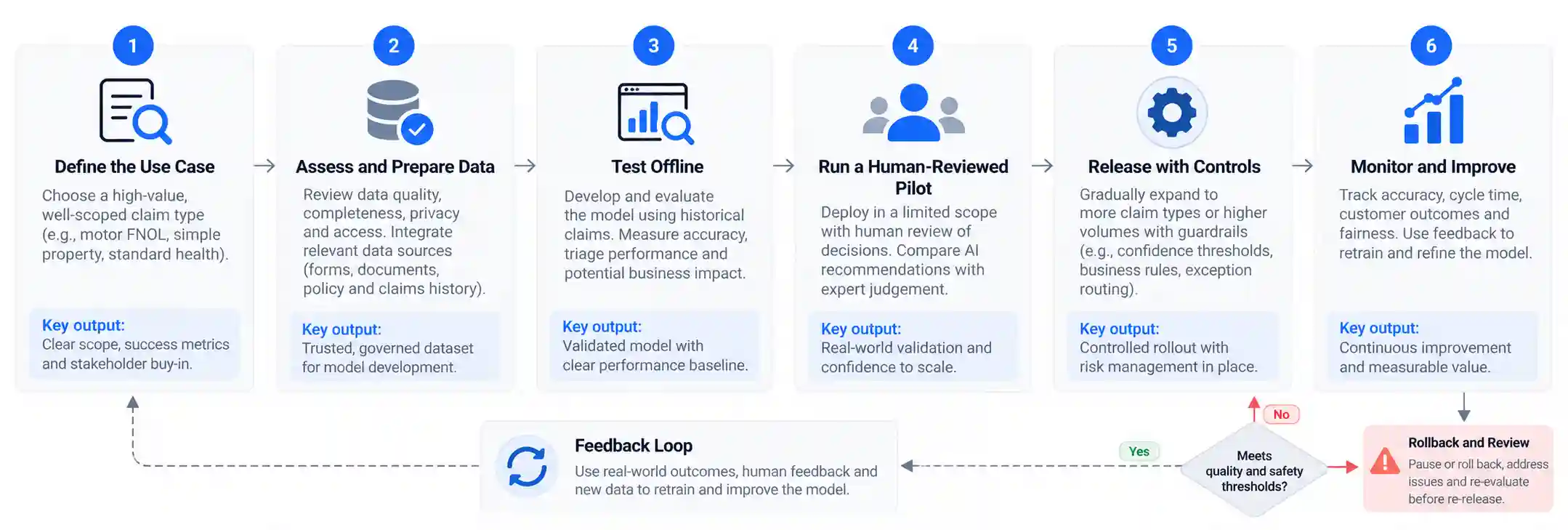
A phased implementation gives insurers a way to test operational value before expanding the scope of automation.
Phase 1: Select a narrow use case
Start with a specific problem, such as routing complete motor claims or identifying missing documents. Define what success means and which errors are unacceptable.
Phase 2: Assess data readiness
Review historical claims, classification quality, missing fields, system compatibility, access permissions, and the availability of reliable outcome labels.
Phase 3: Build and test the workflow
Combine appropriate models with explicit rules and workflow integration. Test on historical data and representative edge cases, including missing documents and unusual claims.
Phase 4: Run a human-reviewed pilot
Generate recommendations while claims professionals retain control. Compare the system's suggestions with actual decisions and investigate meaningful disagreements.
Phase 5: Expand based on evidence
Expand to additional queues or claim types only after the pilot demonstrates acceptable performance, operational value, and appropriate controls.
What should be ready before launch?
Before introducing AI-assisted routing into a production claims environment, the insurer should be able to answer these questions:
Is the intended outcome defined precisely?
Are the source data and historical labels sufficiently reliable?
Have false negatives and false positives been evaluated separately?
Are escalation rules documented and tested?
Can employees see and challenge recommendations?
Are audit records available for later investigation?
Can the system be disabled or rolled back safely?
Are privacy, security, and regulatory requirements addressed?
Is there an owner responsible for ongoing performance?
A pilot should not be considered successful simply because the model runs without technical errors. The operational workflow, employee response, customer impact, and quality of decisions all matter.
What AI Claims Triage Cannot Solve
AI can organize information and recommend next steps, but it cannot remove the underlying uncertainty of insurance claims.
A model cannot establish facts that were never captured in the data. It cannot determine the true cause of damage from an inadequate photograph with certainty. A language model cannot replace missing policy wording or turn an unsupported assumption into evidence.
Nor can automated routing resolve unclear policy language, poor operating procedures, insufficient staffing, or conflicting responsibilities between claims teams.
These problems require changes to data collection, policy administration, operational processes, and human decision-making. AI may help identify some of them, but deploying a model does not fix them automatically.
There is also a trade-off between speed and caution. More aggressive automation may reduce manual work on routine claims, but it can increase the cost of correcting errors if the system routes exceptions incorrectly. The appropriate balance depends on the severity of potential harm, the reliability of available data, and the cost of human review.
For these reasons, insurers should view triage as a decision-support and workflow-management capability first. Broader automation should follow only where evidence shows that the relevant tasks can be performed reliably and within appropriate controls.
Frequently Asked Questions About AI in Insurance Claims Triage
1. What is AI claims triage in insurance?
AI claims triage uses artificial intelligence to classify incoming insurance claims, assess relevant signals, and recommend the next step. It may identify urgent cases, detect missing documents, estimate complexity, or route claims to specialists. The objective is to help claims teams organize their workload and respond appropriately. Triage does not necessarily include deciding whether a claim is covered or calculating the final settlement.
2. How does AI prioritize insurance claims?
AI prioritizes claims by analyzing relevant information, such as incident descriptions, supporting documents, reported damage, urgency indicators, and historical patterns. Rules and predictive models can then recommend a priority category or handling queue. The system should use separate criteria for urgency, complexity, severity, and investigation requirements rather than treating a single score as a complete assessment.
3. Can AI automate the entire insurance claims process?
AI can automate selected tasks, including document extraction, data validation, routine classification, and workflow routing. Some insurers may also automate narrowly defined processing steps when established conditions are met. However, complex, disputed, uncertain, or consequential cases may require human review. The appropriate degree of automation depends on data quality, process reliability, legal requirements, and the potential impact of errors.
4. How is claims triage different from fraud detection?
Claims triage determines what should happen next and who should handle a claim. Fraud detection identifies patterns or inconsistencies that may justify investigation. A fraud-related alert can influence routing, but it does not establish fraud. Insurers should validate suspicious signals, consider alternative explanations, and use appropriate investigation procedures before reaching a conclusion.
5. What data does AI need for insurance claims triage?
Depending on the use case, an insurer may need policy details, incident descriptions, dates, claim categories, supporting documents, photographs, prior handling records, and reliable historical outcomes. The system should collect only data relevant to its defined purpose. Data quality, appropriate permissions, representative examples, and reliable labels are more important than simply collecting the largest possible dataset.
6. How can insurers measure the success of AI-powered triage?
Insurers should measure routing accuracy, urgent-case recall, time to first action, processing delays, rework, human override rates, cost per claim, and relevant differences in error rates. Results should be compared with a documented baseline and evaluated against the claim mix and operational context. A higher automation rate alone does not prove that the system improves service quality or business performance.
7. What are the biggest risks of automated claims prioritization?
The main risks include biased historical data, incorrect urgency assessments, false fraud alerts, privacy breaches, excessive trust in automated recommendations, and performance deterioration over time. These risks can be reduced through representative testing, access controls, documented escalation rules, human oversight, ongoing monitoring, and a reliable process for correcting or reversing errors.
8. Should insurers build or buy an AI claims triage solution?
The choice depends on the insurer's existing claims platform, integration requirements, internal technical expertise, data sensitivity, and need for customization. Buying may provide established workflows and reduce initial development effort, while building can offer greater control over specialized processes. A hybrid approach may also work. Evaluate total operating cost, explainability, vendor data handling, integration quality, and exit options before deciding.
Conclusion: Use AI to Route Claims Better, Not Just Faster
AI in insurance claims triage is most useful when it helps insurers make better decisions about what needs attention, which team should handle a case, and where additional information or investigation is required.
Document processing, machine learning, rules engines, and workflow automation can support these tasks. Their value depends on how well they fit the insurer's operating model, the reliability of the underlying data, and the quality of the controls surrounding them.
The strongest implementation starts with a defined operational problem, measures performance against a baseline, retains human oversight for consequential exceptions, and expands only when the evidence supports doing so.
For insurers evaluating claims automation, the central question is not how many decisions AI can make independently. It is whether the system helps the right claims reach the right people at the right time, with fewer avoidable errors and a clear record of how each recommendation was handled.
Comments (0)
No comments yet. Be the first to share your thoughts!