Every AI Model Released in October 2026: Complete Roundup

Author
Deval Shah
.png)
Explore notable AI models released in October 2026, including GPT-6.1 Terra, Claude Haiku 5.5, Muse Wonder, Grok Voice 3.0 and more.
October has been another busy month for AI, with releases spanning general-purpose reasoning, coding, voice, image generation, lightweight inference and open-weight models. But counting launches is harder than it looks: some trackers count only newly available models, while others include API variants, previews, integrations and model updates.
This ReadInBrief roundup is a dated snapshot as of 27 October 2026. It focuses on notable releases and separates official provider announcements from third-party tracker entries. Availability can differ between an announcement, a public API rollout and access through a consumer app.
Quick takeaway: the month’s clearest themes are more efficient models, specialist voice and multimodal systems, and a push to make AI useful inside real workflows—not just chat interfaces.
October 2026 AI model releases at a glance
Date | Model | Provider | What it is / why it matters |
Oct 6 | Mistral Large 4 | Mistral | Major model release listed in public-preview reporting; verify access and licensing. |
Oct 7 | Claude Haiku 5.5 | Anthropic | Fast, cost-conscious model for high-volume tasks, summaries, subagents and browser use. |
Oct 9 | Qwen Image 2.1 Turbo | Alibaba/Qwen | Image-generation entry listed by trackers; confirm exact version and access route. |
Oct 12 | Muse Wonder / Muse Wonder Full | Meta | New model family in October trackers; availability differs by version and product. |
Oct 14 | Grok Voice 3.0 | xAI | Voice-focused model release for speech-based interactions. |
Oct 15 | Muse Spark Open | Meta | Open-oriented release entry; check weights, license and supported hardware. |
Oct 15 | Nemotron 3.5 Super VL | NVIDIA | Vision-language model entry for multimodal workflows. |
Oct 15 | Nemotron 3.5 Bolt | NVIDIA | Efficiency-focused family; variants should not all be counted as separate flagships. |
Oct 17 | DeepSeek V4.1 Flash 1017 | DeepSeek | Fast model revision listed by gateways; distinguish dated variant from family. |
Oct 19 | MiniMax M3.1 Flash | MiniMax | Speed- and cost-oriented release listed by multiple trackers. |
Oct 19 | Mercury 3 | Inception | New model entry reported by trackers; verify provider documentation for capabilities. |
Oct 22 | Ling 3.1 Flash 1019 | InclusionAI | Dated Flash model update listed in current trackers. |
Oct 23 | Kimi K3.1 Pro | Moonshot AI | Notable release described by trackers as frontier-class; check independent evaluations. |
Oct 26 | GPT-6.1 Terra | OpenAI | Model focused on visual reasoning, computer use and natural writing. |
A note on what “every model” means
There is no universally accepted count of October AI model releases. Trackers apply different rules: one may count a model family once, while another counts sizes, speed tiers, API aliases, previews and provider integrations separately. Some include image, audio and decision models rather than only large language models.
This roundup prioritizes notable releases and model families, treating minor variants as variants unless there is a clear reason to distinguish them. For launch dates, access, licenses and prices, the provider’s release page should be the final authority.
The most important releases to know
1. GPT-6.1 Terra: AI that can interpret screens and take action
OpenAI announced GPT-6.1 Terra on 26 October. The company describes it as a fast, efficient model combining visual reasoning, computer use and clearer writing. Its intended value is practical: understanding a screen and helping complete computer-based work such as interpreting technical drawings, handling forms or moving information between business tools.
For teams evaluating it, benchmark scores are only one input. Test whether it reliably completes your specific workflow, how often it needs human correction, and what access controls are required when it interacts with software.
Official source: https://openai.com/index/introducing-gpt-6-1-terra/
2. Claude Haiku 5.5: efficiency for high-volume work
Anthropic introduced Claude Haiku 5.5 on 7 October and positioned it for high-volume, cost-sensitive workloads. Use cases include summaries, classification, database queries, browser tasks and subagent work alongside more capable models. Anthropic says it costs substantially less to run than Haiku 4.5 on average; treat this as a provider-reported comparison and validate pricing against your own prompts and usage.
This reflects a wider pattern: organizations do not need their most expensive model for every step. A smaller model can handle routine work, with a more capable model reserved for ambiguous or high-stakes tasks.
Official source: https://www.anthropic.com/claude-haiku-5-5
3. Muse Wonder and Muse Spark Open: check access and licensing
Meta-related entries including Muse Wonder, Muse Wonder Full and Muse Spark Open appear in October release trackers. Because naming and access can vary by product surface, check the exact version rather than assuming every model is available in the same way. Developers should confirm whether weights are downloadable, which license applies, what hardware is needed and whether the model is available through an API.
“Open” can mean different things. Read the license and model card instead of assuming that commercial use or modification is unrestricted.
4. Grok Voice 3.0: voice is a distinct AI race
Grok Voice 3.0 is listed among October’s voice-oriented releases. Voice models have different requirements from text-only systems: latency, interruption handling, transcription quality, speech generation, turn-taking and safety controls all affect the experience. A useful voice evaluation checks whether a conversation feels responsive and remains reliable in noisy conditions.
Businesses considering voice AI should test end-to-end latency, supported languages, escalation to a human, consent and recording policies, and the cost of a complete conversation—not only per-token price.
5. Mistral, DeepSeek, MiniMax and efficiency-focused releases
October trackers list Mistral Large 4, DeepSeek V4.1 Flash 1017, MiniMax M3.1 Flash, Mercury 3 and Ling 3.1 Flash 1019 among the month’s releases. These entries show why brand recognition alone is a poor selection method. A smaller or faster model may be a better fit for extraction, classification, support triage or structured outputs, while a larger model may suit complex reasoning.
Availability, context limits, tool support, latency and licensing vary. Check current provider documentation and run a small evaluation using your own tasks.
6. Multimodal and image-focused models
October trackers also list Qwen Image 2.1 Turbo and NVIDIA’s Nemotron 3.5 Super VL, alongside other vision- and image-related entries. The label “multimodal” does not by itself prove that a model suits your workflow. Compare input types, image resolution, document understanding, output control, safety limits and commercial terms.
For production use, test with real screenshots, scans, product images or documents resembling your workflow. Public demos are useful for exploration, but they are not a substitute for repeatable evaluation.
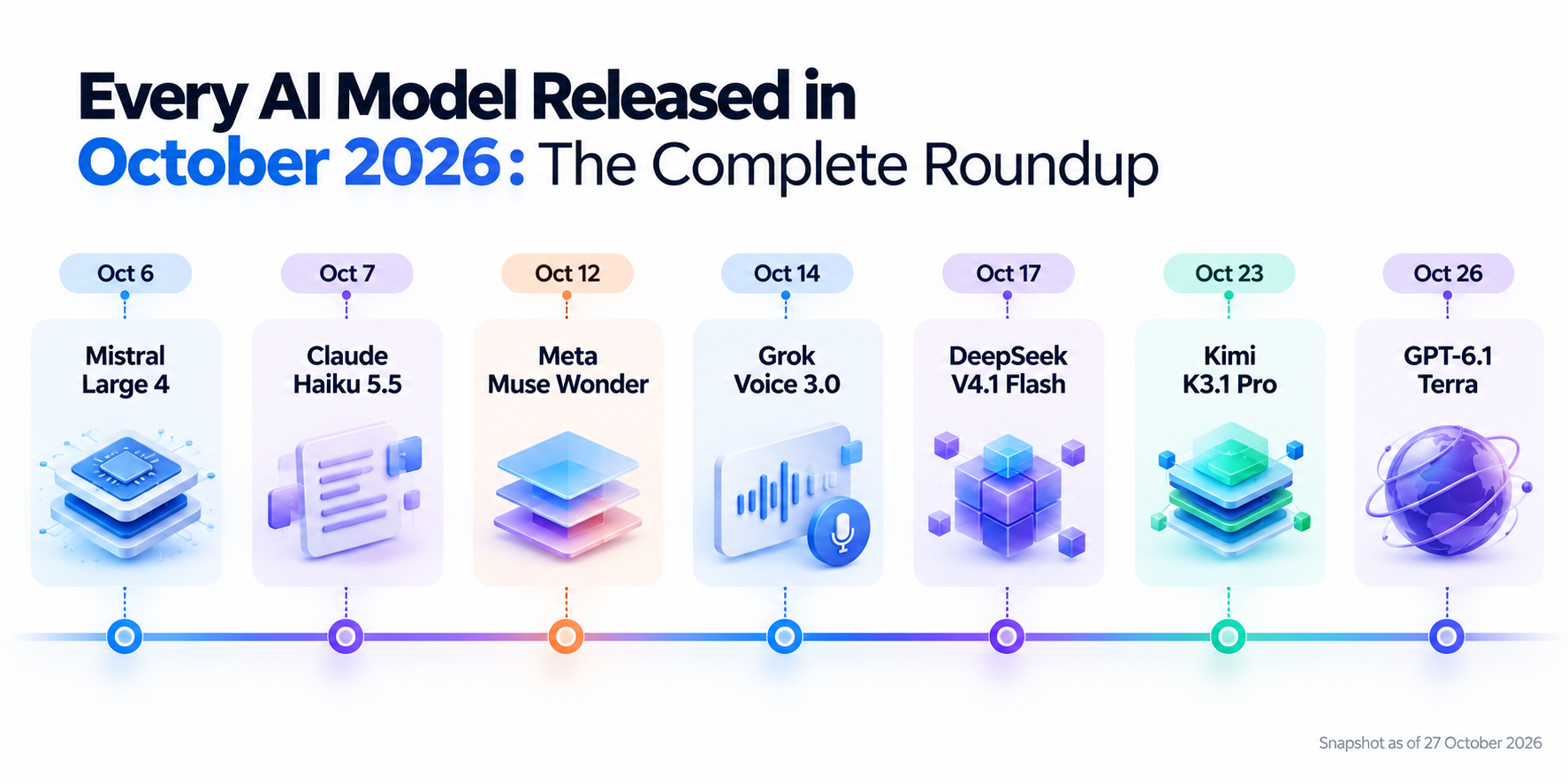
What changed across the AI model market this month
Smaller models are becoming more useful
Efficiency is increasingly a product feature. When a model handles routine work at lower latency and cost, teams can use AI in more workflow steps without routing every request to a flagship model.
AI is moving from answers to actions
Computer-use and agent-style capabilities point toward systems that interact with tools and interfaces. This can save time, but raises the importance of permissions, audit logs, confirmation steps and safe failure handling.
Model names alone are not enough
A release name does not tell you whether a model is available in your region, supports your API, permits commercial use or performs well on your task. Check release notes, model cards, pricing pages and licenses separately.
The release-count problem is real
A headline claiming 40 or 50 releases may include small variants, integrations and product updates. Another tracker may count only a dozen model launches. The methodology differs; a trustworthy roundup explains its counting rule instead of presenting a number without context.
How to choose the right new AI model
Define the task first: coding, writing, document extraction, image understanding, speech, classification or computer use.
Check access and licensing: public app, API, preview, downloadable weights, commercial-use terms and regional restrictions.
Compare total cost: input/output pricing, caching, tool calls, retries and human review.
Test quality on your own examples using a representative evaluation set; score accuracy, latency and failure modes.
Review operational risk: data handling, retention, permissions, auditability and human escalation.
The best model is not necessarily the newest or the highest-ranked. It is the one that meets your task’s quality threshold at an acceptable cost and risk.
Frequently asked questions
Which AI models were released in October 2026?
Notable entries reported by provider announcements and model trackers include GPT-6.1 Terra, Claude Haiku 5.5, Muse Wonder, Grok Voice 3.0, Mistral Large 4, DeepSeek V4.1 Flash 1017, MiniMax M3.1 Flash, Kimi K3.1 Pro and several vision, image and efficiency-focused models. The exact count depends on whether variants, previews and API updates are counted separately.
What was the biggest AI model release in October 2026?
There is no objective winner across every task. GPT-6.1 Terra stands out for computer use and visual reasoning; Claude Haiku 5.5 targets fast, cost-sensitive workloads. Compare other releases using independent evaluations and your own use case.
Are all newly announced models available to everyone?
No. A model may be announced, released as a preview, available only through an API, restricted to certain users, or listed by a third-party gateway before broad access. Check the provider’s official documentation.
How often should this roundup be updated?
Review it at least weekly during the month and show a clear “last updated” date. After October ends, preserve the month-end snapshot and correct errors with a note rather than silently changing the historical record.
Conclusion
October 2026’s releases show an AI market expanding in several directions at once: computer-use systems, efficient models for high-volume work, voice-focused releases and a steady stream of multimodal and specialist models.
The useful question is not which model launched most recently. It is which release changes what you can do, at what cost, and with what reliability. Keep official release notes close, test models on real tasks, and treat independent evaluations as more informative than marketing claims alone.
This roundup is a snapshot dated 27 October 2026. Providers can update availability, pricing and model names after launch, so verify those details before purchasing or deploying a model.
Comments (0)
No comments yet. Be the first to share your thoughts!