What Is AI Orchestration? A Complete Guide to How It Works, Tools, and Real-World Use Cases

Author
Ravi Prajapati

Understand what AI orchestration is, how it works, why enterprises need it, and which tools lead the space in 2026. A clear, practical guide for tech leaders and product teams.
AI orchestration is the coordination layer that connects multiple AI agents, models, and automated tools into a single, coherent workflow. It handles task sequencing, memory sharing, error recovery, and decision-making so that individual AI systems work together rather than in isolation. This guide explains what AI orchestration is, why it matters in 2026, how it works step by step, and which tools are leading the space.
The Coordination Problem Nobody Is Talking About
Most organizations now have AI somewhere in their stack. A chatbot here. A document summarizer there. Maybe a code-review assistant. They all perform well in demos and controlled tests. In production, something breaks down.
The culprit is rarely the AI model itself. It is the absence of coordination between models.
Half of all active AI agents today operate in complete isolation. They cannot pass context to one another, hand off tasks, or recover gracefully when something fails. The result is fragmented workflows, duplicated effort, and AI investments that do not compound into measurable output.
That is exactly the problem AI orchestration solves.
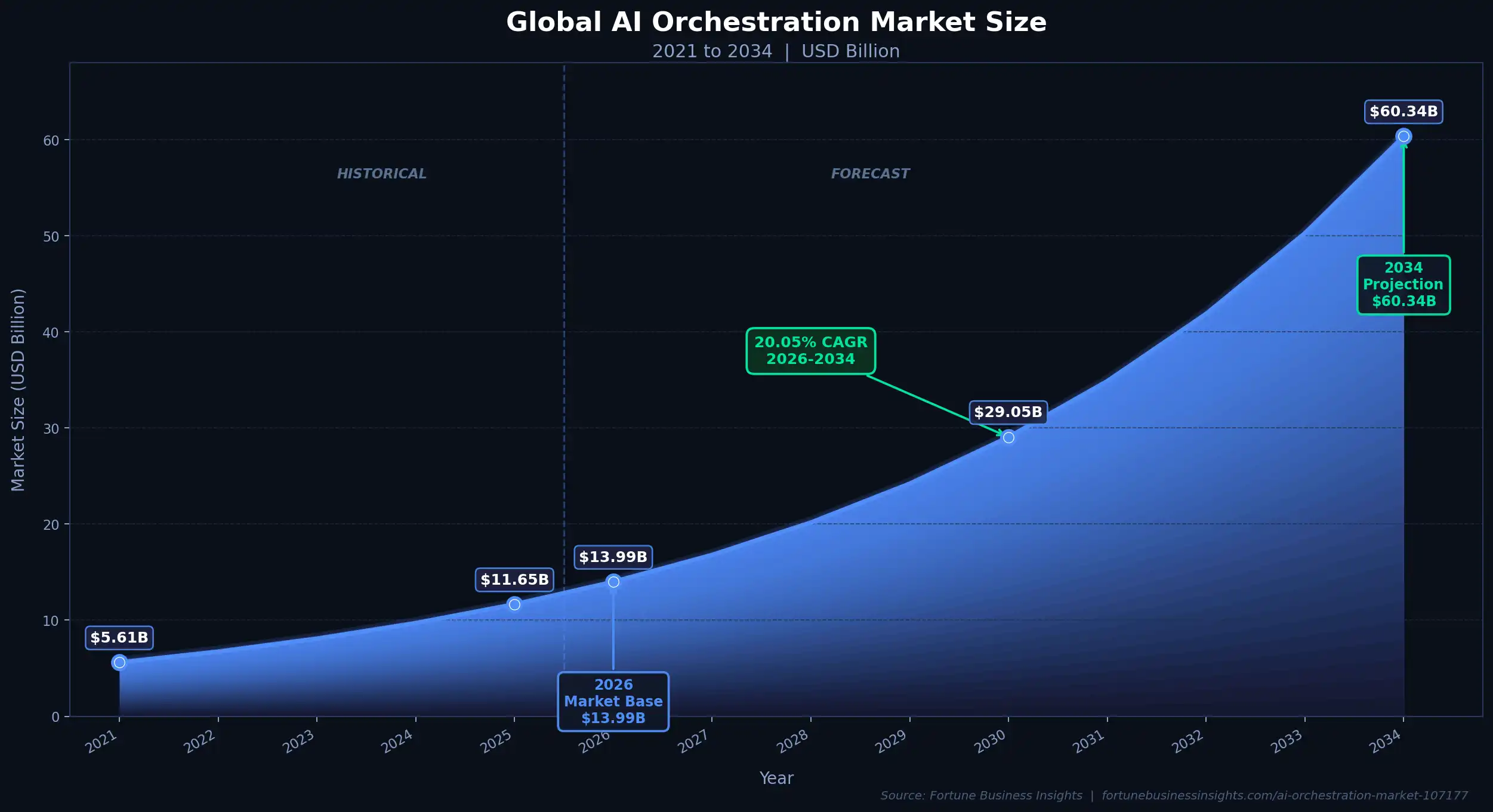
The global AI orchestration market was valued at $13.99 billion in 2026 and is projected to reach $60.34 billion by 2034 (Fortune Business Insights). That trajectory reflects one thing: enterprises are realizing that having AI tools is not enough. Making those tools work together is the real challenge.
What Is AI Orchestration?
AI orchestration is the technology layer that coordinates multiple AI agents or models into a unified, functioning system. Rather than each agent operating independently, an orchestration layer manages which agent handles which task, in what order, with what data, and what should happen when something goes wrong.
Think of a symphony orchestra. Each musician knows their instrument well. But without a conductor to coordinate timing, cues, and transitions, the result is noise. AI orchestration is the conductor.
A traditional automation tool (like RPA) follows a fixed script. A standalone AI agent responds to a prompt. AI orchestration does something more sophisticated: it decomposes complex goals into subtasks, assigns each subtask to the right agent, passes context between them, and dynamically adjusts when conditions change.
It is not a chatbot. It is not a workflow template. It is the architectural layer that makes multi-agent AI systems actually work.
Why AI Orchestration Matters Right Now
The urgency is not theoretical. According to Gartner, more than 40% of agentic AI projects will be cancelled by end of 2027 if businesses do not apply proper orchestration and risk management practices (Gartner, 2025). That statistic is not a prediction about AI quality. It is a prediction about AI coordination.
Here is what unorchestrated AI environments look like in practice:
Agents produce outputs that no other system can consume. LLMs lose context mid-conversation because there is no memory layer connecting interactions. Automation pipelines stall at the first failure and require manual restart. Organizations accumulate five separate AI tools with no shared data pipeline between them.
The problem scales badly. Coordinating one agent is manageable. Five agents running independently become an availability risk. Fifty become a governance crisis.
Organizations that deploy orchestration early report efficiency gains of 20 to 30% in the first year from AI-driven process automation, primarily at the handoff points between systems, teams, and data sources (McKinsey, State of AI).
The transition from AI experimentation to enterprise-grade AI cannot happen without an orchestration layer built into the system from the start.
How AI Orchestration Works: Step-by-Step
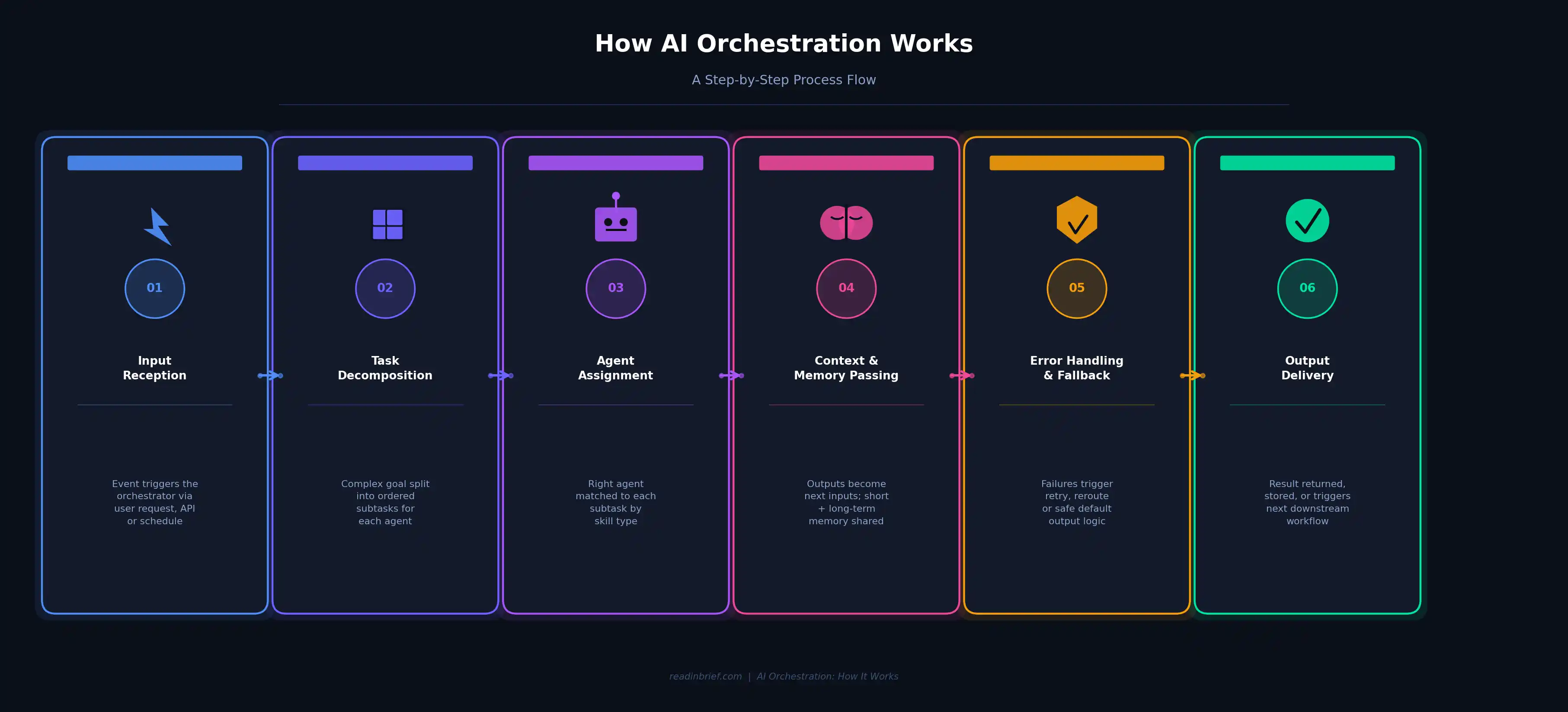
AI orchestration follows a repeatable process, regardless of the tools or models involved. Understanding this process is more useful than memorizing any framework.
Step 1: Input Reception
An event triggers the orchestrator. This could be a user request, a scheduled job, an API webhook, or a change in a dataset. The orchestrator recognizes the trigger and begins processing.
Step 2: Task Decomposition
The orchestrator breaks the goal into subtasks. For example, "generate a monthly financial report" becomes: retrieve data, validate it, run analysis, draft a summary, format the output, and deliver the result. Complex goals require intelligent decomposition before any agent touches them.
Step 3: Agent Assignment
Each subtask is routed to the agent best suited for it. A SQL-capable agent handles data retrieval. An LLM handles drafting. A communication agent handles delivery. Specialization becomes an advantage when there is a coordinator managing it.
Step 4: Context and Memory Passing
This is where most naive implementations fail. Each agent's output becomes the next agent's input. The orchestrator maintains both short-term memory (current session state) and long-term memory (user preferences, past decisions, learned patterns). Without this layer, agents restart from zero on every interaction.
Step 5: Error Handling and Fallback
If an agent times out, returns an unexpected result, or encounters an exception, the orchestrator applies a fallback strategy. This might mean retrying with exponential backoff, routing to an alternative agent, escalating to a human, or returning a safe default output. Without this layer, one failing agent breaks the entire pipeline.
Step 6: Output Delivery
The completed result is returned to the end user, stored in the appropriate system, or used to trigger the next downstream workflow.
Steps 4 and 5 are where the real technical complexity lives. Memory management and error recovery are what separate production-grade orchestration from a proof of concept that works under ideal conditions.
Key Components of an AI Orchestration System
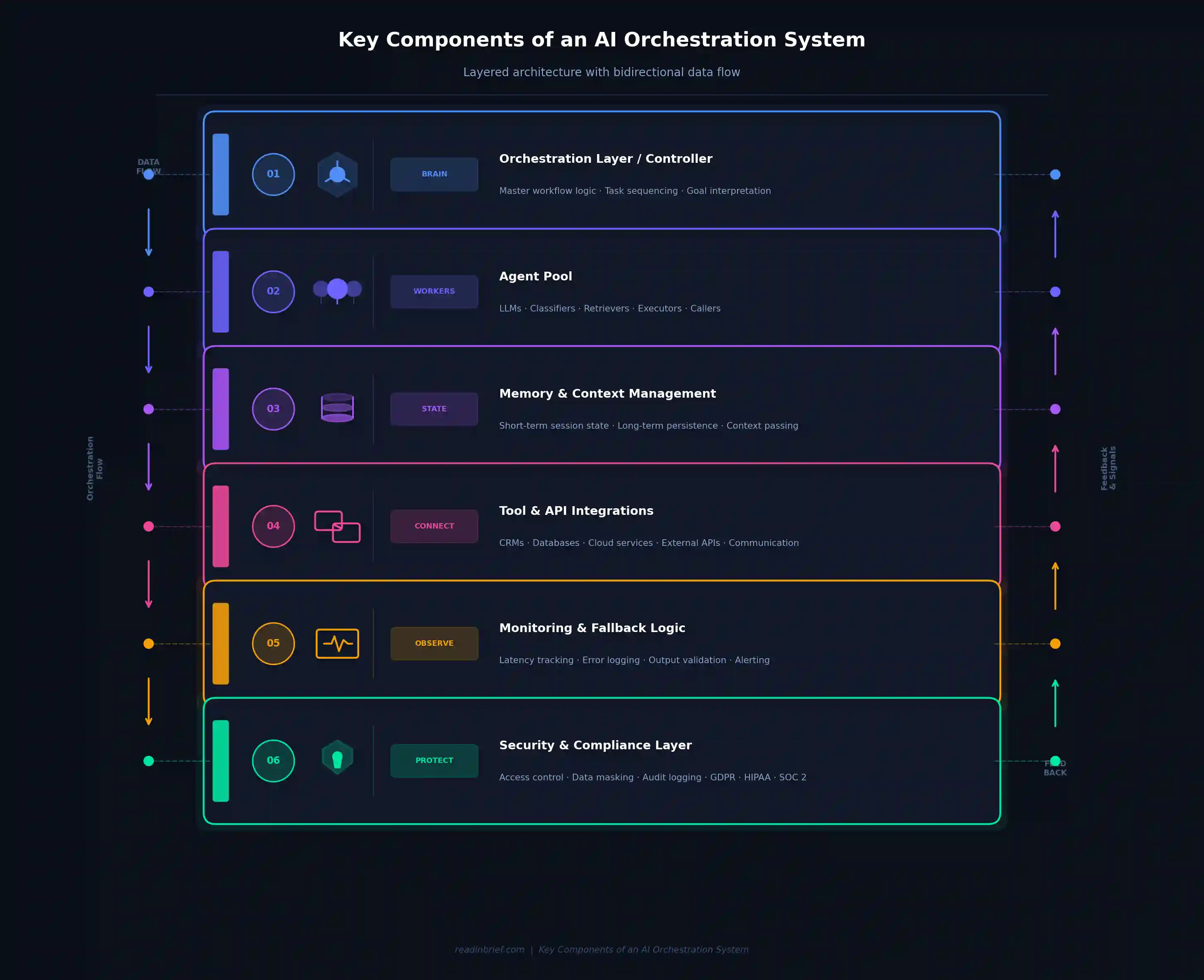
A production-ready AI orchestration system is not a single application. It is a set of integrated layers, each with a specific job.
The Orchestration Layer (Controller)
This is the brain of the system. It holds the master workflow logic, interprets goals, assigns tasks, and manages the sequencing and timing of agent interactions. Without this layer, you have a collection of independent tools, not an orchestrated system.
The Agent Pool
These are the specialized AI workers: large language models, classifiers, retrievers, data executors, and external service callers. Each agent is optimized for a specific type of task. The orchestration layer's job is to assign the right work to the right agent at the right time.
Memory and Context Management
Short-term memory holds session state for the current workflow. Long-term memory stores persistent information such as user preferences, prior decisions, and historical patterns. Context passing ensures that each agent in the pipeline receives structured, relevant output from its predecessor rather than starting from scratch.
Tool and API Integrations
Orchestrators connect to external systems: CRMs, databases, cloud services, communication platforms, and third-party APIs. This is what makes an orchestrated AI agent meaningfully different from a chatbot. An isolated agent responds to prompts. An agent embedded in your toolchain takes action in your actual systems.
Monitoring and Fallback Logic
Every production orchestration system requires observability: latency tracking, error logging, output validation, and alerting. Fallback logic defines what happens when things break. Monitoring without fallback is observation. Fallback without monitoring is guesswork. You need both.
Security and Compliance Layer
Orchestrators move sensitive data between agents, tools, and external APIs, which creates compliance exposure. A properly built orchestration system includes role-based access control, data masking during transmission, encrypted storage, audit logging, and built-in compliance governance for standards like GDPR, HIPAA, and SOC 2. This layer is consistently underbuilt in early implementations and consistently cited in late-stage deployment failures.
AI Orchestration vs. Basic Automation vs. Standalone Agents
The differences between these three approaches are practical, not just conceptual. Getting this wrong leads to choosing the wrong tool for the problem.
Dimension | Basic Automation (RPA) | Standalone AI Agent | AI Orchestration |
|---|---|---|---|
Flexibility | Rule-based and rigid | Adaptive within a single scope | Adaptive across multiple scopes |
Multi-task handling | Sequential fixed steps | Single task only | Multi-agent with parallel execution |
Context awareness | None | Session-level only | Short-term and long-term memory |
Error handling | Fail or manual escalation | Retry or fail | Fallback, reroute, and recover |
Scale | Linear cost increase | Limited by single model | Horizontally scalable |
Governance | Script-level | Prompt-level | System-level |
Automation works well for highly repetitive processes with minimal variation. Standalone agents excel at focused conversational or research tasks. Orchestration becomes necessary when a single process involves multiple steps, dependencies, multiple data sources, or requires recovery from partial failures.
The important nuance: orchestration does not replace RPA or standalone agents. It elevates them. RPA bots can become nodes in an orchestrated pipeline. Individual LLM agents can be specialized workers that the orchestrator assigns tasks to. Orchestration is the coordination layer, not a replacement for what already works.
Real-World AI Orchestration Use Cases
The efficiency gains from AI orchestration are not evenly distributed. They concentrate at the handoff points between systems, which is precisely where manual effort and error rates are highest.
Customer Service Automation
An orchestration layer receives incoming support requests and routes them based on intent and complexity. Simple queries go to an FAQ agent. Billing issues go to a CRM-connected agent. Complex complaints escalate to a human with full context already assembled. In well-implemented systems, 70 to 80% of cases resolve without human intervention.
Supply Chain and Inventory Management
Orchestrators ingest data simultaneously from IoT sensors, ERP systems, and demand forecasting models. They identify anomalies, trigger reorder workflows, and surface exceptions that require human review. The speed advantage comes from parallel processing across data sources that previously required manual aggregation.
Software Development Pipelines
AI-orchestrated CI/CD pipelines can automate code review, test plan generation, security scanning, and deployment approval workflows. Each stage is handled by a specialized agent, with the orchestrator managing dependencies and fallbacks between them.
Healthcare Documentation and Compliance
Clinical documentation workflows arrange transcription models, medical coding agents, compliance checkers, and EHR integration in a coordinated sequence. Practitioners get documentation handled automatically. Compliance requirements are verified at each step rather than after the fact.
Financial Reporting and Fraud Detection
Orchestrated financial workflows gather data from multiple sources, run reconciliation processes, apply AI-based anomaly detection, and surface flagged items for human review. Reporting that previously required days of manual effort can be reduced to hours.
Popular AI Orchestration Tools and Frameworks in 2026
Choosing the right framework depends on your existing stack, your team's technical capabilities, and the complexity of workflows you need to support.
Framework or Tool | What It Does | Best Fit |
|---|---|---|
LangChain and LangGraph | Builds AI agent pipelines and connects multi-step LLM workflows | Complex LLM workflows and multi-agent systems |
Microsoft AutoGen | Enables multiple AI agents to communicate and collaborate | Approval-based and conversational multi-agent workflows |
CrewAI | Assigns roles and responsibilities to AI agents | Simpler team-based AI automation |
Prefect | Manages workflow scheduling, execution, and monitoring | Data pipelines and ML workflow orchestration |
Apache Airflow | Mature pipeline management with broad ecosystem support | Enterprise data and ML pipeline management |
No framework is universally correct. LangGraph is often the right starting point for LLM-heavy workflows. AutoGen suits scenarios where agents need to negotiate or review each other's work. CrewAI is accessible for teams new to multi-agent systems. Prefect and Airflow are strong choices when the orchestration need is primarily around data pipelines rather than LLM agent coordination.
The practical advice: start with a contained proof of concept in one framework before committing your production architecture to it. The time spent validating your framework choice early is always recovered in implementation.
How to Get Started with AI Orchestration
Getting started does not require a complete architectural overhaul. The path is incremental, and the early steps are more about clarity than tooling.
Step 1: Audit your current AI landscape
List every AI tool, automation script, LLM integration, and standalone agent currently in use. Map what data flows into each, what comes out, and what happens at the handoffs. Most organizations discover more tools and more gaps than they expected.
Step 2: Define specific orchestration goals
Vague goals produce vague architectures. Identify the concrete outcomes you want: reduce support ticket resolution time by 40%, eliminate manual reconciliation steps in the reporting pipeline, or reduce time-to-close in the sales workflow. Measurable goals allow you to evaluate whether your orchestration layer is working.
Step 3: Select a framework that matches your stack
Review LangGraph, AutoGen, CrewAI, and Prefect against your existing technology, your team's expertise, and the complexity of the workflows you are targeting. Do not choose based on marketing or popularity alone.
Step 4: Build a proof of concept on a contained use case
Pick one workflow with a clear start, a clear end, and a measurable outcome. Build the orchestration layer for that workflow only. Validate the design in a non-production environment before expanding.
Step 5: Deploy with observability from day one
Track latency, failure rates, and output quality from the first production deployment. Orchestration architectures require iteration. You cannot improve what you are not measuring.
Frequently Asked Questions About AI Orchestration
What is the difference between AI orchestration and basic automation?
Basic automation, such as RPA, follows fixed rule-based scripts that execute the same sequence every time. AI orchestration is fundamentally different: it routes tasks dynamically between agents, maintains context across steps, handles unexpected inputs, and recovers from partial failures. Automation handles repetition. Orchestration handles complexity.
Why do I need orchestration if I already have AI agents?
Individual AI agents are specialized for specific tasks. They produce outputs, but they cannot communicate with each other, share context, or manage multi-step workflows. Without orchestration, you have several effective tools with no coordination between them. Orchestration is what converts a collection of tools into a system.
What role does memory play in AI orchestration?
Memory prevents each step in an orchestrated workflow from starting from scratch. Short-term memory holds current session state. Long-term memory stores persistent data like user preferences, prior decisions, and historical patterns. Context passing ensures that each agent in the pipeline receives the structured output of its predecessor rather than a blank prompt.
How does AI orchestration handle errors and failures?
Error handling is one of orchestration's core functions. A well-built orchestration layer includes retry logic with backoff, alternative routing when an agent is unavailable, human escalation when output quality falls below a threshold, and safe default outputs when recovery is not possible. Without this layer, a single agent failure stops the entire workflow.
How does AI orchestration address security and data privacy?
Orchestration layers move sensitive data between agents, APIs, and external systems. This creates real compliance exposure. Production-grade orchestration systems include role-based access control, data masking during transit, encrypted storage, audit logging, and built-in governance for regulatory frameworks including GDPR, HIPAA, and SOC 2. Security needs to be designed into the orchestration architecture from the start, not added afterward.
Which AI orchestration tools are most widely used in 2026?
LangChain and LangGraph lead for LLM-centric orchestration. Microsoft AutoGen is widely used for multi-agent conversational workflows. CrewAI is popular for teams building role-based agent systems. Prefect and Apache Airflow remain the dominant choices for data and ML pipeline orchestration. Your best tool depends on your specific workflow type, team expertise, and existing technology stack.
The Takeaway
AI orchestration is the infrastructure layer that converts a collection of AI investments into a system that compounds value over time. Without it, agents work in isolation, workflows stall at handoffs, and automation scales poorly.
The market's trajectory from $13.99 billion in 2026 to a projected $60.34 billion by 2034 (Fortune Business Insights) reflects a straightforward conclusion: coordination is the competency that separates organizations getting consistent results from AI from those that are not.
The teams building durable AI-powered operations are not necessarily the ones with the most sophisticated models. They are the ones who built the coordination layer first.
Comments (0)
No comments yet. Be the first to share your thoughts!