AI in Patient No-Show Prediction: Use Cases, Benefits, Models, and Implementation Guide

Author
Ravi Prajapati
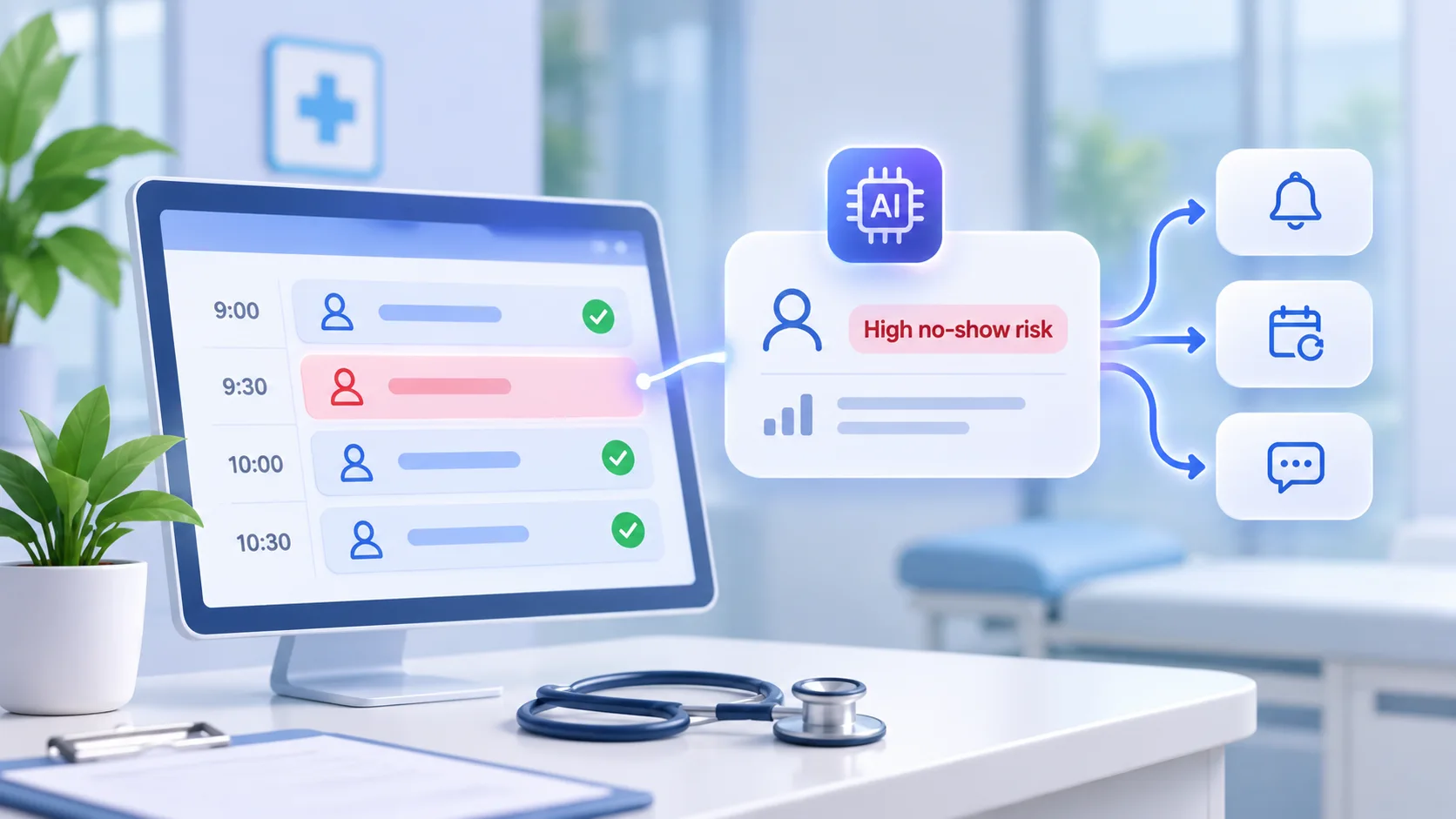
Learn how AI predicts patient no-shows, the machine learning models used, key benefits, implementation steps, and strategies to improve appointment attendance.
Missed healthcare appointments create challenges for hospitals, clinics, and patients. When a patient does not attend a scheduled appointment, healthcare providers lose valuable clinical time, appointment slots remain unused, and other patients may wait longer for care.
Traditional appointment reminders can reduce some missed visits, but they do not always address the reasons behind them. A patient may forget an appointment, face transportation difficulties, have a scheduling conflict, or be unable to attend because of work or family responsibilities.
AI in patient no-show prediction helps healthcare providers estimate which appointments are more likely to be missed and decide where additional support may be useful.
By analyzing appointment histories, scheduling patterns, patient interactions, and other relevant information, machine learning models can identify patterns associated with missed appointments. Healthcare teams can then use these predictions to send targeted reminders, offer rescheduling options, or provide additional assistance.
However, prediction alone does not guarantee improved attendance. The value of AI depends on the quality of the data, the accuracy of the model in a real clinical setting, the intervention offered to patients, and how consistently the system is monitored.
This guide explains how AI-based patient no-show prediction works, which machine learning models are commonly used, real-world research findings, implementation considerations, and how healthcare organizations can develop a practical solution.
What Is Patient No-Show Prediction?
Patient no-show prediction is the process of estimating the likelihood that a patient will miss a scheduled healthcare appointment without cancelling or notifying the provider in advance.
AI-based prediction systems use historical and current appointment data to calculate a risk score for an upcoming appointment.
For example, a clinic may have 500 appointments scheduled for the following week. An AI model can analyze those appointments and identify a subset that may have a higher probability of being missed.
The clinic can then prioritize appropriate actions, such as:
Sending an additional appointment reminder.
Offering a convenient option to confirm or reschedule.
Making a follow-up phone call.
Helping patients understand appointment instructions.
Reviewing whether transportation or accessibility support is needed.
Offering an appointment slot to another patient if a cancellation occurs.
The prediction should be treated as a probability, not a conclusion about a patient’s intentions.
Patient no-show vs. late cancellation vs. provider cancellation
These appointment outcomes should be distinguished when training and evaluating a prediction model.
Appointment outcome | Meaning |
|---|---|
No-show | The patient does not attend and does not cancel within the provider’s defined policy. |
Late cancellation | The patient cancels too close to the appointment time for the provider to fill the slot. |
Early cancellation | The patient cancels with enough notice to allow rescheduling. |
Provider cancellation | The healthcare organization cancels the appointment. |
Attended appointment | The patient attends the scheduled appointment. |
Combining all missed appointments into one category may create misleading results. For example, a model that predicts late cancellations may need different interventions from a model that predicts patients who are likely to forget an appointment.
Why Do Healthcare Providers Need AI for Patient No-Show Prediction?
Missed appointments affect healthcare operations and patient access to care.
1. Unused appointment slots
When a patient misses an appointment, the provider may be unable to use the slot for another patient. This can affect clinic utilization and scheduling efficiency.
2. Longer patient waiting times
Unused slots can coexist with long waiting lists. A clinic may have patients waiting for consultations while appointment capacity remains unused because of missed visits.
3. Disrupted continuity of care
Missed follow-up appointments can delay monitoring, treatment adjustments, and ongoing care.
4. Increased administrative workload
Staff may need to contact patients, manage rescheduling, update records, and fill cancelled appointment slots.
5. Limitations of general reminders
Standard reminders are often sent to every patient using the same schedule and communication channel. They may not be sufficient for patients who need more personalized support.
AI can help providers prioritize outreach, but it should complement—not replace—existing reminder systems and patient access processes.
How Does AI-Based Patient No-Show Prediction Work?
An AI patient no-show prediction system uses historical appointment data to estimate the risk of a patient missing a future appointment.
The process typically includes six steps.
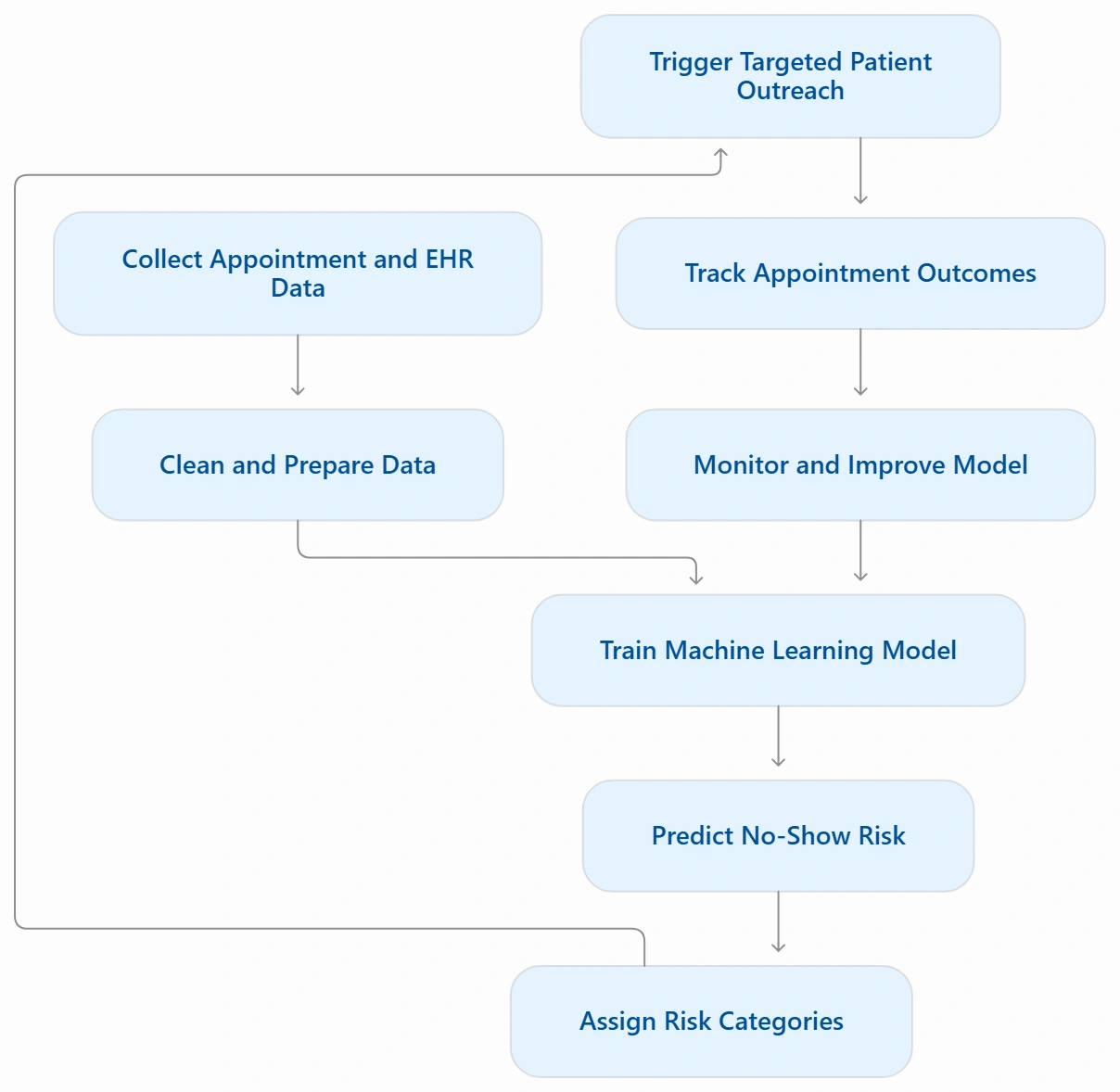
Step 1: Collect relevant healthcare data
The system gathers information from appointment scheduling systems, electronic health records (EHRs), and patient communication platforms.
Common data inputs include:
Appointment date and time.
Appointment lead time.
Previous attendance history.
Previous cancellations and rescheduling.
Specialty and clinic location.
Appointment type.
Reminder delivery and confirmation history.
Patient communication preferences.
Relevant and appropriately governed access-related information.
The organization should only collect data that is necessary for the prediction and intervention purpose.
Step 2: Prepare the data
Healthcare appointment records may contain missing values, inconsistent appointment statuses, duplicate records, and outdated contact details.
Data preparation may involve:
Removing duplicate appointment records.
Standardizing appointment outcome labels.
Handling missing values.
Correcting inconsistent timestamps.
Separating training data from testing data.
Preventing information leakage from events that occurred after the prediction time.
For example, a model should not use a patient's final appointment confirmation status if that confirmation occurred after the time at which the prediction is supposed to be made.
Step 3: Train the machine learning model
The prepared dataset is used to train a model to identify patterns associated with missed appointments.
Algorithms may include logistic regression, random forest, gradient boosting, XGBoost, and other machine learning methods.
The model learns from historical appointment outcomes and evaluates how different factors relate to no-show risk.
Step 4: Generate a risk score
For every upcoming appointment, the system produces a probability or risk score.
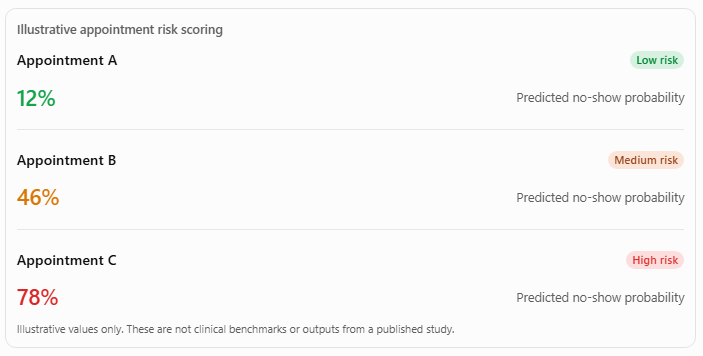
A healthcare organization can define thresholds based on its own historical data, operational capacity, and intervention costs. Risk categories should not be treated as universal standards.
Step 5: Trigger a suitable intervention
The risk score can be connected to an appointment management workflow.
For example:
Low risk: continue standard reminder workflow.
Medium risk: send an additional SMS or confirmation request.
High risk: send a reminder with confirmation and rescheduling options, or initiate an appropriate phone outreach workflow.
The intervention should be based on the patient’s communication preferences and the healthcare provider’s policies.
Step 6: Monitor outcomes
The system should track whether patients attend, cancel, or reschedule appointments.
This information can help healthcare organizations evaluate whether the prediction model is working and whether the outreach strategy is improving attendance.
The model should be monitored for changes in performance over time, particularly when appointment patterns, patient populations, or operational processes change.
What Data Is Required for AI Patient No-Show Prediction?
Data quality is one of the most important factors in building a reliable prediction system.
Data Category | Example Data | Why It Matters |
|---|---|---|
Appointment data | Date, time, specialty, appointment type | Identifies scheduling patterns |
Attendance history | Previous attended and missed visits | Helps identify recurring attendance patterns |
Scheduling data | Lead time, rescheduling history | Helps estimate appointment-related risk |
Communication data | SMS delivery, confirmation, call response | Helps understand reminder engagement |
Clinic data | Location, department, provider schedule | Captures operational differences |
Patient access data | Transportation or access barriers, where appropriately collected | May help identify support needs |
Outcome data | Attended, no-show, cancelled, rescheduled | Provides the target variable for training |
Why appointment lead time is important
Appointment lead time refers to the period between booking an appointment and the scheduled appointment date.
A longer lead time may create more opportunities for scheduling conflicts or changes in a patient's circumstances.
A 2025 study published in Annals of Family Medicine analyzed 109,328 patients and 1,118,236 appointments. Its gradient-boosting model achieved an AUROC of 0.852 for no-show prediction and 0.921 for late cancellations. The study identified schedule lead time as its most important predictor.
These results show that scheduling-related variables can be valuable. However, performance in one healthcare organization does not guarantee the same results in another.
Machine Learning Models Used for Patient No-Show Prediction
Different machine learning algorithms can be used to estimate appointment no-show risk. The best choice depends on the data volume, interpretability requirements, prediction performance, and deployment environment.
1. Logistic Regression
Logistic regression is a commonly used baseline model for binary prediction problems.
It estimates the probability of an appointment being missed based on selected input variables.
Example: The model may estimate no-show probability based on appointment lead time, previous missed visits, appointment type, and reminder status.
Advantages:
Easy to interpret.
Computationally efficient.
Suitable for baseline model development.
Can provide understandable relationships between input variables and predicted risk.
Limitations:
May not capture complex nonlinear relationships without additional feature engineering.
Can underperform more flexible algorithms when patterns are complex.
2. Decision Tree
A decision tree uses a series of rules to make a prediction.
For example:
If appointment lead time is long, evaluate another factor.
If previous no-shows are present, increase the predicted risk.
If appointment confirmation is received, evaluate whether the risk changes.
Advantages:
Easy to explain visually.
Can capture nonlinear relationships.
Useful for communicating model logic.
Limitations:
A single tree may be unstable.
It can overfit historical data.
3. Random Forest
Random forest combines predictions from multiple decision trees.
Each tree is trained using variations of the data and features. Their combined predictions can improve stability and performance compared with a single decision tree.
Advantages:
Handles nonlinear relationships.
Can work with many variables.
Often provides a useful benchmark.
Limitations:
Less straightforward to interpret than a single tree.
May require more computational resources.
4. Gradient Boosting
Gradient boosting builds models sequentially, with each new model attempting to improve on previous errors.
It is useful for structured data such as appointment records and scheduling information.
Advantages:
Can capture complex patterns.
Often performs well on tabular data.
Supports feature importance and explainability methods.
Limitations:
Requires careful tuning.
Can overfit if not validated properly.
May need calibration to make risk scores useful for operational decisions.
5. XGBoost
XGBoost is a gradient-boosting implementation frequently used for structured-data prediction tasks.
It can be useful when appointment datasets contain a large number of features and nonlinear relationships.
In the 2026 MRI no-show study published in JAMIA Open, XGBoost achieved an AUROC of 0.65 on a held-out validation dataset. Its performance decreased to 0.61 during prospective evaluation, partly because of data drift.
Read the 2026 MRI prediction and intervention study.
This illustrates why retrospective model results should not be treated as proof of future operational performance.
6. Neural Networks
Neural networks can model complex patterns and may be appropriate for large datasets or systems that combine structured appointment data with additional data types.
However, they are not automatically better than simpler algorithms.
Healthcare organizations should evaluate them against simpler models and consider interpretability, calibration, deployment costs, and data requirements.
Model comparison
Model | Interpretability | Potential Use |
|---|---|---|
Logistic Regression | High | Baseline prediction |
Decision Tree | High | Rule-based explanation |
Random Forest | Moderate | Robust structured-data modeling |
Gradient Boosting | Moderate | Complex appointment patterns |
XGBoost | Moderate | High-performance tabular prediction |
Neural Network | Lower to moderate | Large or complex datasets |
The final model should be selected using local validation rather than algorithm popularity.
Research and Real-World Evidence: What Does the Latest Data Show?
Published research indicates that machine learning can help identify missed appointments. However, the effectiveness of prediction models and the effectiveness of interventions are two different questions.
2025: Comprehensive review of machine learning no-show prediction
A 2025 review by Toffaha and colleagues examined 52 publications covering machine learning for patient no-show prediction between 2010 and 2025.
The review found that logistic regression was frequently used, while tree-based methods, ensemble techniques, and deep learning were also represented. Model performance varied substantially across studies and healthcare settings.
The review highlights the importance of context, data quality, and implementation.
Read the 2025 review in Intelligence-Based Medicine.
2025: Personalized prediction in primary care
The Annals of Family Medicine study used data from 15 family medicine clinics in Pennsylvania.
Its dataset included:
109,328 patients.
1,118,236 appointments.
77,322 no-shows.
75,545 late cancellations.
The gradient-boosting model reported an AUROC of 0.852 for no-shows and 0.921 for late cancellations.
The study also investigated contributing factors at population and patient levels.
2026: MRI no-show prediction and targeted phone calls
A study published in JAMIA Open in August 2026 evaluated an ML model for outpatient MRI appointments and tested a targeted phone call intervention.
Key findings:
Research Measure | Result |
|---|---|
Total appointments | 38,141 |
Historical no-show rate | 16.6% |
Held-out XGBoost AUROC | 0.65 |
Prospective AUROC | 0.61 |
No-show rate in intervention group | 21.9% |
No-show rate in control group | 22.0% |
The intervention did not produce an overall reduction in no-shows in that study. The authors identified data drift and difficulties reaching patients as important challenges.
2026: Automated phone calls added to SMS reminders
A Penn Medicine study published in NEJM Catalyst evaluated an automated interactive voice response (IVR) system for patients at high risk of missing appointments.
The IVR calls allowed patients to confirm, cancel, or reschedule appointments.
The study reported:
Outcome | SMS reminders only | SMS + IVR calls |
|---|---|---|
No-show rate | 11.3% | 9.6% |
Appointment completion rate | 75.9% | 77.8% |
The trial involved 59,994 high-risk patients. The study reported a 1.7 percentage-point reduction in no-shows and a 1.9 percentage-point increase in completed appointments. Follow-up data from more than 244,000 high-risk patients over six months indicated that the improvement was sustained.
This is a useful example of combining prediction with a practical patient outreach intervention.
Read the Penn Medicine research summary.
Key takeaway from the research: AI can help identify patients who may need additional support, but the model's real value depends on what the healthcare organization does with the prediction.
Practical Use Cases of AI in Patient No-Show Prediction
AI-based no-show prediction can support several healthcare workflows.
1. Targeted appointment reminders
Instead of sending the same reminder to every patient, the system can identify appointments that may benefit from an additional reminder.
For example, a patient with a high predicted risk may receive an SMS reminder a few days before the appointment and another confirmation request closer to the visit.
2. Automated confirmation and rescheduling
AI can be connected to SMS, IVR, chatbot, or patient portal workflows.
Patients can confirm attendance, cancel an appointment, or request a new time without contacting the clinic manually.
This can help staff identify open slots earlier.
3. Appointment slot optimization
When a patient cancels, the scheduling system can notify eligible patients on a waiting list.
AI may help prioritize patients based on appointment suitability, availability, urgency determined by clinical staff, and scheduling constraints.
It should not independently make clinical prioritization decisions.
4. Patient engagement and support
A high risk score can prompt staff to ask whether the patient needs assistance.
For example, the patient may need:
A different appointment time.
Help understanding the appointment instructions.
A preferred reminder channel.
Accessibility support.
Transportation information.
The objective should be to remove barriers to attendance rather than label patients as unreliable.
5. Hospital and clinic resource planning
Aggregated no-show risk patterns can help operational teams understand likely appointment utilization by clinic, specialty, or time period.
These insights can support scheduling decisions and resource planning, provided the predictions are validated and used responsibly.
6. Specialty-specific prediction
No-show patterns can vary between specialties.
A clinic may develop or validate separate models for:
Primary care.
Radiology and MRI.
Dental care.
Mental health appointments.
Specialist consultations.
Follow-up visits.
Specialty-specific modeling may improve relevance, but it also increases the need for sufficient data and ongoing validation.
AI Patient No-Show Prediction: Example Workflow
Consider a hypothetical outpatient clinic with 1,000 appointments scheduled for the coming week.
The clinic already sends standard SMS reminders. Its AI system analyzes appointment data and assigns risk scores.
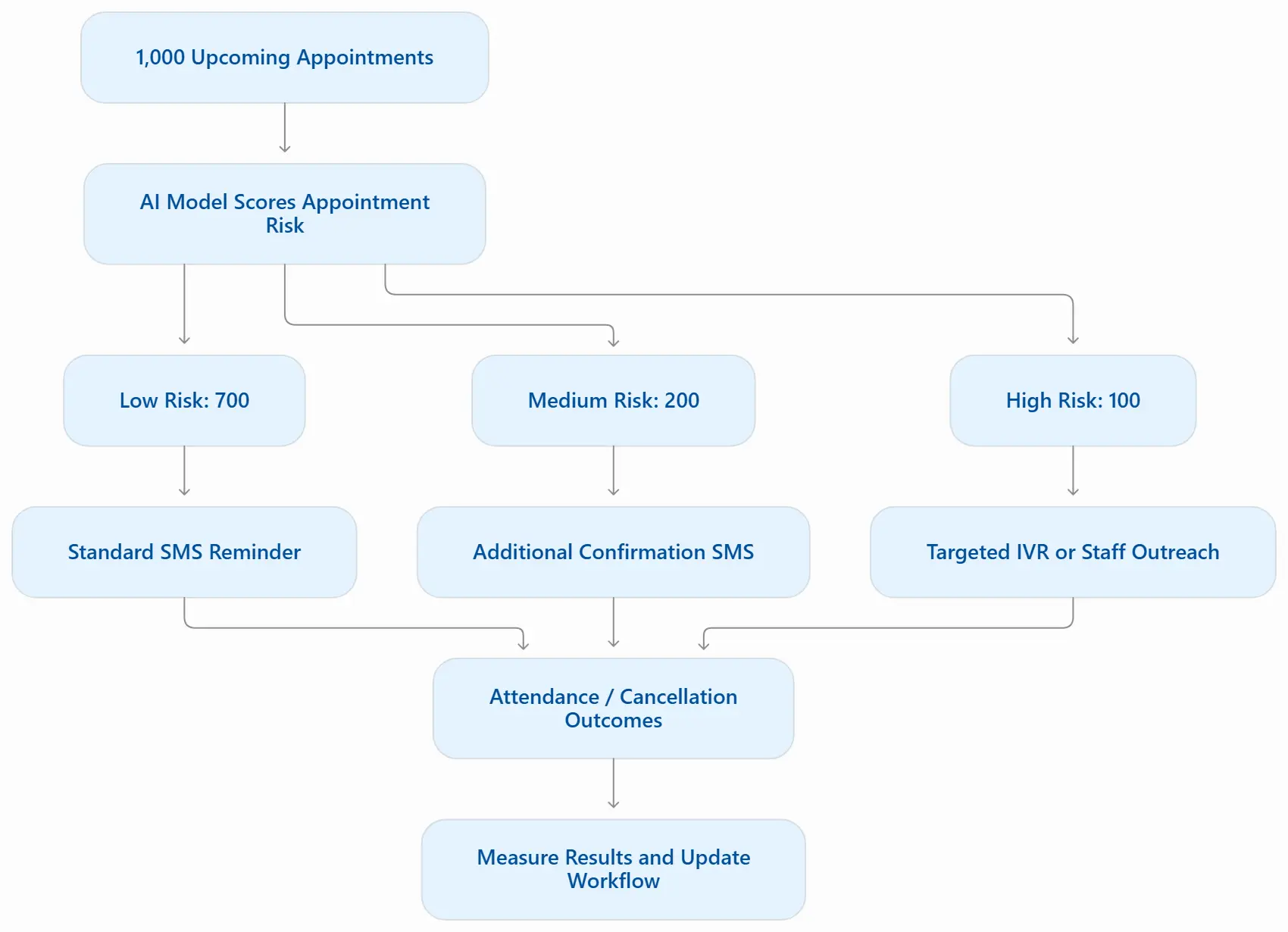
Illustrative workflow only. Appointment counts and risk categories are hypothetical, not published results.
The clinic can compare the outcomes of this workflow with its existing reminder process.
It should also evaluate whether the additional outreach is cost-effective and whether patients find the communication useful.
Benefits of AI-Based Patient No-Show Prediction
Improved appointment attendance
Targeted reminders and timely rescheduling options may help patients attend appointments or cancel early enough for another patient to use the slot.
Better use of appointment capacity
Reducing avoidable missed appointments can help healthcare providers make better use of existing schedules.
Reduced administrative workload
Automated workflows can reduce some manual reminder and confirmation tasks. Staff may still need to handle exceptions, patient questions, and complex rescheduling.
More personalized patient communication
Patients may receive communication based on their preferences and appointment circumstances rather than a uniform reminder sequence.
Improved operational visibility
Healthcare teams can gain insights into attendance patterns, reminder engagement, cancellation behavior, and appointment utilization.
Potential improvement in access to care
When cancellations are identified earlier and appointment slots are reused effectively, other patients may gain access to available appointments sooner.
These benefits are potential outcomes, not guaranteed results. Each healthcare organization should measure its own operational impact.
Challenges and Limitations of AI Patient No-Show Prediction
AI implementation can fail if organizations focus only on model development.
1. Poor-quality appointment data
Incorrect appointment statuses, missing contact information, and inconsistent scheduling records can reduce model reliability.
Solution: Establish data quality checks and standardize appointment outcome definitions before training.
2. Data drift
Appointment patterns can change due to seasonal demand, new clinic policies, provider availability, or changes in patient populations.
A model trained on older data may become less accurate over time.
Solution: Monitor model performance regularly and retrain when necessary.
The 2026 MRI study demonstrated this challenge, with prospective model performance decreasing compared with its held-out validation results.
Reference: JAMIA Open 2026 study.
3. Prediction does not guarantee behavior change
A patient can be predicted as high risk and still attend. Another patient can be predicted as low risk and still miss the appointment.
The system should not assume that a risk score means the patient is unwilling to attend.
Solution: Use predictions to trigger supportive interventions, not punitive decisions.
4. Difficulty reaching patients
An SMS may not be delivered, a phone number may be outdated, or a patient may be unable to respond.
Solution: Support multiple communication channels and respect patient communication preferences.
5. Bias and health equity
A model may perform differently across demographic groups or patients facing different access barriers.
If historical data reflects unequal access to care, the model may reproduce those patterns.
Solution: Evaluate performance and calibration across relevant patient groups. Review whether interventions are equitable and whether the system is identifying barriers that the provider can address.
6. Over-reliance on overbooking
Some organizations may use no-show predictions to overbook appointments.
Overbooking can create operational risk if patients attend as expected, leading to long waiting times and staff overload.
Solution: Treat overbooking as a separate scheduling decision requiring local evaluation and clear operational controls.
How to Measure the Performance of an AI No-Show Prediction System
Healthcare organizations should measure both model performance and operational impact.
Model performance metrics
Metric | What It Measures |
|---|---|
AUROC | How well the model distinguishes between no-show and attended appointments across thresholds |
Precision | How many appointments flagged as high risk actually result in a no-show |
Recall | How many actual no-shows the model identifies |
F1 Score | Balance between precision and recall |
Calibration | Whether predicted probabilities match observed outcome frequencies |
AUPRC | Performance focused on the positive class, useful when no-shows are relatively uncommon |
AUROC should not be used alone. A model can have a respectable AUROC but still generate too many false alerts for an outreach team.
Calibration is particularly important if the system uses risk scores to determine which patients receive additional reminders.
Operational performance metrics
KPI | Purpose |
|---|---|
No-show rate | Measures missed appointment frequency |
Appointment completion rate | Measures appointments attended |
Early cancellation rate | Tracks cancellations that allow slots to be reused |
Rescheduling rate | Measures patients moved to a new appointment |
Slot utilization | Measures how effectively appointment capacity is used |
Outreach response rate | Measures patient engagement with reminders |
Cost per additional completed appointment | Helps evaluate intervention economics |
Staff outreach time | Measures administrative impact |
Patient satisfaction | Evaluates patient experience |
A healthcare provider should compare the intervention with an appropriate baseline or control group. Otherwise, changes may reflect other factors rather than the AI system.
Implementation Roadmap for AI Patient No-Show Prediction
A phased implementation approach can reduce risk and help healthcare teams validate the solution before expanding it.

Phase 1: Define the business and clinical problem
Determine what the healthcare organization wants to improve.
Possible objectives include:
Reducing missed appointments.
Increasing appointment completion.
Improving scheduling efficiency.
Reducing manual outreach.
Increasing the number of appointment slots reused after cancellations.
The organization should define the target outcome, the prediction time, and the intended intervention.
Phase 2: Assess data availability
Review the appointment scheduling system, EHR, patient communication tools, and historical appointment records.
Questions to address:
How many years of appointment history are available?
Are no-show and cancellation outcomes clearly defined?
Are appointment records complete?
Can the system access reminder delivery and confirmation data?
Are data access and use appropriately authorized?
Phase 3: Develop the model
Build a baseline model and compare it with more advanced algorithms.
A practical initial approach may be:
Logistic regression baseline.
Decision tree or random forest comparison.
Gradient boosting or XGBoost evaluation.
Calibration and threshold selection.
Explainability and subgroup analysis.
Phase 4: Validate the model retrospectively
Evaluate the model using data that was not used for training.
Use a time-based split where appropriate, so the evaluation reflects predictions for future appointments rather than random records from the same period.
Phase 5: Run a silent pilot
The model generates predictions in a live environment, but the scores do not yet trigger patient outreach.
The healthcare team evaluates:
Prediction performance.
Data quality.
Risk score distribution.
Model stability.
Differences between historical and live data.
Phase 6: Run an intervention pilot
Introduce targeted reminders for a limited group of appointments.
Compare results with standard reminder workflows and assess whether the intervention produces a meaningful improvement.
Phase 7: Integrate with production systems
Integrate the model with appointment scheduling and communication workflows.
The solution may connect to:
EHR systems.
Appointment management software.
SMS gateways.
IVR platforms.
Patient portals.
Analytics dashboards.
Phase 8: Monitor and improve
Monitor prediction quality, attendance outcomes, communication performance, patient feedback, and equity.
Retrain or adjust the model when data patterns change, while maintaining appropriate clinical and operational oversight.
AI Patient No-Show Prediction System Architecture
A practical system may include a data layer, prediction service, appointment management integration, patient communication service, and analytics dashboard.
Key system components
Component | Responsibility |
|---|---|
Data integration layer | Collect appointment and relevant patient information |
Data preparation service | Validate, clean, and transform data |
ML prediction service | Calculate no-show probability |
Rules engine | Determine suitable outreach based on risk and policies |
Communication service | Send SMS, IVR calls, or portal notifications |
Staff dashboard | Display flagged appointments and outreach status |
Analytics module | Track attendance and intervention performance |
Model monitoring service | Detect performance changes and data drift |
The architecture should support secure data handling, audit logs, access controls, and appropriate integration with existing healthcare systems.
Privacy, Security, and Responsible AI Considerations
Patient no-show prediction involves healthcare data. Privacy and governance should be included from the beginning of the project.
Data privacy
Healthcare organizations should define:
Which data is necessary for prediction.
Who can access the data.
How long the data is retained.
Where the model is hosted.
How data is protected during storage and transmission.
Whether third-party vendors are authorized to process it.
Patient communication
The system should respect patient preferences and applicable communication rules.
For US healthcare providers, the US Department of Health and Human Services explains that appointment reminders are generally considered part of treatment under HIPAA. Organizations still need to follow applicable privacy, security, and communication requirements.
Explainability
Healthcare teams should be able to understand why a prediction was generated at an appropriate level.
Methods such as feature importance and SHAP may help explain model outputs. These explanations should not be treated as proof of causality.
Human oversight
AI should support operational decisions rather than make unsupported judgments about patient behavior.
The World Health Organization’s guidance on ethics and governance of AI for health emphasizes accountability, human rights, and ethical use of AI in healthcare.
For reporting and evaluating clinical prediction models, developers and researchers can also refer to:
These frameworks can help improve transparency and evaluation quality. They do not replace local regulatory or clinical governance requirements.
How Healthcare Organizations Can Choose an AI No-Show Prediction Solution
Healthcare providers should evaluate a solution based on their workflows, data, and operational needs.
Evaluation Factor | Questions to Ask |
|---|---|
Prediction quality | Has the model been validated on our own appointment data? |
EHR integration | Can it connect to our existing scheduling and patient systems? |
Explainability | Can staff understand the factors behind a risk score? |
Communication | Does it support SMS, IVR, portal messages, and patient preferences? |
Workflow flexibility | Can the organization configure its own risk thresholds and interventions? |
Privacy and security | Does the solution meet our security and governance requirements? |
Monitoring | Can we track model drift, calibration, and operational outcomes? |
Scalability | Can the system handle our appointment volume? |
Cost-effectiveness | Does the intervention improve attendance enough to justify its cost? |
A solution should not be selected only because it uses a sophisticated algorithm. Its ability to fit clinical workflows and produce measurable operational improvements is equally important.
Frequently Asked Questions
1. What is AI patient no-show prediction?
AI patient no-show prediction uses machine learning algorithms and historical appointment data to estimate the probability that a patient will miss a scheduled healthcare appointment.
2. How does machine learning predict missed appointments?
Machine learning models analyze variables such as appointment lead time, attendance history, appointment type, reminder engagement, and scheduling patterns. The model uses these inputs to estimate a no-show probability.
3. Which machine learning algorithm is best for patient no-show prediction?
There is no single best algorithm for every healthcare organization. Logistic regression, random forest, gradient boosting, and XGBoost are commonly evaluated. The best model depends on local data quality, validation results, interpretability, and operational requirements.
4. Can AI reduce patient no-show rates?
AI can help identify patients who may benefit from additional outreach. Research from Penn Medicine found that adding targeted automated IVR calls to SMS reminders reduced no-show rates from 11.3% to 9.6% among high-risk patients in its trial. Results may differ across organizations.
Source: Penn Medicine / NEJM Catalyst study.
5. What data is required to build a no-show prediction model?
Common data includes appointment dates, appointment lead time, attendance history, appointment type, cancellation history, and reminder engagement. Additional data should only be used where it is relevant, appropriately authorized, and governed.
6. Can AI predict no-shows in real time?
Yes. A model can generate or update a risk score as new appointment-related information becomes available. The prediction timing and update frequency should be defined based on the healthcare workflow.
7. Is AI patient no-show prediction suitable for small clinics?
It can be suitable, but smaller clinics may have limited historical data. They may benefit from a simpler model, a shared or vendor-managed solution, or a pilot that evaluates whether sufficient local data is available.
8. How can healthcare providers measure ROI?
Healthcare providers can compare the cost of model development, integration, outreach, and maintenance with measurable outcomes such as additional completed appointments, improved slot utilization, reduced staff time, and earlier cancellations.
The calculation should use actual local data rather than assumed savings.
9. Does AI replace appointment reminder systems?
No. AI-based prediction typically complements existing reminder systems by helping determine which appointments may need additional communication or support.
10. What are the main challenges of AI-based no-show prediction?
The main challenges include poor data quality, data drift, model bias, difficulty reaching patients, limited explainability, EHR integration, privacy requirements, and the gap between prediction accuracy and actual attendance improvement.
Conclusion
AI in patient no-show prediction can help healthcare organizations identify appointments that may be missed and prioritize appropriate patient outreach.
Machine learning models such as logistic regression, random forest, gradient boosting, and XGBoost can analyze historical appointment patterns and generate risk scores. These predictions can support targeted reminders, appointment confirmation, rescheduling workflows, and operational planning.
However, the real value of AI is not simply predicting which patients may miss appointments. It is helping healthcare providers take useful action before an appointment slot is lost.
Research published in 2026 demonstrates that targeted automated outreach can improve appointment completion in some settings. Other studies also show that predictive performance may decline in live environments and that interventions do not always produce the expected results.
Healthcare organizations should therefore start with reliable data, validate models locally, run controlled pilots, protect patient information, and continuously measure both prediction performance and operational outcomes.
A well-designed AI patient no-show prediction solution should support healthcare teams, improve patient access, and make appointment management more efficient—without treating risk scores as judgments about individual patients.
Comments (0)
No comments yet. Be the first to share your thoughts!