AI Retail Analytics Platforms: 12 Best Tools for 2027

Author
Ravi Prajapati
Compare 12 AI retail analytics platforms for 2027. Explore forecasting, inventory optimization, pricing, features, and tips for choosing the right tool.
Retailers collect sales transactions, inventory records, customer interactions, product performance data, pricing information, and supply chain signals. The challenge is turning these disconnected datasets into decisions that improve margins, prevent stockouts, and reveal what customers are likely to buy next.
AI retail analytics platforms help retailers analyze business data, identify patterns, forecast demand, and make better decisions about inventory, pricing, merchandising, and customer experience. Depending on the product, these capabilities may come from retail-specific planning software, business intelligence tools, machine learning models, or AI-assisted analytics interfaces.
The right platform depends on the problem a retailer needs to solve. A grocery chain managing thousands of stock-keeping units (SKUs) has different requirements from a fashion retailer tracking competitor prices or an e-commerce business analyzing conversion rates.
This guide compares 12 AI retail analytics platforms and related technologies for 2027. It explains their primary use cases, strengths, limitations, and selection criteria so retail executives, e-commerce managers, operations teams, and data leaders can build a practical shortlist.
Quick answer: Oracle Retail, RELEX Solutions, Blue Yonder, o9 Solutions, and SymphonyAI are worth evaluating for retail planning and operational analytics. Microsoft, IBM, Google Cloud, Tableau, and ThoughtSpot are relevant when the priority is analyzing data and making insights accessible across teams. EDITED focuses on retail market intelligence, while RetailNext is relevant to physical-store traffic and shopper analytics. These products serve different needs and should not be treated as interchangeable.
AI Retail Analytics Platforms at a Glance
Platform | Best suited for | Primary analytics focus | Best-fit buyer |
|---|---|---|---|
Oracle Retail | Retail planning and optimization | Demand, inventory, pricing, assortment | Retailers seeking integrated retail applications |
RELEX Solutions | Retail and supply chain planning | Forecasting, replenishment, merchandising | Grocery and multi-location retailers |
Blue Yonder | Enterprise supply chain planning | Demand forecasting and inventory planning | Complex, large-scale retail operations |
o9 Solutions | Integrated business planning | Merchandising, demand, supply and scenarios | Enterprises coordinating multiple planning functions |
SymphonyAI Retail CPG | Retail and consumer packaged goods operations | Assortment, pricing, promotions and execution | Retailers and CPG organizations |
Microsoft for Retail | Connected retail data and workflows | Forecasting, inventory and customer insights | Organizations using Microsoft technologies |
IBM Cognos Analytics | Governed business intelligence | Reporting, predictive and advanced analytics | Retail teams consolidating business reporting |
Google Cloud BigQuery and Looker | Custom analytics and data platforms | Data analysis, machine learning and BI | Data-driven retailers building analytics infrastructure |
Tableau | Visual analytics and dashboards | Performance analysis and data exploration | Teams requiring flexible reporting |
ThoughtSpot | Search-driven analytics | Self-service questions and business insights | Teams seeking faster access to governed data |
EDITED | Fashion and retail market intelligence | Competitor assortment, pricing and trends | Fashion brands and merchandising teams |
RetailNext | Physical-store analytics | Footfall, shopper behavior and store performance | Brick-and-mortar retailers |
This is a use-case-based shortlist, not a universal ranking. No single tool is best across every retail analytics category. Product capabilities, integrations, deployment requirements, and commercial terms should be confirmed with each vendor before purchase.
What Is an AI Retail Analytics Platform?
An AI retail analytics platform is a software solution that uses artificial intelligence, machine learning, statistical analysis, or AI-assisted querying to interpret retail data and support business decisions.
Traditional retail reporting typically explains what happened. AI-powered analytics can also help estimate what may happen next, identify the factors associated with a change, or recommend actions for a planner or operator to evaluate.
For example, a reporting dashboard might show that sales of a product declined last week. An AI-enabled analytics workflow could help investigate whether the decline coincided with a stockout, a price change, reduced traffic, or a shift in demand. A forecasting system could then estimate future demand using relevant historical and contextual data.
The depth of these capabilities varies by platform. A dashboard with an AI assistant is not automatically a full retail forecasting and optimization system.
How AI Retail Analytics Works
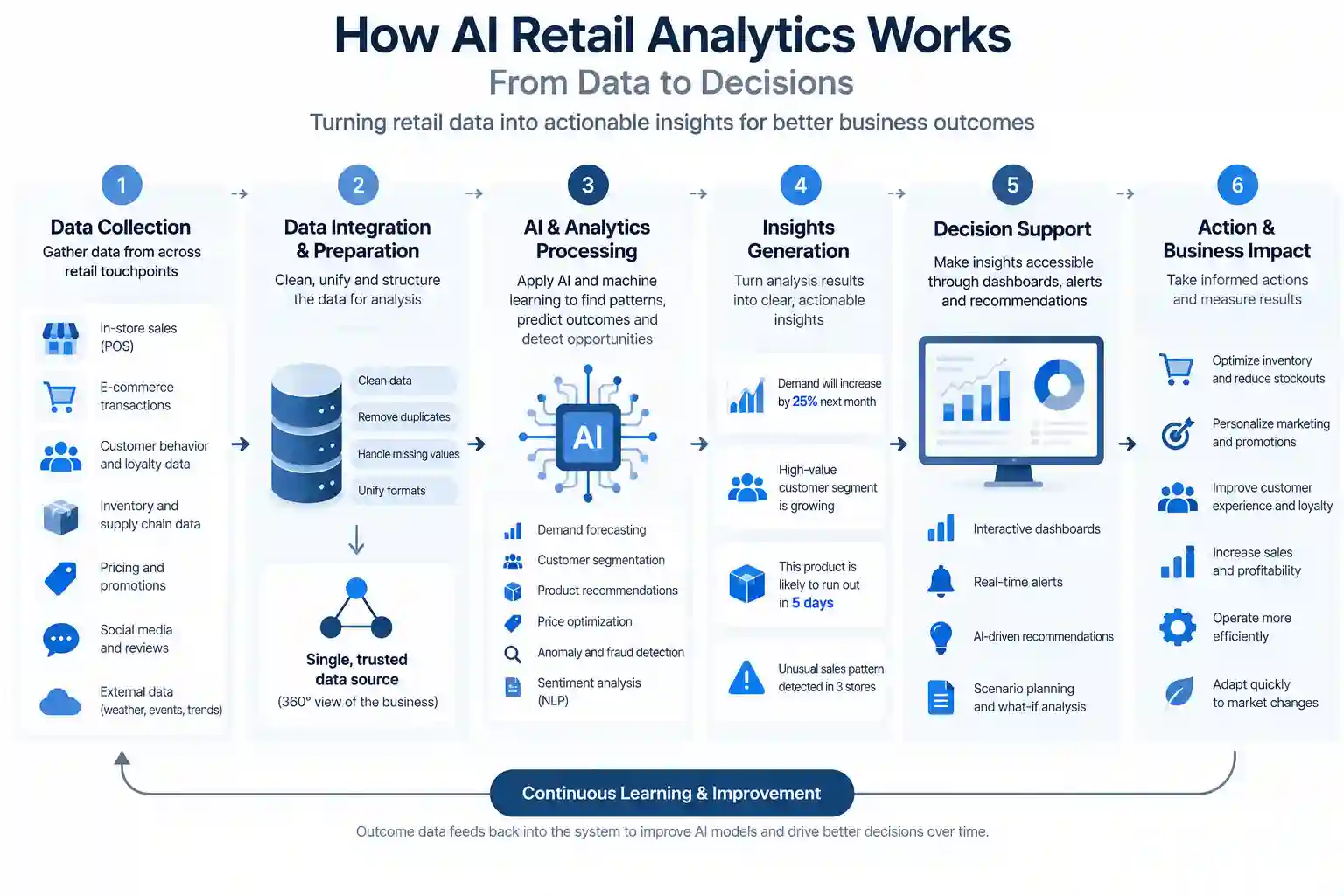
Most retail analytics implementations involve five connected stages:
Data collection: Gather sales, point-of-sale (POS), e-commerce, inventory, customer, pricing, promotion, and supply chain data.
Data preparation: Resolve inconsistent product identifiers, missing values, duplicate records, and mismatched time periods.
Analysis and modeling: Use reporting, statistical methods, machine learning, or natural-language interfaces to examine business performance.
Decision support: Produce forecasts, anomaly alerts, customer segments, recommended actions, or scenario comparisons.
Operational execution: Send approved decisions into replenishment, pricing, merchandising, marketing, or store operations workflows.
The quality of the result depends on all five stages. A sophisticated model cannot reliably compensate for missing inventory records or sales data that does not reflect actual product availability.
Why Retailers Use AI-Powered Retail Analytics
1. Demand forecasting and inventory planning
Demand forecasting estimates how much of a product customers may purchase over a future period. Retailers can use these estimates to plan procurement, replenishment, allocation, and inventory levels.
Machine learning models may consider historical sales, seasonality, promotions, pricing, product characteristics, and other available demand signals. More advanced planning systems connect forecasts with operational constraints, such as supplier lead times, minimum order quantities, and distribution capacity.
The objective is not simply to predict sales accurately. It is to improve the decisions that follow from the forecast.
2. Pricing and promotion analysis
Retail pricing decisions involve trade-offs between volume, revenue, margin, customer demand, and competitor positioning.
AI-powered retail analytics can help teams assess price changes, analyze promotion performance, and model possible outcomes. Some specialized systems support price optimization or markdown recommendations, while general-purpose BI tools may require additional modeling and integration.
Retailers should test recommendations against actual commercial outcomes rather than assume that a model's predicted uplift will materialize.
3. Customer behavior and personalization
Retailers can analyze transactions, browsing behavior, loyalty interactions, and customer service data to identify purchasing patterns and customer segments.
These insights can support product recommendations, targeted campaigns, customer retention analysis, and assortment decisions. The usefulness of the results depends on data coverage, identity resolution, consent, and whether online and offline customer records can be connected appropriately.
4. Store performance and shopper behavior
Physical-store analytics can help retailers understand foot traffic, visitor patterns, conversion, and differences in performance between locations.
When connected with sales and staffing data, these insights can support store layout experiments, scheduling decisions, and location-level comparisons. Footfall alone, however, does not establish why shoppers did or did not purchase.
5. Merchandising and assortment optimization
Retailers need to decide which products to offer, how much inventory to allocate, and how assortments should differ by location or customer segment.
Retail-specific analytics tools can combine product performance, store characteristics, demand patterns, and inventory constraints to support these decisions. Fashion retailers may also need external market data to understand competitor assortment, price positioning, and emerging trends.
12 Best AI Retail Analytics Platforms for 2027
The platforms below are grouped by the problems they address rather than by an unsupported numerical score. Some are retail-specific applications; others are analytics infrastructure or business intelligence products that can be configured for retail use.
1. Oracle Retail: Best for Integrated Retail Planning and Optimization
Oracle Retail provides a collection of retail applications covering analytics, planning, inventory, pricing, assortment, and related operational processes.
Its retail analytics and planning capabilities include demand forecasting, customer and store clustering, inventory planning, assortment optimization, and lifecycle pricing optimization. Oracle describes its Retail AI and Analytics portfolio as supporting decisions across planning, buying, moving, and selling.
Key capabilities
Demand forecasting and inventory planning.
Customer segmentation and store clustering.
Assortment and space optimization.
Pricing, promotion, and markdown analysis.
Retail data consolidation and business reporting.
Why consider it: Oracle Retail is worth evaluating when the business needs retail-specific analytics connected to broader planning and operational applications. It is particularly relevant when merchandising, inventory, and pricing decisions need to work together.
Limitations: A broad enterprise portfolio may introduce integration, implementation, data governance, and change-management requirements. Buyers should confirm which applications are included in the proposed solution rather than assume every capability is available in a single package.
Best for: Established retailers with complex merchandise, inventory, and planning requirements.
2. RELEX Solutions: Best for Demand Forecasting and Retail Replenishment
RELEX Solutions focuses on retail and supply chain planning. Its product category is relevant to retailers that need to connect demand forecasts with replenishment, inventory, merchandising, and other planning decisions.
For multi-location retailers, the operational challenge is that demand can differ significantly by store, product, season, promotion, and local conditions. Forecasting and replenishment tools can help teams coordinate these decisions across a large product and location network.
Key evaluation areas
Forecasting at appropriate product and location levels.
Replenishment and inventory planning workflows.
Treatment of promotions, seasonality, and unusual demand.
Integration with merchandising and supply chain systems.
Planner visibility into exceptions and recommendations.
Why consider it: RELEX is a relevant candidate for retailers seeking connected planning rather than standalone dashboards. Grocery and high-volume retail operations should examine how the system handles perishability, availability, assortment complexity, and replenishment constraints.
Limitations: Buyers should test performance on their own product mix and operational conditions. Forecast accuracy, implementation effort, and measurable business outcomes cannot be assumed from a product description alone.
Best for: Retailers that need to connect demand planning and inventory decisions.
3. Blue Yonder: Best for Enterprise Supply Chain Planning
Blue Yonder offers supply chain planning and execution technologies, including demand planning capabilities. Its planning portfolio is relevant when retail analytics must support decisions beyond reporting, such as responding to demand changes and coordinating inventory across the supply network.
Retailers operating across distribution centers, suppliers, and stores need forecasts that can inform downstream planning rather than remain isolated in a dashboard.
Key evaluation areas
Demand forecasting and demand sensing.
Inventory and supply planning.
Scenario analysis for supply disruptions.
Integration between planning functions.
Exception management and planner workflows.
Why consider it: Blue Yonder is worth shortlisting when forecasting and analytics are part of a broader supply chain transformation. Buyers should evaluate how well the proposed modules connect retail demand signals with replenishment and supply constraints.
Limitations: Enterprise planning systems can require substantial data preparation, process redesign, and integration. The total cost should include implementation and operating requirements, not just software licensing.
Best for: Large retailers with complex supply chains and multi-location inventory requirements.
4. o9 Solutions: Best for Connected Business Planning
o9 Solutions offers integrated planning capabilities intended to connect demand, supply, commercial, and financial decisions. Retail organizations can evaluate its relevance when different planning teams rely on separate assumptions or disconnected forecasts.
For example, a merchandising plan that assumes higher sales needs to be reconciled with supply availability, inventory budgets, and financial targets. A connected planning environment can help teams compare scenarios using more consistent assumptions.
Key evaluation areas
Demand and supply planning.
Merchandise and assortment planning.
Cross-functional scenario analysis.
Financial and operational plan alignment.
Data integration and model transparency.
Why consider it: o9 is a candidate for organizations that want to coordinate multiple planning functions rather than purchase another reporting layer.
Limitations: A connected planning initiative requires agreement on data definitions, planning ownership, business constraints, and decision rights. Buyers should confirm the precise retail capabilities, integrations, and implementation scope offered in their proposal.
Best for: Enterprise retailers coordinating commercial, financial, and supply chain planning.
5. SymphonyAI Retail CPG: Best for Retail and Consumer Goods Operations
SymphonyAI provides industry-focused AI applications, including solutions for retail and consumer packaged goods (CPG) organizations. Its retail-related portfolio is relevant to businesses evaluating analytics for assortment, pricing, promotions, inventory, and retail execution.
Retailers and consumer goods manufacturers often need to analyze related problems from different perspectives. A retailer may prioritize on-shelf availability and category profitability, while a brand may focus on distribution, promotion performance, and product visibility.
Key evaluation areas
Assortment and category analytics.
Pricing and promotion decision support.
Retail execution and inventory insights.
Collaboration between retailers and CPG organizations.
Integration with existing operational data.
Why consider it: It is worth evaluating when the organization needs industry-specific workflows rather than a generic dashboard environment.
Limitations: The exact capabilities depend on the product and package being considered. Ask the vendor to demonstrate the workflows relevant to your business, including the data required and the decisions the system can actually automate.
Best for: Retailers and CPG companies seeking connected, industry-specific analytics.
6. Microsoft for Retail: Best for Retailers Using Microsoft Technologies
Microsoft for Retail brings together technologies and partner solutions for retail data, customer experiences, operations, and AI-enabled workflows. It is better understood as a retail technology ecosystem than as one standalone analytics application.
Microsoft describes retail use cases such as predictive demand forecasting, inventory planning, assortment optimization, price and promotion optimization, and store insights in its Microsoft for Retail portfolio.
Key evaluation areas
Integration with existing Microsoft data and cloud services.
Retail reporting and analytics workflows.
Forecasting and inventory planning through the selected solutions.
Data access, security, and governance.
Connections with POS, e-commerce, and supply chain systems.
Why consider it: Retailers already using Microsoft technologies may find it practical to evaluate solutions that build on their existing infrastructure. The ecosystem also allows organizations to combine analytics, data engineering, and AI capabilities.
Limitations: The overall portfolio does not mean every listed retail capability comes with one subscription. Confirm which Microsoft products, third-party applications, and implementation services are required.
Best for: Retail organizations building on a Microsoft-centered technology stack.
7. IBM Cognos Analytics: Best for Governed Business Intelligence
IBM Cognos Analytics supports reporting, dashboards, data exploration, modeling, and advanced analytics. IBM also describes AI-assisted capabilities for helping users work with business data.
For retailers, the value proposition is the ability to consolidate sales, inventory, customer, and operational reporting into consistent views. A retailer may need to compare store performance, monitor category profitability, investigate changes in conversion, or assess inventory against sales plans.
Key evaluation areas
Governed reporting and dashboard creation.
Integration with retail databases and data warehouses.
Predictive and advanced analytics requirements.
Access controls and consistent business definitions.
Self-service analysis for business teams.
Why consider it: Cognos can be relevant to retailers that need enterprise reporting with governance and more advanced analytical options.
Limitations: A general BI platform is not automatically a retail-specific replenishment or assortment optimization engine. Retailers may need additional data models, integrations, and specialized applications to operationalize forecasts.
Best for: Organizations consolidating business intelligence across retail functions.
8. Google Cloud BigQuery and Looker: Best for Custom Retail Analytics
Google Cloud provides data and analytics technologies that retailers can use to build customized analytical systems. BigQuery supports large-scale data analysis, machine learning, and AI-assisted workflows, while Looker supports governed business intelligence and analytics applications.
The distinction matters: these technologies are building blocks for a retail analytics environment, not one ready-made retail planning product.
Key evaluation areas
Consolidation of POS, online sales, inventory, and marketing data.
SQL-based analysis and machine learning workflows.
Governed metrics and consistent business definitions.
AI-assisted data exploration.
Integration with existing retail applications.
Why consider it: Retailers with data engineering capabilities can build analytics tailored to their own business models, product hierarchies, and reporting needs.
Limitations: Custom analytics requires architecture, data modeling, security, and ongoing maintenance. Demand forecasting, replenishment optimization, and other retail-specific functions may require additional models or applications.
Best for: Data-mature retailers building a flexible analytics foundation.
9. Tableau: Best for Visual Retail Analytics
Tableau is a visual analytics and business intelligence platform that can help retail teams explore data and build interactive dashboards. It is useful when managers need to compare performance across products, stores, regions, channels, and time periods.
A retailer could use dashboards to track revenue, gross margin, sell-through, average transaction value, returns, or inventory turnover. Analysts can also investigate patterns by combining relevant datasets.
Key evaluation areas
Dashboard flexibility and ease of exploration.
Data connectivity and refresh requirements.
Governed metrics and access controls.
Integration with forecasting and machine learning outputs.
Usability for business stakeholders.
Why consider it: Tableau is a relevant option when visibility into performance and flexible data exploration are primary requirements.
Limitations: Visualization alone does not solve data quality problems or guarantee predictive accuracy. Forecasting and optimization workflows may require additional analytical tools or custom development.
Best for: Retail teams that need flexible reporting and interactive analysis.
10. ThoughtSpot: Best for Search-Driven Analytics
ThoughtSpot focuses on making business data accessible through search-driven and AI-assisted analytics. Instead of relying exclusively on predefined reports, users can explore governed datasets by asking business questions through supported interfaces.
For example, a category manager might want to investigate which product categories experienced a decline in sales over a selected period. Whether the platform can answer a specific question depends on the available data, semantic modeling, permissions, and configuration.
Key evaluation areas
Natural-language and search-driven analytics.
Accuracy and consistency of generated answers.
Governance and semantic definitions.
Support for retail metrics and data models.
Integration with existing data infrastructure.
Why consider it: It may help reduce dependence on analysts for routine business questions when the underlying data and metrics are well prepared.
Limitations: Natural-language interfaces do not remove the need for governed data. Retailers should test ambiguous questions, calculations, filters, and explanations against trusted reports before relying on the results for decisions.
Best for: Business users who need self-service access to governed retail data.
11. EDITED: Best for Fashion Retail Market Intelligence
EDITED is a retail intelligence platform focused on market-informed decisions, including assortment, pricing, and merchandising. Its relevance is strongest for fashion brands and retailers that need to understand competitor activity and changing market conditions.
Unlike a general inventory planning platform, market intelligence can help answer external-facing questions: Which products are competitors promoting? How are prices changing? Which categories or styles are gaining attention across the market?
EDITED's January 2026 announcement describes AI-supported workflows for trend validation, identifying market opportunities, and monitoring market movements. These are vendor-reported capabilities, not independent proof of business outcomes.
Key evaluation areas
Competitor assortment and pricing coverage.
Product and category trend analysis.
Market monitoring and merchandising workflows.
Geographic and retailer coverage.
Data freshness and relevance to target markets.
Why consider it: Fashion businesses need context beyond their own sales history. External market intelligence can complement internal forecasting and performance analytics.
Limitations: Competitor and market data should be assessed for coverage, collection methodology, freshness, and relevance. Market intelligence does not replace internal inventory or supply chain planning.
Best for: Fashion retailers, apparel brands, and merchandising teams.
12. RetailNext: Best for Physical-Store Analytics
RetailNext focuses on in-store analytics, helping retailers examine traffic and shopper behavior in physical locations. These capabilities address questions that online analytics alone cannot fully answer, such as how store visits relate to transactions and how shopper activity varies by location.
Retailers may use in-store analytics to compare traffic patterns, investigate conversion differences, and evaluate store layout or operating decisions. The exact metrics available depend on the deployment and selected capabilities.
Key evaluation areas
Footfall measurement and counting methodology.
Store-level traffic and conversion reporting.
Hardware and installation requirements.
Privacy and data handling.
Integration with POS and other store systems.
Why consider it: Physical-store operators need evidence about in-person behavior, not just website sessions and online transactions.
Limitations: Traffic data alone does not explain customer intent or establish causation. Retailers should validate measurement quality and determine whether hardware, installation, and ongoing operational costs are justified.
Best for: Brick-and-mortar chains evaluating store traffic and shopper behavior.
How to Choose the Right AI Retail Analytics Software
Selecting software should begin with the business decision that needs improvement, not with a vendor's AI feature list.
Step 1: Identify the highest-value business problem
Choose one clearly defined problem for the initial evaluation.
Business problem | Capabilities to prioritize |
|---|---|
Frequent stockouts | Demand forecasting, replenishment and inventory visibility |
Excess inventory and markdowns | Inventory optimization, assortment and pricing analytics |
Unclear promotion performance | Promotion analysis, margin reporting and causal testing where appropriate |
Weak store conversion | Traffic analytics, POS integration and store-level analysis |
Fragmented business reporting | Data integration, governed metrics and dashboards |
Slow access to business insights | Self-service and natural-language analytics |
Limited competitor visibility | Retail market intelligence and pricing monitoring |
The table is a starting point, not a substitute for detailed requirements. Several problems may share the same underlying data dependencies, but they do not necessarily require the same software.
Step 2: Assess data readiness
Before comparing predictive capabilities, examine the data available to the proposed platform.
Check whether the retailer has:
Consistent product and store identifiers.
Reliable transaction and return records.
Historical inventory and stockout information.
Accurate pricing and promotion records.
Documented supplier lead times where forecasting requires them.
Appropriate customer consent and access controls for customer-level data.
If inventory data records only what was sold, without indicating when a product was unavailable, a forecasting model may confuse constrained sales with weak demand. This is an important distinction for retail analytics.
Step 3: Test forecasting and recommendations on real data
Request a proof of concept using representative historical data and a clearly defined evaluation period.
For demand forecasting, compare the proposed model with the retailer's existing method and a simple baseline. Use metrics appropriate to the use case, such as weighted absolute percentage error (WAPE), mean absolute error (MAE), or bias. No single metric is appropriate for every demand distribution.
Also examine whether the model performs differently across high-volume and low-volume products, promotions, new products, and seasonal periods.
For recommendations, ask how the system accounts for constraints and how users can review, override, or explain a proposed action.
Step 4: Evaluate integration and operational fit
A platform is only useful if its output reaches the team or system responsible for acting on it.
Confirm compatibility with the retailer's POS, e-commerce platform, enterprise resource planning (ERP) system, warehouse management system, customer data platform, and data warehouse as applicable.
Evaluate data refresh frequency, API availability, permissions, audit logs, and the ability to trace an insight back to the data and assumptions behind it.
Step 5: Calculate the total cost of ownership
Do not compare products solely on subscription price. Include:
Software licensing or usage fees.
Data storage, processing, and transfer.
Implementation and systems integration.
Data preparation and migration.
Hardware and installation where required.
Training and change management.
Ongoing model monitoring and support.
Many enterprise retail products use quote-based commercial arrangements. Request a proposal with clearly defined assumptions, implementation responsibilities, recurring charges, and renewal terms.
Step 6: Define success before deployment
Set measurable criteria before the pilot starts. Depending on the use case, these might include forecast error, stockout frequency, inventory turnover, markdown rate, reporting time, or store conversion.
Separate model performance from business outcomes. A forecast can become more accurate without improving profitability if the organization cannot act on it or if supply constraints remain unresolved.
A Practical Framework for Evaluating Vendors
Use the following evaluation matrix to compare shortlisted tools consistently. The weights are a suggested starting point for a retail planning and analytics project, not a validated industry benchmark.
Evaluation criterion | Suggested weight |
|---|---|
Fit with the business use case | 25% |
Data integration and data quality support | 20% |
Forecasting or analytical performance | 20% |
Workflow and operational integration | 15% |
Governance, security and explainability | 10% |
Total cost of ownership | 10% |
Total | 100% |
Score each shortlisted platform from 1 to 5 against each criterion. Multiply each score by its weight, using a consistent scoring scale, and document the evidence behind every rating.
For example, a retailer prioritizing inventory optimization should assign the strongest evidence to forecasting performance, replenishment integration, and handling of stock constraints. A retailer prioritizing store traffic should use a different evaluation matrix that emphasizes measurement quality, deployment requirements, and POS integration.
Do not publish a vendor's score as an objective ranking unless the methodology, evidence, and evaluation conditions are transparent.
What AI Retail Analytics Platforms Cannot Solve on Their Own
AI retail analytics can improve decision support, but several limitations remain important.
Poor source data: Incomplete product, inventory, pricing, or transaction records can undermine analysis and forecasts.
Unexpected events: Sudden supplier disruptions, policy changes, viral trends, or other unusual events may fall outside historical patterns. Models need monitoring and appropriate fallback processes.
Unclear decision ownership: A recommendation has limited value when no team owns the resulting action or when different departments use conflicting objectives.
Limited causal evidence: A correlation between a promotion and higher sales does not establish that the promotion caused the increase. Seasonality, competitor activity, and other changes may also contribute.
Privacy and governance risks: Customer-level analytics must comply with applicable privacy requirements and organizational policies. Access controls, retention policies, and appropriate use restrictions should be part of the design.
Automation risk: Automatically executing a forecast or pricing recommendation can amplify errors if controls are weak. High-impact actions should have suitable validation, approval, monitoring, and rollback mechanisms.
The best implementation combines reliable data, fit-for-purpose analytics, business context, and accountable decision-making.
Frequently Asked Questions
What is the best AI retail analytics platform?
There is no single best platform for every retailer. Oracle Retail, RELEX Solutions, Blue Yonder, and o9 Solutions are candidates for retail planning and operational analytics. Microsoft, IBM, Google Cloud, Tableau, and ThoughtSpot are relevant to broader analytics and business intelligence requirements. The best choice depends on the business problem, existing data systems, implementation capacity, and measurable results.
What is the difference between retail analytics software and AI retail analytics software?
Traditional retail analytics software primarily supports reporting, dashboards, and data exploration. AI retail analytics software adds capabilities such as machine learning-based forecasting, pattern detection, predictive analysis, or AI-assisted querying. The distinction is not absolute because many platforms combine traditional BI with selected AI capabilities.
How is AI used in retail analytics?
AI can support demand forecasting, inventory planning, customer segmentation, price and promotion analysis, assortment planning, anomaly detection, and natural-language data exploration. Available capabilities vary by product. Retailers should verify which functions are built in, which require configuration, and which depend on additional applications or data science work.
Can AI retail analytics platforms improve demand forecasting?
They can improve forecasting when models use relevant data, are evaluated appropriately, and perform better than existing methods on representative data. Results depend on demand patterns, data quality, product availability, promotions, and other operational conditions. A vendor's claims should be validated through a controlled proof of concept.
How much does AI retail analytics software cost?
Pricing depends on the platform, modules, data volumes, number of users or locations, deployment model, integrations, and implementation scope. Many enterprise solutions require a custom quote. Compare total cost of ownership rather than subscription fees alone, and ask vendors to identify implementation, infrastructure, training, and ongoing support costs.
What data is needed for AI retail analytics?
Common inputs include POS transactions, e-commerce sales, product catalogs, inventory snapshots, prices, promotions, returns, store information, and supplier lead times. Customer data may be useful for segmentation and personalization when its use is appropriate and permitted. The required data depends on the use case.
Are AI retail analytics platforms suitable for small retailers?
Yes, but small retailers may not need a large enterprise planning suite. A BI platform, an existing commerce platform's reporting capabilities, or a focused analytics solution may be more practical. Buyers should prioritize integration simplicity, ease of use, measurable value, and total cost.
What should retailers test before purchasing an AI analytics platform?
Retailers should test data integration, analytical accuracy, usability, explainability, workflow integration, security, and performance on representative business cases. Define the baseline and success metrics before the pilot. Also confirm how the vendor handles missing data, unusual demand, access controls, and ongoing model monitoring.
Conclusion: Choose Retail Analytics Software Around the Decision You Need to Improve
AI retail analytics platforms serve several distinct purposes. Retail planning systems connect forecasting with inventory, merchandising, and supply chain decisions. Business intelligence platforms help teams understand performance and explore data. Retail intelligence products provide external market context, while in-store analytics tools focus on physical shopper behavior.
For a retailer prioritizing inventory and demand planning, start by evaluating retail-specific platforms such as Oracle Retail, RELEX Solutions, Blue Yonder, o9 Solutions, and SymphonyAI against real operational requirements. For organizations building analytics around an existing data stack, evaluate Microsoft, IBM, Google Cloud, Tableau, or ThoughtSpot according to their architecture and governance needs. Fashion teams may find EDITED relevant for market intelligence, while physical-store operators should assess RetailNext for store analytics.
The final decision should come from a structured comparison, a representative proof of concept, and a transparent total-cost assessment. A platform earns its place when it improves a measurable business decision, fits the retailer's operating environment, and produces results that teams can validate and act on.
Comments (0)
No comments yet. Be the first to share your thoughts!