AI Transcription vs Speech Analytics: Differences, Use Cases, Benefits, and How to Choose

Author
Ravi Prajapati
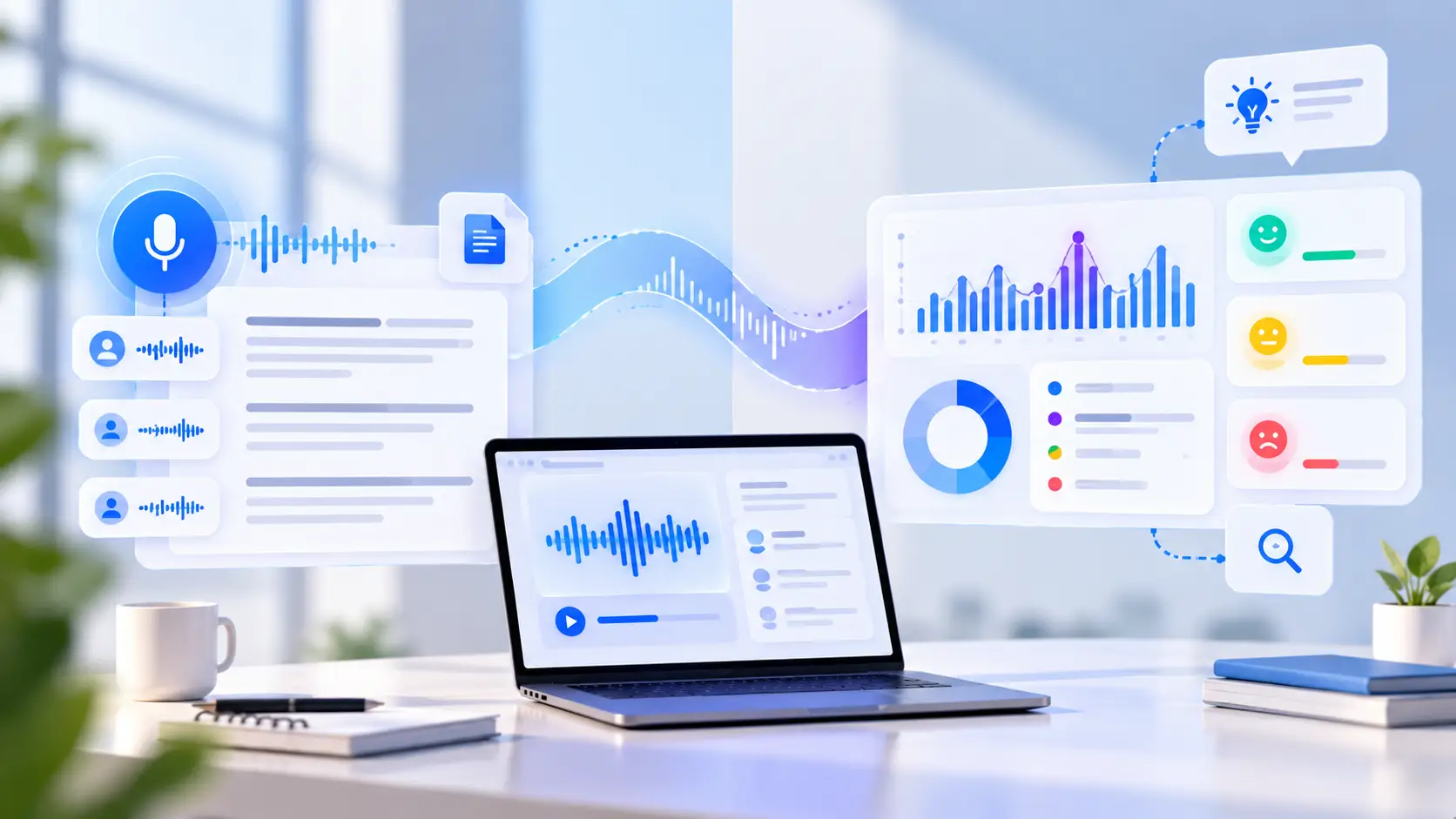
Compare AI transcription vs speech analytics, including key differences, business use cases, benefits, limitations, and how to choose the right solution.
AI transcription and speech analytics both help businesses work with spoken conversations, but they solve different problems. AI transcription converts spoken words into written text. Speech analytics examines conversations to identify patterns, customer issues, sentiment, compliance risks, and opportunities to improve business performance.
For example, a customer support team can use transcription to create a written record of every customer call. With speech analytics, the same team can investigate why customers repeatedly complain about delayed deliveries, identify calls that may require supervisor attention, and understand where support processes need improvement.
The distinction matters because a transcript tells you what was said, while speech analytics helps you understand what the conversation may reveal. Modern platforms can combine both capabilities, using speech recognition, natural language processing (NLP), machine learning, and generative AI to turn conversations into structured insights.
This guide explains the difference between AI transcription and speech analytics, how each technology works, where businesses can use them, their limitations, and how to choose the right solution.
What Is AI Transcription?
AI transcription is the process of converting spoken language from an audio or video recording into written text using artificial intelligence.
A transcription system processes audio, recognizes spoken words, and produces a text representation of the conversation. Depending on the service, it may also identify different speakers, add punctuation, generate timestamps, and support multiple languages.
For example, Google's Cloud Speech-to-Text documentation describes a service that allows developers to send audio to Google's speech recognition system and receive text transcriptions.
How AI transcription works
A typical transcription workflow includes the following steps:
Audio capture: The system receives a recorded meeting, customer call, interview, video, or live audio stream.
Speech recognition: An automatic speech recognition (ASR) model identifies spoken words and converts them into text.
Text processing: The system may add punctuation, normalize numbers, and format the recognized speech.
Speaker identification: When supported, speaker diarization distinguishes between speakers and labels their contributions.
Output generation: The system returns a transcript that can be reviewed, searched, edited, stored, or processed by other applications.
Some tools also support timestamps, custom vocabulary, language identification, and summaries. These capabilities vary by product and configuration.
Example of AI transcription
Imagine a customer calls an online retailer and says:
"I ordered my laptop last Monday, but the tracking page still says the package is being prepared. Can you tell me when it will arrive?"
A transcription system might produce:
Customer: I ordered my laptop last Monday, but the tracking page still says the package is being prepared. Can you tell me when it will arrive?
The transcript gives the company a searchable record of the customer's statement. However, transcription alone does not necessarily determine why the delivery is delayed, whether the customer is frustrated, or whether similar complaints are increasing across the business.
Those questions require further analysis or additional data.
Common use cases for AI transcription
Use case | How transcription helps |
|---|---|
Meetings | Creates written records of discussions and decisions |
Customer support | Records customer-agent conversations for review |
Sales calls | Helps sales representatives revisit requirements and objections |
Interviews | Converts recorded interviews into searchable text |
Education | Produces transcripts of lectures and training sessions |
Healthcare | Supports documentation workflows where appropriate, subject to clinical review and privacy requirements |
Media production | Creates draft subtitles and captions for audio and video |
Research | Converts recorded interviews and focus groups into text for analysis |
AI transcription is particularly useful when people need accurate, searchable records of spoken information.
What Is Speech Analytics?
Speech analytics uses AI and language-processing techniques to examine spoken conversations and identify information that can support business decisions.
Instead of stopping at the transcript, a speech analytics system can analyze conversation content and, depending on the platform, examine characteristics such as sentiment, interruptions, speaking time, recurring phrases, customer issues, and compliance-related language.
Speech analytics is commonly used in contact centers, sales organizations, customer experience teams, and regulated service environments.
For example, Amazon Transcribe Call Analytics supports conversation insights such as sentiment analysis, issue detection, call categorization, speech characteristics, and summaries of customer-agent interactions.
These capabilities can help organizations investigate patterns across calls rather than relying only on individual recordings.
How speech analytics works
A speech analytics workflow typically involves several stages.
Audio ingestion: The system receives recorded or live conversations.
Transcription: Speech recognition converts the audio into text when the analytics workflow requires a transcript.
Conversation analysis: Language-processing models identify topics, phrases, questions, complaints, objections, or other relevant information.
Signal and behavior analysis: Depending on the platform, the system may measure interruptions, pauses, speaking speed, or the distribution of speaking time.
Classification and scoring: Conversations may be categorized according to business rules, detected issues, sentiment estimates, or compliance requirements.
Reporting and alerts: The results appear in dashboards, reports, notifications, or integrations with CRM and customer support systems.
Business action: Teams investigate the findings and decide whether to improve a process, coach an employee, contact a customer, or change a policy.
Not every speech analytics product performs every stage. Some focus on keyword detection, while others combine multiple analytics capabilities and generative AI.
Example of speech analytics
Consider the same customer call about a delayed laptop delivery.
A speech analytics platform might identify:
Topic: Delivery delay.
Customer issue: The order has not progressed as expected.
Possible sentiment: Negative or frustrated, if supported by the platform's analysis.
Relevant phrase: "When will it arrive?"
Suggested follow-up: Check the shipment status and provide a reliable delivery estimate.
At a larger scale, the business could compare thousands of calls to determine whether delivery complaints are increasing, which products generate the most enquiries, or whether agents have enough information to answer delivery questions.
These are potential outputs, not guaranteed conclusions. The quality of the insights depends on audio quality, language support, model performance, business rules, and the data available to the system.
Common use cases for speech analytics
Use case | How speech analytics helps |
|---|---|
Contact centers | Identifies recurring complaints and potential escalations |
Sales teams | Examines objections, product questions, and conversation patterns |
Customer experience | Identifies common friction points across customer interactions |
Quality assurance | Flags calls that may require human review |
Compliance monitoring | Checks for specified phrases or required disclosures |
Workforce coaching | Helps supervisors identify conversations for coaching |
Product management | Reveals recurring feature requests and customer pain points |
Operations | Identifies repeated service failures or process bottlenecks |
Speech analytics is most valuable when an organization needs to move from individual conversations to patterns that can inform decisions.
AI Transcription vs Speech Analytics: Key Differences
The main difference between AI transcription and speech analytics is their intended output. Transcription produces text from speech, while speech analytics produces insights from conversations.
Comparison factor | AI transcription | Speech analytics |
|---|---|---|
Primary purpose | Convert speech into text | Analyze conversations for business insights |
Main output | Written transcript | Metrics, categories, patterns, alerts, and analytical findings |
Core technology | Automatic speech recognition | Speech recognition plus relevant language-processing and analytical techniques |
Sentiment analysis | Not a core requirement | Often available, depending on the product |
Topic identification | May require additional processing | Common capability in analytics-oriented systems |
Speaker identification | Available in some tools | May be used alongside conversation analysis |
Call behavior metrics | Usually limited or unavailable | May include pauses, interruptions, talk time, and speaking speed |
Compliance monitoring | Creates text that can be reviewed | Can flag specified words, phrases, or rules |
Reporting | Transcript-level records | Conversation-level and aggregate reporting |
Typical users | Researchers, journalists, meeting participants, developers | Contact center leaders, sales managers, quality teams, analysts |
Business value | Better access to spoken information | Better visibility into conversation patterns and potential actions |
The categories can overlap. A transcription product may offer summaries and sentiment analysis, while a speech analytics platform may include a complete transcript for every call. The distinction is therefore about the primary purpose and depth of analysis, not a strict separation between product features.
Transcription vs speech analytics vs conversation intelligence
These terms are related, but they are not interchangeable.
AI transcription converts speech into text.
Speech analytics examines spoken conversations to identify patterns, classifications, and signals that support analysis.
Conversation intelligence is a broader category of tools and workflows that capture, analyze, summarize, and organize conversations to help teams improve sales, customer service, or business processes.
Conversation intelligence platforms may combine transcription, speech analytics, meeting summaries, CRM integrations, coaching recommendations, and follow-up automation.
The terminology varies between vendors, so buyers should evaluate actual capabilities rather than relying only on product labels.
Can AI Transcription and Speech Analytics Work Together?
Yes. Combining transcription and speech analytics can create a more complete conversation intelligence workflow.
Transcription makes conversations accessible as text. Speech analytics uses that text, and sometimes additional audio signals or contextual data, to identify information that matters to the business.
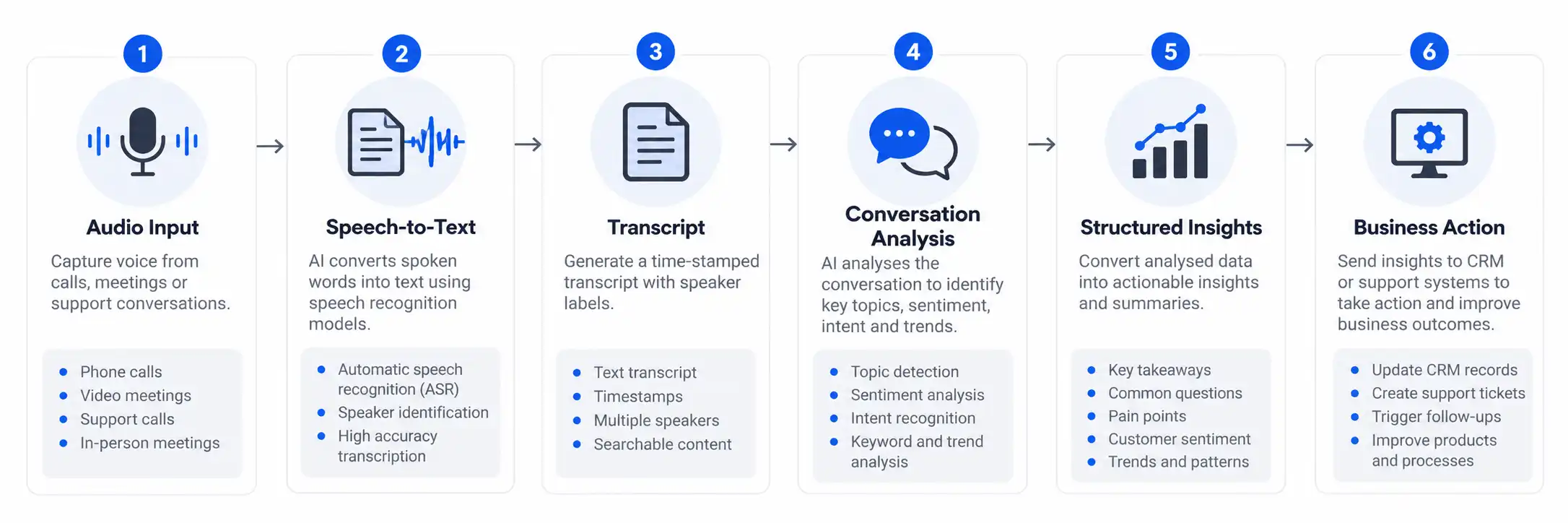
A combined system can follow this process:
Audio recording → speech recognition → transcript → conversation analysis → structured insights → business action
For example, a contact center could use transcription to record every call, analytics to identify recurring billing complaints, and a CRM integration to associate the findings with the relevant customer or service case.
The organization can then investigate whether the complaints relate to unclear invoices, a recent billing change, or a recurring system problem.
The important point is that identifying a pattern is not the same as proving its cause. Teams should validate analytical findings against operational records and customer feedback before making significant decisions.
Benefits of AI Transcription for Businesses
AI transcription offers several practical advantages.
1. Makes spoken information searchable
Teams can search transcripts for names, product references, questions, decisions, or important statements rather than listening to entire recordings.
2. Reduces manual documentation
Automated transcription can reduce the amount of time people spend creating first drafts of meeting notes, interview records, and call documentation. Human review may still be necessary, especially for important or regulated records.
3. Supports accessibility
Transcripts can help people who prefer reading, have difficulty hearing audio, or need to review spoken information in a different environment. Accessibility benefits depend on transcript quality and the availability of suitable formats.
4. Supports downstream AI workflows
Transcripts can serve as inputs for summarization, information extraction, document search, and question-answering systems. These additional capabilities require suitable models or software and should not be assumed to exist in every transcription tool.
5. Creates a record for later review
Organizations can revisit what participants said during a meeting or customer interaction. This is useful when teams need to confirm requirements, reconstruct decisions, or examine a disputed statement.
Benefits of Speech Analytics for Businesses
Speech analytics provides value when organizations need to understand conversations at scale.
1. Identifies recurring customer problems
A business can group conversations by issue and examine how frequently particular problems appear. This may help identify service bottlenecks, confusing policies, or product defects that require investigation.
2. Helps prioritize customer service reviews
Instead of reviewing every call manually, teams can use configured rules and analytical signals to identify interactions that deserve closer attention.
For example, calls containing specific escalation phrases or repeated unresolved issues can be sent to a supervisor for review.
3. Supports sales coaching
Sales managers can examine recurring objections, unanswered questions, and differences in conversation patterns. These findings can inform coaching, although they should not be treated as a complete or objective measure of an employee's performance.
4. Supports quality and compliance checks
Analytics systems can flag specified phrases, missing disclosures, or other defined criteria. Such checks can help reviewers find relevant calls, but detection alone does not establish legal compliance or prove that a conversation was handled correctly.
5. Reveals operational patterns
Aggregate conversation analysis may show that many customers ask about the same billing process, delivery problem, or product feature. Teams can investigate these patterns and decide whether process changes are justified.
Real-World Business Scenarios: Which Technology Should You Use?
The best option depends on the business question you want to answer.
Business scenario | Recommended approach | Reason |
|---|---|---|
A researcher needs written records of interviews | AI transcription | The main requirement is converting recorded speech into text |
A company wants searchable meeting records | AI transcription | Teams need to find and revisit what participants said |
A contact center wants to identify recurring complaints | Speech analytics with transcription | The team needs to classify and compare conversations |
A sales leader wants to review common customer objections | Speech analytics or conversation intelligence | The goal is to identify patterns and support coaching |
A compliance team wants to flag calls containing required phrases | Speech analytics with rule-based checks | The team needs to locate potentially relevant conversations for review |
A product team wants to understand customer feedback at scale | Combined transcription and analytics | Transcripts provide source material for structured analysis |
A business wants summaries and follow-up tasks from calls | A combined platform or integrated workflow | Transcription, summarization, and task extraction may all be needed |
Hypothetical example: An online retailer with recurring delivery complaints
Imagine an online retailer receiving hundreds of customer service calls each week.
Initially, the company uses AI transcription to create searchable records. Employees can find individual complaints, but management still struggles to understand the overall pattern.
The company then introduces speech analytics to categorize calls involving delayed orders, missing tracking updates, and unclear delivery estimates.
After reviewing the results alongside shipment records, managers discover that a particular fulfilment process may be contributing to the complaints. They investigate the process, improve customer notifications, and monitor whether the issue declines.
This is an illustrative scenario, not a documented case study or a claim that analytics alone would establish the root cause.
The broader lesson is that transcription helps preserve evidence, while analytics helps organize that evidence for investigation and decision-making.
How to Choose the Right AI Transcription or Speech Analytics Tool
Choosing a tool requires more than comparing feature lists. Businesses should evaluate how well the product supports their specific workflow, languages, privacy requirements, and operational goals.
1. Define the business problem
Start by identifying the question you need the system to answer.
If the objective is to create meeting notes or searchable records, transcription may be sufficient. If the objective is to investigate customer complaints, compare call outcomes, or flag potential compliance issues, speech analytics may be more appropriate.
2. Evaluate transcription accuracy
Test the system using representative audio rather than relying only on vendor demonstrations.
Include relevant accents, background noise, overlapping speech, specialist terminology, and the languages used by your customers. Review whether important names, amounts, product terms, and negations are recognized correctly.
Google Cloud's speech recognition documentation explains that recognition options and model selection depend on the audio and application requirements.
3. Check analytical capabilities
If you need speech analytics, verify which features are actually supported.
These may include topic classification, custom keyword detection, sentiment estimation, interruption metrics, summaries, and real-time alerts. Confirm whether these functions work for your languages and audio sources.
4. Assess integration requirements
Determine whether the tool can integrate with the systems your team already uses, such as a CRM, ticketing platform, contact center, data warehouse, or reporting dashboard.
Consider API availability, webhooks, authentication, data formats, and whether the system supports real-time or batch processing.
5. Review privacy and security
Voice recordings and transcripts may contain personal, financial, health, or other confidential information.
Before deployment, assess data retention, access controls, encryption, sensitive-information redaction, vendor processing terms, data residency, and applicable legal requirements. Confirm whether recording consent or notification is required in the jurisdictions where the organization operates.
6. Measure business outcomes
Select metrics that correspond to the original business problem.
Examples include:
Time required to prepare and review transcripts.
Percentage of transcripts requiring correction.
Time taken to identify recurring customer issues.
Number of flagged interactions that require human review.
Changes in customer complaint frequency after a verified process improvement.
Accuracy of detected categories against a manually reviewed sample.
These measures should be defined before deployment so the business can compare performance against a meaningful baseline.
What Are the Limitations of AI Transcription and Speech Analytics?
Both technologies can produce misleading results if their limitations are ignored.
Transcription errors
Speech recognition may struggle with poor audio quality, strong accents, overlapping speakers, uncommon names, specialist vocabulary, and code-switching between languages.
An incorrect transcript can affect every subsequent stage of analysis. For example, missing the word "not" may reverse the meaning of a customer statement.
Sentiment is an estimate, not a fact
Speech analytics systems may classify a conversation as positive, neutral, or negative. Such classifications are estimates based on the system's methods and available signals.
A customer speaking loudly may be frustrated, excited, or simply communicating in a noisy environment. A sentiment label should therefore be treated as a signal for review, not definitive evidence of someone's emotional state.
Context can be lost
A phrase can mean different things depending on the conversation. Sarcasm, industry terminology, cultural differences, and earlier statements can make interpretation difficult.
Systems that examine isolated phrases may miss important context.
Compliance flags need human interpretation
A system can detect whether a required phrase appears in a transcript, but the phrase may have been spoken incorrectly, used in the wrong context, or followed by contradictory information.
Human review and appropriate compliance procedures remain important.
Cost and integration complexity
A transcription API may be relatively straightforward to integrate, but a complete analytics solution can require data pipelines, dashboards, business rules, CRM integration, evaluation, and ongoing monitoring.
Costs depend on the chosen services, audio volume, processing method, storage, retention, and engineering requirements. A business should compare the total cost of operating the workflow, not just the advertised price per minute.
Privacy and governance risks
Recorded conversations can contain sensitive information. Poor access controls or excessive retention can create risks even when the transcription and analytics models perform accurately.
Organizations should establish clear policies for collecting, processing, reviewing, retaining, and deleting recordings and derived data.
What Is the Future of AI Transcription and Speech Analytics?
AI transcription and speech analytics are increasingly being combined with summarization, conversational AI, and workflow automation. The practical direction is toward systems that do more than produce a transcript or dashboard.
A combined workflow may eventually support more tasks automatically, such as categorizing a customer issue, preparing a case summary, suggesting a response, and creating a follow-up task. The availability and reliability of these capabilities depend on the specific product and implementation.
However, automation does not eliminate the need for evaluation. Businesses still need to verify transcription quality, test analytical classifications, protect sensitive information, and determine which actions require human approval.
The most useful approach is to start with a clearly defined problem, measure whether the system improves the workflow, and expand automation only when the results justify it.
Frequently Asked Questions
1. What is the main difference between AI transcription and speech analytics?
AI transcription converts spoken words into written text. Speech analytics examines conversations to identify information such as recurring topics, customer issues, sentiment estimates, and specified phrases. Transcription is often an input to speech analytics, but the two serve different primary purposes.
2. Can speech analytics work without transcription?
Some analytics capabilities can examine audio signals directly, such as pauses, speaking speed, or other acoustic characteristics. However, many content-based tasks, including keyword detection and topic analysis, rely on speech recognition or another method of extracting spoken content. The requirements depend on the specific analytics platform.
3. Is speech analytics the same as sentiment analysis?
No. Sentiment analysis is one possible component of speech analytics. Speech analytics can also include topic classification, keyword detection, compliance checks, interruption analysis, call categorization, and reporting. A sentiment score alone does not provide a complete understanding of a conversation.
4. Can AI transcription identify different speakers?
Yes, many transcription services support speaker diarization, which assigns labels to different speakers in an audio recording. Accuracy varies with audio quality, overlapping speech, and the number of speakers. Diarization labels do not necessarily identify a speaker's real-world identity.
5. Can speech analytics work in real time?
Yes, some platforms support real-time speech analytics. They can analyze incoming audio, detect configured phrases, identify potential issues, and generate alerts while a conversation is taking place. Real-time functionality varies by service, language, supported feature, and deployment region.
6. Which is better for a contact center: transcription or speech analytics?
Transcription is useful when the main goal is to create records and search call content. Speech analytics is more appropriate when managers need to identify patterns, flag interactions, monitor defined criteria, or investigate recurring customer issues. Many contact centers benefit from combining both.
7. How accurate is AI speech analytics?
There is no single accuracy figure that applies to all speech analytics systems. Performance varies by language, audio quality, model, task, and evaluation method. Businesses should test representative recordings and measure individual capabilities, such as transcription accuracy, issue classification, and the precision of alerts.
8. Is speech analytics suitable for small businesses?
It can be, especially for businesses that handle enough customer conversations to benefit from structured analysis. A small business may start with transcription and basic categorization before investing in a more extensive analytics platform. The decision should account for expected value, implementation effort, data protection, and ongoing operating costs.
9. Does speech analytics replace human quality assurance?
Not entirely. Analytics can help teams prioritize calls and detect patterns, but automated classifications can be wrong or miss important context. Human reviewers remain important for nuanced decisions, employee coaching, customer disputes, and compliance-sensitive cases.
10. What should businesses evaluate before buying speech analytics software?
Businesses should assess transcription quality, language support, analytical features, integration requirements, real-time processing, privacy controls, reporting, scalability, and total operating cost. They should also test the system against representative conversations and define success metrics before deployment.
Conclusion
AI transcription and speech analytics address different stages of working with spoken information. Transcription converts audio into text, making conversations easier to search, review, and process. Speech analytics examines conversations to identify patterns and signals that can help businesses investigate problems and improve decisions.
For organizations that only need written records, transcription may be enough. For contact centers, sales teams, and customer experience departments that need to understand recurring issues across many conversations, speech analytics can provide additional value.
When both capabilities are combined with reliable data, appropriate governance, and human review, organizations can move from simply recording conversations to using them as a source of operational insight.
Comments (0)
No comments yet. Be the first to share your thoughts!