Apple and Google Gemini: The AI Partnership That Nobody Expected and Why It Actually Makes Sense

Author
Ravi Prajapati
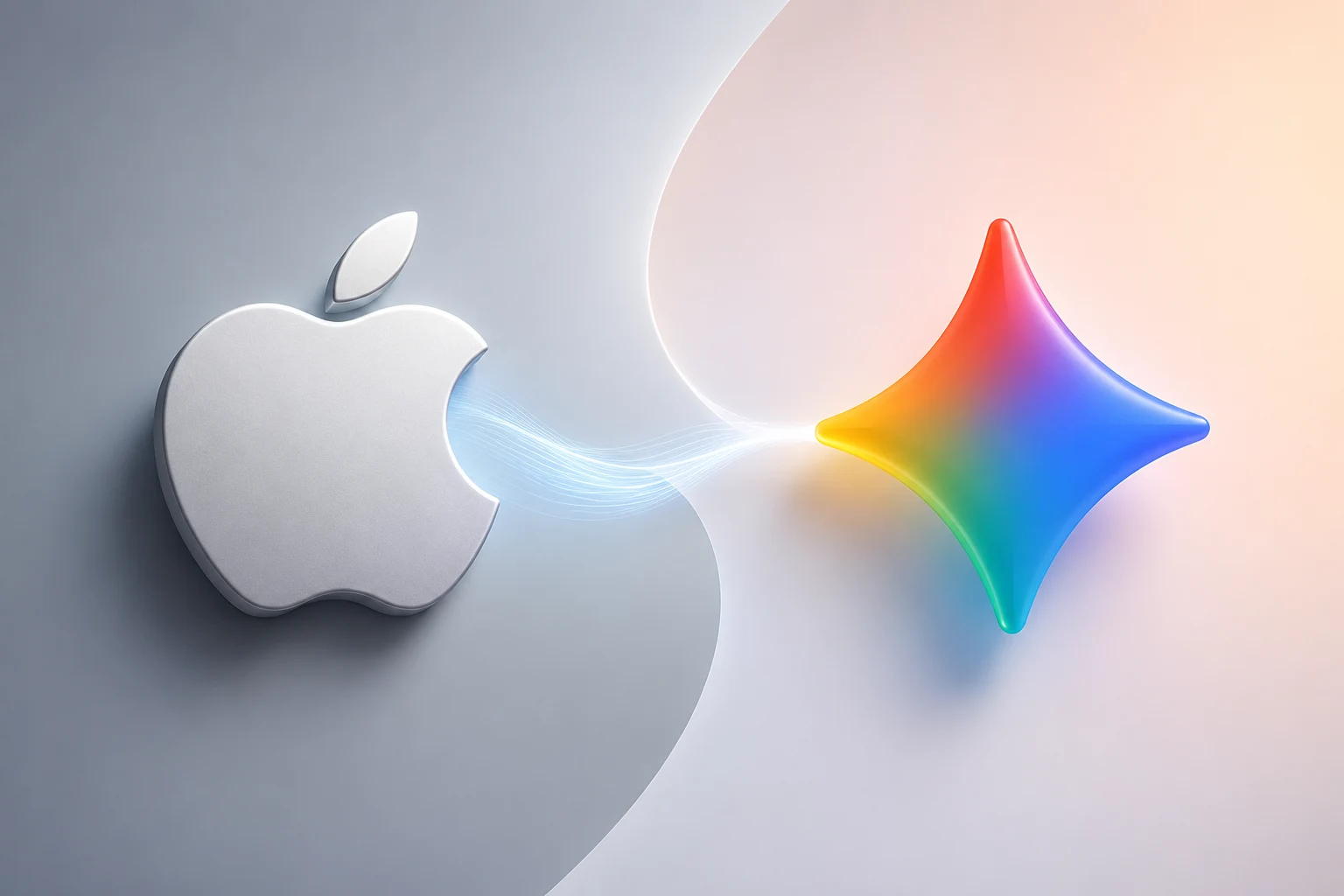
Explore why Apple's Gemini partnership makes strategic sense, how it could reshape AI on iPhones, and what it means for users, developers worldwide.
Apple and Google have spent decades competing across smartphones, search, and software. Yet in the AI era, their interests may be more aligned than ever. With Apple seeking powerful AI capabilities and Google looking to expand Gemini's reach, a partnership between the two tech giants could benefit both companies while accelerating the adoption of AI across billions of devices. This article explores why the Apple-Google Gemini partnership is surprisingly logical, what it means for Apple Intelligence, and how it could reshape the future of consumer AI.
Apple and Google have been rivals for nearly two decades. They have fought over search deals, app store policies, smartphone dominance, and the future of the mobile internet. So when Apple stood on stage at WWDC 2026 and announced that the next generation of Apple Intelligence is built in collaboration with Google's Gemini models, the tech world paused for a moment.
This is not a small footnote in a press release. This is Apple embedding its deepest AI ambitions inside technology co-developed with its oldest and most significant competitor.
The question everyone is asking is simple: why would Apple do this? And once you understand the answer, a more interesting question follows: why does it actually make complete sense?
What Apple Actually Announced at WWDC 2026
Before getting into the why, it is worth being precise about what Apple announced, because a lot of early reporting has blurred some important lines.
Apple introduced a rebuilt version of Siri called Siri AI. This new assistant is not a thin chatbot wrapper. It is a system-wide intelligence layer that understands what is on your screen, what is in your messages and emails, what is in your photos, and what tasks you are trying to accomplish across apps. It can automate multi-step workflows, surface relevant content from your own data, and carry on conversations that build on each other.
Underneath Siri AI sits what Apple calls the next generation of Apple Foundation Models. These are the core AI models that power everything Apple Intelligence does, from writing assistance to image understanding to contextual suggestions. Apple revealed that this new architecture was built in collaboration with Google and the Gemini family of models.
Additionally, Apple announced Visual Intelligence, which allows users to point an iPhone camera at anything and receive contextual information and actions in real time. The Phone app can now pull context from Mail and Messages mid-call. Messages gets AI-powered reply suggestions. Calendar creates events from natural language descriptions. And a new Spatial Reframe feature in Photos can reposition subjects and fill in the background using generative AI.
All of these capabilities run on the new Apple Foundation Models architecture, with a privacy layer called Private Cloud Compute ensuring that user data is never stored or accessible to Apple or any third party.
The Context That Makes This Partnership Understandable
To understand why Apple went to Google, you need to understand the position Apple found itself in heading into 2026.
Apple first announced Apple Intelligence at WWDC 2024 with significant fanfare. The promise was a deeply personal AI assistant that understood your life, your data, and your context. The reality that followed was a slow, painful rollout marked by delayed features, underwhelming demos, and public criticism that Siri had not meaningfully improved in over a decade.
While Apple was struggling, competitors were moving fast. Google had released Gemini across its entire product suite. Samsung was shipping Galaxy AI features to hundreds of millions of Android users. OpenAI had become a household name with ChatGPT. Microsoft had embedded Copilot into Windows and Office. The narrative was forming that Apple, the company that had invented the modern smartphone assistant with the original Siri in 2011, had fallen critically behind in the AI era.
Apple needed a significant reset. It needed both better underlying models and a partner who had already solved some of the hardest problems in large-scale AI development.
Google had built something Apple needed. The Gemini family of models, particularly the multimodal versions that can understand text, images, and speech simultaneously, represented years of research and billions of dollars of investment. Apple's own on-device models had been carefully engineered for efficiency and privacy, but they were not competitive at the scale of capability that users were beginning to expect from AI assistants.
The collaboration gave Apple access to model capabilities at the frontier while letting Apple maintain what it does better than anyone: deep hardware integration, privacy architecture, and user experience design.
Why Apple's Approach to This Partnership Is Different From What You Might Expect
Here is the part that surprises most people when they look closely.
Apple is not simply running Gemini on your iPhone. This is not the arrangement Apple has with OpenAI, where asking Siri a complex question can hand off to ChatGPT. That integration, announced at WWDC 2024, is explicitly an external option that users opt into, and it involves sending queries to OpenAI's servers.
The Google collaboration operates at a different level. Apple and Google worked together to build new Apple Foundation Models. These are Apple's models, trained and shaped through collaboration, running on Apple's infrastructure, under Apple's privacy guarantees.
Craig Federighi, Apple's senior vice president of software engineering, described it this way at WWDC 2026: the new Apple Intelligence architecture uses a system orchestrator to securely coordinate across models. The models themselves understand speech, read text, and process images. They run both on device and on Apple's servers through Private Cloud Compute.
Apple has not outsourced its AI to Google. It has co-developed a new generation of its own models with Google's involvement. The distinction matters enormously for understanding what Apple users actually get.
What Each Company Gets From This Deal
Understanding a partnership requires understanding what both parties gain.
What Apple gets:
Apple gets access to Google's depth of research and model training expertise. Building frontier AI models requires computational resources, research talent, and training data at a scale that is genuinely difficult to assemble quickly. Apple has all the money in the world but buying model capability through collaboration is faster than building it entirely from scratch. Apple also gets a credible story for developers and users: Siri AI is not a small incremental update, it is a ground-up rebuild with serious underlying technology.
Apple also gets something less obvious. By collaborating with Google rather than building independently or relying entirely on OpenAI, Apple avoids being in a dependent relationship with a direct AI competitor. OpenAI's interests and Apple's interests could diverge in significant ways as AI assistants become the primary interface for computing. Google's interests, while competitive in some areas, are primarily organized around search and advertising, not replacing the iPhone as a platform.
What Google gets:
Google gets something Apple cannot easily give back: distribution and data about how AI assistants perform in real-world conditions at massive scale. Apple has over a billion active iPhone users. If even a fraction of those users engage meaningfully with Siri AI and its underlying Gemini-influenced models, Google gains insight into how its technology performs across an extraordinarily diverse set of real queries, contexts, and use cases.
Google also gets a form of validation. Having Apple, the company most associated with premium user experience and privacy, choose to build on Gemini sends a signal to the market about where Google's AI technology stands relative to alternatives.
There may also be financial considerations that Apple has not publicly disclosed. Prior to this announcement, Apple reportedly paid Google approximately 20 billion dollars annually to be the default search engine in Safari. The structure of that relationship and whether this AI collaboration changes its terms has not been made public.
The Privacy Architecture That Makes This Politically Possible Inside Apple
Apple has an identity built around privacy. Tim Cook has referred to privacy as a fundamental human right. The company has positioned itself against advertising-based business models. It has publicly criticized data practices at companies like Facebook. It has built features like App Tracking Transparency specifically to limit what other companies, including Google, can learn about iPhone users.
So how does Apple partner with Google on AI without destroying that identity?
The answer is Private Cloud Compute. Apple has designed a cloud processing system with unusual properties. When Siri AI processes a request that requires cloud computation, the request goes to Apple's servers, not Google's. The data is processed and discarded without being stored. Apple says it cannot access user data processed through this system, and that outside security researchers can independently verify this claim through cryptographic audits.
From the user's perspective, the collaboration with Google happened during model development and training. What runs on your device or Apple's cloud servers when you use Siri AI is Apple's technology, governed by Apple's privacy policies, not Google's.
This is genuinely different from, for example, using Google Assistant on Android, where queries are processed on Google's infrastructure and subject to Google's data policies.
Apple has found a way to absorb Google's AI capabilities while keeping the actual user data relationship entirely inside Apple's privacy framework. Whether users trust that description is a separate question, but architecturally it is coherent.
The Questions This Partnership Raises
No analysis of this deal would be complete without acknowledging the legitimate concerns and open questions it raises.
The first is about long-term dependency. Apple has now tied the quality of its most important product feature to a relationship with Google. If that relationship changes, if commercial terms shift, if regulatory pressure forces restructuring, Apple's AI capabilities could be affected. Apple has historically been aggressive about reducing dependencies on external parties, including building its own chips to reduce reliance on Intel. Building foundational AI models in collaboration with Google introduces a dependency that Apple will likely want to eventually reduce.
The second is about regulatory scrutiny. Apple and Google already face intense antitrust examination in the United States, Europe, and elsewhere. The existing default search deal has been challenged in US courts. A deeper collaboration on AI, one that involves joint model development, could attract fresh attention from regulators who are already skeptical of coordination between two of the world's most powerful technology companies.
The third is about what this means for Apple's independent AI research. Apple Research has published significant work in machine learning and computer vision. The company has acquired AI startups consistently over the past decade. Does a collaboration with Google signal that Apple has concluded it cannot compete at the frontier independently? Or is this a temporary bridge while Apple builds its own next-generation capabilities? Apple has not answered this question publicly.
Why This Makes Sense When You Look at the Broader Industry
It is easy to frame this partnership as a sign of weakness or as an ideological contradiction. But looking at the broader AI industry, it fits a pattern.
The most capable AI systems in the world right now are not built by single companies working in isolation. They are built by organizations that combine hardware expertise, software research, training infrastructure, and deployment at scale. Almost every major AI breakthrough has involved collaboration across research groups, sharing of techniques, and building on prior work.
Apple has always been willing to use other people's technology when it serves users better, as long as Apple controls the experience layer. The original iPhone ran on an operating system that descended from BSD Unix, an open-source project. The App Store distributes millions of applications built by developers who are not Apple employees. Safari is built on WebKit, an open-source project that Google also contributes to. Apple is not purely a vertically integrated creator of all technology; it is a company that curates and integrates technology to deliver experiences.
The Gemini collaboration follows this same logic. Apple is not surrendering its identity. It is doing what it has always done: finding the best available technology, integrating it in a way that serves its users, and making sure that the experience, the privacy protections, and the design feel unmistakably Apple.
What This Means for iPhone Users Starting in Fall 2026
Siri AI will arrive as a beta release alongside iOS 27 in Fall 2026, initially available in English. The full rollout is expected to follow in subsequent months.
For most iPhone users, the practical experience will be this: Siri will finally be the assistant it was always supposed to be. It will understand context from your apps, remember what you talked about earlier in a conversation, help you accomplish tasks across multiple applications in a single request, and answer complex questions with the kind of depth that previously required going to ChatGPT or Google Search.
Visual Intelligence will let users interact with their camera in ways that feel genuinely new. Pointing at a restaurant and getting menu information, booking a reservation, or identifying a plant and getting care instructions represent a shift in how smartphones interact with the physical world.
The photo editing capabilities, particularly Spatial Reframe, represent what happens when a company with Apple's hardware, software, and AI capabilities works at the problem together. Moving a subject in a photo after it was taken and having the background fill in realistically is the kind of feature that would have seemed science fiction five years ago.
Apple Watch, AirPods, and Apple Vision Pro will also receive Apple Intelligence updates, meaning the same underlying intelligence extends across the entire Apple ecosystem in a coherent way.
One significant caveat: users in the European Union will not receive Siri AI at launch. Apple has stated that requirements under the EU's Digital Markets Act conflict with the privacy and security model it has designed for Siri AI. EU iPhone and iPad users will also miss several related features including the dedicated Siri app, expanded Visual Intelligence tools, and new writing tools.
The Bigger Picture: What This Partnership Signals About the AI Industry
The Apple and Google AI collaboration is a signal about where the AI industry is heading, not just a business deal between two companies.
The era of every major technology company building its AI infrastructure entirely from scratch and in isolation is ending. The computational demands of frontier AI, the research talent required, and the complexity of integrating AI safely into products used by billions of people are pushing even the largest companies toward some form of collaboration or specialization.
We are already seeing this pattern elsewhere. Microsoft invested deeply in OpenAI rather than building its own frontier model from scratch. Amazon has partnered with Anthropic. Salesforce, Adobe, and dozens of enterprise software companies are building on top of foundation models rather than beside them.
Apple joining this pattern does not mean the age of Apple innovation is over. It means Apple is being realistic about where the boundaries of its competitive advantage lie. Apple is extraordinarily good at hardware design, privacy architecture, software integration, and user experience. It is catching up in foundation model research. Taking a shortcut through collaboration with Google to accelerate the catching-up phase is a rational strategic choice.
The more interesting question for the next five years is whether Apple uses this collaboration as a bridge or as a permanent dependency. Based on Apple's history, the former seems more likely. Apple tends to internalize capabilities it relies on externally once it has learned what it needs to learn.
Frequently Asked Questions
Does using Siri AI mean Google can see my data?
No. Apple has designed Siri AI so that user data is processed either on device or through Apple's Private Cloud Compute system. Apple says no user data is stored or accessible to Apple or any third party, including Google. The collaboration with Google happened at the model development stage, not the user interaction stage.
Is this the same as when Siri can use ChatGPT?
No. The ChatGPT integration, announced at WWDC 2024, is an opt-in feature where Siri can hand off specific queries to OpenAI's servers. The Google collaboration is different: it happened during the development of Apple's own Foundation Models. Siri AI does not send your queries to Google.
Will Siri AI be available on my iPhone?
Siri AI arrives with iOS 27 in Fall 2026 as a beta, initially in English. It requires iPhone 15 Pro or later, or any iPhone 16 model or newer. EU users will not receive Siri AI at launch due to Digital Markets Act considerations. A wider rollout is expected to follow.
Why did Apple choose Google instead of building its own AI?
Apple has been building its own AI models for years. The collaboration with Google appears to accelerate capability development in areas where Google has significant research depth, particularly in multimodal models that understand images, speech, and text together. Apple is not abandoning independent AI research; it is supplementing it.
Is Apple still competing with Google?
Yes. Apple and Google remain competitors in smartphones, browsers, app distribution, maps, and increasingly in AI assistants. The Gemini collaboration is a specific technical partnership in AI model development, not a broad alliance. Both companies will continue competing aggressively in the market.
Summary
The Apple and Google Gemini partnership is unexpected on the surface because it involves two long-term rivals cooperating on the most strategically important technology of this decade. It makes sense beneath the surface because Apple needed better models faster than it could build them independently, Google needed real-world deployment at Apple's scale, and both companies found a way to make it work within Apple's privacy framework through Private Cloud Compute.
For iPhone users, the result is a Siri that is genuinely transformed: context-aware, capable, and deeply integrated into the apps and services people already use every day. For the industry, it is a signal that the AI era rewards collaboration and integration as much as independent innovation.
The rivalry between Apple and Google is not over. But the most interesting story of WWDC 2026 is not that they fought. It is that they found something worth building together.
Read Also:
Siri AI vs Google Gemini vs ChatGPT: Which AI Assistant Actually Wins
Comments (0)
No comments yet. Be the first to share your thoughts!