Best AI Agent Evaluation Tools for Production Workflows

Author
Deval Shah
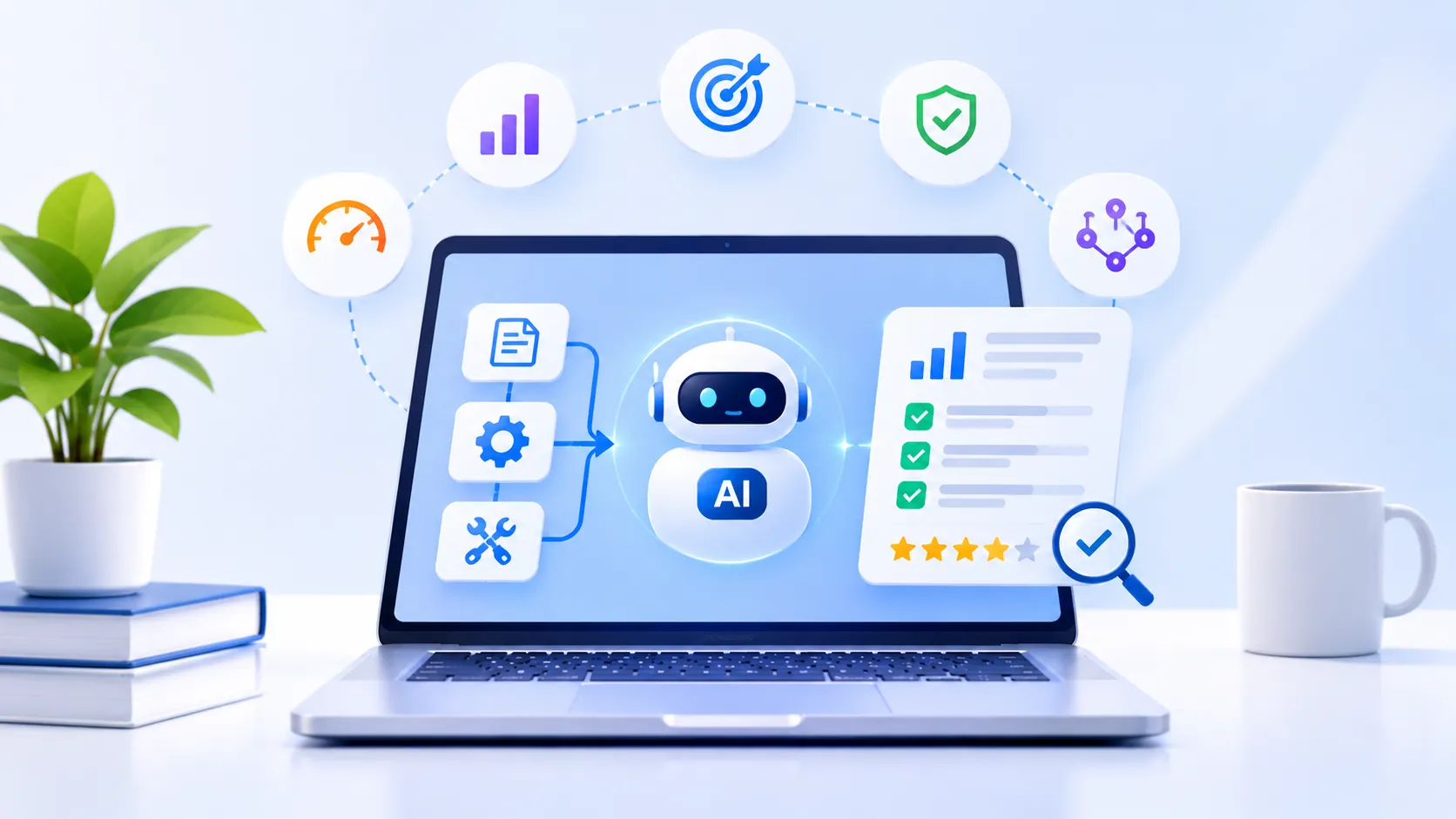
Compare AI agent evaluation tools for production workflows. Explore trajectory evaluation, tool-call correctness, test datasets, and CI/CD integration
AI agents can appear successful while still making serious mistakes. An agent may produce a convincing final answer after selecting the wrong tool, passing incorrect arguments, skipping a required approval, or taking an unnecessarily long route to complete a task.
That is why evaluating an AI agent requires more than checking whether its final response looks correct.
Production teams need to test the entire workflow: the task outcome, the sequence of actions, the tools selected, the arguments passed, recovery from errors, and the time and cost required to complete the task. They also need a repeatable way to detect regressions when prompts, models, tools, or application logic change.
AI agent evaluation tools help teams build datasets, run experiments, inspect traces, score agent behavior, collect human feedback, and integrate quality checks into development and production workflows.
This guide compares the main evaluation tools by their practical strengths and explains how to choose a platform for a production AI workflow.
What Is AI Agent Evaluation?
AI agent evaluation is the process of measuring whether an agent completes a task accurately, reliably, safely, and efficiently.
Traditional LLM evaluation often focuses on a single model response. Agent evaluation must account for the actions that happen before that response is produced. Depending on the application, an agent may retrieve information, call external APIs, update a CRM, execute code, delegate work, or interact with several systems.
A useful evaluation process examines three connected layers:
1. Outcome evaluation
Outcome evaluation checks whether the agent achieved the user’s intended result.
For example, if an agent is asked to find a customer’s order status, the evaluation should verify that it returned the correct order and status, not merely that its response was well written.
Outcome checks may include:
· Exact or structured answer matching
· Task completion
· Factual correctness
· Policy compliance
· Required fields or actions
· Human review against a defined rubric
2. Trajectory evaluation
Trajectory evaluation examines the path the agent followed to reach its result.
Two agents might produce the same final answer, but one may use the correct source and follow the approved workflow while the other relies on an incorrect tool or skips a required step.
Trajectory evaluation can measure:
· Whether the agent followed the expected sequence
· Whether it selected appropriate tools
· Whether it handled errors and retries correctly
· Whether it avoided unnecessary steps
· Whether it respected workflow constraints
· Whether it stopped when the task was complete
3. Tool-call evaluation
Tool-call evaluation examines individual tool interactions.
A tool call can fail even when the model’s intention is reasonable. The agent may choose the wrong function, omit a required parameter, use an invalid value, or misunderstand the tool’s response.
Useful checks include:
· Correct tool selection
· Valid argument structure
· Required parameter presence
· Argument value correctness
· Appropriate handling of tool errors
· Correct interpretation of tool output
· Avoidance of unauthorized actions
A robust evaluation system connects all three layers rather than treating the final response as the only measure of quality.
What to Look for in an AI Agent Evaluation Tool
Not every evaluation platform is designed for the same job. Some focus on developer testing, while others combine evaluation with tracing, production monitoring, collaboration, or human review.
Use the following criteria to build a shortlist.
| Evaluation capability | What it should help your team answer |
| Test datasets | Can we maintain representative examples of real user tasks and known failure cases? |
| Outcome evaluation | Did the agent complete the task correctly? |
| Trajectory evaluation | Did it follow an acceptable sequence of actions? |
| Tool-call correctness | Did it select the right tool and pass valid arguments? |
| Experiment comparison | Did a new prompt, model, or workflow improve results without causing regressions? |
| CI/CD integration | Can evaluations run automatically before a change is released? |
| Production tracing | Can we inspect what happened during a real agent execution? |
| Online evaluation | Can we score sampled production runs and detect quality changes? |
| Human review | Can subject-matter experts review ambiguous or high-impact cases? |
| Deployment and data controls | Does the platform meet the team’s security, privacy, and infrastructure requirements? |
The most important question is not how many features a tool lists. It is whether the tool can evaluate the failure modes that matter to your application.
Best AI Agent Evaluation Tools for Production Workflows
The following tools represent different approaches to evaluation. This is a use-case-oriented shortlist, not a universal performance ranking. Capabilities, licensing, hosting options, and commercial terms can change, so verify current documentation before selecting a platform.
1. LangSmith
Best for: Teams building with LangChain or LangGraph.
LangSmith combines tracing, datasets, experiments, evaluation, and feedback workflows. It is particularly relevant for teams already using LangChain or LangGraph because the evaluation process can fit closely into the application’s development workflow.
Teams can use datasets to test agent behavior, compare experiment results, inspect runs, and evaluate production activity. For agent workflows, trajectory-oriented evaluation can help teams assess whether an agent followed an expected path rather than only checking the final answer.
Consider it when:
· Your agent is built with LangChain or LangGraph.
· You need trace-level debugging and experiment comparison.
· You want to connect development evaluations with production runs.
· Your team needs annotation or review workflows.
Validate before adopting: Check whether the hosting model, access controls, retention, and required evaluation features fit your organization’s deployment requirements.
Official website: https://www.langchain.com/langsmith
2. Braintrust
Best for: Evaluation-driven teams connecting experiments, production traces, and release decisions.
Braintrust focuses on the evaluation loop: create datasets, run experiments, compare results, and use production observations to improve future tests. This approach is useful when evaluation is part of the engineering process rather than a one-time pre-launch activity.
Teams can define scorers for their application, compare changes, and use evaluation results to help determine whether a workflow is ready to ship.
Consider it when:
· Evaluation results influence release decisions.
· You need reusable datasets and experiment comparisons.
· Production traces should inform future test cases.
· Developers and reviewers need a shared evaluation workflow.
Validate before adopting: Test how well the platform supports your agent’s trace structure, evaluator requirements, CI/CD process, and data governance needs.
Official website: https://www.braintrust.dev/
3. Arize Phoenix
Best for: Teams prioritizing tracing, evaluation, and self-managed infrastructure.
Arize Phoenix provides tracing and evaluation capabilities for LLM applications and agents. Its OpenTelemetry-oriented approach can be useful for teams that want visibility into application execution without tying all instrumentation to a single agent framework.
Phoenix can support dataset-based experiments and evaluation workflows, while its broader ecosystem includes commercial capabilities for production monitoring.
Consider it when:
· You need framework-agnostic tracing.
· Your team values self-hosting or infrastructure control.
· You want to inspect traces and run evaluations against application behavior.
· OpenTelemetry is already part of your observability strategy.
Validate before adopting: Review licensing, hosting requirements, and which production monitoring features are included in the specific Phoenix or commercial offering you are evaluating.
Official website: https://phoenix.arize.com/
4. Langfuse
Best for: Teams seeking an open-source-oriented LLM engineering and observability workflow.
Langfuse combines tracing, datasets, experiments, scoring, and prompt-related workflows. It can help teams connect development evaluation with the behavior observed in production.
For agent applications, the value comes from being able to inspect execution traces, create evaluation datasets, score outputs or observations, and use feedback to improve future tests.
Consider it when:
· You want tracing and evaluation in a connected workflow.
· Self-hosting or data ownership is important.
· You need datasets and repeatable experiments.
· Your team wants to connect production observations with evaluation.
Validate before adopting: Confirm the exact capabilities and commercial terms for your chosen deployment, particularly for access controls, retention, and enterprise requirements.
Official website: https://langfuse.com/
5. DeepEval and Confident AI
Best for: Python teams that want evaluation to behave like software tests.
DeepEval provides a developer-oriented evaluation framework, while Confident AI offers a platform for managing evaluation workflows. This combination is relevant to teams that want to write evaluation cases alongside application code and run them as part of automated testing.
For agent workflows, teams can define checks for task completion, tool correctness, argument correctness, and other application-specific behavior.
Consider it when:
· Your engineering team works primarily in Python.
· You want evaluations integrated into test suites.
· You need custom metrics or application-specific assertions.
· Evaluation failures should be visible during development and CI.
Validate before adopting: Test the reliability of your evaluators and the effort required to maintain them as the agent architecture changes.
Official websites: https://deepeval.com/ and https://confident-ai.com/
6. Comet Opik
Best for: Teams looking for an open-source-oriented evaluation and observability platform.
Opik supports evaluation workflows, tracing, experiments, and agent-focused analysis. It can be useful for teams that want to connect evaluation with development and production observations while retaining flexibility around deployment.
Consider it when:
· You need evaluation and tracing in a shared workflow.
· Self-hosting is an important requirement.
· You want to compare agent behavior across experiments.
· Your team needs a platform that can support ongoing evaluation.
Validate before adopting: Confirm the current license, deployment options, and feature availability for your required workflow.
Official website: https://www.comet.com/site/products/opik/
7. Promptfoo
Best for: Developer teams that need repeatable testing, model comparisons, and security-focused evaluation.
Promptfoo is a testing framework for LLM applications, prompts, and agent workflows. It is particularly useful when teams want evaluations to run locally or in CI and need structured test cases, assertions, and comparisons.
Promptfoo can also support security testing and adversarial evaluation, making it relevant when an agent can access sensitive data or perform consequential actions.
Consider it when:
· You need a code-first evaluation workflow.
· You want repeatable tests in CI/CD.
· You need to compare models, prompts, or configurations.
· Security and adversarial testing are part of your release process.
Validate before adopting: Determine whether you also need a separate platform for production trace collection, collaboration, or ongoing online evaluation.
Official website: https://www.promptfoo.dev/
How to Build an Evaluation Dataset for an AI Agent
A test dataset should represent the work the agent is expected to perform, including both common requests and difficult edge cases.
Start with real user tasks, then remove or protect sensitive information as required. Each test case should define the input, expected outcome, relevant constraints, and the evaluation method.
A practical dataset can include:
| Test category | Example |
| Common task | Retrieve a customer’s current order status |
| Missing information | Ask for clarification when the order identifier is absent |
| Tool selection | Use the order lookup tool instead of a general search tool |
| Argument correctness | Pass the correct customer and order identifiers |
| Tool failure | Recover appropriately when the service times out |
| Permission boundary | Refuse to perform an action without authorization |
| Multi-step workflow | Verify a record before updating it |
| Adversarial input | Ignore instructions embedded in untrusted retrieved content |
| Regression case | Re-test a failure fixed in a previous release |
Avoid building a dataset entirely from ideal examples. A production evaluation set should contain ambiguous requests, invalid inputs, tool errors, permission boundaries, and previously observed failures.
How to Evaluate Tool Calls and Agent Trajectories
A useful evaluation process combines deterministic checks with model-based or human judgment.
Use deterministic checks wherever possible
Deterministic checks are appropriate when the expected behavior can be defined precisely.
Examples include:
· The agent called the required tool.
· The tool arguments match a schema.
· A required approval step occurred.
· The agent did not call a prohibited tool.
· The final structured output contains required fields.
· The workflow completed within a defined number of steps.
These checks are generally easier to reproduce and debug than subjective scoring.
Use model-based evaluation for nuanced behavior
Some behaviors are harder to express as exact assertions. A model-based evaluator may assess whether an explanation is supported by retrieved evidence, whether a summary captures important information, or whether an agent’s sequence of actions was reasonable.
Model-based evaluation should use a clear rubric and representative examples. It should also be calibrated against human judgments because evaluators can be inconsistent or overly permissive.
Keep human review for high-impact decisions
Human review remains valuable for ambiguous, sensitive, or high-impact workflows. Reviewers can identify failure patterns, refine rubrics, and determine whether automated scores reflect the quality standards of the business.
How to Integrate Agent Evaluation into CI/CD
A production evaluation workflow should run whenever a change could affect agent behavior.
A practical process looks like this:
1. Create a baseline. Run the current agent against a representative dataset and record outcome, trajectory, tool-call, latency, and cost metrics.
2. Make a change. Update the prompt, model, tool schema, retrieval logic, or workflow.
3. Run the evaluation suite. Execute deterministic checks and selected model-based evaluators.
4. Compare against the baseline. Identify improvements, regressions, and changes in cost or latency.
5. Apply release criteria. Block or flag changes that violate critical quality or safety thresholds.
6. Deploy gradually. Use staged rollout or sampling when appropriate.
7. Evaluate production traces. Feed representative failures and new edge cases back into the dataset.
Do not rely on a single aggregate score. A higher average score can hide a critical regression in a specific task category. Track important dimensions separately and define release thresholds for the failures your business cannot tolerate.
Which AI Agent Evaluation Tool Should You Choose?
Use your team’s most important constraint to narrow the shortlist.
| Your priority | Tools to evaluate first |
| LangChain or LangGraph integration | LangSmith |
| Experiment-driven release workflow | Braintrust |
| Self-managed tracing and evaluation | Arize Phoenix |
| Open-source-oriented LLM engineering workflow | Langfuse |
| Python tests and custom evaluation metrics | DeepEval / Confident AI |
| Open-source-oriented evaluation and observability | Comet Opik |
| Code-first testing and security evaluation | Promptfoo |
For many production teams, the best architecture is not one tool doing everything. A code-first evaluation framework can run deterministic tests in CI, while an observability platform collects traces and supports production evaluation. The important requirement is that both systems use compatible datasets, evaluation criteria, and failure definitions.
Frequently Asked Questions
What is the difference between LLM evaluation and AI agent evaluation?
LLM evaluation often focuses on the quality of an individual response. AI agent evaluation also examines the sequence of actions, tool selection, arguments, state changes, error recovery, and whether the overall task was completed.
What should an AI agent evaluation dataset include?
Include common tasks, edge cases, ambiguous requests, invalid inputs, tool failures, permission boundaries, adversarial inputs, and previously observed production failures. Each case should define its expected outcome and evaluation method.
Can AI agent evaluations run in CI/CD?
Yes. Evaluation frameworks and platforms can run tests during development and CI/CD. Teams can use deterministic assertions, custom evaluators, model-based scoring, and regression comparisons to flag changes before release.
Are AI agent evaluation tools the same as AI observability tools?
They overlap, but they are not identical. Evaluation measures quality against defined criteria. Observability helps teams inspect and understand application behavior. Production agent systems often need both so teams can identify a failure and determine whether it violates a quality requirement.
Is a model-based evaluator enough to test an AI agent?
No. Model-based evaluators can assess nuanced behavior, but they should be combined with deterministic checks and human review where appropriate. Evaluators themselves need calibration and monitoring.
Final Takeaway
AI agent evaluation is a production engineering discipline, not simply a final-answer quality check.
The right tool should help your team answer three questions consistently: Did the agent complete the task correctly? Did it follow an acceptable trajectory? Did it use tools correctly and safely?
Start with a representative dataset, define measurable criteria, and run evaluations whenever prompts, models, tools, or workflows change. Then connect development tests with production traces so real failures become new test cases.
The best evaluation platform is the one that fits your application architecture, exposes the failures that matter, and makes quality checks repeatable throughout the release lifecycle.
Comments (0)
No comments yet. Be the first to share your thoughts!