Computer Vision for UAE Retail Shelf Availability and Store Analytics

Author
Ravi Prajapati
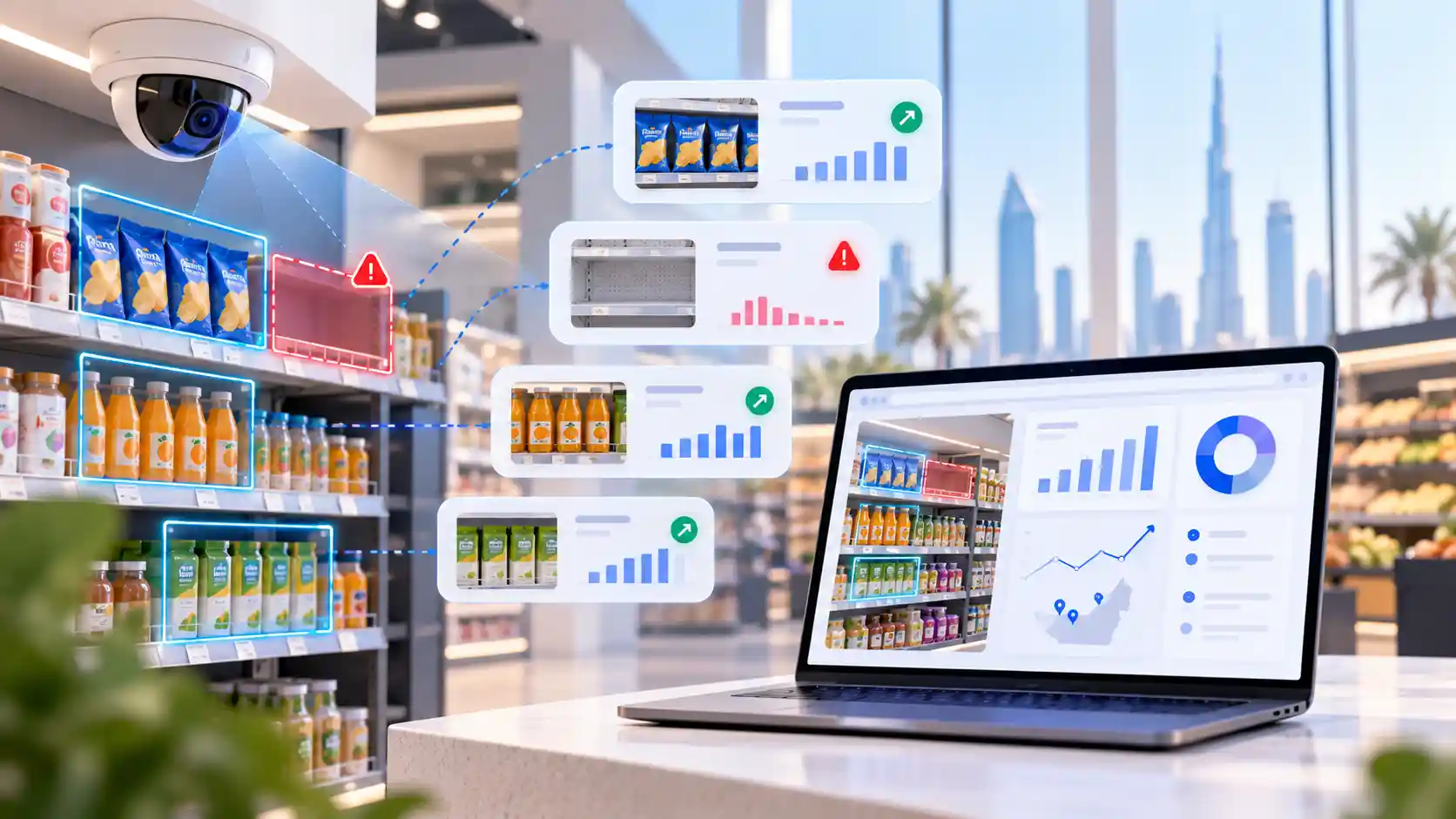
Explore computer vision retail shelf analytics in the UAE, including AI shelf monitoring, product availability, planogram compliance, vendor selection and ROI.
A product can be available in a retailer's warehouse and still be unavailable to a customer standing in front of the shelf. It may be out of stock at the store level, placed in the wrong location, hidden behind competing products, or missing from a promotional display.
For retailers and fast-moving consumer goods (FMCG) brands in the United Arab Emirates, these are practical execution problems. They affect product visibility, merchandising compliance, replenishment decisions, and the ability to understand what is happening across multiple stores.
Computer vision retail shelf analytics uses artificial intelligence to analyze shelf images, identify products, detect availability gaps, and measure in-store execution. Depending on the solution, teams can use smartphone photographs, images from fixed cameras, or other supported visual inputs to monitor product placement, shelf share, promotional displays, and planogram compliance.
The technology can help replace some manual shelf inspections with more consistent, data-driven monitoring. However, its effectiveness depends on image quality, product recognition accuracy, integration with store operations, and how quickly teams act on the resulting insights.
For UAE retailers, the decision is not simply whether to adopt AI. It is whether computer vision can identify meaningful shelf-level problems across the company's actual stores, product ranges, merchandising arrangements, and operating conditions.
This guide explains how the technology works, where it can deliver value, which solution providers are worth evaluating, how to calculate potential ROI, and what UAE businesses should check before implementation.
What Is Computer Vision for Retail Shelf Analytics?
Computer vision for retail shelf analytics is an AI-based approach that interprets images of retail shelves to identify products, assess their positions, detect empty spaces, and evaluate whether displays follow merchandising requirements.
A typical system uses image recognition models to identify known stock-keeping units (SKUs), estimate how many product facings are visible, and compare observed shelf conditions with expected arrangements. The results can be converted into dashboards, alerts, store-level reports, or tasks for field representatives.
For example, an FMCG brand may require a particular beverage SKU to occupy three visible facings on a supermarket shelf. A field representative captures a photograph, and the system identifies the product, checks its visible facings, and flags a potential compliance issue if the display does not match the expected arrangement.
The result is a more structured way to evaluate store execution than relying exclusively on manual observations and written reports.
What Does Retail Shelf Analytics Measure?
Metric | What It Measures | Business Use |
|---|---|---|
On-shelf availability | Whether a product is visibly available to shoppers | Identify potential shelf-level stock gaps |
Out-of-stock indicators | Empty product positions or missing expected SKUs | Prioritize replenishment checks |
Planogram compliance | Whether products appear in their intended shelf positions | Check merchandising execution |
Share of shelf | The visible shelf space or facings occupied by a brand | Evaluate product visibility |
Product facings | The number of visible product fronts | Assess display execution |
Price-label compliance | Whether visible prices match expected pricing information, where supported | Flag discrepancies for verification |
Promotional compliance | Whether promotional displays and materials meet defined requirements | Verify campaign execution |
Assortment compliance | Whether required products appear in the observed display | Identify missing assortment items |
Not every platform measures all these metrics with equal accuracy. Some specialize in mobile image recognition for field teams, while others support fixed-camera monitoring, store analytics, or broader retail execution workflows.
The selection process should therefore begin with the metrics that influence your business decisions, rather than the longest vendor feature list.
Why UAE Retailers Should Evaluate Computer Vision
The UAE retail environment includes supermarkets, hypermarkets, convenience stores, specialty retailers, shopping malls, pharmacies, and other formats. FMCG brands and distributors must also coordinate product availability and merchandising across different retail partners.
Dubai's wholesale and retail trade sector generated AED 86.9 billion in value added during the first nine months of 2025, according to the emirate's official economic reporting. This establishes the commercial importance of retail operations, although it does not independently prove the market size or adoption rate of computer vision solutions. Dubai's official economic report
Several operating conditions make shelf-level visibility worth evaluating.
1. Retail Execution Across Multiple Stores
A brand may distribute products through several retail chains, with each chain operating stores that differ in size, layout, assortment, and promotional arrangements.
Manual audits can provide useful observations, but collecting and consolidating them across a large store network takes time. Computer vision can standardize parts of the process by analyzing images using consistent recognition rules.
Retail managers can then compare stores, identify recurring problems, and prioritize visits based on detected execution gaps.
2. Multilingual Product Packaging and Similar SKUs
Products sold in the UAE may include Arabic and English labels, imported packaging, regional variants, and similar-looking SKUs.
These conditions can make product identification challenging when several items share similar colors, packaging shapes, or brand elements.
A computer vision system must be tested against the actual product catalogue and packaging variations. The fact that a vendor demonstrates recognition on one product range does not establish the same performance across every category.
3. Promotional Displays and Seasonal Demand
Promotional campaigns can involve endcaps, temporary displays, discounts, and changes to shelf arrangements. Retail teams need to know whether the intended displays are actually present and correctly executed.
Computer vision can help compare observed displays with campaign requirements, provided the relevant visual criteria are defined and the system supports the display formats involved.
4. Faster Identification of Shelf-Level Problems
A traditional audit often identifies a problem when a representative visits a store and records the observation. Image recognition can help process the evidence more consistently and route potential issues to the appropriate team.
The time saved depends on how images are collected, processed, reviewed, and converted into action. Automated recognition without a reliable follow-up process does not solve the underlying store problem.
How Computer Vision Shelf Monitoring Works
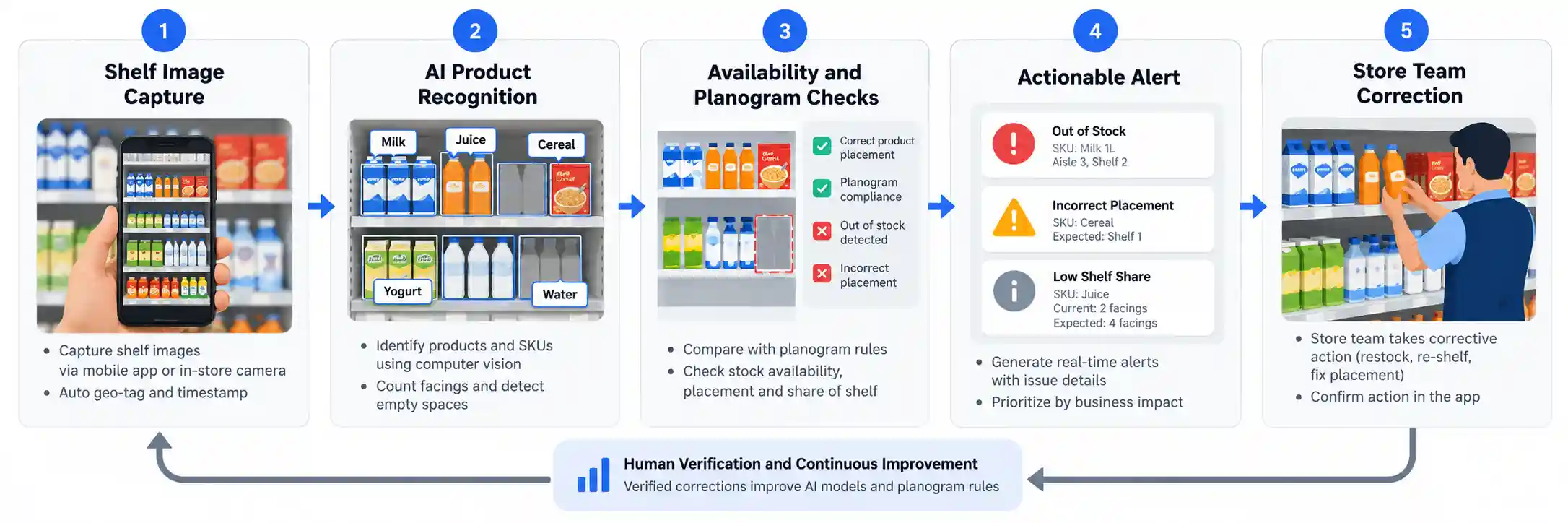
Most retail shelf analytics workflows combine image collection, product recognition, business rules, reporting, and operational follow-up.
Step 1: Capture Shelf Images
Images can come from a field representative's smartphone, a dedicated retail auditing application, or supported fixed cameras.
Mobile image collection is often suitable when a business already conducts merchandising visits. Fixed-camera systems may be more appropriate when frequent monitoring of a defined shelf area is required.
The right approach depends on coverage requirements, store permissions, installation costs, image frequency, and the retailer's operating model.
Step 2: Detect Products and Shelf Positions
The computer vision model analyzes the image to identify recognizable products and estimate their locations.
Depending on the implementation, the model may use object detection, image classification, segmentation, or other recognition techniques. Product catalogues, labeled training images, and reference information may help the system distinguish similar SKUs.
Recognition quality can be affected by glare, shadows, reflections, partial obstruction, packaging changes, crowded shelves, and camera angles.
Step 3: Compare the Observed Shelf with Expected Conditions
The system applies business rules to interpret the detected products.
For example, it may compare the observed shelf with a target planogram, check whether required products are visible, or estimate whether a brand has the expected number of facings.
This stage is important because detecting an object is not the same as deciding whether the display is compliant. The software needs an appropriate reference or rule to determine what the shelf should look like.
Step 4: Generate Alerts and Reports
The platform can turn detected conditions into structured information, such as:
Potentially missing SKUs.
Displays that differ from a planogram.
Products with fewer visible facings than required.
Promotional arrangements that need verification.
Store-level execution reports.
Some solutions also support task assignment and follow-up workflows. These capabilities should be confirmed during vendor evaluation.
Step 5: Assign Corrective Action
A field representative, store employee, or category manager investigates the alert and takes the required action.
The team may replenish the shelf, correct a display, verify a price label, or investigate a potential inventory problem.
A well-designed system records whether the issue was confirmed, corrected, or dismissed. This feedback helps managers distinguish genuine problems from recognition errors and improve the operational process.
Key Use Cases for Computer Vision Retail Shelf Analytics in the UAE
1. On-Shelf Availability Monitoring
On-shelf availability monitoring identifies whether expected products appear to be physically available in the visible display.
This can help FMCG brands and retailers investigate gaps between their expected assortment and what shoppers can see.
For example, a supermarket may have a product listed in its assortment, but the shelf position is empty during a store visit. A shelf analytics system can flag the gap for investigation.
However, an empty shelf position does not necessarily prove that the store has no inventory. Additional stock may be available in the backroom, another shelf, or a nearby display. Computer vision detects visible conditions, while inventory systems and store employees help establish the underlying cause.
This distinction matters when building automated replenishment workflows.
2. Planogram Compliance Monitoring
A planogram defines the intended arrangement of products on a shelf or display. It may specify product positions, facings, shelf levels, and the relationship between adjacent products.
Computer vision can compare a shelf image with the expected arrangement and flag potential deviations.
Retailers can use this information to assess whether stores are following agreed merchandising standards. FMCG brands can use it to evaluate whether their products occupy the intended positions.
The quality of the assessment depends on how accurately the reference planogram represents the actual store, whether the image captures the relevant area, and whether the software can recognize the products involved.
3. Share-of-Shelf and Competitor Visibility Analysis
Share of shelf measures the visible space or facings occupied by a brand or product group within a defined shelf area.
Computer vision can help estimate this metric from shelf photographs, allowing teams to compare display execution across stores and retail partners.
For example, an FMCG category manager could examine whether a brand consistently receives its contracted shelf space in selected stores.
The definition must remain consistent. A share-of-shelf figure based on visible facings is not necessarily equivalent to a measurement based on physical shelf width or area. Vendor reports should specify the metric being calculated.
4. Promotional Display Verification
Retail promotions often depend on specific execution requirements, such as a product occupying an endcap, promotional signage being present, or a designated display containing the correct assortment.
Computer vision can help identify whether the expected visual elements appear in a store image.
This allows campaign managers to review evidence from multiple stores without relying exclusively on manually compiled reports.
The system should be tested against temporary displays, changing promotional artwork, and different store layouts before it is used to evaluate campaign performance at scale.
5. Price-Label and Product-Pairing Checks
Some platforms can detect visible price labels and compare their contents with reference data. Others may focus primarily on product recognition and display compliance.
When price verification is important, ask whether the vendor can read the relevant label, associate it with the correct SKU, and flag discrepancies for human review.
OCR, or optical character recognition, may be used to extract text from images. But extracting a price does not automatically establish that the price is correctly associated with the intended product or that the price is the current approved price.
6. Store Visit Optimization
Retail execution teams often operate with limited time and a large number of stores to cover.
Computer vision insights can help managers prioritize visits based on repeated shelf gaps, incomplete promotional execution, or other verified issues.
For instance, stores with recurring availability problems may receive additional attention, while stores consistently meeting merchandising requirements may need less intensive auditing.
This is a potential operational benefit, not a guaranteed reduction in field costs. It must be measured against the existing visit schedule, travel requirements, alert quality, and actual resolution rates.
Best Computer Vision Solutions to Evaluate for Retail Shelf Analytics
The following vendors provide relevant retail image recognition, shelf monitoring, or retail execution capabilities. This is a shortlist for evaluation, not a ranking of the best vendors for the UAE. Their public materials do not independently establish UAE-specific deployment coverage, local support arrangements, or comparative performance under identical conditions.
Platform | Relevant Capability | Potential Fit | What to Verify |
|---|---|---|---|
ParallelDots ShelfWatch | AI image recognition for shelf execution and product visibility | FMCG brands and retail execution teams | UAE deployment, SKU coverage, integrations, and validated accuracy |
Vispera | Retail image recognition, shelf monitoring, and store execution analytics | Brands and retailers requiring shelf-level insights | Supported image collection methods, product catalogue setup, and local support |
Storecheck Vision | Shelf image analysis, availability, share of shelf, and planogram checks | Merchandising and field audit workflows | Geographic availability, supported retail formats, and integration requirements |
FORM Image Recognition | Image recognition connected to field operations and task management | Organizations coordinating field representatives and store execution | Regional availability, workflow compatibility, and commercial terms |
BeMyEye | Retail execution intelligence and image-based shelf monitoring | Brands seeking field execution insights | UAE coverage, service model, data access, and reporting requirements |
Custom computer vision solution | Tailored product recognition and shelf analytics using a suitable vision model | Organizations with specialized workflows or technical teams | Development cost, model maintenance, infrastructure, and long-term ownership |
1. ParallelDots ShelfWatch
ParallelDots offers ShelfWatch, a retail image recognition platform designed to analyze shelf displays and provide retail execution insights.
Its official website describes capabilities for identifying products, assessing shelf conditions, and supporting corrective action for FMCG and retail teams. See ParallelDots.
Consider it when: Your organization needs SKU-level shelf monitoring and actionable field execution insights.
Before choosing it: Validate performance using your actual product images, Arabic and English packaging variations where relevant, and the shelf configurations found in your UAE retail network.
2. Vispera
Vispera provides image recognition products for retail, including mobile data collection and fixed-camera shelf monitoring options described on its official product page.
Its offerings are relevant when teams need to measure SKU availability, shelf performance, and in-store execution.
Consider it when: You want to evaluate a dedicated retail image recognition platform with options for different store-monitoring workflows.
Before choosing it: Confirm whether the proposed deployment supports your required image capture frequency, store formats, product catalogue, reporting needs, and local service requirements.
3. Storecheck Vision
Storecheck Vision describes a shelf image recognition solution for measuring availability, share of shelf, competitor facings, planogram compliance, and displayed prices. Its official product page provides further information.
Consider it when: Your team already runs merchandising audits and wants to turn shelf photographs into more structured execution data.
Before choosing it: Request a controlled demonstration using actual store images and verify the availability of its services in the UAE.
4. FORM Image Recognition
FORM offers image recognition capabilities integrated with its retail execution and field operations platform. Its official retail image recognition information describes product identification, shelf visibility, and task-related workflows.
Consider it when: Your main requirement is to connect shelf observations with field team assignments and follow-up.
Before choosing it: Confirm supported devices, integrations, pricing, regional availability, and whether its task management workflow fits your existing field operations.
5. BeMyEye
BeMyEye provides retail execution tools and describes image-based shelf analytics for availability, display visibility, and related execution metrics. Its official store execution page explains these capabilities.
Consider it when: You need shelf-level observations tied to broader retail execution and merchandising activities.
Before choosing it: Verify service coverage in the UAE, the data available for your retail partners, and the way detected issues are assigned and resolved.
6. Custom Computer Vision Development
A custom solution may be appropriate when existing retail platforms do not support a required workflow or when a business needs tighter integration with its own systems.
A custom implementation might use an object detection model, a product catalogue, planogram rules, an image-processing pipeline, and a dashboard integrated with inventory or field service systems.
Consider it when: You have specialized requirements, technical ownership, and a clear business case for building and maintaining your own system.
Before choosing it: Include data collection, annotation, model evaluation, deployment, monitoring, updates, and support in the cost estimate. Building a prototype is not the same as operating a reliable retail analytics service across many stores.
How to Compare Computer Vision Vendors for UAE Retail
Vendor selection should be based on demonstrated performance, operational fit, and total cost rather than headline accuracy claims.
Build a Standardized Evaluation Matrix
Evaluation Criterion | Suggested Weight | Questions to Ask |
|---|---|---|
Product recognition accuracy | 20% | Can the system distinguish our real SKUs and packaging variants? |
Shelf availability detection | 15% | Can it identify missing expected products in representative images? |
Planogram and facing analysis | 15% | Can it measure the merchandising requirements we actually use? |
Image capture workflow | 10% | Does it support our field teams, devices, and camera setup? |
Integration and task management | 10% | Can findings reach the teams and systems that need to act? |
Reporting and auditability | 10% | Can users inspect source images, decisions, and corrections? |
Security and privacy | 10% | Does the proposed deployment meet our data-handling requirements? |
Total cost of ownership | 10% | What are the setup, licensing, support, and ongoing operating costs? |
Total | 100% |
These weights are a suggested evaluation model, not an industry standard. Change them according to your priorities. Mandatory security, legal, and operational requirements should be treated as pass-or-fail conditions before applying the weighted score.
Questions to Ask During a Vendor Demonstration
Can the system identify our actual products, including visually similar SKUs?
How does it handle glare, partial obstruction, shelf-edge labels, and low-quality images?
Does it distinguish a genuinely missing product from one that is simply outside the camera's view?
Can it compare the shelf against our existing planograms?
How are new SKUs and packaging changes added?
Can users inspect the image behind an alert?
How are uncertain detections handled?
Can confirmed issues generate tasks for store or field teams?
What integrations are available with our inventory, reporting, or retail execution systems?
Where is the data processed and stored, and what access controls are available?
What support and service arrangements are available for UAE operations?
What costs are charged per user, image, store, SKU, or deployment?
How to Measure ROI from Retail Shelf Analytics
Computer vision can generate business value only when its insights lead to measurable operational improvements.
Potential benefits include fewer manual inspection hours, earlier identification of shelf gaps, more consistent merchandising compliance, and better prioritization of store visits.
These benefits should be measured against a baseline rather than assumed from vendor demonstrations.
1. Calculate the Cost of Manual Audits
Estimate the total annual cost of the existing process, including representative time, travel, reporting, data consolidation, and follow-up.
Compare that with the expected cost of image capture, software licenses, integration, training, and ongoing administration.
Do not assume that all manual audits can be removed. Some checks will still require human judgment or physical inspection.
2. Measure Shelf Availability Before and After Deployment
Choose a representative set of stores and SKUs. Establish a baseline using a consistent definition of on-shelf availability.
Repeat the measurement after the system is deployed, using comparable store conditions and verification methods.
Track whether the team identifies and resolves more genuine shelf gaps, rather than simply producing more alerts.
3. Measure Resolution Time
Record the time between detecting an issue and confirming its resolution.
A system that detects problems accurately but leaves them unassigned may have limited operational value. Measure the complete workflow, including verification and corrective action.
4. Estimate Financial Benefits Conservatively
A practical model is:
Net annual benefit = verified incremental gross profit + realized operational savings − annual operating cost
ROI = (net annual benefit ÷ total investment) × 100
For this calculation, separate incremental profit from revenue and avoid counting the same benefit twice.
Illustrative ROI Scenario
The following numbers are hypothetical assumptions, not reported results from a UAE retailer.
Suppose a retail operation estimates that a shelf analytics deployment could generate AED 240,000 in annual verified benefits from additional gross profit and realized labor savings. Assume its annual operating cost is AED 150,000 and its one-time implementation cost is AED 50,000.
Annual net benefit after recurring operating cost: AED 90,000.
First-year net benefit after implementation cost: AED 40,000.
First-year ROI on total first-year costs: AED 40,000 ÷ AED 200,000 × 100 = 20%.
The calculation depends entirely on the assumptions. A pilot must establish whether the benefits are genuinely incremental, repeatable, and attributable to the system.
Recommended Pilot KPIs
KPI | What It Tells You |
|---|---|
SKU recognition precision | How often identified products are correct |
SKU recognition recall | How many relevant products the system successfully identifies |
False alert rate | How frequently alerts identify problems that are not real |
Missed issue rate | How frequently genuine problems go undetected |
On-shelf availability | The percentage of expected product observations meeting the defined availability criteria |
Planogram compliance | The proportion of assessed displays meeting specified merchandising rules |
Issue resolution time | How long it takes to verify and correct a detected problem |
Cost per audited store | The operational cost of completing a store audit |
Verified financial benefit | The measurable incremental benefit attributable to the intervention |
These metrics should be defined before the pilot begins. Otherwise, a vendor and a retailer may report different figures under the same metric name.
UAE Implementation Considerations: Privacy, Infrastructure, and Operations
A computer vision deployment must fit the retailer's operational and regulatory environment.
1. Data Protection and Privacy
Retail shelf images may contain more than products. Depending on the camera angle and store layout, images may capture shoppers, employees, payment screens, or other information that is not needed for shelf analytics.
The UAE's Federal Decree-Law No. 45 of 2021 on the Protection of Personal Data establishes a framework for personal data processing, confidentiality, and relevant data-transfer requirements. The law's application and any exceptions depend on the circumstances. See the UAE government's overview of data protection laws.
For a retail shelf analytics deployment, practical safeguards may include:
Positioning cameras to focus on products rather than identifiable individuals.
Limiting image capture to the minimum information required.
Applying masking or other privacy controls where appropriate.
Defining retention periods and access permissions.
Reviewing vendor data-processing and cross-border transfer arrangements.
Obtaining legal advice on applicable federal, emirate-level, and free-zone requirements.
Do not assume that all camera footage is personal data or that all footage falls outside data protection rules. Assess the actual information collected and the applicable legal framework.
2. Cloud, Edge, and Hybrid Processing
Computer vision systems may process images on a device, on local infrastructure, or through cloud services.
Deployment Model | Potential Advantage | Trade-Off |
|---|---|---|
Cloud processing | Centralized model management and scalable infrastructure | Connectivity, data transfer, and service dependency |
Edge processing | Local processing and potential reduction in image transfer | Device deployment, maintenance, and hardware constraints |
Hybrid processing | Combines local capture or detection with centralized analytics | More integration and operational complexity |
The best option depends on store connectivity, image volume, latency requirements, security needs, and the vendor's architecture.
3. Product Catalogue and Packaging Maintenance
Retail product ranges change. New SKUs launch, packaging is refreshed, and seasonal promotions introduce new displays.
The system must be able to incorporate these changes without allowing recognition quality to deteriorate.
Ask vendors how new products are onboarded, how much representative image data is required, and how model performance is monitored after catalogue changes.
4. Integration with Retail Systems
Shelf recognition becomes more useful when the results can be compared with trusted business information.
Relevant systems may include:
Product information management (PIM).
Inventory and warehouse management systems.
Enterprise resource planning (ERP).
Retail execution and field service platforms.
Planogram and category management systems.
Business intelligence dashboards.
Integration can help a retailer investigate whether an empty shelf corresponds to low store stock, an unprocessed delivery, a replenishment delay, or a merchandising issue.
However, the relationship between shelf visibility and inventory must be validated. A camera cannot directly establish backroom stock levels unless that information comes from another system or process.
Common Challenges and Limitations
Product Recognition Is Not Always Reliable
Similar packaging, occlusion, reflections, low image resolution, and changing shelf arrangements can cause incorrect detections.
A vendor's published performance figure should not be assumed to apply to your stores. Evaluate the system on a representative set of real images, with ground-truth labels and a documented measurement method.
An Empty Shelf Does Not Explain the Cause
Computer vision can identify a visible gap, but it may not establish whether the cause is a stockout, poor replenishment, a misplaced product, or a temporary display change.
Use the image-based alert as a trigger for investigation, and combine it with inventory data or human verification where needed.
Camera Coverage Can Limit What the System Sees
A shelf image may omit the lower shelves, conceal products behind others, or fail to capture a promotional display in full.
Fixed cameras can improve monitoring frequency in selected areas, but installation, placement, coverage, and privacy considerations require careful planning.
Automation Does Not Replace Store Execution
A system that detects missing products does not physically replenish shelves or resolve delivery problems.
Its operational value depends on whether the organization assigns responsibility, sets response priorities, and tracks the resolution of confirmed issues.
Vendor Accuracy Claims Are Not Directly Comparable
Different vendors may use different datasets, product catalogues, image conditions, evaluation metrics, and definitions of accuracy.
For example, object-detection average precision is not the same as the percentage of shelf audits completed correctly. Compare results only when the evaluation methods are sufficiently aligned.
A Practical Roadmap for Implementing Computer Vision Shelf Analytics
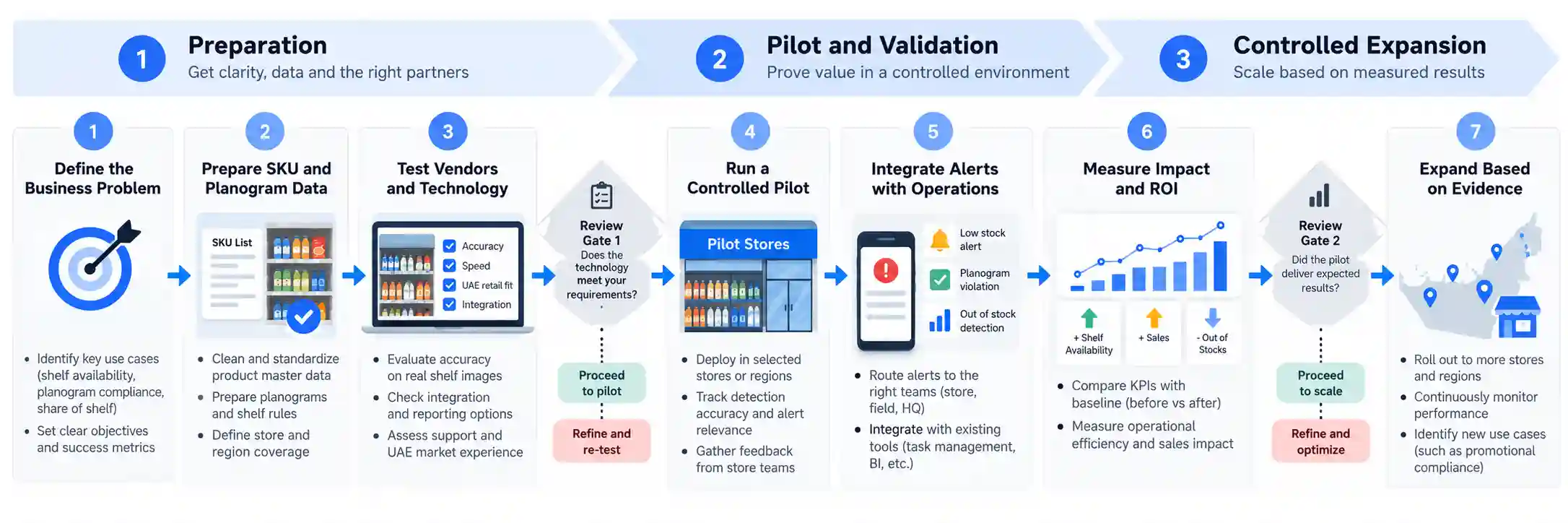
A phased implementation helps businesses establish evidence before committing to a large deployment.
Phase 1: Define the Business Problem
Select one measurable objective, such as identifying missing SKUs, checking promotional displays, or reducing the time required to complete shelf audits.
Identify the teams responsible for collecting images, reviewing results, and resolving problems.
Phase 2: Prepare the Product and Store Data
Compile the relevant SKU catalogue, product images, planograms, store list, and merchandising rules.
Confirm that the data reflects the products and layouts included in the pilot.
Phase 3: Test Vendors with Real Images
Use a representative sample of shelf images from the intended store formats. Include challenging cases such as similar packaging, reflections, partial obstruction, and promotional displays.
Measure recognition accuracy, false alerts, missed issues, and operational usability.
Phase 4: Run a Controlled Pilot
Deploy the chosen solution in a limited set of stores. Compare its output with human-verified observations and measure the time required to resolve confirmed issues.
Keep human review in place for consequential decisions and uncertain detections.
Phase 5: Integrate Alerts with Existing Workflows
Connect verified insights to the systems used by store managers, merchandising teams, or field representatives.
Ensure that each alert has an owner, an appropriate priority, and a clear resolution process.
Phase 6: Measure Business Results
Compare pilot results with the baseline. Evaluate the cost of auditing, availability metrics, resolution time, compliance, and verified financial benefits.
Separate improvements attributable to the technology from changes caused by promotions, staffing, inventory availability, or other operational factors.
Phase 7: Expand Based on Evidence
Expand to more stores, SKUs, or use cases only when the pilot meets predefined quality, security, operational, and financial criteria.
Continue monitoring model performance, packaging changes, false alerts, and the effectiveness of corrective actions.
Frequently Asked Questions
1. What is computer vision retail shelf analytics?
Computer vision retail shelf analytics uses AI to analyze shelf images and identify products, availability gaps, product facings, and merchandising conditions. Depending on the solution, it can compare observed shelves with planograms and generate reports or alerts for store teams. Its accuracy depends on the quality of the images, the product catalogue, the recognition model, and the rules used to evaluate shelf conditions.
2. How can UAE retailers use AI to monitor shelf availability?
UAE retailers can use AI shelf monitoring to analyze images from store visits or supported cameras, identify expected products that appear to be missing, and route potential issues for investigation. Retailers should test the system across their actual product ranges and store formats, and connect verified shelf observations with inventory and replenishment workflows where appropriate.
3. Which computer vision vendors should UAE retailers evaluate?
ParallelDots ShelfWatch, Vispera, Storecheck Vision, FORM Image Recognition, and BeMyEye are potential vendors to evaluate for retail image recognition and execution analytics. The right choice depends on SKU coverage, recognition accuracy, workflow integration, pricing, security, and local service availability. Public product descriptions alone do not establish that a provider is the best fit for a particular UAE retailer.
4. Can computer vision detect out-of-stock products?
Computer vision can identify expected products that are missing from a visible shelf or detect empty shelf positions. However, it cannot reliably determine the complete inventory situation from an image alone. A product may be missing from the shelf while stock remains in a backroom or another display. Retailers should combine image-based findings with inventory information and verification procedures.
5. How does computer vision measure planogram compliance?
The system identifies visible products and their positions, then compares the observed arrangement with a reference planogram or predefined merchandising rules. It can flag missing products, incorrect positions, or differences in expected facings where the solution supports those checks. Results depend on image coverage, product recognition quality, and how accurately the reference planogram represents the store.
6. Is computer vision shelf analytics suitable for FMCG brands?
Yes. FMCG brands can use shelf analytics to monitor product visibility, assortment compliance, promotional displays, and retail execution across stores. The technology is especially relevant when a brand needs consistent evidence from multiple retail partners. The business case should be assessed against the quality of current audits, the number of stores involved, and the ability to resolve detected issues.
7. What should UAE retailers consider when deploying shelf analytics?
Retailers should evaluate recognition performance, image collection methods, integrations, operating cost, data security, and applicable privacy requirements. They should also verify whether the vendor supports the required store formats and provides suitable technical and operational support in the UAE. If images may contain identifiable people, the business should assess the applicable data protection obligations and minimize unnecessary collection.
8. How much does computer vision retail shelf analytics cost?
Pricing depends on the vendor, deployment model, number of stores, image volume, SKU catalogue, integrations, hardware, and support requirements. A reliable estimate should include implementation, product onboarding, training, ongoing licensing, maintenance, and human verification. Request a commercial proposal based on a representative pilot rather than relying on a generic market-wide price estimate.
Conclusion: When Should UAE Retailers Invest in Computer Vision Shelf Analytics?
Computer vision retail shelf analytics is worth evaluating when a retailer or FMCG brand needs more consistent visibility into shelf availability, product placement, planogram compliance, and promotional execution across stores.
The strongest use cases are those where image recognition identifies a specific operational problem, the result reaches the responsible team, and the business can measure whether the issue is resolved more effectively than before.
ParallelDots, Vispera, Storecheck Vision, FORM, and BeMyEye offer relevant capabilities to investigate, while custom development may suit organizations with specialized requirements and the resources to maintain their own systems. None should be selected solely on the basis of published accuracy claims or feature lists.
For UAE businesses, a disciplined approach is to start with one high-value use case, test vendors using real shelf images, confirm privacy and integration requirements, and measure the financial impact of a controlled pilot.
The practical value of computer vision is not the number of shelf images analyzed. It is the number of genuine retail execution problems identified, verified, and resolved at a cost that makes business sense.
Comments (0)
No comments yet. Be the first to share your thoughts!