Meet Feather, the Startup Building the ‘Android of Robotics’

Author
Ravi Prajapati
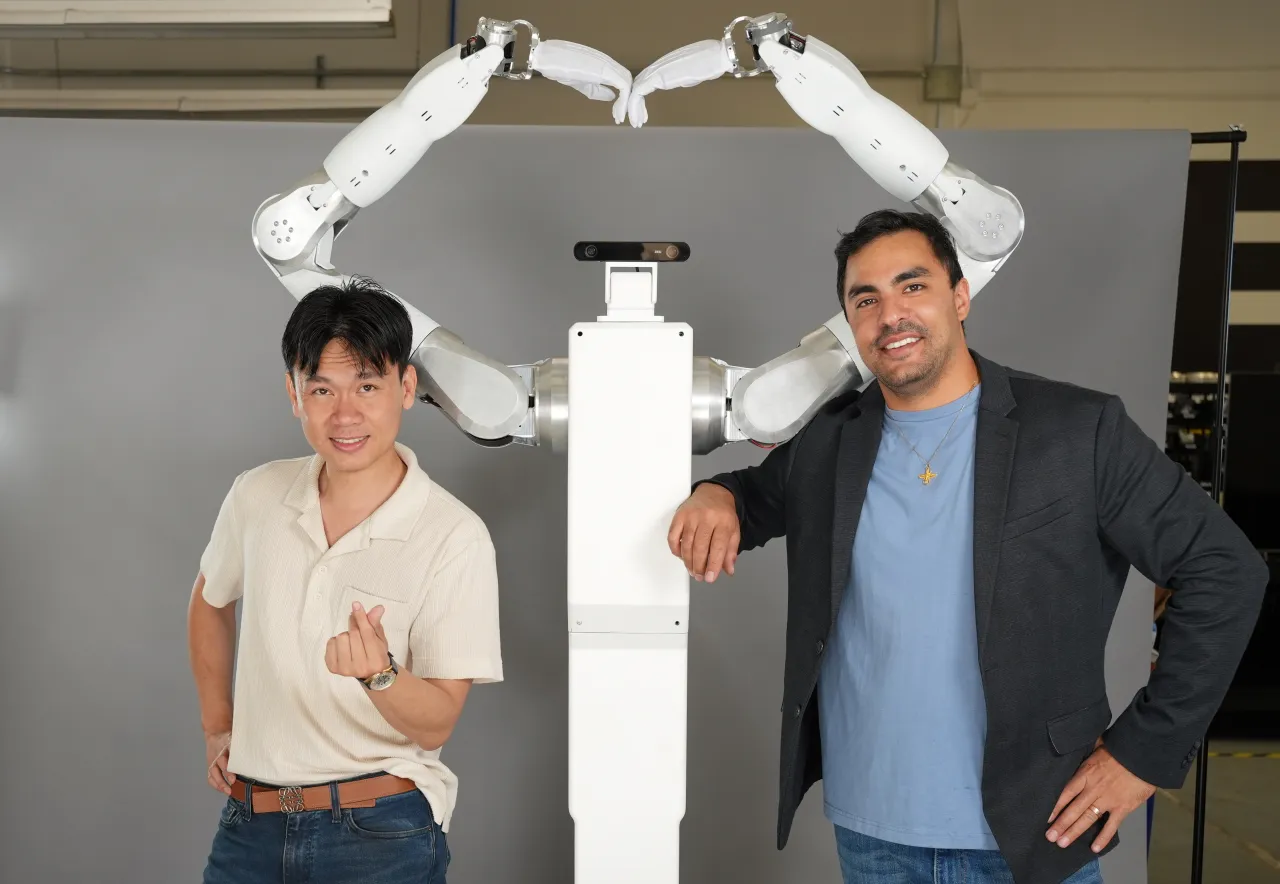
Feather Robotics is building a $30,000 modular humanoid platform that lets developers create and deploy real-world physical AI applications.
Feather Robotics is taking a different route to the humanoid robot race. Instead of trying to build one robot that can do everything, the startup is creating a modular robotics platform that developers can customize, program and deploy for specific real-world jobs.
The company has already crossed $1 million in revenue, raised a $7.6 million pre-seed round led by Gradient Ventures, and is selling its robot for around $30,000.
Its bigger ambition is much more interesting: Feather wants to become something like the “Android of robotics”, providing the underlying platform on which other companies can build physical AI applications.
What Is Feather Robotics?
Feather Robotics is a U.S. robotics startup founded in 2025 by Hoa Mai and Parsa Bakhtiari.
Mai previously co-founded Kind Humanoid, which was acquired by robotics company 1X. According to Feather, he has worked on humanoid and embodied AI systems since 2018 and previously worked at Google and Apple.
Bakhtiari previously worked at Tesla during the Model 3 production ramp and worked on advanced robotics projects.
Instead of competing directly with companies trying to create a completely integrated general-purpose humanoid, Feather is building infrastructure that other robotics and physical AI companies can develop on top of.
Think of the difference this way:
Some companies want to build the iPhone of robotics. Feather wants to build something closer to Android.
A Robot Platform Developers Can Actually Build On
The current humanoid robotics market is dominated by ambitious attempts to combine sophisticated hardware with increasingly capable AI models.
Feather is separating those layers.
Its system is modular, allowing developers to modify hardware configurations for different applications. TechCrunch reports that developers can make changes such as adjusting the robot's arm length depending on the task.
More importantly, Feather isn't forcing developers into a single AI model ecosystem.
Its hardware is designed to work with robotics AI models from different providers, giving developers more flexibility when building physical AI applications.
That could make Feather particularly interesting to startups that have developed AI capable of performing physical tasks but don't want to spend years designing their own robot hardware.
Feather Robots Are Already Doing Real Work
This isn't only a research project.
Feather says its robots are already being deployed for commercial tasks.
According to TechCrunch, Feather robots are being used for jobs including cooking in restaurants in Japan and cleaning science laboratories. The company hasn't publicly disclosed the names of its customers.
Those early deployments have helped Feather generate more than $1 million in revenue.
The company has spent the past year field-testing its system and resolving reliability issues, and it is now preparing for a larger product launch.
The $30,000 Price Could Be Important
One of Feather's most notable decisions is pricing.
Its robot costs approximately $30,000. TechCrunch reports that this is roughly half the price of Unitree's H2 Edu.
That matters because robotics startups face a difficult economics problem.
A company developing a robotics application typically needs hardware before it can even begin proving whether its software or business model works. Building a humanoid platform internally can require significant capital, specialized engineering teams and years of development.
A relatively affordable, programmable platform could lower that barrier.
Instead of building motors, joints, electronics, control systems and an entire robot from scratch, a startup could potentially concentrate on the application it actually wants to commercialize.
Why Feather Calls Itself the “Android of Robotics”
The Android comparison explains Feather's strategy better than simply calling it another humanoid robotics company.
Google doesn't manufacture every Android device. Android provides a platform that allows a much larger ecosystem of hardware manufacturers and software developers to build products.
Feather is betting that robotics could eventually develop in a similar way.
The company believes thousands of physical AI application companies could emerge over the next several years. Rather than competing with every one of them, Feather wants to provide infrastructure they can build upon.
Its own mission describes the problem as robotics' “last-mile” challenge: there are millions of physical tasks that could potentially be automated, but individual companies shouldn't necessarily have to rebuild the hardware and software foundation every time.
Feather Is Making a Different Bet From Tesla and Figure
Companies such as Tesla and Figure are pursuing vertically integrated approaches to general-purpose humanoid robotics.
The long-term vision is powerful: build a robot with hardware and intelligence capable of adapting to many different environments and jobs.
But getting there is extremely difficult.
Feather's strategy is more immediate.
Instead of waiting for a single foundational robotics model to become capable enough to handle almost anything, developers can use Feather's platform to build specialized applications around tasks that can already be automated.
That could mean robots optimized for:
Restaurants
Laboratories
Warehouses
Manufacturing
Facilities management
Logistics
Other repetitive physical work
The key question is whether enough robotics startups prefer a shared platform over building proprietary hardware.
Why This Matters for Physical AI
Generative AI grew rapidly partly because developers didn't need to train a frontier model before building a product.
Thousands of startups could build applications on top of APIs and open-source models from companies such as OpenAI, Anthropic, Google and Meta.
Physical AI doesn't yet have an equivalent development environment.
A startup building an AI application for physical work still needs to solve hardware integration, sensors, movement, reliability, maintenance and deployment.
Feather is effectively betting that robotics needs a developer layer.
If that layer becomes standardized enough, building a robotics startup could start looking less like building a car company and more like building a software company on top of existing infrastructure.
That would be a meaningful shift.
The Bigger Picture
The humanoid robotics race is usually framed around one question:
Who will build the first truly general-purpose humanoid robot?
Feather is asking another question:
What if the bigger opportunity is enabling thousands of developers to build specialized robots first?
That distinction makes the company worth watching.
The winners in physical AI may not necessarily be limited to companies building the smartest robot or the largest robotics foundation model. There could also be significant value in the platforms connecting AI models, developers and deployable hardware.
Feather wants to occupy that layer.
With commercial deployments underway, more than $1 million in revenue and a $30,000 modular platform, the company now has to prove that its “Android of robotics” idea can grow from an interesting analogy into a genuine developer ecosystem.
Key Takeaways
Company: Feather Robotics
Founded: 2025
Founders: Hoa Mai and Parsa Bakhtiari
Focus: Modular humanoid robotics platform
Robot price: Around $30,000
Funding: $7.6 million pre-seed round led by Gradient Ventures
Reported revenue: More than $1 million
Current use cases: Restaurant cooking and science lab cleaning
Long-term goal: Become a development platform for physical AI applications
Comments (0)
No comments yet. Be the first to share your thoughts!