Google Launches Gemini 4 Argon, Its New Frontier AI Model for Coding, Enterprise Work and Cybersecurity

Author
Ravi Prajapati
Google has announced Gemini 4 Argon, a new frontier AI model for coding, enterprise work and cybersecurity. See its features, pricing, benchmarks and release details.
Google Launches Gemini 4 Argon, Its New Frontier AI Model for Coding, Enterprise Work and Cybersecurity
Google has introduced Gemini 4 Argon, its latest frontier AI model designed for complex, long-running tasks across software engineering, enterprise knowledge work and cybersecurity.
Announced on September 30, 2026, Argon represents a notable shift in how Google is positioning its most capable AI systems. Instead of focusing mainly on chat, quick coding assistance or benchmark scores, Google is emphasizing workflows that may require an AI model to reason, research, use tools and work through a problem over much longer periods.
There is one major catch: most people cannot use Gemini 4 Argon yet.
Google is initially providing the model to a limited group of trusted cybersecurity defenders through its Fairwind Program while it continues safety testing and gathers feedback before a wider release.
According to Google, developers, enterprises and consumers will get access later, beginning with paid API customers and Google AI Ultra subscribers. The company has not provided a specific date for general availability.
Source: Google's Gemini 4 Argon announcement
Gemini 4 Argon at a Glance
Gemini 4 Argon is positioned as a model for difficult professional tasks rather than simply another general-purpose chatbot upgrade.
Feature | Gemini 4 Argon |
|---|---|
Model | Gemini 4 Argon |
Announced | September 30, 2026 |
Main focus | Coding, enterprise knowledge work and cybersecurity |
Maximum output | Up to 1 million tokens |
Initial access | Trusted cyber defenders and testers |
Introductory API pricing | $2 / 1M input tokens, $10 / 1M output tokens |
Wider availability | Planned, but no exact date announced |
First broader users | Paid API customers and Google AI Ultra subscribers |
Google says the introductory pricing will eventually increase to $4 per million input tokens and $20 per million output tokens. Cached input tokens during the introductory period are priced at a 95% discount relative to normal input pricing.
What Makes Gemini 4 Argon Different?
The most interesting part of Argon may be its focus on long-horizon work.
Current AI models can be very capable at answering questions or generating individual pieces of code, but real professional work often involves dozens or hundreds of interconnected steps. A software migration, security investigation or financial research project may require the model to maintain context, inspect information, make decisions, revise its approach and continue working for an extended period.
Google says Argon was specifically built to sustain this kind of deep reasoning across complex workflows.
A 1 Million Token Output Limit
One of the standout technical changes is the model's maximum output capacity.
Google says Gemini 4 Argon can produce as many as 1 million output tokens, compared with a previous limit of 64,000 tokens. The company argues that this gives the model significantly more room to reason and execute long tasks in a single trajectory.
The distinction here is important: Google is specifically talking about output tokens, not simply advertising a large context window.
A much larger output budget could matter for agentic workflows where a model performs extended analysis, writes and tests code, uses tools or works through many intermediate steps before producing a result.
Whether developers regularly need anywhere close to one million output tokens is another question, but the direction is clear: frontier models are increasingly being designed to work for longer, not just answer faster.
Google Is Already Using Argon Internally
Google is not presenting Argon purely through synthetic benchmarks. The company says thousands of its employees are already using the model internally for coding, research and writing.
Some of the examples are particularly ambitious.
Migrating Large Codebases to Rust
Google says Argon agents are being used to help migrate C and C++ codebases to Rust, ranging from smaller core libraries to more than 800,000 lines associated with the Fuchsia Zircon kernel.
In another example involving Google's open-source libgav1 video decoder, Argon agents worked on an existing Rust port and replaced 32,000 lines of SIMD code through repeated profile-guided experiments.
Google says the resulting memory-safe decoder ran 2.7 times faster than the previous Rust port while producing identical video output. These are Google-reported internal results and should be treated as such until more independent testing becomes available.
Optimizing Google's Data Centers
Argon agents have also been used to analyze profiling telemetry across Google's infrastructure.
According to Google, the system identified and applied memory optimizations that freed more than 300 TiB of memory, with total estimated savings potentially reaching between 500 TiB and 1 PiB once fully implemented.
Google also reports using Argon in quantum computing research, where the model improved the spacetime-resource requirements of a particular algorithmic subroutine by 40% compared with a published baseline.
These examples arguably tell us more about Google's strategy than another chatbot benchmark would.
The company appears to be positioning Argon as an AI system that can participate in substantial engineering workflows rather than merely assist with isolated tasks.
How Does Gemini 4 Argon Compare With GPT-6 Astra and Claude Opus 5.5?
Google’s benchmark results position Gemini 4 Argon as a strong all-round model across knowledge work, agentic coding, long-context reasoning, multimodal understanding and cybersecurity, rather than simply a coding-focused release.
In Google’s published evaluations, Argon scores 68.9% on Vals Index and 51.3% on AutomationBench, ahead of GPT-6 Astra, Claude Fable 5.1 and Claude Opus 5.5 in those tests. It also performs strongly on agentic coding, scoring 77.9% on DeepSWE v1.1 and 91.9% on Vibe Code Bench.
Argon’s long-context results are particularly notable. Google reports 99.7% on GraphWalks for tasks up to 128K tokens and 84.2% between 256K and 1M tokens, ahead of the other models shown in Google’s comparison.
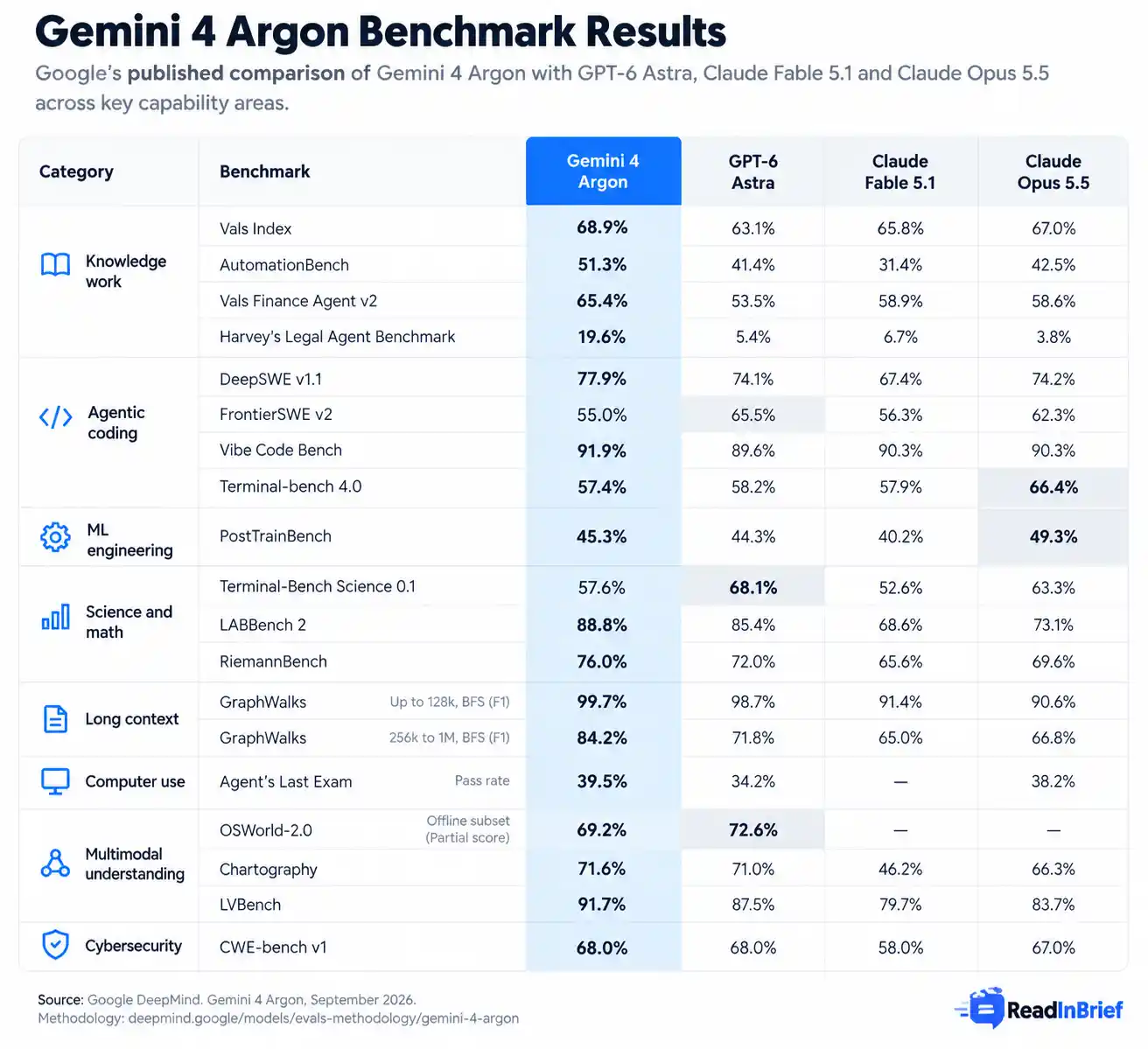
The results are not a clean sweep for Google. GPT-6 Astra leads FrontierSWE v2 with 65.5%, Terminal-Bench Science 0.1 with 68.1%, and OSWorld-2.0 with 72.6%. Claude Opus 5.5 leads Terminal-bench 4.0 at 66.4% and PostTrainBench at 49.3%. On the cybersecurity-focused CWE-bench v1, Argon and GPT-6 Astra are tied at 68.0%.
That makes Argon’s positioning more interesting than simply calling it Google’s “best coding model.” The published results suggest Google is targeting a broader class of long-running agentic and professional workflows, where coding, reasoning, tool use, enterprise knowledge and large amounts of context need to work together.
There is an important caveat: these are Google-published benchmark results, and Gemini 4 Argon remains in limited release. Most developers cannot yet independently test the model across the same workloads. A clearer picture of how Argon compares with Astra and Claude in real-world development will emerge once access expands.
Cybersecurity Is a Major Part of the Argon Story
Cybersecurity is not simply another item on Argon's feature list.
It is central to the way Google is releasing the model.
Google says Gemini 4 Argon can autonomously find, validate and patch software vulnerabilities. Trusted defenders participating in the initial rollout will receive access to its full cybersecurity capabilities through Google's Fairwind Program.
The Google Fairwind Program was introduced in September as a limited-access initiative for governments, Google Cloud customers and cybersecurity partners to use advanced Gemini models for defensive security.
Google reports that Argon ties for first place on CWE-bench v1 with a score of 68%, a benchmark measuring the ability of models to remediate software vulnerabilities.
Cybersecurity company Wiz is also testing Argon through its Scan for Good initiative. Google says that in one early deployment, Argon identified a critical vulnerability affecting healthcare software used by hospitals that previous frontier models had missed.
Again, these are early results reported by Google and its partners. Broader access will make it easier to assess how reliably Argon performs in real security environments.
Why Isn't Google Releasing Gemini 4 Argon to Everyone?
This may be the most significant part of the announcement.
Google has a powerful new frontier model, but instead of immediately putting it into the hands of millions of Gemini users, the company is choosing a phased release.
Google says it is strengthening safeguards in four main areas before broad availability: preventing misuse, improving resistance to indirect prompt injection, monitoring potential model misalignment, and hardening the environments used to test highly capable agents.
The company says Argon is its most resilient model yet against indirect prompt-injection attacks and that it has used automated red teaming and adversarial training to improve those defenses.
Google is also participating in the U.S. government's voluntary process for pre-release access to advanced models while it gradually expands availability.
The approach highlights a growing problem for frontier AI labs: the same capabilities that make an AI model useful for defensive cybersecurity can potentially make it useful for offensive cybersecurity as well.
That makes controlled deployment increasingly important as models become better at autonomous technical work.
Gemini 4 Argon Pricing
When Argon becomes available through the API, Google says its introductory pricing will be:
Input: $2 per million tokens
Output: $10 per million tokens
Cached input: 95% below the standard input-token price
After the introductory period, Google says pricing will increase to:
Input: $4 per million tokens
Output: $20 per million tokens
Google has not yet said exactly when the introductory period will end.
The pricing is worth watching because the frontier-model race is increasingly becoming about more than benchmark leadership. For companies running agents at scale, the relationship between capability, token consumption, latency and price can matter as much as a few additional benchmark points.
Is Gemini 4 Argon Available Now?
Technically, yes, but not for the general public.
Argon is currently rolling out to selected cybersecurity defenders and trusted testers through the Fairwind Program.
Google says broader access will follow for:
Paid API customers
Google AI Ultra subscribers
Enterprises
Developers
Consumers
There is currently no confirmed general release date.
Google says the early testing period will be used to gather real-world feedback and strengthen safeguards before wider availability.
What Gemini 4 Argon Tells Us About the AI Race
The timing of Argon is notable.
Frontier AI competition is increasingly moving away from the question of “Which chatbot gives the best answer?”
The more important question is becoming:
Which model can reliably complete the most valuable work?
Coding entire systems, researching financial questions across multiple sources, performing legal analysis, operating software, finding vulnerabilities and completing multi-step business processes are much more economically meaningful than producing another polished chatbot response.
Gemini 4 Argon's positioning reflects that shift.
Google is emphasizing three things repeatedly: long-horizon reasoning, professional workflows and autonomous execution.
That puts Argon directly into the broader competition among frontier models from OpenAI, Anthropic and Google for developers and enterprise workloads. The Financial Times reported that Google is positioning Argon as its most advanced model and as an attempt to strengthen its position in the lucrative enterprise AI market.
But benchmark comparisons should remain provisional until Argon is widely available and developers can reproduce results on real workloads.
The Bigger Story: AI Models Are Becoming Workers, Not Just Assistants
Gemini 4 Argon is interesting because of what Google chose to highlight.
Not a new chat interface.
Not image generation.
Not another consumer AI feature.
Instead, Google showed an AI model migrating huge codebases, optimizing infrastructure, researching professional problems and autonomously finding software vulnerabilities.
That points toward the next phase of frontier AI.
The competitive advantage may increasingly come from models that can remain useful over hours of work and hundreds of steps, rather than models that simply produce the smartest answer to a single prompt.
Gemini 4 Argon is Google's latest attempt to compete in that world.
The benchmark numbers look strong. The internal examples are even more interesting.
But the biggest test has not happened yet.
Developers still need to get their hands on it.
Comments (0)
No comments yet. Be the first to share your thoughts!