Gemini 4 Argon for AI Agents: What Its 1M-Token Output Changes

Author
Ravi Prajapati
Gemini 4 Argon supports up to 1M output tokens. See what longer reasoning trajectories could change for AI agents, coding, automation and security.
Google’s Gemini 4 Argon introduces something unusual for frontier AI models: an output limit of up to 1 million tokens, up from 64,000 tokens in the previous generation.
That number is easy to mistake for another context-window milestone. It is not.
Google specifically describes 1 million tokens as Argon’s output token limit. The significance for AI agents is that a model can potentially sustain much longer reasoning and execution trajectories before it has to stop, return control, summarize its state, or begin another model call.
That could matter for coding agents, research agents, enterprise workflow automation, large-scale migrations, cybersecurity analysis, and other tasks that may require hundreds or thousands of intermediate decisions.
But 1 million output tokens do not automatically create a better autonomous agent.
The more important question is:
What becomes practical when an AI agent can remain inside one reasoning trajectory for far longer than before?
Quick Answer: What Does Gemini 4 Argon Change for AI Agents?
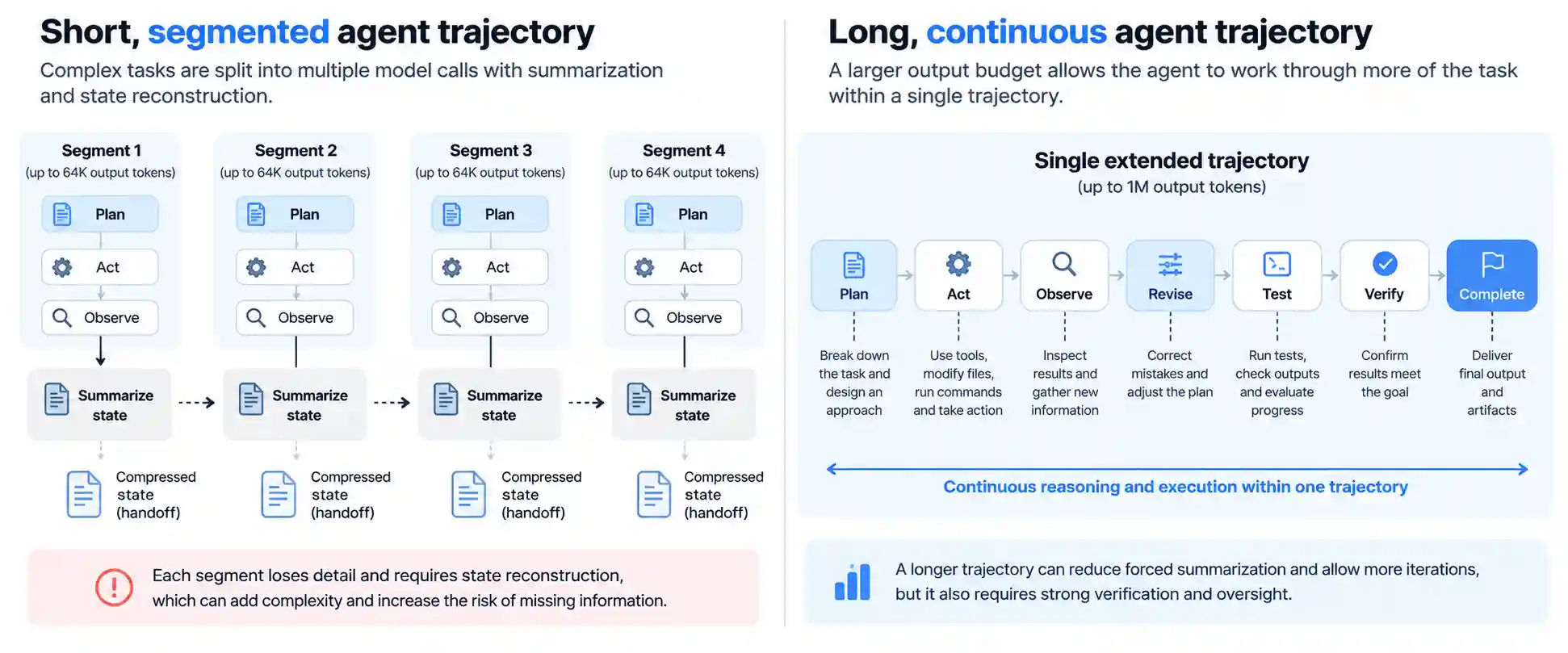
Gemini 4 Argon’s 1M-token output limit gives AI agents substantially more room to reason, iterate, use tools, inspect results, correct mistakes, and continue working within a single trajectory.
That could reduce one of the architectural problems in long-running agents: repeatedly stopping, compressing their state, restarting, and reconstructing what happened earlier.
Google is already reporting Argon-based agents working on large code migrations, data-center optimization, enterprise research, and autonomous vulnerability remediation.
The important change is therefore not simply “AI can produce longer answers.”
It is potentially:
AI agents can sustain longer units of work before orchestration infrastructure has to break the task into another model interaction.
That distinction could affect how developers design agent loops.
However, longer trajectories introduce their own problems: token cost, error accumulation, tool permissions, observability, security, and the difficulty of supervising an agent that may perform thousands of intermediate operations.
So 1M-token output should be viewed as a larger trajectory budget, not a license for unlimited autonomy.
First, 1M Output Tokens Are Not the Same as a 1M Context Window
This distinction matters.
A model’s context window describes how much information it can consider within its active context.
An output-token limit describes how much the model can generate during a response or reasoning trajectory.
According to Google’s Gemini 4 Argon announcement, Argon raises the output limit from 64K to 1M tokens. Google says the additional headroom allows the model to generate hundreds of thousands of tokens in a single trajectory while working through difficult problems.
That is roughly a 15.6x increase over a 64K output ceiling.
For ordinary chatbot conversations, that is excessive.
For an agent repeatedly performing:
reason → act → observe → evaluate → revise → act again
the additional trajectory length is much more interesting.
Think in trajectories, not answers
Imagine a coding agent receives this instruction:
Migrate this large C++ subsystem to Rust while preserving behavior and passing the existing test suite.
The useful output is not necessarily a giant text response.
The agent may need to:
inspect the repository;
map dependencies;
understand existing behavior;
design a migration plan;
modify code;
compile it;
inspect compiler errors;
revise the implementation;
execute tests;
investigate failures;
profile performance;
optimize bottlenecks;
rerun tests;
compare behavior;
document what changed.
Each step can create new information that influences the next step.
That is why output capacity becomes relevant to agent architecture.
Why Long-Running Agents Hit a Trajectory Problem
Most serious AI agents are not one model call.
They are systems.
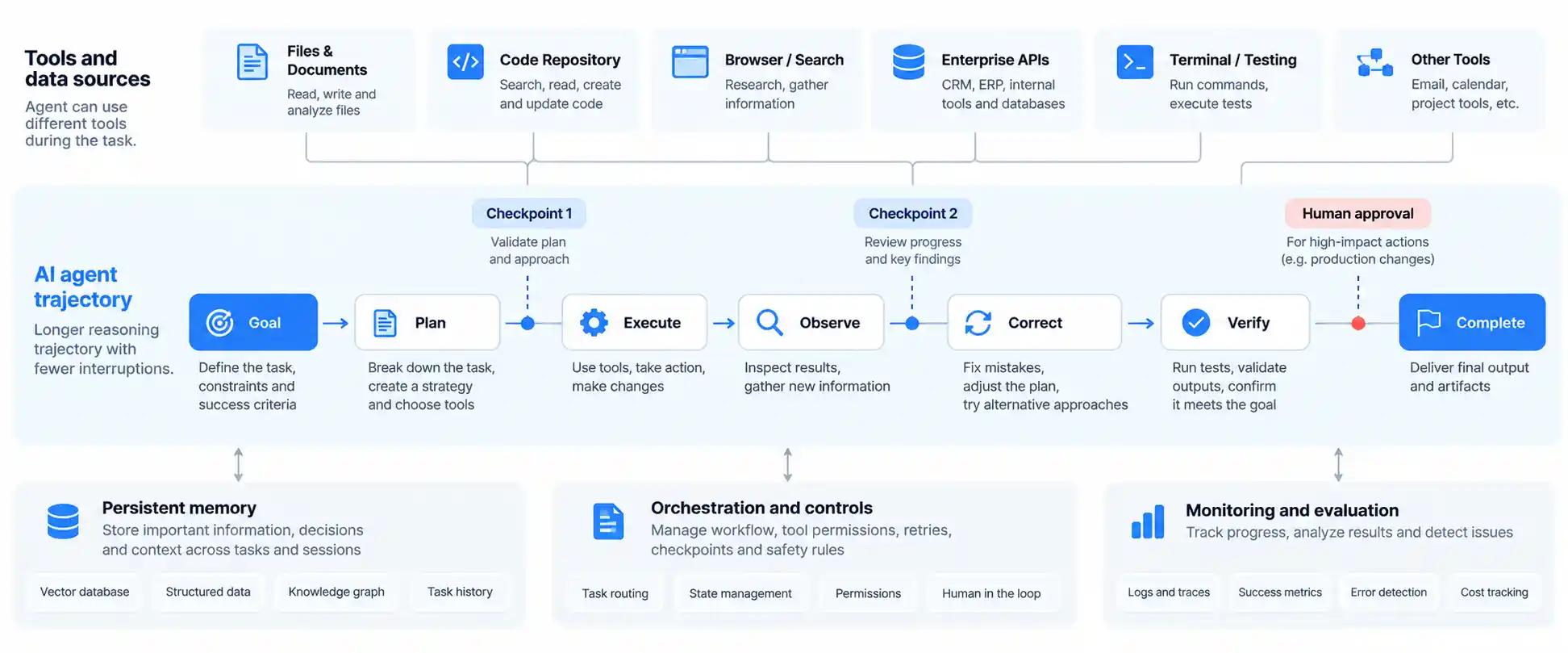
The model interacts with tools, databases, browsers, code environments, APIs, files and sometimes other agents. An orchestration layer decides what information remains available and what happens when a model reaches practical context or output boundaries.
When a long task is split across many calls, the system often has to preserve state externally.
That might involve:
conversation history;
scratchpads;
databases;
checkpoints;
task graphs;
vector retrieval;
summaries of previous work;
files produced by earlier steps.
None of these techniques disappear because Argon can produce more tokens.
But a larger trajectory budget potentially changes how frequently developers need them.
Instead of forcing an agent to summarize itself every few stages, the system may allow a longer sequence of reasoning, execution and verification before creating a checkpoint.
That is especially relevant when intermediate observations are difficult to compress without losing useful details.
The Trajectory Budget: A Better Way to Think About 1M Tokens
A useful way to evaluate Gemini 4 Argon for AI agents is to treat its output capacity as a trajectory budget.
This is an analytical model, not a Google-defined metric.
An agent’s useful trajectory budget can be thought of as:
Trajectory Budget = Reasoning + Tool Decisions + Observations + Corrections + Verification + Final Output
The critical point is that all of those stages compete for the agent’s available working trajectory.
A longer budget can potentially support more iterations.
Agent stage | What consumes the trajectory | Why more headroom can help |
|---|---|---|
Planning | decomposition, assumptions, strategy | More detailed multi-stage plans |
Tool selection | deciding which tool/API to call | More iterative tool use |
Observation | interpreting tool results | Less aggressive compression |
Correction | diagnosing failures | More opportunities to recover |
Verification | tests, checks and comparisons | More validation before completion |
Finalization | producing artifacts or answers | Larger final deliverables when needed |
The implication is subtle.
The value of 1M tokens is not that agents should use all 1M tokens.
It is that systems may have a substantially higher ceiling before trajectory length itself becomes the bottleneck.
What Google Is Already Doing With Argon Agents
The most interesting evidence comes from Google’s own internal deployments.
These should still be treated as vendor-reported examples, not independent case studies.
1. Large codebase migrations
Google says Argon agents are being used to migrate C and C++ codebases to Rust, ranging from tens of thousands of lines to more than 800,000 lines in the Fuchsia Zircon kernel.
Google also describes an Argon agent working on libgav1, its open-source video decoder. The agents replaced 32,000 lines of SIMD code through repeated profile-guided experiments and compiler analysis. Google reports that the resulting Rust implementation ran 2.7 times faster than the earlier Rust port while producing identical video output.
The interesting part for agent developers is not simply code generation.
It is the loop:
inspect → change → compile → profile → inspect compiler behavior → change again → verify
That is precisely the type of workflow where longer trajectories could matter.
2. Data-center optimization
Google reports that a team of Argon agents analyzed fleet-wide profiling telemetry and autonomously identified memory optimizations across its data centers.
According to Google, deployed changes have freed more than 300 TiB of memory, with estimated total savings between 500 TiB and 1 PiB.
Again, this is more interesting as an agent example than as a benchmark.
The agent is not merely answering a question.
It is interpreting telemetry, identifying optimization opportunities and applying changes inside an engineering workflow.
3. Cybersecurity agents
Cybersecurity is currently Argon’s most restricted application.
Through Google DeepMind’s Fairwind Program, selected trusted cyber defenders receive access to Argon’s cybersecurity capabilities.
Google says the model can autonomously find, validate and patch software vulnerabilities. Fairwind partners can also use Argon with CodeMender, Google’s specialized code-security agent.
That capability also explains why Google is not immediately providing unrestricted access to everyone.
Where Gemini 4 Argon Looks Strong for Agentic Work
Benchmarks cannot prove how an agent will perform inside a specific company, but several published results are relevant.
Google reports a 77.9% score on DeepSWE v1.1, which evaluates real-world long-horizon software engineering tasks.
On AutomationBench, which evaluates end-to-end execution across business functions, Google reports Argon at 51.3%.
Independent benchmark provider Vals AI currently reports Argon at 68.90% on its Vals Index, which combines agentic performance across finance, coding, legal and tax tasks using GDP-based weighting.
The benchmark picture therefore supports the argument that Argon is designed for agentic work.
But it also provides an important warning.
A 51.3% automation score is not autonomous reliability
Being first on an automation benchmark and scoring 51.3% can both be true.
That should temper the idea that a 1M-token trajectory suddenly makes unattended agents reliable.
Longer reasoning can provide more opportunities to recover from errors.
It also provides more opportunities to make them.
What 1M-Token Output Could Change in Agent Architecture
The biggest effects may eventually appear in architecture rather than chat interfaces.
Fewer forced trajectory resets
A shorter output ceiling can force an agent to stop even when its task is not logically complete.
The orchestrator then has to capture state and start another model call.
With a much larger ceiling, an agent could potentially continue through more reasoning and execution cycles before reaching that boundary.
Less lossy summarization
Agent systems often compress earlier work to control context growth.
But summaries inevitably discard information.
For simple workflows, that is acceptable.
For debugging, research, legal analysis or large migrations, a detail that looked unimportant 50 steps earlier can suddenly become important.
Longer trajectories may allow systems to retain more intermediate information before compression becomes necessary.
More iteration before human intervention
Consider a coding agent that encounters a failed test.
A shallow workflow might:
write code → run tests → fail → escalate
A longer autonomous loop could:
write → test → inspect failure → trace dependency → modify → retest → profile → compare → verify
The ability to continue is valuable only if the model can recognize errors and correct them effectively.
Larger coherent work units
Agents may eventually operate on larger units of work:
Today’s common agent task | Potential longer-trajectory task |
|---|---|
Fix one bug | Investigate and resolve a related defect cluster |
Modify one function | Refactor a subsystem |
Summarize documents | Conduct multi-source research and reconcile evidence |
Generate migration plan | Execute, test and document parts of the migration |
Identify vulnerability | Find, validate, patch and test remediation |
Analyze spreadsheet | Investigate supporting documents and produce a complete analysis |
This does not mean every workload should become larger.
It means developers may have more freedom when deciding where task boundaries belong.
Longer Trajectories Do Not Eliminate Agent Memory
A tempting conclusion would be:
If the model can reason for 1 million tokens, do agents still need memory?
Yes.
Output capacity and memory solve different problems.
A long trajectory helps an agent remain coherent during one extended unit of work.
Persistent memory helps the system preserve information across tasks, sessions and trajectories.
An enterprise agent may still need to remember:
previous decisions;
customer preferences;
project history;
policies;
approved actions;
unresolved tasks;
previous tool results;
organizational knowledge.
Vector databases, structured stores, knowledge graphs, event logs and other memory architectures therefore remain relevant.
Argon changes how frequently an agent might need to leave its active trajectory to reconstruct state. It does not make persistent memory obsolete.
Longer Output Does Not Eliminate Orchestration Either
The same applies to agent frameworks.
A capable model still needs infrastructure for:
tool permissions, routing, retries, state management, logging, evaluation, human approvals, observability and cost controls.
The best agent architecture may not be the one that allows Argon to run uninterrupted for hundreds of thousands of tokens.
It may be the one that lets Argon run longer when continuity has value, while deliberately interrupting it when verification or authorization is more important.
That distinction will matter in enterprise deployments.
The Hidden Problem: Long Trajectories Can Compound Errors
Suppose an agent makes a slightly incorrect assumption at step 30.
It uses that assumption at step 70.
At step 200, several decisions now depend on it.
A larger token budget does not inherently solve this problem.
It may amplify it.
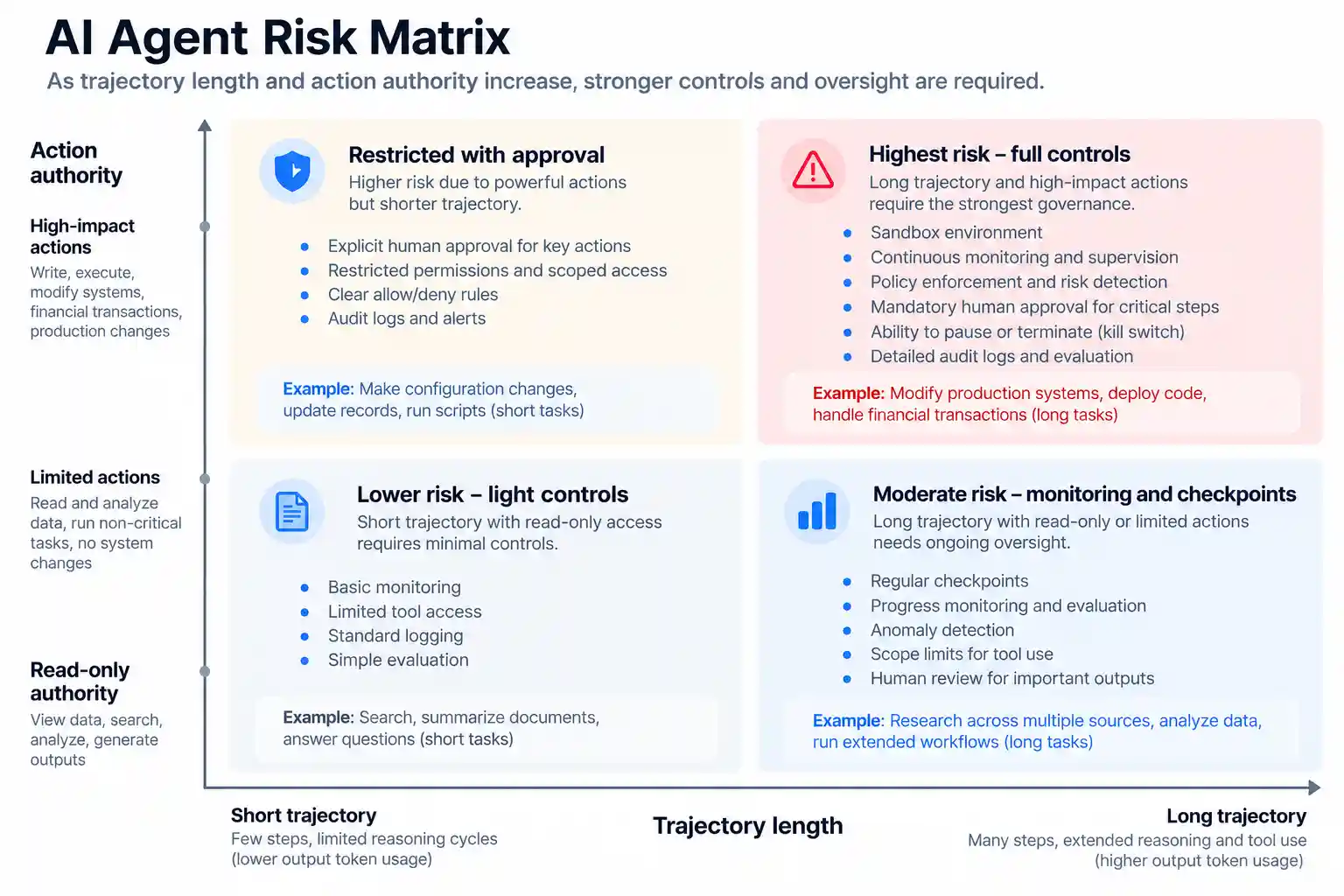
Long-running agents therefore need checkpoints based on risk and uncertainty, not just token consumption.
A practical architecture might interrupt an agent when:
a high-impact external action is about to occur;
confidence drops below a threshold;
tests repeatedly fail;
financial or security permissions change;
the agent modifies production systems;
a decision becomes irreversible;
tool output contradicts earlier assumptions.
This suggests an important design principle:
As trajectory length increases, verification architecture becomes more important, not less.
Security Becomes Harder When Agents Can Work Longer
Google’s own approach reinforces this point.
In its AI Control Roadmap research, Google DeepMind describes treating powerful internal agents similarly to potential insider threats.
The system combines traditional security controls with monitoring, supervision and intervention mechanisms. Google describes trusted AI systems reviewing another agent’s reasoning, actions and plans and stepping in when harmful behavior is detected.
Argon’s launch announcement also discusses protections against prompt injection and mechanisms designed to monitor agent reasoning and actions for misalignment.
These controls become particularly relevant for long-running agents.
An agent operating for five minutes with read-only access presents one risk profile.
An agent operating for hours across repositories, terminals, APIs and production systems presents another.
What Does a 1M-Token Agent Cost?
Another reason not to equate a larger limit with a recommended operating point is cost.
Google lists Gemini 4 Argon at an introductory price of:
Token type | Introductory price |
|---|---|
Input | $2 / 1M tokens |
Output | $10 / 1M tokens |
Cached input | 95% discount |
After the introductory period, Google says pricing will increase to $4 per million input tokens and $20 per million output tokens. Google has not announced when that introductory period ends.
At the introductory rate, generating the theoretical maximum 1M output tokens would therefore cost approximately $10 in output charges alone, before input and other infrastructure costs.
At the later rate, that becomes approximately $20.
That may sound modest for a complex enterprise task.
But agent systems rarely execute one trajectory.
At scale:
1,000 × $10 trajectories = $10,000
before infrastructure, tool/API costs and retries.
Most applications should therefore set sensible output limits rather than allowing every agent to approach the maximum.
A Practical Framework: When Should You Give an Agent a Longer Trajectory?
Instead of asking, “Can Argon use 1M tokens?”, engineering teams should ask:
Does this task benefit from continuity?
Here is a simple planning model.
Give the agent more trajectory budget when:
Continuity is valuable.
Later decisions depend heavily on earlier observations.
The task requires iterative correction.
Testing, debugging, experimentation or research creates feedback loops.
Intermediate state is difficult to summarize safely.
Compressing earlier work could remove details required later.
Actions are reversible.
The system can recover from mistakes.
Verification exists.
Tests, validators, supervisors or humans can check important outputs.
Keep trajectories shorter when:
The task is easily decomposed.
Independent subtasks can be handled separately.
Actions carry significant risk.
Financial transactions, production changes and security-sensitive operations should have explicit gates.
Errors compound quickly.
A mistaken assumption can contaminate hundreds of later steps.
Output cost dominates the economics.
Human decisions are intentionally part of the workflow.
This leads to a more useful rule:
Use the longest trajectory the task benefits from, not the longest trajectory the model permits.
Which AI Agent Use Cases Could Benefit Most?
The most promising categories are tasks where continuity and iteration matter simultaneously.
Software engineering agents
Potential applications include:
large code migrations;
repository-wide refactoring;
dependency upgrades;
debugging across multiple services;
performance optimization;
test generation and remediation.
Google’s own migration work makes this the clearest early use case.
Research agents
A research agent might search hundreds of sources, extract evidence, identify contradictions, investigate gaps and iteratively refine its conclusions.
Longer trajectories could help preserve the chain between early evidence and later analysis.
Enterprise knowledge agents
Finance and legal workflows frequently require multi-document reasoning and repeated evidence gathering.
Google reports strong Argon performance on Vals Finance Agent v2 and legal research/drafting evaluations.
Cybersecurity agents
Vulnerability research naturally involves repeated investigation:
identify → reproduce → analyze → patch → test → verify
Argon is explicitly being deployed for this type of work through Fairwind.
Complex workflow automation
AutomationBench is particularly relevant here because it evaluates end-to-end business execution.
But Argon’s reported 51.3% score is also a useful reality check.
The technology may be moving toward longer autonomous workflows, but current benchmark performance does not justify assuming that complex enterprise processes can simply run unattended.
What Gemini 4 Argon Does Not Solve
A 1M-token output ceiling does not solve:
Hallucination. Longer reasoning can still contain incorrect information.
Agent memory. Long trajectories do not replace persistent state.
Tool reliability. APIs, browsers and external systems still fail.
Authorization. Models still need carefully scoped permissions.
Evaluation. Companies still need ways to measure whether agents complete tasks correctly.
Observability. Longer execution makes logs and traces more important.
Security. More capable agents can create larger consequences when compromised.
Economics. Token consumption can grow rapidly across fleets of agents.
Human accountability. Organizations still need clear ownership for consequential decisions.
These limitations are arguably more important as agents become more capable.
The Bigger Shift: From Response Length to Work Horizon
The most interesting implication of Gemini 4 Argon may have little to do with producing million-token documents.
The real shift is the potential expansion of an AI system’s work horizon.
Early LLM applications centered on single responses:
prompt → answer
Agentic systems changed that into:
goal → plan → act → observe → revise → continue
Argon pushes the second pattern further.
The question for AI models may increasingly move from:
How good is the answer?
to:
How much useful work can the system complete before it needs to stop, reset or ask a human?
That is a more meaningful metric for agents.
And it is one reason trajectory length, tool reliability, verification and security may become as important as conventional benchmark scores.
Should Developers Build AI Agents Around Gemini 4 Argon Today?
For most developers, not yet.
As of early October 2026, Google is rolling Argon out first to selected trusted cyber defenders through the Fairwind Program. Google says broader availability will begin with paid API customers and Google AI Ultra subscribers, but it has not announced a general availability date.
That means many architectural conclusions remain provisional.
Independent developers still need to test:
real-world trajectory stability;
tool-calling behavior;
latency;
retry behavior;
effective token consumption;
long-trajectory error rates;
API limits;
production pricing;
agent framework compatibility.
Google’s published results are promising.
They are not a substitute for workload-specific evaluation.
Conclusion
Gemini 4 Argon’s 1M-token output limit matters for AI agents because it potentially expands how long a model can reason and work continuously, not because anyone needs million-token chatbot responses.
The most promising effect is a larger trajectory budget: more room for planning, tool use, observation, correction and verification before the system is forced to break the task into another model interaction.
Google’s early deployments in code migration, infrastructure optimization and cybersecurity suggest what this could look like in practice.
But longer trajectories introduce a second-order problem.
The longer an agent operates, the more important verification, checkpoints, permissions, monitoring, cost controls and human oversight become.
The real architectural lesson from Argon may therefore be simple:
The next generation of AI agents will not just need longer reasoning. They will need better systems for controlling what happens during that reasoning.
Frequently Asked Questions
What is Gemini 4 Argon?
Gemini 4 Argon is Google’s frontier AI model announced on September 30, 2026. Google designed it for complex, long-horizon tasks including software engineering, finance, legal work and cybersecurity. One of its most notable features is an output-token limit of up to 1 million tokens.
Does Gemini 4 Argon have a 1 million token context window?
The headline 1M figure Google emphasizes for Argon is specifically its output-token limit. Google says it increased the output limit from 64K to 1M so the model can sustain much longer reasoning trajectories. Context capacity and maximum output are related but different model characteristics.
Why does 1M-token output matter for AI agents?
AI agents repeatedly reason, call tools, observe results and correct their actions. A larger output budget potentially lets these loops continue longer before the system must terminate a trajectory, summarize its state or start another model interaction.
Can Gemini 4 Argon run autonomous AI agents?
Google reports using Argon agents internally for tasks including code migration and infrastructure optimization, while selected cybersecurity organizations are receiving access through Fairwind. However, autonomy depends on the complete agent system, including tools, permissions, memory, monitoring and verification, not just the underlying model.
Does a longer trajectory make an AI agent more accurate?
Not necessarily. More reasoning gives an agent additional opportunities to investigate and correct mistakes, but incorrect assumptions can also propagate through a longer trajectory. Long-running agents therefore need checkpoints, automated validation and human approval for consequential actions.
Will Gemini 4 Argon replace agent memory and RAG?
No. A larger output budget can reduce how often an agent must compress its active work, but persistent memory and retrieval solve different problems. Agents still need external systems to preserve organizational knowledge, previous decisions, task history and information across separate sessions.
How much does Gemini 4 Argon cost?
Google announced introductory pricing of $2 per million input tokens and $10 per million output tokens, with cached input discounted by 95%. After the introductory period, Google says pricing will rise to $4 per million input tokens and $20 per million output tokens. Google has not announced when the introductory pricing ends.
When will Gemini 4 Argon be publicly available?
Google initially released Argon to selected trusted cyber defenders through its Fairwind Program. The company says paid API customers and Google AI Ultra subscribers will be among the next groups to receive access, but it has not announced a general public release date.
Comments (0)
No comments yet. Be the first to share your thoughts!