Generative AI in Clinical Documentation: Where It Helps and What Needs Human Review

Author
Ravi Prajapati

Learn how generative AI improves clinical documentation, where AI scribes help, which medical note errors need human review, and how to deploy them safely.
Generative AI can help clinicians document patient encounters, summarize clinical conversations, draft notes, and organize information for electronic health records (EHRs). Its strongest role is reducing repetitive documentation work while allowing clinicians to focus more attention on patients. However, an AI-generated clinical note is not automatically an accurate medical record. Clinicians still need to verify important facts, distinguish what patients reported from what examinations established, and approve the final documentation.
For healthcare technology leaders, the central question is not simply whether generative AI can write a clinical note. It is whether the technology can produce a reliable, secure, clinically useful draft within a workflow that preserves professional judgment and accountability.
This article examines where generative AI in clinical documentation offers practical value, which tasks require human review, what the evidence says about accuracy, and how healthcare organizations can evaluate and deploy these tools responsibly.
What Is Generative AI in Clinical Documentation?
Generative AI in clinical documentation uses AI models to transform clinical conversations, clinician-provided information, and other authorized inputs into structured or unstructured medical documentation. Depending on the system, it can draft progress notes, summarize encounters, organize information into sections such as history and assessment, and prepare text for review in an EHR.
An ambient AI scribe is one example. It processes a patient-clinician conversation, usually through audio, and generates a draft note. Other tools work from clinician dictation, existing clinical text, or information explicitly supplied by the user.
The important distinction is that generating documentation is not the same as establishing clinical truth. An AI system can organize the information it receives, but it may misunderstand speech, omit relevant details, introduce unsupported statements, or express uncertainty as certainty.
A safe implementation therefore treats AI output as a draft that must meet the same clinical documentation standards as any other proposed entry in the medical record.
Where Generative AI Helps With Clinical Documentation
The most suitable use cases are those in which AI organizes information already available to the clinician, produces a reviewable draft, and leaves clinical interpretation and approval under human control.
1. Drafting clinical notes from patient conversations
Ambient documentation tools can capture a clinical encounter and produce a draft note that reflects the conversation. Depending on the product, the note may be organized into sections such as the history of present illness, review of systems, physical examination, assessment, and plan.
This can reduce the need for clinicians to reconstruct a visit from memory or repeatedly switch between a patient conversation and an EHR screen.
The benefit depends on how well the tool handles real clinical conversations. Patients interrupt themselves, use unfamiliar medication names, describe symptoms imprecisely, and sometimes discuss multiple concerns in one visit. The system must also distinguish statements made by the patient from information supplied by the clinician.
Best use: Generate a first draft for clinician review, rather than automatically saving a completed note to the medical record.
2. Summarizing long clinical encounters
Some encounters contain extensive histories, several active problems, medication discussions, and follow-up instructions. Generative AI can condense these conversations into a more organized summary.
A useful summary preserves the details that affect clinical interpretation, including symptom duration, relevant negative findings, medication changes, patient concerns, and agreed next steps.
The main risk is information loss. A summary may read clearly while omitting a detail that matters to the clinician. A model may also treat a tentative possibility as a confirmed diagnosis or combine statements made at different points in a conversation.
The quality test is therefore not whether the summary is shorter. It is whether it retains the information needed for the intended clinical purpose.
3. Organizing information into structured EHR fields
Generative AI can help map free-text information into predefined documentation sections. For example, it may separate the patient's reported symptoms from the clinician's assessment and proposed plan.
Structured documentation can improve readability and make information easier to find later. However, the model must not fill missing fields by guessing.
If the patient has not provided a medication dosage, or the clinician has not documented a physical examination finding, the system should leave that information unresolved rather than infer a plausible value.
A useful implementation makes the distinction between three states explicit:
Present: The information is supported by the source.
Not documented: The source does not establish the information.
Conflicting: Different sources provide inconsistent information.
These states are not interchangeable. In particular, an absent finding is not the same as a documented negative finding.
4. Drafting referral letters and follow-up documentation
AI can help prepare referral letters, visit summaries, and follow-up documentation from approved clinical information. This is particularly useful when clinicians must communicate the same encounter details in different formats.
A referral letter may require a concise clinical history, the reason for referral, relevant investigations, current treatment, and the question the receiving specialist is being asked to address.
The model can help organize these elements, but it should not create a referral rationale, test result, or treatment history that the source does not support. The clinician must also verify that the final document contains the information the recipient needs.
5. Improving documentation consistency
Healthcare organizations often use templates and standardized terminology to make records more consistent. Generative AI can help clinicians organize notes according to approved templates and identify incomplete sections.
However, consistency should not become an excuse to add boilerplate. A note that automatically includes normal findings, counseling statements, or examination details that were never established can create a misleading medical record.
The objective is consistent structure, not identical content. Every statement should remain appropriate to the individual encounter.
6. Reducing repetitive administrative work
Generative AI may help draft routine documentation, reorganize dictated text, and prepare summaries that clinicians would otherwise write manually.
The operational benefit should be measured rather than assumed. Time spent generating a draft is only one part of the workflow. Clinicians may still need to correct errors, reconcile medications, edit templates, and complete EHR fields.
A tool that generates notes quickly but requires extensive corrections may shift work rather than reduce it.
What Does the Research Say About AI Clinical Documentation?
The evidence supports cautious interest in AI scribes, but it does not justify treating every product or implementation as equally effective.
A 2025 randomized clinical trial published in NEJM AI, Ambient AI Scribes in Clinical Practice, evaluated two ambient scribe applications against usual care. The study randomized 238 outpatient physicians across 14 specialties and examined documentation time, physician-reported workload, burnout-related measures, and other outcomes.
The trial is useful because it evaluates AI scribes in clinical practice rather than relying solely on demonstrations or vendor claims. It also illustrates why evaluation should examine the actual workflow and compare outcomes against a control group.
A separate instrument validation study of AI-enabled scribe accuracy and safety reported that errors occur and need to be evaluated to mitigate safety risks. That finding matters because a fluent note can still contain a clinically important omission or inaccurate statement.
These studies should not be interpreted as proving that all AI documentation tools are unsafe or that they consistently save time. Results depend on the system, clinical setting, user behavior, study design, and the outcome being measured.
The practical conclusion is narrower: AI-generated documentation has a credible use case, but organizations need local evidence of accuracy, usability, and net workload reduction before expanding deployment.
Which Clinical Documentation Tasks Need Human Review?
Human review should focus on whether the generated note accurately represents the encounter, preserves relevant clinical context, and avoids unsupported conclusions.
Not every editing task carries the same risk. Correcting a punctuation error is different from correcting a medication dosage or a statement that changes the patient's clinical history.
Encounter facts and clinical history
Verify the chief complaint, symptom onset, duration, chronology, relevant medical history, and the distinction between patient-reported information and clinician observations.
Review priority: High when facts affect clinical interpretation.
Medications, allergies, and dosages
Confirm medication names, strength, dose, route, frequency, allergy status, and changes to treatment. Do not rely on a plausible-looking transcription.
Review priority: Very high.
Examination findings and diagnoses
Check that documented findings were actually observed or supplied, and that the note does not turn a possible diagnosis into a confirmed one.
Review priority: Very high.
Assessment and treatment plan
Confirm that the assessment, investigations, referrals, counseling, and follow-up instructions reflect the clinician's actual decisions.
Review priority: Very high.
Formatting and readability
Correct headings, grammar, duplication, and organization after checking that the editing has not changed the clinical meaning.
Review priority: Lower, unless meaning is affected.
The review process should reflect the consequences of an error, not simply how much text the model produces. A single incorrect allergy statement may matter more than several paragraphs of awkward formatting.
Why a human approval step matters
Human review is not a substitute for a reliable AI system. It is an additional safety control.
Clinicians may overlook errors in polished text, especially when documentation volume is high. Requiring a signature alone does not guarantee meaningful verification. The interface should make important uncertainties and changes easy to identify, and organizations should give clinicians sufficient time and training to review the output.
The American Medical Association's guidance on AI development, deployment, and use emphasizes governance, privacy, security, bias mitigation, and appropriate disclosure and documentation when AI affects clinical care or the medical record.
Common Errors in AI-Generated Clinical Notes
The most important risks are not limited to obvious transcription mistakes. Generative models can produce text that sounds professionally written while subtly changing the meaning of an encounter.
Error type | Illustrative example | Appropriate control |
|---|---|---|
Unsupported detail | Adding a normal examination finding that was never discussed or observed | Compare each finding against the source and encounter record |
Omission | Leaving out a reported adverse reaction or important symptom | Use a clinically relevant completeness checklist |
Negation error | Recording “has chest pain” when the patient denied it | Explicitly verify positive and negative findings |
Medication error | Misstating a dose or confusing two similar drug names | Verify against authorized medication information |
Diagnostic overstatement | Turning “possible infection” into “confirmed infection” | Preserve the clinician's level of certainty |
Attribution error | Recording a patient's assumption as a clinician's conclusion | Keep patient statements and clinical assessments distinct |
Context error | Combining information from different encounters | Validate encounter identity, dates, and source boundaries |
Template inflation | Adding generic counseling or normal findings automatically | Remove statements that are not supported by the encounter |
These examples illustrate failure modes rather than claim that every AI scribe produces them at a particular rate. The frequency and severity of errors must be measured for the specific system being evaluated.
How hallucinations can enter clinical documentation
A generative model predicts text based on its input and learned patterns. It does not independently establish that every statement it generates is true.
In documentation, this can produce a subtle failure: a model fills a gap because a complete note appears more natural than an incomplete one. A medication history may be made more specific than the available evidence allows, or an uncertain symptom description may be converted into a definitive clinical statement.
The appropriate response is to design the workflow so that missing information remains visible. Systems should preserve links to source material where feasible, flag conflicting information, and avoid automatically converting generated text into a signed medical record.
The NIST Generative AI Risk Management Profile provides a broader framework for identifying and managing generative AI risks throughout the AI lifecycle. Its cross-sector approach is relevant to healthcare organizations evaluating reliability, monitoring, and governance.
Generative AI vs. Traditional Medical Dictation
Generative AI documentation tools and traditional speech recognition may both reduce typing, but they solve different problems.
Capability | Traditional dictation | Generative AI documentation |
|---|---|---|
Primary function | Converts spoken words into text | Generates, reorganizes, or summarizes documentation |
Source | Clinician's dictated speech | Conversation audio, dictation, text, or authorized context, depending on the system |
Note structure | Usually depends on the clinician's dictation and template | Can organize content into structured sections |
Summarization | Usually requires separate editing | Can summarize supplied information |
Clinical interpretation | Primarily expressed by the clinician | May introduce interpretations that require verification |
Main review concern | Transcription errors | Transcription, omission, unsupported additions, and meaning changes |
Generative AI is not necessarily better for every task. Traditional dictation may be preferable when a clinician wants direct control over the wording and the workflow is already efficient. AI-generated summaries may be useful when information must be reorganized or adapted to a specific documentation template.
Healthcare organizations should compare the tools against the actual work clinicians perform, rather than assuming a newer technology will deliver better results.
How to Implement AI Clinical Documentation Safely
A successful deployment requires more than selecting a model and connecting it to an EHR. It requires a defined use case, appropriate data controls, workflow integration, clinical evaluation, and ongoing monitoring.
Step 1: Select a narrow, measurable use case
Start with a specific documentation problem, such as drafting outpatient progress notes or preparing referral letters.
Define the intended users, clinical setting, supported languages, information sources, and types of notes the system is allowed to produce. Specify what it must not do, such as independently establish a diagnosis or finalize a note without clinician approval.
A narrow initial scope makes testing more meaningful and reduces the number of variables that must be managed.
Step 2: Establish a baseline before introducing AI
Measure the existing workflow before the pilot begins. Useful baseline measures include:
Time spent drafting and completing notes.
Time spent correcting documentation.
Frequency and severity of documentation errors.
Percentage of notes completed within the intended workflow.
Clinician satisfaction and perceived workload.
Delays or interruptions caused by documentation.
Without baseline data, an organization cannot reliably determine whether the tool improves the workflow. A reduction in drafting time may be offset by longer review sessions or additional technical steps.
Step 3: Assess data quality and integration
Review the information that the AI system will receive. This may include audio, clinician dictation, relevant patient history, medication information, and approved EHR fields.
Confirm how the system identifies the correct patient and encounter, handles incomplete or conflicting information, and transfers the generated note into the EHR.
Integration should preserve the distinction between source information and generated content. It should also prevent drafts from being mistaken for clinician-approved records.
Step 4: Test with representative clinical scenarios
Evaluate the system using a range of realistic cases, including routine visits, complex histories, accented speech, background noise, interruptions, uncommon terminology, and ambiguous medication names.
Include scenarios in which the correct output is to leave information blank or flag uncertainty. Testing only uncomplicated, well-recorded conversations can conceal weaknesses that emerge in daily practice.
Clinical reviewers should assess whether the generated note preserves meaning, includes relevant details, and avoids unsupported additions. Technical teams should also evaluate integration failures and data handling.
Step 5: Run a human-reviewed pilot
Introduce the tool to a limited group of clinicians. Require review before the generated documentation becomes an approved medical record.
Collect structured feedback on the errors clinicians encounter, how difficult they are to identify, and how much time correction takes. Review both common editing issues and less frequent errors that could have serious consequences.
Do not expand the deployment simply because users like the interface or the first few notes look convincing.
Step 6: Expand only when measured results support it
Compare the pilot with the baseline and, where feasible, a contemporaneous control group.
Evaluate net time saved, note quality, correction burden, clinician acceptance, and any safety incidents. Examine differences between specialties and user groups rather than relying only on an organization-wide average.
If a system performs well in routine consultations but poorly in complex cases, the appropriate decision may be to limit its scope rather than abandon it or deploy it everywhere.
Step 7: Monitor performance and maintain a rollback option
AI models, software integrations, templates, and clinical workflows can change after deployment. Organizations should continue sampling approved notes, monitoring error patterns, and collecting feedback.
Define escalation thresholds and assign responsibility for investigating problems. If the tool begins producing clinically significant errors, the organization should be able to restrict its use, revert to the previous workflow, and investigate the cause.
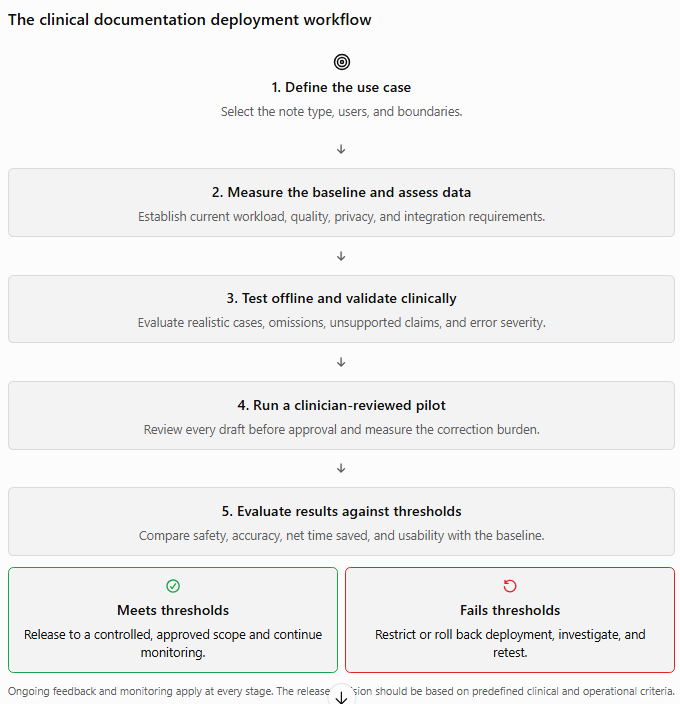
The workflow is intentionally conservative. The purpose of a pilot is not to prove that AI can generate notes. It is to establish whether the complete documentation process is better and sufficiently safe.
Privacy, Security, and Regulatory Considerations
Clinical documentation often contains identifiable and sensitive health information. A tool that processes conversations or patient records must be assessed as part of the healthcare organization's data environment, not merely as a writing application.
Patient information must be handled under an appropriate data agreement
In the United States, the Health Insurance Portability and Accountability Act (HIPAA) governs protected health information in covered settings. The U.S. Department of Health and Human Services explains in its guidance on HIPAA and cloud computing that a cloud service provider that creates, receives, maintains, or transmits electronic protected health information on behalf of a covered entity may be a business associate and may require a HIPAA-compliant business associate agreement.
Healthcare organizations should confirm the applicable contractual requirements before sending patient data to an external AI service. They should also examine data retention, access controls, encryption, audit logs, breach handling, subprocessors, and whether submitted data may be used for model training.
A vendor's statement that it offers secure AI is not a substitute for reviewing the actual service configuration, contractual terms, and organizational obligations.
Compliance requirements differ across jurisdictions
HIPAA is not a global healthcare privacy standard. Organizations operating in other jurisdictions must assess the applicable privacy, health-record, data-protection, and professional obligations.
For example, the European Union's General Data Protection Regulation (GDPR) may apply to the processing of personal data, including health data, depending on the circumstances. National healthcare rules and professional requirements may impose additional obligations.
Consent, patient notification, data residency, retention, and access rights should be reviewed in the context of the relevant jurisdiction and use case. An organization should not assume that compliance with one country's requirements establishes compliance everywhere.
Governance should cover the entire AI lifecycle
The NIST AI Risk Management Framework provides a voluntary approach to managing AI risks. Its Generative AI Profile identifies risks and suggested risk-management actions across the AI lifecycle.
For clinical documentation, this supports a governance process that covers vendor selection, data handling, validation, deployment, monitoring, incident response, and changes to the system.
In the United States, the Office of the National Coordinator for Health Information Technology's HTI-1 final rule also establishes transparency requirements for certain predictive algorithms in certified health IT. Its applicability depends on the technology and regulatory scope; it should not be interpreted as a blanket certification requirement for every generative AI scribe.
Healthcare leaders should distinguish requirements that legally apply to their implementation from voluntary frameworks and recommended practices.
What Healthcare Organizations Should Measure Before Scaling
A pilot should use predefined acceptance criteria rather than a general impression that the AI tool is working well.
Evaluation area | What to measure | Why it matters |
|---|---|---|
Documentation accuracy | Errors, omissions, unsupported additions, and clinical severity | Measures the reliability of the generated note |
Net efficiency | Drafting time plus review, correction, and completion time | Establishes whether the workflow actually saves time |
Completeness | Presence of required, source-supported information | Helps identify clinically relevant omissions |
Clinician usability | Ease of review, correction, and approval | Shows whether the tool fits real working conditions |
Privacy and security | Access violations, retention compliance, and security incidents | Protects sensitive information |
Reliability | Failed sessions, incorrect encounter associations, and integration errors | Measures whether the workflow can be used consistently |
Equity and robustness | Performance across relevant languages, accents, specialties, and patient populations | Identifies weaknesses hidden by aggregate results |
These measures should be interpreted together. For example, a tool that saves time but produces more clinically significant errors may not be acceptable. Likewise, excellent transcription accuracy does not establish that the generated note is complete or clinically appropriate.
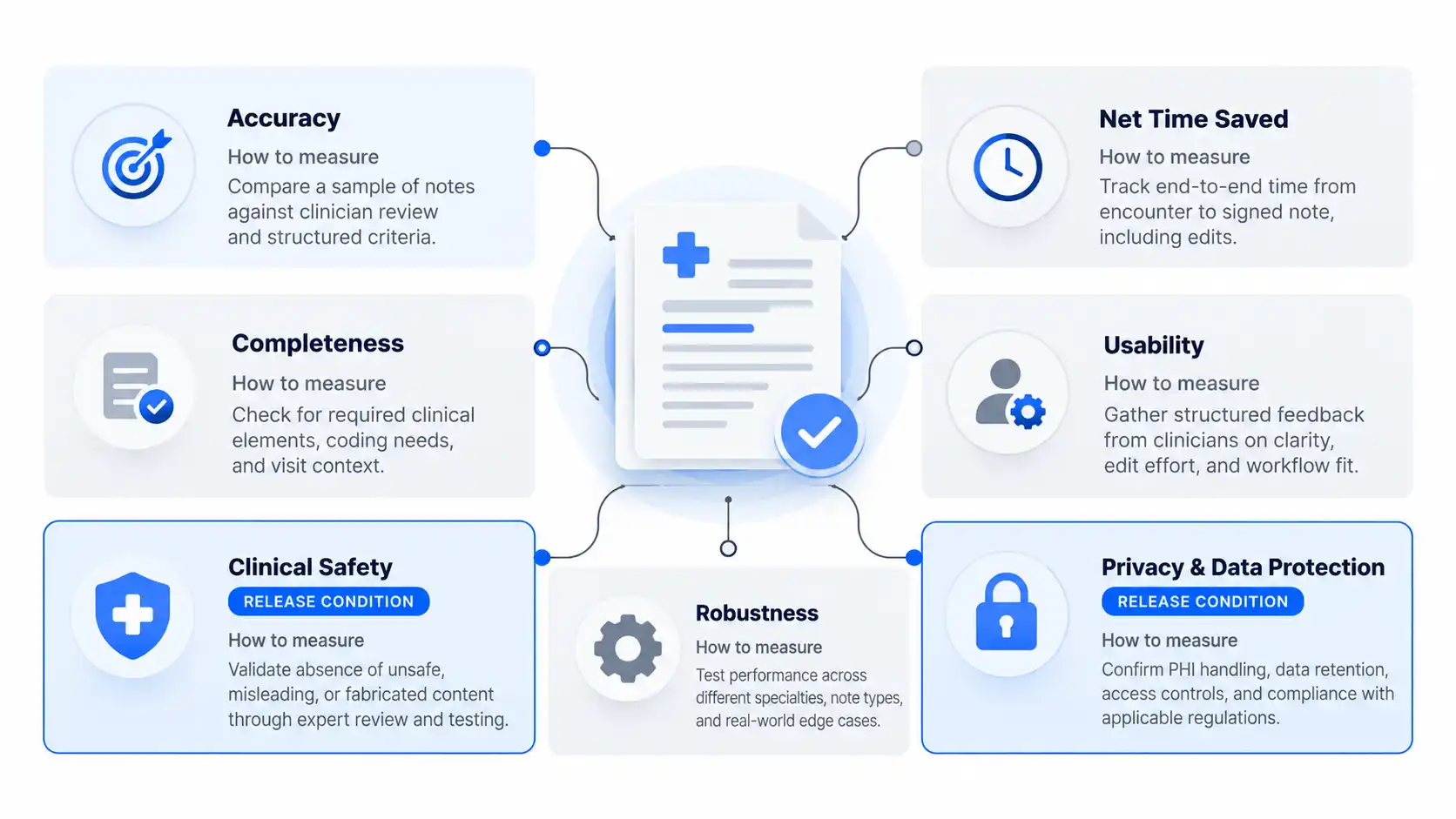
How to measure net time saved
A useful evaluation compares the entire documentation process before and after AI adoption.
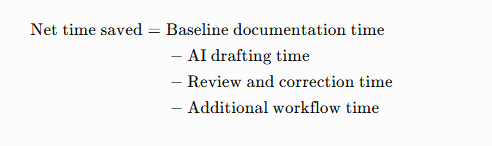
This is a measurement model, not a claim that a particular amount of time will be saved. The organization must collect the underlying data using a consistent method.
For example, if drafting becomes faster but the clinician must spend additional time correcting unsupported details, the net benefit may be small or negative. If the tool reduces after-hours note completion without compromising quality, that may be a meaningful operational improvement even when the average time saved per encounter is modest.
Organizations should also track results over time. Initial performance may differ from later performance as clinicians learn the system, templates change, and software is updated.
What Generative AI in Clinical Documentation Cannot Solve
Generative AI can improve how clinical information is organized, but it cannot automatically resolve every problem in the documentation process.
It cannot establish facts missing from the source
If a patient cannot recall a medication dose and the approved record does not contain it, the model should not guess. The information must be verified or recorded as unknown.
It cannot replace clinical judgment
A documentation tool may organize a clinician's assessment, but it should not silently turn that assessment into a different diagnosis or treatment plan.
It cannot compensate for poor workflows
Duplicate forms, confusing templates, incompatible systems, and unnecessary documentation requirements can remain even after AI is introduced. Automating a flawed process may simply make it faster to produce flawed documentation.
It cannot guarantee better outcomes from faster note creation
Reduced documentation time is an operational outcome, not proof of improved diagnosis, treatment, patient safety, or health outcomes. Those benefits require separate evidence.
It cannot eliminate accountability through automation
Healthcare organizations still need clear policies governing who reviews, approves, corrects, and maintains the medical record. The exact legal and professional responsibilities depend on the jurisdiction and implementation.
These limitations do not make the technology unsuitable. They define the boundaries within which it can be useful.
Frequently Asked Questions
1. What is generative AI in clinical documentation?
Generative AI in clinical documentation uses AI models to draft, summarize, or organize medical records from clinical conversations, dictation, and other authorized information. Common applications include progress notes, encounter summaries, and referral letters. The system generates proposed documentation rather than independently establishing clinical truth. Clinicians must verify that the output accurately reflects the encounter before it becomes an approved medical record.
2. Can AI generate clinical notes automatically?
Yes. Some AI documentation systems can generate draft clinical notes from recorded patient-clinician conversations or other supplied inputs. The level of automation varies by product and workflow. Generating a draft does not mean the note should be signed or saved as final without review. Healthcare organizations should define which actions the AI may perform and require appropriate human approval before clinical documentation is finalized.
3. How accurate are AI-generated clinical notes?
Accuracy varies by system, clinical setting, input quality, and evaluation method. Errors may include omitted symptoms, incorrect medication details, unsupported examination findings, and changes in diagnostic certainty. A polished note is not necessarily an accurate note. Organizations should evaluate representative clinical cases, measure error severity, and establish acceptance thresholds before deploying a system broadly.
4. What is the difference between an AI scribe and medical dictation?
Medical dictation primarily converts spoken words into text. An AI scribe can also organize conversation content, summarize information, and generate a structured draft note. Traditional dictation generally gives clinicians direct control over the words they speak, while generative systems introduce additional risks related to summarization and unsupported content. The appropriate choice depends on the clinical workflow and measured performance.
5. Does generative AI replace medical scribes or clinicians?
Generative AI can automate parts of documentation work, but it does not automatically replace the responsibilities of a medical scribe or clinician. Its practical role depends on the tasks being automated, the quality of the output, and the level of review required. Clinicians remain responsible for their clinical decisions, while healthcare organizations must define appropriate documentation, oversight, and accountability processes.
6. Is AI-generated clinical documentation HIPAA compliant?
Not automatically. In the United States, HIPAA compliance depends on the entities involved, how protected health information is processed, and whether applicable privacy and security obligations are met. A service provider that handles electronic protected health information on behalf of a covered entity may need a business associate agreement. Organizations should assess the specific product, configuration, contractual terms, and data flows before use.
7. How can healthcare organizations evaluate an AI documentation tool?
Organizations should establish a baseline, test the system on representative clinical cases, and run a limited pilot with clinician review. They should measure clinical accuracy, omissions, unsupported additions, net time saved, usability, privacy, and integration reliability. Expansion should depend on predefined safety and performance thresholds, with ongoing monitoring and a rollback option if the system fails to meet them.
8. What should clinicians review in AI-generated notes?
Clinicians should verify the patient and encounter, symptom history, positive and negative findings, medication details, allergies, examination findings, assessment, treatment plan, and follow-up instructions. They should also confirm that the note distinguishes patient statements from clinician observations and does not include unsupported information. The depth of review should reflect the clinical consequences of a potential error.
Conclusion: Use AI to Draft Clinical Documentation, Not to Establish Clinical Truth
Generative AI in clinical documentation is most useful when it reduces repetitive writing without weakening the reliability of the medical record. Drafting notes, summarizing encounters, organizing information, and preparing referral documentation are practical use cases. The main risks arise when the system omits relevant details, introduces unsupported statements, or changes the meaning of clinical information.
Healthcare organizations should evaluate the complete workflow rather than the model's ability to produce fluent text. That means measuring net time saved, testing clinical accuracy, protecting patient information, and requiring meaningful human review before documentation is finalized.
The evidence supports evaluating AI documentation tools in controlled clinical settings. It does not support assuming that every product will improve efficiency or that generated notes can be trusted without verification. A successful implementation is one in which the technology demonstrably reduces administrative work while preserving the accuracy, integrity, and accountability of the clinical record.
Comments (0)
No comments yet. Be the first to share your thoughts!