Generative AI Contract Review in Canada: 6 Tools Compared

Author
Ravi Prajapati

Compare AI contract review tools for Canadian legal teams, including bilingual French and English support, privacy safeguards, workflows, and pricing considerations.
Generative AI for Canadian Contract Review: Tools, Risks, and a Practical Buyer’s Guide
Generative AI contract review software can help Canadian legal teams identify unusual clauses, compare agreements with approved playbooks, extract contractual obligations, and prepare suggested redlines. The right choice depends on the type of contracts a team handles, the volume of documents it reviews, its security requirements, and how much human oversight its workflow requires.
For Canadian buyers, three questions deserve particular attention: Can the tool identify meaningful legal risks? Can the organization use it without compromising confidential information? Can reviewers verify its findings against the original contract?
Teams working with Quebec agreements or clients who operate in French should also test bilingual performance rather than assume that a tool that supports French can interpret French-language legal terminology accurately.
This guide compares five options and explains how to evaluate them for Canadian legal work. Product descriptions are based on publicly available vendor documentation, while buying recommendations are editorial analysis. Vendor claims are not independent proof of accuracy, security, or legal compliance.
What Is Generative AI Contract Review?
Generative AI contract review uses large language models and related document-analysis technologies to interpret agreement text, identify potentially important provisions, answer questions, summarize obligations, and suggest alternative wording.
Traditional contract review often relies on manual reading, clause libraries, keyword searches, and predefined rules. AI-assisted review adds natural-language analysis and, in some systems, automated redlining or review against a company's established legal playbook.
For example, an in-house lawyer reviewing a supplier agreement could ask a tool to:
Identify the liability cap and exceptions to that cap.
Flag an automatic renewal clause that conflicts with company policy.
Compare the indemnity provision with the organization's preferred wording.
Locate provisions that permit unilateral price increases.
Summarize termination rights and notice periods.
Suggest replacement language for a clause that fails the review criteria.
The lawyer must still confirm that the tool found the relevant provisions, interpreted their meaning correctly, and understood how the clauses interact with the rest of the agreement.
AI contract review versus contract management
These products overlap, but they are not interchangeable.
Capability | AI contract review | Contract lifecycle management (CLM) |
|---|---|---|
Main purpose | Analyze clauses, risks and deviations | Manage agreements throughout their lifecycle |
Typical input | Draft agreements and existing contracts | Requests, templates, drafts, approvals and signed agreements |
Main output | Findings, summaries, suggested edits and redlines | Managed workflows, records, approvals and obligation tracking |
Typical users | Lawyers, contract managers and reviewers | Legal, procurement, sales, finance and operations |
Key evaluation question | Does it identify the right issues accurately? | Does it control the full agreement process? |
Some platforms combine both capabilities. For example, Docusign offers AI-Assisted Review alongside its broader agreement-management and CLM products. Its review features include playbook-based analysis, suggested redlines, question answering and drafting assistance. Source: Docusign AI-Assisted Review.
The distinction matters commercially. A small legal team that needs help reviewing incoming agreements may not need an enterprise-wide CLM deployment. A company managing thousands of supplier, customer and employment agreements may need both.
Five AI Contract Review Tools to Evaluate in Canada
The following shortlist covers different buying needs: Canadian-focused legal workflows, high-volume diligence, and agreement review integrated with broader contract-management processes.
It is not a definitive ranking. Public product pages do not provide a consistent, independently validated benchmark for accuracy on Canadian commercial contracts, French-language agreements, or province-specific legal issues. Final selection should depend on a controlled evaluation using the organization's own documents.
Comparison scope: publicly documented capabilities reviewed for this article in October 2026. Pricing, deployment options, regional availability and individual features should be confirmed directly with each vendor.
1. Augure Legal
Best suited for evaluation by Canadian firms prioritizing local legal workflows
Augure Legal presents itself as a Canadian-focused contract review product with playbook-driven clause analysis, risk flags, suggested redlines and references to source paragraphs. Its product page also advertises English and Quebec French support, alongside Canadian-law considerations and CanLII integration.
Why evaluate it: Its stated focus aligns with buyers who want to investigate Canadian infrastructure, Canadian legal references and bilingual workflows in one product.
What to verify: Ask for evidence of performance on real Canadian agreements, details of its hosting and subprocessors, and a demonstration of how its legal references are retrieved and validated.
2. Nimble Intelligence
Best suited for evaluation by teams seeking Canadian-hosted review workflows
Nimble's Legal Contract Review product describes clause-by-clause analysis, jurisdiction-risk checks, per-clause risk reporting and escalation to a drafting workflow. Its product page states that the service supports English and French and operates on Canadian infrastructure.
Why evaluate it: The combination of clause analysis, jurisdiction-related checks and a Canadian infrastructure claim makes it relevant to organizations with specific data-handling requirements.
What to verify: Establish which jurisdictions and legal sources its risk tools cover, whether the hosting claim applies to every processing step, and how it handles documents with mixed English and French clauses.
3. Kira by Litera
Best suited for evaluation by firms conducting high-volume contract diligence
Kira focuses on extracting and analyzing contractual provisions across large document sets. Litera describes lawyer-trained extraction fields, natural-language questions across contracts, collaborative review grids, source-linked findings and reporting. Its stated use cases include mergers and acquisitions, real estate, banking and finance.
Why evaluate it: For a transaction involving hundreds or thousands of agreements, structured extraction and consistent reporting may matter more than a conversational interface alone.
What to verify: Test its performance on the relevant agreement types, French-language documents, Canadian jurisdiction-specific clauses, and the deployment controls available under the proposed plan.
4. Docusign AI-Assisted Review
Best suited for evaluation by organizations already using Docusign agreement workflows
Docusign's product supports playbook-based contract analysis, risk flags, suggested edits, natural-language questions and drafting assistance. The company documents integration with Microsoft Word and availability through its agreement-management products.
Why evaluate it: Teams that already manage agreements through Docusign may benefit from evaluating review within their existing process instead of introducing a separate tool.
What to verify: Confirm the features available in the Canadian offering, plan eligibility, data-processing terms, Microsoft Word compatibility and whether French-language review meets your requirements.
5. CanLII Search+
Best suited as a complementary Canadian legal research resource
CanLII Search+ is not a direct substitute for a commercial contract-review platform. Introduced in February 2026, it helps users search CanLII's legal document corpus through natural-language queries and highlights relevant passages in legal materials.
Why evaluate it: A legal team can consider it as a complementary research resource when checking questions arising during contract review.
What to verify: Confirm that the relevant statute or decision is available, then read the authoritative text. CanLII itself cautions that AI-generated analyses may contain errors and should not replace the original legal materials.
How these tools differ in practice
Tool | Primary strength to investigate | Important limitation or open question |
|---|---|---|
Augure Legal | Canadian-focused, playbook-driven review and advertised bilingual support | Independently validated accuracy and detailed deployment terms need verification |
Nimble Intelligence | Clause analysis, jurisdiction-risk workflows and stated Canadian infrastructure | Coverage, source quality and processing boundaries need verification |
Kira by Litera | Structured extraction and high-volume diligence | Fit, language performance and deployment terms depend on the use case |
Docusign AI-Assisted Review | Review and redlining integrated with agreement workflows | Confirm Canadian feature availability and fit with existing systems |
CanLII Search+ | Natural-language search of Canadian legal materials | Legal research support, not a complete contract review and redlining system |
This comparison separates what the products say they do from what a buyer should establish during evaluation. A vendor's statement that a tool is designed for legal work does not prove that it will reliably identify the provisions that matter to a particular firm.
How to Choose the Right Tool for Your Legal Team
The most useful starting point is the contract-review task, not the AI model or the length of a feature list.
A procurement team reviewing routine supplier agreements needs different capabilities from a law firm conducting acquisition diligence across a large collection of commercial contracts.
Match the tool to the workload
Routine commercial agreements
Prioritize playbooks, clear clause-level findings, redlining, Microsoft Word support and an approval process that non-lawyers can follow.
Mergers and acquisitions
Prioritize bulk document ingestion, structured extraction, cross-document comparisons, source-linked findings, review grids and exportable diligence reports.
Quebec-related or bilingual matters
Prioritize demonstrated English-French legal review, mixed-language contract testing, terminology consistency and validation by lawyers familiar with the relevant jurisdiction.
Sensitive or regulated agreements
Prioritize contractual data-processing commitments, access controls, retention and deletion settings, audit logs, approved infrastructure and a documented security review.
1. Start with your actual contract inventory
Collect representative examples of the agreements your team reviews most frequently. These might include master services agreements, software licensing agreements, vendor contracts, nondisclosure agreements, data-processing agreements, employment agreements or commercial leases.
Record the issues that consume the most review time. For example, your lawyers may repeatedly need to locate liability caps, compare indemnity language, identify data-transfer restrictions or check termination rights.
This inventory creates a more useful test than a generic vendor demonstration. It also helps distinguish between a problem that needs better search and extraction and one that requires nuanced legal interpretation.
2. Build a review playbook before buying
A playbook describes the organization's preferred contractual positions and the conditions that require escalation.
For a supplier agreement, it might specify:
The preferred liability cap and permitted exceptions.
Acceptable indemnity language.
Minimum insurance requirements.
Restrictions on subcontracting.
Data breach notification obligations.
Governing law and dispute-resolution preferences.
Conditions under which legal approval is mandatory.
These requirements should be approved by the relevant legal team. They should not be generated by AI and adopted without review.
A well-defined playbook also makes vendor comparisons fairer. Each shortlisted tool can be asked to assess the same clauses against the same requirements, with the same expected outcomes.
3. Test whether findings are verifiable
A tool that produces a convincing summary may still miss a critical exception in a lengthy agreement.
Require reviewers to navigate from every important finding to the exact source text. Check whether the tool correctly distinguishes between a clause that is absent, a clause that is present but incomplete, and a clause that is present with an exception elsewhere in the document.
For example, an agreement might contain a liability cap in its main section but exclude confidentiality breaches from that cap in a separate clause. A useful review should identify the relationship between those provisions rather than summarize the cap in isolation.
4. Evaluate the workflow, not only the model
An accurate finding has limited value if a lawyer must manually copy it into another system, reconstruct its context or repeat the review after every document change.
Measure how the tool fits into the existing workflow:
Can it read the formats the team actually receives?
Can reviewers edit proposed redlines in their usual document editor?
Can it preserve comments and version history?
Can high-risk findings be assigned for escalation?
Can the team export a review report with source references?
Can the process be audited later?
The best option is the one that improves the complete review process without creating additional verification work that cancels out the initial time savings.
Bilingual Contract Review: What Canadian Buyers Should Test
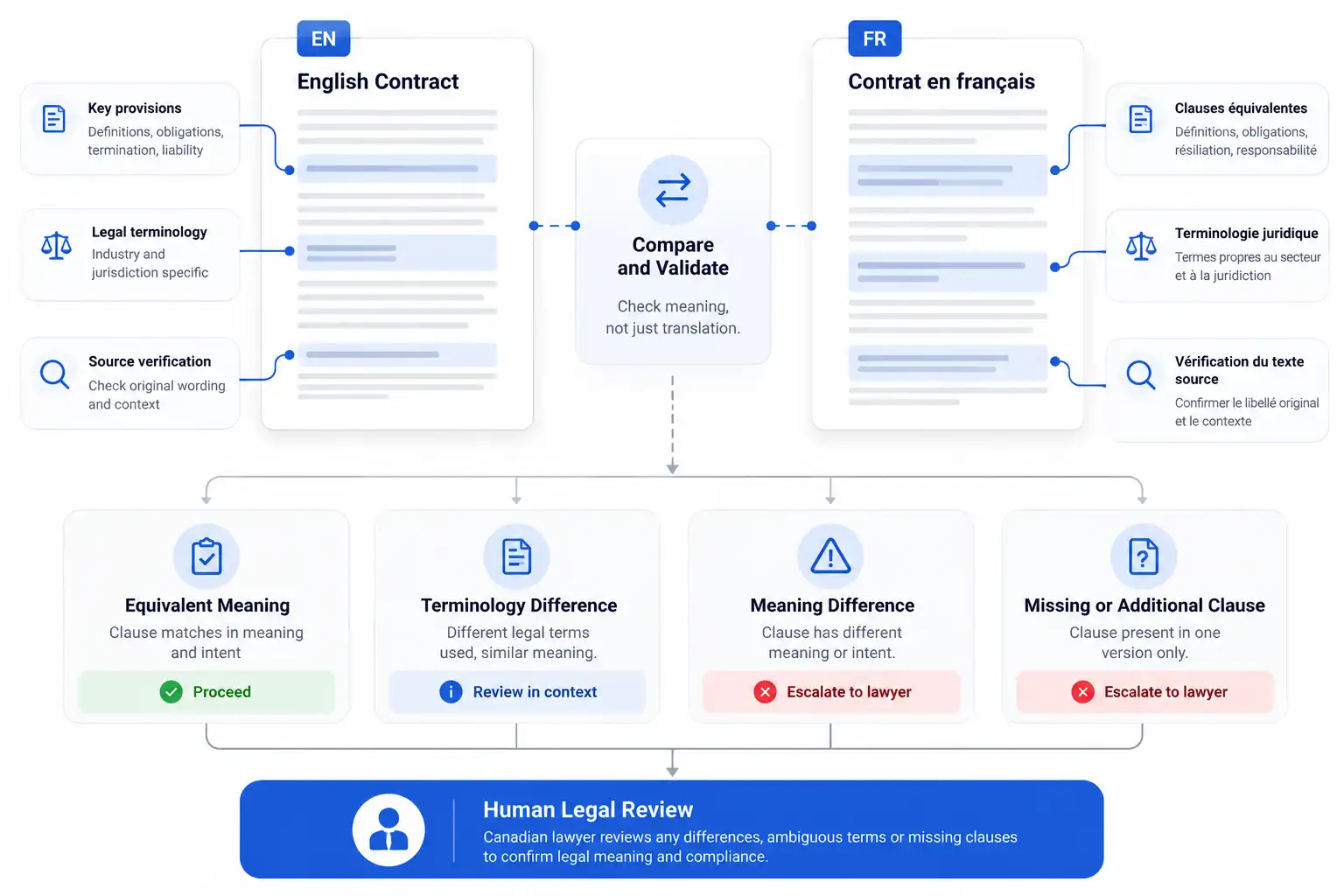
English-French support is an important requirement for some Canadian legal teams, particularly those serving Quebec clients or reviewing agreements drafted in both languages. It should be treated as a testable capability rather than a marketing checkbox.
A tool may accept French input and generate French output without reliably interpreting the legal effect of a clause. General language fluency does not establish competence in Quebec civil law, statutory terminology or bilingual contractual interpretation.
What should a bilingual evaluation include?
Test at least four distinct situations:
French-language agreements: Can the tool identify the same categories of risk in French documents as it does in English documents?
Mixed-language contracts: Can it follow defined terms, cross-references and obligations when sections use different languages?
Translation-sensitive provisions: Does it flag meaningful differences between English and French versions without assuming that the wording is legally equivalent?
Jurisdiction-specific analysis: Can it distinguish language-related findings from conclusions that require legal analysis under the applicable law?
The test should use agreements that have already been reviewed by qualified lawyers. Ask reviewers to identify both missed issues and unnecessary flags. Where possible, include clauses with subtle differences in scope, exceptions, notice periods and defined terms.
When does bilingual support materially change the purchase decision?
Situation | Importance of bilingual testing |
|---|---|
Most contracts are English-only and governed by one familiar jurisdiction | Useful, but may be a secondary criterion |
The team regularly reviews Quebec agreements | High |
Agreements contain parallel English and French versions | High |
Legal teams advise clients across multiple Canadian jurisdictions | High, alongside jurisdiction-specific testing |
French is used only for occasional administrative correspondence | Usually a lower priority than core review accuracy |
The practical conclusion is straightforward: if French-language contracts form part of the normal workload, require a live evaluation using representative documents before selecting a vendor.
Canadian Privacy, Data Residency and Legal Professional Obligations
Contract review tools may process personal information, commercially sensitive information, negotiation positions and documents protected by legal confidentiality obligations. The privacy and security review must therefore cover the entire processing chain, not just the location of the vendor's headquarters.
The Office of the Privacy Commissioner of Canada’s guidance on AI and privacy recommends limiting the sharing of sensitive information, establishing legal authority for personal-information processing, providing appropriate transparency and implementing privacy-by-design safeguards.
Canadian legal teams also need to consider applicable provincial privacy laws, professional-conduct rules, client instructions, contractual confidentiality provisions and the circumstances of each matter.
Does a Canadian company need Canadian data residency?
Not every Canadian organization has the same legal obligation to keep every category of data inside Canada. Requirements depend on the organization, the information, the applicable laws, contractual commitments and the specific processing arrangement.
Under PIPEDA, cross-border processing requires careful attention to accountability and safeguards. The Office of the Privacy Commissioner explains the relevant principles in its guidelines for processing personal data across borders.
Quebec introduces additional considerations. Law 25 amended Quebec's privacy framework, including requirements relevant to certain transfers of personal information outside Quebec and privacy impact assessments. Organizations should consult the applicable provisions of Quebec's private-sector privacy legislation and obtain appropriate advice before processing personal information across borders.
The important distinction is that Canadian data residency, privacy-law compliance and security are related but separate questions. A Canadian hosting location alone does not establish that a product complies with every applicable obligation.
Questions to ask vendors before uploading contracts
Area | Questions to ask | Evidence to request |
|---|---|---|
Data location | Where are documents stored and processed? | Data-flow diagram and regional processing commitments |
Model training | Are customer documents or prompts used to train or improve models? | Contractual terms and documented product settings |
Subprocessors | Which external providers receive document content? | Current subprocessor list and processing agreements |
Retention | How long are uploads, prompts and generated outputs retained? | Retention schedule and deletion procedures |
Access controls | Who can access customer documents? | Role-based access documentation and access logs |
Security | How are data and accounts protected? | Relevant security assessments and technical controls |
Cross-border processing | Which countries may process or access the data? | Processing locations and transfer safeguards |
Incident response | How are suspected breaches handled? | Incident-response commitments and notification terms |
Auditability | Can reviewers reconstruct who accessed and changed a document? | Audit-log and version-history demonstrations |
Do not accept a general statement such as “enterprise-grade security” as sufficient evidence. Ask for the specific contractual and technical controls that apply to the proposed deployment.
What Canadian lawyers should know about AI oversight
The Canadian Bar Association's Ethics of Artificial Intelligence for the Legal Practitioner addresses competence, confidentiality, supervision, client communication and other professional obligations associated with generative AI.
Its guidance emphasizes that lawyers must understand relevant risks, verify AI-generated work and safeguard client information. Using an AI tool does not transfer responsibility for legal judgment to the software provider.
The Canadian Bar Association also passed a resolution on AI's impact on the legal profession on February 26, 2026, identifying concerns involving confidentiality, solicitor-client privilege, professional judgment, privacy and security. Read the CBA resolution.
For procurement teams, these obligations translate into practical controls:
Establish which matters and documents may be processed by AI.
Define who is authorized to use the tool.
Train lawyers and support staff on confidentiality and output verification.
Set clear escalation rules for high-risk clauses.
Determine when client communication or consent is appropriate.
Review the vendor's terms and controls before implementation.
Periodically reassess the tool as its capabilities and terms change.
A vendor's assurances are useful inputs to this process, not a substitute for the organization's own assessment.
A Practical Framework for Testing AI Contract Review Accuracy
Vendor demonstrations tend to emphasize successful examples. Buyers need a test that also reveals failures.
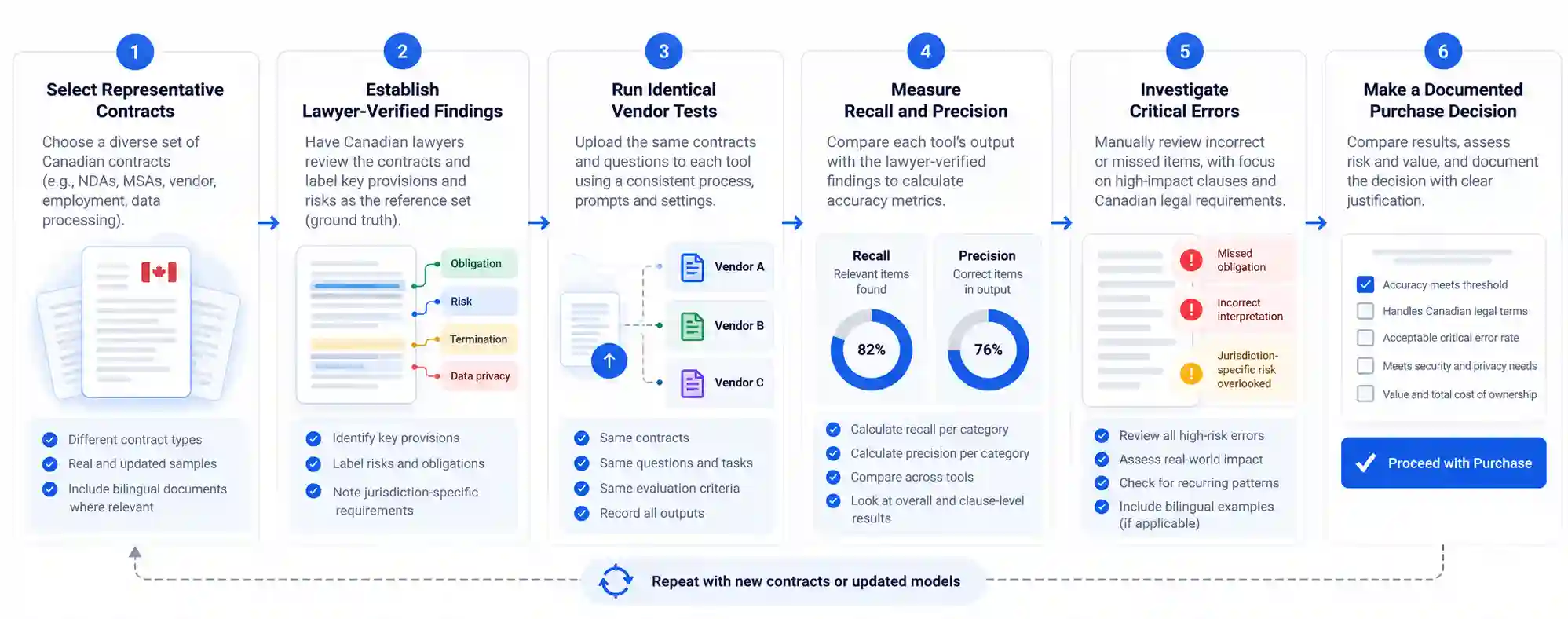
A useful evaluation compares the AI's findings with a lawyer-reviewed reference set. It should include ordinary contracts, ambiguous clauses, uncommon provisions, missing clauses, conflicting language and documents with poor formatting.
Step 1: Create a lawyer-reviewed test set
Select representative agreements from the organization's actual workload. Remove or appropriately anonymize sensitive information before using them in a vendor evaluation.
For each document, have qualified reviewers identify the clauses that matter, classify the risks and record the correct interpretation. Include both issues that should be flagged and ordinary provisions that should not trigger unnecessary warnings.
The reference set should capture context. A clause may be acceptable in one agreement but unacceptable in another because the commercial arrangement, governing law or surrounding provisions differ.
Step 2: Run identical tests across shortlisted tools
Use the same review instructions, playbook requirements and document versions for each vendor. Record the settings used and avoid changing the criteria halfway through the evaluation.
Ask each tool to identify risks, explain why each issue matters, quote the relevant language and suggest an appropriate next step.
Step 3: Measure meaningful outcomes
Use the following metrics to assess performance:
Metric | What it measures | Why it matters |
|---|---|---|
Critical-issue recall | Proportion of known critical issues the tool identifies | Reveals missed high-impact risks |
Finding precision | Proportion of flagged issues that are valid | Measures unnecessary review work |
Source accuracy | Whether findings quote the correct text and location | Makes verification faster |
Interpretation quality | Whether the tool correctly explains the clause in context | Tests more than keyword detection |
Redline usefulness | Whether proposed changes meet approved requirements | Measures practical drafting value |
Reviewer effort | Time needed to verify, correct and finalize findings | Tests real workflow efficiency |
Language consistency | Whether performance remains reliable across English and French documents | Matters for bilingual teams |
Recall and precision should be reported separately. A tool that flags nearly every clause may achieve high recall but create so many false positives that lawyers spend more time reviewing its output. A tool that produces very few warnings may appear efficient while missing critical issues.
For a simple example, suppose a test set contains 40 lawyer-identified material issues. A tool finds 34, of which 30 are valid.
Recall: 34 ÷ 40 = 85%.
Precision: 30 ÷ 34 = 88.2%.
These are illustrative calculations, not benchmark results for any vendor. The remaining six missed issues would need individual analysis, especially if they involved significant liability, privacy or termination risks.
Step 4: Set risk-based acceptance criteria
Not all mistakes have the same consequence. A minor formatting issue should not carry the same weight as a missed indemnity exception or a fabricated legal reference.
Before the test begins, decide which failures are unacceptable. For example, a team might require every designated critical issue in its test set to be identified for manual escalation, while setting separate targets for routine issues, false positives and reviewer effort.
Do not treat a small test set as proof of general reliability. Results apply to the documents, prompts, configurations and evaluation criteria tested. Repeat the test when the vendor materially changes the product or the team's workload changes.
What Are the Limitations of Generative AI Contract Review?
AI contract review can reduce repetitive reading and make document analysis more consistent, but it cannot guarantee that a contract is legally sound.
Several limitations deserve explicit attention during procurement and implementation.
1. Missing context
A clause may appear acceptable on its own but create a problem when read alongside another provision, an amendment, a statement of work or a governing agreement.
2. Incorrect interpretations
A model may misunderstand a defined term, overlook an exception or recommend wording that changes the commercial balance of an agreement.
3. Unsupported legal conclusions
A tool may generate a plausible explanation without establishing that the conclusion follows from current legislation, applicable case law or the relevant jurisdiction's legal principles.
4. Weak performance on unusual documents
Poorly scanned PDFs, complex tables, handwritten amendments and inconsistent formatting can make extraction unreliable.
5. Automation bias
Reviewers may accept a confident-looking answer without checking the original text. The Canadian Bar Association specifically warns against over-reliance on generative AI where it could compromise independent legal judgment.
6. Changing product capabilities
Model updates, changes to processing terms and new features can affect performance or risk. Procurement should include ongoing evaluation rather than treating approval as permanent.
The practical response is to assign AI a defined role. Use it to surface issues, organize evidence and prepare suggestions. Keep legal interpretation, material risk acceptance and final approval with authorized people.
What Are the Limitations of Generative AI Contract Review?
AI contract review can reduce repetitive reading and make document analysis more consistent, but it cannot guarantee that a contract is legally sound.
Several limitations deserve explicit attention during procurement and implementation.
1. Missing context. A clause may appear acceptable on its own but create a problem when read alongside another provision, an amendment, a statement of work or a governing agreement.
2. Incorrect interpretations. A model may misunderstand a defined term, overlook an exception or recommend wording that changes the commercial balance of an agreement.
3. Unsupported legal conclusions. A tool may generate a plausible explanation without establishing that the conclusion follows from current legislation, applicable case law or the relevant jurisdiction's legal principles.
4. Weak performance on unusual documents. Poorly scanned PDFs, complex tables, handwritten amendments and inconsistent formatting can make extraction unreliable.
5. Automation bias. Reviewers may accept a confident-looking answer without checking the original text. The Canadian Bar Association specifically warns against over-reliance on generative AI where it could compromise independent legal judgment.
6. Changing product capabilities. Model updates, changes to processing terms and new features can affect performance or risk. Procurement should include ongoing evaluation rather than treating approval as permanent.
The practical response is to assign AI a defined role. Use it to surface issues, organize evidence and prepare suggestions. Keep legal interpretation, material risk acceptance and final approval with authorized people.
How Much Does AI Contract Review Software Cost in Canada?
There is no reliable, comparable public price list for the five products discussed above that establishes the total cost of deploying them in a Canadian legal team. Buyers should request current quotations rather than rely on unsupported market averages.
The commercial model may depend on the number of users, document volume, features, deployment requirements, integrations and support arrangements.
Evaluate the full cost of ownership, not just the subscription price.
Cost component | What to investigate |
|---|---|
Software licensing | Per-user, usage-based, enterprise or negotiated pricing |
Implementation | Configuration, deployment and workflow setup |
Playbook development | Time required to document and configure review standards |
Integration | Microsoft Word, CLM, document management and identity systems |
Security and compliance | Vendor assessments, legal review and additional controls |
Training | User onboarding, governance and continuing education |
Quality assurance | Lawyer time spent testing, verifying and correcting AI output |
Maintenance | Playbook updates, model changes and periodic evaluations |
How should a buyer calculate return on investment?
Use measured review time rather than vendor marketing claims.
A simple model is:

To estimate annual time savings, measure the difference between the current workflow and the AI-assisted workflow, including time spent verifying findings and correcting errors.
For example, assume a legal team reviews 500 agreements each year and saves 20 minutes per agreement after verification.

At an assumed internal cost of CAD $150 per hour, the estimated annual value of that time is CAD $25,000.
This is an illustrative scenario, not a claim about typical savings or a recommendation to use that hourly rate. The business case must also account for software fees, implementation, training, additional review work and whether the saved hours can be used productively elsewhere.
A tool that saves time on routine agreements but introduces errors in high-risk contracts may not produce a positive return. The pilot should measure both efficiency and quality.
A 30-Day Pilot Plan for Canadian Legal Teams
A structured pilot allows buyers to validate the tool before committing to a longer contract.
Days 1–5: Define the scope
Select the contract types, review playbooks, user roles, security requirements and success criteria. Identify which documents may be shared with the vendor.
Days 6–10: Establish the baseline
Record current review times and known issues using lawyer-reviewed examples. Include English and French documents if bilingual work is part of the team's normal workload.
Days 11–20: Run controlled evaluations
Test shortlisted products against the same documents and criteria. Record missed risks, false positives, source-text accuracy, redline usefulness and verification time.
Days 21–25: Test operational fit
Evaluate integrations, permissions, audit logs, retention settings, workflow handoffs and the practical effort required to maintain playbooks.
Days 26–30: Make a documented decision
Compare the results with the pre-agreed acceptance criteria. Identify unresolved risks, calculate the likely cost of ownership and decide whether to proceed, extend the pilot or reject the product.
The 30-day period is a proposed planning framework, not a claim that every deployment can be evaluated conclusively within a month. Complex enterprise integrations or specialized legal workflows may require longer.
Frequently Asked Questions
1. What is the best generative AI contract review tool in Canada?
There is no single best tool for every Canadian legal team. Augure Legal and Nimble Intelligence are worth evaluating for Canadian-focused workflows, Kira by Litera for high-volume contract diligence, and Docusign AI-Assisted Review for agreement workflows integrated with Docusign. The right choice depends on verified accuracy, security, language requirements, workflow fit and total cost.
2. Can generative AI replace lawyers in contract review?
No. AI can assist with clause identification, summaries, risk flags and suggested redlines, but these outputs require appropriate verification. Lawyers remain responsible for professional judgment, client confidentiality, supervision and the quality of legal services. AI should support qualified reviewers rather than independently make final legal decisions.
3. Is it safe to upload confidential contracts to AI tools?
Only after assessing the specific tool and its terms. Review data retention, model-training policies, subprocessors, access controls, processing locations, deletion procedures and incident response. Obtain the required internal approvals and follow applicable legal and professional obligations. Avoid uploading sensitive client material into an unapproved public AI service.
4. Do Canadian legal teams need a Canadian-hosted AI tool?
Not necessarily. Canadian hosting may be an important contractual or organizational requirement, but it does not automatically establish privacy compliance or security. Buyers should assess applicable federal and provincial laws, cross-border processing, contractual commitments and the organization's risk profile. Where required, Canadian hosting should be documented in the contract and verified across the processing chain.
5. Can AI review contracts in both English and French?
Some vendors advertise bilingual capabilities, but support for both languages does not prove equal legal accuracy. Test representative French-language agreements, mixed-language clauses, defined terms and jurisdiction-specific terminology. Compare the output against reviews by qualified lawyers, particularly when the agreements concern Quebec law or parallel language versions.
6. How accurate is AI contract review software?
Accuracy varies by product, task, document type, language and configuration. A vendor's general accuracy claim may not predict performance on a particular organization's contracts. Buyers should measure critical-issue recall, finding precision, source accuracy, interpretation quality and reviewer effort against a lawyer-verified reference set.
7. Can AI contract review identify Canadian legal risks?
AI can flag potential issues and assist with questions about contractual language, but its ability to identify Canadian legal risks depends on the product's capabilities, source material, jurisdictional coverage and the task. Reviewers should verify relevant legislation, case law and contractual context. A flagged issue is not, by itself, a definitive legal conclusion.
8. What should a company look for in an AI contract review demo?
Use the company's actual review requirements and a representative test set. Ask the vendor to identify a known risky clause, find an important exception elsewhere in the agreement, cite the relevant text and suggest a playbook-compliant edit. Also test missing clauses, false positives, bilingual documents where relevant and the security controls available in the proposed plan.
Conclusion: Choose Based on Verified Review Quality, Not Feature Count
Generative AI contract review is most useful when it helps legal teams identify important issues earlier, apply established review standards consistently and spend less time on repetitive document analysis.
For Canadian buyers, the decision should rest on four requirements: reliable findings on representative contracts, appropriate privacy and security controls, compatibility with the team's actual workflow, and meaningful human oversight.
The shortlist in this guide offers different starting points, but vendor documentation alone cannot establish which product will perform best for a particular organization. A controlled pilot using lawyer-reviewed Canadian agreements is the most defensible way to compare the options.
For teams handling French-language or Quebec-related agreements, bilingual legal performance should be tested directly. For teams managing sensitive client documents, security and data-processing terms should be reviewed before any live contract is uploaded.
The best purchase is not necessarily the tool with the most AI features. It is the tool that improves review quality and efficiency without creating unacceptable legal, confidentiality or operational risks.
Comments (0)
No comments yet. Be the first to share your thoughts!