Generative AI for Australian Mining Shift Reports and Incident Summaries: Use Cases, Benefits and Implementation

Author
Ravi Prajapati
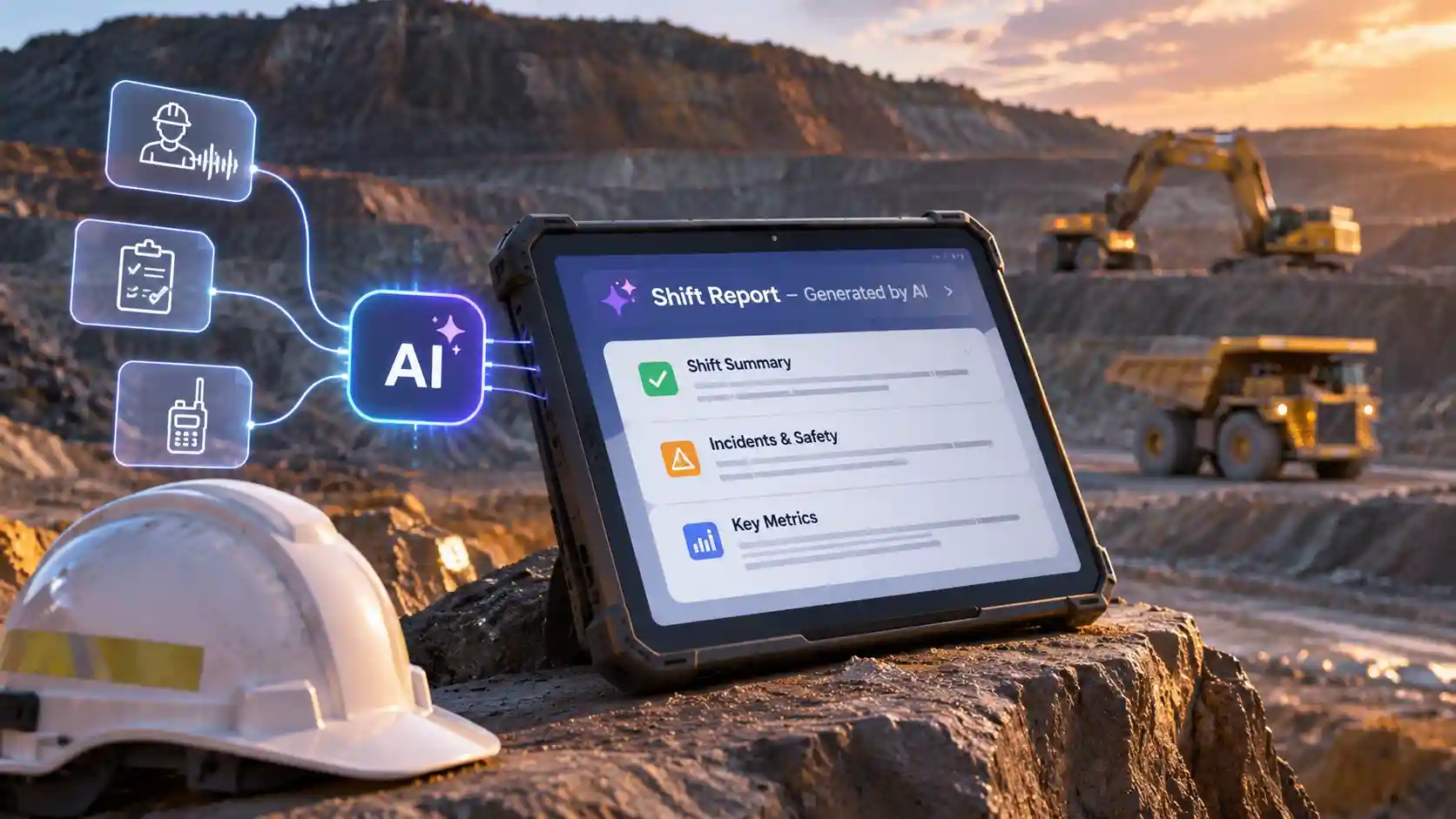
Learn how generative AI automates mining shift reports and incident summaries in Australia, improves handovers, and supports safer, data-driven operations.
Mining operations in Australia generate a large volume of operational information during every shift. Supervisors record equipment performance, production figures, maintenance activities, safety observations, environmental conditions, delays, and incidents. This information helps the incoming crew understand what happened, what remains unfinished, and which risks need attention.
However, much of this information is recorded in spreadsheets, digital forms, handwritten notes, maintenance systems, safety platforms, and operational logs. Preparing a clear shift report often requires supervisors to collect information from several sources, verify it, and organise it into a standard format.
Generative AI for mining shift reports in Australia can help automate this reporting process by converting operational records into structured summaries, highlighting unresolved issues, and preparing draft incident summaries for human review. It can also help mining teams search historical reports and identify recurring operational or safety patterns.
The opportunity is not simply to generate reports faster. It is to make operational information easier to understand, verify, share, and act upon.
For Australian mining companies considering AI adoption, the key question is how to implement these capabilities without compromising operational accuracy, worker safety, data security, or regulatory reporting obligations.
This article explains the practical applications of generative AI in mining shift reporting, the technology behind it, its benefits and limitations, and how mining operators can evaluate and implement an AI-powered reporting system.
What Is Generative AI for Mining Shift Reports?
Generative AI for mining shift reports is the use of artificial intelligence models to transform operational data, written notes, maintenance records, and safety observations into structured, readable shift summaries.
The technology can process information from multiple systems, organise it according to a reporting template, and generate a draft report that a supervisor can review.
For example, a mining supervisor may provide the following information:
Crusher experienced an unexpected shutdown during the afternoon shift.
Maintenance team inspected the conveyor motor.
Equipment restart was delayed pending a mechanical inspection.
Production was below the shift target.
A safety observation was recorded near the loading area.
The maintenance task remains open for the incoming shift.
A generative AI system can convert these notes into a structured shift report containing operational status, equipment issues, production updates, safety observations, and outstanding tasks.
The AI does not independently establish whether the information is correct. It works with the information provided by connected systems and authorised users.
Its primary role is to reduce manual reporting effort and improve the consistency of operational documentation.
Why Mining Shift Reporting Is a Suitable Use Case for Generative AI
Mining shift reports are repetitive in structure but variable in content. Every shift may follow a similar reporting format, yet the operational events, equipment conditions, production figures, and safety observations change.
This makes reporting a suitable candidate for AI-assisted document generation.
Mining Operations Generate Information Across Multiple Systems
A typical mining operation may use separate systems for:
Mine production and dispatch
Equipment maintenance and asset management
Safety and incident management
Workforce management
Environmental monitoring
Operational planning
Supervisory reporting
The information required for a shift report may exist across several of these systems.
An AI reporting solution can retrieve authorised information from these sources and organise it into a consolidated report.
Manual Shift Reports Can Be Inconsistent
Different supervisors may use different writing styles, levels of detail, or reporting structures.
Some reports may contain detailed equipment updates, while others may focus mainly on production. Important outstanding tasks may also be described inconsistently.
AI-assisted reporting can apply a common reporting template across shifts, departments, and operational areas.
Shift Handover Requires Clear Operational Context
An incoming crew needs more than a list of events. It needs to understand the current operational situation.
For example:
Which equipment is unavailable?
Which maintenance activities remain incomplete?
What safety observations require follow-up?
Which production targets were not achieved?
What activities should the incoming supervisor prioritise?
Generative AI can organise these details into a concise handover summary, provided the source information is accurate and sufficiently complete.
Historical Reports Contain Useful Operational Information
Mining companies may hold years of operational records, incident narratives, maintenance notes, and shift reports.
These records can contain useful information about recurring equipment issues, operational delays, and safety observations.
AI-powered search and summarisation can make these records easier to analyse, although meaningful trend analysis still requires structured data, appropriate validation, and domain expertise.
How Generative AI Automates Mining Shift Reports
An AI-powered mining reporting system typically follows a workflow that combines data collection, processing, report generation, validation, and distribution.
Step 1: Collect Operational Data
The system retrieves information from authorised operational sources.
Potential data sources include:
Mine operations management systems
Fleet management systems
Computerised maintenance management systems (CMMS)
Safety management platforms
Digital shift logs
Production spreadsheets
Supervisor-entered notes
Equipment monitoring systems
The system should only access data that its users and service accounts are authorised to retrieve.
Step 2: Process and Standardise the Information
Operational records may contain different formats, terminology, abbreviations, and levels of detail.
The AI workflow can standardise these records into a common structure.
For example, equipment identifiers, shift dates, operational areas, task statuses, and incident categories can be mapped to predefined fields.
This stage is important because inconsistent source information can result in inaccurate or confusing reports.
Step 3: Generate the Shift Report
The generative AI model receives the processed information and a reporting template.
It creates a draft report containing sections such as:
Shift overview
Production performance
Equipment status
Maintenance activities
Safety observations
Operational delays
Outstanding tasks
Incoming shift priorities
The report should distinguish confirmed facts from missing information or observations that require verification.
Step 4: Validate the Report
The system performs checks before the report reaches the supervisor.
Validation may include:
Checking production figures against source records
Verifying equipment identifiers
Confirming shift dates and times
Identifying missing mandatory fields
Checking whether tasks are still open
Flagging contradictory source information
Identifying unsupported statements
A supervisor then reviews and approves the report.
Step 5: Distribute the Approved Report
Once approved, the report can be stored or distributed through the organisation's existing operational systems.
Possible destinations include:
Digital shift handover platforms
Operational dashboards
Maintenance management systems
Document management platforms
Internal reporting portals
AI should prepare the report, but the approved workflow should determine who receives it and when.
Key Use Cases of Generative AI in Australian Mining Operations
Generative AI can support several reporting-related workflows across mining operations. The value depends on the quality of the source data, the reporting process, and the level of human oversight.
1. Automated Mining Shift Handover Reports
Shift handover reporting is one of the most practical applications of generative AI.
The system can consolidate information from the outgoing shift and prepare a structured summary for the incoming team.
A report may include:
Production status
Equipment availability
Maintenance work completed
Pending maintenance activities
Safety observations
Operational constraints
Outstanding work orders
Priorities for the next shift
For example, an open maintenance task can be included in the handover report with its current status and source reference.
This reduces the need for supervisors to manually copy information from multiple systems.
The AI-generated report should not replace direct communication between supervisors, especially when operational conditions require immediate attention.
2. AI-Generated Mining Incident Summaries
Generative AI can help prepare incident summaries using information from authorised incident management systems.
Inputs may include:
Incident descriptions
Worker observations
Witness statements
Equipment details
Initial investigation records
Corrective actions
Supporting documentation
The AI can organise these records into a consistent format.
A draft incident summary may contain:
Incident date and location
Event description
Equipment or activity involved
Reported consequences
Immediate response
Investigation status
Corrective actions
Outstanding information
The system should not independently assign blame, determine legal responsibility, or declare a root cause without an appropriately conducted investigation.
3. Near-Miss Reporting and Safety Observation Summaries
Near-miss reports and safety observations can provide useful information about potential hazards.
Generative AI can help standardise descriptions submitted by workers and supervisors.
For example, several reports may describe workers entering an area where mobile equipment is operating.
An AI system can group these reports by operational area, activity, hazard category, or equipment type for review by safety personnel.
This can help safety teams identify recurring themes that may deserve further investigation.
However, AI-generated patterns should be treated as analytical findings requiring verification, not as proof that a specific control has failed.
4. Equipment Maintenance Shift Summaries
Mining equipment maintenance generates a large volume of information through work orders, inspection notes, breakdown reports, and maintenance logs.
Generative AI can convert these records into readable summaries.
A maintenance shift report may contain:
Equipment breakdowns
Inspections completed
Repairs performed
Components replaced
Outstanding work orders
Equipment awaiting approval
Maintenance priorities for the next shift
The system can also summarise historical maintenance notes when authorised personnel need to understand the background of a recurring equipment issue.
AI-generated summaries must preserve the technical details and status information recorded by maintenance personnel.
5. Production Performance Summaries
Generative AI can create written summaries of production data retrieved from authorised systems.
For example, it may explain that a shift achieved a particular production figure, identify recorded delays, and summarise the operational reasons documented by supervisors.
A production summary may include:
Actual production versus target
Equipment utilisation
Downtime
Material movement
Operational delays
Recorded production constraints
The AI should not invent explanations for production shortfalls.
If a system contains production figures but no verified reason for a shortfall, the report should state that the cause has not been recorded.
6. Environmental Monitoring Reports
Mining operations may collect environmental information relating to dust, water, emissions, noise, and other site-specific monitoring activities.
Generative AI can help organise environmental records into daily or shift-level summaries.
Possible outputs include:
Monitoring activity summaries
Recorded readings
Environmental observations
Unusual conditions
Outstanding monitoring tasks
Follow-up actions
Any compliance-related interpretation must be checked against the relevant environmental requirements, approved monitoring procedures, and source data.
AI should not independently declare that an operation is compliant.
7. Historical Incident Report Search and Summarisation
Mining companies may have large collections of historical incident reports and investigation documents.
An AI-powered search system can help authorised users find relevant information using natural-language queries.
For example:
"What previous incidents involved conveyor maintenance and incomplete isolation procedures?"
The system can retrieve relevant records and summarise their contents.
This can help safety teams review historical information during investigations, training, and risk assessment.
The quality of the results depends on document availability, indexing, metadata, permissions, and retrieval accuracy.
Example: AI-Generated Mining Shift Report
The following is a hypothetical example created to illustrate how generative AI can transform raw operational notes into a structured report. It is not a real mining company case study.
Raw Shift Notes
Shift: Afternoon
Crusher stopped unexpectedly.
Maintenance inspected the conveyor motor.
Restart delayed pending mechanical inspection.
Production below target.
Safety observation recorded near loading area.
Maintenance work order remains open.
Incoming shift needs to follow up on equipment inspection.
AI-Generated Shift Summary
Shift Overview
The afternoon shift experienced an unexpected crusher shutdown, which affected production performance. Maintenance personnel inspected the conveyor motor, but equipment restart remained pending further mechanical inspection.
Production Performance
Production was below the shift target. The available records identify the crusher shutdown as an operational disruption. The exact production impact should be confirmed against the production system.
Equipment and Maintenance Status
The conveyor motor was inspected by the maintenance team. The associated work order remains open, and further mechanical inspection is required before restart.
Safety Observations
A safety observation was recorded near the loading area. The observation details and required follow-up should be reviewed by the incoming supervisor.
Incoming Shift Priorities
Confirm the status of the mechanical inspection.
Review the outstanding maintenance work order.
Verify equipment restart authorisation.
Review the safety observation recorded near the loading area.
Confirm the final production impact.
This example demonstrates how AI can organise raw information into a consistent report while preserving the distinction between recorded information and items that still require verification.
Generative AI vs Traditional Mining Reporting Software
Generative AI and conventional reporting software serve different purposes.
Traditional software is generally better suited to structured calculations, predefined rules, and reliable recordkeeping. Generative AI is useful for interpreting written information, summarising records, and producing natural-language reports.
Capability | Traditional Reporting Software | Generative AI Reporting |
|---|---|---|
Numerical calculations | Strong for predefined calculations | Requires verification against source data |
Structured data processing | Strong | Can assist with interpretation |
Natural-language summarisation | Usually limited | Core capability |
Standard report generation | Template and rule-based | Context-aware draft generation |
Historical document search | Often keyword-based | Can support semantic search |
Unstructured notes processing | Often requires manual input | Can summarise and organise text |
Consistency | High with fixed rules | Depends on prompts, models, and validation |
Factual accuracy | Depends on data and rules | Requires grounding and human review |
Root-cause determination | Depends on analytical tools and investigation | Should not independently establish root cause |
Regulatory reporting | Supports predefined processes | Can assist with draft preparation |
A practical mining reporting system often combines both approaches.
Traditional software manages structured records, calculations, permissions, and workflows. Generative AI helps convert the information into readable summaries and supports natural-language interaction.
Benefits of Generative AI for Mining Shift Reports
The potential benefits depend on how the solution is implemented and whether reporting is a significant operational bottleneck.
Reduced Manual Reporting Work
Supervisors may spend time collecting information, rewriting notes, and preparing reports.
AI-assisted report generation can reduce repetitive writing and data consolidation work.
The time saved should be measured through a pilot rather than assumed.
More Consistent Shift Handover Documentation
A common reporting template helps different supervisors follow the same structure.
This can make it easier for incoming crews to locate equipment updates, safety observations, outstanding work, and operational priorities.
Better Access to Historical Operational Information
AI-powered search can make historical reports easier to retrieve and understand.
This may support maintenance planning, incident reviews, and operational learning.
Improved Reporting Visibility
A consolidated reporting workflow can help managers access approved operational summaries without manually collecting documents from multiple teams.
The benefit depends on integration with existing systems and appropriate access permissions.
Support for Safety Analysis
AI can help organise incident narratives and identify recurring themes for review.
It may support safety teams in understanding historical observations, but it does not replace safety investigations, risk assessments, or professional judgement.
More Time for Supervisory Activities
If reporting effort decreases, supervisors may have more time available for field observations, crew communication, operational coordination, and other responsibilities.
Whether this happens in practice depends on the quality of the workflow and the amount of manual review still required.
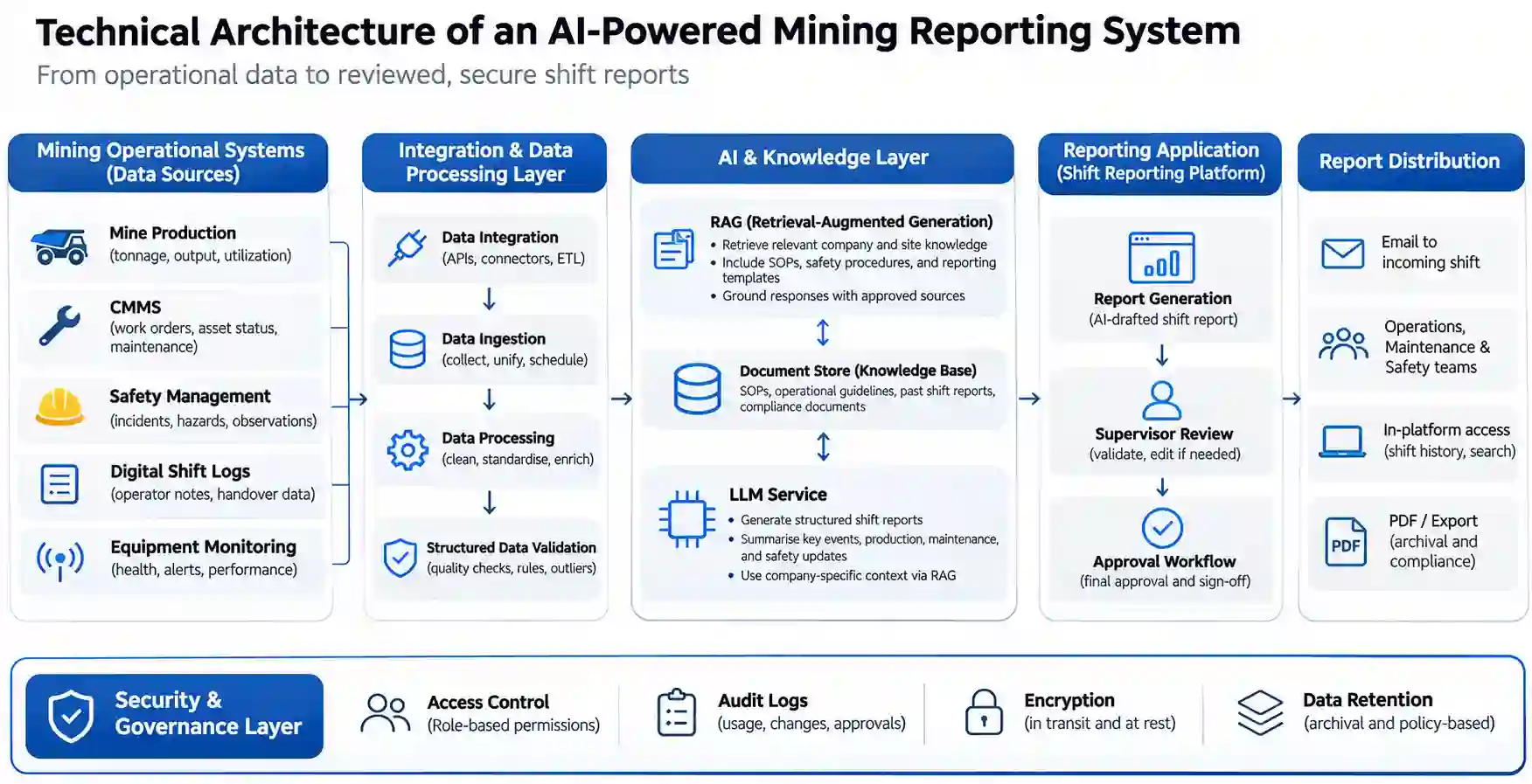
Technical Architecture of an AI-Powered Mining Reporting System
An enterprise-grade mining reporting solution requires more than connecting a language model to a spreadsheet.
The architecture should account for data integration, access control, operational reliability, model accuracy, and auditability.
Data Integration Layer
The data integration layer connects the reporting application to authorised operational systems.
Possible technologies include REST APIs, database connectors, message queues, and integration middleware.
The integration approach depends on the capabilities and security requirements of the source systems.
Data Processing Layer
This layer cleans, standardises, and validates operational information.
It may include:
Equipment identifier mapping
Shift date and time normalisation
Record deduplication
Data quality checks
Structured field extraction
Status validation
AI and Retrieval Layer
The AI layer may use a large language model (LLM) to generate summaries.
For historical document search, a retrieval-augmented generation (RAG) architecture can retrieve relevant records before the model generates a response.
RAG helps ground answers in retrieved information, but it does not guarantee factual accuracy. Retrieval quality, document permissions, source freshness, and output validation remain important.
Reporting Application Layer
The reporting interface provides supervisors and authorised users with tools to:
Generate draft reports
Review source information
Edit summaries
Approve reports
View outstanding tasks
Search historical records
Security and Governance Layer
Security and governance should operate across the entire system.
Important controls include:
Role-based access control
Authentication and authorisation
Encryption in transit and at rest
Data retention policies
Audit logging
Model access restrictions
Secure handling of worker information
Human approval workflows
Risks and Limitations of Generative AI in Mining Reporting
Generative AI can improve reporting workflows, but mining environments require careful control of its limitations.
AI Hallucinations and Unsupported Information
Generative AI can produce statements that are not supported by source records.
The National Institute of Standards and Technology (NIST) identifies confabulation, commonly referred to as hallucination, as a risk associated with generative AI.
Source: NIST Generative AI Risk Management Profile
For mining reports, unsupported information could create confusion about equipment status, safety events, maintenance actions, or operational conditions.
Mitigation measures include source-grounded generation, field-level validation, confidence-based escalation, and supervisor approval.
Incomplete or Inconsistent Data
If the source systems contain missing or outdated information, the AI may generate an incomplete report.
For example, a maintenance work order may show an open status even though the repair has been completed but not updated in the system.
AI cannot reliably correct such discrepancies without additional verified information.
Data Security and Confidentiality
Mining operational records may contain sensitive information about assets, infrastructure, workers, production, and site operations.
Organisations should evaluate where data is processed, how it is retained, whether it is used for model training, and how access is controlled.
Enterprise AI deployments should follow the organisation's data security and privacy requirements.
Regulatory Reporting Risks
Australian mining operators have jurisdiction-specific reporting obligations.
For example, Safe Work Australia explains that incident notification requirements under model WHS laws must be checked against the laws adopted in the relevant jurisdiction.
Source: Safe Work Australia: Reporting an Incident
In NSW, the Resources Regulator specifies different notification requirements depending on the type of incident.
Source: NSW Resources Regulator: Report an Incident or Injury
Generative AI may assist with preparing draft documentation, but it should not replace the required reporting process, statutory notifications, or authorised decision-makers.
Over-Reliance on AI-Generated Reports
Supervisors may assume that an AI-generated report is complete because it appears professionally written.
This creates a risk of overlooking missing details or incorrect statements.
The system should make source references and review requirements visible to the user.
Integration Complexity
Mining organisations may operate legacy systems with limited API support or inconsistent data structures.
Integration can require additional development, data mapping, security reviews, and operational testing.
The cost and implementation timeline depend heavily on the existing technology environment.
How to Implement Generative AI for Mining Shift Reports
A phased implementation can help mining companies test the technology before expanding it across multiple sites.
Phase 1: Identify the Reporting Problem
Start with one reporting workflow.
Examples include:
Daily shift handover
Equipment maintenance summaries
Safety observation summaries
Incident documentation drafts
Identify who prepares the report, what information is required, where the information originates, and how the report is used.
Phase 2: Assess Data Availability
Review the systems that contain the required information.
Determine whether the data is accessible, sufficiently accurate, consistently structured, and suitable for AI processing.
Poor data quality should be addressed before attempting large-scale automation.
Phase 3: Define the Reporting Template
Create a standard reporting structure.
For each section, define:
Required information
Source system
Validation rules
Responsible reviewer
Approval requirements
This helps reduce ambiguity in the AI-generated output.
Phase 4: Build a Controlled Pilot
Develop a pilot using a limited dataset and a selected operational team.
The system should generate draft reports that can be compared with manually prepared reports.
The pilot should measure:
Report preparation time
Completeness of required fields
Accuracy of extracted operational details
Unsupported statements
Supervisor correction rate
User acceptance
Phase 5: Validate and Improve
Collect feedback from supervisors, maintenance personnel, and safety teams.
Improve the prompts, data mappings, retrieval methods, validation rules, and user interface based on observed problems.
Phase 6: Expand to Additional Workflows
Once the initial workflow demonstrates acceptable results, consider extending the solution to other reporting activities.
Expansion should follow successful validation, operational approval, and security review.
How to Evaluate an AI Mining Reporting Solution
Mining companies evaluating AI reporting software or a custom AI development partner should assess the solution against operational requirements rather than focusing only on the language model.
Evaluation Criteria | Questions to Ask |
|---|---|
Data integration | Can the solution connect to existing mine operations, maintenance, and safety systems? |
Report accuracy | How does the system verify generated content against source records? |
Data security | Where is operational data processed and stored? |
Human oversight | Can supervisors review and approve reports before distribution? |
Auditability | Can users trace report statements back to source records? |
Customisation | Can the system follow site-specific reporting templates? |
Scalability | Can the solution support additional sites and operational departments? |
Access control | Can information access be restricted by role and operational area? |
System reliability | What happens when source systems or AI services are unavailable? |
Performance measurement | Can the organisation measure time saved, corrections, and report quality? |
A solution that generates polished reports but cannot explain where the information came from may be unsuitable for high-risk operational workflows.
Build vs Buy: Should Australian Mining Companies Develop a Custom AI Reporting System?
Mining companies can evaluate prebuilt AI reporting software or develop a custom solution.
The right approach depends on the complexity of the reporting process, the existing technology environment, and the level of customisation required.
Factor | Prebuilt AI Reporting Software | Custom AI Reporting Solution |
|---|---|---|
Initial deployment | Potentially faster | Usually requires development |
Reporting templates | May offer standard templates | Can be designed for site-specific needs |
Integration | Depends on supported connectors | Can be tailored to existing systems |
Workflow customisation | May be limited | Greater flexibility |
Ownership and control | Depends on vendor terms | Greater control over application design |
Maintenance | Vendor-managed components | Requires an ongoing maintenance strategy |
Best suited for | Standardised reporting needs | Complex operational workflows |
A prebuilt product may be suitable when reporting requirements are standard and supported by the vendor.
A custom AI solution may be more appropriate when the organisation needs specific integrations, unique reporting structures, detailed permissions, or a workflow that existing products cannot support.
The decision should account for total cost of ownership, including integration, infrastructure, security, ongoing maintenance, and AI usage.
What Technology Is Required to Build a Custom Mining AI Reporting Solution?
The technology stack depends on the organisation's existing systems and infrastructure.
A custom AI reporting application may include the following components:
Frontend: React, Angular, or another enterprise web framework for supervisor dashboards, report review, and approval interfaces.
Backend: Node.js, Python, Java, or .NET for API development, integration logic, workflow management, and validation.
AI Models: Enterprise-accessible large language models for summarisation, information extraction, and natural-language report generation.
Data Integration: REST APIs, database connectors, integration middleware, and event-based data pipelines.
Data Storage: Relational databases and document storage for structured records, generated reports, and supporting documents.
Retrieval Architecture: RAG-based retrieval and vector search where historical report search or contextual document grounding is required.
Cloud Infrastructure: An approved enterprise cloud or controlled infrastructure environment selected according to the organisation's security, availability, and data residency requirements.
Security: Identity management, role-based access control, encryption, audit logging, and data retention controls.
The technology selection should be based on the mining company's existing environment, rather than adopting a stack solely because it is commonly used in AI projects.
What Does the Future of AI-Assisted Mining Reporting Look Like?
Generative AI reporting is a practical starting point for broader AI adoption in mining operations.
Once reporting workflows are connected to reliable operational data, organisations may explore additional capabilities such as:
Natural-language search across historical shift reports
Automated identification of outstanding maintenance activities
Summarisation of recurring safety observations
AI-assisted preparation of daily operational briefings
Integration with maintenance and operational dashboards
Contextual recommendations for supervisor review
More advanced agentic AI workflows may eventually coordinate multiple steps across connected systems.
However, the ability to generate a report is different from the ability to make and execute operational decisions safely.
In mining environments, any movement toward autonomous actions should involve a separate risk assessment, clearly defined permissions, appropriate safety controls, and rigorous validation.
AI-generated summaries should remain a support tool for authorised operational personnel.
Frequently Asked Questions
1. How can generative AI automate mining shift reports in Australia?
Generative AI can collect authorised information from mining production systems, maintenance records, safety logs, and digital shift notes. It can organise the information into a standard reporting template and prepare a draft shift report. Supervisors can review the generated content, verify operational details, and approve the report before distribution. This reduces repetitive report-writing work while maintaining human oversight.
2. Can AI generate mining incident summaries automatically?
Yes. Generative AI can prepare draft incident summaries using information from incident management systems, witness statements, equipment records, and investigation notes. It can structure the information into event descriptions, immediate responses, investigation status, and corrective actions. However, the generated summary must be reviewed by authorised personnel. AI should not independently determine legal responsibility, establish root causes, or replace mandatory incident notification procedures.
3. What data is required for an AI-powered mining shift reporting system?
An AI mining reporting system may use production data, equipment status, maintenance work orders, digital shift logs, safety observations, incident records, and operational notes. The required data depends on the reporting workflow. Organisations should ensure that the information is accessible, accurate, properly structured, and authorised for AI processing before implementing the solution.
4. Can generative AI integrate with existing mining management systems?
Yes. Custom AI reporting applications can integrate with existing mining management systems through APIs, database connectors, middleware, or other approved integration methods. The available integration options depend on the source systems and their technical capabilities. Legacy systems may require additional integration development and data standardisation.
5. Is generative AI safe for mining safety and incident reporting?
Generative AI can support mining safety reporting, but it should not be treated as an independent source of verified safety information. AI-generated content can contain unsupported statements or omit important details. A suitable system should include source grounding, validation, access controls, audit logs, and human review. Regulatory reporting and safety-critical decisions must remain within the organisation's approved procedures and authorised responsibilities.
6. What is the difference between AI mining shift reports and traditional reporting software?
Traditional reporting software generally uses predefined rules, structured data, and fixed templates to produce reports. Generative AI can interpret written notes, summarise unstructured records, and create natural-language explanations. A combined system can use traditional software for calculations, data management, and validation while using AI to prepare readable summaries.
7. Should mining companies buy AI reporting software or build a custom solution?
Mining companies should buy a prebuilt solution when it supports their existing reporting requirements and integrations. A custom solution may be appropriate when the organisation requires site-specific workflows, specialised integrations, customised reporting templates, or greater control over application functionality. The decision should consider development cost, implementation time, security, maintenance, scalability, and long-term ownership.
8. How can mining companies measure the ROI of AI reporting?
Mining companies can evaluate AI reporting ROI by comparing the existing reporting process with the AI-assisted workflow. Useful metrics include report preparation time, supervisor correction rate, report completeness, data accuracy, user adoption, and cost per report. The organisation should establish baseline measurements before the pilot and calculate benefits using actual operational results rather than assumed productivity improvements.
Conclusion
Generative AI for Australian mining shift reports and incident summaries offers a practical way to reduce repetitive documentation work and improve the consistency of operational reporting.
Its most useful applications include shift handover summaries, maintenance reporting, safety observation summaries, incident documentation drafts, and historical report search.
The technology is most effective when it works with reliable operational data, follows site-specific reporting requirements, and operates within a controlled workflow.
For mining companies, the implementation priority should be to select a well-defined reporting problem, assess the quality of existing data, develop a controlled pilot, and validate the output with operational personnel.
Generative AI should not replace supervisors, safety professionals, maintenance engineers, or statutory reporting processes. It should help them access and organise information more efficiently.
The long-term opportunity is to build reporting systems that connect operational data with clear, verified, and actionable information for mining teams.
Comments (0)
No comments yet. Be the first to share your thoughts!