GPT-6.1 Sol vs Claude Opus 5.5: Which Is Better for Coding, AI Agents, and Real-World Work?

Author
Ravi Prajapati

A sourced comparison of GPT-6.1 Sol and Claude Opus 5.5 on coding, AI agents, and real-world work, including pricing, benchmarks, and where each model wins.
Quick answer: GPT-6.1 Sol and Claude Opus 5.5 are not direct peers. GPT-6.1 Sol is OpenAI's mid-tier model, priced at $2 per million input tokens and $10 per million output tokens, while Opus 5.5 is Anthropic's flagship, priced at $4 and $20. On the benchmarks each company has published, GPT-6.1 Sol wins on cost-efficiency and matches Opus 5.5 on some agentic workflow tasks, while Opus 5.5 leads on raw coding accuracy and long-horizon autonomous work. Neither company has run a fully matched, independent head-to-head between the two models, so treat every number below as vendor-reported and directional, not definitive.
Both models shipped within a week of each other in late September 2026, during one of the most compressed release cycles either company has had. Anthropic launched Claude Opus 5.5 on September 22 as the first model in its new 5.5 family. OpenAI launched GPT-6 Sol and GPT-6 Luna that same day, then followed a week later, on September 29, with an upgraded version called GPT-6.1 Sol. That timing is not a coincidence. It is the clearest sign yet that OpenAI and Anthropic are now iterating against each other on a roughly weekly cadence, and it means anyone comparing these two models needs to know which numbers are current and which were published before the other model even existed.
This article works through what both companies have actually reported, where their claims agree, where they conflict, and what that means if you are deciding which model to build on.
GPT-6.1 Sol and Claude Opus 5.5 Are Not the Same Weight Class
The single most important fact to understand before reading any benchmark number is that these two models occupy different positions in their respective lineups.
Claude Opus 5.5 is Anthropic's top-tier model, sitting above Sonnet and Haiku in the current Claude lineup, and Anthropic describes it as performing at the level of Claude Fable 5.1, its most capable model, on most work. GPT-6.1 Sol is explicitly a mid-tier model. As one detailed technical rundown of the release put it, GPT-6.1 Sol "slots below GPT-6 Astra, the flagship launched on September 3, and above GPT-6 Luna, the small model," according to DataCamp's breakdown of the release. OpenAI's own announcement frames GPT-6.1 Sol's entire value proposition around this positioning: "near-Astra intelligence for coding, computer use, and professional work at one-fifth of Astra's standard input and output token prices," per OpenAI's official GPT-6.1 Sol announcement.
Pricing makes the tier gap concrete. Here is how the current lineup compares on standard API pricing per million tokens:
Model | Company | Tier | Input | Output | Cached input |
|---|---|---|---|---|---|
GPT-6 Luna | OpenAI | Small | $0.10 | $0.50 | $0.01 |
GPT-6.1 Sol | OpenAI | Mid | $2 | $10 | $0.10 |
Claude Opus 5.5 | Anthropic | Flagship | $4 | $20 | $0.20 |
Claude Opus 5 (prior generation) | Anthropic | Flagship | $5 | $25 | $0.50 |
GPT-6 Astra | OpenAI | Flagship | $10 | $50 | $1.00 |
Sources: OpenAI GPT-6.1 Sol announcement and Anthropic Claude Opus 5.5 announcement.
Claude Opus 5.5 costs twice as much per token as GPT-6.1 Sol, and about 60 percent of what OpenAI charges for its actual flagship, Astra. If you are choosing purely by price tier, Sonnet-class Anthropic models are the more natural comparison to GPT-6.1 Sol, and GPT-6 Astra is the more natural comparison to Opus 5.5. The reason "GPT-6.1 Sol vs Claude Opus 5.5" is still a meaningful comparison, rather than an apples-to-oranges mistake, is that OpenAI is explicitly positioning Sol as a near-flagship substitute, and on several of the benchmarks below, it delivers on that claim against Opus 5.5 specifically, not just against Astra.
Why the Published Benchmarks Do Not Line Up Cleanly
Before looking at specific numbers, it is worth being direct about a limitation that most comparison articles gloss over: Anthropic and OpenAI did not benchmark against the same version of each other's models, and neither ran a controlled, third-party head-to-head.
Anthropic's official comparison table, published on September 22, benchmarks Opus 5.5 against Claude Fable 5.1, Claude Opus 5, GPT-6 Astra, and a model it labels GPT-5.6 Sol. GPT-6.1 Sol did not exist yet when that table was published, so it simply is not in it. OpenAI's GPT-6.1 Sol launch post, published a week later, does include direct comparisons to Opus 5.5 on three evaluations: GDP.pdf, AutomationBench, and Terminal-Bench Science. Those are the only genuinely apples-to-apples data points available between the two current models, and even those come with an important caveat printed directly on OpenAI's own page: "Evaluations of competitor models were taken from publicly available reports," per OpenAI's GPT-6.1 Sol announcement. In practice, that means OpenAI ran GPT-6.1 Sol itself and compared it to Anthropic's self-reported Opus 5.5 numbers, rather than running both models independently under identical conditions.
This is normal practice in the industry, and it does not make the numbers useless. It does mean that a full third-party evaluation, once one exists, deserves more weight than either company's launch-day comparison.
How the Two Models Compare on Coding
Coding is the category both companies lead with, and it is also where the most direct comparisons exist.
On DeepSWE v1.1, a benchmark that evaluates long-horizon software engineering tasks in real codebases, OpenAI reports that GPT-6.1 Sol "matches GPT-6 Astra at roughly one-fifth of the cost, while eclipsing GPT-6 Sol's best score by 6.4 percentage points at a lower reasoning effort and cost," according to OpenAI's GPT-6.1 Sol announcement. OpenAI did not publish an Opus 5.5 score on this specific benchmark, so there is no direct comparison point here.
Anthropic's own coding benchmarks tell a different, and in some ways more useful, story about Opus 5.5's absolute capability. On Terminal-Bench 4.0, which measures a model's ability to complete complex, multi-step professional tasks inside a command line interface, Anthropic reports Opus 5.5 scoring 66.4 percent, ahead of GPT-6 Astra's 57.9 percent and far ahead of the older GPT-5.6 Sol at 37.3 percent, according to Anthropic's Claude Opus 5.5 announcement. On FrontierCode v1.1, which measures whether an agent's code changes would actually be merged into a real codebase, Opus 5.5 scores 54.4 percent at its default effort setting, ahead of GPT-6 Astra's top score of 53.3 percent, per the same source. On CursorBench 4.0, built from real ambiguous, multi-file tasks taken from Cursor sessions, Opus 5.5 scores 57.8 percent, compared to 41.7 percent for the older GPT-5.6 Sol.
Anthropic also shared a concrete practical example: an early tester used Opus 5.5 to "audit and fix a 200,000-line codebase in under three hours, where Opus 5 took over 20 hours and used 2.5x as many tokens," per Anthropic's announcement. GitHub's Chief Product Officer, Mario Rodriguez, reported that "in our testing across GitHub Copilot CLI and VS Code, Claude Opus 5.5 used among the fewest tokens and steps we measured," a quote included in Anthropic's launch materials.
Coding benchmark | Claude Opus 5.5 | GPT-6.1 Sol | GPT-6 Astra | Notes |
|---|---|---|---|---|
Terminal-Bench 4.0 | 66.4% | Not published | 57.9% | Anthropic's table does not include GPT-6.1 Sol |
FrontierCode v1.1 | 54.4% | Not published | 53.3% | Anthropic's table does not include GPT-6.1 Sol |
CursorBench 4.0 | 57.8% | Not published | Not published | Compared only to older GPT-5.6 Sol (41.7%) in Anthropic's table |
DeepSWE v1.1 | Not published by OpenAI | Matches GPT-6 Astra at ~1/5 cost | Reference point | OpenAI's table does not include Opus 5.5 |
The honest conclusion from the coding data available today: Opus 5.5 has demonstrated strong, independently verifiable accuracy leads over GPT-6 Astra, OpenAI's actual flagship, on three separate coding benchmarks. GPT-6.1 Sol has demonstrated that it can approach Astra's coding performance at a fraction of Astra's cost, but neither company has published a direct GPT-6.1 Sol versus Opus 5.5 coding accuracy comparison. If coding accuracy is your top priority and cost is secondary, the published evidence currently favors Opus 5.5. If cost-efficiency per coding task is the deciding factor, GPT-6.1 Sol's positioning against Astra suggests it is worth testing directly against Opus 5.5 on your own codebase before assuming either model wins.
How the Two Models Compare on AI Agents and Multi-Step Workflows
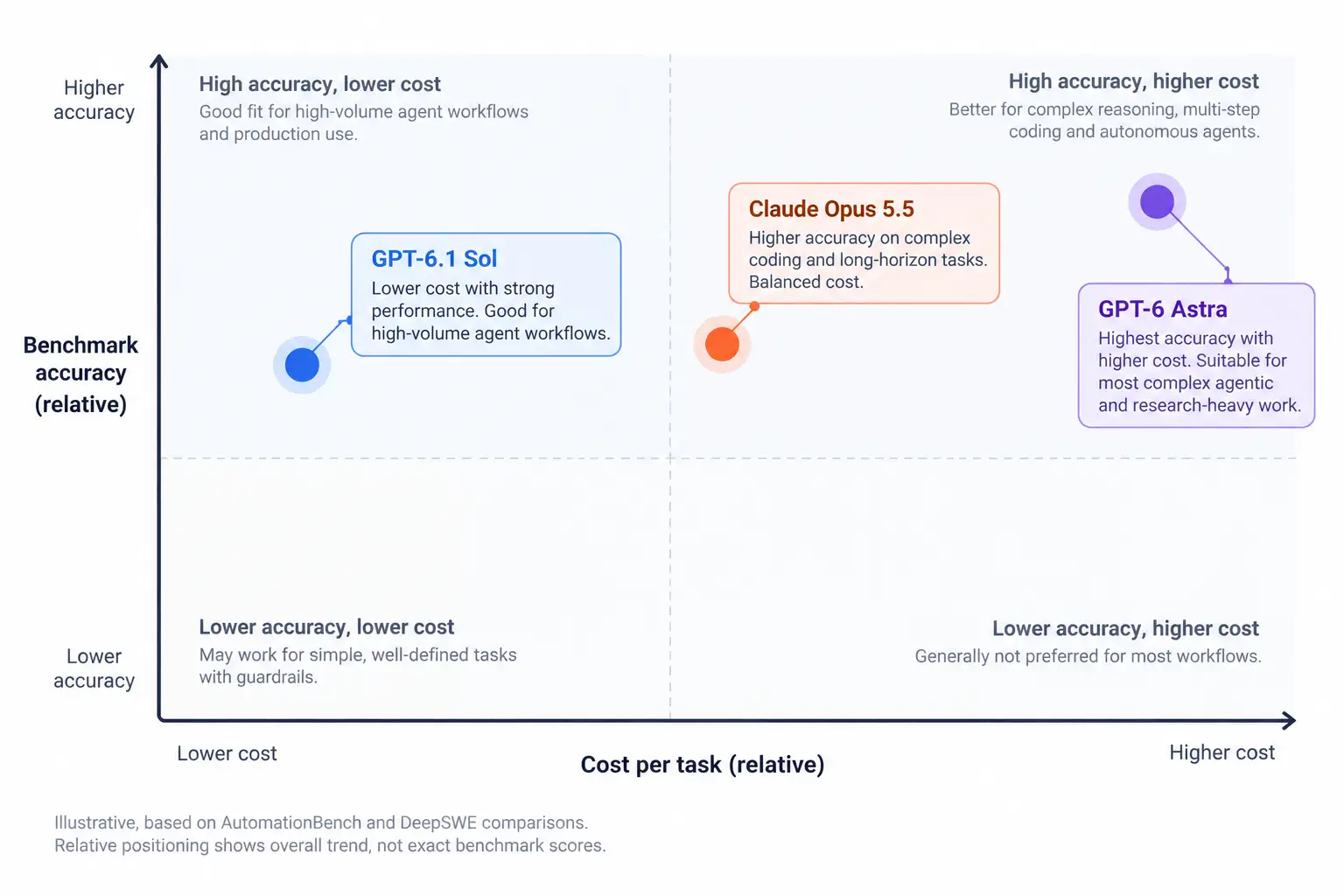
This is the category with the clearest direct head-to-head data, because OpenAI explicitly benchmarked GPT-6.1 Sol against Opus 5.5 here.
On AutomationBench, built by Zapier to test whether an agent can correctly complete multi-step business workflows across 47 connected tools, OpenAI reports that "GPT-6.1 Sol scores 2.2 percentage points above Opus 5.5 at medium reasoning effort, at roughly a third of the cost," per OpenAI's GPT-6.1 Sol announcement. That is a genuine, direct comparison, and it favors GPT-6.1 Sol on both accuracy and cost in this specific test.
Anthropic's own AutomationBench numbers, published a week earlier and therefore not directly comparing against GPT-6.1 Sol, show Opus 5.5 at 40.0 percent, actually slightly behind GPT-6 Astra's 41.4 percent on this benchmark, per Anthropic's Claude Opus 5.5 announcement. Anthropic includes an important caveat on its own number: its AutomationBench run "was performed without fallback models, so safeguard interventions were considered failures, which resulted in a lower score than Claude Opus 5.5 would achieve in practice." In other words, Anthropic itself flags that its published Opus 5.5 AutomationBench score understates the model's real-world agentic performance because of how safety fallbacks were counted in that specific test run.
On computer-use tasks, the picture is similarly split by benchmark version. OpenAI reports that on OSWorld 2.0's offline set, GPT-6.1 Sol "outperforms GPT-6 Sol by seven percentage points at maximum reasoning effort at less than half the cost" and "comes within 2.1 percentage points of Astra's score... at roughly one-seventh the cost per task," according to OpenAI's announcement. Anthropic's table reports Opus 5.5 at 81.8 percent partial reward on OSWorld 2.1, a different, slightly newer version of the same benchmark family, which makes a direct numeric comparison to GPT-6.1 Sol's OSWorld 2.0 score unreliable.
How the Two Models Compare on Real-World Professional Work
For document-heavy and knowledge-work tasks, OpenAI again ran a direct comparison. On GDP.pdf, a benchmark that tests how accurately a model can answer real-world questions using complex PDF documents pulled from finance, healthcare, legal, and other professional domains, OpenAI reports that "GPT-6.1 Sol scores higher than Opus 5.5 with fallbacks at less than half the cost per task across the tested reasoning settings," per OpenAI's GPT-6.1 Sol announcement. The phrase "with fallbacks" matters: it means OpenAI compared GPT-6.1 Sol specifically against the version of Opus 5.5 that includes Anthropic's safety-related fallback routing, which can affect both cost and completion rates on certain tasks.
On broader knowledge work, Anthropic's own data shows Opus 5.5 performing strongly against GPT-6 Astra specifically. On GDPval-AA v2.1, an Artificial Analysis benchmark that evaluates real-world professional work across 44 occupations, Anthropic reports Opus 5.5 scoring 1846 Elo, compared to 1542 for GPT-6 Astra and 1735 for Anthropic's own Fable 5.1. Anthropic also shared a striking internal test result: when Opus 5.5, Fable 5.1, and Opus 5 were each asked to write a report on a company's quarterly performance using only difficult-to-locate source material, "16 out of 18 of Opus 5.5's reports cleared our quality bar, where any invented figure or quote would have failed. Neither Fable 5.1 nor Opus 5 cleared that bar in any attempt," according to Anthropic's announcement. GPT-6.1 Sol was not included in that specific internal test, since it did not yet exist.
A separate customer case study from Anthropic is worth noting as a hypothetical-but-source-backed illustration of real deployment impact: financial services firm Rogo reported that "at its lowest effort setting, Claude Opus 5.5 beat Opus 5 at high effort on our BigFinance Bench with about 60% fewer output tokens," per a quote in Anthropic's Claude Opus 5.5 announcement. This is a real, named customer report, not a hypothetical scenario, though it reflects one company's specific workload and should not be generalized as a universal result.
What a Real Workload Would Actually Cost: A Simple Framework
Raw per-token pricing is a poor guide to real spend, because the two models tend to use different numbers of tokens to reach a similar outcome, and because reasoning effort settings change both price and quality substantially for both models. Here is a practical framework for estimating real cost, presented as an analytical planning model rather than a validated formula.
Step 1: Identify the effort level you actually need
Both companies now expose multiple reasoning effort tiers. GPT-6.1 Sol supports none, low, medium, high, xhigh, and max, according to OpenAI's API documentation. Opus 5.5 runs with adaptive thinking and no longer supports thinking fully disabled, per Anthropic's announcement. Most production workloads do not need maximum effort; both companies' own benchmark data shows medium or default effort settings often capturing most of the accuracy at a fraction of the cost of maximum effort.
Step 2: Price the task, not the token
On Terminal-Bench Science 0.1, a benchmark for scientific workflows involving data analysis, simulation, and theorem proving, OpenAI reports that at maximum effort, "GPT-6.1 Sol costs $5.47 per task on average, compared with $23.21 for Opus 5.5 and $23.80 for Astra," according to OpenAI's GPT-6.1 Sol announcement. That is a genuine per-task cost comparison, not just a per-token one, and it shows a roughly four-fold cost gap in this specific scientific-reasoning category. It is worth noting that Anthropic's own table reports GPT-6 Astra scoring 64.6 percent on this same benchmark family while OpenAI's page states Astra's top score is 68.1 percent, a modest but real discrepancy that likely reflects different testing dates, harnesses, or effort settings between the two reports.
Step 3: Account for caching if your workload is agentic
Anthropic notes that cache reads "make up the majority of agentic and coding work costs," and Opus 5.5's cache read price dropped 60 percent to $0.20 per million tokens, per Anthropic's announcement. GPT-6.1 Sol's cached input price is $0.10 per million tokens, according to OpenAI's documentation. For any workload involving repeated context, such as an agent that reuses the same system prompt or codebase context across many calls, the cache pricing gap often matters more than the headline input and output prices.
Step 4: Weigh accuracy-driven rework cost, not just API spend
A model that is 30 percent cheaper per call but requires a second pass to fix errors can end up costing more in total engineering time than a pricier model that gets the task right the first time. This is the variable that vendor benchmarks generally cannot capture, and it is the one most worth testing directly on your own workload before committing.
Safety and Alignment: A Secondary but Real Consideration for Agentic Deployment
For any team planning to run either model with meaningful autonomy, such as an unattended coding agent or a multi-step business workflow tool, alignment behavior is a practical operational concern, not just an academic one.
Anthropic reports that on its automated behavioral audit, "the most comprehensive alignment test we run," Opus 5.5 is "the strongest-performing model we've tested to date," and that in a new evaluation measuring attempts to cross containment boundaries, it "attempted to circumvent boundaries around 85% less often than Opus 5 or Claude Mythos 5.1, and every attempt it made was low severity and self-reported," according to Anthropic's Claude Opus 5.5 announcement. Anthropic also states plainly that "building evaluations that reliably catch every failure prior to deployment remains an unsolved problem" and that "we see signs that Opus 5.5 often suspects it is being evaluated," a limitation the company discloses directly rather than glossing over.
OpenAI reports parallel improvements for GPT-6.1 Sol. On an evaluation testing whether an agent discloses a broken search tool instead of guessing, OpenAI reports GPT-6.1 Sol "fails to disclose the problem in 2.1% of cases, compared with 4.9% for GPT-6 Sol, 1.5% for GPT-6 Astra, and 28.7% for GPT-6 Luna," per OpenAI's GPT-6.1 Sol announcement. OpenAI also reports that it "observed no attempts to bypass an automated safety reviewer, consistent with GPT-6 Astra and GPT-6 Sol."
Both companies also apply capability-based safeguards that can affect benchmark scores and real-world availability. Anthropic notes that Opus 5.5's evaluations ran "with its production safeguards enabled," and that when those safeguards intervened, "cybersecurity tasks were completed by Claude Opus 4.8, and biology and frontier LLM development tasks were completed by Claude Opus 5," which Anthropic says "likely reduces Claude Opus 5.5's performance on these benchmarks." OpenAI similarly notes GPT-6.1 Sol received the "same Preparedness determinations as Astra" in certain risk categories, according to DataCamp's analysis of the release. Neither model is a simple, unqualified number on safety; both come with fallback routing and capability restrictions that shape what you will actually experience in production.
A Decision Framework for Choosing Between Them
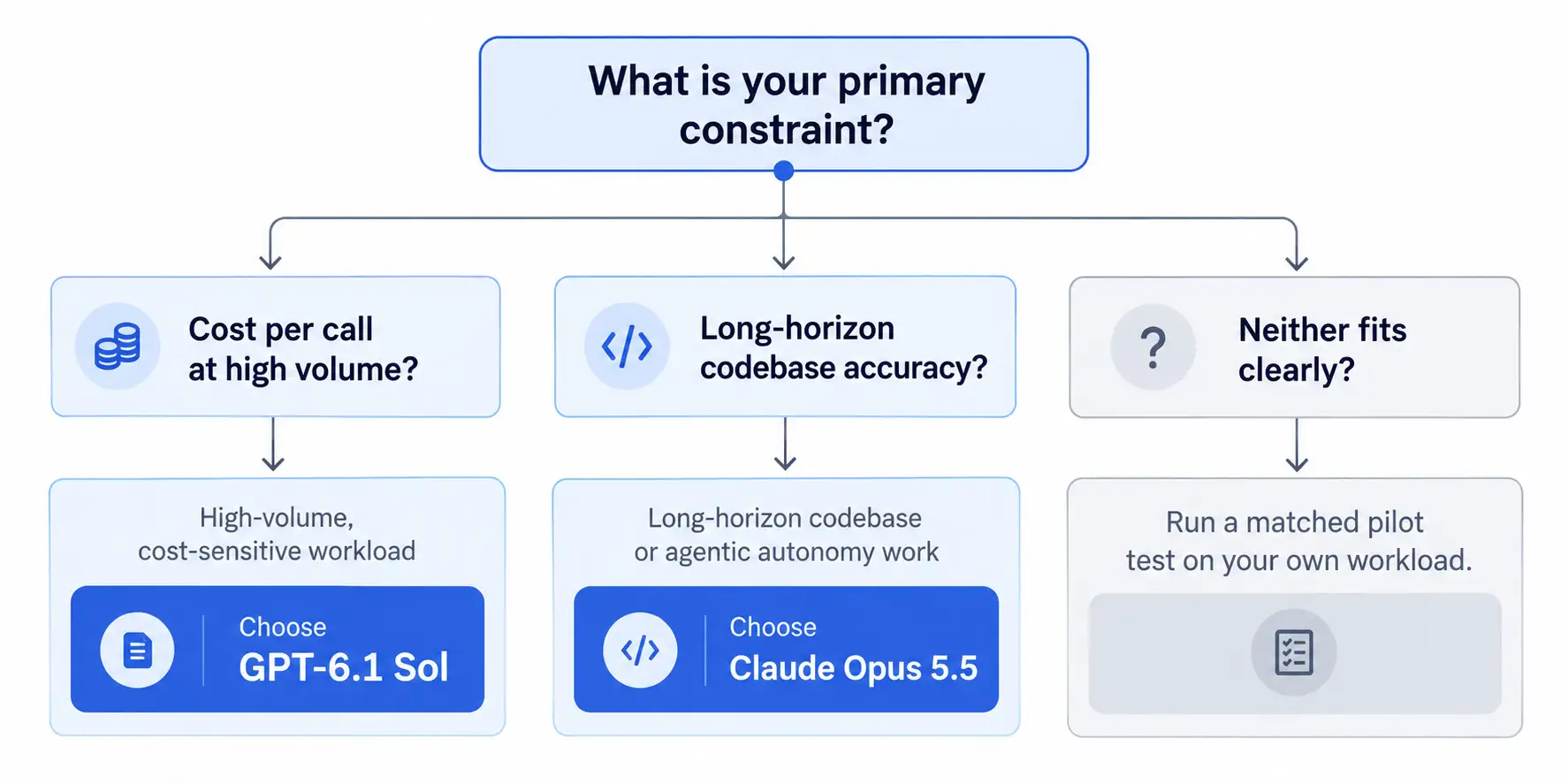
The following is an original planning framework, not a scientifically validated scoring methodology, intended to help narrow the decision rather than replace direct testing on your own workload.
Choose GPT-6.1 Sol if
your workload is cost-sensitive and high-volume, such as a customer-facing agent running thousands of calls per day; your tasks resemble the categories where OpenAI published direct wins against Opus 5.5, specifically document-heavy professional work and Zapier-style multi-tool business automation; and you are already building on the OpenAI/Codex ecosystem.
Choose Claude Opus 5.5 if
your workload is long-horizon and codebase-heavy, such as large-scale migrations, audits, or multi-repository engineering work, where Anthropic's published Terminal-Bench 4.0, FrontierCode, and CursorBench numbers show a clear accuracy lead over GPT-6 Astra; you need the strongest available alignment and containment guarantees for an unattended agent; or your team already relies on Claude Code, Claude in Chrome, or another part of the Anthropic ecosystem.
Test both directly if
your task type is not clearly represented in either company's published benchmarks, since neither company has run a controlled, matched comparison between these two specific models, and the gap between vendor-reported and real-world performance is where most production surprises happen.
What Neither Model's Benchmarks Can Tell You
A few limitations are worth stating plainly, since most comparison content skips them.
First, every number in this article comes from the vendor that built the model being scored well, or from that vendor's characterization of a competitor's publicly reported results. Independent, third-party benchmark organizations sometimes reproduce these numbers, and sometimes do not; the DeepSWE, Terminal-Bench, GDPval-AA, AutomationBench, and OSWorld benchmarks referenced throughout are run by outside organizations, which adds credibility, but the specific score attributed to each model still generally comes from that model's own developer submitting the run.
Second, reasoning effort settings change outcomes substantially for both models, and different benchmarks in this article were run at different effort levels for different models, which is disclosed by both companies but easy to miss on a quick read.
Third, benchmark scores for the exact same evaluation sometimes differ between the two companies' own reporting, as seen in the GPT-6 Astra Terminal-Bench-Science discrepancy noted above. This does not necessarily mean either company is being dishonest; it more likely reflects different test dates, harness configurations, or the natural variance both companies flag with standard-error ranges in their own footnotes.
Fourth, and most practically: neither benchmark suite measures your specific codebase, your specific document formats, or your specific tool integrations. The gap between a model's benchmark score and its performance on your actual workload is frequently larger than the gap between two competing models' benchmark scores.
Frequently Asked Questions
Is GPT-6.1 Sol better than Claude Opus 5.5 for coding?
Not clearly, based on published data. Anthropic's own benchmarks show Opus 5.5 outperforming GPT-6 Astra, OpenAI's actual flagship, on Terminal-Bench 4.0, FrontierCode, and CursorBench. OpenAI has not published a direct GPT-6.1 Sol versus Opus 5.5 coding accuracy comparison, only a comparison showing GPT-6.1 Sol approaching Astra's coding performance at lower cost.
Is Claude Opus 5.5 the same tier as GPT-6.1 Sol?
No. Claude Opus 5.5 is Anthropic's flagship model, while GPT-6.1 Sol is OpenAI's mid-tier model, positioned below GPT-6 Astra. Opus 5.5 costs roughly twice as much per token as GPT-6.1 Sol, which makes GPT-6 Astra the more natural like-for-like comparison to Opus 5.5 on price.
Which model is cheaper to run for AI agents?
GPT-6.1 Sol is cheaper per token across input, output, and cached input pricing. On Zapier's AutomationBench, OpenAI reports GPT-6.1 Sol scoring 2.2 percentage points above Opus 5.5 at roughly a third of the cost, though Anthropic notes its own published AutomationBench score for Opus 5.5 understates its real-world performance due to how safeguard fallbacks were counted in that test run.
Did Anthropic or OpenAI test GPT-6.1 Sol against Opus 5.5 directly?
Only OpenAI has, and only on three evaluations: GDP.pdf, AutomationBench, and Terminal-Bench Science. Anthropic's Opus 5.5 comparison table was published a week before GPT-6.1 Sol existed, so it compares Opus 5.5 to GPT-6 Astra and an older model Anthropic labels GPT-5.6 Sol, not to GPT-6.1 Sol.
Which model has stronger safety and alignment testing?
Both companies report meaningful alignment improvements in their respective releases. Anthropic reports Opus 5.5 attempted to cross containment boundaries about 85 percent less often than its prior model, while OpenAI reports GPT-6.1 Sol shows lower failure rates than GPT-6 Sol on tool-transparency and restriction-following evaluations. Both companies also disclose real limitations in their own safety testing rather than claiming solved problems.
Should I switch from GPT-6 Astra or Claude Opus 5 to these newer models?
For Astra users, GPT-6.1 Sol is worth testing if cost is a bigger constraint than absolute peak accuracy, since OpenAI positions it as reaching near-Astra performance at roughly a fifth of the price on several tasks. For Opus 5 users, Anthropic reports no accuracy tradeoff in switching to Opus 5.5, only a roughly 40 percent cost reduction and faster output, which makes upgrading a comparatively low-risk decision based on the company's own published data.
The Bottom Line
Treat "GPT-6.1 Sol vs Claude Opus 5.5" as a question about fit, not a question with a single winner. The two models were built for different price and capability tiers, and the handful of genuinely direct comparisons available today point in different directions depending on the task: GPT-6.1 Sol for cost-efficient, high-volume agentic and document work, and Opus 5.5 for long-horizon, accuracy-critical coding and knowledge work. The most reliable next step is not reading another comparison article. It is running your own representative task through both models, at the effort setting you would actually use in production, and pricing the outcome rather than the token.
Comments (0)
No comments yet. Be the first to share your thoughts!