How Much Water Does AI Actually Use? A Data-Backed Breakdown

Author
Ravi Prajapati
How much water does AI use? See real data for ChatGPT and Gemini prompts, AI training and data centers, plus what the numbers actually mean.
Every time you ask ChatGPT a question, generate an image, summarize a document, or use an AI assistant, computers inside a data center perform the work. Those computers consume electricity and generate heat. Keeping them running efficiently can require water.
So, how much water does AI use?
There is no single number that applies to every AI request.
For one useful reference point, OpenAI CEO Sam Altman stated in 2025 that an average ChatGPT query uses about 0.000085 gallons of water, approximately 0.32 milliliters. Google researchers separately measured the median Gemini Apps text prompt at approximately 0.26 milliliters, or roughly five drops of water.
Those numbers are far smaller than some earlier estimates circulating online. But they do not mean AI's overall water footprint is insignificant.
A single prompt and the infrastructure supporting hundreds of millions or billions of AI interactions are two very different questions.
This article separates them.
Quick Answer: How Much Water Does AI Use?
A typical text prompt can consume fractions of a milliliter of water according to recent first-party measurements, but there is no universal "water per AI prompt" number.
OpenAI CEO Sam Altman reported approximately 0.32 mL per average ChatGPT query, while Google's 2025 production measurement found approximately 0.26 mL for the median Gemini Apps text prompt.
Google's figure came from a methodology designed to account for the full AI serving stack, including accelerators, host systems, idle capacity and data-center overhead.
Earlier academic estimates have produced much larger numbers under different assumptions and system boundaries. For example, a widely cited 2023 study estimated that training GPT-3 in Microsoft's U.S. data centers could directly evaporate approximately 700,000 liters of freshwater.
The important distinction is that training a model, running one inference request, operating a data center and measuring electricity-related water consumption are not the same thing.
AI water use at a glance
Measurement | Reported/estimated water use | What it measures |
|---|---|---|
Average ChatGPT query | ~0.32 mL | Figure reported by Sam Altman |
Median Gemini Apps text prompt | ~0.26 mL | Production AI inference |
GPT-3 training | ~700,000 liters | Academic estimate of direct freshwater evaporation during training |
Google's 2024 operations | 4.5 billion gallons replenished | Corporate water stewardship, not AI-only consumption |
The numbers should not be directly compared as though they measure the same thing. They use different methodologies, workloads and boundaries.
Why Does AI Use Water in the First Place?
AI does not literally "drink" water.
Most of the water footprint comes from the physical infrastructure required to train and operate AI models.
There are two major paths.
1. Water used directly for data-center cooling
AI accelerators such as GPUs and TPUs perform enormous numbers of calculations. Electricity entering those chips ultimately produces heat.
That heat must be removed.
Some data centers use cooling systems in which water absorbs heat and part of it evaporates. Evaporative cooling can be highly effective, but evaporation means some water is consumed rather than immediately returned to the original source.
Other facilities use closed-loop liquid cooling, air cooling, reclaimed water or newer designs intended to reduce or eliminate freshwater consumption for cooling.
Microsoft, for example, says its newer data-center design can operate with zero water for cooling and avoid an estimated 125,000 cubic meters of water annually per facility compared with traditional designs.
Microsoft 2025 Environmental Sustainability Report
2. Water used indirectly to generate electricity
Cooling the data center is only part of the story.
AI consumes electricity, and electricity generation itself can have a water footprint. Some thermal and nuclear power plants use water for cooling, while the water intensity of electricity varies significantly depending on the generation mix.
That means an AI workload can have:
Direct water consumption: water used at the data center.
Indirect water consumption: water associated with producing the electricity that powers it.
This distinction explains why two identical AI workloads running in different regions can have different water footprints.
One AI Prompt Does Not Have a Universal Water Footprint
The question "How much water does one AI prompt use?" sounds like it should have a simple answer.
It does not.
Consider two prompts:
"Translate hello into Spanish."
and
"Analyze this 150-page report, compare its financial assumptions, search supporting documents and produce a detailed strategic analysis."
Both count as one prompt.
They clearly do not require the same amount of computation.
Water consumption can vary according to:
Variable | Why it changes water consumption |
|---|---|
Model | Different architectures require different amounts of computation |
Prompt length | More input tokens can increase processing |
Output length | Longer responses require more inference |
Reasoning depth | Reasoning models may perform substantially more computation |
Hardware | Newer accelerators can perform work more efficiently |
Data-center design | Cooling technologies have different water requirements |
Location | Temperature and humidity influence cooling |
Electricity source | Power generation has its own water intensity |
Utilization | Underused hardware still consumes infrastructure resources |
Time of operation | Grid mix and environmental conditions can change |
This is why statements such as "every AI prompt uses X bottles of water" should be treated cautiously unless the model, workload, location, methodology and system boundary are clearly specified.
ChatGPT Water Usage: What Does OpenAI Actually Say?
In June 2025, Sam Altman published one of the clearest first-party figures for ChatGPT.
He wrote that the average ChatGPT query consumes approximately 0.000085 gallons of water, which converts to roughly 0.32 milliliters.
Sam Altman's original statement
For perspective, one teaspoon contains roughly 5 milliliters.
At 0.32 mL per query, about 15 to 16 average queries would correspond to approximately one teaspoon of water.
But there is an important limitation.
Altman's post provides the figure but does not publish a detailed accompanying methodology showing precisely which models, infrastructure components, geographic regions or water accounting boundaries went into that average.
It is therefore useful as a first-party operational estimate, but not as a universal scientific conversion factor for every ChatGPT interaction.
Google Measured Gemini at About Five Drops Per Text Prompt
Google provided a more detailed production measurement in 2025.
Researchers examined the environmental impact of serving Gemini at Google scale and estimated that a median Gemini Apps text prompt consumed 0.24 Wh of electricity and 0.26 mL of water.
That is approximately five drops of water.
Google technical paper on AI serving impact
Importantly, the methodology went beyond measuring the power consumed by the AI accelerator while generating an answer.
It included:
active AI accelerator power
host-system energy
idle machine capacity
data-center energy overhead
Google also reported that the energy required for its median Gemini Apps text prompt fell by a factor of 33 over 12 months, while its carbon footprint fell by a factor of 44.
Google's explanation of its AI energy-efficiency research
This illustrates an important part of the AI water debate: per-request footprints are not fixed.
Hardware, models, serving software and cooling systems continue to change.
Why Have You Heard That ChatGPT Uses a Bottle of Water?
One of the most frequently repeated statistics about generative AI came from the 2023 paper “Making AI Less Thirsty: Uncovering and Addressing the Secret Water Footprint of AI Models.”
Researchers Pengfei Li, Jianyi Yang, Mohammad A. Islam and Shaolei Ren developed a methodology for estimating AI's water footprint.
Among their findings, they estimated that training GPT-3 in Microsoft's U.S. data centers could directly evaporate approximately 700,000 liters of freshwater.
The researchers also estimated, under the assumptions in their analysis, that GPT-3 could consume roughly a 500 mL bottle of water for around 10 to 50 medium-length responses, depending on where and when the model ran.
Original “Making AI Less Thirsty” paper
That estimate became extremely shareable.
But it should not be transformed into:
"ChatGPT currently consumes one bottle of water every X prompts."
The study was an analytical estimate using specific assumptions and infrastructure conditions available at the time. Today's production systems, hardware, models and cooling technologies have changed.
More recent first-party measurements from OpenAI and Google report much lower per-query or per-prompt figures.
That does not make the earlier research useless. It shows why date, methodology and measurement boundary matter.
Training AI and Using AI Are Different Water Problems
Another source of confusion is mixing training with inference.
Training
Training creates or updates an AI model.
Large numbers of accelerators can run continuously for days, weeks or months while processing massive datasets and adjusting model parameters.
Training frontier models can therefore require substantial electricity and cooling infrastructure.
Inference
Inference happens after training.
When you ask ChatGPT, Gemini or another AI application a question, the trained model performs computation to generate its response.
A single inference request is much smaller than a major training run.
But inference occurs repeatedly.
Millions of people can generate prompts throughout the day, while businesses increasingly embed models inside search systems, software products, coding tools, agents and automated workflows.
This creates an important equation:
small per-request footprint × enormous request volume = potentially meaningful infrastructure demand
The environmental question is therefore shifting from simply "How resource-intensive is training?" toward "How efficiently can AI be served at global scale?"
The AI Water Footprint Has Four Layers
Looking only at "water per prompt" misses much of the system.
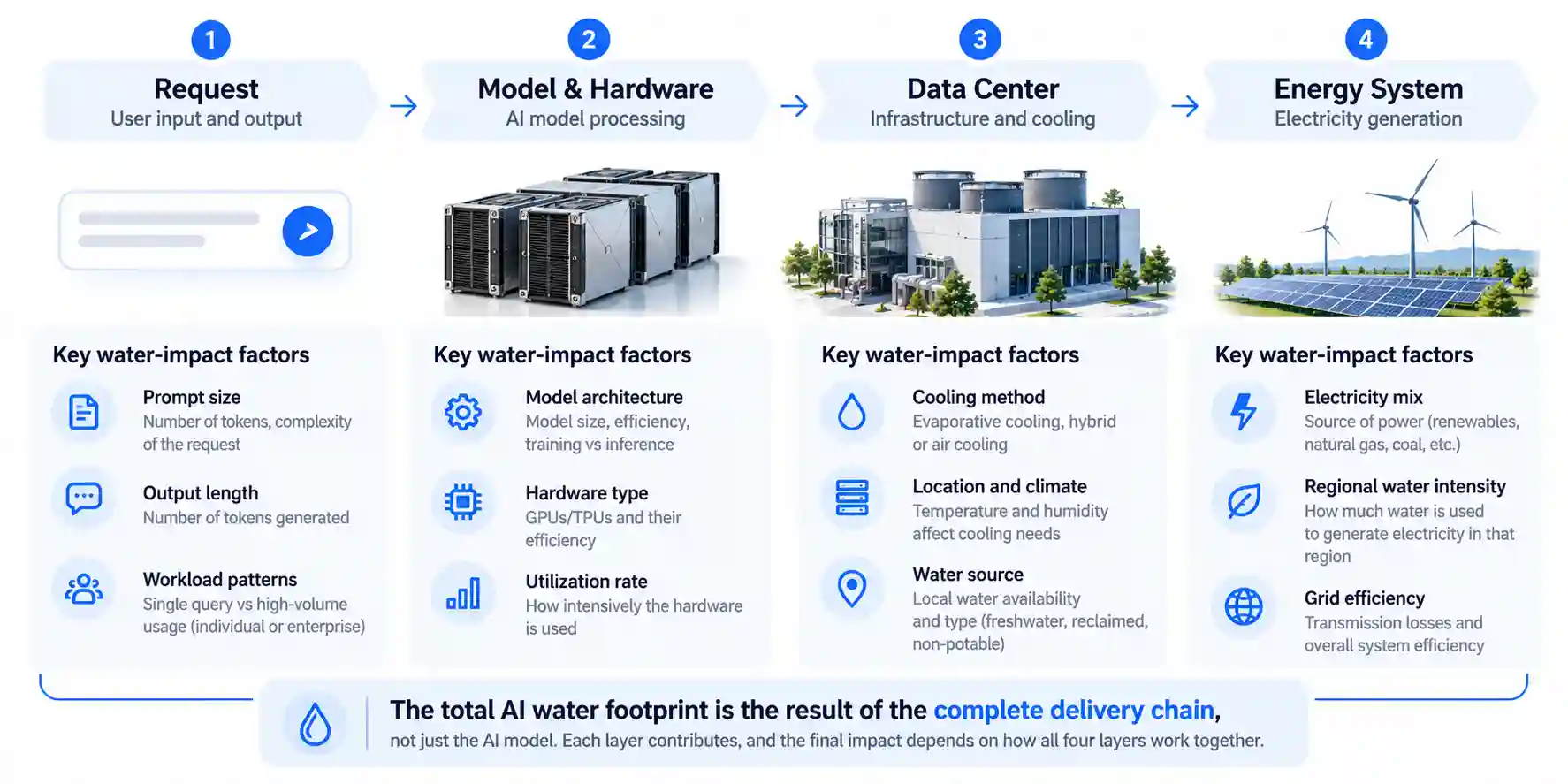
A more useful way to evaluate AI water consumption is what we can call the Four-Layer AI Water Footprint Model.
This is an analytical framework for understanding AI infrastructure, not a standardized scientific methodology.
Layer 1: Request
What computation did the user actually request?
A short classification task, long document analysis, image generation and complex reasoning request have different computational requirements.
Layer 2: Model and hardware
Which model processes the request, and on what hardware?
Model architecture, quantization, batching, accelerators and serving efficiency affect electricity consumption.
Layer 3: Data center
How does the facility remove heat?
Climate, cooling technology, water source and facility efficiency determine direct operational water consumption.
Layer 4: Energy system
Where does the electricity come from?
The water footprint associated with electricity depends on the regional energy mix.
So instead of asking only:
How much water does this prompt use?
a more technically meaningful question is:
What is the total water footprint of delivering this workload through this model, hardware, data center and energy system?
Why Data-Center Location Matters More Than Most Prompt Comparisons Suggest
A liter of water consumed in one place does not necessarily have the same environmental significance as a liter consumed somewhere else.
Water is fundamentally local.
A data center operating in a water-abundant region can face a very different environmental context from one operating in a drought-prone or water-stressed watershed.
Temperature also matters.
Cooling systems may consume different amounts of water depending on outdoor temperature and humidity.
The electricity mix introduces another geographic variable.
This means that two identical AI models processing identical prompts can potentially have different environmental footprints simply because they operate in different locations.
This is one reason global "water per prompt" averages have limited value when evaluating local environmental effects.
AI's Scale Is More Important Than Whether One Prompt Uses Five Drops
The recent ChatGPT and Gemini figures suggest that an individual text request can have a very small water footprint.
But AI infrastructure should not be evaluated only at the individual level.
Google disclosed at I/O 2025 that the company had gone from processing 9.7 trillion tokens per month to more than 480 trillion tokens per month across its products and APIs in one year, a roughly 50-fold increase.
Google I/O 2025 infrastructure and usage disclosure
The statistic is not a measure of water consumption.
It illustrates the scale problem.
Efficiency per AI interaction can improve dramatically while aggregate infrastructure demand continues to increase because AI usage grows even faster.
This is sometimes described as a rebound effect: making something cheaper and more efficient can encourage much more of it to be used.
For AI, both trends can occur simultaneously:
AI becomes dramatically more efficient per task.
Total AI computation continues growing.
Any serious discussion of AI's environmental footprint needs to account for both.
How Much Water Do AI Data Centers Use?
There is no reliable public figure representing the water consumed specifically by all AI data centers worldwide.
AI workloads frequently share cloud infrastructure with search, storage, video, enterprise applications and other computing services. Corporate environmental disclosures also tend to report company-wide or data-center-wide consumption rather than isolating every AI workload.
The broader data-center sector, however, is expanding quickly.
The U.S. Department of Energy's Lawrence Berkeley National Laboratory published a major data-center energy analysis in 2024 examining historical electricity consumption and projecting future demand through 2028.
Lawrence Berkeley National Laboratory 2024 U.S. Data Center Energy Usage Report
Water demand follows a more complicated path than electricity because facilities use different cooling systems and electricity sources.
This is why estimates of "AI's global water use" should be treated differently from measured operational disclosures.
Are Technology Companies Reducing AI's Water Use?
Yes, significant engineering work is going into reducing water requirements, although rapidly expanding AI infrastructure makes the overall picture more complicated.
Microsoft is moving toward zero-water cooling
Microsoft says a newer data-center design introduced for AI workloads uses chip-level cooling in a closed loop and consumes zero water for cooling, avoiding an estimated 125 million liters per facility annually.
The company's 2025 sustainability reporting also describes direct-to-chip cooling and water reuse initiatives.
Microsoft Environmental Sustainability Report
Microsoft's 2026 reporting says it continues to improve data-center water-use efficiency and reported a 23% year-over-year reduction in Water Usage Effectiveness at its Phoenix data centers in FY25, with similar improvements being deployed elsewhere.
Microsoft 2026 Environmental Sustainability Report
Google is making AI inference substantially more efficient
Google reported that energy consumption for its median Gemini Apps text prompt decreased 33x over 12 months.
Its 2025 environmental reporting also stated that Google replenished 4.5 billion gallons of water in 2024, equivalent to 64% of its freshwater consumption that year.
Google 2025 Environmental Report
Google now reports that its water-stewardship projects replenished approximately 7.7 billion gallons in 2025, equivalent to roughly 78% of total freshwater consumption.
Google water stewardship and operations data
These replenishment figures should not be confused with eliminating water consumption. Replenishment programs and operational water efficiency address different parts of water stewardship.
Can AI Eventually Use Almost No Water for Cooling?
For some data centers, direct freshwater consumption for cooling can potentially approach zero.
Microsoft's closed-loop cooling design demonstrates that water does not necessarily have to be continually evaporated to remove server heat.
OpenAI has also said its Stargate Michigan campus will use a closed-loop cooling system designed to significantly reduce water consumption.
OpenAI Stargate Michigan infrastructure announcement
But "zero water for cooling" does not mean "zero water footprint."
Electricity generation can still consume water. Manufacturing chips and constructing infrastructure also have environmental footprints.
The correct boundary therefore matters.
A facility can eliminate direct operational cooling-water consumption without eliminating every water impact associated with the computing service it provides.
The Better Metric Is Not Simply Water Per Prompt
Water per prompt is easy to understand, which makes it attractive for headlines.
But it can also be misleading.
Imagine that Model A consumes less water per request than Model B.
That does not automatically make Model A environmentally preferable.
Perhaps Model A requires several requests to accomplish something Model B handles in one. Perhaps one runs in a water-stressed region while the other uses recycled water in a cooler climate. Perhaps one model produces much longer outputs.
A more meaningful sustainability metric would consider something closer to:
Water consumed per useful unit of AI work
That could eventually mean measurements such as:
water per million tokens
water per completed task
water per successful coding task
water per document processed
water per image generated
water per agent workflow
water per benchmark-quality unit
No single metric works for every AI workload.
But workload-normalized measurements would make comparisons more meaningful than simply counting prompts.
What Current AI Water Numbers Cannot Tell Us
Today's evidence has several limitations.
Proprietary infrastructure remains difficult to inspect
AI companies disclose more environmental information than they did several years ago, but independent researchers still cannot observe every model, GPU cluster, cooling system or inference workload.
Models change quickly
A measurement made today may age quickly.
Google's reported 33-fold improvement in median Gemini prompt energy consumption over just 12 months demonstrates how rapidly inference efficiency can change.
"Prompt" is an inconsistent unit
A five-word request and an agent processing 100,000 tokens are both technically prompts or requests.
Water accounting boundaries differ
Some studies count direct cooling water.
Others include water associated with electricity.
Others evaluate withdrawal rather than consumption.
Those metrics are related but not interchangeable.
Corporate data often combines AI with other services
A hyperscale data center might simultaneously serve AI, search, cloud computing, storage and enterprise software.
Separating AI-specific resource consumption is difficult.
These limitations are not reasons to ignore the available numbers.
They are reasons to report them precisely.
So, Is AI Using Too Much Water?
There is no scientifically useful yes-or-no answer based only on the amount used by one prompt.
At the individual text-query level, recent first-party measurements suggest water consumption can be well below one milliliter.
At infrastructure scale, however, AI is contributing to rapid data-center expansion, making water availability, cooling efficiency and electricity sourcing increasingly important.
The better questions are:
How quickly is total AI water demand growing?
Where is that water being consumed?
Is freshwater being used in water-stressed regions?
How much can closed-loop cooling and reclaimed water reduce demand?
Are efficiency improvements keeping pace with AI adoption?
And are companies reporting enough information to answer these questions independently?
Those questions reveal far more than comparing a ChatGPT prompt with a bottle of water.
Practical Checklist: How to Evaluate an AI Water-Use Claim
When you see a claim about AI consuming a particular amount of water, check six things:
What is being measured? Training, inference, a data center or an entire company?
Is it measured or estimated? Operational measurements and modeled estimates are not equivalent.
What does "water use" mean? Withdrawal, consumption, evaporation or replenishment?
What infrastructure is included? Only GPUs, the entire data center or electricity generation too?
When was it measured? AI efficiency is changing rapidly.
Where did the workload run? Climate, cooling technology and electricity mix matter.
If a claim cannot answer most of these questions, treat a precise-looking number with caution.
FAQs About AI Water Consumption
How much water does one AI prompt use?
Recent first-party estimates put some common text prompts below one milliliter. Sam Altman reported approximately 0.32 mL for an average ChatGPT query, while Google measured approximately 0.26 mL for the median Gemini Apps text prompt. These are not universal values. Water consumption changes with the model, workload, hardware, cooling system, location and measurement methodology.
How much water does ChatGPT use per question?
Sam Altman stated in 2025 that the average ChatGPT query uses approximately 0.000085 gallons, or 0.32 milliliters, of water. OpenAI has not provided a detailed public methodology alongside that figure, so it should be treated as a first-party average rather than a fixed value applicable to every ChatGPT request.
Does every ChatGPT prompt use a bottle of water?
No. The frequently repeated bottle comparison originated from academic modeling under particular assumptions rather than a measurement showing that each ChatGPT prompt consumes a bottle of water. More recent first-party figures from OpenAI and Google put common text queries at fractions of a milliliter.
Why does AI need water?
AI hardware generates heat while performing computation. Some data centers use water-based cooling systems to remove that heat. AI also consumes electricity, and producing electricity can itself require water. The total water footprint can therefore include both direct data-center cooling and indirect water consumption associated with electricity.
Does AI use more water than Google Search?
There is not enough standardized public data to make a universal comparison. AI queries can require more computation than traditional search, but workload complexity varies substantially and search itself increasingly incorporates AI. A reliable comparison would require equivalent system boundaries, infrastructure and workload measurements.
Does training AI use more water than asking it questions?
A single major training run consumes vastly more computing resources than one inference request. However, inference happens continuously at global scale. As AI adoption grows, the cumulative footprint of serving models can become significant even though each individual request consumes relatively little water.
Can data centers operate without water?
Some new data-center cooling systems can operate without continually consuming water for cooling. Microsoft has announced closed-loop designs that consume zero water for cooling. However, this does not necessarily create a zero-water computing service because electricity generation, semiconductor manufacturing and other infrastructure can still have water footprints.
Will AI water consumption increase?
Total demand could increase as AI adoption and data-center capacity expand, even while water consumption per task decreases. The outcome depends on the rate of AI adoption, hardware efficiency, model efficiency, cooling technology, data-center locations, electricity sources and water-reuse systems.
Conclusion
So, how much water does AI actually use?
For an individual text prompt, the best recent first-party figures suggest the answer can be surprisingly small: approximately 0.26 mL for a median Gemini Apps text prompt and about 0.32 mL for an average ChatGPT query, according to Google and Sam Altman respectively.
But those numbers do not settle the environmental question.
AI's water footprint exists across a system: the request, the model and hardware, the data center and the electricity supplying it. Training frontier models can consume substantial resources, and billions of small interactions can accumulate into significant infrastructure demand.
The most useful question is therefore no longer simply "How many drops of water does my prompt use?"
It is:
How efficiently can we deliver useful AI computation at enormous scale, and where does the water required to support that infrastructure come from?
That is the number worth watching as AI grows.
Comments (0)
No comments yet. Be the first to share your thoughts!