Where Should Human Approval Sit in an Agentic Workflow? A Practical Decision Guide

Author
Ravi Prajapati
Learn where human approval should sit in agentic workflows, how to assess AI agent risks, and how to design secure, practical human-in-the-loop controls.
Human approval in an agentic workflow should sit at the point where an AI agent is about to perform an action that could create meaningful risk, cost, business impact, or an irreversible change. It should not automatically be placed after every AI step, nor should it be limited to reviewing the agent's final answer.
The right approval point depends on what the agent can do, what the action changes, how reversible it is, and who is accountable for the outcome.
For example, an AI agent that summarizes invoices may operate without approval. An agent that changes an invoice's payment details or releases a payment should have stronger controls. An agent that prepares a production database migration may work autonomously in a test environment, but require explicit authorization before changing production.
The goal of human-in-the-loop AI agents is not to make people supervise every decision. It is to preserve human control over decisions that matter while allowing low-risk work to proceed efficiently.
This guide explains where approval belongs, how to determine when it is required, and how engineering teams can design approval workflows that are practical, auditable, and scalable.
What Is Human-in-the-Loop AI?
Human-in-the-loop (HITL) AI is an approach in which a person participates in an AI system's decision-making or execution process. Depending on the workflow, the person may provide input, review a recommendation, approve an action, reject a proposed operation, or intervene when the system encounters an exception.
In an agentic workflow, HITL commonly means that an AI agent pauses before a specific tool call or consequential action until a human or authorized policy process makes a decision.
The OpenAI Agents SDK documentation on human-in-the-loop approvals describes a technical pattern in which tool execution can be paused, an approval interruption can be surfaced, and the workflow can resume after approval or rejection.
Human-in-the-loop is different from simply asking a person to review an AI-generated response at the end. The approval may occur in the middle of the workflow, precisely where the agent's proposed action crosses a risk boundary.
Human-in-the-loop vs. human-on-the-loop vs. human-out-of-the-loop
These terms describe different levels of human involvement. They are useful operating concepts, not universal technical standards with one fixed definition.
Operating model | Human role | AI agent's autonomy | Suitable examples |
|---|---|---|---|
Human-in-the-loop | Approves or contributes to a decision before a consequential action | Limited at critical steps | Payments, account cancellations, production changes |
Human-on-the-loop | Monitors the system and intervenes when needed | Higher, with supervision | Routine ticket routing, monitored data processing |
Human-out-of-the-loop | Does not participate in individual actions | High within defined boundaries | Low-risk classification, repetitive internal processing |
The choice should not be made based on how advanced the agent appears. It should be based on the consequences of its actions.
An agent can be highly capable at analyzing information and still require approval before making a legally, financially, or operationally significant change.
Where Should Human Approval Sit in an Agentic Workflow?
Human approval can be placed at several points in an agentic workflow. The most appropriate location depends on the kind of risk the business is trying to control.
1. Before the workflow starts
Approval at the beginning is useful when the task itself requires authorization.
For example, an AI agent may be asked to:
Access a confidential customer dataset.
Initiate a sensitive investigation.
Create a new vendor.
Begin a production deployment.
Process a high-value financial request.
A human authorizes the task, its scope, and the resources the agent may use.
This approval answers the question: Is the agent allowed to begin this work?
However, initial approval does not automatically authorize every action the agent may decide to take later. The workflow could encounter new risks as it progresses.
2. Before a sensitive tool call
This is often the most useful approval location for agentic systems.
An AI agent may perform several low-risk steps before reaching a sensitive action. The approval checkpoint sits directly before the tool that creates the consequential change.
Examples include:
Before sending a customer refund.
Before deleting a file.
Before changing a user's access permissions.
Before updating a supplier's bank details.
Before executing a production command.
Before submitting a legally significant document.
The agent can prepare the action, collect relevant information, and explain its recommendation. The system then pauses before execution.
This approach preserves autonomy for routine work while keeping consequential operations under control.
OpenAI's guardrails and human review guide specifically describes human review as a way to pause tool calls before side effects such as cancellations, edits, shell commands, or sensitive MCP actions.
3. Before the final output is released
Some workflows produce outputs that may be technically correct but still require human review before they are shared or published.
Examples include:
A medical report prepared for a clinician.
A legal document prepared for a lawyer.
A customer-facing response involving a disputed claim.
A financial report submitted to a regulator.
A public announcement drafted by an AI agent.
The agent can complete its research and preparation autonomously, but a person approves the final release.
This checkpoint is useful when the output itself creates risk, even if no external tool action is involved.
4. At an exception or uncertainty branch
Approval does not always need to be triggered by a predefined action. It can also be triggered when the agent encounters an unexpected situation.
Examples:
Conflicting information across systems.
Missing required data.
An amount outside the approved policy.
A request that falls outside the agent's permitted scope.
An unexpected tool result.
A low-confidence recommendation in a high-impact decision.
The agent should pause, explain what it encountered, and request human input.
This is particularly useful in workflows where the agent cannot anticipate every possible condition.
5. During execution when the scope changes
An agent may begin with an authorized task and later determine that it needs additional permissions or access.
For example, an agent approved to inspect a staging environment may attempt to access production data to complete its work.
The original authorization should not automatically extend to the new scope.
A further approval checkpoint should be required when the agent changes the target environment, permission level, data access, or operational scope.
The key principle is simple: approval should follow the risk boundary, not merely the workflow sequence.
A Risk-Based Decision Matrix for Human Approval
A practical approval design begins with the consequences of an action. The following matrix is a recommended operating model, not a formal regulatory classification.
Risk level | Typical action | Suggested control | Human approval |
|---|---|---|---|
Low | Summarize a document, classify a ticket, extract data | Automated validation and monitoring | Usually not required |
Moderate | Draft a response, update a non-critical record, prepare a report | Policy checks, audit trail, possible review sampling | Depends on business policy |
High | Send a refund, modify sensitive data, change access permissions | Mandatory approval before execution | Required |
Critical | Execute a destructive production operation, make a high-impact decision, perform an irreversible action | Strict authorization, independent safeguards, limited scope | Explicit approval, possibly multiple reviewers |
A useful starting point is to evaluate each action using five questions:
Impact: What happens if the action is wrong?
Reversibility: Can the action be safely undone?
Scope: Does the action affect one record or an entire system?
Authority: Is the agent permitted to make this decision?
Evidence: Can the reviewer understand why the agent proposed the action?
The answers help determine whether the action should be autonomous, reviewed, restricted, or blocked.
A simple approval rule
A practical policy can be expressed as:
If an action is low-risk, within the agent's authority, and reversible, allow it with monitoring.
If an action has meaningful business impact or uncertainty, route it for review.
If an action is outside the agent's authority or prohibited by policy, block it.
If an action is high-impact and irreversible, require explicit approval before execution.
This distinction matters because human approval is not a substitute for policy enforcement.
A reviewer should not be asked to approve an action that the system should have prohibited in the first place.
Who Should Approve an AI Agent's Action?
The reviewer should be the person who has the authority and knowledge to evaluate the proposed action.
An approval workflow should not simply send every request to a generic administrator.
Action | Appropriate reviewer |
|---|---|
Customer refund outside normal limits | Finance or customer operations manager |
Supplier bank account change | Authorized finance or vendor management reviewer |
Production database modification | Engineering lead or designated release owner |
Sensitive customer communication | Customer service manager or accountable business owner |
Access permission change | System owner or security-authorized reviewer |
Medical recommendation or clinical document release | Qualified healthcare professional |
Legal document release | Authorized legal professional |
In larger organizations, the approver may be determined by role-based access control (RBAC), an approval policy, or a workflow management system.
The agent should not be allowed to select its own approver without constraints. Otherwise, the system could route a risky action to someone who lacks the authority to approve it.
What should an approval request contain?
An approval interface should provide enough information for a person to make a meaningful decision.
A useful approval request contains:
Requested action: What the agent wants to do.
Business context: Why the action is necessary.
Target: Which customer, record, system, or resource will be affected.
Parameters: The actual values or command being proposed.
Risk explanation: What could go wrong.
Supporting evidence: Relevant source data or tool results.
Policy reference: The rule that requires approval.
Available decisions: Approve, reject, request changes, or escalate.
Audit information: Agent identity, workflow ID, timestamp, and action identifier.
The reviewer should be able to inspect the proposed operation itself, not only a natural-language summary produced by the agent.
For example, a request to “update the vendor information” is too vague. The interface should show the existing details, proposed new details, and the exact system operation.
Example: Where Approval Should Sit in an AI Accounts Payable Workflow
Consider a hypothetical AI accounts payable agent that processes supplier invoices.
The agent can extract invoice details, match purchase orders, check for duplicates, identify exceptions, and prepare payment instructions.
The approval design should distinguish between analysis and execution.
Workflow step | Agent activity | Approval decision |
|---|---|---|
1. Invoice received | Extracts supplier, invoice number, amount, and due date | Usually no approval |
2. Purchase order matching | Compares invoice with purchase order and receipt | Usually no approval |
3. Duplicate detection | Checks for repeated invoice identifiers or amounts | No approval for detection |
4. Exception identification | Flags mismatches, missing data, or suspicious changes | Review if the exception is consequential |
5. Payment preparation | Creates a proposed payment instruction | Approval depends on payment policy |
6. Payment release | Initiates payment through a financial system | Explicit approval according to policy |
7. Audit recording | Stores action, decision, and execution outcome | No separate approval, but logging is required |
Illustrative scenario
Suppose the agent finds an invoice that matches a purchase order but detects that the supplier's bank account differs from the vendor record.
The agent should not automatically update the bank account and release payment.
A better sequence is:
The agent identifies the discrepancy.
It gathers the invoice, purchase order, and existing vendor details.
It creates an exception.
The system routes the proposed bank detail change to an authorized reviewer.
The reviewer checks the supporting information and approves or rejects the change.
The system records the decision.
Payment can proceed only if the required checks and approvals are satisfied.
This example is hypothetical. It illustrates how an approval boundary can be placed before a consequential action.
The value is not simply that a person checks the agent. The value is that the workflow prevents the agent from crossing an authorization boundary without the required decision.
Should Every AI Agent Tool Call Require Human Approval?
No. Requiring approval for every tool call can make an agentic workflow slow, expensive, and difficult to use.
An agent may need to search internal documentation, read records, calculate values, or retrieve data from several systems before it can produce a useful result.
These steps do not necessarily require human intervention.
The more effective approach is to distinguish between tool calls that observe information and tool calls that create side effects.
Tool call category | Example | Typical control |
|---|---|---|
Read-only | Search a knowledge base, retrieve a record | Access control, monitoring |
Analytical | Calculate totals, compare documents | Automated validation |
Reversible write | Update a draft, create a temporary record | Policy checks, possible approval |
External communication | Send an email or customer notification | Approval based on recipient and content risk |
Financial action | Release payment, issue refund | Authorization and explicit approval |
Destructive action | Delete data, terminate a resource | Strong approval or prohibition |
Privilege-changing action | Grant admin access, alter permissions | Explicit approval and identity controls |
This classification is a useful starting point, but it is not universal. A read-only tool can still expose sensitive information, and a seemingly reversible update can have downstream consequences.
The system should evaluate the actual effect of the operation, not only the tool's name.
How to Design the Human Approval Architecture
A robust approval workflow should separate the AI agent from the authority to execute consequential actions.
The agent can recommend and prepare an operation. A policy engine determines whether it is permitted. An approval service collects the necessary decision. The execution layer enforces the final authorization.
Recommended architecture components
Component | Responsibility |
|---|---|
Agent orchestrator | Manages the workflow, agent steps, and state |
AI agent | Interprets the task, plans actions, and proposes tool calls |
Policy engine | Evaluates permissions, risk rules, and approval requirements |
Approval service | Creates requests, routes them, and records decisions |
Reviewer interface | Displays action details and enables authorized decisions |
Tool execution layer | Executes permitted actions against connected systems |
Audit and monitoring layer | Records decisions, actions, outcomes, and exceptions |
Why the policy engine should be separate
The AI agent should not be the only component deciding whether its proposed action is safe or authorized.
For example, an agent might decide that a payment is appropriate based on the invoice details. A policy engine can independently check whether:
The supplier is approved.
The payment amount is within the agent's permitted limit.
The required invoice match exists.
The reviewer has the correct role.
The action is permitted under the workflow's rules.
The agent's reasoning and the authorization decision are different responsibilities.
The policy engine should be able to deny an action even when the agent strongly recommends it.
Approval lifecycle
A typical approval lifecycle looks like this:
The agent proposes a tool call.
The system evaluates the proposed action against policy.
If approval is required, the action is paused.
The approval service creates a review request.
An authorized person approves, rejects, or requests changes.
The system validates that the decision is still applicable.
The permitted action is executed.
The result and approval decision are logged.
The agent resumes the workflow with the execution result.
The OpenAI Agents SDK approval documentation describes an interruption and resumable-state approach for this kind of approval lifecycle.
Important implementation detail: An approval should be tied to the specific proposed action. If the agent changes the amount, recipient, target system, or operation after approval, the prior approval should not automatically authorize the modified action.
The system should re-evaluate the changed operation.
What Happens When a Human Reviewer Is Unavailable?
An approval workflow needs a defined behavior when no reviewer responds.
The system should not silently execute a high-risk action after a timeout.
Possible policies include:
Keep the action pending.
Notify a backup reviewer.
Escalate to a designated manager.
Cancel the proposed action.
Resume only after an explicit authorized decision.
The appropriate behavior depends on the business context. A delayed report may be acceptable. A time-sensitive operational task may require a fallback reviewer.
For high-impact actions, a fail-closed approach is generally safer: if the required approval cannot be obtained, the action does not proceed.
The system should also avoid treating silence, a missing response, or a reviewer interface failure as approval.
Avoid approval fatigue
Approval fatigue occurs when people receive too many requests that require little judgment.
If a person is repeatedly asked to approve routine, low-risk actions, they may begin approving requests without examining them.
To reduce approval fatigue:
Do not route low-risk read operations for review.
Combine related requests when it is safe to do so.
Present the exact action and relevant evidence.
Use policy rules to handle routine cases.
Escalate only meaningful exceptions.
Measure how often reviewers reject, modify, or approve requests without changes.
The objective is to make human review selective and meaningful.
How Human Approval Relates to AI Governance and Regulation
Human approval is an important part of AI governance, but it does not by itself make an AI system compliant.
Organizations also need to consider data access, system security, risk management, documentation, monitoring, accountability, and the intended use of the system.
EU AI Act: Human oversight for high-risk AI systems
Article 14 of the EU AI Act addresses human oversight for high-risk AI systems. It requires those systems to be designed to enable effective human oversight during operation. Oversight measures are expected to be proportionate to the system's risks, autonomy, and context of use.
Article 14 also addresses the need for people to understand system limitations, monitor operation, interpret outputs, and intervene when appropriate.
This does not mean every AI agent in every business application must use the same approval screen or require a human to confirm every tool call. Applicability and requirements depend on the system's classification and use.
Organizations should evaluate the relevant legal requirements with qualified compliance professionals rather than treating an approval mechanism as a complete compliance solution.
NIST AI Risk Management Framework
The NIST AI Risk Management Framework provides a voluntary framework for identifying, assessing, and managing AI risks.
Its functions, Govern, Map, Measure, and Manage, can help organizations structure their AI oversight practices. Human approval is one possible control within a broader risk-management process.
For an agentic workflow, this can mean:
Defining who is accountable for an agent's actions.
Mapping the business processes and affected stakeholders.
Evaluating the likelihood and impact of incorrect actions.
Testing the effectiveness of approval rules.
Monitoring actual performance after deployment.
Revising controls when risks or capabilities change.
A mature governance model treats human approval as one control among several, rather than the only safeguard.
What Human Approval Cannot Solve
Human approval is useful, but it has limitations.
1. A reviewer can approve an incorrect action
A person may misunderstand the context, miss a critical detail, or trust the agent's recommendation too much.
The approval interface should therefore show the actual action, supporting evidence, and relevant policy requirements.
2. The reviewer may lack sufficient context
If the agent presents only a short explanation, the reviewer may not have enough information to assess the action.
For consequential operations, reviewers need access to relevant records, tool arguments, and the evidence behind the proposal.
3. Approval does not replace security controls
An approval decision should not allow an agent to bypass permissions, access restrictions, or technical safeguards.
The execution layer should still enforce identity, authorization, and scope.
4. Human review can become a bottleneck
If every minor operation requires a person, the workflow may lose much of its efficiency.
Approval should be proportionate to the action's risk and impact.
5. A single approval can become outdated
The action may change after the reviewer approves it. The system should validate the approved action against the action being executed.
A useful design principle is: Human approval reduces risk, but the system must still enforce technical boundaries.
A Practical Implementation Checklist for Engineering Teams
Before deploying a human-in-the-loop AI agent, engineering and business teams should work through the following checklist.
Approval workflow readiness checklist
Define the agent's permitted tasks and prohibited actions.
Classify tool calls by risk, impact, and reversibility.
Identify the exact operations that require approval.
Define authorized reviewer roles and escalation paths.
Build a policy engine independent of the agent's recommendation.
Pause execution before sensitive tool calls.
Show reviewers the exact proposed action and relevant evidence.
Bind approval to the specific action and its parameters.
Revalidate authorization immediately before execution.
Define timeout, rejection, and reviewer-unavailable behavior.
Record approval requests, decisions, tool calls, and outcomes.
Test modified actions, duplicate requests, and approval bypass attempts.
Monitor approval latency, rejection rates, exceptions, and incidents.
Review approval policies when agent permissions or workflows change.
Metrics to evaluate the approval workflow
Approval mechanisms should be evaluated using operational measures, not just whether they exist.
Metric | What it helps evaluate |
|---|---|
Approval request volume | How frequently the agent reaches human checkpoints |
Approval latency | How long the workflow waits for a decision |
Rejection rate | How often proposed actions are not accepted |
Modification rate | How often reviewers change the proposed action |
Policy violation rate | Whether prohibited or unauthorized actions are being attempted |
Approval bypass incidents | Whether controls can be circumvented |
Execution failure rate | Whether approved actions still fail |
Reviewer workload | Whether the process creates excessive manual work |
These metrics do not prove that an agent is safe. They provide operational signals that can help teams identify weaknesses and improve the workflow.
For example, a very low rejection rate could mean the agent consistently proposes good actions. It could also mean reviewers are approving requests too quickly. The metric needs to be interpreted alongside review quality and audit evidence.
A Decision Guide: When Should You Require Human Approval?
Use this decision sequence when designing an agentic workflow.
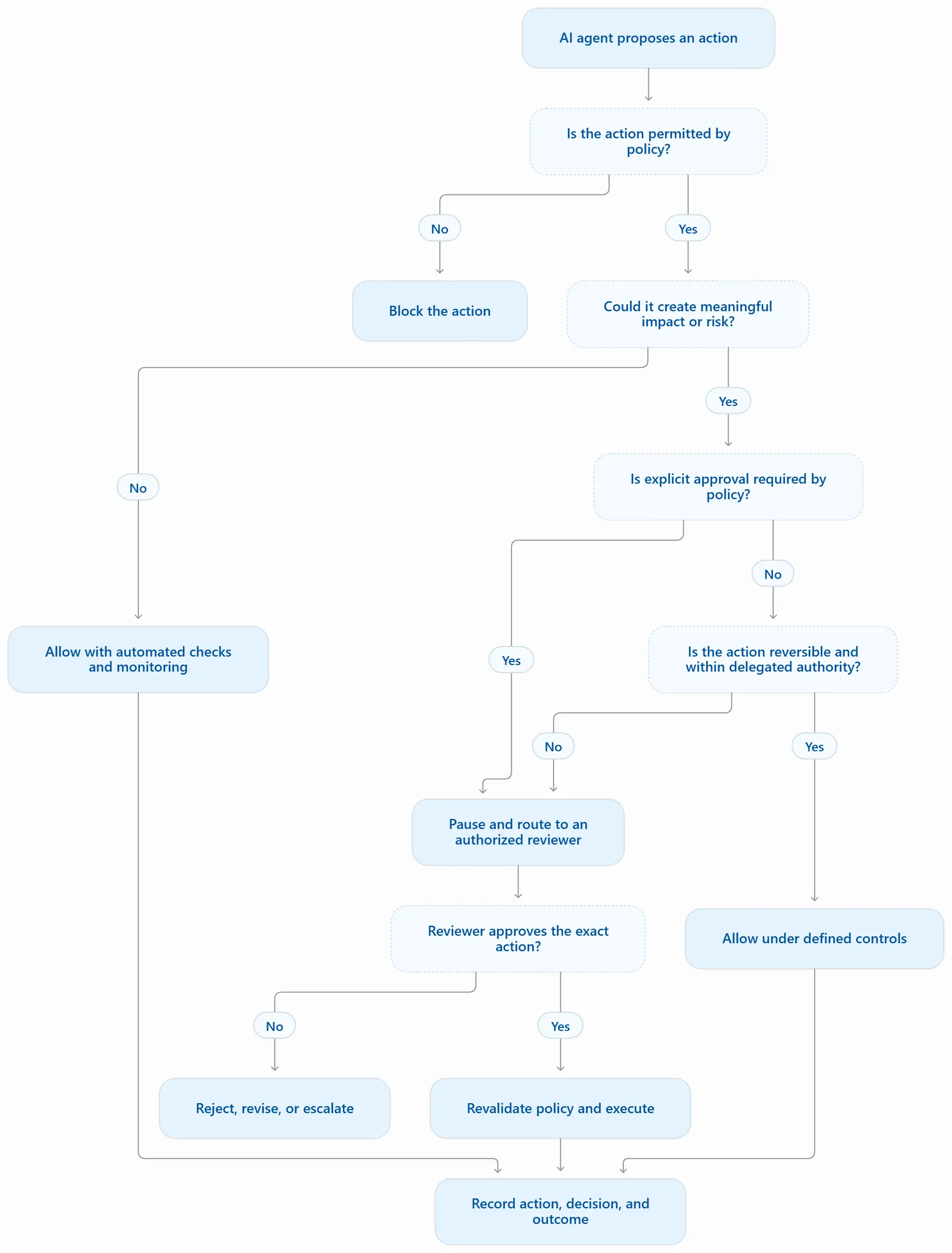
This decision guide should be implemented as application logic and policy, not left solely to the AI agent's reasoning.
That question helps engineering teams create workflows that are autonomous where appropriate, controlled where necessary, and accountable when business outcomes matter.
Frequently Asked Questions
What is the best place for human approval in an AI agent workflow?
The best place is usually immediately before a consequential action, such as sending a payment, changing sensitive data, executing a production operation, or releasing a high-impact output. Approval should be triggered by risk and authority requirements rather than by every step in the workflow.
Should human approval happen before or after an AI agent uses a tool?
For a tool that creates a consequential side effect, approval should happen before execution. The agent may gather information and prepare the tool arguments first, allowing the reviewer to evaluate the exact proposed action. Read-only or low-risk tools may operate under automated controls without human approval.
Can AI agents operate without human approval?
Yes. AI agents can operate without per-action human approval for tasks that are low-risk, within defined permissions, and appropriately monitored. Organizations should still enforce access controls, policy restrictions, and logging. Autonomy should be limited by the consequences of the actions the agent can perform.
What is the difference between human-in-the-loop and human-on-the-loop AI?
Human-in-the-loop generally involves a person participating in a decision or approving an action before it proceeds. Human-on-the-loop generally means the AI operates more autonomously while a person monitors the system and can intervene. The distinction is about the timing and level of human involvement.
How can human approval be implemented in an AI agent?
A typical implementation uses a policy engine to determine whether a proposed tool call requires approval. If it does, the workflow pauses and creates an approval request. An authorized reviewer approves or rejects the action. The application then validates the decision, executes the permitted action, and records the outcome.
What happens if a human does not approve an AI agent's action?
The action should not execute. Depending on the workflow, the system may cancel it, request changes, escalate it to another authorized reviewer, or keep it pending. A timeout or missing response should not be treated as approval for a high-risk action.
Is human approval enough to make an AI agent safe?
No. Human approval is one safeguard. AI agents also need technical permission boundaries, policy enforcement, input and output validation, monitoring, audit logs, and controls against unauthorized or unintended actions. The required safeguards depend on the system's use and risk.
How does the EU AI Act address human oversight?
Article 14 of the EU AI Act addresses effective human oversight for high-risk AI systems. It calls for oversight that is proportionate to the risks, autonomy, and context of use. The exact requirements depend on the system and its legal classification. Human approval alone does not establish compliance.
Conclusion: Put Human Approval at the Point of Consequence
Human approval should sit where an AI agent's proposed action crosses a meaningful risk, authority, or impact boundary.
For most agentic workflows, the most effective pattern is to allow the agent to perform low-risk preparation and analysis, then pause before a sensitive tool call, consequential release, or action outside its delegated authority.
The approval mechanism should be supported by independent policy enforcement, role-based authorization, clear reviewer context, action-specific approvals, audit logging, and defined fallback behavior.
The important design question is not simply, “Should a human be involved?”
It is:
“At which point does this AI agent need authority it should not receive automatically?”
That question helps engineering teams create workflows that are autonomous where appropriate, controlled where necessary, and accountable when business outcomes matter.
Comments (0)
No comments yet. Be the first to share your thoughts!