AI People Interview: Mona Larissa Kohlhaas on Whether AI Can Turn Marketing Data Into Better Decisions, Not Just Better Reports

Author
Ravi Prajapati
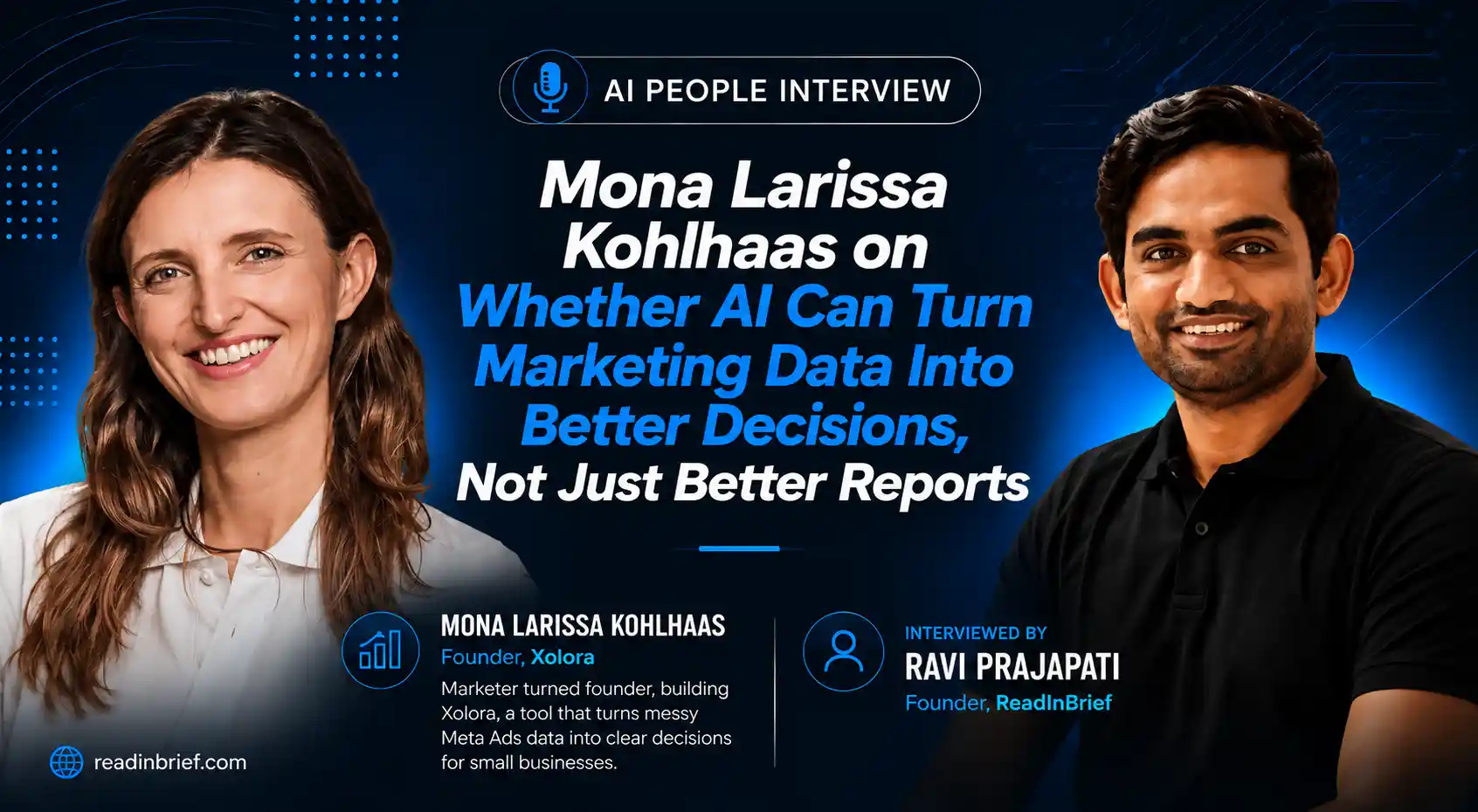
AI People Interview on ReadInBrief: Mona Larissa Kohlhaas of Xolora on why small business owners need marketing decisions from AI, not more reports.
Mona Larissa Kohlhaas, Founder of Xolora, explains why most marketing tools are built for marketers rather than the coffee shop owners, coaches, and plumbers actually running ads, and why she thinks the real value of AI in marketing is confidence, not more charts.
Mona Larissa Kohlhaas is a marketer turned founder from Germany, and the creator of Xolora, a tool that turns messy Meta Ads data into clear decisions. Instead of handing users another dashboard, Xolora analyzes an uploaded Meta Ads report and tells them what to scale, what to pause, and what to test next, with the reasoning behind each recommendation.
In this AI People interview, Mona talks about why so many small business owners can't act on their marketing metrics, what she learned as a first-time SaaS founder, why a waitlist doesn't prove anything, and why she believes a human should always make the final call, even with an AI tool telling them what to do.
The Core Question
Ravi Prajapati: Why do you think most marketing tools got so good at reporting and so bad at actually helping someone decide what to do next?
Mona Larissa Kohlhaas: I think it's because the people behind the tools assume the user knows what to do next. But that is a myth. There are so many metrics to look at, and it gets overwhelming. Last year I surveyed solopreneurs and small business owners and 80% said they didn't know their KPIs, and if they did, they wouldn't know what to do with them.
Marketing tools are made for marketers. But what about the small business owner who can't afford to hire a marketer or an agency? That's why I'm building Xolora. It's for the coffee shop owner. For the coach. For the plumber. For people who run ads, but aren't marketing pros.
Ravi Prajapati: What's the real difference between a dashboard that shows you numbers and a system that tells you what to scale, pause, or test? Where does one end and the other begin?
Mona Larissa Kohlhaas: The difference is the confidence the user gets. If you only see numbers, you're often still clueless. You still wonder: is this good? Or: now what? A system that tells you what to scale, pause, or test next gives you the confidence to act. It gives you the clarity you need.
Where Xolora Started
Ravi Prajapati: What were you doing before Xolora, and what was the moment you decided this specific problem, messy Meta Ads data, was worth building a company around?
Mona Larissa Kohlhaas: Before I started working on Xolora I was a marketer, and I still am. I was freelancing for a coach who told me he didn't know his marketing KPIs, and the marketer in me was shocked! But it also made me want to understand more of solopreneurs' and small business owners' problems with marketing. It turns out most of them have the exact same issue: not knowing their KPIs. When it comes to running ads, that means you're leaving money on the table.
We started with Meta Ads because it's a very common ad platform. After beta we will add more platforms.
Ravi Prajapati: What's been the hardest part of building Xolora so far, technically or otherwise?
Mona Larissa Kohlhaas: I find it hard to say that one thing was the hardest part. As a first-time SaaS founder I'm learning something new every week. I started off vibe-coding, but learned the hype around it is not worth it, and if you want a stable, scalable product, you need an actual developer.
Another big learning was that a waitlist doesn't mean anything. People sign up for a tool or a waitlist out of curiosity. But a founder needs real testers who give real feedback.
Inside Xolora
Ravi Prajapati: Walk us through what actually happens after someone uploads a Meta Ads report. What is Xolora looking for, and how does it decide what matters?
Mona Larissa Kohlhaas: After someone uploads their Meta Ads report, Xolora shows the winner and the loser on top and gives a summary of the campaign's overall performance. It then gives you a health scorecard based on a grading system like in school, which grades the audience, funnel, creative, and spend. It also shows the amount spent, impressions, purchases, and cost per purchase, split by age and gender. The actionable recommendations Xolora gives are divided into critical and warning, and the user can tick them off.
Xolora uses a marketing benchmark to decide what matters. That benchmark will get refined in the future, so the outcome will be even better. It will be based on someone's industry, goal, and budget.
Ravi Prajapati: You mention users can ask Xolora questions about their ad account and pressure-test decisions. How conversational is that experience meant to feel, more like an analyst you're talking to, or a report you're querying?
Mona Larissa Kohlhaas: Xolora is your marketing manager. The chat is supposed to be conversational, but to the point. It doesn't talk about anything outside of Meta Ads.
From Reports to Decisions
Ravi Prajapati: How do you make sure a recommendation to scale or pause a campaign is actually trustworthy, and not just a confident-sounding guess?
Mona Larissa Kohlhaas: The recommendations are based on a benchmark that gets more and more refined.
Ravi Prajapati: Where should a human still make the final call, and where are you comfortable letting Xolora's recommendation carry more weight?
Mona Larissa Kohlhaas: I think a human should always make the final call and never blindly rely on an AI tool. With every tool you use or every piece of advice you follow, even from another human, you should still use your own brain.
Working With Marketers
Ravi Prajapati: You say no marketing degree is required. What have you learned about designing this for someone who isn't a performance marketing specialist?
Mona Larissa Kohlhaas: That plain language is key. Non-marketers don't understand marketing jargon. As a marketer, it's actually quite challenging to design something without using the wording you're used to. I'm glad my developer isn't a marketer. He designed the tool in a way he would understand it, and that helped a lot.
Ravi Prajapati: How does someone's relationship with their own data change after using Xolora for a while, compared to when they started?
Mona Larissa Kohlhaas: The relationship turns from frustration to confidence. Many people are overwhelmed and frustrated with their data, and Xolora gives them clarity. It gives them the confidence to make the next step.
What's Next
Ravi Prajapati: Right now Xolora focuses on Meta Ads. Where do you see this going: more platforms, more of the marketing stack, or deeper into the ones you already cover?
Mona Larissa Kohlhaas: A mix. It will definitely go deeper on what it's already covering. But I plan to add more platforms, not only platforms where people run ads, but also third-party platforms such as Google Analytics and Shopify. There's often a discrepancy between what Ads Manager says and what Google Analytics says. Xolora will look at both and give an analysis and recommendations based on that.
Ravi Prajapati: A year from now, what would have to be true for you to say Xolora actually changed how people make marketing decisions, not just how they read reports?
Mona Larissa Kohlhaas: Getting feedback from people saying that it changed how they make marketing decisions. People actually paying for it is probably the best form of validation.
About Mona Larissa Kohlhaas
Mona Larissa Kohlhaas is a marketer turned founder from Germany. After earning her master's degree, she started in outbound marketing at an international consultancy before moving into inbound marketing. After several career stops, she decided it was time to fulfill her dream of building her own businesses. Besides Xolora, she works on several other ventures.
Website: xolora.io
X: @MonaLK1990
Instagram: @mona_larissa_kohlhaas
This interview is part of ReadInBrief's AI People series, where we talk to AI founders and experts building at the edge of the industry. Have someone you'd like us to feature? hello@readinbrief.com or drop a message to Ravi Prajapati.
Comments (0)
No comments yet. Be the first to share your thoughts!