Private AI vs Public AI: Key Differences, Risks and When to Use Each

Author
Ravi Prajapati
Private AI vs public AI compared: data control, cost, model quality and compliance, plus a decision matrix showing which option fits each workload.
Private AI vs public AI comes down to who controls the model and the data. Public AI is a model run by an outside provider that you use through an app or API over the internet. Private AI runs inside an environment your organization controls: your own servers, your private cloud, or a hardware-isolated enclave. Public AI gives you the strongest models with almost no setup. Private AI gives you more control over where your data goes, in exchange for cost and engineering work.
That textbook answer hides the decision most teams actually face in 2026. The paid business tiers of public AI services no longer train on customer data by default. The best open-weight models now trail the best closed models by months, not years. Apple now runs its "private" cloud AI on servers owned by Google. The line between private and public has become a spectrum, and most organizations end up using several points on it at once.
This guide explains the five deployment models between fully public and fully private, where data exposure really happens, what each option costs, how regulation affects the choice, and a decision matrix you can apply workload by workload.
What Is the Difference Between Private AI and Public AI?
The difference is control over three things: where the model runs, who can see the prompts and outputs, and who decides whether that data is kept or reused. Public AI hands all three to a provider under its terms. Private AI keeps them inside your organization's boundary. Model quality, cost and speed of adoption follow from that choice.
What is public AI?
Public AI refers to AI models hosted and operated by a third party and offered to many customers at once. You reach them through a consumer app such as the ChatGPT, Gemini or Claude apps, or through a paid API. The provider owns the infrastructure, updates the model, and sets the rules for data retention in its terms of service. You pay per seat or per token and can start in minutes.
What is private AI?
Private AI refers to AI systems deployed inside an environment an organization controls, so that prompts, documents and outputs do not pass to an outside party that could retain or reuse them. In practice, private AI usually means one of three setups: open-weight models on your own hardware, models hosted inside your own cloud account, or workloads that run in confidential computing enclaves the operator cannot inspect. For a deeper definition, see our guide to what private AI is.
Watch the naming trap: "public AI" has a second meaning
In policy circles, "public AI" means something different: AI that is publicly funded and governed, in the way a public library or public broadcaster is. The Public AI Network white paper and Mozilla's vision for public AI use the term for public goods, public orientation and public use in AI. That debate is about who owns AI as infrastructure. This article uses the commercial meaning: models offered as a shared service by a provider.
Private AI vs Public AI at a Glance
Factor | Public AI | Private AI |
|---|---|---|
Where the model runs | Provider's shared infrastructure | Your servers, your cloud account or a sealed enclave |
Who operates it | The provider | Your team or a contracted partner |
Data exposure | Prompts leave your boundary; retention follows the provider's terms | Prompts stay inside your boundary |
Training on your data | Common by default in consumer tiers; excluded by default in most business tiers | No, unless you choose to fine-tune |
Model quality | Frontier closed models | Usually open-weight models a few months behind the frontier |
Cost model | Pay per token or seat; no upfront spend | Upfront hardware or reserved capacity plus staff |
Time to deploy | Minutes to days | Weeks to months |
Customization | Prompting, retrieval and limited fine-tuning | Full control of weights, tuning and serving |
Best for | General productivity, frontier reasoning, fast experiments | Regulated data, high steady volume, air-gapped or sovereign needs |
Why Private vs Public AI Is Really a Spectrum of Five Options
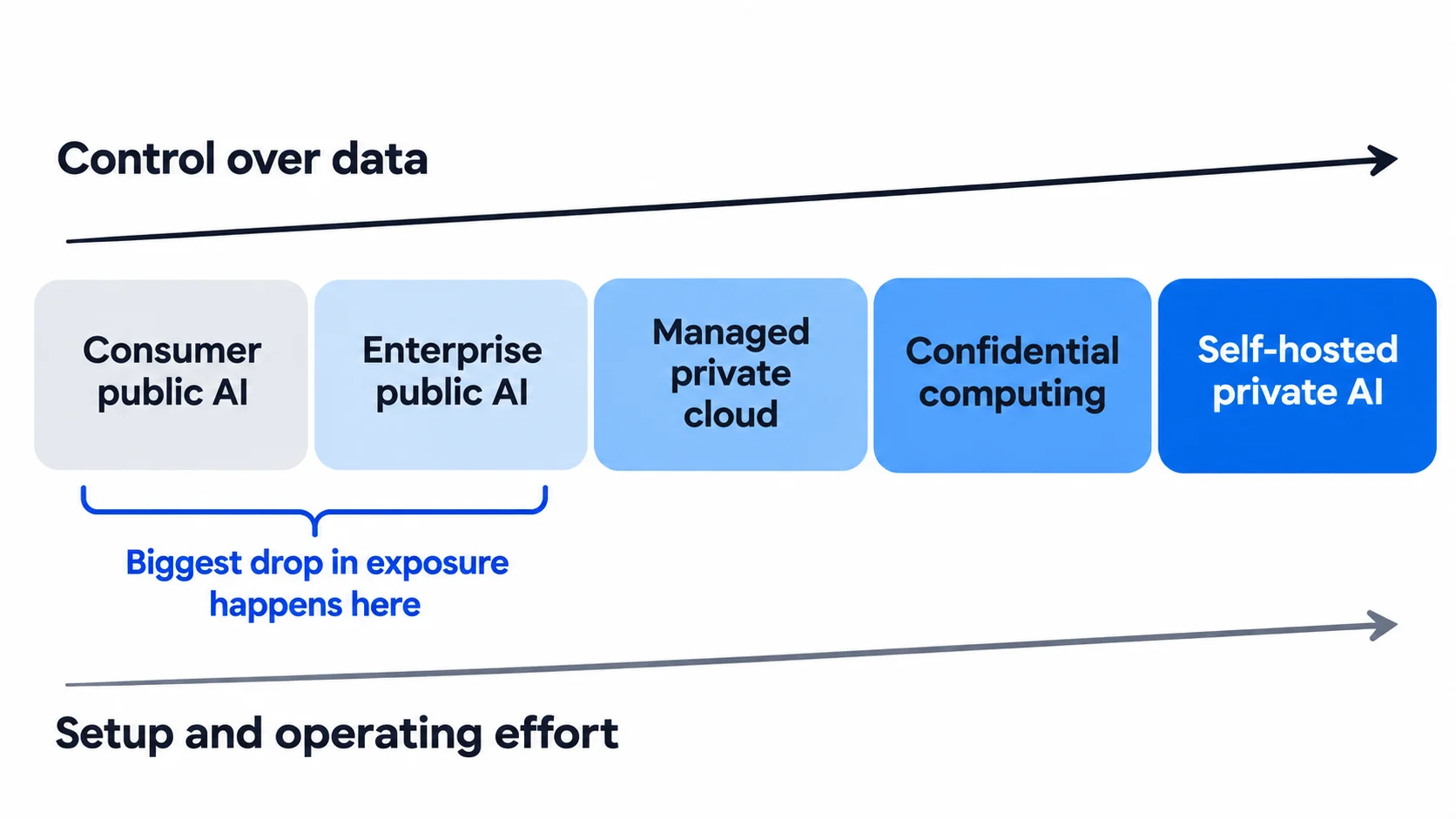
Treating the choice as binary causes most bad decisions. Between a free chatbot and an air-gapped server room sit three options that many teams overlook. Each step to the right trades convenience for control.
Deployment model | What it is | Who can see your prompts | Trains on your data? | Your operating burden |
|---|---|---|---|---|
1. Consumer public AI | Free and personal plans of chatbot apps | The provider, retained under consumer terms | Often yes by default, with an opt-out | None |
2. Enterprise public AI | Business plans and APIs under a data processing agreement | The provider, with limited retention and zero-retention options for some customers | No by default (provider's stated policy) | Low |
3. Managed private cloud | Hosted models running inside your cloud account and region, such as Amazon Bedrock | The cloud platform under shared responsibility; model makers have no access (platform's stated policy) | No (platform's stated policy) | Low to medium |
4. Confidential computing | Workloads in hardware trusted execution environments with remote attestation | Designed so even the operator cannot read data in use | No | Medium |
5. Self-hosted private AI | Open-weight models on your own GPUs, private cloud or air-gapped network | Only your organization | No | High |
Two details matter here. First, options 2 and 3 rest on contractual and documented promises from the provider. OpenAI states that by default it does not use data from ChatGPT Enterprise, Business, Edu or its API platform for training, and that qualifying organizations can choose zero data retention on the API. AWS documentation states that Amazon Bedrock does not store or log prompts and completions, does not use them to train AWS models, and does not share them with third-party model providers. These are company claims. They are backed by contracts, but they are not the same as technical impossibility.
Second, option 4 is the only one where privacy is designed to be technically verifiable rather than promised. That is why it is reshaping the debate, as covered below.
Where Does the Real Data Risk Come From?
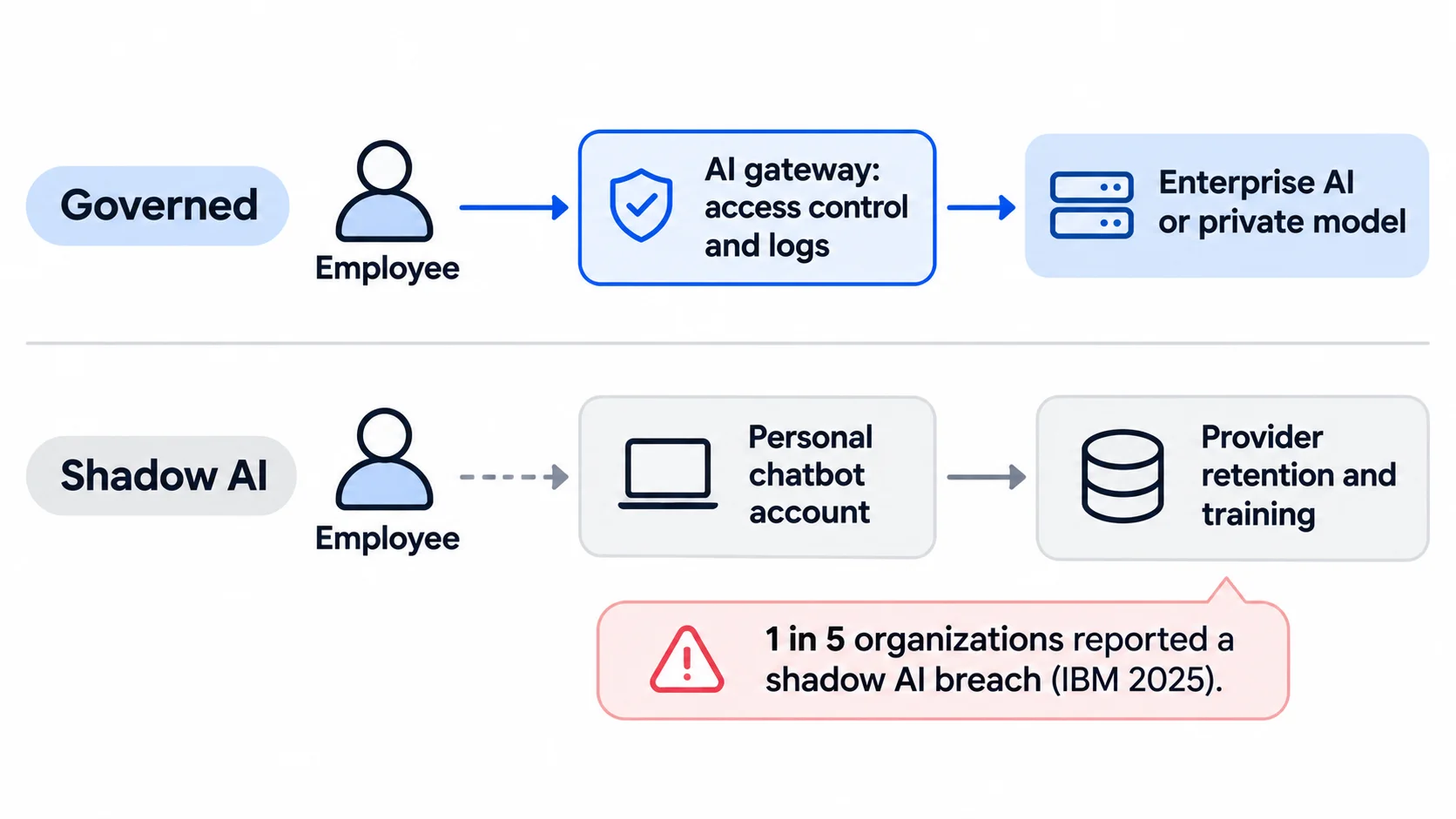
The largest data risk in most organizations is not a provider secretly training on enterprise data. It is employees pasting sensitive material into consumer tools that do train on chats by default, outside any company control. The jump in risk between consumer and enterprise tiers is much larger than the jump between enterprise tiers and self-hosting.
Consumer tiers often train on your chats by default
A Stanford study of six U.S. frontier AI developers' privacy policies, published in October 2025, found that all six appear to use their users' chat data to train and improve their models by default, and that some retain this data indefinitely. The study examined consumer chat products from Amazon, Anthropic, Google, Meta, Microsoft and OpenAI.
Policies also change. In August 2025, Anthropic updated its consumer terms so that chats from its Free, Pro and Max plans may be used for model training unless users opt out, with data retained for five years for those who allow it. The change did not apply to its commercial and API offerings. The lesson is general: consumer terms are set by the provider and can be revised.
Enterprise tiers exclude training by contract
Business plans and APIs work differently. They typically come with a data processing addendum, retention controls, and a default promise not to train on customer content, as in the OpenAI and AWS policies cited above. For most business data, a properly contracted enterprise tier removes the training risk that makes headlines. What remains is the ordinary risk of any cloud vendor: breach, subpoena, misconfiguration and provider-side retention for abuse monitoring.
Shadow AI is the costliest gap
Shadow AI means employees using AI tools their employer has not approved. IBM's Cost of a Data Breach Report 2025, based on research by the Ponemon Institute across 600 organizations, found that one in five organizations reported a breach due to shadow AI. Organizations with high levels of shadow AI saw breach costs about USD 670,000 higher than those with little or none. Only 37% had policies to manage AI or detect shadow AI.
Even security leaders are not immune. In January 2026, TechCrunch, citing Politico, reported that the acting head of the U.S. cybersecurity agency CISA had uploaded contracting documents marked "for official use only" to ChatGPT, triggering internal security alerts. The documents were not classified, and CISA said the use was authorized under a temporary exception. The episode still shows how easily sensitive material reaches a public tool when a convenient option is one tab away.
Private AI does not remove risk on its own
Moving models in-house shifts security work onto your team. The same IBM report found that 13% of organizations reported breaches of AI models or applications, and 97% of those lacked proper AI access controls. A self-hosted model with weak access control, an exposed inference endpoint or an unpatched serving stack can leak data as easily as any public service. Prompt injection, data poisoning and over-permissioned AI agents affect private and public deployments alike.
How Big Is the Capability Gap Between Open and Closed Models?
Private AI usually runs on open-weight models, so the capability gap decides what you give up. The short answer: the best open-weight models trail the best closed models by roughly four months, and the gap is small on many everyday tasks but still visible at the frontier.
Epoch AI, an independent research group, found that since January 2026 the most capable open-weight models have lagged frontier closed models by an average of four months on its Epoch Capabilities Index, an aggregate measure of model capability. Stanford's AI Index 2026 shows closed models leading throughout on Arena rankings, reaching a score of 1,503 against 1,454 for the top open model in 2026. Open-weight releases tracked by Epoch in 2026 include Google's Gemma 4, Moonshot's Kimi K2.6 and Z.ai's GLM-5.
Our interpretation for buyers: if your workload is classification, extraction, summarization, search over internal documents or drafting, a strong open-weight model is very likely good enough, and a four-month lag rarely matters. If your workload depends on the hardest reasoning, long agentic coding sessions or the newest multimodal features, you will feel the gap, and a public frontier model or a managed private cloud offering closed models may be the better fit. Benchmarks are averages, so test candidate models on a sample of your own tasks before committing.
What Does Private AI Really Cost Compared With Public AI?
Public AI is a variable cost that keeps falling. Private AI is a mostly fixed cost that pays off only when the hardware stays busy. That single difference, utilization, decides most cost comparisons.
Public AI prices keep falling
According to Stanford's AI Index 2025, the cost of querying a model at roughly GPT-3.5 level fell from USD 20 per million tokens in November 2022 to USD 0.07 by October 2024, a reduction of more than 280 times. Every price cut moves the break-even point for self-hosting further away.
Private AI pays off only at high, steady utilization
A Carnegie Mellon cost-benefit analysis of on-premise LLM deployment estimated break-even periods of a few months for small models, around two years for medium models and around five years for large models, compared with commercial services. Those figures assume heavy, constant use. A 2026 study of LLM infrastructure cost estimation points out that common calculators assume fixed or 100% GPU utilization, which real request patterns rarely reach. A separate study of private inference on consumer Blackwell GPUs for small businesses found very low per-token costs when the hardware is busy, but break-even stretching to thousands of days at low daily volumes.
Cost element | Public AI | Private AI (self-hosted) |
|---|---|---|
Upfront spend | None | GPUs and servers, or reserved cloud capacity |
Variable cost | Per token or per seat | Power, cooling, bandwidth |
People | Integration and governance | ML engineers, platform and security staff |
Upgrades | Included by the provider | Re-evaluating and redeploying new open models every few months |
Idle capacity | Not your problem | Paid for whether used or not |
Cheapest when | Usage is low, spiky or experimental | Usage is high, steady and predictable |
How Does Regulation Affect the Choice?
Most privacy laws do not require private AI. They require controls: a lawful basis for processing, contracts with processors, limits on cross-border transfers, breach notification and, for high-risk uses, documented risk management. Enterprise public AI can often meet these requirements, while some sector rules and data residency demands push workloads toward private deployment.
Contracts and sector agreements. OpenAI states it offers a data processing addendum and a Business Associate Agreement for its healthcare and API healthcare customers to support HIPAA compliance. Without such agreements, sending regulated health data to a public service is usually off the table.
EU AI Act. The Act regulates what an AI system is used for, not where it runs, so a private deployment does not change a system's risk classification. Under the Digital Omnibus amendments, law firm Orrick reports that obligations for high-risk systems listed in Annex III now apply from 2 December 2027 instead of 2 August 2026.
India's DPDP Act. The government notified the Digital Personal Data Protection Rules on 14 November 2025 with an 18-month phased rollout, so core obligations for companies arrive in May 2027. Organizations processing Indian personal data with AI tools need consent, purpose limitation and breach reporting in place, whichever deployment model they choose.
Classified and defence work. In our assessment, workloads under national security accreditation regimes are the clearest case where only self-hosted or air-gapped private AI is practical, because commercial multi-tenant services typically cannot meet those accreditation rules.
Confidential Computing: The Middle Ground Changing the Debate
Confidential computing runs AI workloads inside a hardware trusted execution environment (TEE), an isolated area of a chip that encrypts data while it is being processed and can prove, through remote attestation, which code is running. The goal is cloud-scale AI where even the operator cannot read your data.
The technology is now in production at large scale. Microsoft announced general availability of Azure confidential VMs with NVIDIA H100 GPUs in September 2024. NVIDIA documents confidential computing support across its Hopper and Blackwell GPUs. Google launched Private AI Compute in November 2025, which relies, like Apple's system, on trusted execution environments.
The most telling example is Apple. In 2026, Apple expanded Private Cloud Compute to Google Cloud, implemented with NVIDIA confidential computing GPUs, Intel CPUs with TDX and Google's Titan chip. As InfoQ reported, Apple's most privacy-sensitive cloud AI workloads now run on infrastructure Apple does not own or operate. For buyers, this signals a shift: "private" increasingly means verifiable guarantees about who can access data, not ownership of the servers.
Limitations remain. Confidential computing depends on trust in the chip makers and on the quality of attestation and independent audits. It adds setup complexity, and options for running the very largest closed models inside customer-controlled enclaves are still limited.
When Should You Use Public AI, Private AI or Both?
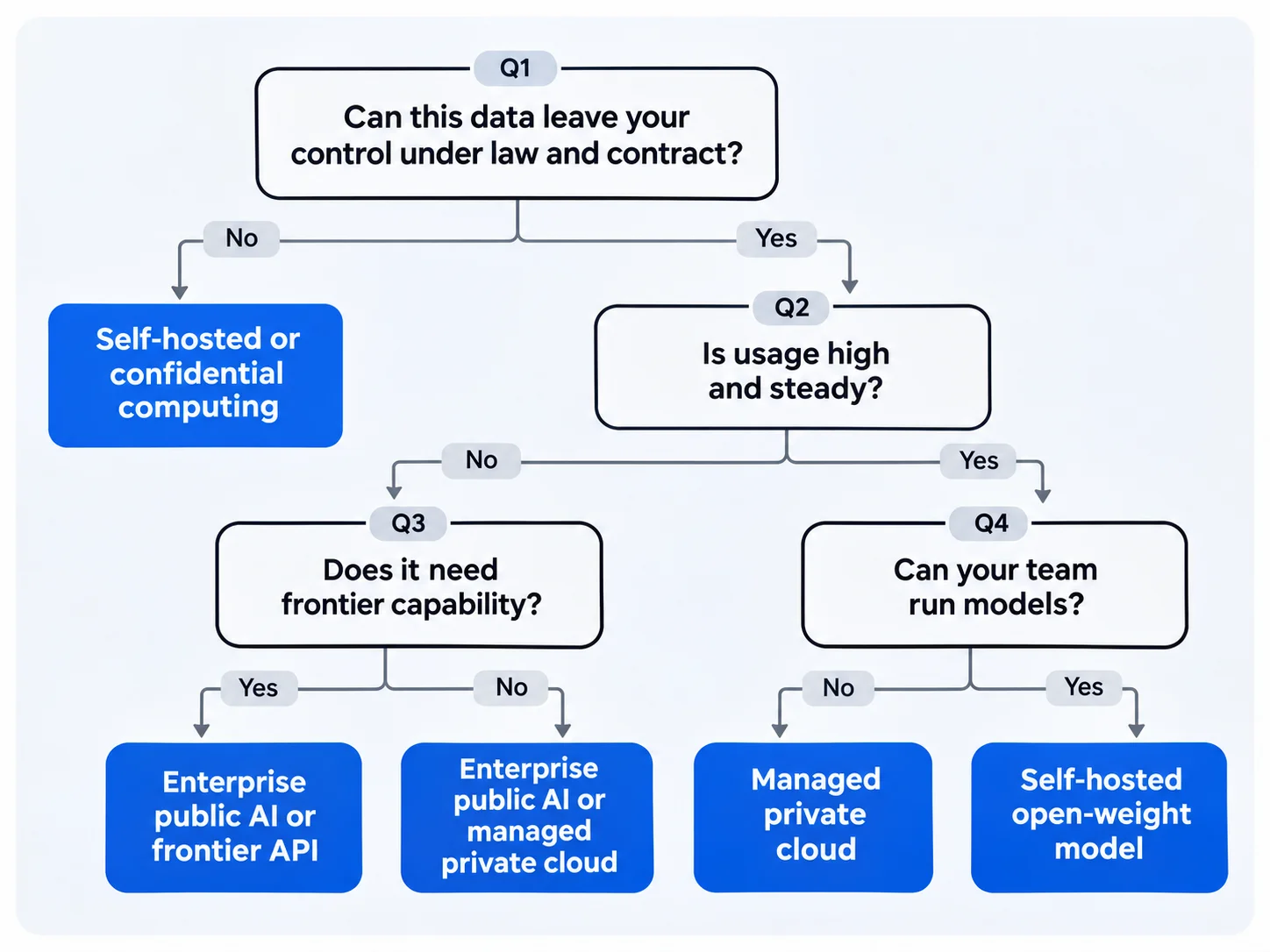
Use public AI when data sensitivity is low or covered by an enterprise contract and you need frontier capability or speed. Use private AI when law, contracts or risk tolerance forbid data leaving your control, or when usage is high and steady enough to keep hardware busy. Most organizations should run a hybrid: a governed enterprise tier for everyday work and private deployment for the few workloads that need it.
Answer four questions for each workload, not for the organization as a whole:
How sensitive is the data, and what do laws and contracts allow? Public, internal, confidential, regulated or classified.
How much and how steadily will it run? Occasional and spiky favours public pricing. High and constant favours owned capacity.
How much capability does it need? Routine language tasks suit open-weight models. Frontier reasoning favours closed models.
Can your team run it? Self-hosting needs people for serving, security, evaluation and upgrades.
Workload | Data sensitivity | Suggested model | Why |
|---|---|---|---|
Marketing drafts, research on public sources | Low | Enterprise public AI | Frontier quality, no infrastructure, no training on business data by default |
Customer support with customer records | Confidential, personal data | Enterprise public AI with DPA and retention limits, or managed private cloud | Contracts and regional hosting cover most privacy duties |
Coding assistant on proprietary source code | Confidential IP | Enterprise tier with zero data retention, or managed private cloud | Strong coding models with contractual protection |
Clinical notes and patient records | Regulated | Managed private cloud or enterprise tier with a BAA; self-hosted at high volume | Sector agreements are required; volume decides build versus buy |
Millions of documents classified daily | Mixed | Self-hosted small open-weight model | Steady high utilization makes owned capacity cheapest |
Defence, classified or air-gapped sites | Classified | Self-hosted, air-gapped | No external connection is acceptable |
Hardest reasoning on non-sensitive data | Low | Public frontier API | The capability gap matters more than control |
Two Illustrative Scenarios
The following examples are hypothetical and simplified to show how the framework applies. They are not case studies of real organizations.
A regional hospital group wants AI to summarize discharge notes. The data is regulated health information, so consumer tools are ruled out. Volume is moderate and irregular. The group signs a healthcare agreement with an enterprise provider or uses a managed private cloud in its own region, keeps a small self-hosted model for an internal search pilot, and blocks consumer chatbots on its network.
A 40-person software company wants AI for coding, sales emails and support. Its data is confidential but not regulated, and usage is spiky. Buying GPUs would leave them idle most of the day. An enterprise tier with zero data retention for code, plus a written AI use policy, gives better models at lower cost than self-hosting.
Common Misconceptions About Private and Public AI
"Public AI trains on everything you type." True for many consumer plans by default, but business tiers and APIs from major providers state they do not train on customer data by default.
"Private AI is automatically secure." It moves security work to you. IBM found that 97% of organizations reporting AI model or application breaches lacked proper AI access controls.
"Self-hosting is always cheaper at scale." Only at high, steady utilization, and falling API prices keep moving the break-even point.
"Open models are years behind." Independent tracking puts the gap at roughly four months in 2026.
"Private means on-premises." Confidential computing lets private workloads run on someone else's hardware, as Apple's use of Google Cloud shows.
What Private AI Cannot Fix
Private deployment changes who can see your data. It does not make a model more accurate, remove hallucinations, stop prompt injection through retrieved documents, or replace governance over what agents may do. It can also create a new kind of lock-in: to hardware you have bought and to the team that knows how to run it. Treat private AI as one control among several, alongside access management, logging, evaluation and clear usage policies.
Frequently Asked Questions
Is ChatGPT public AI or private AI?
ChatGPT is public AI, because OpenAI runs the models on its own infrastructure for many customers. Its privacy terms differ by plan. OpenAI states that it does not train on data from ChatGPT Enterprise, Business, Edu or its API by default, while consumer plans follow different terms with their own data controls. A business tier gives contractual protections, but it is still not private AI in the strict sense, because prompts are processed by the provider.
Is private AI more secure than public AI?
Private AI gives you more control, which is not the same as more security. It removes the risk of a provider retaining or reusing your data, but you take on patching, access control and monitoring. A well-governed enterprise AI tier can be safer than a poorly secured self-hosted model. The bigger security gain usually comes from stopping shadow AI and choosing business tiers over consumer apps.
Can I use public AI with confidential company data?
Often yes, if you use a business plan or API under a data processing agreement, with retention controls and a stated policy of not training on your data. Check whether your contracts with clients restrict third-party processing, and whether sector rules such as HIPAA require specific agreements. Do not use free or personal consumer accounts for confidential data.
What is an example of private AI?
A common example is a company running an open-weight model such as Google's Gemma 4 on its own GPU servers to search internal documents, with no data leaving its network. Other examples include models hosted inside a company's own cloud account and region, and confidential computing systems such as Apple Private Cloud Compute, which process data in hardware-isolated enclaves.
Is private AI more expensive than public AI?
For most organizations, yes, at least at first. Private AI needs upfront hardware or reserved capacity, plus engineers to run it, and it pays off only when the hardware stays busy. Research from Carnegie Mellon estimated break-even periods ranging from a few months for small models to around five years for large ones, under heavy-use assumptions. Low or irregular usage almost always favours public pricing.
What is hybrid AI deployment?
Hybrid AI deployment means using public and private AI together and routing each workload to the option that fits it. A typical setup uses an enterprise public AI tier for general productivity and frontier reasoning, and a private or self-hosted model for regulated data or high-volume tasks. An internal AI gateway often enforces which data may go where.
Does the EU AI Act require private AI?
No. The EU AI Act regulates AI systems by their purpose and risk level, not by whether they run on public or private infrastructure. A high-risk system must meet the same obligations either way. Under the Digital Omnibus amendments, obligations for high-risk systems listed in Annex III now apply from 2 December 2027.
So, Private AI or Public AI?
The evidence supports a clear answer for most organizations: neither alone. The largest reduction in data risk comes from moving people off consumer chatbots and onto governed enterprise tiers, not from building a GPU cluster. Private AI earns its cost in three situations: data that legally or contractually cannot leave your control, high and steady volumes that keep hardware busy, and air-gapped or sovereign environments.
What remains uncertain is how fast the middle ground matures. If confidential computing becomes standard for frontier models, the trade-off between capability and control could shrink sharply. Until then, make the decision workload by workload, write it into an AI use policy, and revisit it every few months as model quality and prices move.
Comments (0)
No comments yet. Be the first to share your thoughts!