RAG vs Fine-Tuning for a Private Company Knowledge Base: Differences, Use Cases, Architecture and How to Choose

Author
Ravi Prajapati
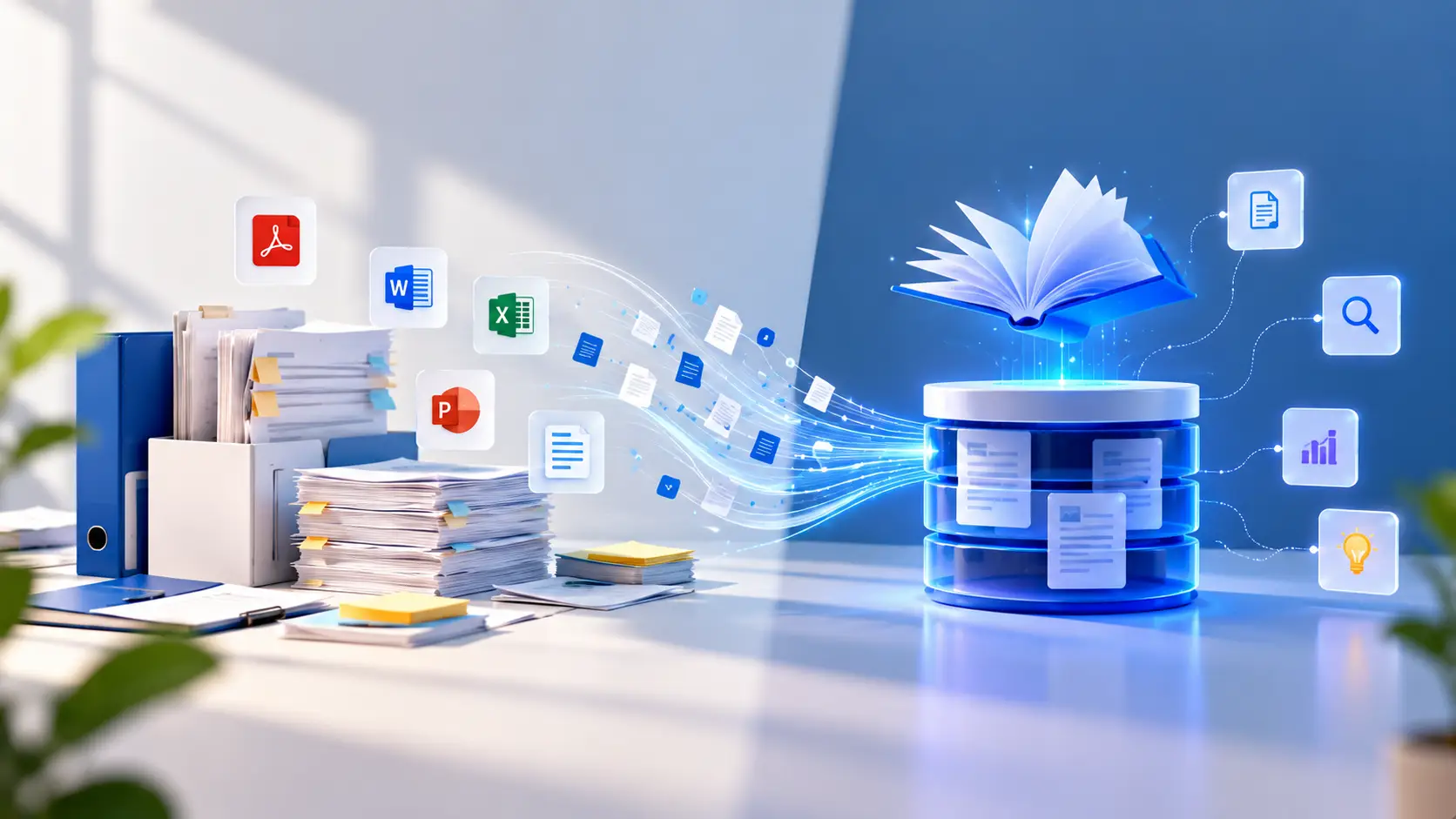
Compare RAG vs fine-tuning for a company knowledge base. Learn how they work, key differences, costs, architecture, use cases and when to combine them.
Companies have accumulated years of internal information across documents, databases, CRM systems, ERP platforms, support tickets, project management tools, employee handbooks and other business applications.
Making this information accessible through AI can help employees find answers, support customers, automate internal processes and make better business decisions.
However, a standard Large Language Model (LLM) does not automatically know what is inside a company's private systems. It needs a way to access that information or learn the specific behaviour required by the business.
Two commonly discussed approaches are Retrieval-Augmented Generation (RAG) and fine-tuning.
Although both help customize AI applications for business requirements, they solve different problems.
RAG retrieves relevant information from an external knowledge source when someone asks a question. Fine-tuning trains a model using carefully prepared examples so that it learns to perform particular tasks or follow specific response patterns more consistently.
Consider a company with 500 employees. It wants to build an internal AI assistant that can answer questions about HR policies, employee benefits, project documentation, technical procedures and company processes.
Should the company train an AI model using all its internal documents? Should it connect an existing model to a searchable knowledge base? Or should it combine both approaches?
The answer depends on what the company expects the AI application to do.
This guide explains RAG vs fine-tuning for a private company knowledge base, including their architectures, differences, advantages, limitations, implementation considerations and practical business scenarios.
It also explains when combining the two approaches makes sense.
1. What Is RAG (Retrieval-Augmented Generation)?
Retrieval-Augmented Generation (RAG) is an AI architecture that allows a Large Language Model to access external information before generating an answer.
Instead of relying entirely on information learned during its original training, the model receives relevant information retrieved from a connected knowledge source.
This knowledge source might contain:
Company policies and employee handbooks.
Product documentation and technical manuals.
Customer support conversations.
Internal project documentation.
Sales proposals and business reports.
CRM and ERP information.
Legal documents and compliance guidelines.
Product catalogues and pricing information.
The AI application searches this information when a user submits a question. It retrieves relevant content and passes that content to the language model as context.
The model then generates an answer using the retrieved information.
In simple terms: RAG gives an AI model access to a company's information when it needs to answer a question. The company does not need to retrain the model every time an internal document changes.
According to the OpenAI Retrieval documentation, semantic search can identify relevant information even when the search query and the source document use different words.
How does RAG work?
A typical RAG implementation has two major stages: knowledge preparation and question answering.
Stage 1: Preparing the company knowledge base
Before employees can ask questions, the application needs to process and index company information.
Data collection: Collect information from approved company sources such as PDFs, Word documents, websites, databases and internal applications.
Document processing: Extract text and relevant metadata from the collected information.
Chunking: Divide large documents into smaller sections so the retrieval system can identify relevant information.
Embedding generation: Convert text chunks into numerical representations called vector embeddings.
Vector storage: Store these embeddings and associated content in a searchable vector database or search index.
Stage 2: Answering employee questions
User query: An employee asks a question through an internal chatbot.
Query processing: The application prepares the question for retrieval.
Information retrieval: The search system finds relevant document sections.
Context preparation: Relevant results are added to the model's input.
Answer generation: The LLM generates a response using the retrieved context.
Source references: The application can provide links or citations to the original documents.
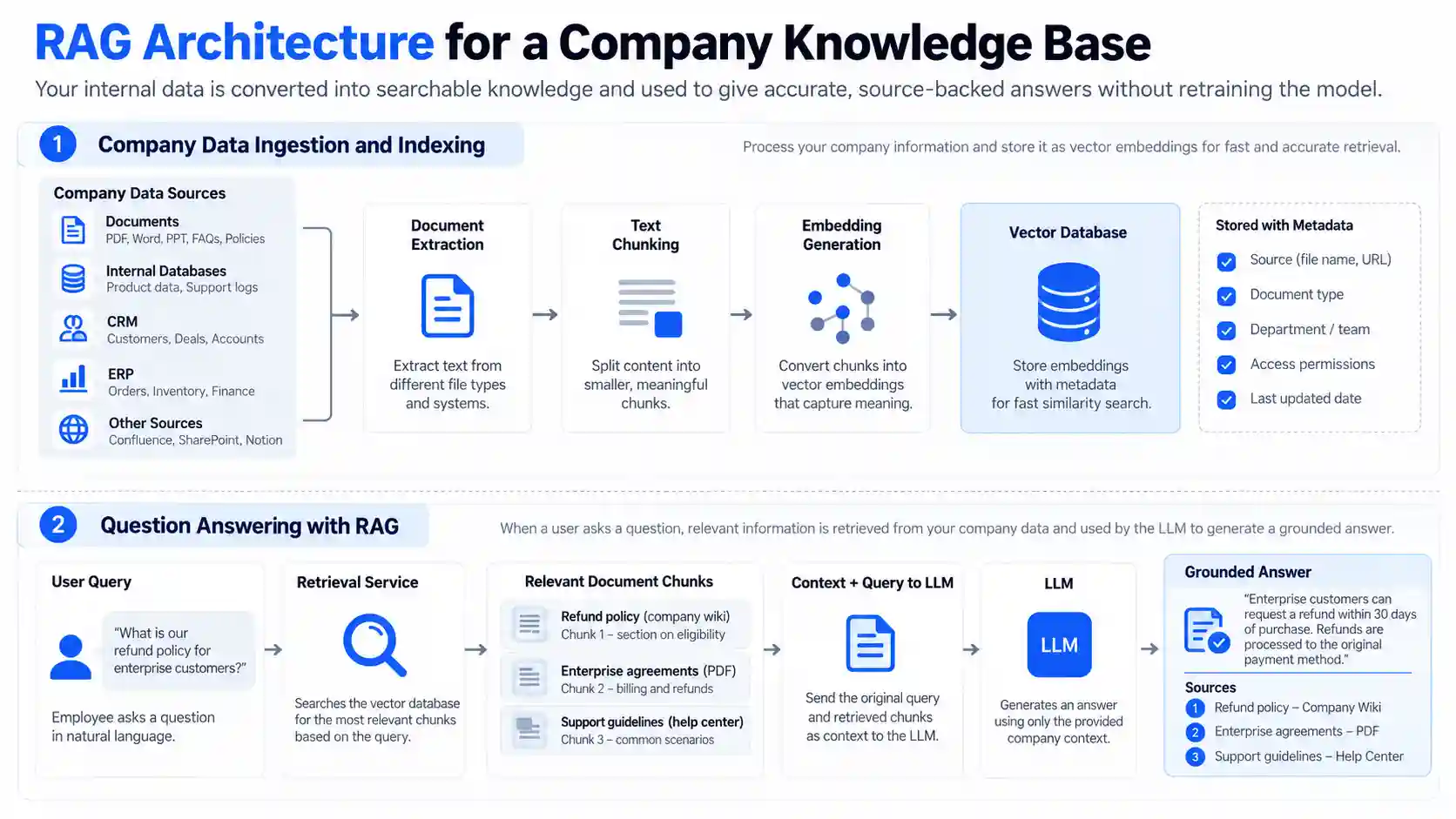
Example: RAG for an employee knowledge assistant
Imagine an IT company with 500 employees.
An employee asks:
What is the company's work-from-home policy for employees who have completed one year?
The RAG application searches the company's HR documents and retrieves the relevant policy section.
The LLM receives that information and generates an answer:
"Employees who have completed one year of service can request up to three work-from-home days per week, subject to manager approval and project requirements. Please refer to the HR Work Policy for the complete conditions."
The assistant can also provide a link to the original HR document.
If HR updates the policy, the company can update the relevant knowledge-base content and re-index it. The model itself does not necessarily need to be retrained.
This is one of the main reasons RAG is useful for company knowledge systems.
Main components of a RAG architecture
Component | Purpose |
|---|---|
Data connectors | Collect information from company systems |
Document processor | Extracts and cleans information |
Chunking mechanism | Divides documents into searchable sections |
Embedding model | Converts text into numerical representations |
Vector database | Stores embeddings and searchable content |
Retrieval engine | Finds relevant information |
Reranker | Improves the relevance of retrieved results |
LLM | Generates natural-language responses |
Application interface | Allows employees to interact with the AI |
Access control | Restricts information based on user permissions |
Evaluation system | Measures retrieval quality and answer accuracy |
RAG does not simply mean connecting a chatbot to a vector database. The quality of the complete retrieval pipeline, document processing, permissions, context preparation and response generation determines how useful the application becomes.
Microsoft's RAG solution design and evaluation guide explains why retrieval configuration, chunking, embeddings and systematic evaluation all matter when building production-grade RAG applications.
2. What Is Fine-Tuning in AI?
Fine-tuning is a process of further training an existing AI model using a carefully prepared dataset so that it performs particular tasks or produces outputs in a desired way.
A foundation model already understands language, patterns and general concepts. Fine-tuning adjusts its learned parameters using additional training examples.
These examples show the model what good input-output behaviour looks like.
Fine-tuning can help an AI application:
Follow a particular response format.
Classify information into predefined categories.
Generate outputs in a company's preferred style.
Follow domain-specific terminology.
Perform repetitive business tasks consistently.
Produce structured JSON or other predefined outputs.
Improve performance on a specialized task.
In simple terms: Fine-tuning teaches an AI model how to perform a task or respond in a particular way. It is not simply a method of uploading company documents into a model.
This distinction is important when comparing RAG vs fine-tuning for a company knowledge base.
How does fine-tuning work?
The process generally involves the following steps:
Select a foundation model: Choose an existing model that supports the required fine-tuning method.
Prepare training data: Collect examples of the inputs the model will receive and the outputs it should produce.
Clean and validate the dataset: Remove incorrect, duplicated, inconsistent and irrelevant examples.
Create training and validation datasets: Keep separate data for training and evaluating performance.
Run fine-tuning: Train the selected model using the prepared examples.
Evaluate the model: Test whether it performs better on the intended tasks.
Deploy the customized model: Integrate it into the application and continue monitoring its behaviour.
Example: Fine-tuning a customer support AI assistant
Consider an eCommerce company that receives thousands of customer support requests.
The company wants its AI assistant to classify incoming messages into categories such as:
Order status.
Payment failure.
Refund request.
Product replacement.
Delivery complaint.
Account access issue.
The company prepares hundreds or thousands of representative examples.
Customer message | Expected classification |
|---|---|
Where is my order? | Order status |
My payment was deducted twice. | Payment issue |
I received a damaged product. | Product replacement |
I want to return my purchase. | Refund request |
I cannot log in to my account. | Account access |
The model is fine-tuned using these examples so that it learns the desired classification behaviour.
When a new message arrives, the customized model can classify it into the appropriate category.
Notice something important: the company is not teaching the model its latest order status, refund balance or customer account information through these examples.
Those details are better obtained from live business systems through APIs or a suitable retrieval architecture.
What does fine-tuning actually change?
Fine-tuning updates model parameters based on training data. It can change how a model responds to particular instructions and tasks.
However, it does not automatically create a reliable, searchable, continuously updated database of company information.
If the company's product prices, HR policies or customer records change frequently, fine-tuning alone is generally not the right way to keep the AI informed about those changes.
OpenAI's Supervised fine-tuning documentation describes the use of example inputs and desired outputs to customize model behaviour. Its fine-tuning best practices also emphasizes representative, consistent training examples and separate evaluation data.
3. RAG vs Fine-Tuning: What Is the Actual Difference?
The central difference is that RAG focuses on providing the model with relevant information, while fine-tuning focuses on changing how the model performs a task.
A company building an AI knowledge assistant should first identify whether its primary challenge is access to information or the model's behaviour.
Comparison factor | RAG | Fine-tuning |
|---|---|---|
Primary purpose | Give the model access to external knowledge | Customize model behaviour |
How it works | Retrieves relevant information at answer time | Trains model parameters using examples |
Company documents | Indexed in an external knowledge source | May be used to prepare training examples, but not as a live searchable knowledge base |
Updating information | Update and re-index changed content | Requires additional training or another update process |
Current information | Can retrieve current indexed information | Does not automatically know the latest changes |
Source citations | Can provide references to retrieved documents | Does not inherently provide source references |
Response consistency | Depends on prompts, context and retrieval quality | Can improve task-specific consistency |
Training requirements | No model fine-tuning required | Requires a training dataset and supported training process |
Best suited for | Company knowledge assistants and document question answering | Classification, formatting, specialized task behaviour |
Main technical challenge | Retrieving the right information | Preparing representative training examples and avoiding overfitting |
Evaluation focus | Retrieval relevance and answer groundedness | Task accuracy and behavioural consistency |
The distinction is also explained in OpenAI's Optimizing LLM Accuracy guide, which separates problems caused by incorrect retrieved context from problems caused by the model's inability to follow the desired behaviour.
A simple analogy: Company employee training
Imagine hiring a new employee.
You provide the employee with two different kinds of support.
RAG is like giving the employee access to the company's information library.
Whenever the employee needs to answer a question about a policy, project or customer, they can search the latest approved documents and use that information.
Fine-tuning is like teaching the employee how to perform a particular job.
You train them to classify customer requests, follow communication standards, prepare reports and use a consistent response format.
These are different capabilities.
An employee can know how to communicate professionally but still need access to the company's latest policies.
Similarly, an AI model can be trained to behave consistently but still need RAG to access current company information.
4. When Should a Company Use RAG Instead of Fine-Tuning?
RAG is generally the more appropriate starting point when a company's main requirement is to make private, changing or frequently updated information accessible through an AI application.
Consider RAG when:
4.1 The company has frequently changing information
Companies regularly update:
Employee policies.
Product documentation.
Pricing information.
Technical manuals.
Customer records.
Inventory information.
Compliance documents.
Training a model again whenever these details change can create unnecessary complexity.
With RAG, the application can retrieve the latest approved information from its indexed knowledge source.
4.2 Employees need answers based on internal documents
A company may have thousands of documents spread across different departments.
Employees may spend considerable time searching for information across folders, shared drives and internal systems.
A RAG-based assistant can provide a conversational interface for finding relevant information.
For example, an employee could ask:
"Which technical requirements did we agree upon with the client in the last project review?"
The system can retrieve relevant meeting notes, approved project documents and other authorized sources.
4.3 The company needs traceable answers
In regulated or business-critical environments, employees often need to know where an answer came from.
RAG can return the documents or passages used to generate an answer.
This makes it easier to verify information, although citations alone do not guarantee that the answer is correct.
4.4 Different users need different information
A company may have separate departments with different permissions.
For example:
HR employees can access employee records.
Finance employees can access financial documents.
Developers can access technical documentation.
Sales employees can access approved proposals.
Management can access selected business reports.
A RAG application can enforce these restrictions through identity-aware retrieval and document-level authorization.
Importantly, access controls must be enforced before retrieved information reaches the model. Hiding a document link in the chatbot interface is not sufficient.
4.5 The company wants to avoid retraining its model for every content update
If the business regularly changes its internal documents, a searchable knowledge base is often more manageable than repeatedly training a model.
This does not mean RAG is maintenance-free. Document synchronization, indexing, permissions, retrieval quality and evaluation still require ongoing work.
5. When Should a Company Use Fine-Tuning Instead of RAG?
Fine-tuning is more appropriate when the company needs to improve how the model performs a repeatable task rather than simply provide access to more information.
Consider fine-tuning in the following situations.
5.1 The AI must follow a consistent communication style
A company may want its customer support assistant to use a particular tone, terminology and response structure.
Fine-tuning can help the model reproduce the desired communication patterns across different requests.
5.2 The AI needs specialized classification capabilities
Consider an insurance company that receives thousands of claims.
The AI needs to classify requests according to predefined categories, identify relevant fields and produce structured outputs.
A well-prepared training dataset can help customize the model for this task.
5.3 The application needs consistent structured outputs
Some applications require predictable output formats.
For example, an AI application may need to return:
Customer ID.
Request category.
Priority level.
Assigned department.
Recommended action.
Fine-tuning may help improve adherence to these formats, although schema-constrained output mechanisms and validation should also be considered.
5.4 The company wants to optimize cost and latency
Fine-tuning can sometimes help a smaller model perform a specific task effectively, reducing the need for long prompts and expensive larger models.
However, this depends on the model, task, training data and evaluation results. Fine-tuning does not automatically make every AI application cheaper or faster.
6. Can RAG and Fine-Tuning Work Together?
Yes. RAG and fine-tuning can be combined in the same AI application.
In fact, combining them can make sense when the company has two separate requirements:
The AI needs access to private and frequently updated information.
The AI needs to perform tasks in a consistent and specialized manner.
RAG provides the relevant business context, while the fine-tuned model helps follow the desired task behaviour.
Example: Enterprise customer support platform
Consider a software company that provides customer support to thousands of users.
The company wants an AI support assistant that can:
Understand customer questions.
Search product documentation.
Retrieve the latest troubleshooting instructions.
Identify the customer's subscription plan.
Classify the support request.
Generate responses using the company's communication guidelines.
Escalate complex issues to human support agents.
A combined architecture could work as follows:
Requirement | Technology |
|---|---|
Access product documentation | RAG |
Retrieve current troubleshooting instructions | RAG |
Retrieve customer account information | Authorized API or database integration |
Classify incoming requests | Fine-tuned model, if evaluation supports it |
Follow communication guidelines | Prompt engineering and potentially fine-tuning |
Generate grounded answers | LLM with retrieved context |
Escalate complex cases | Workflow or agent orchestration |
Verify response quality | Evaluation and monitoring |
The customer submits a question:
"My subscription was renewed, but I cannot access the premium features."
The system can:
Retrieve the current subscription troubleshooting documentation.
Check the customer's subscription status through an authorized API.
Identify the issue category.
Generate a response using the retrieved information and required communication format.
Escalate the request if the account information indicates a problem that requires human intervention.
The combination allows the application to use current business information while following customized task behaviour.
7. RAG vs Fine-Tuning: Cost, Maintenance and Complexity
The technology choice should not be based only on implementation cost. Companies should consider the complete lifecycle of the AI application.
Both approaches have different infrastructure, development and maintenance requirements.
Cost factor | RAG | Fine-tuning |
|---|---|---|
Initial development | Data connectors, document processing, indexing and retrieval | Dataset preparation, training pipeline and model evaluation |
Infrastructure | Search index or vector database, storage and model inference | Training infrastructure and model inference |
Ongoing updates | Document synchronization and re-indexing | Additional training when behaviour or training data needs updating |
Inference costs | Retrieval operations plus model usage | Model inference, potentially with shorter prompts |
Maintenance | Retrieval quality, data freshness and permissions | Training data quality, model versions and regression testing |
Technical expertise | Backend, data engineering, search and AI integration | ML engineering, dataset preparation and model evaluation |
There is no universal cost winner.
A relatively small RAG system can be inexpensive to operate, while a poorly designed RAG application with complex data integrations can become expensive.
Similarly, fine-tuning may be economical for a high-volume, repetitive task, but the preparation and maintenance of quality training data can require substantial effort.
What affects RAG implementation costs?
The main cost drivers include:
Number and size of documents.
Number of connected data sources.
Document extraction complexity.
Embedding model usage.
Vector database or search infrastructure.
Retrieval and reranking requirements.
LLM inference volume.
Security and access-control requirements.
Monitoring and evaluation.
What affects fine-tuning costs?
The main cost drivers include:
Selected foundation model.
Size and quality of the training dataset.
Training method.
Number of training iterations.
Evaluation requirements.
Model hosting and inference.
Ongoing dataset maintenance.
Important: A company should evaluate total cost of ownership rather than compare only the initial development estimate.
8. What Are the Limitations and Risks of RAG?
RAG can make company information accessible to AI, but it does not guarantee accurate answers.
A production implementation needs to address several technical challenges.
8.1 Incorrect information retrieval
If the retrieval system finds the wrong document sections, the LLM may generate an incorrect answer even when the correct information exists in the knowledge base.
For example, an employee asks about the 2026 leave policy, but the system retrieves a 2024 policy document.
The model may produce a convincing answer based on outdated information.
Possible solution:
Add document version metadata.
Prioritize approved and current documents.
Apply date and department filters.
Implement hybrid search.
Evaluate retrieval relevance.
8.2 Poor document chunking
Chunking means dividing large documents into smaller searchable sections.
If a document is divided without preserving its meaning, important information may become disconnected.
For example, a contract clause might contain a condition in one section and an exception in the next. If the retrieval system returns only one section, the AI may miss the exception.
Possible solution: Use semantic chunking, appropriate overlap, document structure and metadata to preserve context.
8.3 Hallucinations
Even when the system retrieves relevant information, the LLM may misinterpret it or introduce unsupported details.
RAG can reduce reliance on unsupported model knowledge, but it cannot eliminate hallucinations.
Possible solution: Use grounded-answer instructions, source citations, confidence handling, response validation and human review for high-risk decisions.
8.4 Data security and access permissions
Private company knowledge bases may contain confidential financial, employee, customer and operational information.
A RAG application must ensure that users can retrieve only information they are authorized to access.
Security considerations include:
User authentication.
Role-based access control.
Document-level permissions.
Tenant isolation.
Encryption.
Audit logs.
Data retention policies.
Protection against prompt injection in retrieved documents.
8.5 Multiple data sources
Large organizations may store information across SharePoint, Google Drive, Salesforce, databases, ERP platforms and internal applications.
Connecting these systems requires reliable data synchronization, identity management and permission handling.
Microsoft's RAG architecture and evaluation guidance discusses the different stages involved in building and evaluating production RAG systems. Its documentation also highlights retrieval strategies such as vector, full-text and hybrid search.
Microsoft Learn+1
9. What Are the Limitations and Risks of Fine-Tuning?
Fine-tuning also has limitations that companies should understand before investing in model customization.
9.1 It does not provide a continuously updated knowledge source
If a company fine-tunes a model using its product documentation, that does not mean the model will automatically know about every subsequent product update.
Additional training or an external knowledge retrieval mechanism may be required.
9.2 Training data quality determines results
A model trained using inconsistent examples may learn inconsistent behaviour.
For example, if the customer support training dataset contains conflicting refund responses, the customized model may reproduce those inconsistencies.
9.3 Overfitting
Overfitting happens when a model learns training examples too closely and performs poorly on new or different inputs.
A model may perform well on the examples used during training but fail when customers phrase questions differently.
Separate validation and test datasets help identify this problem.
9.4 Model maintenance
Fine-tuned models require ongoing evaluation when:
Business requirements change.
The underlying foundation model changes.
New use cases are introduced.
Training data becomes outdated.
The model starts producing inconsistent results.
9.5 Model-provider limitations
Not every AI provider supports the same fine-tuning methods, model families or deployment options.
Availability and pricing can change.
For example, as of October 30, 2026, OpenAI's published supervised fine-tuning documentation states that its fine-tuning platform is being wound down for new users, with eligible existing customers able to create training jobs until January 6, 2027, subject to earlier base-model retirement. This is a provider-specific policy, not an indication that fine-tuning as a general machine-learning technique is ending.
10. RAG vs Fine-Tuning: Practical Decision Matrix
Before selecting an approach, companies should identify what they actually want their AI application to accomplish.
The following decision matrix can help.
Business requirement | Recommended starting point |
|---|---|
Search internal company documents | RAG |
Answer questions about current HR policies | RAG |
Search product manuals and technical documentation | RAG |
Retrieve current customer information | Authorized API integration, potentially with RAG |
Classify customer support tickets | Prompting or fine-tuning |
Generate consistent structured outputs | Structured output controls, potentially fine-tuning |
Follow specialized communication patterns | Prompt engineering or fine-tuning |
Access frequently changing business data | RAG or direct API integration |
Improve specialized task performance | Fine-tuning |
Build a private company knowledge assistant | RAG |
Build an AI application with current knowledge and specialized behaviour | RAG + fine-tuning |
A simple decision tree
Use these questions before choosing a technology.
Question 1: Does the AI need access to information stored in private company documents or systems?
Yes: Start by evaluating RAG or direct API integrations.
No: Continue to the next question.
Question 2: Does the model need to learn a specialized task or follow a consistent output pattern?
Yes: Evaluate prompting, structured outputs and fine-tuning.
No: A standard foundation model with suitable instructions may be sufficient.
Question 3: Does the application require both current company information and specialized task behaviour?
Yes: Consider combining RAG and fine-tuning.
No: Use the simpler architecture that meets the requirements.
Question 4: Can the solution demonstrate measurable improvements in a test environment?
Yes: Proceed towards a controlled production rollout.
No: Improve the data, prompts, retrieval configuration or model selection before expanding the implementation.
11. How to Build a Private Company Knowledge Base Using RAG
For organizations planning an internal AI assistant, RAG is often a sensible starting point when the primary requirement is searching private company information.
However, a successful implementation needs more than a vector database and an LLM API.
The following implementation approach covers the major stages.
Step 1: Identify business requirements
Start by identifying the actual problem the company wants to solve.
Possible use cases include:
Internal HR knowledge assistant.
Customer support knowledge assistant.
Technical documentation assistant.
Sales enablement assistant.
Legal document search.
Project knowledge management.
Enterprise document question answering.
Avoid starting with the technology. First identify the users, information sources, questions and expected outcomes.
Step 2: Identify and connect data sources
List the systems where relevant information is stored.
Data source | Example information |
|---|---|
SharePoint | Internal documents and policies |
Google Drive | Business documents and reports |
CRM | Customer and sales information |
ERP | Operational and financial records |
HRMS | Employee policies and HR documents |
Project management tools | Tasks, project notes and specifications |
Internal databases | Structured business information |
Not every data source should be indexed in the same way.
For example, a product manual may be suitable for document retrieval, while live customer account balances should generally be obtained through an authorized database query or API.
Step 3: Prepare and organize documents
Before indexing, process the documents.
Important activities include:
Extracting text from PDFs and Word documents.
Handling scanned documents using OCR.
Removing duplicated content.
Preserving headings and document hierarchy.
Adding document titles and metadata.
Identifying outdated documents.
Recording document ownership and permissions.
Document quality has a direct impact on retrieval quality.
Step 4: Select an embedding model and search infrastructure
An embedding model converts text into numerical representations that can be compared for semantic similarity.
The resulting vectors can be stored in a vector database or search platform.
Common technology options include:
Technology | Role |
|---|---|
OpenAI Embeddings | Generate text embeddings |
Azure AI Search | Enterprise search and vector retrieval |
Pinecone | Managed vector database |
Weaviate | Vector database and search |
Qdrant | Vector search infrastructure |
PostgreSQL with pgvector | Vector search using PostgreSQL |
Elasticsearch | Full-text and vector search |
These are examples, not a ranking. Selection depends on data volume, filtering requirements, hosting preferences, security, integration complexity and operational cost.
Step 5: Implement retrieval and ranking
When a user asks a question, the retrieval layer needs to identify the most relevant information.
There are several search methods:
Keyword search: Matches exact terms and phrases.
Semantic search: Finds information based on meaning.
Hybrid search: Combines keyword and semantic search.
Reranking: Reorders retrieved results based on relevance.
Hybrid retrieval can be particularly useful when company documents contain technical terminology, product IDs, contract references or exact identifiers.
For example, an employee searching for "Project ZS-204 payment terms" may need an exact identifier match rather than a result that is merely semantically similar.
Microsoft's RAG and Generative AI documentation describes combining keyword and vector search to improve retrieval coverage.
Step 6: Connect the LLM
After retrieving relevant information, send the user query and selected context to the LLM.
The application should instruct the model to:
Use the supplied information when answering.
Avoid inventing unsupported details.
State when the available information is insufficient.
Identify relevant source documents.
Preserve important dates and conditions.
Follow the required response format.
The model should not be expected to compensate for a poorly designed retrieval system.
Step 7: Implement access control and security
This stage is particularly important for private company knowledge bases.
For example, a finance employee should not automatically gain access to confidential HR records simply because both document collections are connected to the same AI assistant.
Apply access control at the data retrieval layer.
Also consider prompt injection, malicious document content, sensitive data exposure, tenant isolation and audit requirements.
Step 8: Evaluate the application before deployment
Do not measure success only by whether the chatbot produces fluent answers.
Prepare a test dataset containing realistic questions and verified answers.
Evaluate:
Evaluation area | What to measure |
|---|---|
Retrieval relevance | Does the system retrieve the correct document sections? |
Answer accuracy | Does the answer match the source information? |
Groundedness | Are the claims supported by retrieved content? |
Citation accuracy | Do the references point to the correct sources? |
Permission enforcement | Can unauthorized users retrieve restricted information? |
Response latency | How long does it take to produce an answer? |
Cost | What does each query cost to process? |
Failure handling | Does the assistant acknowledge missing information? |
Microsoft's RAG solution design and evaluation guide provides a useful reference for retrieval evaluation, embedding selection, chunking and end-to-end answer quality.
Step 9: Monitor and improve
Once the application goes live, monitor:
Frequently asked questions.
Queries with no relevant results.
Incorrect or incomplete answers.
Outdated documents.
Permission failures.
User feedback.
Retrieval latency.
Model usage and costs.
Use these findings to improve the retrieval pipeline and application instructions.
Fine-tuning can be considered later if evaluations show that the model consistently struggles with a specific behaviour that better prompts or other controls do not adequately address.
12. What Should Companies Consider Before Investing in RAG or Fine-Tuning?
The architecture decision should consider the company's business objectives, data maturity, technical capabilities and long-term maintenance requirements.
Here are six important questions to answer before starting development.
1. Is company information structured or unstructured?
Structured information, such as customer balances or inventory quantities, may be better accessed through database queries or APIs. Unstructured information, such as manuals, policies and reports, is often suitable for document retrieval.
2. How frequently does the information change?
Frequently updated information usually favours retrieval or direct system integration over repeatedly training a model.
3. Does the application need to explain where its answers came from?
If traceability matters, design retrieval and citation capabilities into the application.
4. What level of security is required?
Define access permissions, sensitive information handling, auditability and data residency before connecting internal systems.
5. Can the company measure answer quality?
Create an evaluation process before deployment. Without reliable testing, it is difficult to establish whether RAG or fine-tuning has actually improved performance.
6. Does the company need an AI assistant or an AI-powered business workflow?
A chatbot that answers questions is different from an AI application that can retrieve information, update records, initiate workflows and request approvals.
The latter may require API integrations, workflow orchestration and agent capabilities in addition to RAG or fine-tuning.
13. What Is the Future of Enterprise Knowledge Systems?
Enterprise AI applications are moving beyond simple question-answering interfaces.
Companies increasingly need AI systems that can access information from multiple sources, understand user requests, retrieve relevant context and perform approved actions through connected business applications.
This creates opportunities for several related approaches:
Advanced RAG: More sophisticated retrieval using query rewriting, hybrid search, reranking and multi-step retrieval.
Agentic RAG: AI agents that decide when and how to retrieve information using available search tools.
Graph-based retrieval: Connecting related entities and relationships to support questions involving complex business relationships.
Multimodal RAG: Retrieving information from different content types, including text, images and other supported media.
API-based knowledge access: Accessing live, structured business data directly from authorized systems.
RAG with fine-tuning: Combining up-to-date external context with specialized model behaviour.
These approaches are not interchangeable, and not every enterprise application needs all of them.
For example, an internal HR assistant may work effectively with conventional RAG, while an AI-powered financial operations platform may need database integrations, retrieval, workflow orchestration and human approval controls.
Microsoft's current documentation distinguishes classic RAG from agentic retrieval, where an agent can determine which retrieval operations to perform based on the user's request.
The practical direction is to build AI applications around reliable data access, measurable task performance, appropriate permissions and controlled business workflows rather than selecting a sophisticated architecture without a clear requirement.
Frequently Asked Questions
1. Is RAG better than fine-tuning for a private company knowledge base?
RAG is generally a better starting point when the primary requirement is answering questions using private company documents and frequently updated information. Fine-tuning is more suitable for improving specialized task behaviour. Companies requiring both capabilities can combine the approaches.
2. Does RAG require fine-tuning an LLM?
No. RAG does not require fine-tuning the foundation model. It retrieves relevant external information and supplies that information to the model as context. A standard LLM can therefore power a RAG application without additional model training.
3. Can fine-tuning teach an AI model all company information?
Fine-tuning can expose a model to examples derived from company information, but it does not create a reliable, continuously updated and searchable company knowledge base. For questions requiring current policies, documents, customer records or product information, retrieval or direct API access is generally more appropriate.
4. Can RAG work without a vector database?
Yes. RAG does not fundamentally require a dedicated vector database. It can use keyword search, full-text search, vector search or hybrid retrieval. The appropriate search infrastructure depends on the data and application requirements.
5. Is RAG more expensive than fine-tuning?
Not necessarily. RAG involves document processing, indexing, retrieval and model inference costs. Fine-tuning involves training data preparation, model training, evaluation and inference costs. The more economical option depends on query volume, infrastructure, task complexity and maintenance requirements.
6. Can RAG reduce AI hallucinations?
RAG can reduce the model's reliance on unsupported internal knowledge by supplying relevant source material. However, retrieval errors, incomplete documents and incorrect interpretation can still produce hallucinations. Grounding instructions, source validation and systematic evaluation are important.
7. Which vector database is best for a company knowledge base?
There is no universally best vector database. Options include Pinecone, Weaviate, Qdrant, PostgreSQL with pgvector and Azure AI Search. Selection should consider data scale, hybrid search, filtering, security, deployment requirements, integrations and total operating costs.
8. Should a company use RAG and fine-tuning together?
A company should consider combining RAG and fine-tuning when the application needs both current private information and specialized model behaviour. For example, a customer support assistant can retrieve current product documentation through RAG while using a customized model to classify requests and follow a consistent response format.
Conclusion: Choose the Approach Based on the Problem, Not the Technology
RAG and fine-tuning are not competing technologies that companies must choose between in every situation. They address different limitations of AI applications.
RAG makes private and changing company information accessible to an AI model. Fine-tuning helps customize the model's behaviour for particular tasks.
For most organizations building their first private company knowledge assistant, starting with RAG is a practical approach when document-based question answering is the main requirement.
Fine-tuning can be introduced when testing demonstrates that the application needs more consistent task-specific behaviour. A combined architecture can be useful when both requirements exist.
The most important consideration is not whether an application uses RAG, fine-tuning or both. It is whether the complete system retrieves the correct information, generates reliable responses, protects confidential data and delivers measurable business value.
A well-designed enterprise AI application should solve a defined business problem, not simply demonstrate that an organization can connect an LLM to its documents.
Comments (0)
No comments yet. Be the first to share your thoughts!