RAG vs Fine-Tuning Explained: What Each One Actually Does

Author
Ravi Prajapati
RAG vs Fine-Tuning explained: what each does, how they work, and when to use RAG, fine-tuning, or both for enterprise AI applications.
Most teams building with large language models eventually hit the same wall. The model is fluent, the demo looks great, and then someone asks it a question about last week's pricing change or a client's specific contract terms, and it either makes something up or shrugs. At that point, someone in the room says "we should fine-tune it," and someone else says "no, we need RAG," and the meeting stalls.
This isn't a minor technical disagreement. Retrieval-Augmented Generation (RAG) and fine-tuning solve different problems, and picking the wrong one wastes months of engineering time and, in regulated industries, can create real compliance exposure. Both improve how an LLM performs on your specific tasks. Neither is a drop-in upgrade for the other.
The stakes are only growing. According to McKinsey's State of AI 2025 survey of nearly 2,000 organizations across 105 countries, roughly three-quarters of companies now regularly use generative AI in at least one business function, up sharply from just a few years earlier. Gartner has separately projected that more than 80% of enterprises will use generative AI APIs or models by 2026, compared with under 5% in 2023. Adoption is no longer the hard part. Architecture is.
This article breaks down what RAG and fine-tuning actually do under the hood, where each one wins, where each one fails, and how leading AI vendors combine them in production. By the end, you should be able to walk into that stalled meeting with an answer.
What Is Retrieval-Augmented Generation (RAG)
RAG is a technique that connects a language model to an external knowledge source at the moment a query comes in, so the model can pull in relevant facts before it writes a response. IBM describes RAG as a way of guiding a model toward more relevant and accurate outputs by grounding it in an organization's own data rather than relying solely on what it learned during training.
Think of RAG like an open-book exam. The model doesn't have to memorize your entire employee handbook, product catalog, or compliance manual. It just needs to know how to look up the right page and read it before answering. A closed-book exam, where a model relies purely on its trained parameters, forces it to guess when the material wasn't in its original training data.
How RAG works, step by step
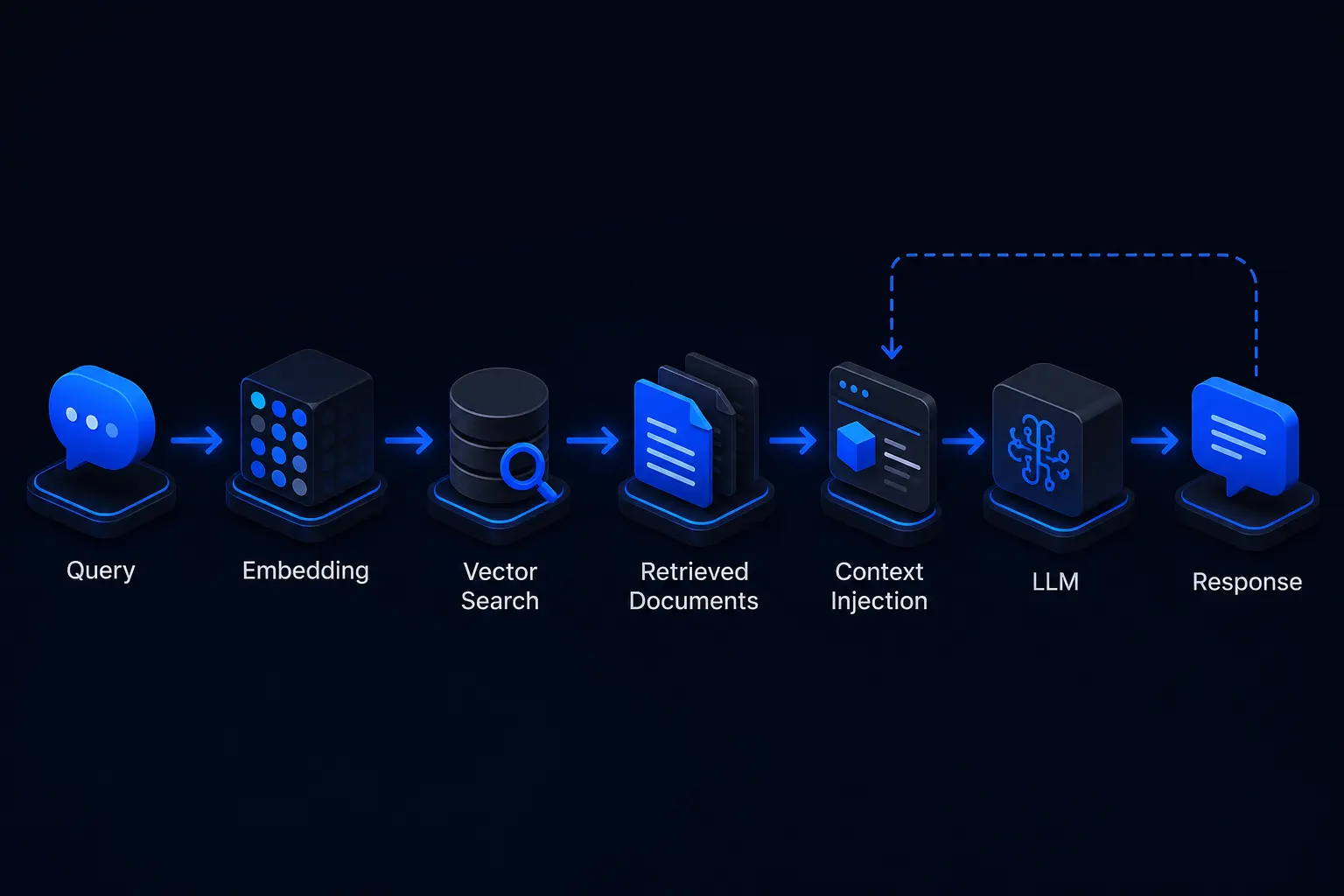
User query. A person or application sends a natural language question.
Embedding. The query is converted into a numerical vector using an embedding model, capturing its semantic meaning rather than just its keywords.
Vector search. That vector is compared against a vector database (tools like Pinecone, Weaviate, Chroma, Milvus, or FAISS are common choices) to find document chunks with similar meaning.
Relevant documents. The top-matching chunks are retrieved, often after a reranking step that reorders results by relevance using a more precise (but slower) model than the initial vector search.
Context injection. The retrieved text is inserted into the prompt alongside the original query, giving the LLM grounded, current information to work with.
LLM generation. The model generates a response using both its general language ability and the specific context it was just handed.
Response. The answer, ideally with citations back to the source documents, is returned to the user.
Core components of a RAG architecture
Embedding models turn text into vectors that capture meaning, enabling similarity search instead of brittle keyword matching.
Vector databases store and index those vectors for fast retrieval at scale.
Retriever executes the search and pulls back candidate documents.
Reranker re-scores those candidates for relevance before they reach the model.
Context window is where retrieved text lives temporarily, inside the prompt, without altering the model itself.
Advantages of RAG
Knowledge stays current without retraining: update the source documents and the next query reflects the change immediately.
It's easier to trace an answer back to a source document, which matters for audit trails and compliance.
It works well with private, sensitive, or fast-changing data that a foundation model was never trained on.
It's typically cheaper to stand up than a full fine-tuning pipeline, since you're not touching model weights.
Limitations of RAG
Retrieval quality caps answer quality: if the retriever pulls the wrong chunks, the model confidently builds on the wrong information.
It adds latency, since every query now involves a search step before generation.
It doesn't change how the model reasons, writes, or follows instructions; it only changes what information it has access to.
Poorly chunked or poorly maintained document stores lead to noisy, inconsistent answers over time, a problem sometimes called vector drift.
What Is Fine-Tuning
Fine-tuning takes a pretrained model and continues training it on a smaller, task-specific dataset, adjusting the model's internal weights so its behavior changes permanently. Where RAG changes what the model knows at query time, fine-tuning changes how the model behaves at every query.
This is a knowledge-versus-behavior distinction worth sitting with. A fine-tuned customer support model doesn't necessarily know your current return policy any better than the base model did, but it will consistently respond in your brand's voice, follow your ticket-formatting conventions, or classify tickets the way your team classifies them, because that pattern is now baked into its weights.
Types of fine-tuning
Supervised Fine-Tuning (SFT): the model is trained on labeled input-output pairs (for example, a support question paired with the ideal response) to teach it a specific task or output format.
Instruction tuning: a form of SFT focused on teaching the model to follow instructions more reliably across a range of tasks, which is how many general-purpose chat models are built from raw pretrained models.
Parameter-Efficient Fine-Tuning (PEFT): rather than updating all of a model's billions of parameters, PEFT methods update a small subset, dramatically cutting compute and storage costs.
LoRA (Low-Rank Adaptation): a PEFT technique that inserts small, trainable low-rank matrices into the model's layers instead of retraining the full weight matrices, making fine-tuning feasible on modest hardware.
QLoRA: combines LoRA with quantization of the base model's weights, further shrinking memory requirements so large models can be fine-tuned on a single GPU.
Full fine-tuning: every parameter in the model is updated, which typically produces the strongest task adaptation but requires substantially more compute, data, and MLOps maturity.
What actually changes
During fine-tuning, a training dataset of examples is run through the model repeatedly, and gradient updates nudge the model's weights toward producing outputs that match the examples. At inference time, no retrieval happens; the model simply generates from its now-adjusted weights. That's why fine-tuning is well suited to reshaping behavior, tone, and task performance, but poorly suited to injecting knowledge that changes weekly, since every knowledge update means another training run.
RAG Architecture Explained
A production RAG pipeline typically flows like this:
User Query
   ↓
Embedding (query converted to a vector)
   ↓
Vector Search (similarity search against a vector database)
   ↓
Relevant Documents (top-k chunks retrieved, often reranked)
   ↓
Context (retrieved text merged into the prompt)
   ↓
LLM (generates a response using query + context)
   ↓
Response (returned to the user, ideally with citations)
Each stage is a place where quality can be won or lost. The embedding model determines how well semantic meaning is captured: a poor embedding model will cluster unrelated concepts together. The vector database determines retrieval speed and scale. The reranker determines precision at the final cut. And the LLM's context window determines how much retrieved material can actually be used without crowding out the instructions or the user's original question.
How Fine-Tuning Works
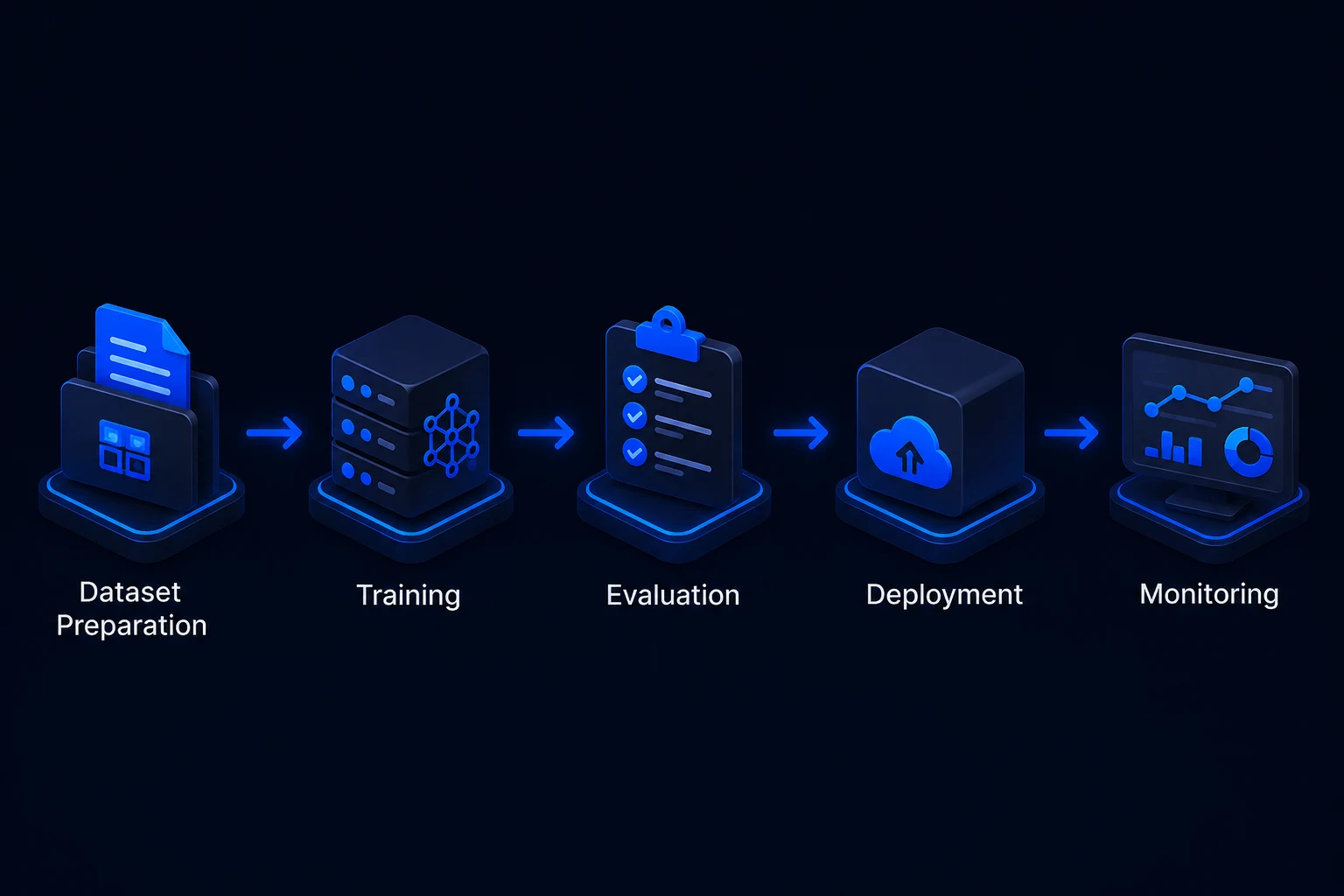
Dataset preparation. Curated examples are collected and formatted, often as instruction-response or prompt-completion pairs. Quality and consistency here matter more than sheer volume.
Training. The dataset is run through the model using an optimization method (full fine-tuning, LoRA, or QLoRA), with the model's weights updated to reduce error against the target outputs.
Model adaptation. The model's behavior shifts to reflect the patterns in the training data: a new tone, a new task format, a new classification scheme.
Evaluation. The tuned model is tested against held-out examples and business-specific benchmarks to check whether it actually improved on the target task without degrading general capability.
Deployment. The fine-tuned model (or adapter weights, in the case of LoRA) is deployed to production infrastructure.
Monitoring. Ongoing evaluation tracks drift, regressions, and edge cases, since a model's real-world performance can diverge from what benchmarks predicted.
RAG vs Fine-Tuning: The Complete Comparison
Comparison Point | RAG | Fine-Tuning |
|---|---|---|
Purpose | Ground responses in external knowledge | Change model behavior and task performance |
Knowledge updates | Instant, update the document store | Requires retraining or re-adapting |
Training cost | Low to none for the base model | Moderate to high, depending on method |
Latency | Higher, due to retrieval step | Lower, no retrieval overhead |
Infrastructure | Vector database, retriever, reranker | Training pipeline, GPUs, evaluation harness |
Model size impact | Base model unchanged | New model or adapter weights produced |
Scalability | Scales by adding documents | Scales by retraining on more examples |
Maintenance | Ongoing document curation | Periodic retraining cycles |
Real-time data | Strong fit | Poor fit |
Private data handling | Well suited, data stays in the retrieval layer | Data gets embedded into model weights |
Security surface | Access controls at the retrieval layer | Sensitive data can be memorized in weights |
Accuracy on facts | High, when retrieval is precise | Depends on training data recency |
Hallucination risk | Reduced, but not eliminated | Can still hallucinate outside training distribution |
Response quality | Strong on factual grounding | Strong on tone, format, and task consistency |
Customization type | What the model knows | How the model behaves |
Domain knowledge depth | Broad, as wide as the document store | Deep, on the specific patterns trained |
Deployment complexity | Moderate (retrieval pipeline to maintain) | Higher (training and evaluation pipeline) |
Retraining frequency | Rarely needed for the base model | Needed as behavior requirements evolve |
Cost profile | Ongoing inference and retrieval costs | Upfront training cost, then lower per-query cost |
Best use cases | Knowledge bases, support, search, compliance lookups | Style, classification, structured output, narrow tasks |
When to Use RAG
RAG tends to be the right default when the core problem is "the model doesn't know this," rather than "the model doesn't behave the way I want."
Customer support: grounding answers in current product docs and policies instead of a static training snapshot.
Internal knowledge bases: letting employees query HR policies, engineering wikis, or onboarding material in natural language.
Legal documents: surfacing relevant clauses or precedents from a firm's own case library.
Healthcare: retrieving current clinical guidelines or patient records to support (not replace) clinical decision-making.
Financial reports: pulling figures from the latest filings or internal financial data rather than relying on memorized numbers.
Product documentation: answering technical questions from manuals that change with every release.
Company wikis: turning scattered internal documentation into a single searchable interface.
Research: synthesizing findings across a large, evolving corpus of papers or reports.
Enterprise search: replacing keyword search with semantic search across internal systems.
AI chatbots: any conversational agent that needs to reflect information that changes faster than a retraining cycle would allow.
When Fine-Tuning Is Better
Fine-tuning tends to win when the problem is about consistent behavior, format, or narrow task performance rather than access to more facts.
Medical coding: teaching a model the precise structure and terminology of a coding system like ICD-10.
Fraud detection: adapting a model to recognize patterns specific to a company's transaction data and risk taxonomy.
Coding assistants: tuning a model to a specific codebase's conventions, internal libraries, or style guide.
Legal classification: training a model to sort documents into a firm's own case categories reliably.
Brand voice: locking in a consistent tone across thousands of generated marketing or support messages.
Translation: adapting a model to domain-specific terminology, such as medical or legal translation.
Industry-specific writing: teaching a model the conventions of, say, insurance underwriting language or pharmaceutical labeling.
Email automation: producing consistent structure and tone across high-volume automated communications.
Structured outputs: reliably producing a specific JSON schema or report format without prompt engineering doing all the work.
Can RAG and Fine-Tuning Work Together?
Yes, and in mature enterprise deployments, this is increasingly the norm rather than the exception. IBM frames prompt engineering, fine-tuning, and RAG as three distinct optimization levers that enterprises can combine depending on the use case, rather than competing alternatives.
A common hybrid pattern looks like this:
Fine-Tuned Model (consistent tone, task behavior, output format)
        +
RAG (real-time grounding in current, private data)
        +
AI Agents (multi-step reasoning, tool use, orchestration)
        =
Production Enterprise AI System
In practice, this might mean a fine-tuned model that has learned a company's support tone and ticket-classification behavior, wired to a RAG pipeline that retrieves the current policy or account details for the specific customer, orchestrated by an agent framework that can also call external tools, checking an order status, opening a ticket, or escalating to a human. Fine-tuning handles the "how," RAG handles the "what," and the agent layer handles the "what next."
Real-World Examples
Microsoft Copilot grounds responses in a user's own Microsoft 365 data (emails, documents, calendar) using a retrieval layer, while relying on underlying foundation models for language generation.
Google Vertex AI offers both managed RAG tooling (grounding, vector search) and supervised fine-tuning pipelines, letting enterprise customers choose per use case.
OpenAI provides fine-tuning APIs for its models alongside retrieval and file-search tools, positioning them as complementary options in its documentation.
Anthropic supports RAG-style grounding through tool use and context injection with Claude models, emphasizing retrieval and structured context over frequent retraining for most enterprise use cases.
Meta has released open-weight Llama models that the broader ecosystem fine-tunes for specific domains, while also publishing retrieval-augmented research architectures.
AWS Bedrock offers native "Knowledge Bases" for RAG alongside model customization features for fine-tuning, within a single managed service.
LangChain is a framework widely used to orchestrate RAG pipelines, chaining retrieval, reranking, and generation steps together.
LlamaIndex focuses specifically on data ingestion and indexing for RAG, connecting unstructured enterprise data to LLMs.
NVIDIA provides RAG reference architectures (such as its NeMo Retriever tooling) alongside fine-tuning frameworks for enterprises building on its stack.
IBM Watsonx offers both RAG capabilities and fine-tuning/prompt-tuning options within its enterprise AI platform, explicitly positioning them as complementary tools rather than substitutes.
Common Myths
"RAG replaces fine-tuning." They solve different problems, knowledge access versus behavior change, and many production systems use both.
"Fine-tuning stores company documents." Fine-tuning adjusts weights based on patterns in training examples; it isn't a reliable way to store or retrieve specific documents on demand, and it can inadvertently memorize sensitive snippets rather than cleanly "containing" them.
"RAG trains the model." RAG doesn't touch model weights at all; it only changes what's in the prompt at inference time.
"Fine-tuning eliminates hallucinations." A fine-tuned model can still generate incorrect information, especially outside the distribution of its training data.
"Bigger models don't need RAG." Even the largest models have a training cutoff and no access to private enterprise data, so scale alone doesn't solve the knowledge-freshness problem.
Challenges
Cost: RAG carries ongoing infrastructure and retrieval costs; fine-tuning carries upfront training costs that can recur with every retraining cycle.
Latency: retrieval steps add response time in RAG systems; fine-tuned models respond faster but can't adapt to new information without redeployment.
Security: RAG systems must enforce access controls at the retrieval layer; fine-tuned models risk memorizing sensitive training data into their weights.
Context window limits: even with long-context models, there's a ceiling on how much retrieved text can be stuffed into a single prompt before quality degrades.
Vector drift: as document stores grow and change, embeddings can become inconsistent with newer content unless re-indexed regularly.
Data freshness: fine-tuned models age the moment training ends; RAG systems age only as fast as their underlying documents go stale.
Training data quality: fine-tuning results are only as good as the labeled examples used, and poor-quality data can quietly degrade general model capability.
Evaluation: measuring "did this get better" is harder than it sounds for both approaches, especially for open-ended generation tasks.
Governance: both approaches need clear ownership over what data feeds the system and how outputs are reviewed.
Compliance: regulated industries need auditable answers to "why did the model say that," which favors RAG's traceability but requires discipline in either architecture.
Future Trends
Agentic AI: systems that plan, call tools, and take multi-step actions are increasingly layered on top of both RAG and fine-tuned models rather than replacing either.
Memory systems: persistent memory across sessions is emerging as a third pillar alongside retrieval and fine-tuning, letting systems remember user-specific context over time.
Long-context models: as context windows grow, some retrieval use cases shrink, though retrieval still wins for very large or frequently changing corpora.
Knowledge graphs: structured relationships between entities are being combined with vector retrieval for more precise, explainable grounding.
Multimodal RAG: retrieval is expanding beyond text to images, audio, and video, broadening what "context" can mean.
Self-improving AI: feedback loops that use production outcomes to refine retrieval quality or guide targeted fine-tuning are becoming more common in mature AI teams.
Enterprise AI platforms: vendors are increasingly bundling RAG, fine-tuning, and agent orchestration into single managed platforms rather than requiring separate tools.
Decision Matrix: Business Goal to Recommended Approach
Business Goal | Recommended Approach |
|---|---|
Answer questions from an internal wiki | RAG |
Keep a chatbot's tone consistent with brand guidelines | Fine-Tuning |
Ground a legal research assistant in current case law | RAG |
Build a coding assistant tuned to an internal codebase | Fine-Tuning |
Support agents needing the latest product specs | RAG |
Automatically classify support tickets into internal categories | Fine-Tuning |
Search across financial filings that update quarterly | RAG |
Generate structured JSON output in a fixed schema | Fine-Tuning |
Provide compliance answers with source citations | RAG |
Translate industry-specific medical terminology | Fine-Tuning |
Power an enterprise search tool across many document types | RAG |
Detect fraud patterns specific to one company's transactions | Fine-Tuning |
Build a research assistant synthesizing recent papers | RAG |
Maintain a consistent voice across thousands of marketing emails | Fine-Tuning |
Combine real-time grounding with a specialized agent's behavior | Hybrid (RAG + Fine-Tuning) |
Pros and Cons
RAG | Fine-Tuning | |
|---|---|---|
Pros | Fresh knowledge, traceable answers, lower upfront cost, easier to update | Consistent behavior, faster inference, strong on narrow tasks, no retrieval dependency |
Cons | Added latency, retrieval quality dependency, ongoing document maintenance | Costly retraining, slower to update knowledge, risk of overfitting to narrow data |
Architecture Comparison
RAG | Fine-Tuning | |
|---|---|---|
Core components | Embedding model, vector database, retriever, reranker, LLM | Base model, training dataset, optimizer, evaluation harness |
Where knowledge lives | External document store | Model weights |
Update mechanism | Re-index documents | Retrain or re-adapt weights |
Cost Comparison
RAG | Fine-Tuning | |
|---|---|---|
Upfront cost | Low to moderate (retrieval infrastructure) | Moderate to high (compute for training) |
Ongoing cost | Retrieval and vector database hosting | Periodic retraining as needs evolve |
Cost driver | Document volume and query volume | Model size and training data volume |
Performance Comparison
RAG | Fine-Tuning | |
|---|---|---|
Response latency | Higher (retrieval + generation) | Lower (generation only) |
Factual accuracy on private data | High, if retrieval is well-tuned | Depends on training data recency |
Consistency of tone/format | Variable, depends on prompting | High, built into weights |
Adaptability to new information | Immediate | Requires retraining |
Frequently Asked Questions
What is the main difference between RAG and fine-tuning?
RAG gives a model access to external information at query time without changing its weights, while fine-tuning permanently adjusts a model's weights to change its behavior.
Is RAG cheaper than fine-tuning?
Generally, yes for getting started, since RAG avoids training compute costs, but RAG carries its own ongoing retrieval infrastructure costs that scale with usage.
Can I use RAG without fine-tuning?
Yes. Many production systems use RAG alone, especially when the goal is grounding answers in current or private data rather than changing model behavior.
Does fine-tuning eliminate the need for prompt engineering?
No. Fine-tuned models still benefit from well-designed prompts; fine-tuning shifts the model's default behavior, but prompting still shapes individual responses.
Which approach reduces hallucinations more effectively?
RAG tends to reduce hallucinations on factual, document-grounded questions because the model has real source material to draw from, though neither approach eliminates hallucination entirely.
Is fine-tuning a good way to add proprietary company knowledge?
It's better suited to teaching behavior and patterns than to reliably storing and recalling specific documents; RAG is generally the more reliable choice for that.
What is LoRA and why does it matter for fine-tuning?
LoRA is a parameter-efficient fine-tuning method that trains small additional weight matrices instead of the full model, making fine-tuning far cheaper and more accessible.
Do I need a vector database to build RAG?
Yes, in most architectures a vector database (such as Pinecone, Weaviate, Chroma, Milvus, or FAISS) stores document embeddings for fast similarity search.
Can RAG and fine-tuning be combined in one system?
Yes, and this hybrid approach is increasingly common in enterprise deployments, using fine-tuning for consistent behavior and RAG for current, private knowledge.
How do I decide between RAG and fine-tuning for my use case?
Ask whether the core problem is "the model doesn't know this" (favor RAG) or "the model doesn't behave this way" (favor fine-tuning); many real use cases need both.
Key Takeaways
RAG adds external knowledge at query time without touching model weights; fine-tuning changes the model's weights and, with them, its behavior.
RAG is the stronger fit for knowledge that changes often or lives in private, sensitive document stores.
Fine-tuning is the stronger fit for consistent tone, structured output, and narrow task specialization.
Neither approach eliminates hallucination risk entirely, and both require ongoing maintenance and evaluation.
Leading vendors, including Microsoft, Google, AWS, and IBM, increasingly offer both capabilities in a single platform, reflecting how often enterprises need both.
Hybrid architectures combining fine-tuning, RAG, and AI agents are becoming the standard pattern for production enterprise AI.
Conclusion
RAG and fine-tuning answer two different questions. RAG answers "does the model have access to the right information right now?" Fine-tuning answers "does the model behave the way we need it to, every time?" Enterprises that treat these as competing options tend to over-invest in one and under-solve the other. Enterprises that treat them as complementary tools, grounding a model's knowledge with retrieval while shaping its behavior with targeted fine-tuning, tend to build systems that are both accurate and reliable. As agentic AI, longer context windows, and managed enterprise platforms mature, the practical question is shifting from "RAG or fine-tuning" to "how much of each, and where."
Comments (0)
No comments yet. Be the first to share your thoughts!