Sarvam AI: The Aadhaar Architect and the AI4Bharat Researcher Building India's Sovereign AI Stack
Author
Ravi Prajapati

Two IIT and Aadhaar veterans left deep-tech careers to build Sarvam AI, now valued for sovereign, India-first models beating Gemini and ChatGPT on benchmarks.
Some founders chase a trend. Others spend twenty years building toward a moment, then move the instant it arrives.
Dr. Vivek Raghavan and Dr. Pratyush Kumar had circled the same problem from different directions for over a decade before starting a company together. Raghavan served as Chief Product Manager and Biometric Architect at UIDAI, helping design and implement Aadhaar, and later mentored AI4Bharat at IIT Madras as Chief AI Evangelist for the EkStep Foundation, advising Digital India Bhashini on delivering government services in local languages. Before that, he spent 20 years in Electronic Design Automation, founding and selling two EDA companies. He holds a B.Tech in Electrical Engineering from IIT Delhi and a PhD in Electrical and Computer Engineering from Carnegie Mellon University.
Kumar holds a B.Tech in Electrical Engineering from IIT Bombay and a PhD in Computer Engineering from ETH Zurich, and spent years at Microsoft Research and IBM Research before co-founding Sarvam. He also co-founded AI4Bharat, the research lab focused on open-source AI tools and datasets for Indian languages.
The Problem: The "Token Tax"
At AI4Bharat, the two built some of the world's largest open-source datasets for Indian languages and realized that global models like GPT were mathematically inefficient for Indian scripts, a problem they called the "Token Tax," where Indian languages cost 5 to 10 times more to process than English.
Kumar co-founded Sarvam AI in August 2023 alongside Raghavan, with a mission to build a full-stack generative AI platform focused on voice-enabled applications and efficient models for India's multilingual needs.
The Build
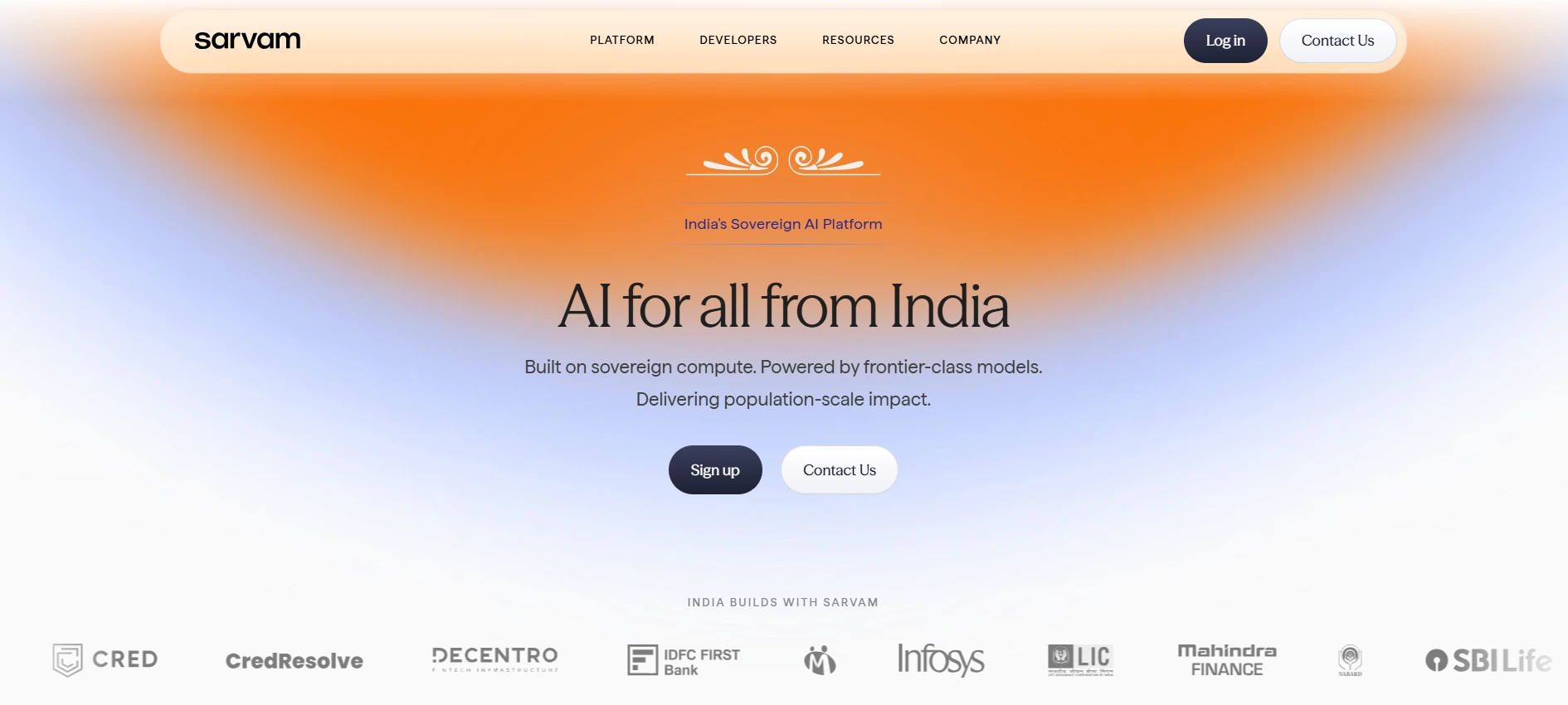
Rather than building applications on top of someone else's models, the pair set out to build the foundational models themselves, trained on trillions of India-specific data points.
The bet paid off fast. In December 2023, Sarvam announced a combined seed and Series A round of approximately $41 million, led by Lightspeed Venture Partners, with participation from Peak XV Partners and Khosla Ventures. In February 2026, the company released two foundational models: Sarvam-30B, a 30 billion parameter mixture-of-experts model, and Sarvam-105B, built for complex reasoning and enterprise use. A beta version of Sarvam-105B, named Indus, launched shortly after on the Apple App Store, Google Play, and the web.
The company has also built multimodal systems including a speech model called Saaras V3 and a vision-language model, Sarvam Vision, aimed at document understanding and OCR in Indian scripts.
The Recognition
Sarvam has been selected to contribute to India's sovereign AI model initiative under the IndiaAI Mission, and presented its models at the India AI Impact Summit 2026 in New Delhi. Attention peaked when Prime Minister Narendra Modi was seen wearing a pair of AI driven spectacles at that summit, Sarvam Kaze, a wearable developed by the company that supports more than 10 Indian languages for voice interaction and translation.
The Numbers
A record $41 million seed/Series A round in December 2023, the largest for an Indian AI startup at the time
Sarvam Vision reportedly leads OCR benchmarks with 84.3% accuracy on olmOCR-Bench, ahead of Gemini 3 Pro and DeepSeek OCR v2
Founders reportedly hold over 51.34% of the company as of late 2025
Why It Matters
Sarvam's story is two deep-tech veterans applying twenty years of infrastructure-building experience, one in national identity systems, one in multilingual research, to a single, deliberately unglamorous thesis: that AI built for India has to be built in India, on Indian data, from the ground up.
The Takeaway
Raghavan and Kumar did not wait for permission to build something the world said only a handful of countries could build. They spent twenty years in unglamorous, behind-the-scenes work, biometric systems, chip design, research labs, before ever writing a line of code for Sarvam. That patience is the real lesson here.
The next big AI breakthrough will not always come from the loudest voice in the room. Sometimes it comes from two engineers who spent decades solving smaller, harder problems first, then had the conviction to bet everything the moment the world caught up to what they already understood. If there is one thing every founder can take from Sarvam's story, it is this: build the foundation first, even when no one is watching. The recognition comes later. The work has to come first.
Comments (0)
No comments yet. Be the first to share your thoughts!