UN University Rector Tshilidzi Marwala: “You Can’t Regulate AI Without Understanding It

Author
Ravi Prajapati
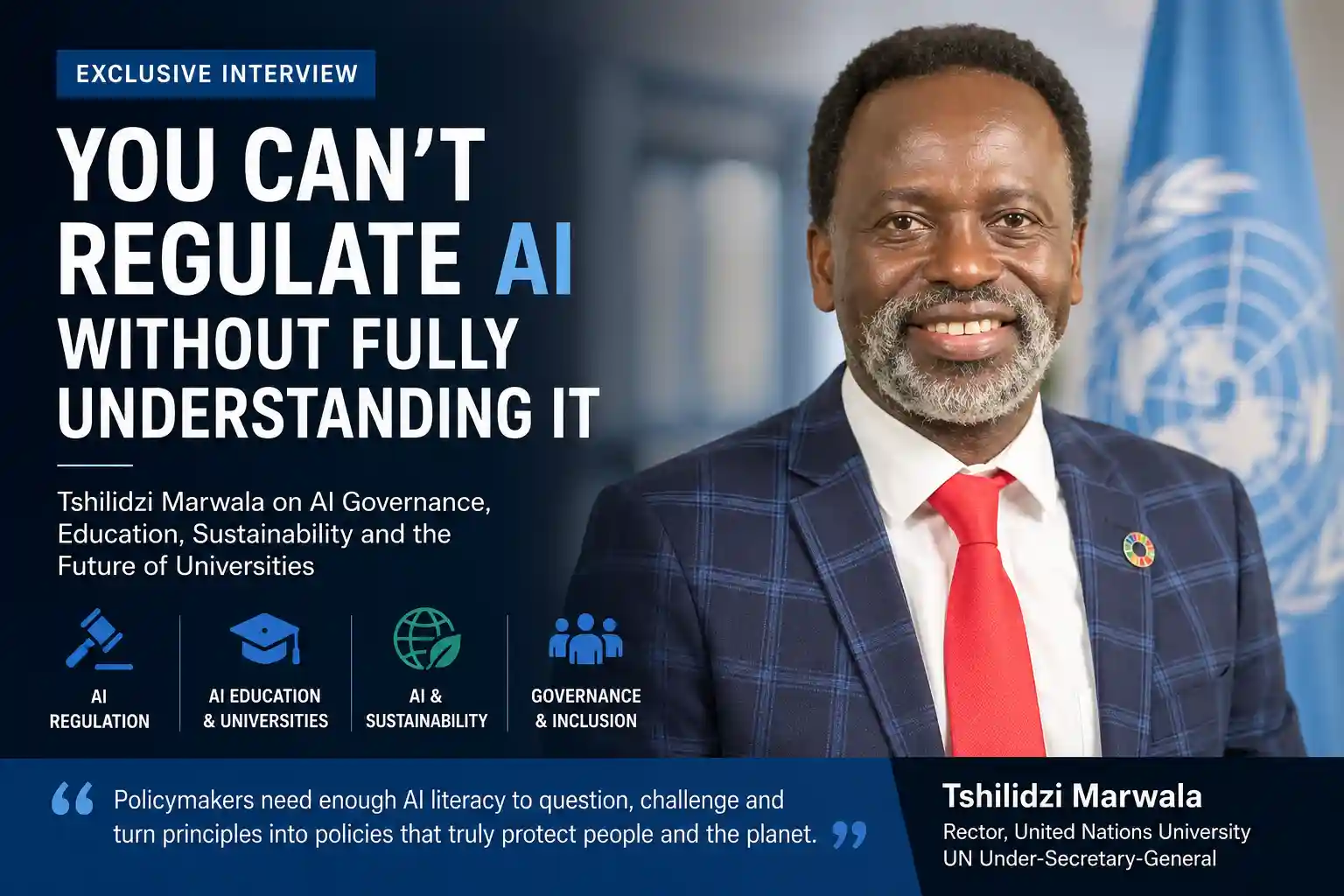
UN University Rector Tshilidzi Marwala discusses AI regulation, governance, education, sustainability and why policymakers need stronger AI literacy.
Artificial intelligence regulation is advancing around the world, but Professor Tshilidzi Marwala believes policymakers face a fundamental problem: many of the people responsible for governing AI still do not understand the technology well enough.
Marwala, Rector of the United Nations University (UNU) and a United Nations Under-Secretary-General, is an engineer, academic and longtime artificial intelligence researcher. His concern is not that every politician needs to understand the mathematics behind a large language model. Rather, policymakers need enough AI literacy to question companies, recognise risks and turn broad principles such as transparency, fairness and accountability into rules that can actually be enforced.
Speaking to Geneva Solutions around the UN Global Dialogue on AI Governance held on 6–7 July 2026, Marwala discussed the growing gap between AI development and AI governance, the environmental cost of AI infrastructure, the future of universities and why education may ultimately determine whether AI regulation succeeds.
Interview: Tshilidzi Marwala on Governing the AI Era
Q: What did the UN Global Dialogue on AI Governance reveal about where the world currently stands on AI regulation?
Tshilidzi Marwala: One of the important developments is that AI governance is increasingly being recognised as something much broader than a specialist technology issue.
Governments have already spent considerable time discussing principles. The challenge now is moving from those principles towards practical cooperation — building capacity, developing partnerships and creating mechanisms through which countries can participate meaningfully in AI governance.
That inclusion matters particularly for countries that historically have had limited influence over the technical standards shaping emerging technologies.
The discussion, in other words, is moving from what responsible AI should look like towards how responsible AI can actually be implemented.
Q: Why is AI literacy so important for policymakers?
Marwala: Regulation can look strong on paper while becoming ineffective very quickly if those responsible for enforcing it cannot understand the technology they are regulating.
AI systems depend on interconnected layers of data, algorithms and computing infrastructure. Policymakers do not need to become software engineers, but they need sufficient technical fluency to ask informed questions and challenge questionable claims.
As Marwala puts it:
“You can’t regulate what you don’t fully understand.”
That becomes particularly important when governments are dealing with powerful technology companies whose technical expertise may significantly exceed that available inside regulatory institutions.
A policymaker who understands the fundamentals of AI is better positioned to question how a model was trained, what data it relies upon, how its outputs are evaluated, where bias could enter the system and who should be accountable when something goes wrong.
For Marwala, therefore, AI education for legislators should be viewed as part of governance infrastructure rather than an optional technology course.
Q: Is there a danger that regulation will always lag behind AI development?
Marwala: That risk becomes much greater when policymakers lack technical understanding.
AI capabilities can evolve faster than legislation. Regulations written around today's technology may become outdated as models, computing systems and applications change.
This is why regulation cannot simply consist of fixed rules. Governments need institutions capable of continuously understanding the technology and translating scientific developments into practical policy.
The United Nations University sees itself as part of that bridge between scientific research and policymaking.
Marwala's broader work on AI governance has similarly argued for governance structures capable of balancing innovation with ethical concerns, human rights and social welfare rather than treating AI oversight as a purely technical problem.
Q: Is that why the United Nations University is creating a dedicated AI institute?
Marwala: Yes. One challenge within international institutions is that AI is frequently discussed at the policy level without policymakers necessarily working closely enough with the underlying technology.
UNU is establishing an AI and big-data institute in Bologna, Italy, intended to narrow that gap.
The institute will benefit from proximity to the Bologna Technopolo and the Leonardo supercomputer and is expected to work directly with AI, big data and supercomputing.
Its research will examine complex issues including climate change, demographic shifts and economic transitions, with the aim of turning technical research into practical tools and evidence for policymakers.
This represents an important change in approach: AI governance institutions increasingly need not only lawyers and diplomats, but also researchers and technologists capable of understanding what advanced systems actually do.
Q: AI governance conversations often focus on safety and misinformation. What about AI's environmental impact?
Marwala: Environmental sustainability deserves considerably more attention.
The infrastructure supporting modern AI requires enormous amounts of electricity, water and physical resources. Looking only at carbon emissions can also produce an incomplete picture.
Research highlighted by UNU shows why these trade-offs matter. An energy source that appears preferable when measured purely through carbon emissions could have significantly greater consequences for water consumption or land use.
According to figures discussed by Marwala, AI-related data centres could by 2030 consume electricity approaching three times the combined electricity consumption of Pakistan, Bangladesh and Nigeria. Their water footprint could also become comparable to the basic domestic water requirements of approximately 1.3 billion people in sub-Saharan Africa.
For governments, that changes the AI infrastructure debate.
Data centres are not simply digital infrastructure. Their electricity, water and land requirements increasingly make them physical infrastructure projects with environmental consequences.
Marwala argues that governments therefore need to evaluate carbon, water and land footprints together when deciding where AI infrastructure should be built and how it should be regulated.
Q: What does AI mean for universities and higher education?
Marwala: AI forces universities to reconsider what students actually need to learn.
The calculator offers a useful historical comparison. Before calculators became widely available, people needed to master manual methods for calculations that machines can now perform instantly.
Generative AI potentially represents a much larger version of that shift.
Today's systems can generate essays, summarise research, analyse information, write software and perform tasks that previously formed part of university assessment.
That raises a difficult question: if AI can perform the task, should universities continue assessing students primarily on their ability to perform that task?
Marwala believes verification will become increasingly important. Students need to understand how to determine whether AI-generated information is accurate rather than simply accepting machine-generated output.
Q: Does that mean traditional essays and coursework are becoming obsolete?
Marwala: Universities need to adapt their assessments.
If students have easy access to systems capable of producing competent essays, repeatedly assigning conventional essays and then complaining that students used AI misses the larger issue.
Education should increasingly test abilities that cannot simply be outsourced to a chatbot: gathering original information, interpreting evidence, analysing data, defending conclusions and demonstrating individual reasoning.
AI therefore creates pressure to redesign assessment rather than merely police AI usage.
Q: Could relying on AI weaken critical thinking?
Marwala: It could, if education systems allow students to outsource too much of their thinking.
Critical thinking therefore needs to remain central to future curricula.
Students still need the ability to question information, exercise judgement, communicate with other people, read closely, write clearly and engage critically with evidence.
The objective should not be to choose between human intelligence and artificial intelligence. Education needs to determine which cognitive tasks technology can reasonably assist with while protecting the capabilities humans still need to develop themselves.
Q: What needs to change for teachers?
Marwala: AI literacy cannot stop with students.
Teachers need appropriate training, and educational material about AI needs to become more accessible.
One current problem is the gap between highly technical explanations produced for specialists and oversimplified descriptions aimed at the general public.
Marwala argues for a clearer language around AI — accessible enough for non-specialists while remaining technically meaningful.
That principle applies beyond schools. Policymakers, executives, journalists and members of the public increasingly need enough AI literacy to make informed decisions about systems affecting their lives.
Q: Could AI ultimately threaten universities themselves?
Marwala: Universities have survived previous technological shifts, including personal computers, the internet, social media and mobile technology. But AI presents another fundamental challenge to assumptions about how universities operate.
If machines can perform analytical tasks that institutions have traditionally used to measure student ability, universities will have to reconsider both teaching and assessment.
As Marwala argues, AI exposes the vulnerability of the idea that universities can remain largely unchanged while technology transforms everything around them.
The more important question may therefore not be whether AI will replace universities, but whether universities can redesign themselves quickly enough for an era in which access to machine intelligence becomes routine.
AI Governance Is Becoming an Education Problem
Marwala's argument connects several debates that are often treated separately.
AI regulation, education, environmental sustainability, inequality and technological development are increasingly parts of the same governance problem.
Governments cannot effectively scrutinise AI companies without technical literacy. Teachers cannot prepare students for AI-enabled workplaces without understanding the technology themselves. Universities cannot preserve meaningful assessment without reconsidering what humans should learn when machines can perform more intellectual tasks. And governments cannot expand AI infrastructure indefinitely without considering its demands on electricity, water and land.
That makes AI literacy more than a workforce skill.
It is becoming part of the institutional infrastructure required to govern artificial intelligence.
Marwala's central message is therefore less about slowing AI development than ensuring society's ability to understand the technology develops alongside it.
The engineers building increasingly capable AI systems will continue pushing the technology forward. The harder challenge may be ensuring lawmakers, educators and institutions do not fall so far behind that they lose the ability to question, govern and meaningfully shape where those systems take society.
Source: Based on Kasmira Jefford's interview with Professor Tshilidzi Marwala for Geneva Solutions, published 24 July 2026 and updated 27 July 2026, with additional background from the United Nations University.
Comments (0)
No comments yet. Be the first to share your thoughts!