Unified AI Governance Architecture: A Practical Guide to Frameworks, Layers, and Implementation

Author
Ravi Prajapati

Learn how a unified AI governance architecture connects AI policies, risk management, security, compliance, and monitoring across the enterprise.
A unified AI governance architecture gives an organization a coordinated way to manage AI systems, policies, risks, security controls, accountability, and compliance throughout the AI lifecycle. Instead of governing each AI application independently, it connects business ownership, technical safeguards, risk assessment, monitoring, and oversight through shared processes.
For enterprises deploying machine learning models, generative AI applications, and AI agents, the objective is not to create another layer of bureaucracy. It is to establish clear rules for how AI systems are approved, deployed, monitored, changed, and retired.
The practical challenge is that AI governance spans several different responsibilities. Legal teams interpret applicable regulations. Security teams manage threats and access. Data teams oversee data quality and privacy. Engineering teams test models and monitor production behavior. Business leaders remain accountable for the decisions made with AI.
A unified architecture connects these responsibilities without requiring every team to use identical tools or follow identical controls.
This guide explains the core architectural layers, how established frameworks such as the NIST AI Risk Management Framework and ISO/IEC 42001 fit into the design, and how organizations can implement governance without slowing down legitimate AI development.
What Is a Unified AI Governance Architecture?
A unified AI governance architecture is an organizational and technical design that brings AI policies, accountability, risk management, compliance, security, lifecycle controls, and monitoring into a coordinated governance system.
It establishes common requirements across AI initiatives while allowing individual applications to receive controls appropriate to their purpose, risk, and operating environment. The architecture may include centralized policies and reporting, shared technical services, standardized approval workflows, and application-specific safeguards.
For example, a company using AI for internal document search, customer support, employee recruitment, and financial forecasting should not necessarily apply identical approval requirements to all four applications. However, each application should have an identifiable owner, a documented purpose, appropriate security controls, and a process for assessing and addressing risks.
A unified approach makes those requirements consistent and traceable.
The term unified AI governance architecture describes a design approach, not a single universally prescribed architecture or an official certification standard. Organizations can implement it using different combinations of governance frameworks, internal policies, software platforms, and technical controls.
What does the architecture unify?
Policies and accountability: Who can authorize AI use, who owns each system, and who is responsible when something goes wrong.
Risk management: How an organization identifies, assesses, prioritizes, and treats AI-related risks.
Technical controls: How access restrictions, testing, monitoring, logging, and security safeguards are enforced.
Compliance management: How applicable legal, regulatory, contractual, and internal requirements are translated into operational controls.
Lifecycle oversight: How AI systems move from experimentation to production and remain monitored throughout their use.
Evidence and reporting: How teams demonstrate that required assessments, approvals, tests, and corrective actions have taken place.
The result is a shared governance model with controls that can be applied consistently across different AI systems, rather than a collection of disconnected policies and project-specific checklists.
Why Enterprises Need a Unified Approach to AI Governance
AI governance becomes harder to coordinate as AI use expands across departments, platforms, and business processes. A team might use an approved enterprise model through an internal application, another team might connect a third-party AI API, and employees might adopt separate AI tools for everyday work.
Without shared oversight, the organization may struggle to determine which systems are in use, what data they process, which business decisions they influence, and whether the required controls are in place.
A unified architecture addresses these problems through common processes and visibility.
1. AI inventory and ownership
An organization cannot govern systems it does not know exist. An AI inventory provides a record of the systems being developed, purchased, integrated, or used by employees.
Useful inventory fields include the system's business purpose, owner, provider, model or service dependencies, data categories, deployment environment, risk classification, and current lifecycle status.
The inventory should also distinguish between an AI model and the application that uses it. A single model may support multiple applications with different data access, users, and consequences.
2. Consistent risk assessment
Different teams often evaluate AI risks using different terminology and methods. One team may focus on data privacy, another on model accuracy, and another on regulatory obligations.
A shared assessment process helps connect these concerns. It can consider the potential impact on individuals, data sensitivity, decision-making authority, security exposure, model limitations, and the consequences of incorrect outputs.
Risk classification should influence the depth of review, testing, approval, and monitoring. A low-impact internal summarization tool generally does not need the same controls as an AI system that influences hiring or access to essential services.
3. Security and privacy across AI systems
AI applications introduce security and privacy considerations that extend beyond traditional application security. These may include sensitive information entering prompts, excessive tool permissions, unauthorized data retrieval, prompt injection, insecure integrations, and unintended disclosure through generated outputs.
A unified architecture connects AI-specific safeguards with established identity management, data protection, application security, and incident-response processes.
It should also account for third-party services. An application may be governed by the organization's policies while depending on a model provider whose processing, retention, or security practices require separate evaluation.
4. Traceability and accountability
When an AI system produces an unexpected result, teams need to establish what happened and who is responsible for responding.
Depending on the application, useful evidence may include the model version, application configuration, retrieval sources, relevant input and output records, evaluation results, human review, approval history, and subsequent corrective actions.
Not every system should retain complete prompts and outputs indefinitely. Logging must be designed around investigation needs, data minimization, access controls, retention requirements, and applicable privacy obligations.
5. Regulatory and policy alignment
Organizations operating across markets may need to address different legal requirements, contractual obligations, and industry-specific expectations.
A unified architecture can map these requirements to shared controls and identify where additional safeguards are necessary. It should not assume that one framework or certification automatically satisfies every applicable law.
This distinction is especially important for multinational enterprises. A common global policy can provide consistency, while regional rules and application-specific requirements determine the additional controls needed for particular deployments.
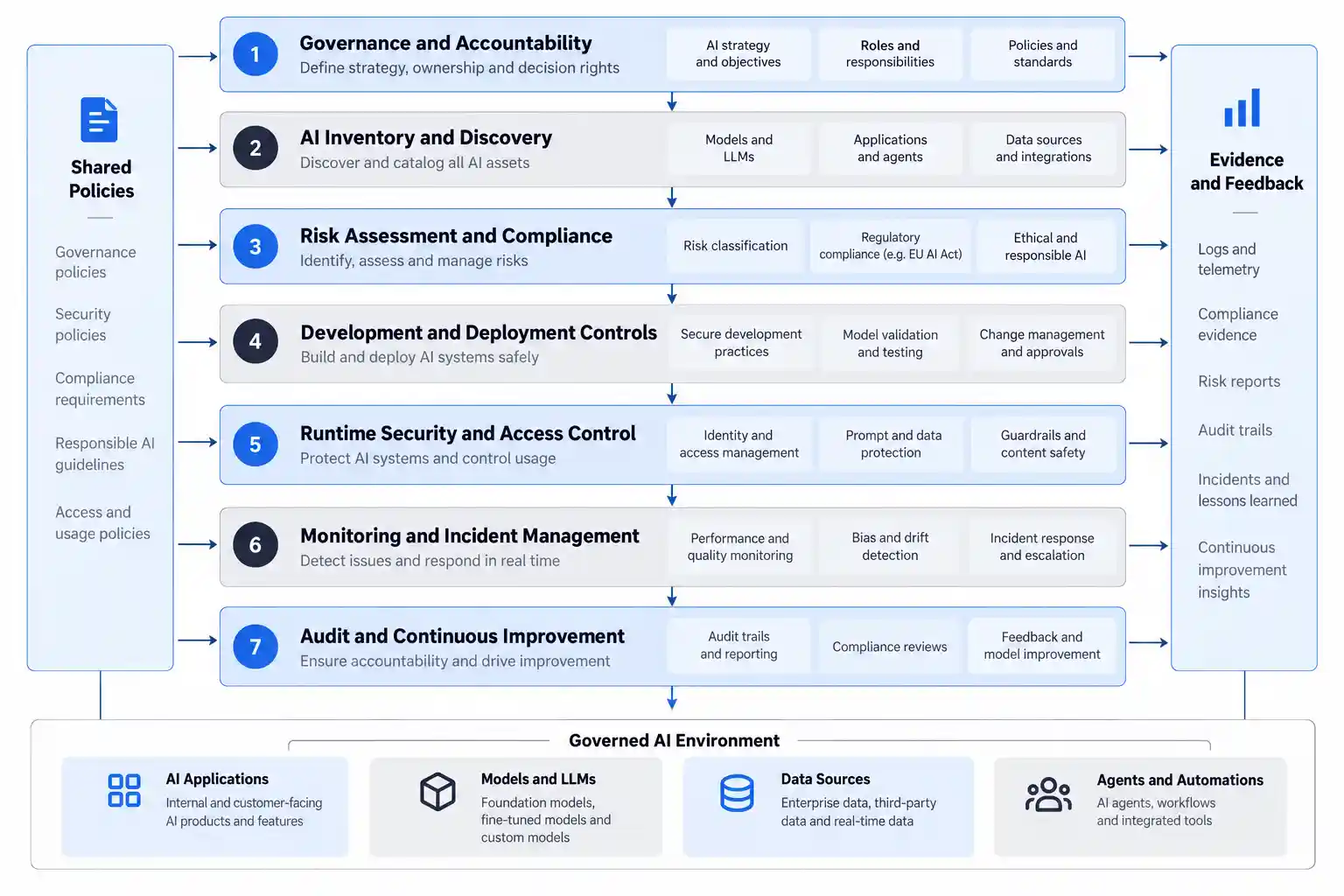
Core Layers of a Unified AI Governance Architecture
A practical architecture separates governance responsibilities into layers while connecting them through shared policies, evidence, and accountability. The following model is a proposed implementation pattern, not an official architecture mandated by NIST or ISO.
Each layer has a distinct responsibility, but the layers must work together. A risk assessment, for example, should influence technical controls, release approval, monitoring requirements, and escalation procedures.
1. Governance strategy and accountability layer
This layer establishes the organization's AI governance policy, risk appetite, decision-making authority, and oversight responsibilities.
Senior leadership defines the business objectives and the level of risk the organization is willing to accept. A designated AI governance committee or equivalent group coordinates decisions across business, legal, security, privacy, data, and engineering teams.
Key responsibilities include:
Defining acceptable and prohibited AI uses.
Assigning business owners and technical owners to AI systems.
Establishing approval and escalation procedures.
Defining risk acceptance authority.
Setting requirements for human oversight.
Reviewing significant incidents and governance performance.
Governance should not exist only as a policy document. It needs clear decision rights. For instance, an engineering team may be authorized to release a low-risk internal tool after completing predefined checks, while a system with substantial potential consequences may require additional legal, risk, or executive review.
2. AI inventory and discovery layer
The inventory layer provides visibility into AI systems, including applications built internally, externally hosted models, third-party AI services, and AI capabilities embedded in business software.
A useful inventory records more than model names. It should identify the complete application context, including the data it accesses, the people affected, the decisions it supports, and the systems it depends on.
Inventory field | What it helps establish |
|---|---|
System and application name | Which AI capability is being governed |
Business owner | Who is accountable for the intended use |
Technical owner | Who maintains the implementation |
Provider and model | Which external or internal AI components are involved |
Data categories | What information the application processes |
Intended use | What the system is permitted to do |
Risk classification | What level of review and control is required |
Deployment status | Whether the system is experimental, approved, active, or retired |
Dependencies | Which APIs, databases, retrieval systems, and tools it relies on |
Review history | When the system was assessed and approved |
The inventory should be connected to procurement, software development, cloud environments, and employee AI-use policies wherever practical.
It also needs an update mechanism. A system's risk profile can change when its model, data sources, intended purpose, permissions, or user population changes.
3. Risk assessment and classification layer
This layer determines how much oversight each AI system needs.
A risk assessment should consider the intended use, potential harms, affected people, data sensitivity, degree of automation, human oversight, and consequences of failure. It should also consider the surrounding application rather than evaluating the underlying model in isolation.
For example, a general-purpose language model used to summarize public documentation presents a different risk profile from the same model connected to confidential employee records or a tool that can execute financial transactions.
A practical internal classification model might use three levels:
Internal risk tier | Example use case | Typical governance response |
|---|---|---|
Lower risk | Internal summarization of approved public documents | Standard security checks, ownership, basic evaluation, and periodic review |
Moderate risk | Customer support assistant accessing approved knowledge bases | Privacy assessment, retrieval controls, output testing, human escalation, and ongoing monitoring |
Higher risk | AI influencing recruitment, credit decisions, or consequential eligibility assessments | Enhanced impact assessment, specialist review, documented human oversight, stronger validation, and formal approval |
These are illustrative enterprise tiers, not official NIST or EU AI Act classifications. They should not be treated as legal determinations. Applicable regulations may prescribe specific classifications and obligations that an organization's internal scoring system cannot replace.
The risk assessment should also be repeatable. Two teams deploying comparable applications should be able to explain why they received similar or different controls.
4. Policy and compliance mapping layer
The policy layer translates high-level governance principles into requirements that teams can apply.
A policy might require that sensitive data cannot be sent to an unapproved external AI service. Another might require documented evaluation before an AI application is used in a customer-facing workflow.
The compliance function maps applicable requirements to controls and evidence.
For example:
Requirement area | Example operational control | Example evidence |
|---|---|---|
Data privacy | Restrict data access and minimize personal information in prompts | Privacy assessment, access configuration, data-flow documentation |
Security | Authenticate users and restrict model or tool permissions | Access policies, security test results, audit logs |
Transparency | Inform users when required that they are interacting with AI | Interface review, approved disclosures, testing records |
Human oversight | Require authorized review for defined high-impact decisions | Workflow configuration, review records, escalation logs |
Reliability | Test the application against representative scenarios | Evaluation reports, acceptance criteria, regression results |
Change management | Reassess material changes before release | Version history, change approval, updated risk assessment |
The important distinction is between a policy and an enforceable control. A policy says what must happen. A control makes it happen, or identifies when it has not happened.
Where possible, controls should be embedded in existing procurement, identity management, software delivery, and incident-response workflows instead of being managed through disconnected documents.
5. AI development and deployment control layer
This layer connects governance requirements to the engineering lifecycle.
AI governance should begin before deployment. Teams should identify the intended use, permitted data, evaluation criteria, security requirements, and approval conditions during design and development.
A controlled release process may include:
Register the AI application and assign owners.
Complete the required risk and data assessments.
Evaluate the model and application against defined acceptance criteria.
Test security, privacy, access restrictions, and failure scenarios.
Record approvals and deployment conditions.
Release the application with the required monitoring and rollback mechanisms.
Not every experiment needs the same approval process. A well-designed architecture can allow teams to explore approved tools in a restricted environment while requiring additional review before they connect to production data or influence consequential decisions.
For generative AI applications, testing should include more than whether the model produces a plausible answer. Teams should evaluate factual accuracy, unsupported claims, prompt injection, unauthorized information retrieval, harmful outputs, and behavior when required information is unavailable.
For AI agents, the evaluation should also cover the tools the agent can call, the permissions associated with those tools, and the consequences of an incorrect action.
6. Runtime security and access-control layer
Runtime controls protect AI applications while they are operating.
This layer may include identity and access management, API authentication, secrets management, network restrictions, input validation, data-loss prevention, rate limiting, and policy enforcement around model access.
Generative AI systems require controls tailored to their application patterns.
For example, retrieval-augmented generation (RAG) systems retrieve information from external or internal sources before generating an answer. The architecture must enforce permissions during retrieval, not merely instruct the model to avoid disclosing confidential information.
Similarly, an AI agent that can search a knowledge base should not automatically inherit permission to modify customer records or initiate payments. Tool access should be limited to the actions required for its approved purpose.
Prompt injection is another relevant risk. Malicious or untrusted content may attempt to influence a model into disregarding intended instructions or misusing available tools. Defenses should include permission boundaries, input and output checks, constrained tool execution, and human authorization for sensitive actions.
No single safeguard reliably prevents every attack. Runtime security needs layered controls, testing, and an incident-response process.
7. Monitoring, evaluation, and incident management layer
An AI system that passed its initial evaluation can still fail after deployment because its inputs, dependencies, users, data, or operating conditions change.
The monitoring layer tracks technical performance and governance-related signals throughout production.
Depending on the application, these signals may include:
Response accuracy and task completion.
Unsupported or fabricated claims.
Data leakage and unauthorized access attempts.
Bias or performance differences across relevant groups.
Model latency, availability, and operating cost.
Human escalation and override rates.
Policy violations and abnormal tool usage.
Changes in input data or output patterns.
Monitoring must be appropriate to the system. A text-generation application may need output-quality and safety evaluations, while a predictive model may need performance, calibration, and drift monitoring.
Alerts should lead to defined actions. For example, a serious access-control failure might trigger immediate suspension, while a gradual reduction in answer quality might trigger investigation and reevaluation.
Incident management should specify who can disable an AI capability, who investigates the issue, what evidence must be retained, when affected stakeholders need to be informed, and what conditions must be met before service resumes.
8. Audit, reporting, and continuous-improvement layer
The final layer connects governance activity to evidence and management decisions.
It should make it possible to answer questions such as:
Which AI systems are currently active?
Which systems have overdue reviews?
Were required risk assessments completed?
Which systems have unresolved high-priority findings?
Have approved changes been implemented?
Are monitoring alerts being investigated?
What evidence supports the organization's governance claims?
Useful reporting metrics include the proportion of registered systems with assigned owners, completion of required assessments, overdue remediation items, incident trends, and compliance with release requirements.
Metrics need context. A high number of detected incidents could indicate a worsening risk environment, but it could also reflect improved detection. Similarly, a high rate of completed assessments does not establish that those assessments were effective.
The objective is to make governance performance observable and actionable, not simply to produce a dashboard.
How the Layers Work Together
The architecture is useful only when decisions made in one layer influence the others.
Consider an enterprise deploying a generative AI assistant that answers employees' questions using internal documents.
The inventory layer records the application, its business owner, its model provider, and its data sources. The risk layer identifies confidentiality, access-control, and answer-reliability concerns. The policy layer defines which documents may be retrieved and what information the assistant may disclose.
Engineering implements access-aware retrieval, identity checks, and output evaluation. The runtime layer enforces those permissions. Monitoring tracks retrieval failures, unauthorized access attempts, and answer quality. The audit layer retains the evidence needed to investigate incidents and review the system later.
If the organization changes the assistant to include HR records, that change should trigger a reassessment. The original approval should not automatically cover the new data and use case.
This is the central principle of unified governance: a change in risk, purpose, data, or capability should be reflected in the controls and approvals that govern the system.
The architecture should support that relationship through connected workflows and records rather than depending on individual teams to remember every requirement.
Which AI Governance Frameworks Should You Use?
A unified AI governance architecture does not replace established standards or regulations. It provides the operating structure through which an organization can apply relevant frameworks, translate requirements into controls, and demonstrate how those controls work.
Three important resources are the NIST AI Risk Management Framework, ISO/IEC 42001, and the OECD AI Principles. The EU AI Act is also important for organizations whose activities fall within its scope.
NIST AI Risk Management Framework
The NIST AI Risk Management Framework (AI RMF) is a voluntary framework developed by the US National Institute of Standards and Technology to help organizations manage risks associated with AI.
Its four core functions are GOVERN, MAP, MEASURE, and MANAGE. These functions organize governance and risk-management activities across the AI lifecycle.
GOVERN: Establish policies, roles, accountability, and risk-management practices.
MAP: Understand the context, intended use, affected stakeholders, and potential risks.
MEASURE: Assess, analyze, and monitor identified risks.
MANAGE: Prioritize risks and implement appropriate responses.
The functions are interconnected rather than a rigid sequence of one-time steps. GOVERN is cross-cutting, supporting the other three functions throughout the lifecycle.
In a unified architecture, NIST AI RMF can provide the structure for risk assessments, governance processes, evaluation criteria, and risk-treatment decisions.
NIST also published the Generative Artificial Intelligence Profile, NIST AI 600-1, on July 26, 2024. It provides additional guidance for applying AI risk-management practices to generative AI systems.
Important limitation: NIST AI RMF is voluntary guidance, not a universal certification or a substitute for binding legal requirements. NIST has also stated that AI RMF 1.0 is being revised, so organizations should check the official AI RMF page for current developments.
ISO/IEC 42001:2023
The ISO/IEC 42001 standard specifies requirements for establishing, implementing, maintaining, and continually improving an Artificial Intelligence Management System (AIMS).
Published in December 2023, it provides a management-system approach to responsible AI development and use. Its scope includes organizational policies, processes, risk management, and continual improvement.
In a unified architecture, ISO/IEC 42001 can help establish the management processes that keep governance operational. These include defining responsibilities, maintaining documented procedures, evaluating performance, and improving controls when weaknesses are identified.
It is particularly relevant to organizations seeking a structured, auditable AI management system.
Important limitation: ISO/IEC 42001 does not prescribe every technical control for every AI application. Organizations still need application-specific engineering, security, testing, and monitoring measures. Certification, where pursued, should not be confused with proof that every AI output is safe or correct.
OECD AI Principles
The OECD AI Principles provide international policy guidance for trustworthy AI that respects human rights and democratic values.
Updated in May 2024, the principles address issues including privacy, intellectual property, safety, and information integrity.
These principles can inform an organization's governance policy, particularly when defining expectations for responsible AI, transparency, fairness, accountability, and human oversight.
They are not a detailed technical implementation standard. An organization must translate relevant principles into concrete requirements, such as testing for discriminatory outcomes, restricting sensitive data access, documenting system limitations, and establishing escalation procedures.
EU AI Act
The EU AI Act is a legal framework, not a voluntary governance methodology. Its requirements depend on factors such as the organization's role, the AI system's purpose, the applicable provisions, and the relevant market or activity.
The Act uses a risk-based approach, with specific requirements for prohibited AI practices, general-purpose AI models, transparency, and high-risk systems.
As of October 2026, the European Commission's published implementation guidance states that the majority of the Act's rules and applicable enforcement provisions began applying on August 2, 2026. Under the current published timeline, the high-risk rules for systems listed in Annex III are scheduled for December 2, 2027, while high-risk AI embedded in certain regulated products is scheduled for August 2, 2028. Some provisions have different dates and transitional arrangements.
Organizations should verify the latest legal text and official implementation guidance before relying on those dates for compliance planning.
Within a unified architecture, relevant legal obligations should be mapped to system inventories, risk assessments, technical controls, documentation, and accountability processes.
AI governance frameworks compared
Framework or regulation | Primary role | How it fits the architecture |
|---|---|---|
NIST AI RMF | AI risk management guidance | Structures risk identification, evaluation, and treatment |
ISO/IEC 42001 | AI management system standard | Establishes organizational governance and continual improvement |
OECD AI Principles | International policy principles | Informs responsible AI policies and organizational expectations |
EU AI Act | Binding EU legislation within its scope | Defines legal obligations that must be translated into controls |
These resources are complementary, not interchangeable. An organization can use NIST AI RMF to structure risk management, ISO/IEC 42001 to organize its management system, OECD principles to inform policy, and the EU AI Act to identify applicable legal obligations.
The right combination depends on the organization's operations, jurisdictions, risk profile, and assurance needs.
How to Build a Unified AI Governance Architecture Step by Step
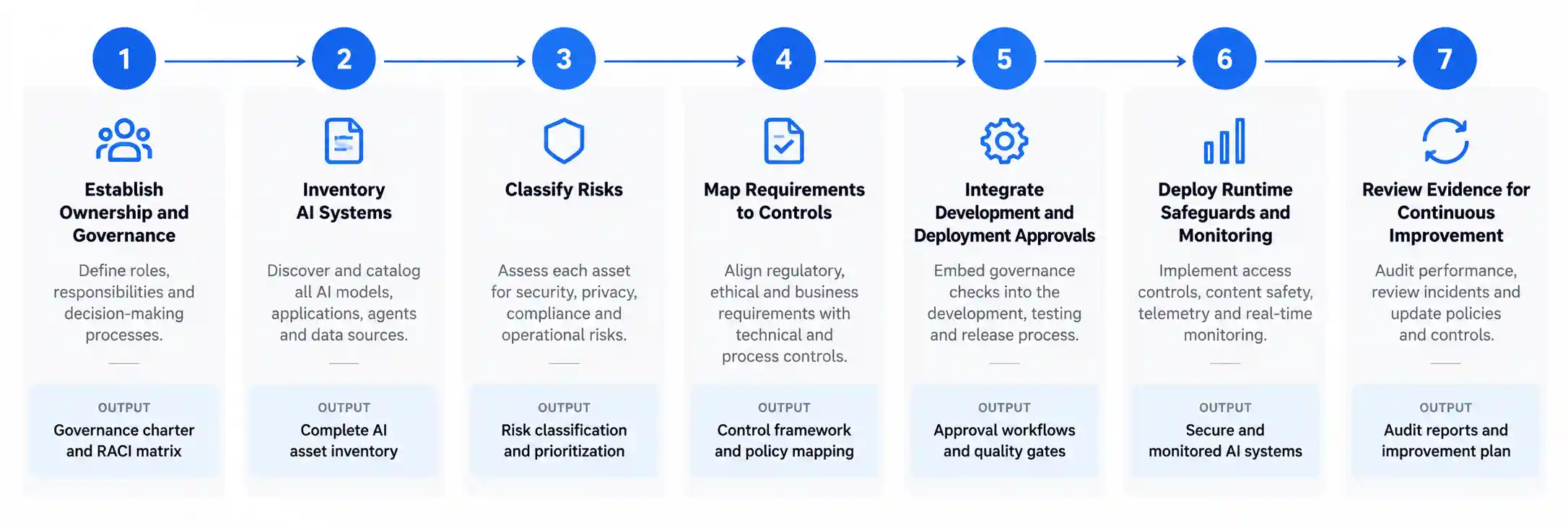
Implementing governance is an operating-model and engineering task, not just a policy-writing exercise. The following sequence provides a practical starting point for enterprises that need to coordinate existing AI initiatives.
Step 1: Establish ownership and decision rights
Start by identifying who can approve AI use, who owns risk decisions, and who is responsible for maintaining the controls.
Define responsibilities across business leadership, legal and compliance, security, privacy, data governance, engineering, and internal audit. Smaller organizations may assign several responsibilities to the same person, provided that accountability remains clear and conflicts are managed.
Document which decisions can be made by application teams and which require specialist or executive approval.
Step 2: Build an AI inventory
Identify AI systems in development, production, procurement, and employee use. Include third-party services and AI capabilities embedded in existing software.
For each system, record its owner, purpose, provider, data access, deployment status, dependencies, and review history.
Do not wait for perfect inventory coverage before beginning risk management. Register the systems already known to have the greatest potential impact, then improve discovery and coverage over time.
Step 3: Classify systems by risk and intended use
Define a risk-assessment process that considers potential harm, data sensitivity, degree of automation, affected stakeholders, and the consequences of incorrect outputs.
Assign the required review and control levels to each category. Specify when a system must be reassessed, such as after a major model change, the introduction of sensitive data, or the addition of new agent capabilities.
Where a law establishes its own risk classification, apply the legal criteria separately rather than substituting an internal rating.
Step 4: Map requirements to controls
Translate applicable laws, standards, contractual obligations, and internal policies into operational controls.
For each requirement, document the control owner, implementation method, verification procedure, and evidence needed to demonstrate completion.
A requirement should have a clear implementation path. If a policy says only approved users can access a model, for example, the organization needs an access-control mechanism and a way to verify that the restriction is working.
Step 5: Integrate governance into development workflows
Embed required assessments and approvals into procurement, design reviews, CI/CD pipelines, deployment procedures, and change management.
Use automated checks for requirements that can be reliably verified by software, such as whether an application has an assigned owner or whether required tests have passed. Reserve expert review for decisions that need contextual judgment.
Avoid making every change subject to the same approval process. The depth of review should reflect the potential impact and the nature of the change.
Step 6: Implement runtime controls and monitoring
Establish access restrictions, data protection, model and application evaluation, audit logging, and incident response.
For generative AI, test the full application, including retrieval, external tools, prompts, permissions, and output handling. For AI agents, restrict actions to the minimum necessary permissions and require human authorization where the consequences warrant it.
Set clear thresholds for investigating failures and deciding whether to restrict, roll back, or suspend a system.
Step 7: Review evidence and improve the architecture
Review governance performance at a defined cadence and after material changes or incidents.
Track overdue assessments, unresolved risks, failed controls, monitoring findings, and remediation progress. Use the results to update policies, improve technical controls, and refine approval requirements.
Governance should evolve as the organization gains experience. A process that works for a small number of experimental models may require stronger automation and clearer ownership when hundreds of applications are deployed.
Practical Example: Governing an Enterprise AI Assistant
Consider a hypothetical company introducing an AI assistant that searches internal documentation and answers employees' questions.
The assistant uses a language model, retrieves information from company documents, and provides responses through an internal application. Some documents contain confidential information, and access differs by department.
This example illustrates how a unified architecture can govern a real application without treating every control as a separate project.
Before deployment
The business owner defines the assistant's purpose and permitted uses. The technical team documents the model provider, data sources, retrieval mechanism, and system dependencies.
The risk assessment identifies confidentiality, unauthorized retrieval, inaccurate answers, and employee reliance on incorrect information as relevant risks.
The organization then defines controls, including:
Authentication through the company's identity provider.
Document-level access checks during retrieval.
Restrictions on sending confidential information to unapproved external services.
Evaluation against representative employee questions.
Clear instructions for escalating questions the assistant cannot answer reliably.
Logging that supports investigation without unnecessarily retaining sensitive information.
The release approval records the required controls and any outstanding limitations.
During operation
Monitoring evaluates answer quality, retrieval failures, unauthorized access attempts, latency, and other application-specific signals.
Suppose an employee asks a question about a document they are not authorized to access. The retrieval layer should enforce the employee's permissions before the model receives the document. The system should not rely solely on the model to recognize that the information is confidential.
If testing reveals that unauthorized content can enter the model's context, the team should investigate the retrieval and authorization controls, assess the scope of exposure, and restrict or suspend the affected capability where necessary.
When the application changes
Suppose the company later connects the assistant to HR records.
That change introduces new data categories, permissions, and potential consequences. The organization should reassess the use case, update its data-flow documentation, review access restrictions, and repeat relevant tests before approving the expanded capability.
The original deployment approval is not sufficient evidence that the changed system remains safe.
This example demonstrates why unified governance must connect inventory, risk assessment, technical controls, monitoring, and change management. A control that exists only in a policy document cannot reliably protect an application when its actual data access and capabilities change.
Common Challenges in Unified AI Governance and How to Address Them
A unified architecture can improve coordination, but it also creates implementation challenges. The objective is to address them without creating unnecessary bureaucracy.
Challenge | Why it occurs | Practical response |
|---|---|---|
Incomplete AI inventory | Teams adopt different services and embedded AI features | Combine procurement records, approved-service lists, developer inventories, and employee reporting |
Slow approvals | Every application follows the same review process | Use risk-based approval paths and predefined controls for common use cases |
Conflicting responsibilities | Legal, security, data, and engineering teams own different parts of governance | Define decision rights, control owners, and escalation routes |
Inconsistent evaluations | Teams use different acceptance criteria | Establish common evaluation requirements and application-specific tests |
Excessive logging | Teams retain sensitive prompts and outputs without clear purpose | Define retention, access, redaction, and evidence requirements |
Vendor dependency | Applications rely on external models and services | Assess provider practices, data handling, contractual terms, dependencies, and exit options |
Outdated approvals | Applications change after initial assessment | Trigger reassessment when material changes affect purpose, data, permissions, or behavior |
Compliance theater | Teams complete checklists without testing whether controls work | Verify controls through technical tests, evidence reviews, and incident analysis |
Centralized governance versus distributed execution
Centralized governance provides consistency, but excessive centralization can create a bottleneck. A completely decentralized model can move faster, but it may produce inconsistent controls and unclear accountability.
A practical design separates policy ownership from operational execution.
Governance responsibility | Recommended ownership |
|---|---|
Enterprise AI policy and risk appetite | Executive leadership and designated governance body |
Common control standards | AI governance, security, privacy, legal, and risk teams |
Application implementation | Product and engineering teams |
Business outcomes and intended use | Business application owner |
Monitoring and incident response | Assigned operational and technical owners |
Independent assurance, where appropriate | Internal audit or another independent assurance function |
The exact structure depends on organizational size and regulatory context. The essential requirement is that every important decision and control has an accountable owner.
How to Measure Whether AI Governance Is Working
Governance performance should be measured by both control coverage and control effectiveness.
A completed assessment is useful evidence that a process took place. It does not establish that the assessment identified the right risks or that the resulting safeguards work.
A balanced measurement approach should include several categories.
Measurement category | Example indicator | What it reveals |
|---|---|---|
Inventory coverage | Percentage of known AI systems registered | Visibility into AI usage |
Accountability | Percentage of active systems with assigned owners | Clarity of responsibility |
Assessment coverage | Percentage of systems with current, required assessments | Completion of governance requirements |
Control effectiveness | Results of access-control and security tests | Whether safeguards work as intended |
Remediation | Age and status of unresolved high-priority findings | Whether identified weaknesses are addressed |
Runtime performance | Relevant quality, safety, drift, and reliability signals | Whether deployed systems remain fit for purpose |
Incident response | Time to investigate and contain incidents | Operational readiness |
Change management | Percentage of material changes reviewed as required | Whether governance remains effective as systems evolve |
These indicators should be interpreted in context. For example, the percentage of systems with current assessments is meaningful only if the inventory is sufficiently complete and the assessments are appropriate to the systems' risk.
Organizations should establish baselines, define measurable targets, and review trends rather than adopting arbitrary universal thresholds.
What a Unified AI Governance Architecture Cannot Solve
A unified architecture reduces fragmentation, but it cannot eliminate AI risk.
It cannot guarantee correct outputs. Language models and other AI systems can still produce errors, unsupported claims, or unexpected behavior. Evaluation and monitoring reduce uncertainty but do not prove that every future output will be correct.
It cannot replace human accountability. An organization must still decide who is responsible for consequential decisions, incidents, and risk acceptance. Assigning those responsibilities to an AI governance platform does not transfer organizational accountability to the software.
It cannot guarantee regulatory compliance automatically. Compliance depends on applicable laws, organizational activities, the actual implementation of controls, and the evidence available. A framework or certification does not automatically establish compliance with every legal obligation.
It cannot eliminate third-party dependency. External models, hosted services, and integrated applications introduce dependencies that the organization may not fully control. Vendor assessment, contracts, technical safeguards, contingency planning, and ongoing review remain necessary.
It cannot make every AI use case equally safe. A shared governance process creates consistency, but the controls still need to reflect the specific application, affected people, data, and potential consequences.
These limitations are reasons to design governance as an ongoing management process rather than a one-time approval exercise.
Frequently Asked Questions
1. What is a unified AI governance architecture?
A unified AI governance architecture is a coordinated system of policies, responsibilities, risk assessments, technical controls, and monitoring processes used to govern AI across an organization. It connects business accountability with engineering, security, privacy, and compliance requirements. Its purpose is to make AI oversight consistent and traceable while allowing controls to vary according to the risks of each application.
2. What are the main components of an AI governance architecture?
The main components typically include governance and accountability, AI inventory, risk assessment, policy and compliance mapping, development and deployment controls, runtime security, monitoring, and audit. These components form a connected operating model. The precise architecture depends on the organization's AI use cases, technical environment, regulatory obligations, and risk tolerance.
3. How does NIST AI RMF support unified AI governance?
The NIST AI Risk Management Framework provides four core functions: GOVERN, MAP, MEASURE, and MANAGE. Organizations can use these functions to establish accountability, identify AI risks, evaluate their significance, and determine appropriate responses. The framework supports risk management across the AI lifecycle, but it does not replace applicable legal obligations or prescribe every technical control an organization needs.
4. What is the difference between NIST AI RMF and ISO/IEC 42001?
NIST AI RMF provides voluntary guidance for identifying and managing AI risks through its four core functions. ISO/IEC 42001 specifies requirements for an organizational AI management system, including processes for implementation and continual improvement. The two can complement each other: NIST can structure risk-management activities, while ISO/IEC 42001 can support the broader management system. Neither automatically guarantees compliance with every applicable law.
5. How does AI governance apply to generative AI and AI agents?
For generative AI, governance should address output reliability, data protection, prompt injection, retrieval permissions, and evaluation. AI agents also require controls over tool access, delegated authority, and actions that can affect external systems. Organizations should evaluate the complete application, including its integrations and permissions, rather than relying solely on the underlying model's capabilities or safety measures.
6. How can companies implement AI governance without slowing development?
Companies can integrate governance into existing development, procurement, and deployment workflows. Standardized assessments, reusable controls, automated checks, and risk-based approval paths reduce repetitive work. Low-risk applications can follow predefined processes, while systems with greater potential impact receive more extensive review. This approach preserves accountability without requiring every application to pass through the same manual approval process.
7. Does a unified AI governance architecture guarantee regulatory compliance?
No. A unified architecture helps an organization identify applicable requirements, assign responsibility, implement controls, and retain evidence. However, compliance depends on the specific law, the organization's role, the AI system's purpose, and the effectiveness of the controls. Organizations must verify applicable requirements and obtain qualified legal advice when needed.
8. How often should an AI governance architecture be reviewed?
An AI governance architecture should be reviewed periodically and whenever significant changes affect its effectiveness. Relevant triggers include new AI regulations, material model or application changes, new data sources, expanded permissions, security incidents, and changes in intended use. The review schedule should reflect the organization's risk profile and applicable obligations rather than relying on one universal interval.
Conclusion: Build Governance Around the AI Lifecycle
A unified AI governance architecture gives enterprises a consistent way to connect AI strategy, accountability, risk management, security, compliance, and operational monitoring.
The most effective approach is not to force every application into an identical control process. It is to establish shared policies, clear ownership, a reliable inventory, risk-based safeguards, and evidence that controls continue to work after deployment.
Established resources such as NIST AI RMF and ISO/IEC 42001 can provide useful foundations, while the OECD AI Principles and applicable regulations help inform policy and legal obligations.
For organizations starting from fragmented AI practices, the first priority should be visibility and accountability. Identify the AI systems already in use, assign owners, assess the most consequential risks, and connect those findings to practical controls. Expand automation and reporting as the governance model matures.
The defining test is whether the architecture changes how AI systems are selected, approved, secured, monitored, and improved. If it only produces policies and dashboards without influencing operational decisions, it has not achieved unified governance.
Comments (0)
No comments yet. Be the first to share your thoughts!