AI People Interview: Viacheslav Airapetian on "We Don't Build AI, We Build the Workspace for AI": What Does the Next Business OS Look Like?
Author
Ravi Prajapati
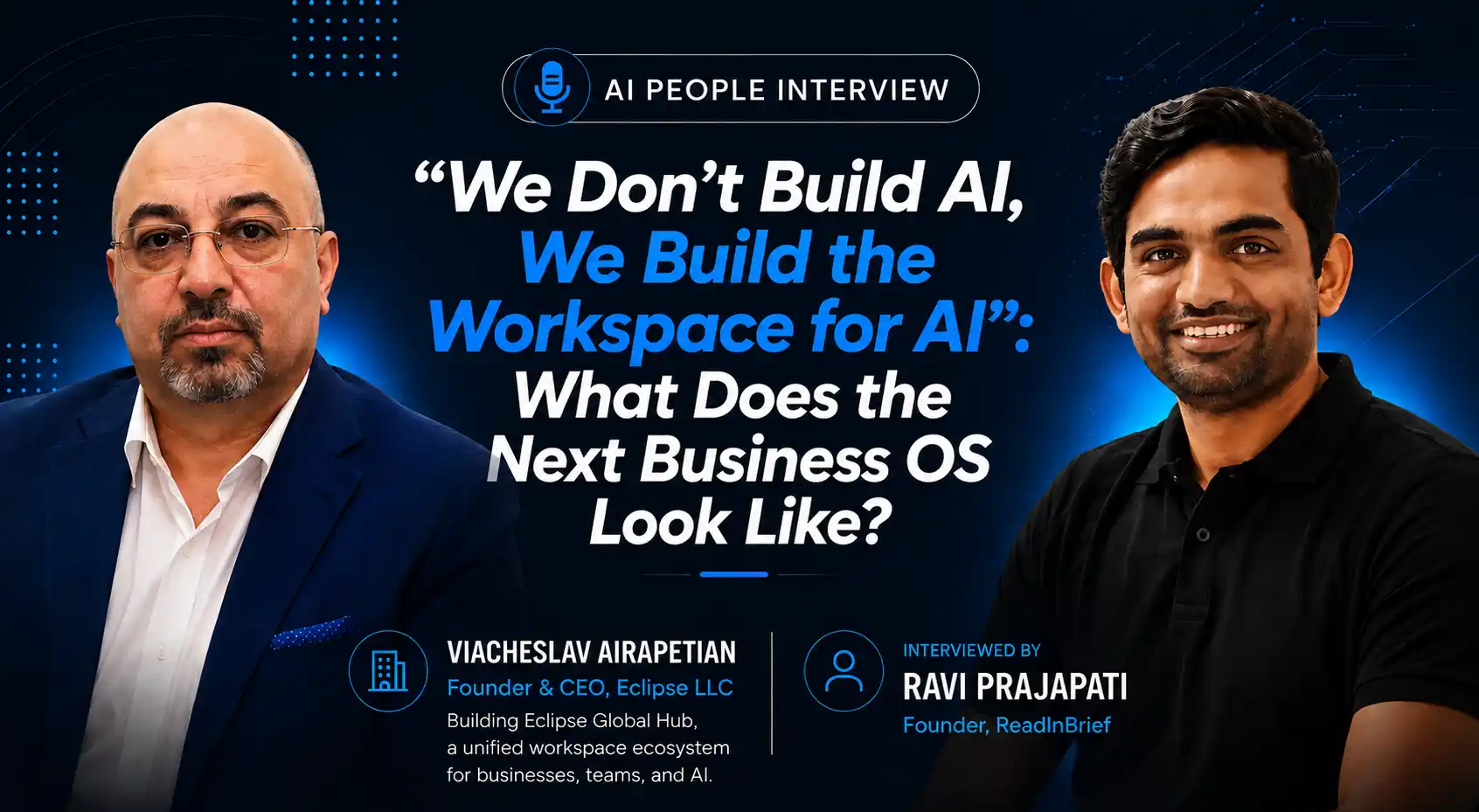
Viacheslav Airapetian, founder of Eclipse LLC, on why his company isn't building another AI model, and what the next generation of business operating systems needs to look like.
Viacheslav Airapetian, Founder & CEO of Eclipse LLC, explains why Eclipse isn't betting on any single AI model, and what the operating system for the AI era actually needs to look like.
Viacheslav Airapetian is the Founder & CEO of Eclipse LLC, a technology company building Eclipse Global Hub, a unified workspace ecosystem for businesses, teams, and artificial intelligence. Rather than betting on which AI model wins, Eclipse is built on a different premise: the future belongs to an open working environment where people and companies can plug in whichever AI best fits their needs. The company sums up its approach in two lines: One Window. One Ecosystem. and We Don't Build AI. We Build the Workspace for AI.
In this AI People interview, Viacheslav talks about the bet he's making that most AI companies aren't, why he thinks a more powerful AI model helps Eclipse rather than threatens it, and what it will take for AI to become a real participant in how teams work, rather than another chatbot bolted onto the side.
The Core Bet
Ravi Prajapati: "We don't build AI, we build the workspace for AI." That's a deliberate line in the sand. What's the bet you're making that most AI companies aren't?
Viacheslav Airapetian: I believe one of the biggest mistakes in today's market is trying to predict which specific AI model will ultimately win. Today it might be ChatGPT. Tomorrow it could be Claude, Gemini, Grok, or an entirely new model. At the same time, open-source solutions, local models, specialized enterprise AI systems, and autonomous agents will continue to evolve.
That is why Eclipse is not betting on a single LLM. Our bet is different. We believe that almost every person and every company will eventually have their own AI, or even an entire team of AI agents. And all of them will need a place where they can actually work. Not another browser window. Not another standalone AI chat. But a real working environment where AI understands context, interacts with employees, participates in communications, receives tasks, and helps execute real business processes.
If tomorrow a new AI model appears that is ten times more powerful than today's models, that is not a threat to us. On the contrary, it can make Eclipse stronger, because our job is to give the best AI a place to work.
Ravi Prajapati: If someone's never heard of Eclipse, how do you explain what it actually is in the first thirty seconds?
Viacheslav Airapetian: Eclipse is a unified digital workspace for businesses, where communications, tasks, meetings, and, in the future, AI operate within one connected system. Today, a typical company might use one product for communication, another for video conferencing, another for task management, several additional business services, and then separate AI applications on top of all of that. Employees are constantly switching between windows, and every switch creates friction and fragments context.
We are building a different approach: One Window. One Ecosystem. The web version of Eclipse is already operational, with our chat-centric business messenger and task creation and management system already working together inside the platform. The next step is to bring the other core workspace tools into the same environment, then build the AI layer on top of that foundation.
Ravi Prajapati: What has to be true about the future of work for "one window, one ecosystem" to be the right way to build a company, instead of a nice idea that doesn't scale?
Viacheslav Airapetian: In my view, this transformation is already happening. The number of digital tools used by an average employee keeps increasing. Communications live in one place, tasks are somewhere else, documents are in another system, meetings happen in another application, CRM is somewhere else again, and now we're adding a growing number of separate AI products. But human attention does not scale at the same rate as the number of applications.
That is why I believe the next stage of workplace software is not about creating even more windows. It is about bringing working context together. AI only accelerates this transition. AI is not at its most useful when a person has to explain the entire situation from scratch every time they interact with it. It becomes much more valuable when it operates inside an environment where communications, tasks, projects, roles, permissions, and work history already exist. So for us, One Window. One Ecosystem. isn't a marketing slogan, it's an architectural principle.
Where It Started
Ravi Prajapati: What were you building or working on before Eclipse, and what pulled you toward this specific problem?
Viacheslav Airapetian: Eclipse did not begin with the idea, "Let's build another AI startup." We started with a more fundamental problem: modern digital work is too fragmented. People use many different services, data is distributed across platforms, and workflows are constantly interrupted by switching between applications.
We began building our own technology core and gradually arrived at the idea of a unified working ecosystem. Then, as generative AI began developing at extraordinary speed, it became clear that this kind of infrastructure would become even more important, because AI needs context too. AI also needs a working environment. That expanded the Eclipse vision: not simply to combine workplace tools, but to create a space where people and AI can work together.
Ravi Prajapati: Was there a specific frustration, your own or a client's, that made you think existing tools like Slack or Zoom weren't going to cut it in an AI-driven world?
Viacheslav Airapetian: I wouldn't say Slack or Zoom are bad products. Quite the opposite, they're strong companies that solved enormous problems for their era. But much of today's workplace software was designed during a different technological period. First came chat. Video conferencing developed separately. Task management developed separately. And now companies are trying to add AI on top of these existing products.
We're approaching the problem from a different direction. We're designing the architecture with the understanding that AI should eventually become not an additional button, but a real participant in the working process. AI needs to understand where it is, who it's interacting with, which project is being discussed, what permissions it has, what task has been assigned, and which actions it's authorized to perform independently. That goes far beyond connecting a chatbot API. It requires a different workspace architecture.
Ravi Prajapati: What's been the hardest thing to get right so far, technically or in terms of convincing people?
Viacheslav Airapetian: The hardest part is not designing a beautiful interface, it's building the foundation. We made a conscious decision not to assemble Eclipse from ten different third-party products and then simply call the result an ecosystem. We're building the core of the platform ourselves. That requires more time and resources, but it gives us control over the architecture.
The second challenge is discipline. There's always a temptation to begin aggressive commercial expansion very early and continuously add features mainly for marketing purposes. We chose a different path. Access to the product already exists, billing works, and the product can be purchased and tested. But we've deliberately not pushed full-scale commercial expansion or our main partner distribution channels yet. We want to complete the core ecosystem first and then scale it.
Inside the Product
Ravi Prajapati: Messaging, task management, and video conferencing are usually separate products from separate companies. What actually changes for a team when all three sit inside one AI-native system?
Viacheslav Airapetian: The biggest change is that context stops falling apart. Imagine someone writes in a chat: "We need to prepare the presentation by Friday." In a traditional environment, an employee may need to open another service, create a task, copy the information, assign someone, and then return to the original conversation.
In Eclipse, communication and the task exist within the same working logic. And when AI enters that environment, the possibilities become much broader. The AI is already inside the working context, so it can understand the discussion, help create tasks, prepare materials, analyze project history, or participate in subsequent actions, naturally, within the permissions it's been given. Over time, we want to reduce the boundary between "we are discussing the work" and "we are doing the work."
Ravi Prajapati: What does "AI chat-native operating system" mean in practice, versus an AI assistant bolted onto existing chat and video tools?
Viacheslav Airapetian: For me, AI-native means that artificial intelligence isn't simply attached to a product after that product has already been designed. The architecture itself anticipates AI as a full participant.
We're not building our own foundational LLM, and we don't believe users should have to abandon the model they prefer. Quite the opposite. Our long-term vision is for Eclipse to work with different AI systems: ChatGPT, Claude, Gemini, Grok, other LLMs, open-source solutions, local models, enterprise models, and specialized AI agents. We want Eclipse to become a connecting layer between the person, the corporate working environment, and the world of AI.
Ravi Prajapati: How far can a business customize Eclipse before it stops being Eclipse? Where's that line?
Viacheslav Airapetian: Quite far, but we don't want Eclipse to become an endless collection of one-off custom developments. Eclipse remains Eclipse as long as the fundamental architecture stays intact: a unified workspace, the communication layer, tasks and workflows, identity and permissions, and, eventually, the AI layer. Within that architecture, a company will be able to decide which AI systems to use, which models and agents to connect, which permissions to grant them, and which processes they can access.
One particularly important area for us is on-premise AI. We believe a significant part of professional AI in the future may run on infrastructure controlled by users and companies themselves, workstations, local servers, and enterprise computing systems. Eclipse should be able to work with that kind of AI as well.
Eclipse Global Hub as a Community
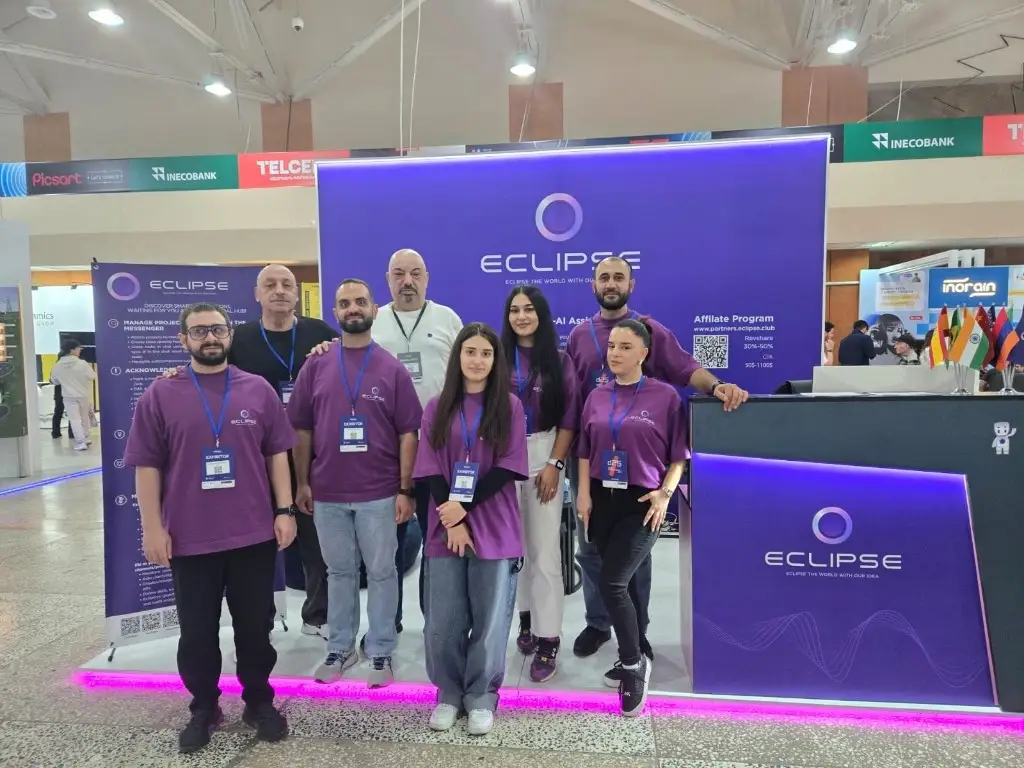
Ravi Prajapati: Eclipse Global Hub pulls together people across IT, communications, marketing, data security, and Big Data. Why build a hub that wide instead of going deep on one industry first?
Viacheslav Airapetian: Because work itself is multidisciplinary. A real company isn't made up only of developers or marketers. There are sales teams, finance, legal, HR, cybersecurity, management, engineering, marketing, and many other functions, and AI is gradually entering all of these areas at the same time.
That's why we're building a horizontal working environment. Over time, highly specialized vertical AI agents can operate inside it: an AI programmer, DevOps agent, legal agent, financial analyst, HR agent, marketing agent, sales agent, and many others. So the platform itself is horizontal, while the intelligent workers operating inside it can be highly specialized.
Ravi Prajapati: What's the most unexpected connection or collaboration you've seen happen inside the hub?
Viacheslav Airapetian: What interests me most is the point at which AI stops being a personal tool used by one employee. Imagine a company where a developer works with their own AI programmer, the finance team works with an analytical agent, legal works with a specialized legal AI, marketing has its own AI tools, and all of them begin interacting within the same project and under the same corporate access policies.
At that point, a completely new kind of organization begins to emerge. Not simply a team of people, but people plus personal AI plus enterprise AI agents. I believe this is where the market is gradually heading.
Ravi Prajapati: Bringing communications, tasks, and video into one connected system raises the stakes on data security. How do you think about that?
Viacheslav Airapetian: For us, security has to be part of the architecture, not an item added to a marketing presentation. This becomes especially important when AI has access to corporate context.
In our future AI architecture, we expect our own AI Gateway to play an important role. Its purpose will be to control which models are being used, where a request is routed, what data a particular AI can access, what permissions it has, and which actions it's allowed to perform. This is another reason we're very interested in on-premise AI. Not every company will want to send critical corporate data to an external AI system, so the architecture needs to give businesses the ability to choose the level of control they require.
Standing Out in a Crowded Market
Ravi Prajapati: Every business tool claims to be "AI-powered" now. How do you cut through that and explain what's genuinely different about Eclipse?
Viacheslav Airapetian: I actually try to use the phrase "AI-powered" less and less. It's become so broad that almost any product can connect to an LLM API and describe itself as AI-powered.
We're not building an "Ask AI" button. We're building workspace architecture for AI. Our ultimate goal is for AI inside Eclipse to become a real participant in the workspace. You should be able to assign it a task, add it to a project, give it specific permissions, ask it to prepare a document, analyze information, help with code, prepare materials, and eventually execute entire chains of business processes, while the underlying AI model can change. That distinction is fundamental to us.
Ravi Prajapati: Who do you consider your real competition: the Slacks and Zooms of the world, or the new wave of AI-native startups?
Viacheslav Airapetian: I don't look at the market purely as a list of companies we need to defeat. Slack solved communication. Zoom solved video conferencing. Other companies solve project management, CRM, and many other problems extremely well. AI companies are creating increasingly powerful intelligence. Eclipse sits at the intersection of several of these markets, so competition exists in several directions at once.
But our goal isn't to build "a slightly better Slack than Slack" or "a slightly better Zoom than Zoom." If that were the only game we were playing, Eclipse wouldn't be very interesting. Our opportunity is in helping define a different category: a unified AI-native working environment capable of working with different AI models and AI agents.
Ravi Prajapati: What's the most common thing a potential customer gets wrong about what an AI-native workspace can actually do for them?
Viacheslav Airapetian: Many people still think of AI primarily as a very intelligent search engine or chatbot. I ask a question, and AI gives me an answer. But that's only the beginning.
The real value emerges when AI can act within an actual working context. Not simply say "here is how you could prepare a report," but help prepare it. Not simply suggest a list of tasks, but create those tasks in the correct workflow. Not simply draft an email, but understand why that email is needed, the context around it, and who's involved in the process. That's why the workspace around AI becomes so important.
Ravi Prajapati: How do you decide what AI capability belongs natively in the workspace versus what should stay a specialized tool businesses plug in separately?
Viacheslav Airapetian: We don't want to build everything. I think that would be a dead-end strategy. Eclipse's main job is to create a universal interaction infrastructure. Certain capabilities need to be deeply integrated into the workspace: context, identity, permissions, routing, interaction with communications and tasks, and corporate workflows.
But if there's an outstanding specialized AI for software engineering, finance, design, or legal work, why should we necessarily build a copy of it? It's much more interesting to enable that AI to work inside Eclipse. That's why our principle is simple: Eclipse doesn't choose the AI for the user, Eclipse brings them together.
What's Next
Ravi Prajapati: What would you need to see happen, in the market or in AI itself, for you to say Eclipse's bet has paid off?
Viacheslav Airapetian: For me, it won't be defined only by a funding round, a particular company valuation, or even a specific number of users. I'll know the bet has paid off when people begin treating their AI as naturally as they treat a colleague inside a workspace today. When a user says "add my AI to this project," and everyone immediately understands what that means.
When different AI systems can work alongside people inside the same environment without forcing the user to constantly think about where a particular model is physically running, in the cloud, locally, on an enterprise server, as an open-source solution or a commercial model, those things should gradually become implementation details. When that happens, I'll say that this new category has truly arrived.
Ravi Prajapati: What's your honest advice for a founder trying to build infrastructure for AI, rather than another AI product on top of everyone else's infrastructure?
Viacheslav Airapetian: First, don't try to guess which model will win. The pace of AI development is so fast that an architecture completely dependent on a single model or provider can very quickly become a limitation.
Second, don't confuse an impressive AI demo with real infrastructure. Today, it's possible to build a compelling AI demonstration very quickly, but infrastructure begins when you have to deal with permissions, security, reliability, scalability, context, history, integrations, routing, observability, and accountability for AI actions.
Third, build for the world that will exist several years from now, not only for what today's models can do. Models will become more capable at an extraordinary pace, and good infrastructure should benefit from every improvement. That's the philosophy behind Eclipse: every new and more powerful AI model should make Eclipse stronger, not obsolete.
Ravi Prajapati: Why doesn't Eclipse build its own LLM?
Viacheslav Airapetian: Because we don't believe the world needs another foundational LLM simply so Eclipse can say "we have our own AI." The largest technology companies are investing enormous resources in LLM development, and I'm convinced the range of choices will only become broader.
So we made a different strategic bet: we don't want to compete with the companies building AI, we want to build the environment where the best AI can work. I like the analogy with the evolution of personal computing. Building a powerful processor and building the working environment that makes that computing power useful to people are two very different problems. We see Eclipse at that infrastructure layer.
A user shouldn't choose Eclipse because we force them to use our AI model. It should be exactly the opposite. Inside Eclipse, they should be able to use the AI that best solves their specific problem, whether that's ChatGPT, Claude, Gemini, Grok, a local model, an open-source solution, an enterprise LLM, or a specialized AI agent. Our goal isn't to build another brain, it's to build the place where the best AI systems can work alongside people.
Ravi Prajapati: What is the current status of Eclipse? What already works today, and what comes next?
Viacheslav Airapetian: For me, it's particularly important to distinguish between a vision and a real product. Eclipse is no longer a project on paper, the core of the platform has been built, and the product is operational. Today, users already have access to the web version of Eclipse, with our chat-centric business messenger and task creation and management system already working together within the same environment. Billing has also been integrated and tested.
At the same time, we've deliberately chosen not to begin full-scale commercial expansion yet. We want to complete the core ecosystem first and then scale sales, rather than bringing a huge number of users into a partially completed ecosystem and explaining that key components will arrive later.
The next major stage is to bring the core components of the working environment into one unified space: messaging, task management, desktop applications, video conferencing, and other essential elements of the ecosystem. Once that foundation is in place, the next major technological layer begins: the AI workspace. In parallel, we've already developed infrastructure for future commercial scaling, including two partner platforms designed for different models of user acquisition and audience development, though we don't want the partner programs to become the central story of Eclipse.
Our sequence is deliberate: first build a strong working ecosystem, then bring AI into that ecosystem, then scale. We could have started aggressively selling individual parts of the platform much earlier, but our ambition is much larger. We want to build an infrastructure that can become a unified working environment for people, businesses, and AI.
About Viacheslav Airapetian
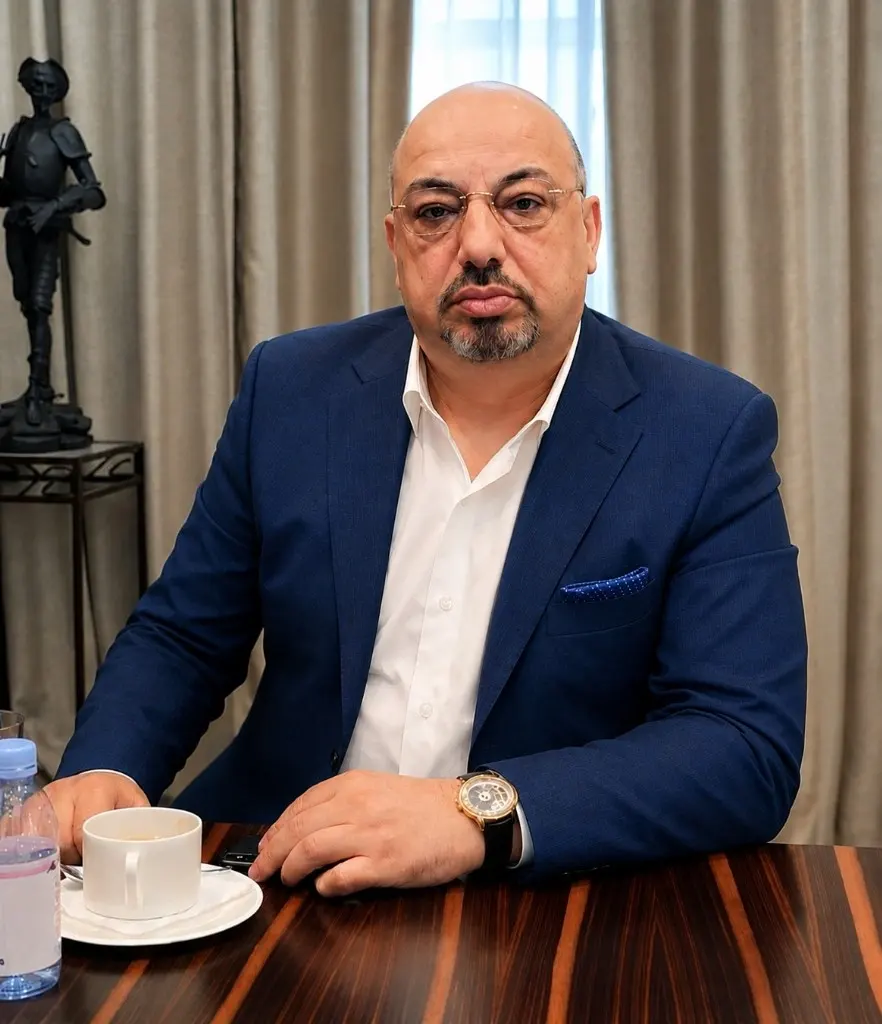
Viacheslav Airapetian is the Founder & CEO of Eclipse LLC, the company behind Eclipse Global Hub, a unified workspace ecosystem for businesses, teams, and artificial intelligence. Rather than building on top of a single AI model, Eclipse is designed as an open working environment where any AI model, agent, or system can plug in and operate alongside people.
His philosophy: "We Don't Build AI. We Build the Workspace for AI."
Eclipse LLC: https://eclipse.club/
This interview is part of ReadInBrief's AI People series, where we talk to AI founders and experts building at the edge of the industry. Have someone you'd like us to feature? hello@readinbrief.com or drop a message to Ravi Prajapati.
Comments (0)
No comments yet. Be the first to share your thoughts!