Tokenization can change financial infrastructure, but it does not eliminate legal, technological or market risks.

Author
Deval Shah

Tokenization explained in simple terms: how assets become digital tokens, why businesses care, real-world use cases, benefits, risks, and what comes next.
Tokenization sounds like one of those technology terms that belongs in a blockchain conference presentation.
But something has changed.
Banks, asset managers, financial institutions and large companies are increasingly treating tokenization as a serious piece of financial infrastructure rather than a speculative crypto experiment.
In a 2026 Broadridge survey of 200 North American financial-services leaders, 84% said tokenization was strategically important to their firms. Nearly two-thirds expected to offer tokenized assets within two years, while 92% expected digital and traditional assets to coexist for the foreseeable future.
That raises a practical question:
What exactly is tokenization, and why are companies starting to care?
In simple terms, tokenization is the process of representing an asset, ownership right, or economic claim as a digital token that can be recorded and managed on a blockchain or other distributed ledger.
The important part is not the word "token."
The important part is what happens after something becomes programmable, transferable and digitally recorded.
A tokenized asset could potentially be transferred faster, divided into smaller interests, used as collateral, integrated into automated workflows, or settled around the clock.
That does not mean tokenization magically makes an asset more valuable.
It changes the infrastructure around how that asset can be represented, transferred and managed.
And that distinction is where the real business story begins.
First, What Does “Tokenization” Actually Mean?
There is a small problem with the word tokenization: it can mean different things in different industries.
A payments company might use tokenization to replace a sensitive card number with a substitute value so the original information does not need to be exposed during a transaction.
An AI developer might talk about tokenization when explaining how language models break text into smaller units called tokens.
A financial institution might use tokenization to represent ownership of a bond, fund, property, deposit or another asset on a blockchain.
These are three different technologies solving very different problems.
For this article, we are primarily talking about asset tokenization, particularly the tokenization of financial and real-world assets.
That is the version attracting increasing attention from banks, asset managers and corporations.
What Is Asset Tokenization?
Imagine a company owns an asset worth $10 million.
Traditionally, information about that asset may be spread across legal documents, custodians, databases, registries, brokers, administrators and other intermediaries.
Tokenization creates a digital representation of the ownership or economic rights associated with that asset.
Instead of relying exclusively on traditional records and processes, a blockchain-based token can become part of the infrastructure used to record, transfer and manage those rights.
The underlying asset can remain exactly where it was.
A building does not have to move onto the blockchain.
A Treasury security does not physically disappear into a blockchain.
A fund does not stop being a fund.
Instead, the token becomes a digital representation of ownership or exposure, depending on how the product has been structured.
Tokenization changes the way an asset can be represented and managed. It does not automatically change the underlying asset itself.
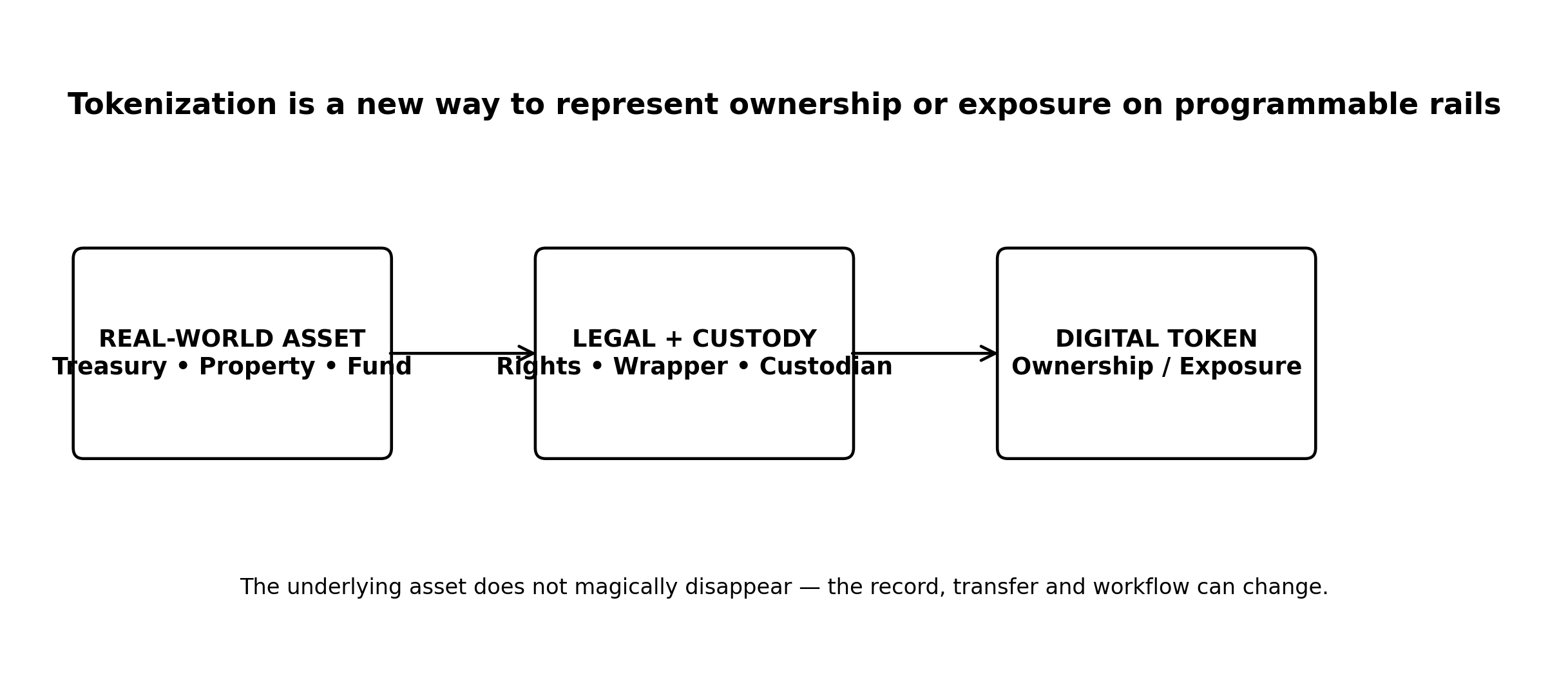
From a real-world asset to a programmable digital representation.
How Does Tokenization Work?
A simplified tokenization process usually involves several layers.
1. An underlying asset exists
· A government bond
· A money market fund
· Real estate
· Private credit
· Company shares
· Commodities
· Deposits or cash
· Intellectual property or other contractual rights
2. The legal ownership or economic claim is defined
This is one of the most important—and most overlooked—parts of tokenization.
A digital token is only useful if there is a legally meaningful relationship between the token and what it represents.
Depending on the structure, the token might represent direct ownership, a beneficial interest, or an economic exposure to an underlying asset.
The legal wrapper, custody arrangement and investor rights therefore matter just as much as the blockchain.
3. The asset or claim is represented digitally
A token is created on a blockchain or distributed ledger.
The token contains or points to information defining what it represents and how it can be transferred.
4. Rules can be programmed
Smart contracts can automate certain processes.
For example, a tokenized financial product could include rules governing who is allowed to hold it, how transfers occur, or how certain lifecycle events are processed.
5. The token can be transferred or used
Depending on the product and regulatory framework, the token may be transferred between approved participants, traded, settled, or potentially used as collateral.
This is where tokenization starts becoming more interesting for businesses.
The value is not simply putting something on a blockchain.
The value comes from changing what can happen around that asset once the infrastructure becomes programmable.
Why Are Companies Starting to Care?
The business case for tokenization is becoming less about cryptocurrency and more about financial operations.
Companies care about settlement times, liquidity, capital efficiency, reconciliation, access to investors and the cost of moving assets.
Tokenization potentially touches all of these areas.
1. Faster settlement
Traditional financial transactions can involve multiple institutions and reconciliation processes.
Tokenized assets can potentially settle much faster because ownership records and transaction instructions can operate on shared digital infrastructure.
That does not mean every tokenized transaction settles instantly.
The actual speed depends on the blockchain, payment mechanism, legal structure and institutions involved.
But the direction is important: financial markets are exploring infrastructure that can operate continuously rather than being constrained by traditional processing windows.
2. Assets become programmable
This may be one of tokenization's most important advantages.
A conventional asset is generally accompanied by contracts, processes and people who manage what happens to it.
A token can be combined with programmable rules.
That could allow certain transactions, permissions, distributions or compliance checks to become more automated.
Instead of simply storing ownership information, the infrastructure can become part of the workflow.
3. Better asset mobility
Companies often have valuable assets sitting inside systems that make them difficult to move or use.
Tokenization can potentially make some assets easier to transfer, track or mobilize.
J.P. Morgan, for example, is positioning tokenized assets as a way for businesses to unlock additional utility from assets, including their potential use as collateral.
That changes the conversation from: "Can we put this asset on a blockchain?"
"What could we do with this asset if its ownership and transfer became programmable?"
That is a much more useful business question.
4. Fractional ownership
Tokenization can divide certain assets into smaller units.
Consider a $10 million property.
Traditional ownership structures may make it difficult for smaller investors to gain exposure to it.
A properly structured tokenized product could divide the economic interest into smaller units.
However, fractionalization should not be confused with automatic liquidity.
Creating 100,000 tokens does not guarantee that 100,000 buyers will appear.
The market still needs demand, regulation, distribution and functioning secondary-market infrastructure.
5. More transparent records
Blockchain-based systems can provide a shared transaction history.
For businesses, that can potentially reduce the amount of reconciliation required between different databases and institutions.
Instead of several parties maintaining separate versions of transaction information, participants can work from a common ledger or connected infrastructure.
That does not eliminate the need for controls, audits, or trusted institutions.
It can, however, change how those controls are implemented.
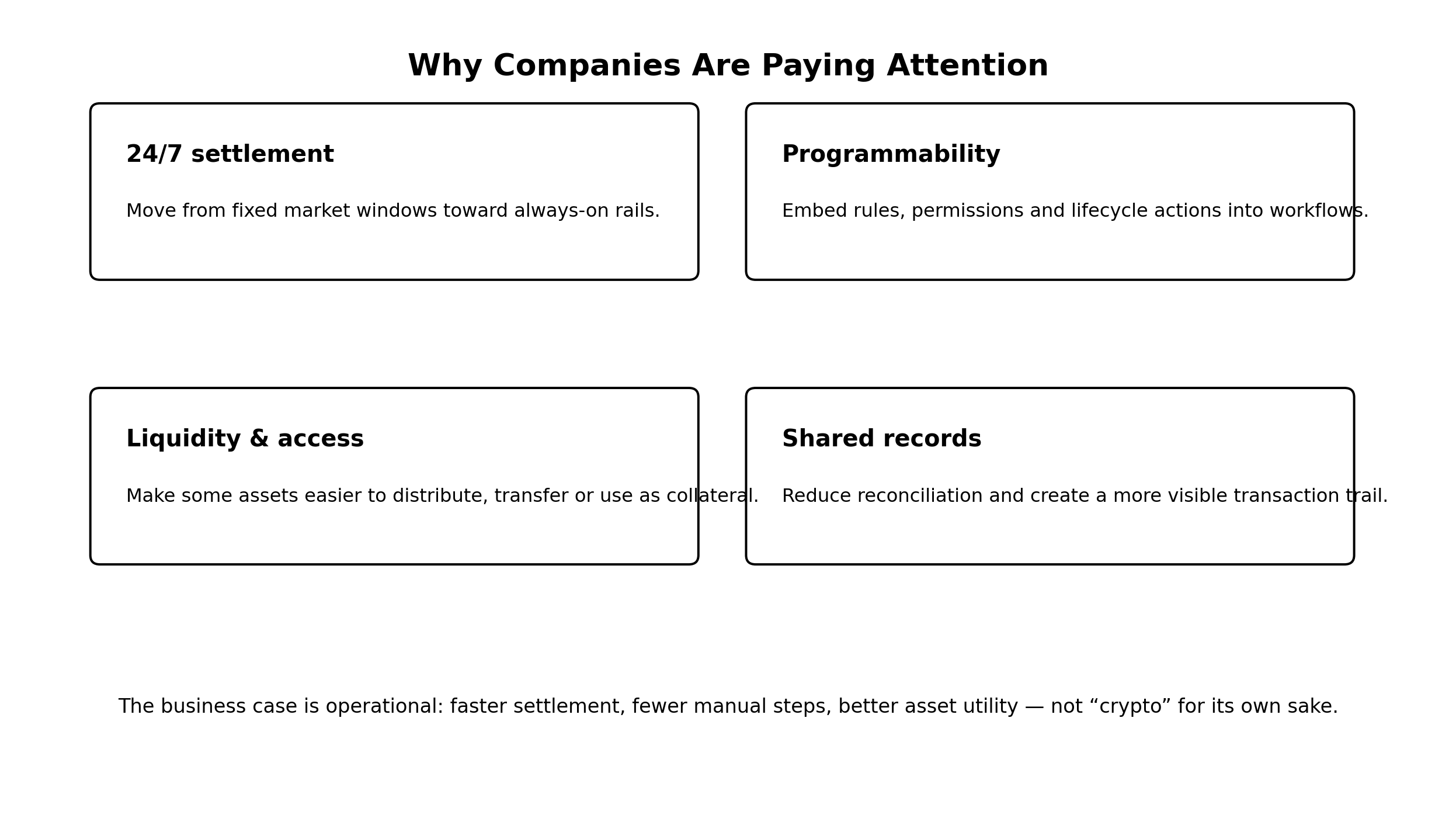
The business case for tokenization is increasingly about efficiency, liquidity and programmable financial infrastructure.
What Can Be Tokenized?
Almost any asset with clearly defined ownership or economic rights could theoretically be represented digitally.
But not every asset is equally suitable.
The areas attracting significant institutional attention include:
Asset | Why Tokenize It? |
U.S. Treasuries | Faster settlement, digital distribution and programmable ownership |
Money market funds | On-chain access, transferability and potential 24/7 settlement |
Private credit | Better tracking, distribution and operational efficiency |
Real estate | Fractional ownership and potentially broader access |
Corporate securities | Digital issuance, settlement and lifecycle management |
Commodities | Digital ownership records and transferability |
Cash/deposits | Programmable settlement and faster movement of value |
Tokenized Treasury products and money-market-style funds are particularly important because they combine traditional financial assets with digital infrastructure without requiring investors to abandon the underlying financial system.
The market is still relatively small compared with traditional global financial markets, but the direction of institutional investment is increasingly difficult to ignore.
Tokenization Is Not the Same as Cryptocurrency
This distinction matters.
Cryptocurrency generally refers to digital assets that exist natively on blockchain networks.
Tokenization can instead take something that already exists in the traditional economy and create a blockchain-based representation of it.
A tokenized Treasury fund is still connected to a Treasury-related financial product.
A tokenized property is still connected to a real property.
A tokenized money market fund is still backed by an underlying financial structure.
Think of tokenization as a digital wrapper and infrastructure layer, rather than automatically creating a new type of asset.
That is why financial institutions that have historically been cautious about cryptocurrencies are still exploring tokenization.
They do not necessarily need to believe that every cryptocurrency will succeed.
They are asking whether blockchain-based infrastructure can make existing financial markets work better.
Why 2026 Is Different
The tokenization conversation has been around for years.
So why does it suddenly feel more serious?
Because the discussion is moving from experimentation toward infrastructure.
J.P. Morgan's Kinexys platform is already being used for institutional blockchain and tokenization applications, including tokenized money market funds.
BlackRock describes tokenization as a way to represent ownership or exposure to assets as digital tokens that can be programmed, traded, settled and recorded on blockchain infrastructure.
PwC expects tokenized fund assets under management to grow significantly through 2030 and describes tokenization as an increasingly strategic capability for asset managers.
Meanwhile, institutional surveys show that financial firms are no longer treating tokenization purely as a distant possibility.
The question is increasingly becoming how to implement it, rather than simply whether it exists.
That is a meaningful shift.
What Tokenization Does Not Solve
This is where many tokenization articles become too optimistic.
Putting an asset on a blockchain does not automatically solve the problems surrounding that asset.
Legal ownership still matters
A token can represent a claim, but someone still needs to establish what that claim legally means.
If the legal structure is weak, a technically perfect token does not fix it.
Smart contracts can fail
Code can automate processes, but software can contain vulnerabilities or incorrect logic.
Automation can make a correct process faster.
It can also make a mistake faster.
The physical asset still exists
If a token represents a building, someone still needs to manage the building.
If it represents gold, someone needs to hold and safeguard the gold.
If it represents securities, the underlying legal and custody arrangements still matter.
Tokenization does not eliminate the physical and institutional world.
It connects that world to digital infrastructure.
Liquidity is not guaranteed
This is perhaps the biggest misconception.
A token may be transferable 24/7 without having a liquid market.
Liquidity requires buyers and sellers.
A tokenized asset can therefore have excellent technology and poor market liquidity at the same time.
Regulation remains complicated
Tokenized securities can still be securities.
Different jurisdictions can apply different rules to issuance, custody, investor eligibility, taxation and trading.
Regulatory clarity may accelerate adoption, but regulation will not disappear simply because an asset moves onto a blockchain.
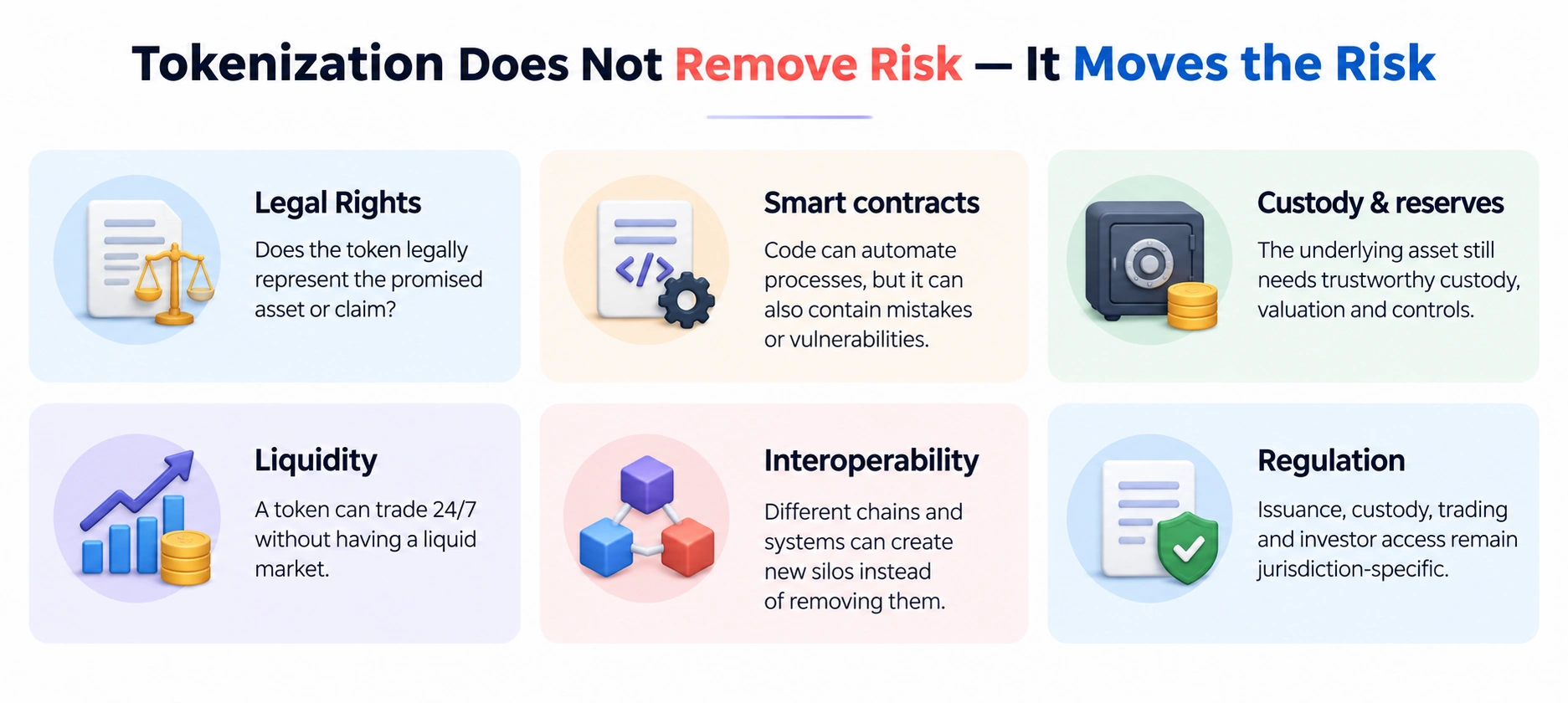
Tokenization can change financial infrastructure, but it does not eliminate legal, technological or market risks.
The Bigger Opportunity: Programmable Finance
The most interesting part of tokenization may not be fractional ownership.
It may be programmable finance.
Today, financial transactions often involve separate systems.
· One system records ownership.
· Another handles payments.
· Another handles compliance.
· Another manages settlement.
· Another maintains customer information.
· Another produces reports.
Tokenization creates the possibility of connecting some of these processes through programmable digital infrastructure.
Imagine a future transaction where:
1. A buyer is approved.
2. The payment is verified.
3. Ownership changes.
4. Compliance records update.
5. The asset becomes available as collateral.
6. Reporting information is generated automatically.
The point is not that every financial transaction will suddenly work this way.
The point is that the boundaries between asset ownership, payments, settlement and software can become much thinner.
That is what makes tokenization strategically interesting.
What Does Tokenization Mean for Ordinary Businesses?
Most companies do not need to tokenize something tomorrow.
For many businesses, the more immediate question is whether tokenization will change the financial infrastructure they depend on.
A company might eventually interact with tokenized:
· Treasury investments
· Money market funds
· Corporate securities
· Invoices or receivables
· Collateral
· Cross-border payments
· Private-market investments
This could affect treasury departments, CFOs, investment teams, banks and financial operations long before the average employee ever hears the word token.
The first visible change may therefore not be a new consumer app.
It may be a faster settlement process happening quietly behind the scenes.
So, Should Every Company Care About Tokenization?
No.
And that is an important conclusion.
Tokenization is not a universal technology upgrade.
If a business has no relevant assets, no financial workflows that benefit from programmable infrastructure, no need for improved settlement or liquidity, and no regulatory path for its intended use case, tokenization may provide little immediate value.
Companies should instead ask four questions:
1. What asset or financial process are we trying to improve?
If there is no clear problem, blockchain infrastructure is unlikely to create one.
2. Does tokenization produce a measurable advantage?
Look for faster settlement, lower operational friction, broader distribution, better collateral mobility or improved transparency.
3. What legal structure supports the token?
The technology is only one part of the solution.
4. Can the new system connect with existing infrastructure?
This may become one of the biggest challenges.
The future is unlikely to be a world where every financial institution throws away its existing systems and moves entirely onto one blockchain.
A more realistic future is hybrid.
Traditional infrastructure and blockchain-based infrastructure will coexist and gradually connect.
That is also consistent with current institutional thinking: Broadridge found that 92% of surveyed firms expect digital and traditional assets to coexist for the foreseeable future, while 69% planned to hybridize existing infrastructure rather than replace it entirely.
The Bottom Line
Tokenization is often presented as a story about blockchain.
That is technically correct, but it misses the bigger picture.
The real story is about how ownership and financial transactions are represented, transferred and automated.
A tokenized asset can potentially move through digital infrastructure faster, operate with programmable rules, become easier to divide or distribute, and interact with other digital financial systems.
But tokenization is not magic.
It does not automatically create liquidity.
It does not eliminate regulation.
It does not remove the need for custodians.
And it does not make the underlying asset safer or more valuable simply because it has a token attached to it.
What it can do is change the infrastructure surrounding ownership.
That is why companies are starting to care.
The question is no longer simply: "Is blockchain useful?"
For financial institutions and increasingly for businesses, the more relevant question is: "What becomes possible when assets, money and ownership can move through programmable digital infrastructure?"
That is the question that will shape the next phase of tokenization.
And in 2026, institutions are beginning to move from discussing the answer to actually building it.
Comments (0)
No comments yet. Be the first to share your thoughts!