Who Owns AI-Generated Art? The Copyright Battle Explained (2026 Guide)

Author
Ravi Prajapati
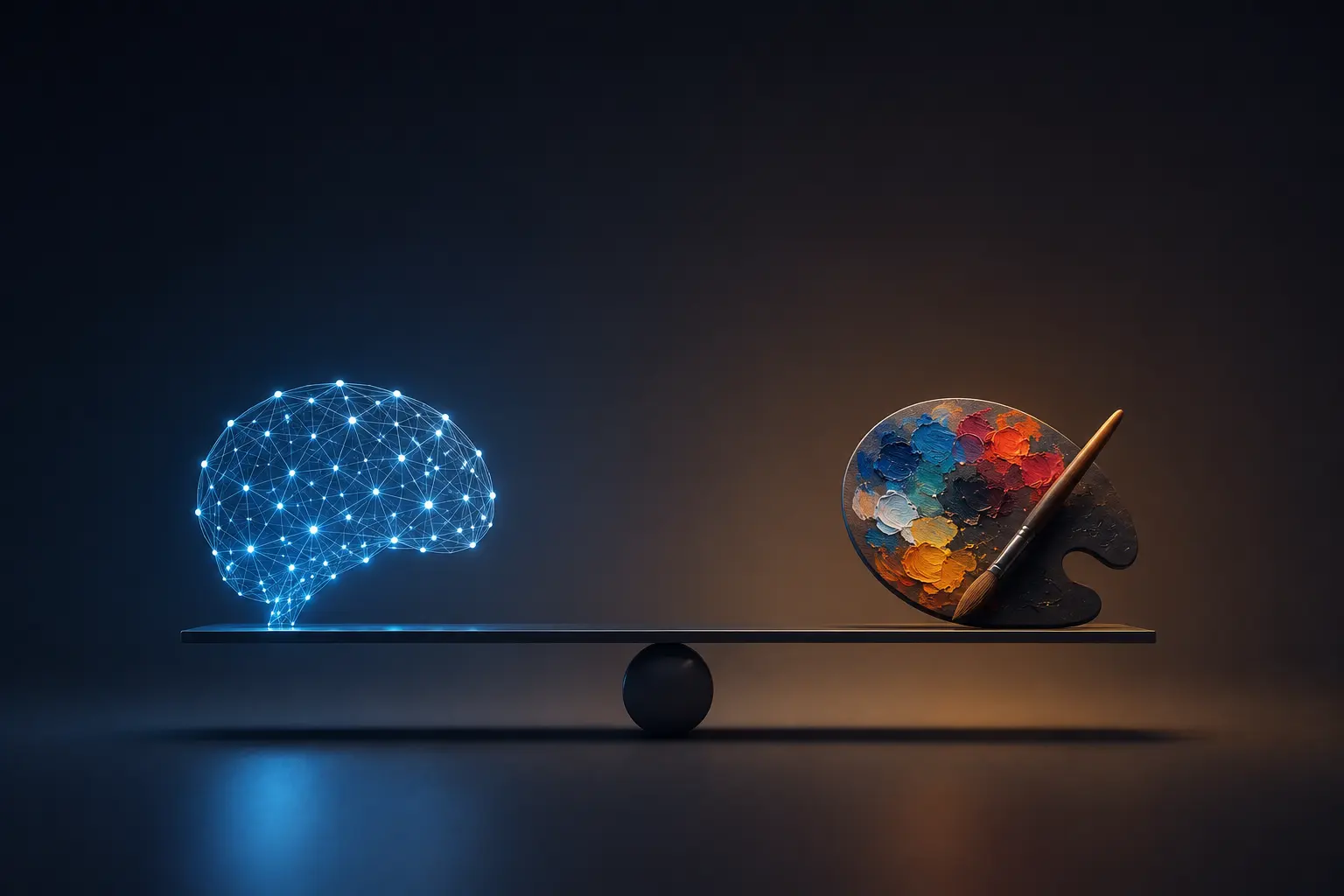
Who owns AI-generated art? Explore the latest court rulings, copyright laws, real cases, and what creators need to know in 2026. Updated with Supreme Court decisions.
Artificial intelligence can create stunning artwork in seconds, but one legal question remains at the center of the debate: Who owns AI-generated art? The answer depends on how the artwork was created, the level of human involvement, the AI platform's terms of service, and the copyright laws of each country. While many AI tools allow users to commercially use generated images, courts and copyright offices in the United States, European Union, and other jurisdictions have generally ruled that purely AI-generated works without meaningful human authorship are not eligible for copyright protection. This guide explains current copyright laws, ownership rules, landmark legal decisions, and what creators, businesses, and artists need to know in 2026.
Imagine spending hours crafting the perfect prompt, generating a stunning piece of digital art with an AI tool, and preparing to publish it. Then comes the question that stops you cold: do you actually own this?
It is one of the most important and confusing questions in the creative world right now. As AI image generators like Midjourney, DALL-E, Stable Diffusion, and Adobe Firefly become everyday tools for designers, marketers, and artists, the legal ground beneath them is shifting fast.
Courts are ruling. Laws are being rewritten. Billion-dollar lawsuits are in progress. And the answers are not simple.
This guide breaks down everything you need to know about AI art copyright in 2026: the landmark cases, the current legal rules, how different countries are handling it, and most importantly, what it means for you as a creator.
What Is AI-Generated Art and Why Does Copyright Matter?
AI-generated art is any visual content produced by an artificial intelligence system, typically a generative AI model trained on large datasets of existing images. You type a prompt like "a sunset over a cyberpunk city in the style of impressionism" and within seconds, the AI produces an original-looking image.
The question of copyright matters here for a very practical reason: without copyright protection, anyone can copy, sell, or use your AI-generated image without your permission or payment.
Copyright law exists to give creators exclusive rights over their work, allowing them to profit from it and control how it is used. The big legal fight of our generation is whether AI-generated content qualifies for that protection, and if so, who gets it.
The numbers make clear why this matters. The global generative AI art market is expected to grow by 42% through 2029, reaching an estimated market size of over 2.5 billion dollars. This is no niche debate. It is a question with real money, real jobs, and real creative futures at stake.
The Core Legal Question: Can a Machine Be an Author?
Every copyright system in the world traces back to the idea of a human author. The principle is simple: a person creates something original, and the law protects that creation.
AI complicates this entirely. When a machine generates the expressive elements of a work, without direct human hand-crafting of those specific pixels, who is the author?
There are three possible answers that legal systems are grappling with:
The AI is the author. This would mean the AI itself holds the copyright, which raises the absurd question of who enforces it or collects the royalties.
The user who prompted the AI is the author. This is what most creators intuitively believe. You typed the instructions, you guided the outcome.
Nobody is the author. The work falls into the public domain immediately, free for anyone to use.
Courts and regulators across the world have been forced to pick a lane. The answers are not unanimous, and that is exactly what is creating so much confusion and litigation.
The Landmark Case That Defined the US Position: Thaler v. Perlmutter
The most important AI copyright case in history involves a computer scientist named Dr. Stephen Thaler and a painting called A Recent Entrance to Paradise.
Thaler did not make this image himself. His AI system, which he called the Creativity Machine, generated it entirely autonomously. Thaler applied for copyright registration with the US Copyright Office in 2018, listing the AI as the author and himself as the owner.
The Copyright Office rejected the application. Thaler sued. And what followed was a years-long legal journey that reached all the way to the Supreme Court.
Here is the timeline:
2022: The US Copyright Office formally denies the application, stating that copyright requires human authorship.
2023: A federal district court in Washington D.C. rules against Thaler, calling human authorship "a bedrock requirement of copyright."
March 2025: The D.C. Circuit Court of Appeals upholds that ruling. Judge Patricia Millett writes that "the Creativity Machine cannot be the recognized author of a copyrighted work because the Copyright Act of 1976 requires all eligible work to be authored in the first instance by a human being."
March 2, 2026: The US Supreme Court declines to hear Thaler's appeal, leaving the lower court's decision intact.
This is now settled law in the United States: a work generated entirely by AI, with no meaningful human creative input, cannot receive copyright protection.
Thaler's lawyers argued that this refusal would "irreversibly and negatively impact AI development and use in the creative industry during critically important years." The Supreme Court's silence on the matter speaks volumes: for now, the human authorship standard stands.
What the US Copyright Office Actually Says in 2026
The US Copyright Office did not just rely on court decisions. In January 2025, it published Part Two of its landmark Copyright and Artificial Intelligence Report, specifically addressing the question of AI-generated content and copyrightability.
The report lays out a clear framework with four key principles:
Works entirely generated by AI are not copyrightable. If you typed a prompt and the AI produced everything else, you likely cannot register a copyright for those expressive elements.
Prompts alone do not create authorship. Even highly detailed, painstakingly crafted prompts do not automatically give the prompter copyright in the final output. The Copyright Office considers the act of selecting a prompt to be closer to giving instructions than to actually creating the art.
Human contributions in hybrid works can be protected. If you used AI as a tool within a larger creative process, adding your own selection, arrangement, editing, or additional creative choices, those human contributions may be eligible for copyright protection.
AI as a creative tool is different from AI as the creator. Using AI the way you might use Photoshop, as a tool to assist and enhance your own human vision, keeps the copyright question much cleaner. The human remains the author.
The practical rule that emerges is this: the more creative control a human exercises over the final expression of the work, the stronger the copyright claim. The less control, the weaker or nonexistent the protection.
There is also a new disclosure requirement: if your work contains AI-generated content and you apply for copyright registration, you must disclose that fact and describe what elements a human authored.
The Getty Images vs. Stability AI Battle: The Training Data Front
While the Thaler case was about whether AI outputs can be copyrighted, a parallel legal battle is raging over a different question: was it legal to train AI on copyrighted images in the first place?
This is where the stakes get enormous.
Getty Images, one of the world's largest stock photography companies representing over 600,000 photographers and artists, sued Stability AI (the company behind Stable Diffusion) in both the UK and the US, alleging that Stability AI illegally used millions of Getty photographs to train its AI model without permission or payment.
The UK case produced a landmark ruling on November 4, 2025. The High Court of England and Wales delivered a nuanced decision: it dismissed Getty's primary copyright infringement claim on the question of whether Stable Diffusion itself constituted an infringing copy of Getty's works. However, the court did find limited liability for trademark infringement.
The key technical finding was that although Getty's images were used in training, the way the model "learned" from that data meant that it did not actually contain any copies in any legally meaningful sense under UK law.
Crucially, the judge noted that the training of AI on copyrighted content without permission would require a license under UK law. This was a win for content creators even inside a loss for Getty on the specific claim it brought.
The US case between Getty and Stability AI is still ongoing, and its outcome could have even larger consequences for how AI companies are allowed to build their training datasets.
Meanwhile, a separate but connected case in Germany added another data point. In November 2025, the Munich court ruled that training AI on copyrighted song lyrics required a license, taking a stricter interpretation than the UK court. Unlike the UK finding, the German court essentially held that since the AI model could reproduce the lyrics as output, it had in a meaningful sense "embodied" that content.
Two countries, two rulings on similar facts, two different outcomes. This fragmentation is exactly why the global AI copyright situation remains so complicated.
The Hollywood vs. AI Fight: Disney, Universal, and Midjourney
The legal battles are not limited to photographers. Major entertainment companies have entered the arena.
In June 2025, Disney, NBCUniversal, and DreamWorks filed suit against Midjourney in US federal court, alleging that Midjourney's model was trained on tens of thousands of copyrighted works without permission and produces images that are virtually indistinguishable from their protected characters and intellectual property.
Midjourney's defense centers on the argument that training on copyrighted works is transformative fair use, that the model extracts statistical patterns rather than protected expression, and that resemblance alone does not constitute unlawful copying.
This case is closely watched because it will force courts to grapple with a genuinely difficult question: even if the output does not reproduce a specific work, can the style, character likeness, or aesthetic of a protected work be infringed through AI generation?
The Andersen v. Stability AI case is another major lawsuit to watch. Artists Sarah Andersen, Kelly McKernan, and Karla Ortiz filed suit against Stability AI, Midjourney, and DeviantArt, alleging that their copyrighted works were scraped and used for training without consent. That case is heading to trial in September 2026 and could set transformative precedent on how US courts view the training data question.
How Different Countries Approach AI Art Copyright
The global picture is fragmented, and where you are located or where you publish your work can significantly affect your rights.
United States The current rule is clear: human authorship is required. Pure AI output cannot be copyrighted. Human contributions within AI-assisted works may be protected on a case-by-case basis. The Copyright Office is working on Part Three of its AI Report, which will address training data and licensing questions.
United Kingdom The UK has a unique legal provision under Section 9(3) of the Copyright, Designs and Patents Act 1988 that provides a 50-year copyright term for works "generated by computer in circumstances such that there is no human author." This makes the UK potentially more protective of AI-generated outputs than the US, though the law's application to modern generative AI is still being tested. The UK government is required to publish a full report on the use of copyright works in AI development, which should bring further clarity.
European Union The EU AI Act, fully in force in 2026, requires transparency labeling for AI-generated content and mandates that AI developers publish summaries of their training data and comply with EU copyright opt-out provisions. However, the Act does not create a new copyright framework for AI outputs. Individual EU member states vary, with Germany being particularly strict about requiring demonstrable human originality.
China China's approach is notably more AI-friendly. A Beijing Internet Court ruling in November 2023 recognized copyright protection for an AI-generated image where the output demonstrated originality and reflected human intellectual effort. China's 2025 judicial interpretations have further recognized copyright in AI-generated works where human creative contribution is substantial. In some interpretations, copyright of AI-generated art can be shared between the creator and the platform.
Japan Japan has made itself one of the most favorable jurisdictions globally for AI development. Its 2024 amendments to the Copyright Act permit AI training on copyrighted works under broad fair-use-like provisions, making it a popular jurisdiction for AI model training operations.
India India's position is still developing. Preliminary guidelines suggest that only human-supervised AI outputs qualify for protection, but no comprehensive legal framework has yet been established.
The Key Cases Shaping the Future: A Quick Reference
Case | Parties | Status | Key Issue |
|---|---|---|---|
Stephen Thaler vs. US Copyright Office | Resolved (2026) | Can AI be listed as author? No. | |
Getty vs. Stability AI | Decided Nov 2025 | Was training on Getty images copyright infringement? Limited liability found. | |
Getty Images v. Stability AI (US) | Getty vs. Stability AI | Ongoing | Same question under US law |
Artists vs. AI companies | Trial Sept 2026 | Was scraping artists' work for training illegal? | |
Disney vs. Midjourney | Major studios vs. Midjourney | Ongoing | Does AI-generated lookalike content infringe IP? |
GEMA vs. OpenAI (Germany) | Music rights body vs. OpenAI | Decided Nov 2025 | AI training on song lyrics requires licensing |
What About AI-Assisted Art? The Important Distinction
Here is where many creators get confused, and where there is actually some good news.
The law draws a meaningful distinction between AI-generated art (where the AI makes all the creative decisions) and AI-assisted art (where a human uses AI as one tool among many in their creative process).
Think of it this way: a photographer using Photoshop to edit their photos does not lose copyright in those photos. A designer using illustration software does not surrender ownership of the design. AI tools, used thoughtfully within a human-driven creative process, are increasingly treated the same way.
The US Copyright Office has already granted copyright registration to at least one AI-assisted artwork. In a case involving a piece called A Single Piece of American Cheese, the Copyright Office granted registration after initially denying it, concluding that the work contained sufficient human authorship. Prior to that, a graphic novel that used Midjourney images received partial copyright coverage: the human-written text and the human-curated selection and arrangement of the work were protected, while the individual AI-generated images themselves were not.
For creators, the emerging principle is this: document your creative process, make meaningful human choices that go beyond just writing a prompt, and build those human contributions into your workflow if copyright matters to your use case.
The Fair Use Question: Could AI Training Be Legal After All?
AI companies defending themselves against copyright lawsuits often invoke the doctrine of fair use. Under US copyright law, using a copyrighted work can be legal even without permission if it meets a four-factor test: the purpose and character of the use (is it transformative?), the nature of the copyrighted work, how much of the work was used, and the effect on the market for the original.
AI companies argue that training on images is transformative because the model does not copy the images but learns from them statistically, producing new outputs rather than reproducing originals.
Rights holders argue the opposite: that AI models compete directly with the markets for the works they trained on, that the use is commercial, and that the scale of copying involved is far beyond anything fair use contemplated.
No US court has yet resolved this question definitively at the training data level. The outcomes of Andersen v. Stability AI and the US Getty case will likely provide the clearest signal yet.
The Licensing Economy Is Already Emerging
While the courts deliberate, the market is not waiting. A new economy of AI licensing deals has been quietly forming.
OpenAI has signed licensing agreements with the Financial Times, Vox Media, The Atlantic, Reddit (reportedly at 70 million dollars per year), and multiple other publishers. Google has struck its own Reddit licensing deal and agreements with news organizations. Shutterstock reportedly generated 104 million dollars in AI licensing revenue in 2024 alone, having proactively built an opt-in licensing model for its contributors.
This signals where the industry is heading: even if training on copyrighted data is ultimately found to be fair use in some jurisdictions, the commercial pressure and reputational risk is pushing AI companies toward proactive licensing as standard practice.
What This Means for Creators, Brands, and Businesses
If you create, commission, or commercially use AI-generated images, here is the practical landscape as of mid-2026:
If you generate AI art with a simple text prompt and nothing more, you likely cannot copyright the resulting image in the US, UK, EU, or most jurisdictions. Anyone can technically copy and use it, including your competitors.
If you use AI as part of a broader creative process, editing, arranging, adding your own original elements, making significant creative selections, you may be able to copyright the human portions of the work. Document your process carefully.
If you are using AI-generated images commercially, check the terms of service of your tool. Midjourney, DALL-E, and Adobe Firefly all have different rules about commercial use, ownership of outputs, and what happens if your generated image resembles existing protected works.
If you are a photographer, illustrator, or artist, your existing body of work may have been used to train AI models without your consent. The ongoing lawsuits aim to establish whether you are owed compensation for this and whether you can opt out of future AI training.
If you are a brand or marketing team, using AI-generated images in campaigns carries legal risk if those images resemble existing protected characters, styles, or IP. A policy of human review and basic reverse-image checking before publishing is becoming standard practice.
The Bigger Picture: What the Copyright Battle Is Really About
Beneath the legal arguments and court filings, the AI art copyright battle is really a debate about two things that seem to be in tension: innovation and fairness.
AI companies and their advocates argue that overly strict copyright rules applied to AI training will slow technological progress, harm innovation, and put US and European companies at a disadvantage relative to countries like Japan and China with looser rules.
Artists, photographers, and rights holders argue that the current situation effectively allows AI companies to profit massively from creative work they never paid for, while simultaneously devaluing that work by producing endless AI imitations of it.
The outcome of this battle will determine whether the creative economy rewards human creativity or whether it gets hollowed out by systems that learned from that creativity without compensating it.
There is no clean answer yet. The law is genuinely in transition.
Frequently Asked Questions About AI Art Copyright
Can I sell AI-generated art?
Yes, in most places you can sell AI-generated art. But the buyer should be aware that you likely do not hold copyright in it, meaning anyone else could also sell copies of the same or similar AI outputs.
Does AI art belong to the AI company?
Usually no. Most AI tool providers explicitly disclaim ownership of the outputs you generate. But they also do not transfer copyright to you, because they cannot transfer what does not exist. Read the terms of service for your specific tool.
What if I substantially edit AI-generated art?
Substantial human editing, if it adds original, independently copyrightable creative expression, can create a new copyrightable layer on top of the AI-generated base. Courts and copyright offices are evaluating this case by case.
Is generating AI art in someone else's style copyright infringement?
Style itself is generally not copyrightable. But if an AI output closely reproduces specific, recognizable protected works or characters rather than merely reflecting a style, infringement becomes a real risk.
Does using AI on my own original photos change my copyright?
No. If you photograph something and use AI to edit or enhance the photo, your copyright in the underlying original photograph remains intact.
The Bottom Line: Who Owns AI-Generated Art in 2026?
The short answer, based on where the law stands today: mostly nobody.
Pure AI outputs, generated with minimal human creative direction, sit in a legal gray zone that leans toward the public domain in most major jurisdictions. The US Supreme Court's decision not to intervene in the Thaler case has locked in that position for now.
But this is not a permanent answer. It is a current snapshot of a legal system scrambling to keep up with technology it was never designed for.
What is clear is that the creators who understand the law, document their process, and use AI thoughtfully within a genuine human creative framework are in the strongest position, both legally and commercially.
The copyright battle over AI art is far from over. The trials of 2026 will produce new rulings. Legislatures in the US, EU, and UK are all working on updated frameworks. And as AI tools become even more sophisticated, the line between human creativity and machine generation will get harder to draw.
For now, the safest thing any creator can do is stay informed, understand the tools they use, and treat AI as a powerful collaborator rather than an anonymous shortcut.
The art might be instant. The ownership question is anything but.
This article is for informational purposes only and does not constitute legal advice. For decisions involving significant intellectual property risk, consult a qualified IP attorney.
Related Reading:
Comments (0)
No comments yet. Be the first to share your thoughts!