Zoho Classes 2.0 Launches as AI-First LMS for Schools

Author
Ravi Prajapati
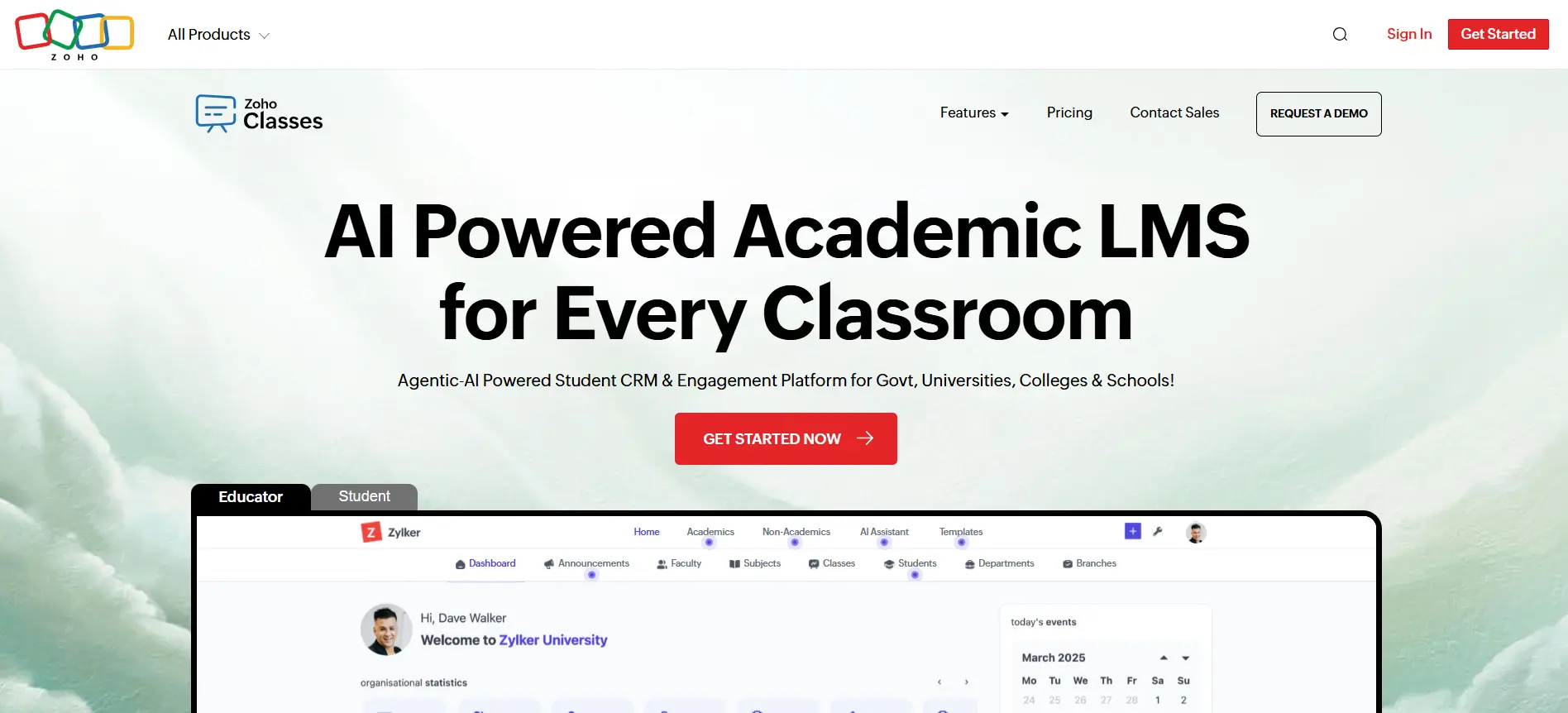
Zoho Classes 2.0 brings an AI Tutor, AI course builder and 22-language support to schools and colleges. Here's what the new LMS changes for educators.
Zoho has rolled out Classes 2.0, an AI-powered learning management system for schools, colleges and coaching institutes. The platform adds an AI Tutor, automated course creation, 22 Indian languages, and free access for government schools, positioning it as a homegrown challenger to global EdTech incumbents.
Chennai-based software maker Zoho has released a new version of its education platform, and it is betting heavily on artificial intelligence to win over classrooms.
Zoho Classes 2.0 arrives as an academic learning management system, or LMS, aimed at schools, universities, coaching centers and other training providers. The company describes it as built in India but intended for institutions anywhere in the world.
What sets this release apart from a typical software update is how central AI has become to the product. Instead of treating AI as an add-on feature, Zoho has embedded it into course creation, student support, grading and administration.
The launch also lands at a moment when education systems worldwide are experimenting with generative AI tools, often with mixed results. Zoho's approach offers a useful case study in how a major software vendor is trying to package that experimentation into a single, purpose-built platform.
What Is Zoho Classes 2.0?
Zoho Classes 2.0 is the latest version of Zoho's academic LMS, built to bring teaching, learning, student records and institutional administration onto one platform.
It is designed for a wide range of users, from K-12 schools and universities to coaching institutes and vocational training providers. The platform combines classroom tools with back-office functions such as enrollment tracking, attendance and communication.
Zoho is pitching the release as an AI-first rebuild rather than a simple feature update, with three broad pillars: AI woven through the learning journey, engagement tools aimed at digital-native students, and lifecycle management paired with institutional data insights.
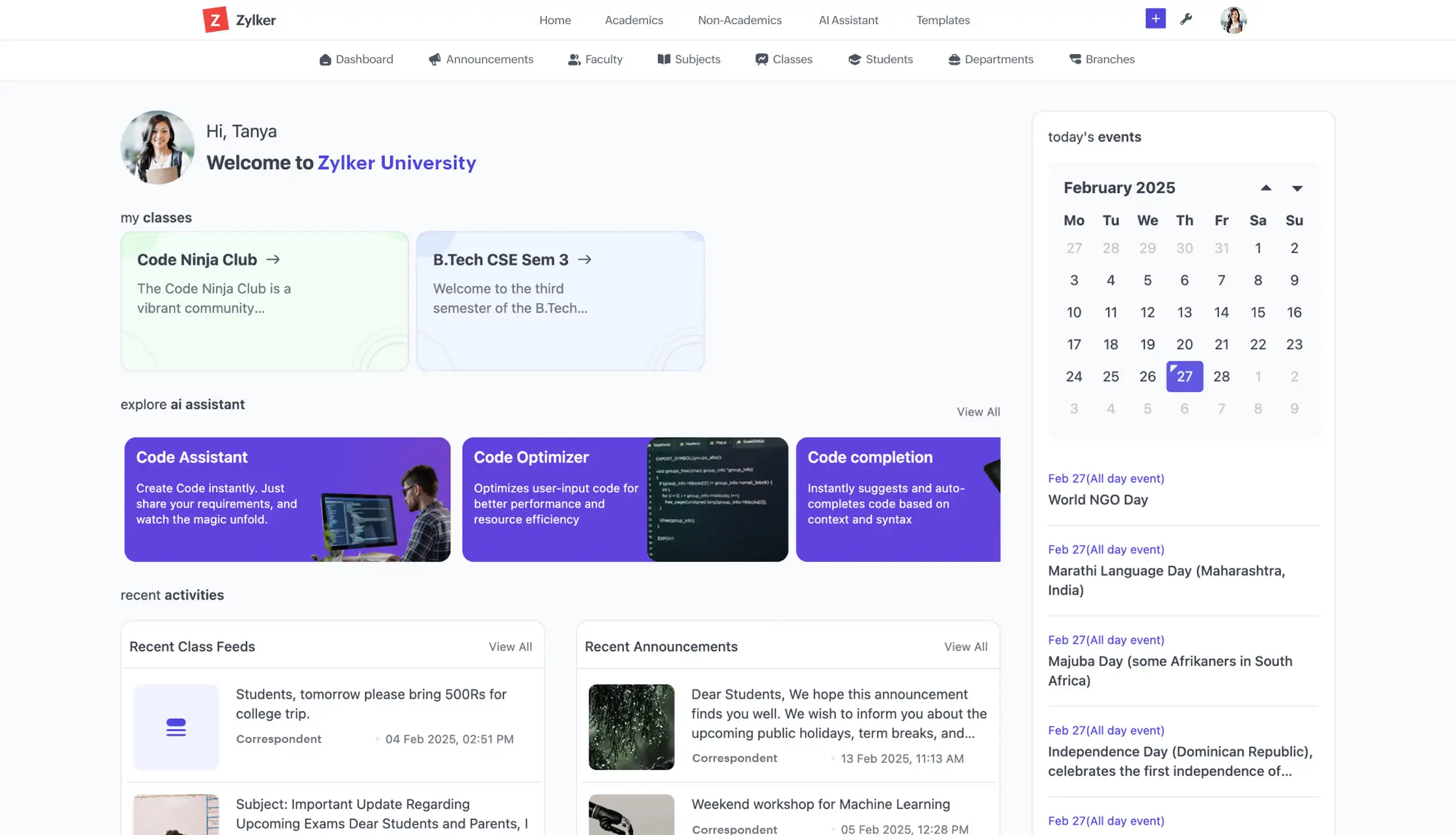
Key AI Features
AI Tutor
Every enrolled student gets access to an AI Tutor that is restricted to the subjects and syllabus they are actually enrolled in. The idea is to give students a round-the-clock resource for clarifying doubts and working through concepts at their own pace, without the tutor wandering outside the approved curriculum.
AI Course Builder
Teachers can feed in a syllabus, lesson plan or topic, and the AI Course Builder assembles a structured course from it. According to Zoho, this includes video lesson outlines, reading material, assignments with grading rubrics and adaptive practice tests, with content mapped to course and program outcomes used in accreditation frameworks.
Automated Assessments
The platform automates grading for multiple-choice and coding assignments and supports repeatable practice tests with score tracking, aiming to cut down the hours teachers spend on manual evaluation.
Student Lifecycle Management
Zoho Classes 2.0 tracks each student from enrollment through course completion. AI-driven analysis is meant to help institutions flag students who may be falling behind, so staff can step in earlier.
Attendance and Assignments
Standard LMS functions — attendance tracking, assignment submission, deadline reminders and grade visibility — are built into the platform, giving students and parents a single place to check on academic progress.
Communication Tools
Announcements, class feeds and discussion boards are included to keep students, teachers and, in some cases, parents updated in real time.
Multilingual Support
The platform supports all 22 languages scheduled under the Indian constitution, letting AI-generated content, assessments and learning material be delivered in a student's preferred language. This is a notable design choice, since most global LMS products default to English-first content generation.
Administrative Capabilities
Institutions get centralized dashboards for enrollment, reporting and content distribution. Zoho also includes a low-code micro-app builder, letting administrators create custom internal tools — for admissions or syllabus management, for example — without hiring developers.
What Makes It Different From Traditional LMS Platforms?
Most legacy LMS platforms were built primarily as content repositories: places to upload files, post grades and manage a calendar. AI, where it exists, is often bolted on as a separate module.
Zoho Classes 2.0 instead treats AI as core infrastructure. Course creation, tutoring and evaluation are generated rather than manually assembled, which shifts the teacher's role from content producer to content editor and reviewer.
The multilingual depth is also unusual. Few global LMS providers offer native support for over twenty regional languages, which matters for institutions serving linguistically diverse student populations, particularly outside major English-speaking markets.
Why This Matters for Indian Education
India has a large population of school and college students, and public education systems there have historically had uneven access to modern classroom technology, particularly in government-run institutions.
Zoho's decision to offer the platform free of licensing cost to central and state government schools, colleges and universities is a direct attempt to address that gap. Individual teachers with up to 100 students can also use it at no charge.
This matters because cost has long been one of the biggest barriers to EdTech adoption in public education. A no-cost tier removes that barrier for a meaningful segment of institutions, though it does not address other challenges like device access, internet connectivity, or teacher training — factors this platform alone cannot solve.
Zoho has also said it is working with government education bodies on broader digital education initiatives, including support for out-of-school students and polytechnic colleges, suggesting the company sees this as a longer-term public-sector partnership rather than a one-time product launch.
Benefits for Schools, Teachers, and Students
For schools and institutions: a single platform for admissions, attendance, communication and reporting can reduce reliance on multiple disconnected tools, and the free tier lowers the financial barrier to adoption.
For teachers: automated course generation and assessment grading could meaningfully cut the time spent on repetitive administrative work, freeing more time for actual instruction and mentoring.
For students: on-demand, syllabus-restricted AI tutoring and native-language content could help students who struggle with English-medium instruction or need extra support outside class hours.
These are real, plausible benefits based on the platform's stated design. Whether they materialize at scale will depend on execution, training and how well the AI-generated content holds up to teacher review.
Potential Limitations and Considerations
An AI Tutor restricted to enrolled subjects reduces the risk of students receiving off-syllabus or inaccurate answers, but it does not eliminate the broader concerns that come with any generative AI tool in education: the need for human oversight of AI-generated course content, the risk of over-reliance on automated answers instead of independent problem-solving, and questions about how student data is stored and used.
Automated course and assessment generation also shifts responsibility onto teachers to review AI output before it reaches students. Institutions adopting the platform will need clear policies on how much AI-generated material gets used unedited versus reviewed and adjusted.
Rollout is another factor. Zoho Classes 2.0 has launched first in India, with international availability expected to follow over time. Institutions outside India considering the platform should check current regional availability and compliance requirements, such as local data protection rules, before committing.
Finally, as with any new LMS deployment, migrating existing student records, retraining staff, and integrating with existing school-management software can take considerable time regardless of how capable the underlying AI tools are.
How It Compares With Other AI LMS Platforms
Feature | Zoho Classes 2.0 | Google Classroom | Moodle | Canvas LMS | Microsoft Teams for Education |
|---|---|---|---|---|---|
AI Tutor | Yes, restricted to enrolled subjects | No native AI tutor | Available via third-party plugins | Limited, via partner integrations | AI features via Copilot integration |
AI Course Creation | Yes, generates full courses from a syllabus | No | No native tool; plugin-dependent | Limited AI content tools | Limited, via Copilot |
Multilingual Support | 22 Indian languages plus broader localization | Wide language support, interface-level | Community-driven translations | Multiple languages supported | Wide language support |
Student Management | Full lifecycle tracking, attendance, admin tools | Basic classroom management | Highly customizable, needs setup | Strong academic and grading tools | Integrated with Microsoft 365 ecosystem |
Pricing | Free for eligible government institutions and small teacher accounts; paid tiers for larger institutions | Free with Google Workspace for Education | Free open-source; hosting costs apply | Paid, institution-level licensing | Bundled with Microsoft 365 Education plans |
Best For | Schools, colleges, coaching institutes seeking an all-in-one AI platform | K-12 classrooms already on Google Workspace | Institutions wanting full customization and control | Higher-education institutions needing robust grading and accreditation tools | Institutions already standardized on Microsoft tools |
This comparison reflects publicly available product information as of the platforms' current offerings and may change as vendors update their AI capabilities.
Industry Perspective
The push toward AI-embedded learning platforms is not unique to Zoho. Over the past two years, major EdTech and productivity vendors have added generative AI features to existing tools — from AI-assisted grading to chatbot-style tutoring — rather than building entirely new platforms.
Analysts covering the education technology sector have generally noted that the appeal of AI tutoring lies in scalability: a single AI system can, in theory, offer personalized support to far more students than an equivalent number of human tutors could reach.
At the same time, education researchers and policymakers have raised recurring questions about data privacy, algorithmic bias in automated grading, and whether AI tools genuinely improve learning outcomes or simply automate existing processes faster. These are open questions across the industry, not specific to any one vendor.
Zoho's move to build multilingual support directly into the platform reflects a broader trend of localization becoming a competitive differentiator, particularly for vendors targeting markets with strong regional language use, rather than assuming English-first design fits everywhere.
Key Takeaways
Zoho Classes 2.0 is an AI-first LMS combining teaching, learning and administration in one platform.
It includes an AI Tutor restricted to a student's enrolled subjects, plus an AI Course Builder that generates full courses from a syllabus.
The platform supports 22 scheduled Indian languages for content and assessments.
It is free for eligible Indian government schools and for individual teachers with up to 100 students.
It launches first in India, with global availability planned in phases.
Institutions should plan for staff training, data policy review, and human oversight of AI-generated content before full deployment.
Conclusion
Zoho Classes 2.0 is a clear signal that AI is moving from an experimental add-on to a foundational layer in education software. Its combination of AI tutoring, automated course creation and deep language localization addresses real gaps that many existing LMS platforms have left unfilled, particularly for institutions outside major English-speaking markets.
Whether it delivers on those promises at scale will depend on how institutions implement it, how much oversight teachers apply to AI-generated content, and how the free-access model holds up as adoption grows. For now, it adds a notable, India-built option to a global AI-in-education market that is still taking shape.
FAQs
What is Zoho Classes 2.0?
It is an AI-powered learning management system from Zoho that combines classroom teaching, student tracking and institutional administration on one platform.
Is Zoho Classes free?
It is free for eligible central and state government schools, colleges and universities in India, and for individual teachers with up to 100 students. Larger institutions may need a paid plan.
Does it support AI tutoring?
Yes. Each enrolled student gets access to an AI Tutor that is limited to the subjects they are enrolled in, so responses stay tied to the syllabus.
Which institutions can use it?
Schools, colleges, universities, coaching institutes and other training organizations can use the platform.
Does it support multiple languages?
Yes, it supports all 22 languages scheduled under the Indian constitution, in addition to broader localization for global rollout.
How is it different from Google Classroom?
Google Classroom does not include a built-in AI tutor or automated course generation. Zoho Classes 2.0 builds both directly into the platform, along with deeper student lifecycle tracking.
Can colleges use Zoho Classes?
Yes, the platform is designed to serve higher-education institutions as well as schools and coaching centers.
Is Zoho Classes available globally?
It has launched first in India, with international availability planned in phases over the coming months, including region-specific features.
Comments (0)
No comments yet. Be the first to share your thoughts!