AI Agents vs AI Chatbots: What’s the Real Difference?

Author
Ravi Prajapati
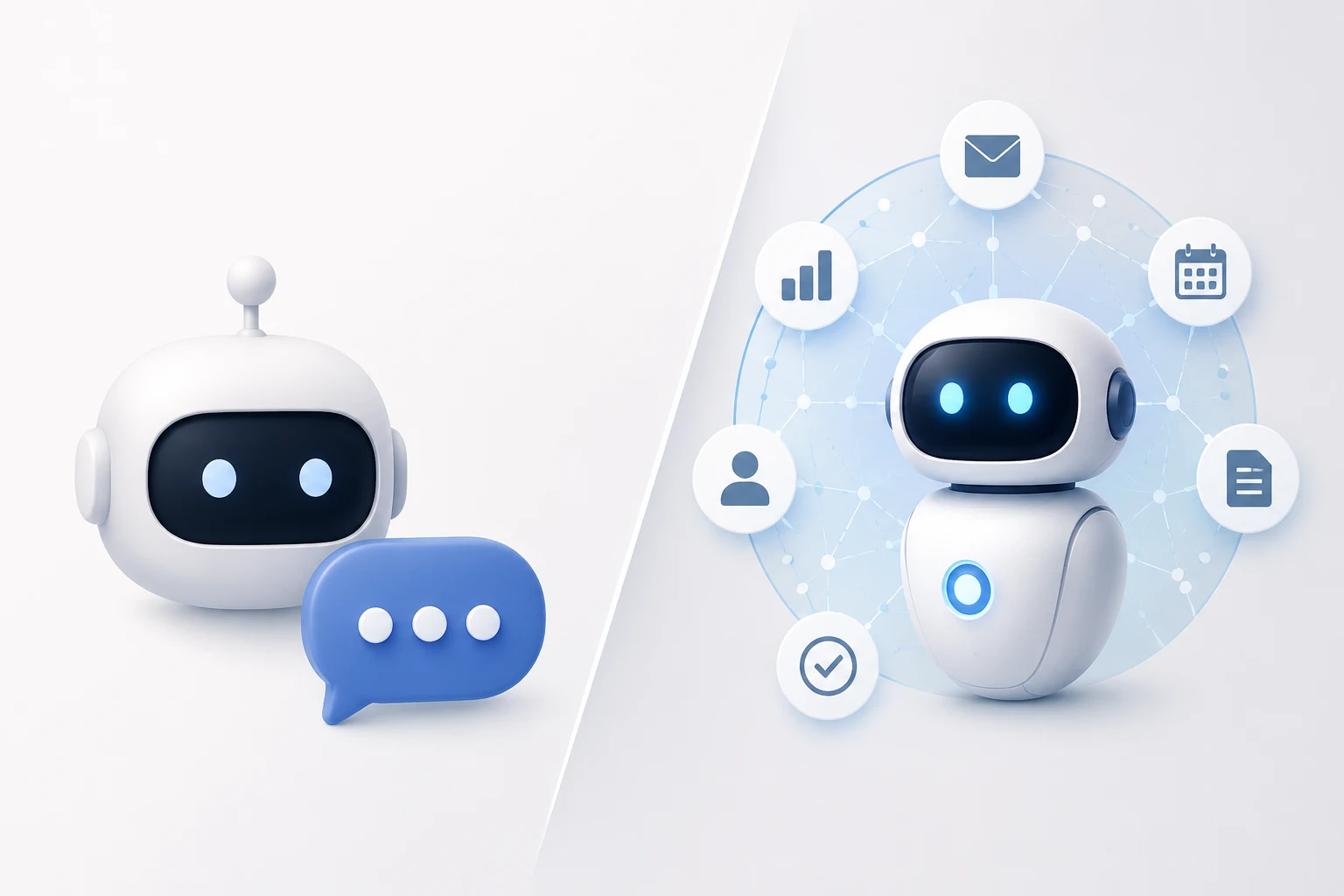
Learn the difference between AI agents and AI chatbots, how they work, key features, real-world use cases, and why AI agents are shaping the future.
A chatbot follows pre-programmed rules and responds only when prompted. An AI agent uses large language models (LLMs) to understand context, make decisions, and take autonomous action without waiting to be told what to do next. They are not the same thing, and confusing them is costing businesses real money.
And honestly, understanding the difference is becoming increasingly important because AI is rapidly moving beyond simple conversations into automation, reasoning, decision-making, and autonomous workflows.
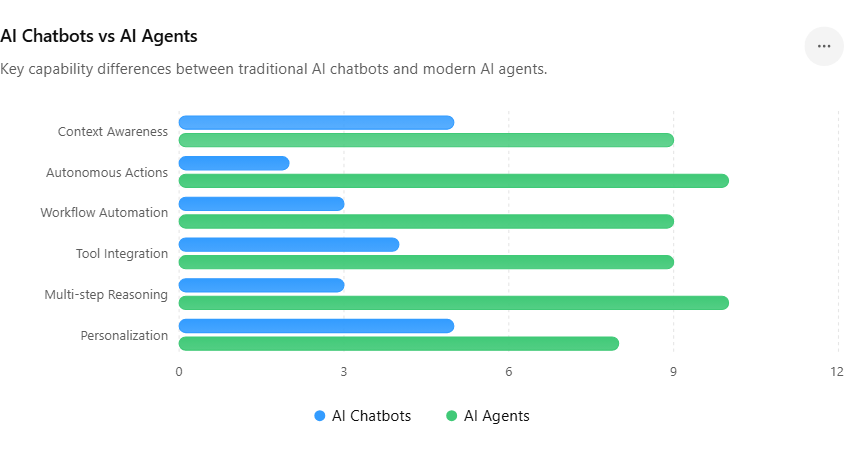
Traditional AI chatbots were mainly built to answer questions and simulate conversations. AI agents, on the other hand, are designed to perform tasks, make decisions, use tools, interact with systems, and complete multi-step actions with minimal human input.
AI chatbots can talk. AI agents can act. Learn the real difference, how they work, use cases, and why AI agents are shaping the future.
What Is a Chatbot?
A chatbot is a software program designed to simulate conversation. At its core, it works by recognizing keywords or phrases in a user's message and returning a pre-written response from a scripted library.
The concept is not new. The first chatbot ELIZA was built at MIT in 1966. It matched patterns in typed text to predefined response templates. Everything that followed, for decades, was a variation of that same architecture: pattern → trigger → scripted output.
Modern chatbots improved with Natural Language Processing (NLP) and Natural Language Understanding (NLU), making them better at parsing human language. But they remained fundamentally reactive. They wait for a user to speak. They check the input against their trained rules. They respond and then stop.
Even "AI-powered" chatbots (those enhanced with conversational AI or generative models) are still largely prompt-dependent. They do not plan. They do not initiate. They do not act.
In plain terms: A chatbot is a very good question-answering machine. Nothing more.
What Is an AI Agent?
An AI agent is a goal-oriented autonomous system powered by large language models (LLMs). It does not just respond to input it reasons about a situation, plans a sequence of actions, and executes tasks across systems and data sources to achieve an outcome.
Where a chatbot asks "what did the user say?", an AI agent asks "what does the user need, and how do I make that happen?"
AI agents can:
Access real-time external data (CRMs, databases, APIs)
Execute multi-step workflows without human hand-holding
Adapt mid-conversation as context changes
Initiate contact proactively (outbound engagement)
Learn from past interactions and refine their behaviour over time
The underlying technology shift is significant. Chatbots rely on dialogue flows maps of possible conversations, all written by humans in advance. AI agents use LLMs to reason dynamically, which means they can handle conversations that were never anticipated during their design.
In plain terms: An AI agent is a digital employee. It understands goals, handles ambiguity, and gets things done autonomously.
AI Agents vs AI Chatbots: Key Differences at a Glance
Feature | AI Chatbot | AI Agent |
|---|---|---|
Core technology | NLP + scripted rules | LLMs + agentic reasoning |
Behaviour | Reactive (waits for input) | Proactive (can initiate action) |
Task complexity | Simple, single-turn | Complex, multi-step workflows |
Context awareness | Limited to current session | Retains short & long-term memory |
Learning | Static (requires manual updates) | Adaptive (learns from interactions) |
System integrations | Limited | Deep (CRMs, APIs, ticketing systems) |
Handling ambiguity | Fails or returns error | Reasons through uncertainty |
Who is in control? | Always the human | The agent plans; human oversees |
Best for | FAQs, scripted flows, ID&V | End-to-end resolution, complex CX |
Cost to deploy | Lower upfront | Higher upfront, greater long-term ROI |
The 5 Dimensions That Separate AI Agent and AI Chatbot
1. Autonomy
This is the defining difference. A chatbot has zero autonomy it processes input and returns output. An AI agent has genuine decision-making capacity: it evaluates a situation, selects an action, executes it, observes the result, and adjusts accordingly.
Think of it like the difference between a vending machine (chatbot) and a personal assistant (AI agent). The vending machine gives you what you press. The assistant figures out what you need.
2. Task Complexity
Chatbots handle single-turn, rule-bound tasks: answer a question about shop hours, confirm a booking, check an order status. The moment a user deviates from the expected path, the chatbot breaks down.
AI agents handle multi-step, context-sensitive processes: rebook a flight, resolve a billing dispute, process an insurance claim with document verification, or coordinate between a CRM and a live support queue all without a human touching it.
3. Learning and Memory
Traditional chatbots are static. If your return policy changes, someone must manually rewrite the chatbot's responses. The bot has no awareness that the world has moved on.
AI agents are dynamic. They retain context across interactions, learn which response strategies produce better outcomes, and update their behaviour based on new information without requiring a developer to reprogram them.
4. Integration Depth
A chatbot might pull from a knowledge base. An AI agent connects to your entire operational stack: CRM, order management, ticketing systems, internal databases, communication tools. This is what allows it to take action, not just provide information.
5. Conversational Quality
Chatbot conversations feel scripted because they are. Users often hit dead ends, have to rephrase questions, or restart the conversation entirely.
AI agent conversations feel like talking to an informed, capable person. They track context across the full conversation, handle topic shifts gracefully, and detect emotional signals like frustration or urgency adjusting tone and approach accordingly.
Real-World Use Cases Compared for AI Agent and Chatbot
Where Chatbots Excel
FAQ Automation: Handling the top 20 questions a business receives store hours, return policies, account password resets. Repetitive, predictable, and well-suited to scripted response.
Identity Verification (ID&V): Guiding users through a verification process with step-by-step prompts. Structured and finite a chatbot handles this well.
Document Collection: Walking a customer through submitting required paperwork (e.g., for an insurance claim). Each step is known in advance; the chatbot just executes the sequence.
Order Status Updates: Pulling data from a backend and surfacing it to the user. Simple read-only integrations where no action is required.
Where AI Agents Excel
End-to-End Customer Service: Resolving a complaint from initial contact through diagnosis, action, and resolution across channels and systems without any human handoff.
Outbound Engagement: Proactively contacting customers when a trigger event occurs (a flight delay, an expiring subscription, an engine warning light in a connected vehicle) and completing the follow-up action (rebooking, renewing, scheduling service).
Agent Copilot: Assisting human service agents in real time listening to calls, surfacing relevant information, suggesting next best actions, and auto-generating post-call summaries.
Complex Issue Resolution: Handling multi-party, multi-system problems like a billing dispute involving a third-party processor, a refund policy, and a loyalty programme without escalation.
AI Agent vs. Chatbot: Which One Does Your Business Actually Need?
Use this framework to decide:
Choose a chatbot if:
Your support queries are predictable and repetitive
You need to reduce volume on your human team for simple tasks
Your budget is limited and you need a fast deployment
You're automating a single, well-defined workflow (e.g., ID&V or FAQ)
Choose an AI agent if:
Your customers have complex, varied, or unpredictable needs
You want true end-to-end automation without human intervention
You're dealing with high call/message volumes across multiple channels
You want automation that improves over time without constant manual updates
You care about customer experience quality, not just deflection rates
The honest answer for most mid-to-large businesses: You need both, deployed strategically. A chatbot handles the routine. An AI agent handles the complex. Together, they cover the full spectrum of customer needs with humans handling only what genuinely requires human judgment.
This "composite AI" model where process-driven bots and goal-driven agents work in tandem is how leading enterprises are building their customer service infrastructure.
Related: Different Types of Intelligent Agents in Artificial Intelligence
The Future: Beyond the Chatbot Era
The chatbot was a necessary first step. It proved that automation in customer service was viable. But the limitations were always real, and customers felt them: dead-end conversations, robotic phrasing, endless loops, and the frustration of being failed by a machine that didn't understand what you actually needed.
AI agents represent a fundamentally different class of technology. They don't just simulate conversation they perform work. They bring contextual intelligence, real-world integrations, and the ability to act. For the first time, automation can genuinely replace what a skilled human would do, at a fraction of the cost, available around the clock.
The enterprises that move first on AI agents are not just cutting costs. They are raising the floor of what "good customer service" means and making it hard for competitors relying on legacy chatbots to keep up.
The shift from chatbot to AI agent is not an upgrade. It is a reclassification. One is a tool. The other is a workforce.
Frequently Asked Questions about AI Agent vs Chatbot
Q: Are all chatbots AI?
No. Many chatbots use simple keyword matching and scripted decision trees with no AI involved at all. Some modern chatbots incorporate NLP and LLMs, but even AI-powered chatbots remain reactive and rule-dependent a fundamentally different architecture from AI agents.
Q: Is ChatGPT a chatbot or an AI agent?
ChatGPT in its basic form is closer to a conversational AI chatbot it responds to prompts but doesn't take autonomous action. When integrated into workflows with tools and APIs (as in GPT agents or Operator), it becomes closer to an AI agent.
Q: Will AI agents replace chatbots entirely?
Not entirely. Chatbots remain cost-effective and sufficient for narrow, repetitive use cases. Most businesses will run both in parallel chatbots for structured tasks, AI agents for complex workflows. The real shift is that the bar for what counts as "acceptable automation" keeps rising as customers experience AI agent quality.
Q: Are AI agents the same as agentic AI?
Closely related but distinct. Agentic AI refers to the underlying capability LLM-powered systems that can reason, plan, and act autonomously. AI agents are the deployed implementations of that capability. Agentic AI is the technology; an AI agent is the product built on it.
Q: What's the main risk of using an AI agent over a chatbot?
AI agents access more systems and data, which raises the stakes for data privacy and error consequences. A misconfigured chatbot gives a wrong answer. A misconfigured AI agent could take the wrong action in a live system. This makes governance, testing, and oversight more critical but the expanded capability is worth the added responsibility when managed correctly.
Q: How much does it cost to deploy an AI agent vs. a chatbot?
Chatbots typically have lower upfront costs and faster deployment. AI agents require more integration work and configuration. However, AI agents tend to deliver greater long-term ROI by reducing human escalations, handling more complex cases autonomously, and improving continuously without manual retraining.
Q: What industries benefit most from AI agents?
Any industry with high customer interaction volume and complex service needs: telecommunications, financial services, insurance, airlines, healthcare, retail, and automotive. AI agents are particularly powerful anywhere customers need to complete multi-step transactions not just get answers.
Comments (0)
No comments yet. Be the first to share your thoughts!