AI in Medical Coding Audits: Use Cases, Limits and Implementation

Author
Ravi Prajapati

Learn how AI in medical coding audits can detect coding risks, review documentation and prioritize claims, plus its limitations and implementation steps.
AI in medical coding audits can help healthcare organizations review more encounters, identify documentation-code mismatches, prioritize high-risk claims and give human auditors a narrower set of records to investigate. What it cannot reliably do is turn coding compliance into a fully autonomous process.
That distinction matters.
Medical coding is not simply a text-classification problem. A code may depend on clinical documentation, code-set conventions, sequencing rules, modifiers, payer policies, medical necessity and the circumstances of the encounter.
The financial consequences of getting those decisions wrong can be significant. CMS reported that incorrect coding accounted for 11.1% of national Medicare fee-for-service improper payments in the 2025 reporting period, while insufficient documentation accounted for 53%.
For Evaluation and Management (E/M) services specifically, CMS reported a 10.3% improper payment rate for the 2024 reporting period, representing a projected $3.9 billion. Incorrect coding accounted for 49.1% of E/M improper payments.
AI therefore has a credible role in coding audit workflows, but the strongest use case is not "replace the auditor."
It is:
Review more → identify anomalies → explain why a record was flagged → route the right cases to qualified humans → learn from confirmed outcomes.
That is a more realistic model for AI-assisted medical coding audits.
What Is AI in Medical Coding Audits?
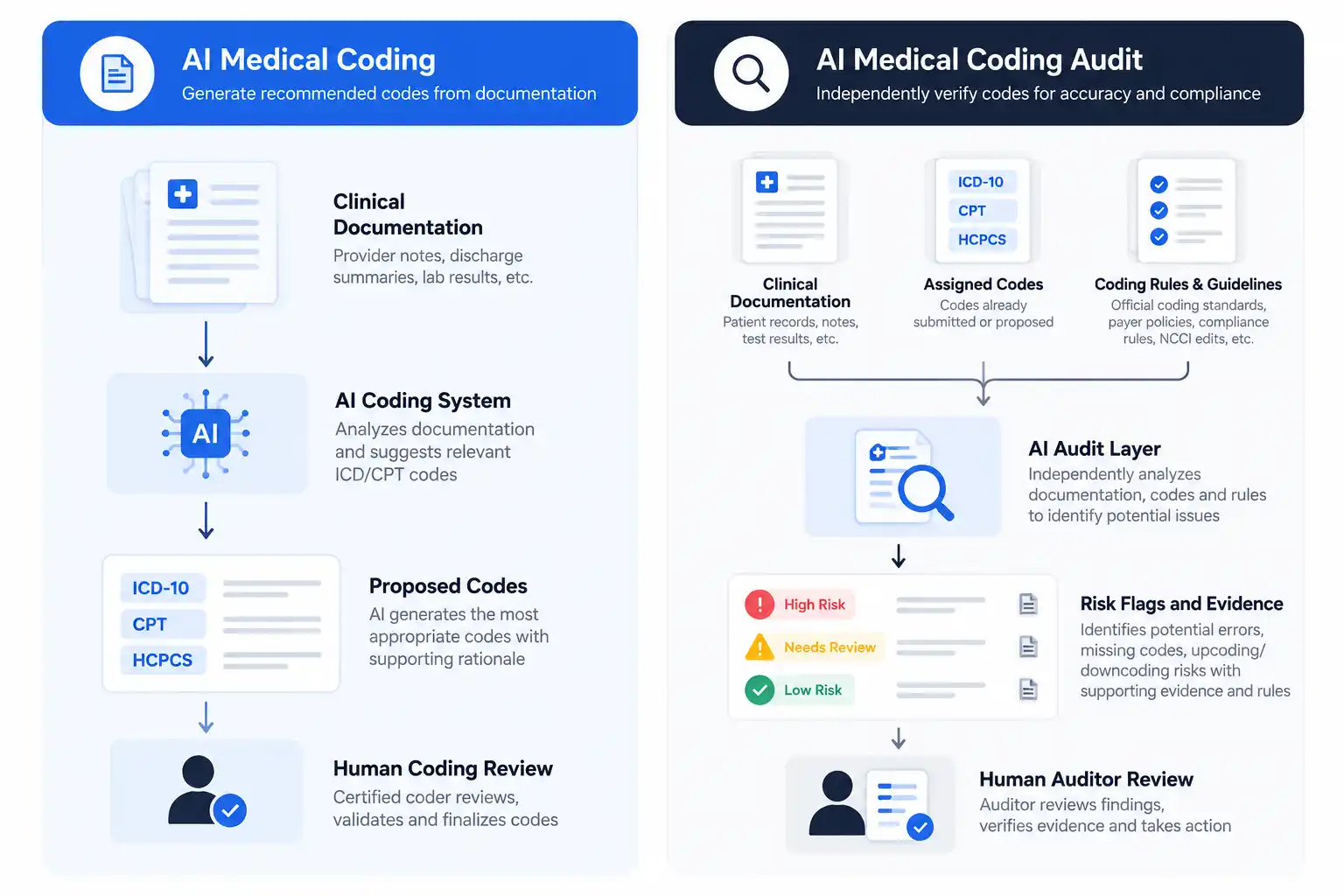
AI in medical coding audits is the use of machine learning, natural language processing, large language models or rules-based systems to review coded healthcare encounters and identify possible coding, documentation or compliance issues for further investigation.
The distinction between AI coding and AI coding audit is important.
An automated coding system attempts to determine which ICD, CPT, HCPCS or other code should be assigned.
An AI-assisted audit system asks a different question:
Given the documentation, assigned codes and applicable rules, is there evidence that this record deserves further review?
The two systems may use similar technologies, but their objectives should be different.
AI medical coding | AI medical coding audit |
|---|---|
Suggests or assigns codes | Reviews codes already assigned |
Optimizes coding workflow | Tests coding quality and compliance |
Produces a coding recommendation | Produces a risk signal or audit finding |
Often operates before claim submission | Can operate pre-bill or post-bill |
Focuses on likely correct code | Focuses on possible discrepancy |
Human validates uncertain coding | Human investigates flagged cases |
That separation also creates a useful control.
If the same system generates a code and effectively approves its own decision, the audit loses some of its independence.
A stronger architecture separates generation from verification.
Why Medical Coding Audits Are a Good Candidate for AI
Traditional audits face a sampling problem.
A healthcare organization may process far more encounters than its coding and compliance teams can manually review. Auditors therefore have to decide which records deserve attention.
That creates an obvious place for machine assistance.
Instead of manually auditing a small random sample, AI can potentially analyze a much larger population and identify records with characteristics associated with coding risk.
This does not mean every flagged record is wrong.
It means the organization can move from:
random sampling
toward:
risk-based sampling.
The value is prioritization.
An auditor's time can then be concentrated on claims where documentation, coding patterns or other signals suggest that deeper investigation may be useful.
What Can AI Actually Do in a Medical Coding Audit?
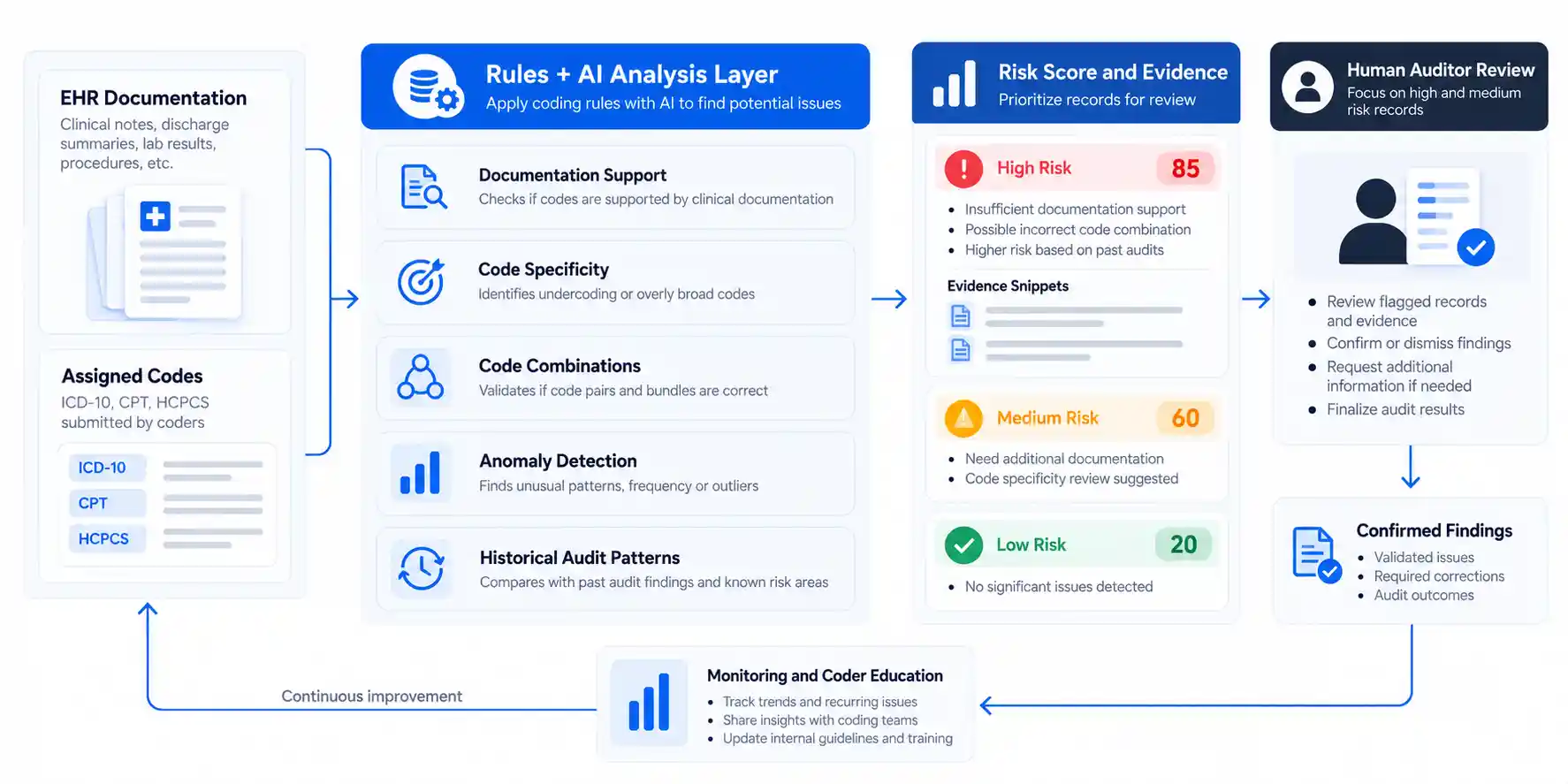
Several use cases are technically realistic today, although reliability depends heavily on the system, data, code set and clinical context.
1. Detect Documentation-Code Mismatches
One of the clearest applications is comparing assigned diagnosis codes against clinical documentation.
For example, an audit system could examine whether documentation contains evidence supporting an ICD-10-CM diagnosis assigned to the encounter.
This does not mean that keyword matching is enough.
The official U.S. ICD-10-CM Coding Guidelines emphasize that complete and accurate code assignment depends on consistent, complete documentation and review of the entire record.
An AI audit system therefore needs more than:
Does this diagnosis appear somewhere in the note?
It needs to evaluate context.
A condition might be historical rather than current. It may have been ruled out. Documentation might lack required specificity. The code may be valid but incorrectly sequenced.
This is where natural-language processing and clinical language models can potentially help identify relationships between the documentation and the submitted code.
2. Find Potential Overcoding and Undercoding
AI can compare documentation against assigned codes and flag situations where the code appears more or less specific than the supporting record.
Potential patterns include:
unsupported higher-severity diagnoses
missed specificity
inconsistent procedure coding
questionable modifiers
diagnosis-code combinations that deserve review
possible undercoding
possible overcoding
The word potential matters.
A model should not declare fraud or noncompliance simply because a statistical pattern looks unusual.
It should identify a discrepancy for investigation.
3. Prioritize High-Risk Diagnoses
Risk adjustment illustrates why targeted auditing matters.
In September 2026, the HHS Office of Inspector General reported on a Medicare Advantage compliance audit of selected HumanaChoice diagnosis codes. For 178 of 220 sampled enrollee-years, the medical records did not support the selected diagnosis codes, resulting in $669,237 in overpayments in the sample. OIG estimated at least $130.9 million in overpayments for 2020 and 2021 based on its sample methodology.
That finding should not be generalized to all coding or all Medicare Advantage organizations.
It does illustrate why documentation-supported diagnosis coding is financially important.
An AI audit layer could help prioritize records involving known high-risk patterns so qualified auditors spend more time where the financial or compliance exposure is greater.
4. Detect Unusual Coding Patterns Across Providers
Individual claims tell only part of the story.
AI can also examine patterns across:
physicians
facilities
specialties
locations
diagnosis groups
procedure groups
time periods
Suppose one provider's distribution of a particular code differs sharply from comparable providers.
That does not prove the provider is coding incorrectly.
Patient complexity, specialization and practice setting can produce legitimate differences.
But it can provide a useful audit signal.
This is a good application for anomaly detection because the system does not need to decide whether a claim is definitively wrong. It needs to identify where human investigation may produce the highest value.
5. Check Procedure-to-Procedure and Unit Patterns
Not every useful audit signal requires generative AI.
CMS already uses deterministic coding logic through its National Correct Coding Initiative (NCCI). Procedure-to-Procedure edits are designed to address inappropriate code combinations, while Medically Unlikely Edits define unit-of-service thresholds used to help reduce improper payments.
An effective audit system can combine such structured rules with machine-learning analysis.
This matters because rules and AI solve different problems.
A deterministic rule is often better when the compliance requirement is explicit.
AI becomes more useful when the system must interpret unstructured clinical documentation, identify unusual combinations or prioritize ambiguous cases.
6. Review Coding Against Clinical Context
A more sophisticated audit system can combine multiple evidence sources:
clinical note + diagnoses + procedures + encounter type + coding rules + historical patterns.
That is substantially more useful than auditing the code in isolation.
For example, an assigned diagnosis may be valid in the code set but poorly supported by the documentation for that particular encounter.
The AI system can flag the relationship and show the relevant documentation to an auditor.
The final judgment remains a compliance decision rather than a text-generation task.
7. Find Repeated Error Patterns
Confirmed audit results create another useful data source.
If human auditors repeatedly identify the same type of problem, organizations can analyze those findings to identify systematic weaknesses.
For example:
Audit finding → categorize error → identify recurring pattern → locate affected claims → educate coders/providers → monitor recurrence.
This shifts AI from individual claim review toward continuous quality improvement.
Where AI Coding Audits Still Fail
The attractive part of AI-assisted auditing is scale.
The difficult part is judgment.
Rare Codes Remain Difficult
A 2026 systematic review of 54 automated ICD coding studies found that performance tended to be stronger for frequent codes than for full label spaces. It also identified continuing problems with rare-code prediction, interpretability, dataset generalizability and inconsistent evaluation.
Another recent systematic review reached a similar conclusion: frequent labels were generally predicted more reliably than rare labels, and performance varied with the dataset, task, label space and evaluation design.
This has direct implications for auditing.
Rare cases may be precisely the cases where organizations want additional scrutiny.
Coding Rules Are More Than Clinical Semantics
An LLM may correctly understand what happened clinically and still select the wrong billing code.
A 2026 study testing several large language models on common spine-surgery coding scenarios found exact-match rates ranging from 40% to 65%. The researchers also observed important errors involving complex procedure hierarchies and concluded that the tested models should be used as adjuncts requiring human supervision.
Another 2026 study involving simple foot-and-ankle CPT coding found large performance differences among five LLMs, with accuracy ranging from 48.2% to 92.9%. Its authors similarly concluded that current models were not reliable enough for independent clinical use.
These are limited studies in specific specialties and should not be interpreted as universal benchmarks for all coding systems.
They do demonstrate something important:
Strong language understanding does not automatically equal reliable coding-rule execution.
Hallucination Is Especially Dangerous in Audits
A normal AI assistant can generate an incorrect explanation.
An audit system generating an incorrect explanation creates a different problem: the explanation may look like evidence.
This is one reason AI-generated audit findings need to be grounded in source documentation rather than accepted at face value. Understanding what AI hallucination is and how to prevent it helps explain why every flagged coding discrepancy should include verifiable evidence.
For example, a model might claim that a note supports a diagnosis when the documentation does not actually contain the necessary evidence.
The system should therefore ground findings in the record.
Instead of:
Code X appears unsupported.
A stronger audit output is:
Code X was flagged because the audit engine could not identify documentation supporting criterion Y. Relevant documentation reviewed: [specific sections]. Applicable rule: [rule reference].
The auditor can then verify the reasoning.
Payer Rules Change
Coding systems do not operate in a static environment.
CMS updates ICD files and coding guidance, and NCCI edit files are updated quarterly. CMS's current ICD-10 page, for example, lists FY2027 code files effective October 1, 2026.
An AI audit system relying on outdated rules can produce highly confident but obsolete recommendations.
Rule versioning is therefore not an administrative detail.
It is part of the model's accuracy.
Documentation Can Be Ambiguous
AI cannot reliably infer documentation that does not exist.
The official ICD-10-CM guidelines explicitly emphasize that accurate coding depends on complete documentation.
When evidence is missing, the correct result may be:
insufficient information for automated determination.
That is a valuable output.
A system that always feels compelled to select "correct" or "incorrect" will create false certainty.
The Better Model: AI Should Triage Audit Risk, Not Pretend to Be the Auditor
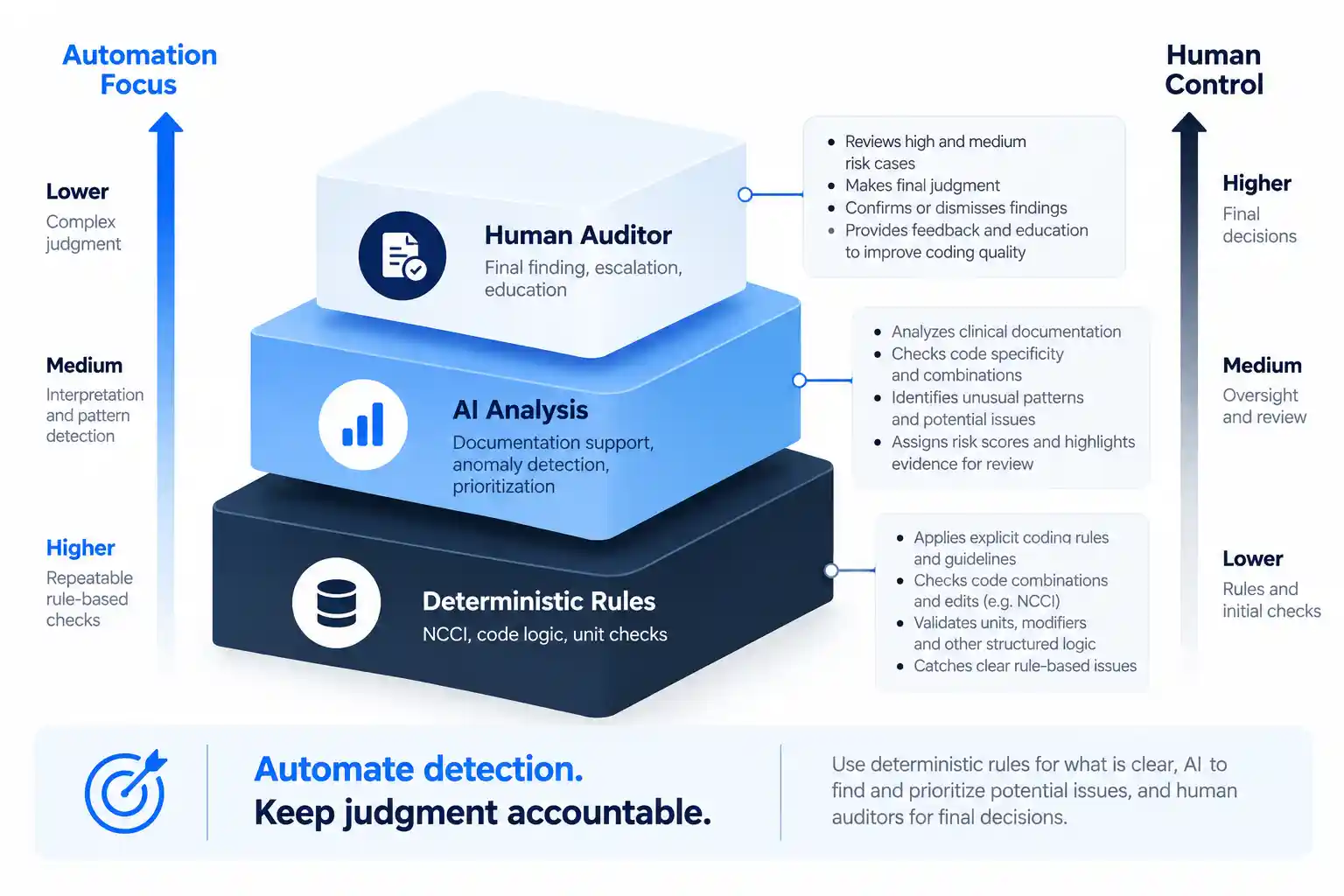
The strongest implementation pattern is a layered one.
A coding audit involves at least three different types of reasoning:
Layer | Best suited to | Example |
|---|---|---|
Deterministic rules | Explicit coding constraints | NCCI edits, unit limits, required combinations |
AI analysis | Unstructured and pattern-based review | Documentation support, anomaly detection |
Human auditor | Contextual compliance judgment | Final finding, escalation, education |
Trying to replace all three with a general-purpose LLM weakens the system.
Instead, organizations can use AI where ambiguity and scale make automation useful, rules where requirements are deterministic, and human expertise where judgment carries compliance or financial consequences.
This produces a more defensible principle:
Automate detection aggressively. Automate final judgment cautiously.
How to Implement AI in Medical Coding Audits
Buying an AI tool is not the first step.
Defining the audit problem is.
Step 1: Choose a Narrow Audit Target
Do not begin with:
Audit all medical coding using AI.
Choose a specific problem.
Examples include:
documentation support for selected diagnosis groups
modifier review
E/M coding risk
high-risk risk-adjustment diagnoses
procedure-code combinations
suspected undercoding
repeated coder error patterns
A narrow scope makes validation much easier.
Step 2: Define the Authoritative Evidence
Determine what the system is allowed to use.
That might include:
encounter documentation
ICD-10-CM/PCS files
official coding guidelines
CPT rules under appropriate licensing
HCPCS rules
NCCI edits
payer policies
organization-specific compliance rules
previous confirmed audit findings
Each source should be versioned.
The system should know which rules applied on the date of service, not simply which rules exist today.
Step 3: Separate Rules From Probabilistic Reasoning
Do not ask a language model to rediscover a deterministic coding rule every time it reviews a claim.
If the rule can be represented reliably as structured logic, use structured logic.
Reserve AI for tasks such as:
understanding clinical narrative
linking documentation with codes
detecting unusual patterns
summarizing supporting evidence
ranking audit priority
This hybrid architecture is usually more explainable than asking one model to do everything.
Step 4: Require Evidence With Every Flag
A useful audit finding should answer:
What was flagged?
Why was it flagged?
What documentation supports the concern?
What rule or policy is relevant?
How confident is the system?
What should the human reviewer inspect?
An unexplained risk score is much less useful to a coding auditor than a traceable finding.
Step 5: Validate Against Human-Audited Cases
Before production use, test the system against records already reviewed by qualified auditors.
Do not evaluate only overall accuracy.
Measure:
precision
recall
false-positive rate
false-negative rate
performance by code category
performance on rare codes
performance by specialty
performance by facility or documentation style
disagreement with human auditors
Financial impact should also be evaluated carefully.
A system that catches many low-value discrepancies while missing a smaller number of high-value errors may look accurate statistically while performing poorly as an audit tool.
Step 6: Decide Where Human Review Is Mandatory
Not every finding needs the same workflow.
For example:
Low risk: monitor only.
Moderate risk: include in auditor queue.
High financial/compliance risk: mandatory qualified review.
Ambiguous documentation: route for human assessment rather than force an automated conclusion.
Thresholds should reflect the organization's risk tolerance and use case.
Step 7: Monitor the System After Deployment
Validation does not end at launch.
Coding rules change.
Clinical documentation changes.
Providers change behavior.
Models change.
Data distributions change.
Performance therefore needs ongoing monitoring.
The broader health-IT regulatory direction reinforces this principle. The U.S. Office of the National Coordinator's HTI-1 framework introduced transparency requirements for certain predictive algorithms within certified health IT and emphasizes information needed to evaluate fairness, appropriateness, validity, effectiveness and safety.
Those requirements do not automatically apply to every coding-audit product, but the governance principle is relevant: organizations should know how an AI system was developed, evaluated and monitored before depending on its outputs.
A Practical ReadInBrief Framework for Evaluating AI Coding Audit Readiness
Before deploying AI into a coding audit workflow, organizations can evaluate five dimensions.
This is a ReadInBrief implementation framework, not an industry standard.
Dimension | Key question | Warning sign |
|---|---|---|
Evidence | Can every important flag be traced to documentation and rules? | Model gives conclusions without evidence |
Validation | Has performance been tested on your actual coding environment? | Vendor benchmark is the only validation |
Independence | Is audit logic sufficiently separate from code generation? | Same model generates and approves codes |
Governance | Are rules, models, permissions and changes controlled? | No versioning or change log |
Escalation | Are uncertain/high-risk cases routed to qualified humans? | Model automatically closes ambiguous findings |
These controls are part of a broader approach to responsible AI deployment. Our guide to AI governance, trust, and compliance explains how organizations can establish oversight, maintain audit trails, manage risks, and monitor AI systems after deployment.
An organization with weak performance in any of these areas probably has an AI governance problem before it has an AI coding problem.
Build, Buy or Add AI to the Existing Audit Workflow?
Organizations considering AI-assisted coding audits generally have three options.
Approach | Best fit | Main advantage | Main limitation |
|---|---|---|---|
Buy specialized platform | Organizations wanting faster deployment | Existing coding workflows and integrations | Less architectural control |
Build custom audit system | Large organizations with unique requirements | Control over data, rules and workflows | Higher engineering/governance burden |
Add AI layer to existing tools | Organizations with established audit systems | Preserves existing compliance logic | Integration complexity |
Selecting a suitable platform is only one part of implementation. Organizations must also define ownership, integration requirements, measurable outcomes, and ongoing monitoring. This is consistent with the broader lessons in why AI strategies fail even when the technology works.
The decision should depend less on who has the most impressive AI demo and more on:
Can the system reproduce its reasoning against the organization's actual records and rules?
A vendor claiming 95% accuracy is not providing enough information.
You need to know:
95% of what?
On which specialties?
Which code sets?
Which documentation types?
Which payer rules?
How were ambiguous cases treated?
How did rare codes perform?
What happens when the model is uncertain?
Those questions determine whether a benchmark is useful.
Should AI Automatically Change Medical Codes?
For high-consequence audit workflows, organizations should be cautious about allowing probabilistic AI outputs to automatically change codes without an appropriate validation and governance process.
Automation may eventually be appropriate for tightly defined, well-validated situations.
That is different from giving a general-purpose model broad authority over coding changes.
The AMA's current CPT AI taxonomy itself distinguishes assistive, augmentative and autonomous uses of AI in medical services and procedures. The terminology is designed for AI-enabled medical services rather than coding-audit automation specifically, but the distinction is useful: not every use of AI represents the same level of machine autonomy.
For coding audits, the same question should be asked explicitly:
Is the AI assisting a professional, augmenting a professional's judgment, or making the decision itself?
The governance requirements should become stricter as autonomy increases.
The level of human oversight becomes particularly important when AI outputs influence decisions with financial, legal, or patient-safety consequences. Our discussion of accountability when AI causes harm provides broader context on responsibility and oversight in high-stakes AI applications.
What Should Healthcare Organizations Measure?
The wrong KPI can make an AI audit program look more successful than it is.
"Number of claims reviewed by AI" tells you very little.
Better operational measures include:
confirmed findings per 1,000 records screened
auditor acceptance rate of AI flags
false-positive rate
false-negative rate on validation samples
auditor time per confirmed finding
high-risk claims detected
performance by specialty
performance by code family
performance on rare codes
value of overcoding identified
value of undercoding identified
recurring error reduction after education
percentage of findings with traceable evidence
The objective is not maximum AI activity.
It is better audit coverage without reducing audit quality.
The Biggest Implementation Mistake: Measuring AI Against Humans on the Easy Cases
A system can look excellent if the test set contains mostly straightforward encounters.
Real audit value often lies in difficult cases:
incomplete documentation
conflicting documentation
unusual procedures
rare diagnoses
complicated sequencing
payer-specific requirements
modifier combinations
high-risk reimbursement scenarios
That suggests a better validation strategy.
Do not ask only:
How accurate is the system overall?
Also ask:
Where does it fail?
Those failure boundaries matter more than an impressive aggregate accuracy number.
AI Will Probably Change the Shape of Coding Audits Before It Eliminates Auditors
The strongest evidence today supports a more measured conclusion than either "AI cannot do medical coding" or "AI will automate the whole department."
Automated coding research has made meaningful technical progress, particularly with deep learning, transformers and newer language-model approaches. But systematic reviews continue to identify problems with rare codes, external validation, interpretability and generalization.
For audits, those weaknesses matter even more because the system is being asked to identify mistakes rather than merely make a prediction.
The practical opportunity is therefore not to remove the auditor from the process.
It is to change what the auditor spends time doing.
Instead of manually searching through large numbers of records to find possible problems, auditors can increasingly focus on:
investigation, judgment, escalation, education and prevention.
AI handles more of the screening.
Rules handle deterministic checks.
Humans remain accountable for decisions where documentation, coding policy and financial consequences require professional judgment.
That architecture is less dramatic than "autonomous medical coding audits."
It is also far more credible.
Human oversight is not just a technical safeguard; it also affects whether people trust and adopt AI-supported workflows. Read more about the relationship between AI, data quality, and trust and why dependable systems require more than model performance alone.
Frequently Asked Questions
How is AI used in medical coding audits?
AI can compare medical documentation with assigned codes, detect unusual coding patterns, identify possible documentation gaps, prioritize high-risk claims and present evidence for human auditors. Its strongest current role is screening and prioritization rather than making every final compliance decision independently.
Can AI detect medical coding errors?
AI can identify patterns that may indicate coding errors, but a flag is not automatically proof of an error. Performance varies by code type, specialty, documentation quality and system design. Human verification remains particularly important for ambiguous, unusual or financially significant cases.
Can AI audit ICD-10 codes?
Yes, AI can assist with ICD-10 audits by comparing assigned diagnoses with clinical documentation and identifying records that deserve review. However, official coding conventions and guidelines still govern code assignment, and incomplete documentation or rare diagnoses can make automated conclusions unreliable.
Can ChatGPT perform medical coding audits?
General-purpose LLMs can help analyze coding scenarios, but published studies show variable CPT coding performance and errors on complex cases. They should not be assumed to provide the same reliability, governance, current rule integration or audit trail as a purpose-built and validated coding-audit system.
Will AI replace medical coding auditors?
Current evidence does not support assuming that AI can replace qualified coding auditors across complex workflows. A more realistic near-term model uses AI to screen larger claim populations and prioritize cases while auditors handle interpretation, validation, escalation and compliance decisions.
What data does an AI medical coding audit system need?
Depending on the use case, it may require clinical documentation, assigned codes, encounter information, current code-set rules, applicable payer policies, structured edits and previous audit findings. Access should be limited to what is necessary and governed according to applicable privacy and security requirements.
What is the biggest risk of AI in medical coding audits?
One major risk is false confidence: a system can generate a plausible explanation for an incorrect conclusion. Audit systems therefore need evidence traceability, rule versioning, validation against real cases and clear escalation paths for uncertain findings.
How should hospitals evaluate an AI coding audit vendor?
Evaluate the system on your own data and ask for performance by specialty, code family and difficult-case category. Examine false positives and false negatives, evidence traceability, rule-update processes, model monitoring, security, integration, human-review controls and how the vendor handles uncertainty.
Comments (0)
No comments yet. Be the first to share your thoughts!