What Is AI Hallucination? Why It Happens and How to Avoid It

Author
Ravi Prajapati

AI hallucination explained: what it is, why chatbots make up facts, real examples, and proven ways to spot and avoid false AI answers.
Quick Overview
AI hallucination happens when an AI tool like ChatGPT, Gemini, or Copilot confidently states something false, made-up, or unverifiable as if it were fact.
It happens because AI models predict the next likely word based on patterns, not because they "know" or "check" facts.
Hallucination rates vary widely by task: well under 1% on simple factual questions with top models, but as high as 60–75% in specialized areas like legal or medical research without proper safeguards.
You can sharply reduce hallucinations by using grounded search tools, asking for sources, verifying claims independently, and using clear, specific prompts.
No AI model has reached zero hallucinations, so human verification is still essential, especially for legal, medical, financial, or published content.
You ask an AI chatbot a simple question, and it answers instantly, smoothly, and with total confidence. The problem is, the answer is wrong. Maybe it cites a court case that doesn't exist, invents a statistic, or describes a product feature your company never built. This is what's known as AI hallucination, and it's one of the most talked-about limitations of today's generative AI tools.
If you've ever caught ChatGPT, Gemini, or another AI assistant making something up, you're not alone. As more people rely on AI for research, writing, customer support, and decision-making, understanding why these tools sometimes invent information has become essential, not just for developers, but for everyday users, students, marketers, and business owners.
In this guide from ReadInBrief, we'll break down exactly what AI hallucination means, why it happens at a technical level (explained simply), real-world examples of hallucinations causing trouble, and practical, no-jargon steps you can take to catch and avoid them, whether you're using AI for a school project or a company report.
What Is AI Hallucination?
AI hallucination refers to instances when a generative AI model produces output that sounds plausible and is delivered confidently, but is factually incorrect, fabricated, or not actually grounded in real data. The term applies to large language models (LLMs) like GPT, Claude, Gemini, and Llama, as well as AI voice and image generators.
Hallucinations can take several forms:
Fabricated facts: Inventing statistics, dates, or events that never happened.
False citations: Generating fake research papers, court cases, or book references that look real but don't exist.
Incorrect attributions: Crediting a quote, invention, or idea to the wrong person or source.
Confident wrong answers: Stating something incorrect with the same tone of certainty as a correct answer, with no indication of doubt.
Made-up code or commands: Suggesting software libraries, functions, or commands that don't actually exist.
The unsettling part is that hallucinated content is often written in the same fluent, authoritative style as accurate content, which makes it hard to spot without independent verification.
Why Does AI Hallucination Happen?
To understand why AI tools hallucinate, it helps to understand what they're actually doing under the hood.
1. AI models predict patterns, they don't "know" facts
Large language models are trained on massive amounts of text and learn to predict the most statistically likely next word in a sequence. They aren't pulling answers from a verified database the way a search engine pulls from indexed web pages. Instead, they're generating language based on probability, which means a fluent-sounding but false sentence can feel just as "natural" to the model as a true one.
2. Gaps and biases in training data
If a model wasn't trained on enough accurate, diverse, or up-to-date information about a topic, it may fill in the gaps with its best statistical guess rather than admitting it doesn't know. Research has found that models trained on more carefully curated datasets show noticeably fewer hallucinations than models trained on raw, unfiltered internet data.
3. Lack of real-time grounding
Many AI models don't automatically check their answers against live, verified sources unless they're specifically connected to search or retrieval tools. Without that grounding, the model relies purely on what it learned during training, which can be outdated or incomplete.
4. Overconfidence by design
AI chatbots are typically trained to be helpful and to always produce an answer rather than say "I don't know." This design choice, sometimes called sycophancy, can push a model toward generating a plausible-sounding response even when it has low confidence internally. A 2026 Stanford HAI AI Index analysis found that sycophancy-related hallucination rates varied dramatically, from roughly 22% to as high as 94%, depending on the model and task.
5. Complex or ambiguous prompts
Vague, overly broad, or highly technical questions give the model more room to "guess." Research has also shown hallucination rates climb with longer, more complex inputs and multi-step reasoning tasks.
6. High-stakes, specialized domains
General knowledge questions tend to be the safest territory for AI accuracy. Specialized fields are riskier. A Stanford study on legal AI tools found hallucination rates as high as 75% when models answered questions about court rulings, in some cases inventing entirely fictional cases with realistic-sounding names. A separate 2025 study on AI-generated clinical case summaries found hallucination rates of around 64% without any mitigation steps, dropping to about 43% once structured prompting was applied.
Real-World Examples and Why They Matter
AI hallucination isn't just a theoretical or academic concern, it has already caused real problems:
Legal filings
Lawyers in multiple cases have submitted court documents citing AI-fabricated case law, resulting in sanctions and public embarrassment. A legal citation tracking database has logged well over a thousand such incidents.
News and journalism
A Columbia Journalism Review study testing AI search tools on news-sourcing questions found that several generative tools gave incorrect answers more than half the time when asked to identify the original source of a news excerpt.
Healthcare guidance
An independent patient safety organization named AI chatbot misuse for health information as one of the top technology hazards heading into 2026, noting that tens of millions of people consult AI chatbots daily for health questions, even though these tools aren't regulated as medical devices.
Business decisions
Enterprise surveys have found that a meaningful share of organizations using AI report negative consequences tied directly to AI inaccuracy, ranging from flawed reports to customer-facing errors.
These examples highlight why verification matters most in high-stakes situations: legal documents, medical information, financial reporting, and anything published publicly under your name or your brand's name.
How to Spot an AI Hallucination
Before getting into prevention, it helps to know the warning signs:
The AI cites a source, study, or quote you can't locate anywhere else.
Statistics or dates feel oddly specific without an obvious origin.
The tone is fully confident even on a niche or obscure question.
Names of people, companies, or products sound plausible but unfamiliar.
Code suggestions reference a library, function, or API you've never heard of.
The answer contradicts something you already know to be true from a reliable source.
If any of these apply, treat the answer as unverified until you check it independently.
How to Avoid AI Hallucination: Practical Tips
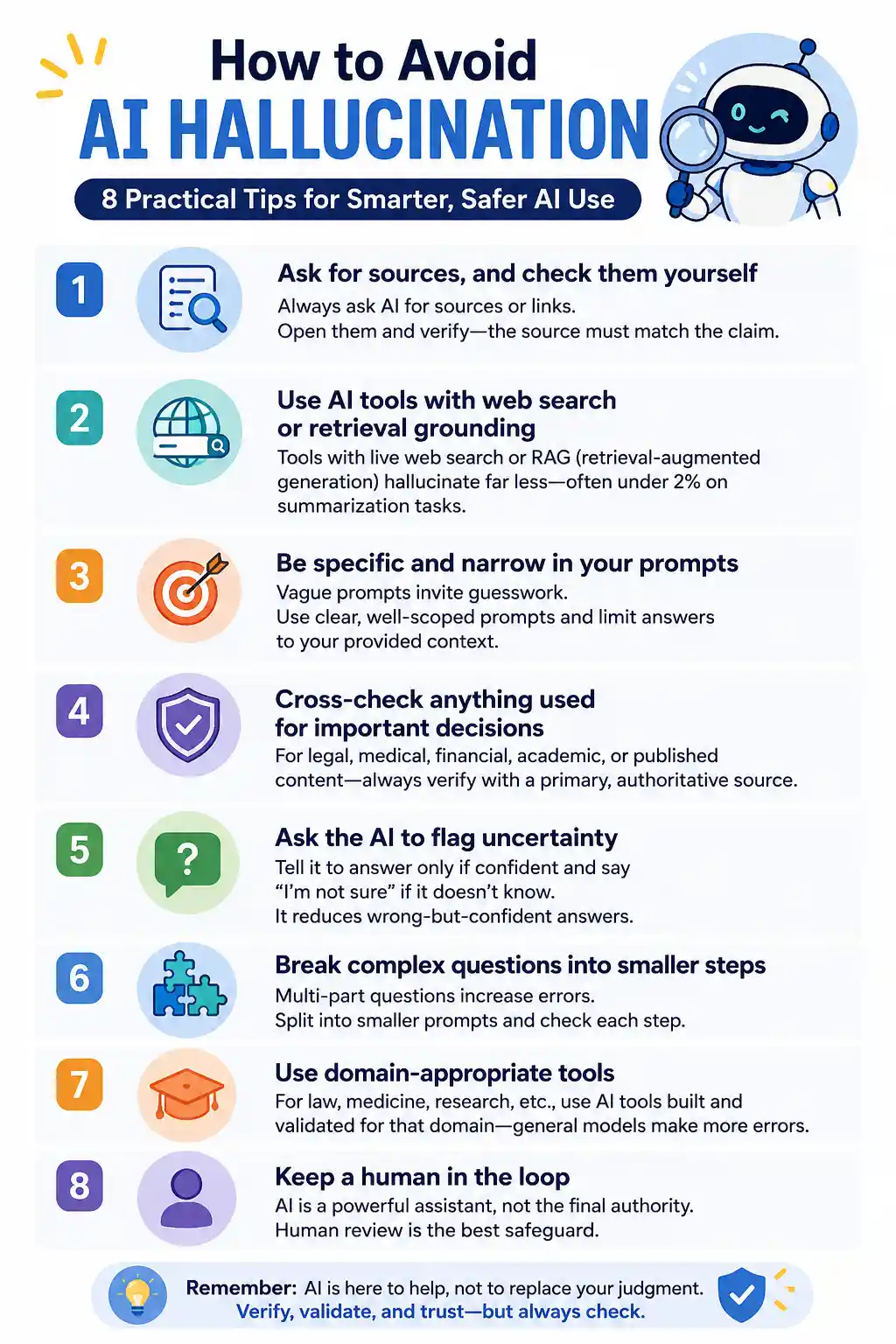
You can't eliminate hallucination risk completely with any AI tool available today, but you can dramatically reduce it with a few habits.
1. Ask for sources, and check them yourself
Prompt the AI to include sources or links for any factual claim, then actually open those links. If a source can't be found or doesn't say what the AI claims, that's a red flag.
2. Use AI tools with built-in web search or retrieval grounding
Tools that can search the live web or pull from a verified document base (sometimes called retrieval-augmented generation, or RAG) tend to hallucinate far less than models answering purely from memory. When given access to grounded search, top models have shown hallucination rates well under 2% on summarization-style tasks, compared to much higher rates without it.
3. Be specific and narrow in your prompts
Vague prompts invite vague, guess-filled answers. Instead of "tell me about this company's history," try "summarize this company's history using only the information in the attached document." Narrow, well-scoped prompts reduce the model's room to improvise.
4. Cross-check anything used for important decisions
For legal, medical, financial, academic, or published content, always verify AI-generated facts against a primary, authoritative source before relying on them. Treat AI output as a draft or starting point, not a finished, fact-checked answer.
5. Ask the AI to flag uncertainty
Prompting with instructions like "only answer if you're confident, and say 'I'm not sure' if you don't know" can reduce confidently wrong answers, though it isn't foolproof.
6. Break complex questions into smaller steps
Multi-part or highly complex queries are more prone to hallucination. Splitting a big question into smaller, sequential prompts, and checking each step, tends to produce more reliable results.
7. Use domain-appropriate tools
For specialized fields like law, medicine, or scientific research, use AI products specifically built and validated for that domain rather than a general-purpose chatbot, since general models show measurably higher error rates in these areas.
8. Keep a human in the loop
The most reliable safeguard remains human review. Treat AI as a fast, capable assistant, not a final authority, particularly for anything that will be published, submitted, or acted on.
Will AI Hallucination Ever Be Fully Solved?
Not entirely, according to current research. Some 2025 academic work has argued that completely eliminating hallucination is mathematically very difficult for any model built on current probabilistic, pattern-prediction architectures. That said, real progress is happening: hallucination rates on general knowledge questions have dropped sharply over the past few years as training data quality, retrieval grounding, and verification techniques have improved. The gap that remains is largest in specialized, high-stakes domains, which is exactly where careful human verification matters most.
Frequently Asked Questions
What is an AI hallucination in simple terms?
It's when an AI tool states something false or made-up as if it were a verified fact, usually without any sign of doubt.
Why does ChatGPT or Gemini make things up?
Because these models generate answers by predicting likely word patterns from their training data rather than checking a verified database in real time.
Can AI hallucination be completely fixed?
Not yet, and some researchers argue it may never be fully eliminated with current model architectures. It can, however, be significantly reduced with grounding, verification, and good prompting habits.
Which AI tasks are most prone to hallucination?
Specialized, high-stakes areas like legal research, medical information, and niche technical topics tend to show the highest hallucination rates compared to general knowledge questions.
How can I tell if an AI answer is hallucinated?
Look for unverifiable sources, oddly specific statistics, unfamiliar names, or claims that contradict what you already know, then check independently.
Final Thoughts
AI hallucination is a built-in limitation of how today's generative AI models work, not a rare glitch. Understanding why it happens, pattern prediction without real fact-checking, gaps in training data, and pressure to always produce an answer, makes it much easier to use AI tools responsibly. The good news is that with the right habits (asking for sources, using grounded search tools, writing specific prompts, and verifying anything important), you can keep enjoying the speed and convenience of AI while avoiding the costly mistakes that come from blindly trusting its answers.
At ReadInBrief, we believe trustworthy content starts with understanding the tools behind it. The more clearly you understand how and why AI can get things wrong, the better equipped you are to use it as a genuinely useful assistant rather than an unreliable narrator.
Read Also:
What Is AI Orchestration? A Complete Guide to How It Works, Tools, and Real-World Use Cases
AI Agents Are Here: What They Are and Why They Change Everything
What Is Gemini Omni? Google's Biggest AI Video Leap Explained
What Is Gemini Spark? Google's 24/7 Personal AI Agent Explained
What Is Google Antigravity? The Platform Nobody Has Fully Explained Yet
Comments (0)
No comments yet. Be the first to share your thoughts!