AI Agents Are Here: What They Are and Why They Change Everything

Author
Ravi Prajapati
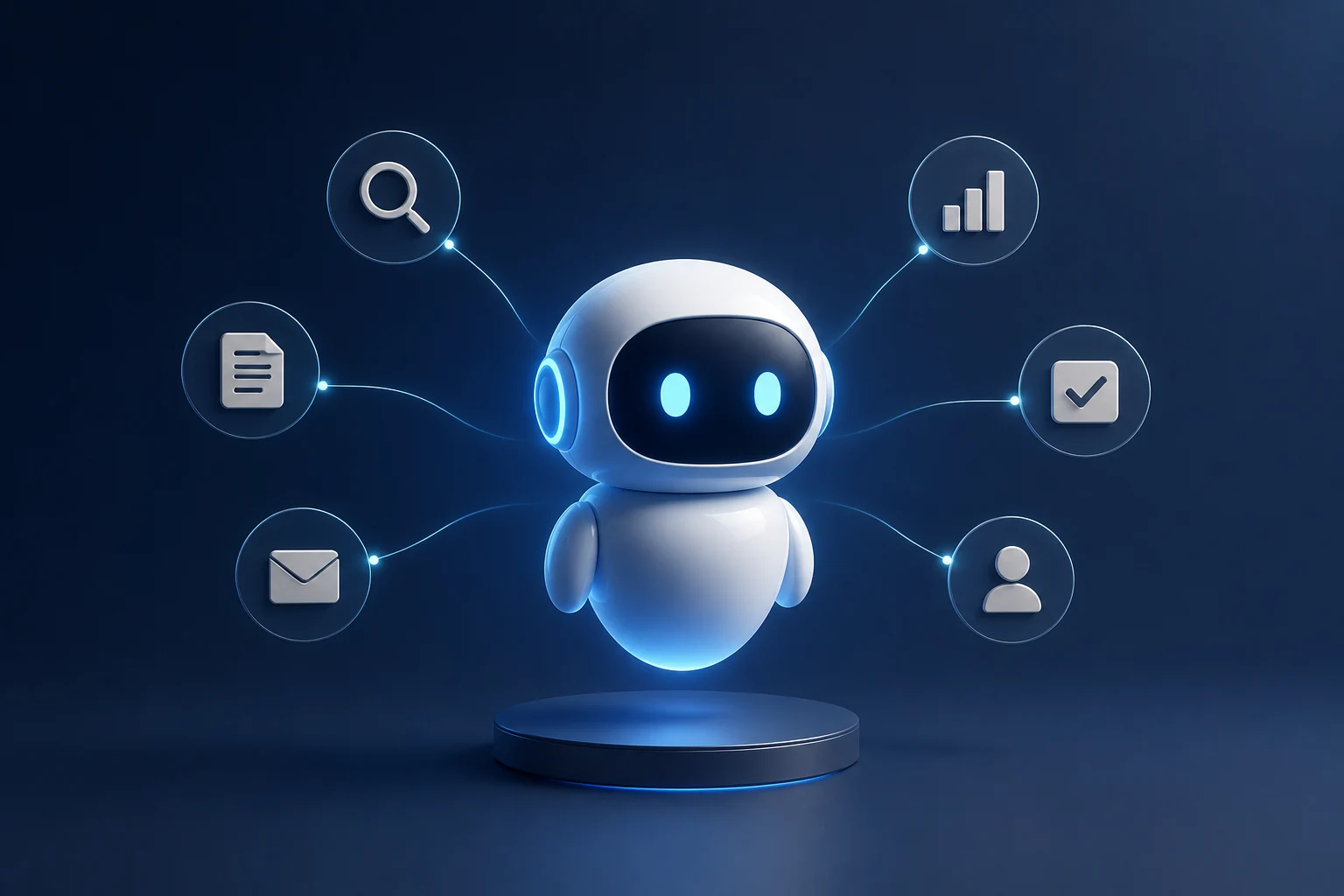
Discover what AI agents are, how they work, real-world use cases, benefits, and why autonomous AI agents are transforming every industry now.
Artificial intelligence is entering a new era with the rise of AI agents are autonomous systems that can reason, plan, make decisions, and complete complex tasks with minimal human input. Unlike traditional AI chatbots that simply respond to prompts, AI agents can use tools, access external data, remember previous interactions, and execute multi-step workflows to achieve specific goals. Powered by large language models (LLMs), memory systems, retrieval-augmented generation (RAG), and agent frameworks, AI agents are transforming customer support, software development, research, sales, healthcare, education, and business automation.
If you have been paying attention to the AI space in 2026, you have probably heard the phrase "AI agents" thrown around everywhere. Tech executives are talking about them. Investors are pouring money into them. And developers are building with them at a pace that feels almost frantic.
But what exactly is an AI agent? How is it different from the chatbots and AI assistants we already use? And why is everyone saying this is the technology that will change everything?
This guide breaks it all down clearly, without the jargon, without the hype, and with real data to back it up.
What Is an AI Agent? (The Simple Explanation)
Think about the AI tools most people use today. You type a question into ChatGPT or Claude, it responds, and then it waits. It does one thing and stops. That is a reactive AI model. It answers when asked.
An AI agent is fundamentally different. An AI agent can:
Set its own goals based on a broader objective you give it
Break that objective into steps
Use tools like web search, code execution, file systems, or APIs to take action
Evaluate its own results and adjust
Complete multi-step tasks with little to no human input along the way
In short, a standard AI model responds. An AI agent acts.
If you asked a standard AI "book me a flight to Delhi next Friday under 5,000 rupees," it would tell you how to do it. An AI agent would actually open a travel site, search available flights, compare prices, apply your preferences, and present you with the best option, or even complete the booking depending on the permissions you have given it.
That shift from responding to doing is why AI agents represent a new era entirely.
How Do AI Agents Actually Work?
Under the hood, every AI agent is built around a reasoning loop. Here is how the core components come together:
Perception is how the agent understands its environment. It reads your instructions, scans documents, browses web pages, or receives data from connected systems.
Reasoning is the brain of the agent. A large language model (LLM) like GPT-4 or Claude processes the input, decides what needs to happen next, and plans a sequence of steps.
Memory allows the agent to retain context across multiple steps or even across sessions. Without memory, an agent forgets what it did three steps ago, making complex tasks impossible.
Tool Use is what separates agents from chatbots. Agents can call APIs, run Python scripts, search the web, read and write files, or trigger actions in other applications.
Action and Feedback is the final loop: the agent executes a step, evaluates whether it worked, and decides what to do next. This self-correction is what makes agents genuinely autonomous.
The orchestration layer that ties all of this together has matured dramatically. Protocols like MCP (Model Context Protocol, introduced by Anthropic) and Agent-to-Agent (A2A) communication standards mean that agents can now talk to tools and to each other in standardized ways, the same way USB-C gave devices a universal connector.
Single Agents vs. Multi-Agent Systems
Not all AI agent deployments look the same. There are two broad categories:
Single agents handle one task domain autonomously. A coding agent, a customer support agent, or a research agent are all examples. They are focused, fast, and the most common form of AI agent in production today.
Multi-agent systems involve multiple specialized agents working together. An orchestrator agent receives the main goal and delegates subtasks to worker agents, each built for a specific domain. The orchestrator-worker model accounts for roughly 70% of production multi-agent deployments as of 2026, according to Decode the Future's multi-agent systems analysis.
A real-world example: An e-commerce company might deploy one agent to handle customer queries, a second to manage inventory checks, a third to process payments, and a fourth to coordinate shipping, all orchestrated by a master agent that routes each task to the right specialist.
Multi-agent systems can deliver 25 to 45% process optimization gains. However, research from Google cited in Openlayer's 2026 multi-agent architecture guide also found they can reduce performance by 39 to 70% on simple sequential reasoning tasks where coordination overhead is not worth it. The lesson: architecture must match the task.
The Numbers That Prove This Is Not Hype
The growth of the AI agents market is not just a talking point. The data is striking.
According to Grand View Research, the global AI agents market was valued at USD 7.63 billion in 2025 and is projected to reach USD 182.97 billion by 2033, growing at a CAGR of 49.6%.
Research and Markets puts the 2026 market value at USD 12.06 billion, representing 45.5% growth from the previous year.
Precedence Research forecasts the market will hit USD 294.66 billion by 2035, growing at a CAGR of 43.57%.
Enterprise adoption data is equally compelling:
Gartner forecasts that 40% of enterprise applications will feature task-specific AI agents by end of 2026, up from under 5% in 2025
PwC reports that 79% of companies are already adopting AI agents
88% of executives plan to raise AI-related budgets specifically because of agentic AI (PwC)
Microsoft found that 93% of Indian business leaders plan to use AI agents within 12 to 18 months
72% of enterprises globally plan to deploy AI agents in 2026 (SQ Magazine)
The verdict is clear: AI agents are not a future technology. They are being deployed right now, at scale, across industries.
Real-World AI Agent Use Cases Across Industries
Customer Support and Service
AI agents have moved well beyond basic chatbots. Today's support agents handle end-to-end resolution: they read a user's complaint, access the CRM, check account history, execute a refund or change, update the ticketing system, and send a confirmation email, all without a human touching it. According to Aleaitsolutions, enterprises are seeing 30 to 70% cost savings on repetitive tasks and 20 to 40% faster resolution times.
Software Development
Coding agents like Claude Code and GitHub Copilot Workspace can explore entire codebases, plan implementations, write code across multiple files, run tests, debug failures, and iterate until a task is complete. This is not autocomplete anymore. These agents can take a feature request and ship working code.
Research and Knowledge Work
Legal teams use research agents to draft case briefs. Marketing teams use content agents to generate and optimize copy at scale. Financial analysts use agents to scan regulatory filings and surface relevant data. Educative.io's 2026 AI agents use case report highlights that tools like LangChain and OpenAI's function-calling API power high-volume knowledge workflows that were previously human-only.
Finance and Fraud Detection
AI agents now automate invoice processing, transaction reconciliation, anomaly detection in financial data, and regulatory reporting. They run continuously, flag issues in real time, and create audit trails automatically, work that previously required entire compliance teams.
Healthcare
Clinical documentation agents reduce the time doctors spend on paperwork by listening to patient consultations and generating structured notes directly in electronic health record systems. Diagnostic agents cross-reference symptoms with medical databases and flag potential conditions for physician review.
Manufacturing and Supply Chain
Siemens, for instance, launched Industrial AI Agents at Automate 2025, moving from AI copilots to semi-autonomous agents that execute complete industrial processes end to end within its Industrial Copilot ecosystem. 8allocate's top agentic AI implementations report documents dozens of similar deployments across predictive maintenance, supply chain monitoring, and quality control.
Why AI Agents Change Everything: The Deeper Shift
Most technology improvements make existing workflows faster. AI agents do something more disruptive: they redesign what workflows even look like.
Consider a business process that currently involves five people across three departments handling approvals, data entry, review cycles, and communication. An AI agent does not just speed that up. It can potentially collapse all five roles into a single automated workflow that runs in minutes instead of days.
Unicoconnect's agentic AI statistics report for 2026 makes this point sharply: "Agents fail on governance and evaluation, not models." The technology itself is capable. The challenge is human organizations adapting their processes to work with it.
There are three structural shifts that make 2026 the turning point:
Model maturity has crossed the threshold. Models like GPT-4, Claude 3.7, and Gemini Ultra can now reliably handle complex, multi-step reasoning that would have failed 18 months ago. The intelligence is genuinely there.
Infrastructure has caught up. Vector databases, orchestration frameworks like LangGraph and CrewAI, monitoring tools, and standardized protocols like MCP have matured to enterprise-grade reliability. Building production agents is no longer a research project.
Economic pressure is accelerating adoption. In an environment where efficiency matters more than ever, the case for automating repetitive, high-volume knowledge work is almost impossible to ignore.
The Challenges and Risks You Should Know About
It would be dishonest to write about AI agents without acknowledging what can go wrong.
The production gap is real. Only about 23% of organizations are currently scaling agents beyond pilots. Gartner predicts more than 40% of agentic AI projects will be cancelled by 2027, mostly because of unclear business value and poor governance design.
Hallucination remains a risk. Agents inherit the imperfections of the underlying models. When an agent is taking real-world actions based on a flawed reasoning chain, the consequences can be more serious than a wrong answer in a chat interface.
Security and permissions matter enormously. Agents with broad tool access can cause real damage if manipulated through prompt injection attacks or misconfigured permissions. Human-in-the-loop checkpoints are not optional for high-stakes workflows; they are essential.
Job displacement is a genuine social concern. Roles built around repetitive knowledge work, data entry, basic support, and simple analysis are directly in the automation path. Individuals and organizations both need to be thinking about reskilling.
The Most Popular AI Agent Tools and Frameworks Right Now
If you want to understand the landscape, here are the tools driving the AI agent ecosystem:
Building frameworks: LangGraph, CrewAI, and AutoGen are the dominant open-source frameworks for building multi-agent systems. Each has different strengths in orchestration style and ease of use.
Coding agents: Claude Code, GitHub Copilot Workspace, Cursor, and Devin are leading the autonomous software development space.
Enterprise platforms: Microsoft Copilot Studio, Google Agentspace, and Salesforce Agentforce are bringing no-code and low-code agent building to enterprise users.
Research agents: Perplexity, Deep Research (from OpenAI and Google), and similar tools are the most visible consumer-facing agent applications today.
Protocols: MCP (Model Context Protocol) and A2A (Agent-to-Agent) have emerged as the dominant standards for connecting agents to tools and to each other, significantly reducing the integration overhead that previously slowed enterprise adoption.
What Should You Do With This Information?
Whether you are a developer, a business owner, or someone trying to understand where AI is headed, here is the practical takeaway:
If you are an individual, start experimenting with agent-powered tools today. Deep Research features in Perplexity or Google, Claude Code for development tasks, or even simple automation tools like Zapier's AI features give you a real feel for what agentic AI does.
If you are a business, the question is not whether to adopt AI agents but where to start. TechAhead's analysis of enterprise agentic AI recommends identifying one high-volume, repetitive workflow with clear success criteria and building a focused agent for it rather than attempting broad transformation at once.
If you are a developer, frameworks like LangGraph and CrewAI have lowered the barrier to building production agents dramatically. The agent ecosystem is one of the fastest-growing areas in software development right now.
The Bottom Line
AI agents are not a future concept you need to prepare for eventually. They are here, they are in production at scale, and the market is growing faster than almost any technology category in history.
The shift from AI that responds to AI that acts is the single most important development in the current wave of artificial intelligence. It moves AI from being a productivity tool into being an autonomous workforce layer that runs alongside human teams.
The organizations and individuals who understand that shift early, and start building with it rather than waiting, are the ones who will have a meaningful advantage in the years ahead.
The age of AI that just talks is ending. The age of AI that does has already begun.
Frequently Asked Questions About AI Agents
What is the difference between an AI agent and a chatbot?
A chatbot responds to questions. An AI agent takes actions: it uses tools, completes multi-step tasks, and works toward a goal with minimal human input.
Are AI agents safe to use?
They can be, with proper governance. Best practice involves limiting tool permissions to what is necessary, including human-in-the-loop checkpoints for high-stakes decisions, and monitoring agent behavior continuously.
What industries are using AI agents most actively right now?
Customer support, software development, finance, healthcare, and manufacturing are the leading sectors in 2026.
Do I need technical skills to use AI agents?
Not necessarily. Platforms like Microsoft Copilot Studio, Salesforce Agentforce, and Zapier offer no-code or low-code agent building for business users. Developer-facing tools like LangGraph and CrewAI require coding knowledge.
What is the Model Context Protocol (MCP)?
MCP is an open standard introduced by Anthropic that gives AI applications a shared interface to connect to external tools and data sources. Think of it as the USB-C of AI integration.
Read Also:
How to Use AI to Cut Your Work Week to 4 Days
Comments (0)
No comments yet. Be the first to share your thoughts!