50 Best GPT-6 Astra Prompts for Work, Research & Coding

Author
Ravi Prajapati

Use these 50 GPT-6 Astra prompts for work, research and coding, plus a practical framework for writing better prompts and getting stronger results.
GPT-6 Astra changes an important assumption about prompting AI.
The best prompt is no longer always the one that tells the model exactly how to produce every sentence.
Sometimes the better approach is to clearly define what you want accomplished, give Astra the context and boundaries it needs, and let it determine how to get there.
That matters because GPT-6 Astra was designed for more than question answering. OpenAI describes Astra as its most capable model for complex end-to-end work, with strengths across computer use, browsing, software engineering, research, science and professional work. It can also carry out multistep workflows and produce documents, spreadsheets and presentations.
The model's API supports a context window of 1,050,000 tokens and up to 128,000 output tokens, making it particularly relevant for large codebases, document collections and complex workflows.
So instead of giving you 50 variations of:
"Act as an expert and do X..."
this guide focuses on prompts built around goals, context, constraints, tools, verification and outcomes.
What Are the Best GPT-6 Astra Prompts?
The best GPT-6 Astra prompts clearly define the desired outcome, provide relevant context, set boundaries and explain what a successful result looks like. For complex tasks, they should also tell Astra what tools or information it may use, what it should verify, and which decisions require human approval.
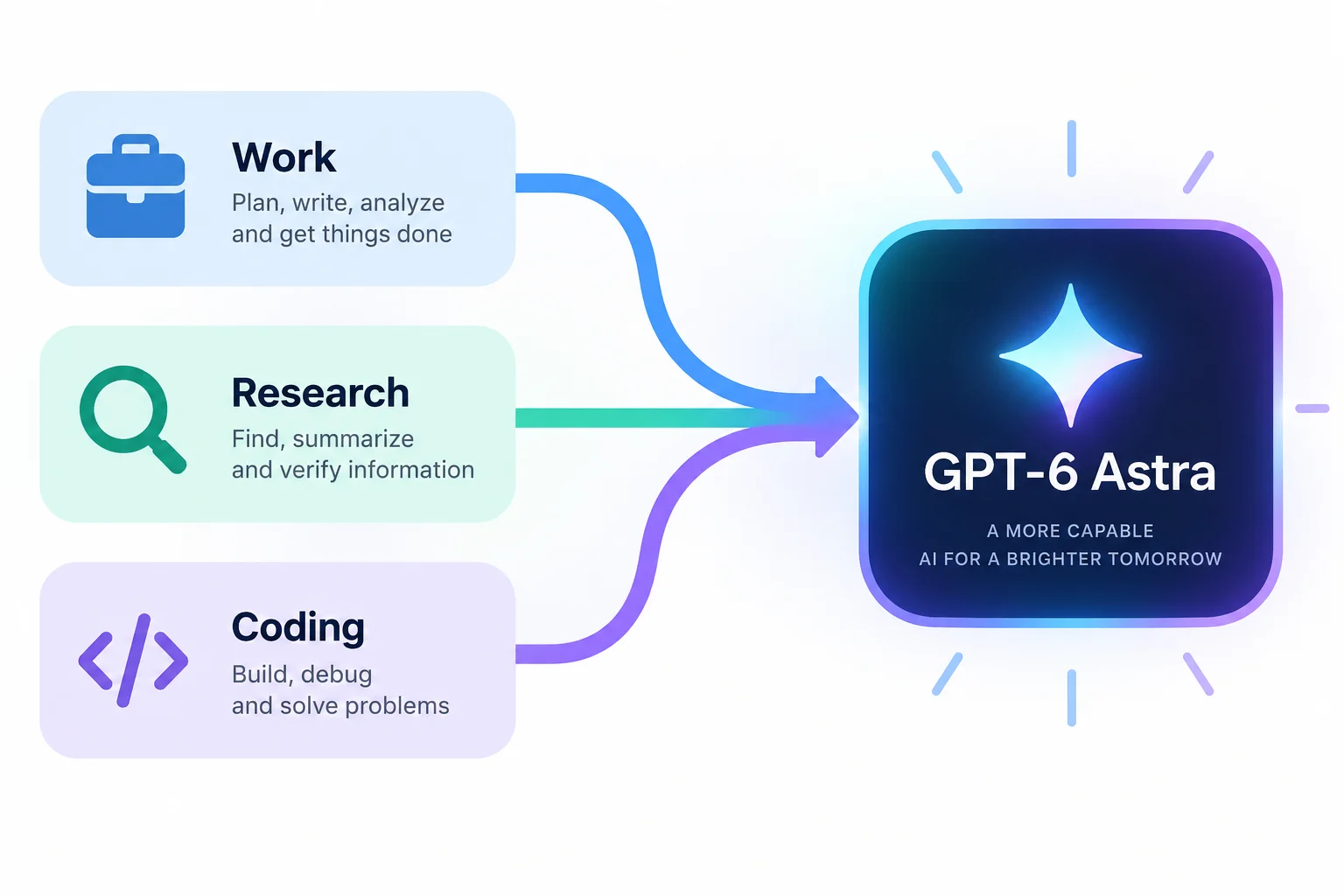
GPT-6 Astra at a Glance
Prompt Category | Best For | Example Tasks |
|---|---|---|
Work | Knowledge workers and teams | Reports, planning, meetings, analysis |
Research | Analysts and researchers | Market research, source comparison, literature reviews |
Coding | Developers and engineering teams | Debugging, architecture, testing, code review |
Agentic Tasks | Multi-step workflows | Research → analyze → create → verify |
Computer Tasks | Work involving software/UI | Forms, QA, data entry, software troubleshooting |
OpenAI says Astra can handle demanding professional computer workflows such as online research, CRM updates, forms, document creation, software installation and frontend QA. It is also specifically trained for professional work involving documents, presentations, spreadsheets and analyses.
This makes prompt design increasingly about delegating a well-defined job, rather than merely asking a clever question.
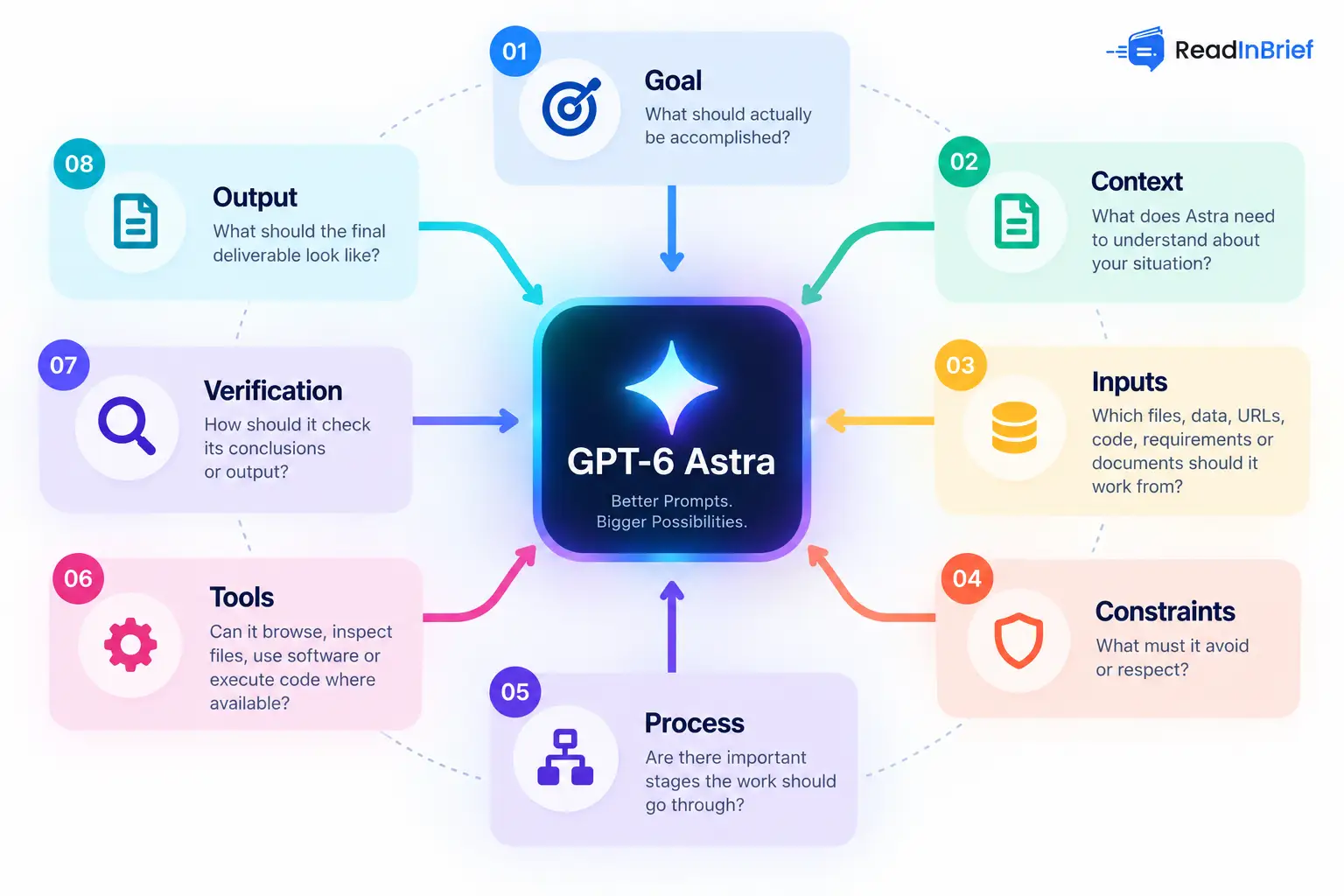
A useful framework is:
Goal + Context + Inputs + Constraints + Process + Tools + Verification + Output
Goal
What should actually be accomplished?
Context
What does Astra need to understand about your situation?
Inputs
Which files, data, URLs, code, requirements or documents should it work from?
Constraints
What must it avoid or respect?
Process
Are there important stages the work should go through?
Tools
Can it browse, inspect files, use software or execute code where available?
Verification
How should it check its conclusions or output?
Output
What should the final deliverable look like?
Example
Instead of:
Research the AI agent market.
Try:
Research the current AI agent market for a software company considering a new product.
Goal: identify three underserved opportunities worth investigating.
Focus on products launched or meaningfully updated during the last 12 months.
Use primary sources wherever possible. Separate verified facts from your interpretation.
Compare competitors, target users, pricing, common complaints and obvious market gaps.
Do not assume popularity equals demand.
Look for repeated pain points across multiple independent sources.
Finish with a ranked opportunity table containing:
problem
target user
existing alternatives
evidence of demand
competition
possible MVP
biggest risk
confidence level
Include source links for important claims.
That gives Astra a job, not just a topic.
50 Best GPT-6 Astra Prompts
GPT-6 Astra Prompts for Work
If you mainly use Astra for day-to-day professional tasks, you may also want to explore our AI productivity tools collection.
1. Turn a Goal Into an Execution Plan
Best for: Turning an unclear business objective into actionable work.
Prompt:
I need to achieve the following outcome:
[GOAL]
Context:
[BUSINESS/PROJECT CONTEXT]Deadline:
[DEADLINE]Available resources:
[TEAM/BUDGET/TOOLS]Constraints:
[CONSTRAINTS]Break the goal into milestones, dependencies and concrete actions.
Identify assumptions that could materially change the plan.
Prioritize actions by impact and urgency.
For every milestone define:
objective
owner/role required
dependencies
expected output
success metric
major risk
Finish with the five actions I should take first.
Customize: Goal, context, deadline, resources and constraints.
Why it works: It forces the model to move from broad strategy to execution while exposing assumptions and dependencies.
2. Analyze a Business Decision
Best for: Important decisions with competing options.
Prompt:
Help me decide between:
Option A: [OPTION]
Option B: [OPTION]
Option C: [OPTION]My objective is [OBJECTIVE].
Context:
[CONTEXT]Evaluate each option using:
expected upside
cost
implementation difficulty
time to value
reversibility
major risks
opportunity cost
evidence supporting the option
Challenge my assumptions instead of simply agreeing with them.
Identify information that would materially improve the decision.
Give me your recommendation, confidence level and the strongest argument against your recommendation.
Why it works: Asking for the strongest counterargument reduces one-sided recommendations.
3. Create an Executive Brief From Messy Information
Best for: Turning notes, emails and documents into a concise decision brief.
Prompt:
Review the material I provide.
Create an executive brief for [AUDIENCE].
Do not summarize everything.
Extract only what affects decisions.
Structure it as:
Situation
What changed
Why it matters
Evidence
Risks
Decisions required
Recommended next actions
Clearly distinguish facts from assumptions.
Flag conflicting information rather than silently resolving it.
Keep the final brief under [LENGTH].
Customize: Audience and desired length.
4. Turn a Meeting Transcript Into Actions
Best for: Converting long meetings into useful follow-up.
Prompt:
Analyze this meeting transcript.
Ignore greetings, repetition and irrelevant discussion.
Extract:
decisions made
action items
owner of each action
deadlines mentioned
unresolved questions
risks or blockers
commitments made
Do not assign an owner or deadline unless the transcript supports it.
Then create a concise follow-up summary suitable for sending to attendees.
Finally, list anything that appears important but ambiguous so I can verify it.
Why it works: It explicitly prevents invented ownership and deadlines.
For dedicated transcription, note-taking and meeting workflows, see our AI meeting assistants
5. Build a Weekly Priority Plan
Best for: Professionals juggling too many tasks.
Prompt:
Here are my current tasks:
[TASK LIST]
My main objective this week:
[OBJECTIVE]Available working time:
[HOURS]Rank these tasks using impact, urgency, dependency and effort.
Identify work that should be:
done now
scheduled
delegated
automated
dropped
Build a realistic Monday-Friday plan.
Do not fill every available hour. Leave room for unexpected work.
Explain which tasks I should intentionally NOT prioritize.
6. Analyze a Spreadsheet or Dataset
Best for: Business analysis without manually searching rows.
Prompt:
Analyze the attached dataset.
Objective:
[QUESTION I NEED ANSWERED]Before drawing conclusions:
inspect the columns and data types
identify missing or suspicious values
identify possible data-quality problems
explain any assumptions required
Then analyze the data for:
important trends
anomalies
meaningful segments
correlations worth investigating
unexpected findings
Do not imply causation from correlation.
Produce a concise executive summary followed by supporting analysis and recommended next questions.
7. Draft a Professional Report
Best for: Creating a polished report from source material.
Prompt:
Create a professional report about [TOPIC] for [AUDIENCE].
Use the attached material as the primary evidence.
Objective:
[PURPOSE]The reader should be able to make this decision after reading:
[DECISION]Structure the report around the reader's questions rather than around the order of the source material.
Include:
executive summary
current situation
evidence
analysis
options
risks
recommendation
next steps
Flag claims that need external verification.
8. Turn a Report Into a Presentation
Best for: Converting dense documents into executive slides.
Prompt:
Turn the attached report into a presentation for [AUDIENCE].
Presentation objective:
[OBJECTIVE]Maximum slides:
[NUMBER]Do not convert every report section into a slide.
Build a narrative:
problem → evidence → implication → options → recommendation → next action.Each slide should communicate one main idea.
Minimize text.
Suggest the most useful chart, diagram or visual for each slide.
Finish with a slide-by-slide outline including headline, supporting points and visual recommendation.
9. Find Repetitive Work Worth Automating
Best for: Identifying realistic AI automation opportunities.
Prompt:
Analyze this workflow:
[WORKFLOW]
Identify repetitive, rule-based or information-heavy tasks that could potentially be automated.
For each opportunity assess:
frequency
time currently required
predictability
data required
systems involved
consequence of an error
human judgment required
automation complexity
Categorize each as:
Automate / AI-assisted / Keep human-led.Rank opportunities by expected value versus implementation effort.
Do not recommend AI where a simple rule or conventional automation would be more reliable.
10. Create a Project Risk Register
Best for: Finding failure points before a project starts.
Prompt:
Review this project plan:
[PLAN]
Act as a skeptical project reviewer.
Identify risks across:
scope
timeline
people
technology
dependencies
budget
security
adoption
For each risk provide:
probability, impact, early warning signal, mitigation and contingency.Highlight assumptions the plan depends on but has not validated.
Finish with the three risks most likely to derail the project.
11. Analyze Customer Feedback
Best for: Finding patterns across reviews, tickets and survey responses.
Prompt:
Analyze the customer feedback provided.
Cluster feedback by underlying problem rather than exact wording.
Identify:
most common pain points
high-severity issues
repeated feature requests
moments of delight
churn signals
confusing product experiences
Include representative evidence for each theme.
Separate frequent complaints from complaints that are rare but severe.
Finish with the five product changes most strongly supported by the evidence.
12. Prepare for a Client Meeting
Best for: Sales, consulting and account management.
Prompt:
Help me prepare for a meeting with [CLIENT/COMPANY].
Meeting objective:
[OBJECTIVE]What I already know:
[CONTEXT]Research current public information where tools allow.
Identify:
company priorities
relevant recent developments
likely business problems
questions I should ask
assumptions I should avoid
ways our offering may or may not fit
Separate verified information from inference.
End with a one-page meeting brief and 10 high-value questions.
13. Improve a Business Process
Best for: Operations and process optimization.
Prompt:
Map this current process:
[PROCESS]
Identify:
unnecessary steps
repeated data entry
bottlenecks
handoff delays
approval loops
error-prone work
steps that exist only because of legacy processes
Design a simpler future-state process.
Explain what should be eliminated, automated, consolidated or redesigned.
Estimate the likely operational impact without inventing unsupported numbers.
14. Write a Decision Memo
Best for: Leadership decisions that need clear reasoning.
Prompt:
Create a decision memo about:
[DECISION]Context:
[CONTEXT]Options:
[OPTIONS]Write for [DECISION MAKER].
Include:
decision required
context
available options
evidence
trade-offs
recommendation
risks
what would change the recommendation
Keep the reasoning transparent enough that someone can disagree intelligently.
15. Turn Rough Notes Into a Polished Document
Best for: Converting incomplete thinking into usable writing.
Prompt:
Turn these rough notes into a polished [DOCUMENT TYPE].
Audience:
[AUDIENCE]Goal:
[GOAL]Preserve my actual ideas and intent.
You may reorganize them for clarity, but do not introduce unsupported claims.
Identify missing information with [NEEDS INPUT] rather than inventing it.
Use clear, natural language and remove repetition.
After the draft, list the three places where additional evidence or context would improve it most.
16. Create SOPs From an Existing Workflow
Best for: Documenting recurring operational work.
Prompt:
Convert this workflow into an SOP:
[WORKFLOW]
Write it so a competent new team member can execute the process without relying on tribal knowledge.
Include:
purpose
prerequisites
tools/access required
step-by-step procedure
decision points
exceptions
quality checks
escalation conditions
definition of done
Flag anything the source material does not explain clearly.
17. Run a Pre-Mortem
Best for: Testing a strategy before committing resources.
Prompt:
Assume this initiative failed badly 12 months from now:
[INITIATIVE]
Work backward and identify the most plausible reasons.
Avoid dramatic but unlikely scenarios.
Focus on realistic failures involving execution, adoption, economics, technology, people and market assumptions.
For each failure mode give:
cause
early warning sign
prevention
recovery action
Then identify which assumptions we should test before proceeding.
GPT-6 Astra Prompts for Research
If your workflow is mainly about condensing research papers, reports or long documents, browse our AI summarizer tools
18. Build a Deep Research Brief
Best for: Understanding an unfamiliar topic quickly.
Prompt:
Research [TOPIC] for [AUDIENCE].
My objective is:
[OBJECTIVE]Investigate:
current state
key developments
important players
strongest available evidence
competing viewpoints
unresolved questions
Prioritize primary sources and recent evidence.
Separate:
established facts
reasonable interpretations
disputed claims
unknowns
Cite sources beside important claims.
Finish with the five conclusions most supported by evidence.
19. Compare Conflicting Sources
Best for: Topics where credible sources disagree.
Prompt:
Investigate this question:
[QUESTION]
Find credible sources representing the major positions.
Do not simply count how many sources support each side.
Evaluate them based on:
methodology
sample
recency
directness of evidence
conflicts of interest
reproducibility
Explain exactly where the evidence agrees and disagrees.
Give your best evidence-weighted conclusion and confidence level.
20. Conduct a Literature Review
Best for: Academic and technical research.
Prompt:
Conduct a structured literature review on:
[RESEARCH QUESTION]Prioritize peer-reviewed and primary research.
Organize papers by themes rather than listing them chronologically.
For each major theme summarize:
key findings
methodology
limitations
areas of agreement
contradictions
Identify gaps in the existing literature.
Do not treat preprints and peer-reviewed work as equivalent without noting the distinction.
21. Find Research Gaps
Best for: Researchers looking for unanswered questions.
Prompt:
Review current research on:
[TOPIC]Identify questions that remain meaningfully unresolved.
Distinguish between:
genuinely under-researched problems
problems with lots of weak evidence
problems with conflicting evidence
questions that have largely been answered
Rank the most promising research gaps by importance, feasibility and potential contribution.
22. Fact-Check an Article
Best for: Editors, journalists and content teams.
Prompt:
Fact-check the following article:
[ARTICLE]
Extract every externally verifiable factual claim.
Classify each as:
supported
partly supported
unsupported
misleading
outdated
unable to verify
Use primary sources wherever possible.
Provide the evidence and source for each judgment.
Pay special attention to statistics, dates, quotations, product capabilities and causal claims.
Do not rewrite the article until the verification is complete.
23. Research a Market
Best for: Founders, product teams and strategists.
Prompt:
Research the market for:
[PRODUCT/CATEGORY]Geography:
[MARKET]Target customer:
[CUSTOMER]Analyze:
market structure
demand drivers
customer pain points
competitors
pricing models
buying behavior
barriers to entry
emerging changes
Avoid using generic market-size reports as the sole evidence of demand.
Look for behavioral evidence such as customer discussions, hiring, spending, adoption and product activity.
24. Analyze Competitors
Best for: Understanding how competitors actually differ.
Prompt:
Analyze these competitors:
[COMPETITORS]
Compare:
target customer
core problem solved
positioning
features
pricing
distribution
strengths
weaknesses
customer complaints
Use official product information for factual capabilities and independent sources for market/customer perception.
Identify areas where competitors look different in marketing but are functionally similar.
Finish with underserved customer needs.
25. Find Evidence for a Business Hypothesis
Best for: Testing an idea before investing in it.
Prompt:
Test this hypothesis:
[HYPOTHESIS]
Do not try to prove it.
Actively search for evidence both supporting and contradicting it.
Evaluate evidence quality.
Identify alternative explanations.
Tell me:
what supports the hypothesis
what weakens it
what remains unknown
what evidence would falsify it
End with a confidence level and the cheapest useful test we could run next.
26. Create a Research Timeline
Best for: Understanding how a technology or market evolved.
Prompt:
Build an evidence-based timeline of:
[TOPIC]Include only developments that materially changed the field.
For each milestone explain:
what happened
when
why it mattered
what changed afterward
Link to primary sources wherever possible.
Distinguish contemporary evidence from later interpretations of events.
27. Analyze a Research Paper
Best for: Understanding technical papers without losing the nuance.
Prompt:
Analyze this paper as if helping a knowledgeable reader decide how much confidence to place in it.
Explain:
research question
methodology
dataset/sample
main result
strongest evidence
limitations
assumptions
possible confounders
what the paper does NOT establish
Then explain the practical implications without overstating the findings.
28. Compare Multiple Research Papers
Best for: Synthesizing evidence rather than summarizing papers individually.
Prompt:
Compare the attached papers around this question:
[QUESTION]
Do not write separate summaries first.
Build a synthesis around:
where findings agree
where they conflict
methodological differences
differences in samples/data
strength of evidence
Explain whether disagreements are substantive or caused by different definitions/methods.
Finish with what the combined evidence suggests.
29. Research an Emerging Trend
Best for: Separating a real shift from temporary hype.
Prompt:
Investigate whether [TREND] represents a meaningful structural change or short-term hype.
Look for:
adoption evidence
customer behavior
investment
technical progress
product launches
hiring
regulation
failure cases
Weight actual behavior more heavily than predictions.
Identify signals that would indicate the trend is accelerating or fading.
30. Investigate a Claim Going Viral
Best for: Checking claims circulating online.
Prompt:
Investigate this claim:
[CLAIM]
Trace it back to the earliest reliable source you can find.
Determine whether later articles/posts accurately represent the original evidence.
Check dates, context, methodology and wording.
Separate:
original fact
interpretation
exaggeration
unsupported additions
Give me a verdict with supporting sources.
31. Find Primary Sources Behind an Article
Best for: Replacing secondary citations with stronger evidence.
Prompt:
Review this article:
[URL/TEXT]
Identify major factual claims relying on secondary reporting.
Find the closest available primary source for each claim, such as:
research paper
company announcement
regulatory filing
government data
court document
official documentation
Create a table mapping claim → secondary source → primary source.
32. Build a Research Evidence Table
Best for: Keeping complex research auditable.
Prompt:
Research:
[QUESTION]Build an evidence table with:
claim
evidence
source
publication date
source type
evidence quality
limitations
confidence
Do not combine multiple claims into one row.
Then synthesize the table into a conclusion, giving stronger evidence more weight.
33. Identify What We Don't Know
Best for: Avoiding false confidence.
Prompt:
Review what is currently known about:
[TOPIC]Instead of giving me another general summary, focus on uncertainty.
Identify:
missing data
unresolved debates
assumptions commonly presented as facts
measurement problems
conflicting findings
areas where evidence is outdated
Rank these unknowns by how much they affect decision-making.
34. Turn Research Into Executive Recommendations
Best for: Moving from information gathering to action.
Prompt:
Review this research:
[RESEARCH]
My decision is:
[DECISION]Extract only findings relevant to that decision.
For each recommendation show:
supporting evidence
confidence
assumptions
downside
what would invalidate it
Do not recommend an action simply because it appears frequently in the sources.
Finish with:
Do now / Test first / Monitor / Avoid.
GPT-6 Astra Prompts for Coding
OpenAI specifically positions Astra for complex reasoning and software engineering, including multi-step workflows across code, browsers and professional software.
That makes coding prompts more useful when they define the desired behavior, repository context, constraints, permissions and acceptance criteria, rather than simply asking Astra to "write the code."
Developers experimenting with natural-language software creation can also compare tools in our AI app building tools
35. Understand an Unfamiliar Codebase
Best for: Developers joining an existing project.
Prompt:
Analyze this codebase before suggesting changes.
Build a mental model of:
architecture
major modules
entry points
data flow
external dependencies
persistence layer
authentication/authorization
test structure
deployment configuration
Trace one representative user request through the system.
Identify areas where your understanding is uncertain.
Do not propose refactoring yet.
Finish with a concise architecture map and the files I should understand first.
36. Debug a Difficult Bug
Best for: Finding root causes rather than patching symptoms.
Prompt:
Debug this issue:
Expected behavior:
[EXPECTED]Actual behavior:
[ACTUAL]Reproduction steps:
[STEPS]Relevant logs/errors:
[LOGS]Inspect the relevant code before changing anything.
Generate multiple plausible hypotheses.
Rank them by likelihood.
Test or eliminate each using available evidence.
Identify the root cause before proposing a fix.
After fixing it, add or recommend a regression test proving the issue cannot silently return.
37. Implement a Feature in an Existing Repository
Best for: Production feature development.
Prompt:
Implement this feature:
[FEATURE]
Acceptance criteria:
[CRITERIA]Before editing:
inspect the repository
identify existing patterns
locate related tests
identify dependencies
Reuse existing conventions unless there is a strong reason not to.
Make the smallest coherent change that satisfies the requirements.
Do not modify unrelated code.
Add/update tests.
Run relevant checks where tools permit.
Finish with:
files changed
design decisions
tests performed
unresolved risks.
38. Review a Pull Request
Best for: Finding meaningful problems rather than style nitpicks.
Prompt:
Review this pull request.
First understand what the change is trying to accomplish.
Evaluate:
correctness
regressions
edge cases
security
performance
concurrency
error handling
maintainability
test coverage
Prioritize findings:
Critical / High / Medium / Low.Do not flag stylistic preferences unless they materially affect maintainability.
For every issue cite the relevant code and explain a realistic failure scenario.
39. Refactor Without Changing Behavior
Best for: Cleaning legacy code safely.
Prompt:
Refactor this code while preserving observable behavior.
Objective:
[REFACTORING GOAL]Before modifying anything:
identify existing behavior
identify callers
inspect tests
identify side effects
Add characterization tests if behavior is insufficiently protected.
Make incremental changes rather than rewriting everything.
Afterward verify that public interfaces and expected behavior remain unchanged.
40. Design a System Architecture
Best for: New products and major technical features.
Prompt:
Design an architecture for:
[SYSTEM]
Requirements:
[REQUIREMENTS]Expected scale:
[SCALE]Constraints:
[CONSTRAINTS]Consider:
components
data model
APIs
storage
authentication
authorization
reliability
observability
security
deployment
cost
Present at least two viable architectures.
Explain trade-offs instead of pretending there is one universally correct design.
Recommend one and explain what future conditions would cause you to reconsider it.
41. Generate a Test Strategy
Best for: Improving confidence before release.
Prompt:
Create a test strategy for:
[FEATURE/SYSTEM]
Identify:
critical user journeys
unit tests
integration tests
end-to-end tests
edge cases
failure scenarios
security checks
performance checks
Prioritize tests based on impact and likelihood of failure.
Avoid tests that merely duplicate implementation details.
Define what must pass before release.
42. Find Performance Bottlenecks
Best for: Slow applications and APIs.
Prompt:
Investigate this performance problem:
[SYMPTOM]
Available evidence:
[METRICS/LOGS/PROFILES]Do not optimize based on intuition alone.
Identify measurable hypotheses involving:
database
network
CPU
memory
caching
algorithms
external services
Determine what measurements would confirm each hypothesis.
Recommend fixes only after identifying the likely bottleneck.
Explain expected impact and how to benchmark before and after.
43. Review API Design
Best for: Designing maintainable interfaces.
Prompt:
Review this API design:
[SPEC]
Evaluate:
resource modeling
naming
consistency
validation
errors
pagination
authentication
authorization
idempotency
versioning
backwards compatibility
Simulate how a developer would actually integrate with it.
Identify confusing or failure-prone areas.
Suggest improvements without redesigning parts that already work well.
44. Design a Database Schema
Best for: New applications and features.
Prompt:
Design a database model for:
[DOMAIN]
Requirements:
[REQUIREMENTS]Expected usage:
[READ/WRITE PATTERNS]Expected scale:
[SCALE]Define entities, relationships, constraints and indexes.
Consider:
integrity
query patterns
concurrency
migrations
auditability
retention
Explain major normalization/denormalization decisions.
Include example queries for the most important access patterns.
45. Plan a Legacy System Migration
Best for: Framework, database or infrastructure migrations.
Prompt:
Plan a migration from:
[CURRENT SYSTEM]
to:
[TARGET SYSTEM]
Constraints:
[CONSTRAINTS]Design a phased migration that minimizes downtime and rollback risk.
Identify:
compatibility issues
data migration
dependencies
testing
deployment stages
monitoring
rollback strategy
Avoid a big-bang migration unless evidence shows it is genuinely safer.
46. Investigate a Production Incident
Best for: Engineering incident analysis.
Prompt:
Investigate this production incident:
Timeline:
[TIMELINE]Logs/metrics:
[DATA]Known changes:
[CHANGES]Separate confirmed facts from hypotheses.
Reconstruct the likely failure chain.
Identify:
triggering event
contributing conditions
detection failure
containment
root cause
Do not stop at "human error."
Recommend system-level changes that reduce the chance or impact of recurrence.
47. Generate Technical Documentation
Best for: Making undocumented systems understandable.
Prompt:
Create technical documentation for:
[CODE/SYSTEM]
Audience:
[AUDIENCE]Derive documentation from the actual implementation rather than assumptions.
Cover:
purpose
architecture
setup
configuration
important workflows
APIs
dependencies
common failure modes
troubleshooting
Include examples where useful.
Mark anything you cannot verify from the code as requiring confirmation.
48. Build a Frontend From a Specification
Best for: Turning product requirements into working interfaces.
Prompt:
Implement this frontend:
[SPECIFICATION]
Use the project's existing stack and design conventions.
Requirements:
[REQUIREMENTS]Account for:
responsive behavior
loading states
empty states
errors
accessibility
keyboard navigation
validation
After implementation, inspect the rendered result where tools permit.
Test major interactions and viewport sizes.
Fix obvious visual or functional defects before declaring the task complete.
49. Find Technical Debt Worth Fixing
Best for: Prioritizing engineering improvements based on impact.
Prompt:
Analyze this codebase for technical debt.
Do not produce a generic list of code smells.
Find issues that materially affect:
developer speed
reliability
security
performance
testability
ability to change the system
For each issue provide:
evidence, impact, effort and risk of leaving it unchanged.Rank recommendations by ROI.
Explicitly identify technical debt that is ugly but currently not worth fixing.
50. Take a Feature From Requirement to Verified Implementation
Best for: Testing Astra as an end-to-end engineering agent.
Prompt:
Take this requirement from analysis through verified implementation:
[REQUIREMENT]
Success criteria:
[CRITERIA]You may inspect the repository and use available development tools.
Work through:
understand the existing system
identify affected components
create an implementation plan
implement the change
add or update tests
run relevant checks
inspect failures
fix problems
verify acceptance criteria
Respect the existing architecture and avoid unrelated changes.
Stop and ask before any action that is destructive, irreversible or outside the authorized scope.
At completion provide:
what changed
why
tests/checks performed
known limitations
remaining risks
anything requiring human review.
Why it works: This is closer to delegating an engineering outcome than requesting code generation. That aligns particularly well with Astra's emphasis on complex end-to-end work.
Do GPT-6 Astra Prompts Need to Be Long?
No.
Prompt length and prompt quality are different things.
If the task is straightforward, a one-sentence instruction can be enough. Longer prompts become useful when a task has multiple objectives, important constraints, source requirements, tool permissions or a specific definition of success.
The goal is not to give Astra more words.
The goal is to remove important ambiguity.
When Should You Give GPT-6 Astra Files?
Give Astra files when the task depends on information contained inside those files rather than on general knowledge.
That could include:
contracts
research papers
spreadsheets
reports
codebases
meeting transcripts
project documentation
customer feedback
logs
specifications
This becomes particularly interesting with large collections of information. The API documentation lists a 1,050,000-token context window for GPT-6 Astra.
But more context is not automatically better.
Give the model the information relevant to the task, and tell it what role each source plays.
When Should You Ask Astra to Research Before Answering?
Research first when freshness or evidence matters.
For example:
Weak:
What are the fastest-growing AI agent markets?
Better:
Research the fastest-growing AI agent use cases using current evidence. Prioritize primary sources and adoption data over predictions. Cite evidence beside each conclusion and separate verified growth from analyst forecasts.
OpenAI specifically lists browsing among Astra's strongest capabilities, making research-oriented workflows an important use case for the model.
Don't Just Ask Astra to "Act as an Expert"
Prompts like:
Act as a world-class product strategist...
aren't inherently harmful.
They are simply incomplete.
A much more useful instruction is:
We are deciding whether to build [PRODUCT]. Evaluate the opportunity using customer pain, alternatives, willingness to pay, competition, distribution and implementation difficulty. Challenge the assumptions in my thesis and identify what evidence we need before investing.
The second prompt tells the model what successful expertise actually looks like.
Give Astra a Definition of Done
This may be one of the most useful changes you can make to complex prompts.
Instead of:
Build this feature.
Try:
The task is complete when:
all acceptance criteria are implemented
existing relevant tests still pass
new behavior has regression coverage
no unrelated files are modified
major edge cases have been checked
remaining limitations are documented
This makes completion measurable.
Let Astra Handle Routine Gaps, But Set Boundaries
One interesting part of OpenAI's model guidance is its description of Astra's behavior when instructions leave room for interpretation. The guidance says Astra can use available context to fill routine gaps while asking focused questions when ambiguity could materially affect the outcome.
That suggests a useful prompt pattern:
Make reasonable decisions independently when they are low-risk and easily reversible.
Ask me before decisions involving cost, irreversible changes, external communication, security, production systems or a material change in scope.
This is more practical than telling an agent either to "ask before everything" or "never ask questions."
For tools built specifically around autonomous and multi-step execution, browse the AI Agents Directory
Verification Matters More as AI Gets More Capable
The more work you delegate, the more important verification becomes.
Instead of:
Analyze these competitors.
add:
Verify important factual claims against primary sources and distinguish facts from your interpretation.
Instead of:
Fix the bug.
add:
Reproduce the issue first and run a regression test after the fix.
Instead of:
Analyze this dataset.
add:
Check data quality and missing values before drawing conclusions.
A strong prompt doesn't only describe what Astra should produce.
It describes how you will know the result deserves trust.
Where Human Review Still Matters
Astra's stronger autonomy doesn't eliminate human judgment.
Human review remains especially important when work affects:
financial commitments
legal obligations
hiring or employment decisions
sensitive personal information
security
production infrastructure
external communications
strategic decisions
high-impact research conclusions
OpenAI describes Astra as its most aligned model and reports improvements in respecting task boundaries, but the company also notes that the model has reached its "Critical" cybersecurity capability threshold and has deployed stronger safeguards around potentially harmful cyber actions.
Capability and reliability are not the same thing as permission.
Your prompt should define both.
Frequently Asked Questions
What are the best prompts for GPT-6 Astra?
The best GPT-6 Astra prompts specify the desired outcome, relevant context, inputs, constraints and expected output. For complex tasks, also define available tools, verification requirements, permissions and a definition of done. This gives Astra enough structure to complete the task while avoiding unnecessary micromanagement.
How do you write a good GPT-6 Astra prompt?
Start with the goal. Then provide the context Astra needs, relevant files or data, important constraints, permitted tools and the expected deliverable. For high-stakes or complex tasks, explain what needs verification and which decisions require your approval.
Is GPT-6 Astra good for coding?
GPT-6 Astra is specifically designed for complex reasoning and software engineering. OpenAI positions it for demanding end-to-end coding tasks and multi-step workflows across code and software tools. Good coding prompts should include repository context, requirements, constraints, tests and clear acceptance criteria.
Can GPT-6 Astra conduct research?
Yes. Browsing and research are core GPT-6 Astra use cases. Research prompts work best when they define the research question, evidence standards, source preferences and expected output. For important conclusions, ask Astra to distinguish facts, interpretations, conflicting evidence and uncertainty.
How much context can GPT-6 Astra handle?
OpenAI's API documentation lists a 1,050,000-token context window for GPT-6 Astra, with up to 128,000 output tokens. This makes it suitable for tasks involving substantial code, documents or research material, although providing relevant context is still preferable to uploading information indiscriminately.
Do GPT-6 Astra prompts need to be detailed?
Not always. Simple tasks can work with simple prompts. Detailed prompts become more valuable when the task involves several steps, ambiguous requirements, tools, important constraints or a specific output standard. Include detail when it changes how the task should be performed.
Can GPT-6 Astra perform multi-step tasks?
Yes. OpenAI describes GPT-6 Astra as capable of carrying out multistep workflows across code, browsers and professional software. Its professional-work capabilities also cover documents, spreadsheets, presentations, analyses and computer-based workflows.
Should I tell GPT-6 Astra how to solve the problem?
Only when the process itself matters. Otherwise, define the goal, boundaries and success criteria and allow the model some flexibility in how it reaches the outcome. Over-specifying every step can sometimes prevent the model from finding a better route.
Conclusion: What Should You Do With These 50 Prompts?
Don't save all 50 and forget about them.
Choose the prompt closest to the problem you are solving.
Then replace the placeholders with real context.
If the task depends on your information, give Astra the relevant files, code or data. If freshness matters, ask it to research. If accuracy matters, define how the result should be verified. If actions carry risk, define what requires your approval.
Most importantly, tell Astra what success looks like.
The shift with models such as GPT-6 Astra is from asking:
"What should I ask AI?"
toward asking:
"What work can I clearly define, delegate and verify?"
That's a much more useful way to think about prompting.
Comments (0)
No comments yet. Be the first to share your thoughts!