AI People Interview: Chris Ross on Building AI-Native Startups That Beat the Odds

Author
Ravi Prajapati
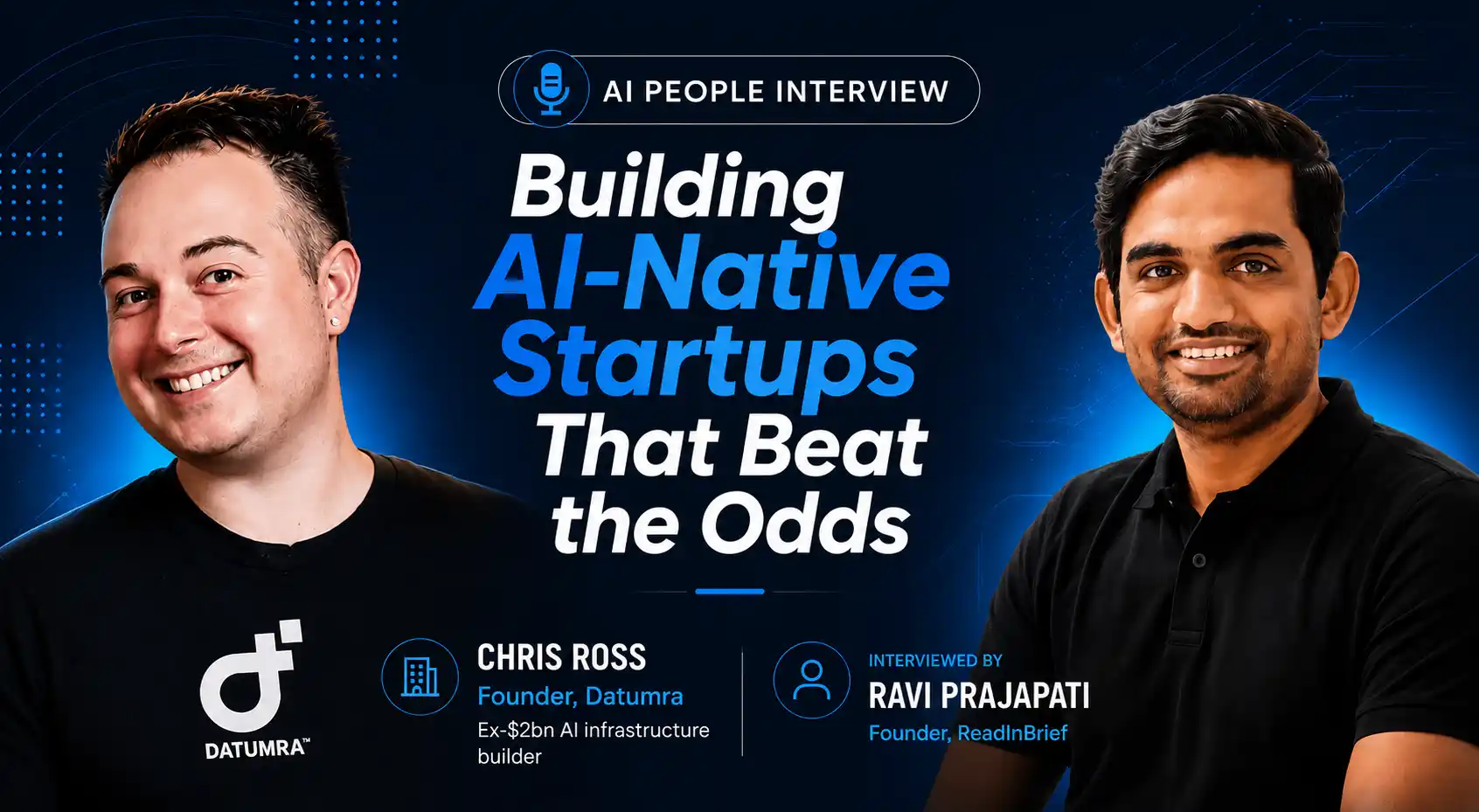
Chris Ross, founder of Datumra, shares how AI-native startups can work smarter, build stronger moats, avoid common mistakes, and beat the odds.
Chris Ross has seen both sides of building with AI: the enterprise scale of helping a company grow from $20m to $125m in ARR in a single year, reaching a valuation of more than $2bn, and now the ground-floor reality of building Datumra, an AI-native operating system designed to help founders run, grow, and protect the businesses they're building. His philosophy is simple: don't follow systems blindly, understand them, then redesign them to move faster.
In this AI People interview, Chris talks about why he decided to build Datumra now instead of waiting five years, what actually separates a genuinely AI-native company from one that's just bolted a chatbot onto an existing product, and why founder survival often comes down to things that never make it into a business plan.
Background & Personal Journey
Ravi Prajapati: You helped build AI infrastructure at a company that scaled to $2bn. What made you leave that to start Datumra?
Chris Ross: Datumra was never my plan for this year. My original plan was to launch something like it five years from now. It wasn't even called Datumra when I started; the name came after I had already begun building, and the idea had started to take on a life of its own.
I came across Elon Musk's advice to try to achieve your five-year goals in the next six months. I looked at this business I had been planning to build one day and asked myself why I was waiting. I called it my Goldilocks Time.
I was old enough to have the life experience, commercial understanding, and battle scars needed to start a serious company, but young enough to still manage the 12 to 16 hour days it can take to get something ambitious off the ground.
Having been a partner of a company that grew from approximately $20m to $125m in annual recurring revenue in a year and reached a valuation of more than $2bn, I had seen what world-class execution could look like.
Eventually, you have to decide whether an idea will remain part of your five-year plan or become the thing you start building today.
Ravi Prajapati: What's the biggest lesson from building large-scale AI infrastructure that you've carried into building a startup from scratch?
Chris Ross: The biggest lesson I learned is that the same principles of busy time versus productive time exist inside both enterprise organisations and small startups. Knowing that can be empowering.
Large companies can still waste huge amounts of time on meetings, internal processes, and work that never meaningfully moves the business forward. Small companies can still operate with focus, discipline, and ambition. You do not need thousands of employees to think big or build strong systems.
I also learned that it takes roughly the same amount of emotional energy to build something small as it does to build something big. Both can consume your time. Both can keep you awake at night. Both require resilience, sacrifice, and years of problem-solving.
So you might as well be building something big. That doesn't mean trying to build every feature at once. It means choosing a mission, market, and opportunity that are worthy of the energy you are going to put into them.
Ravi Prajapati: Was there a specific moment that made you want to focus on helping founders survive, rather than building at scale again?
Chris Ross: Back in 2019, I ran a workshop at my local university called "Build an App in 60 Minutes." Running those sessions was always fun and inspiring because I could see firsthand how passionate people were about building apps and turning their ideas into reality.
What I learned was that very few of those ideas were simply about building an app. Most were deeply rooted in the dream of starting a successful business.
What began as a technical app-building session would quickly become a wider lesson about customers, pricing, business models, validation, and how to launch a startup. There is something incredibly powerful about helping someone realise that their dream of building a business is much more achievable than they first thought.
You can almost see the moment when the idea changes in their mind. It stops being something imaginary and becomes something they believe they could genuinely create. That experience stayed with me. Datumra is partly about creating that moment for far more people, and then giving them the systems they need to keep going after the initial excitement.
Datumra & Its Mission
Ravi Prajapati: For readers who've never heard of it, how would you describe Datumra's mission in one sentence?
Chris Ross: Datumra's mission is to make technology and entrepreneurship more accessible by removing the barriers to starting and scaling a business, while helping traditional companies introduce powerful AI into their everyday operations without breaking the bank or adding unnecessary complexity.
Ravi Prajapati: What does "AI-native systems" mean in practice, and how is that different from just adding AI features to an existing product?
Chris Ross: An AI-native system is designed from the ground up for AI automation and generative AI. The workflows, data structure, permissions, and customer experience are all built with an understanding of what AI can do. AI is part of how the system operates, rather than an extra feature added later.
We will see many more AI-native businesses become the new normal, particularly across professional services. Historically, many professional services have charged by the hour. The client pays for the number of hours required to complete a piece of work. AI disrupts that model.
As more processes become partially or fully automated, customers will increasingly pay for outputs and outcomes rather than billable hours. They will care about the quality of the result, how quickly it is delivered, and the value it creates.
That creates a major opportunity for new companies. It also creates a challenge for established businesses whose economics depend on work taking a long time.
Adding a chatbot to an existing product does not make a business AI-native. The deeper change happens when AI reshapes how the work is delivered, priced, and experienced by the customer.
Ravi Prajapati: Who is Datumra actually built for: solo founders, early-stage teams, or later-stage startups?
Chris Ross: Datumra is ultimately being built for all businesses.
Under the surface, we are building an end-to-end business infrastructure that will allow us to run our own operations with an extraordinary level of efficiency. Our focus right now is on providing the right tools to help people get started or scale. That includes solo founders, early-stage teams, small businesses, and traditional companies.
Ultimately, Datumra is for anyone who wants to implement AI into their business but currently lacks the technical experience, knowledge, or resources to do it properly. These businesses cannot afford to spend several years figuring everything out while their competitors move ahead.
We are beginning with founders and smaller teams because they often experience the greatest level of pressure with the fewest resources. The underlying infrastructure, however, is being built to support businesses throughout their entire journey.
Ravi Prajapati: What's one problem Datumra solves that founders don't realize they have until it's too late?
Chris Ross: One of the biggest problems founders face is failing to document and automate their processes early enough. At the beginning, they know how everything works; it's small enough for them to be involved in every decision, with the important information living inside their head.
But then the money starts coming in, and demand for their service or product increases. As demand increases, they soon realise that they need to hire more people to manage the workload.
When new members join the team, they discover they don't actually know what they are supposed to do because nothing has ever been documented. The founder then spends more time answering questions, checking work, and correcting mistakes than they expected. Hiring was supposed to reduce the pressure, but initially, it creates even more work. The problem of a lack of playbooks and processes creeps up on them before they even knew it would be a problem.
AI for Startups: The Current Moment
Ravi Prajapati: Most startups today claim to be "AI-powered." What separates a company genuinely using AI well from one just bolting it on?
Chris Ross: One important test is whether the business would still be valuable if AI were stripped out of the product entirely. There should be real value beneath the technology. That could come from the workflow, customer experience, specialist expertise, proprietary data, intellectual property, relationships, brand, or distribution.
If the entire business model consists of wrapping an existing large language model, then the business does not have much of a competitive moat. It is essentially reselling AI at a much higher price to customers while relying on technology that almost anyone else can access.
A strong AI company uses foundational models as one component inside a much wider system. The business should solve a meaningful problem, own valuable assets around the technology, and become more useful through the information, customer context, or processes it develops. Adding an AI button or chatbot is easy. Building a valuable and defensible company around AI is far harder.
Ravi Prajapati: What's the biggest mistake you see early-stage founders make when adopting AI into their business?
Chris Ross: I see two common mistakes.
The first is doing it too late. Adding AI into an existing process can often be almost as difficult as building the process itself. The company may already have disconnected systems, inconsistent information, manual workarounds, and employees who have developed their own ways of doing things. Introducing AI becomes much easier when it is considered from the beginning.
The second mistake is adding AI because it seems fun, innovative, or impressive, even when it doesn't solve a real problem for the customer. A feature can be technically exciting and commercially useless at the same time. Every AI implementation should answer one simple question: what becomes meaningfully better for the customer?
Does it save time? Improve the quality of the result? Reduce costs? Remove a frustrating manual process? Help them make a better decision? If the answer is vague, the company may be building novelty rather than value.
Ravi Prajapati: How has building with AI changed the odds for early-stage startups, for better or worse?
Chris Ross: It has changed the odds for both the better and worse.
For people who are implementing AI well, this is a gold rush opportunity that has never been available before. Work that once required a large team, significant funding, or specialist technical support can increasingly be completed by solo founders and lean teams. That is dramatically reducing the barriers to entry. A founder can research markets, prototype products, build automations, create content, analyse customer feedback, and test ideas at a speed that would have been almost impossible a few years ago.
For businesses that are not using AI, the situation is very different. They are likely to find that they quickly lose their edge to competitors who can operate faster, serve customers more efficiently, and produce work at a lower cost. It is also a threat to non-technical founders because practical AI education has not been equally available to everybody. There are incredibly capable people who know that AI matters but have no idea where to begin, which platforms they can trust, or how to introduce it safely.
AI can level the playing field, but people still need access to the knowledge and systems required to use it.
Ravi Prajapati: Is there a type of startup or business model that AI has made obsolete, or made dramatically easier to build?
Chris Ross: Businesses that lack strong moats are becoming much easier to copy. You could build a functional clone of a platform like Facebook. You could reproduce many of its visible features and design a similar interface, but that doesn't mean you have recreated Facebook as a business. Its network effect protects it. The users, relationships, communities, habits, and enormous volume of interaction cannot be recreated simply by copying the product.
The risk is much greater for businesses built purely around a novel feature without intellectual property, proprietary data, distribution, community, or another valuable asset. AI has made it possible to build and copy software much faster than before. A feature that may once have given a company a two-year advantage could now be reproduced in a few weeks or months.
Founders need to think beyond what they are building and ask what will make the business difficult to copy, replace, or leave.
Surviving as a Founder
Ravi Prajapati: Your work is framed around helping founders "beat the odds and survive." What does survival actually depend on in year one?
Chris Ross: There is a commonly repeated idea that startups that survive their first five years experience a dramatic improvement in their long-term odds. The exact percentages vary, but the underlying point is important. The early years are when a business is most vulnerable.
As the company survives longer, it builds revenue, customer relationships, operating experience, and a better understanding of the market. Some of the biggest threats in year one are rarely discussed in traditional business plans.
We repeatedly see imposter syndrome, founder loneliness, technical overwhelm, knowledge overwhelm, and a lack of access to the right network. These things can affect the founder's ability to make decisions, ask for help, sell confidently, and continue through difficult periods.
Survival also depends on managing cash, speaking to customers, learning quickly, and focusing on the work that creates progress. However, founders are human. A promising business can still struggle when the person carrying it feels isolated, exhausted, or out of their depth.
The right systems matter. The right people and relationships matter just as much.
Ravi Prajapati: What's a resourcing or hiring decision AI has changed for early-stage founders, things they used to need a team for that one person can now do?
Chris Ross: When tools such as ChatGPT were first used by the wider world, there was a strange fear that the technology could do people's jobs better than they could. People who used AI often seemed uncomfortable admitting it. I think many were scared that their boss would ask, "Why am I paying you if AI can do your work?"
That attitude has now changed. The question is increasingly becoming, "Why am I paying you to complete work inefficiently when AI could help you do it faster or better?"
AI does not automatically make somebody good at their job. It can, however, dramatically increase the output of somebody who already has judgement, knowledge, and initiative.
When it comes to hiring, I am personally biased towards people who are more technical or actively embrace AI in their everyday work. The ability to work effectively with AI is becoming a fundamental professional skill.
Early-stage companies can now reduce the amount they spend hiring people purely to complete repetitive administrative work. They can focus more of their resources on people who bring judgement, customer understanding, creativity, relationships, and specialist expertise.
Ravi Prajapati: How do you help founders avoid over-relying on AI tools in ways that create fragile businesses?
Chris Ross: This depends on the type of AI tool being used and whether the business has sovereignty over the platform.
If you are using a tool that is powering foundational models and training itself using your data, you risk proprietary information leaking into models that other people could later access. Businesses need to know where their data is going, how it is stored, and whether it is being used to improve somebody else's technology.
Agentic AI workflows create additional risks. An agent may move information between multiple platforms, APIs, or services. If one part of that process is unsafe, sensitive company information can enter a system the business does not control. Founders need to ensure that no agentic workflow is leaking data into insecure processes.
The same principle applies commercially. At the beginning of the current AI era, many wrapper companies were created that relied entirely on AI APIs and other people's technology. Investors do not want to invest in something that is simply white-labelling AI that everybody else can access.
A resilient AI business protects its data, controls its workflows, and creates proprietary value beyond the foundational model.
Ravi Prajapati: What's one AI-native workflow or system you'd recommend every early-stage founder set up on day one?
Chris Ross: It depends entirely on the business. I'd recommend that a founder makes a list of all the things that regularly consume their time. That might include replying to emails, scheduling meetings, posting on social media, following up after calls, applying for grants, or completing procurement applications. You want to find a repeated process that consumes a meaningful amount of time.
The most important question is whether implementing an AI automation would save more time than it takes to set up and maintain. If you build a complicated automation yourself, it may take a long time before you recover the hours invested in creating it.
Using a provider such as Datumra changes that calculation because the automation has already been built. You can introduce a pre-built workflow and begin saving time almost immediately.
The best first automation is rarely the most technically impressive one. It is the process that consistently gives you meaningful time back. Some of the most common automations are virtual receptionists and Google Review reply bots. They are not the most technically impressive, but they solve a problem and save time or reduce dropped opportunities.
Industry & Investment Landscape
Ravi Prajapati: How has investor expectations around AI usage changed for startups pitching today versus two years ago?
Chris Ross: Investors increasingly expect founders to pitch businesses that have value beyond AI. They want to understand what would remain valuable if access to the foundational models disappeared tomorrow.
If the entire company relies on somebody else's technology, the business is highly vulnerable. Founders need to be prepared to answer difficult questions about pricing and dependency, including things such as what would happen if foundational model pricing spiked, and whether the company owns its workflows, relationships, data, and intellectual property.
Simply having AI in your business is no longer enough. Investors want to know how AI contributes to a lasting advantage that the business genuinely owns.
Ravi Prajapati: What's your take on infrastructure-heavy AI startups versus lightweight AI-wrapper startups, is one more durable than the other?
Chris Ross: Regardless of whether the startup is infrastructure-heavy or lightweight, the most important thing is whether the business has strong competitive moats and intellectual property.
An infrastructure company can still be fragile if its technology is easy to replace or its costs are unsustainable. A lightweight application can become highly durable if it owns an important workflow, trusted brand, valuable dataset, customer relationship, or distribution channel.
The weakest model is a pure AI wrapper with no meaningful moat. If the company relies entirely on another provider's models, offers very little proprietary value, and can be reproduced easily, it has a fragile and potentially short-lived business model.
The important question is not how technically complicated the company appears. It is what the company owns, what protects it, and why customers will continue choosing it as the foundational models improve.
Ravi Prajapati: What's a trend in AI tooling for startups right now that you think is overhyped?
Chris Ross: Vibe coding is overhyped, in my opinion.
It can be brilliant for prototyping. You can turn an idea into something visible, test a customer journey, and begin learning much faster than before. However, a prototype and a robust application are very different things.
If you are building a product that needs to be secure, legally compliant, and capable of supporting high user volumes, you are still going to need somebody technical. Founders need to be able to understand the architecture, test the application properly, protect customer information, and recognise risks that an AI coding tool may overlook.
I am a huge believer in Wizard of Oz and white-glove prototypes. They are fantastic for proving a concept, learning from customers, and generating early revenue without overbuilding. That traction can open doors to investment far faster than spending years quietly building a technically perfect product that nobody has agreed to buy.
Use vibe coding to learn, test, and validate. Do not confuse a quickly generated prototype with secure, production-ready infrastructure.
Advice & Forward-Looking
Ravi Prajapati: For a founder starting today with no funding and no team, what's the first AI system or tool you'd tell them to set up?
Chris Ross: Datumra, of course. I am biased, but I genuinely believe our starting workflows distill knowledge that took me more than 20 years of trial and error to learn about getting a successful business off the ground.
We help founders work through the things that are easy to overlook when they are excited about an idea. That includes understanding the customer, validating the opportunity, researching the market, building an initial business plan, identifying risks, and deciding what needs to happen next. The workflows are currently completely free to use.
For a founder without funding or a team, the first priority should be reducing avoidable mistakes and focusing limited time on the work that gives the business its best chance of moving forward. We have already seen hundreds of founders use these workflows to develop and validate their ideas.
Our goal is to give everyone a useful starting system without requiring technical knowledge, a large budget, or weeks of setup.
Ravi Prajapati: What gives you the most confidence about where AI-native startups are headed in the next few years?
Chris Ross: When you hear stories such as the reported two-person company Medvi being on track to generate approximately $1.8bn in annual revenue, it changes how you think about the relationship between headcount and business growth.
Regardless of what happens with one individual company, the wider direction is difficult to ignore. AI-native companies can automate work from the beginning. They do not have to build enormous teams first and then spend years trying to automate the processes they created.
It feels like only a matter of time before the first 10-person company worth $10bn, the first 100-person company worth $100bn, or even a remarkably lean trillion-dollar company becomes a reality.
Until recently, building a company of that scale seemed to require tens of thousands of employees, enormous physical infrastructure, and layers of management spread across the world. A trillion-dollar business built by a small team would have sounded completely unrealistic.
AI-native companies are changing that equation. They can automate work from the beginning, serve customers globally, and create enormous output without increasing headcount at the same rate as revenue or valuation.
Companies such as SpaceX showed that private businesses could pursue ambitions once reserved for governments. The next shift may be companies reaching a trillion-dollar scale with a fraction of the workforce we would previously have considered necessary.
That is what gives me confidence. We are approaching a point where the size of an opportunity will no longer determine the size of the team required to pursue it.
About Chris Ross
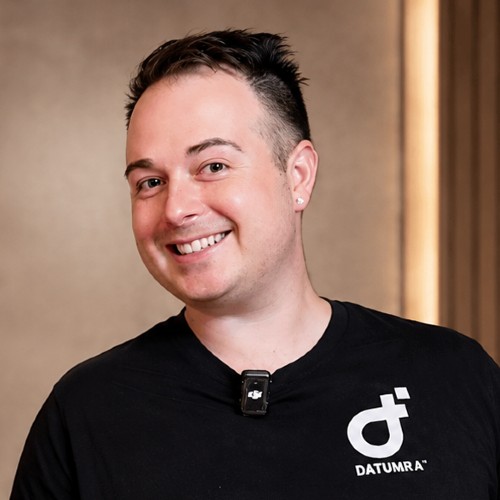
Chris Ross is the founder of Datumra, an AI-native business operating system designed to help founders and growing businesses run, grow, and protect what they are building. Before founding Datumra, Chris spent a decade helping ambitious startups and global enterprises build high-performing teams, including serving as a partner and executive hiring lead at an AI company that grew from $20m to $125m in ARR in a single year.
His philosophy: "Do not follow systems blindly. Understand them, then redesign them to move faster."
Datumra: datumra.com
LinkedIn: linkedin.com/in/chrisrossglobal
This interview is part of ReadInBrief's AI People series, where we talk to AI founders and experts building at the edge of the industry. Have someone you'd like us to feature? hello@readinbrief.com or drop message to Ravi Prajapati
Comments (0)
No comments yet. Be the first to share your thoughts!