Gemini 4 Argon vs Claude Opus 5.5: Coding, Agents, Context and Pricing Compared

Author
Ravi Prajapati

Compare Gemini 4 Argon vs Claude Opus 5.5 for coding, AI agents, context and API pricing. See verified limits, rollout status and practical selection advice.
Gemini 4 Argon vs Claude Opus 5.5 is a comparison about how AI handles demanding work: understanding a codebase, completing a sequence of actions, carrying relevant information forward and delivering a result someone can actually use.
But two details can distort the decision before the first test. A million-token output allowance is different from a million-token context window. An introductory API price is different from the rate a company should use in its long-term budget.
This guide separates verified specifications from practical interpretation. It draws on official announcements and developer documentation, rather than claiming hands-on results we have not measured. The intended reader is a developer, engineering leader or product team choosing a model for coding and agent workflows.
Quick answer: which model should you choose?
Claude Opus 5.5 is the more straightforward starting point for a team that needs documented, available coding and agent capabilities today. Gemini 4 Argon is a candidate for evaluating extended reasoning and difficult engineering tasks as access expands. Neither is a universal winner: compare accepted results, elapsed time and total task cost under the same conditions.
That recommendation reflects deployment readiness, not proof that one model is intrinsically smarter. Availability is a practical requirement. A promising model outside your access tier cannot meet a client deadline.
Gemini 4 Argon vs Claude Opus 5.5 at a glance
The distinction between an announced capability and a deployable specification matters throughout this table.
Comparison point | Gemini 4 Argon | Claude Opus 5.5 |
|---|---|---|
Access at the update date | Phased rollout to trusted testers; wider release planned | Active model with documented API access |
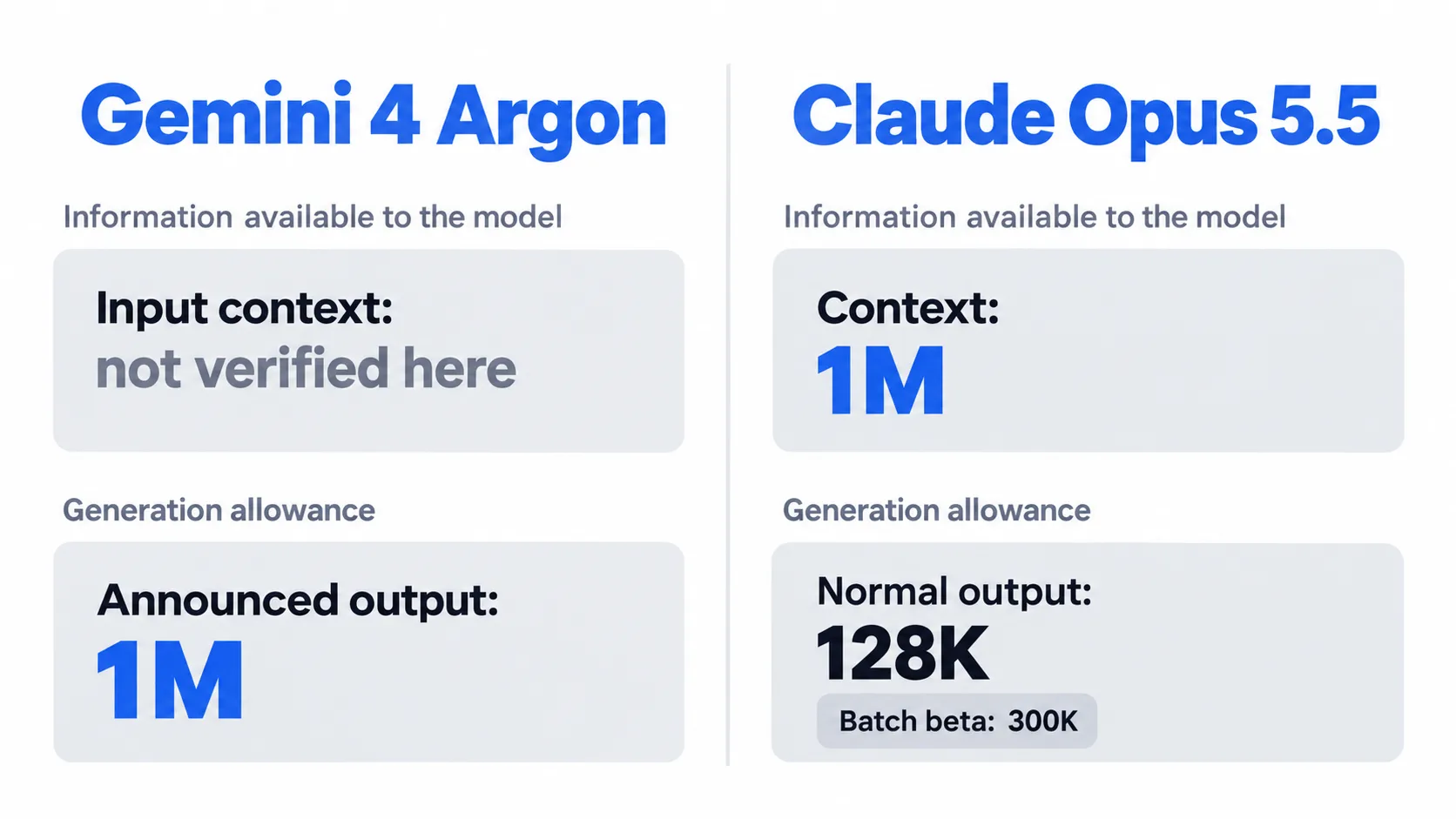
Context window | Not established by the launch announcement reviewed here | 1M tokens |
Output allowance | Announced limit of 1M tokens | 128K normally; up to 300K through Batch API beta |
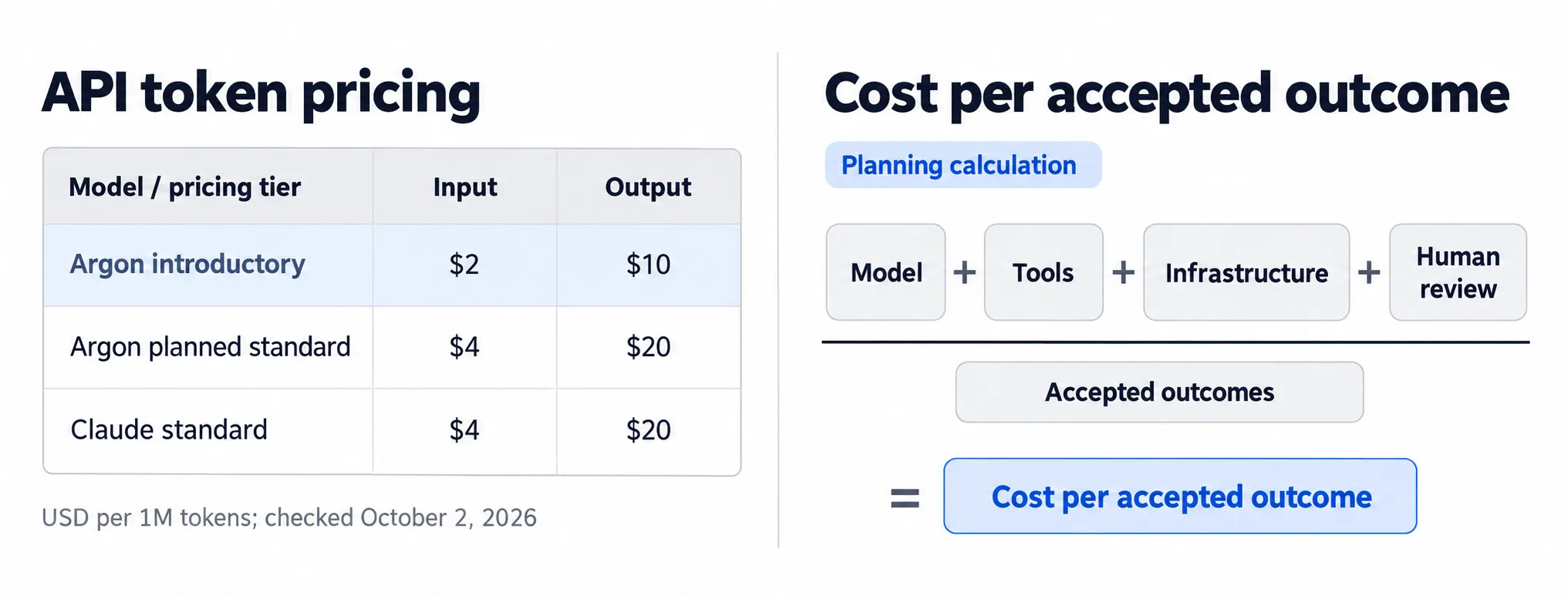
Input price per million tokens | Announced introductory $2; planned standard $4 | Standard $4 |
Output price per million tokens | Announced introductory $10; planned standard $20 | Standard $20 |
Cached input / cache read | Announced 95% reduction from input rate | $0.20 per million cache-read tokens |
Practical evaluation focus | Extended reasoning and difficult engineering workflows | Available coding and agent workflow integration |
Argon figures and rollout status come from Google’s launch announcement. Claude specifications come from the Opus 5.5 model documentation. Prices are in US dollars and refer to tokens, not chat subscriptions. Recheck access and billing terms before procurement.
The table deliberately leaves Argon’s input context unconfirmed. It would be misleading to copy its output figure into that row just to produce a symmetrical comparison.
Context window and output limit solve different problems
A context window limits the information available within a model request. An output limit constrains how much the model can generate. A large value on one dimension does not establish a large value on the other, and neither guarantees reliable reasoning across every token.
For Claude, the context-window documentation explains that capacity includes conversation history and newly generated output. Treating the advertised context as an unrestricted input allowance would therefore be inaccurate.
When a large context window helps
Imagine an engineering team investigating a regression involving application code, deployment settings and a long incident discussion. Its task is to connect evidence across those materials.
The evaluation should ask whether the model identifies the relevant configuration, preserves important constraints and cites the actual evidence behind its proposed fix. Merely accepting the files is insufficient.
A useful test deliberately includes plausible distractions: an obsolete design document, an earlier failed fix and logs from an unrelated environment. Score whether the model distinguishes current evidence from material that only looks relevant.
When a large output allowance helps
A different task may require sustained generation or reasoning through an extensive engineering problem. Here, generation headroom may be useful, especially if smaller limits interrupt a productive attempt.
However, a maximum is a ceiling, not a recommended target. Producing a huge change set can increase review effort, obscure mistakes and make rollback harder. Ask for staged deliverables when the work naturally separates into independently verifiable units.
For a migration, those units might be a dependency map, a pilot module, its tests and a documented expansion plan. A model that finishes these cleanly can be more useful than one that produces an enormous patch reviewers cannot confidently approve.
What remains uncertain for Argon
Do not infer Argon’s input capacity, practical latency or public endpoint behavior from its announced output allowance. Those require model-specific documentation or measured access. This uncertainty does not dismiss the capability; it sets the boundary of what a buyer can responsibly assume today.
Coding: compare accepted changes rather than impressive demos
Neither launch material nor a single leaderboard establishes the best model for your repository. Coding performance depends on the task, available tools, instructions, reasoning budget and verification process.
Google reports Argon at 77.9% on DeepSWE v1.1. That is a vendor-reported result for a specific engineering evaluation, not a measured success rate on your projects. See the official announcement’s engineering section.
Anthropic’s Opus 5.5 announcement also presents coding and professional-work evaluations. Its WANDR discussion explicitly notes that a different setup makes results unsuitable for direct comparison with Perplexity’s published setup. That is a useful reminder to examine evaluation conditions before combining scores.
Use three kinds of repository tasks
Task | What to provide | What an acceptable result requires |
|---|---|---|
Regression repair | Reproducible failure, relevant history, expected behavior | Correct fix and a test that exposes the original defect |
Feature implementation | Acceptance criteria, existing conventions, integration boundaries | Working feature, appropriate tests and a reviewable change |
Refactor or migration | Compatibility requirements, representative modules, rollback constraints | Preserved behavior and evidence that the transformation is safe |
Do not choose only easy tasks. Include a problem where the obvious solution is wrong, a feature with an ambiguous requirement and a migration with a compatibility edge case. These reveal whether the model investigates, asks appropriately and respects constraints.
Keep the starting repository identical. If one model receives the hidden explanation of a defect and the other must discover it, the comparison measures prompt advantage.
Review quality is part of coding quality
Track the time an engineer spends reviewing and correcting each result. A patch that passes visible tests can still introduce unnecessary abstractions, miss an authorization boundary or change unrelated behavior.
Record whether the model explains the root cause, distinguishes completed checks from assumptions and makes the diff easy to inspect. Clear reporting does not prove correctness, but poor reporting makes correctness more expensive to establish.
There is no basis here for declaring Argon the coding winner solely from a generation limit, or Claude the coding winner solely from availability. Repository evidence should make that decision.
Agents: the model is only one part of the workflow
An agent combines a model with tools, instructions, state and an execution environment. Its result depends on whether those components permit it to gather evidence, act correctly, recover from errors and stop at the right point.
Consider an agent that investigates a support issue, checks a database, prepares a fix and creates a review request. Fluent reasoning cannot compensate for incorrect permissions, an incomplete tool response or an environment that loses state halfway through the task.
Test completion, recovery and boundaries
Evaluate both candidates against the same operational questions:
Does the agent complete the requested outcome rather than merely describe the next step?
Does it recover when a tool fails or returns incomplete information?
Does it distinguish an intended action from an instruction embedded in retrieved content?
Does it preserve the user’s constraints through a long sequence?
Does it stop before an action requiring human authorization?
Does its final report match what actually happened?
These are proposed evaluation criteria, not claims that either model has passed a particular test.
For an illustrative client workflow, give each agent a ticket containing conflicting notes and a temporary API failure. The desired behavior is to resolve the evidence, retry appropriately, produce a valid deliverable and identify any remaining blocker. A smooth demonstration without these complications tells you less about production reliability.
Why integration can change the winner
Suppose your team already has a tested Claude workflow with tool schemas, tracing and an approved deployment route. Replacing the model has an engineering cost even if the alternative produces better isolated answers.
Conversely, a team evaluating a Google-oriented workflow may have different integration requirements. Existing infrastructure should influence the pilot design, but it should not become a substitute for testing task outcomes.
For Claude migrations, check the Opus 5.5 migration guide. It documents behavior changes, including the default million-token context configuration. Treat model upgrades as software changes with compatibility implications.
Pricing: Argon’s introductory advantage changes at standard rates
At announced introductory rates, Argon’s input and output prices are half Claude Opus 5.5’s standard rates. Google says Argon’s later standard prices will be $4 input and $20 output per million tokens, matching Claude’s published base rates. The launch announcement does not specify an introductory expiry date, so do not invent one.
Use Google’s Argon announcement for the announced terms and Claude’s pricing documentation for current billing options. A future budget should show both promotional and standard scenarios.
An equal-volume cost example
The following is an illustrative calculation, not a benchmark. Assume 100,000 uncached input tokens and 20,000 billed output tokens, with no other charges or discounts.
Model and rate | Input cost | Output cost | Total |
|---|---|---|---|
Argon, announced introductory | $0.20 | $0.20 | $0.40 |
Argon, planned standard | $0.40 | $0.40 | $0.80 |
Opus 5.5, standard | $0.40 | $0.40 | $0.80 |
This isolates price. It does not imply that the models consume identical token volumes or complete the same work with equal reliability. The output assumption refers to billed usage, rather than the length of a visible final answer.
Compare cost per accepted outcome
For a pilot, calculate:
Cost per accepted outcome = (model charges + tool charges + execution infrastructure + human review and correction cost) ÷ accepted outcomes.
Include expenditure on failed attempts in the numerator. Excluding failures makes a model with frequent retries look artificially economical.
An illustrative example shows the difference. Workflow A spends $12 on model calls and $30 on review to produce six accepted outcomes. Its cost is $7 per accepted outcome. Workflow B spends $18 on calls and $18 on review to produce nine accepted outcomes. Its cost is $4. The higher model bill supports the cheaper usable result.
The numbers are hypothetical. Their purpose is to show why procurement should consider completion and review effort alongside token prices.
Caching needs its own budget
Claude’s prompt-caching documentation distinguishes cache writes from cache reads. A low read rate is valuable only when requests actually reuse eligible content; it is not the price of every input token.
For either provider, track cache hits, refreshes and applicable storage or write charges. Test realistic prompts that evolve during work. A budget based on a perfectly static prompt can understate expenditure for an agent whose context changes constantly.
A practical framework for choosing between the models
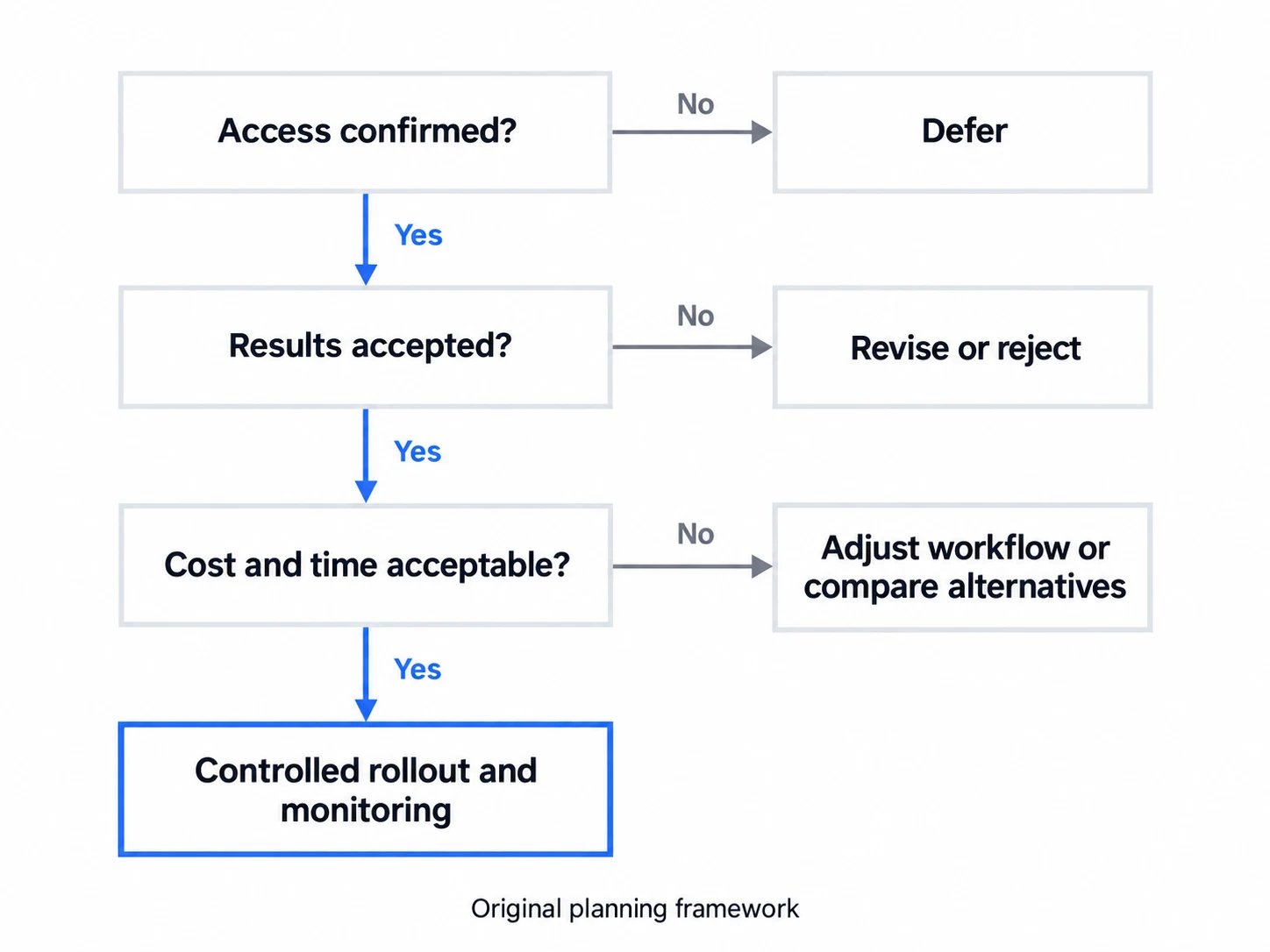
The following Access, Acceptance, Economics framework is an original planning aid for this comparison. It is not a validated scoring methodology.
1. Access: can the model run in your environment?
Confirm that your account can use the intended model and deployment route. Check rate limits, contractual requirements, available tools and the time needed to integrate it.
Make access a gate rather than a weighted score. A model that fails a mandatory deployment requirement should not win because it scores highly on unrelated tasks.
2. Acceptance: does the result meet your quality bar?
Write the acceptance criteria before running the pilot. For coding, require functional correctness, relevant tests, a manageable diff and satisfactory review. For research, require source-supported claims and accurate calculations. For operational agents, require correct state changes and an auditable record.
Where practical, have reviewers inspect anonymized outputs. Repeat difficult tasks enough to observe variability. A model that succeeds once after several failures deserves a different deployment decision from one that performs consistently.
3. Economics: what does useful completion cost?
Only compare economics after results meet the quality threshold. Measure accepted-outcome cost and elapsed time separately. A cheaper result delivered too late can still fail the business requirement.
Your situation | Sensible starting decision | What could change it |
|---|---|---|
Need an available coding model immediately | Pilot Opus 5.5 | Argon becomes accessible and passes the same requirements |
Complex task repeatedly hits generation limits | Evaluate Argon when available | Staged execution solves the problem more efficiently |
Existing Claude agent implementation | Establish an Opus baseline first | Alternative improves accepted results enough to justify integration |
High-volume workload with tight margins | Test both on actual usage | Standard-rate economics, caching and retries change the apparent advantage |
Sensitive workflow with approval requirements | Require both to pass boundary tests | Deployment controls or behavior fail mandatory requirements |
Frequently asked questions
Is Gemini 4 Argon better than Claude Opus 5.5 for coding?
There is no universal winner established by the evidence reviewed here. Argon’s announced engineering results make it worth evaluating, while Opus provides an available baseline. Compare the same repository tasks, tests, review criteria and resource limits. The useful winner is the model that consistently delivers accepted changes within your time and cost requirements.
Does Argon’s million-token output mean it has a larger context window?
No. Output allowance and context capacity describe different constraints. The launch figure cannot establish Argon’s input context. Claude documents its context and output separately. Compare published model-specific input and generation limits, then test whether the model actually uses the supplied evidence reliably. Large capacity alone does not demonstrate correct retrieval or reasoning.
Is Gemini 4 Argon cheaper than Claude Opus 5.5?
Its announced introductory input and output rates are lower. Its planned standard base rates match Claude’s currently published standard rates. Actual expenditure depends on billed usage, caching, retries and execution costs. For a longer contract, calculate the budget at both introductory and standard rates rather than assuming the initial discount continues indefinitely.
Which model is better for AI agents?
Choose through an end-to-end workflow evaluation. Tool correctness, recovery, permissions and reporting matter alongside reasoning quality. Give both models the same task and environment, including controlled failures. A model that writes an excellent plan but leaves the requested state unchanged has not completed the workflow. Measure finished, accepted outcomes and the interventions required.
Do these API prices include Claude or Gemini subscriptions?
No. The rates compared here are token-based API figures. A chat subscription has its own access conditions, usage limits and features. Do not convert a monthly subscription into an assumed unlimited API allowance. Decide first whether your use case needs interactive chat, an existing coding product or an application calling a model endpoint.
Should teams send the entire codebase to a large-context model?
Only when doing so serves the task and fits the applicable limits. More material can bring relevant evidence, but it can also add obsolete files and distractions. Test a targeted retrieval approach against broader context. Preserve critical requirements in either case, and evaluate correctness rather than assuming the largest prompt is the best prompt.
Which model deserves your first pilot?
Start with Opus 5.5 if your immediate priority is an accessible coding or agent workflow with documented specifications. Add Argon to the same evaluation as access becomes available, particularly for demanding work where generation constraints appear to be a real bottleneck.
For Gemini 4 Argon vs Claude Opus 5.5, the decisive question is whether a model completes your actual work correctly, within the available environment, at an acceptable cost. Keep context and output separate, budget beyond introductory pricing and let accepted results determine the choice.
Read Also:
Gemini 4 Argon vs GPT-6 Astra: Which Is Better for Coding, AI Agents and Real-World Work?
Comments (0)
No comments yet. Be the first to share your thoughts!