Gemini 4 Argon vs GPT-6 Astra: Which Is Better for Coding, AI Agents and Real-World Work?

Author
Ravi Prajapati

Gemini 4 Argon vs GPT-6 Astra compared on coding, AI agents, context, pricing, benchmarks and real-world work. See where each model fits.
Gemini 4 Argon and GPT-6 Astra represent two different approaches to frontier AI.
Google is pushing Argon toward long-horizon reasoning, with an unusually large 1 million-token output limit and early deployments involving large code migrations, infrastructure optimization, financial research and cybersecurity.
OpenAI has positioned Astra around computer use, coding, complex reasoning and professional work, backed by a mature tool ecosystem and a 1.05 million-token context window.
On benchmarks, neither model has a clean advantage across every workload. Independent testing from Artificial Analysis currently gives Gemini 4 Argon and GPT-6 Astra at maximum reasoning the same overall Intelligence Index score of 53, while their individual strengths differ considerably.
There is also a major price difference.
At announced introductory API rates, Argon costs $2 per million input tokens and $10 per million output tokens. GPT-6 Astra's standard API pricing is $10 input and $50 output per million tokens.
So the useful question is not simply:
Which model is smarter?
It is:
Which model architecture and capability profile better fits the work you are trying to automate?
Quick Answer
Gemini 4 Argon looks particularly interesting for long-running AI agents, large coding workflows, research-heavy tasks and applications where token economics matter. Its 1M output-token ceiling gives agents substantially more room to continue reasoning and iterating inside a single trajectory.
GPT-6 Astra is especially compelling when work depends on computer use, browser interaction, existing developer tooling, polished professional artifacts and established production access.
Independent evaluations show both models near the frontier rather than establishing one as universally superior. The practical choice depends on whether your bottleneck is trajectory length, execution environment, task type, cost or integration maturity.
Gemini 4 Argon vs GPT-6 Astra at a Glance
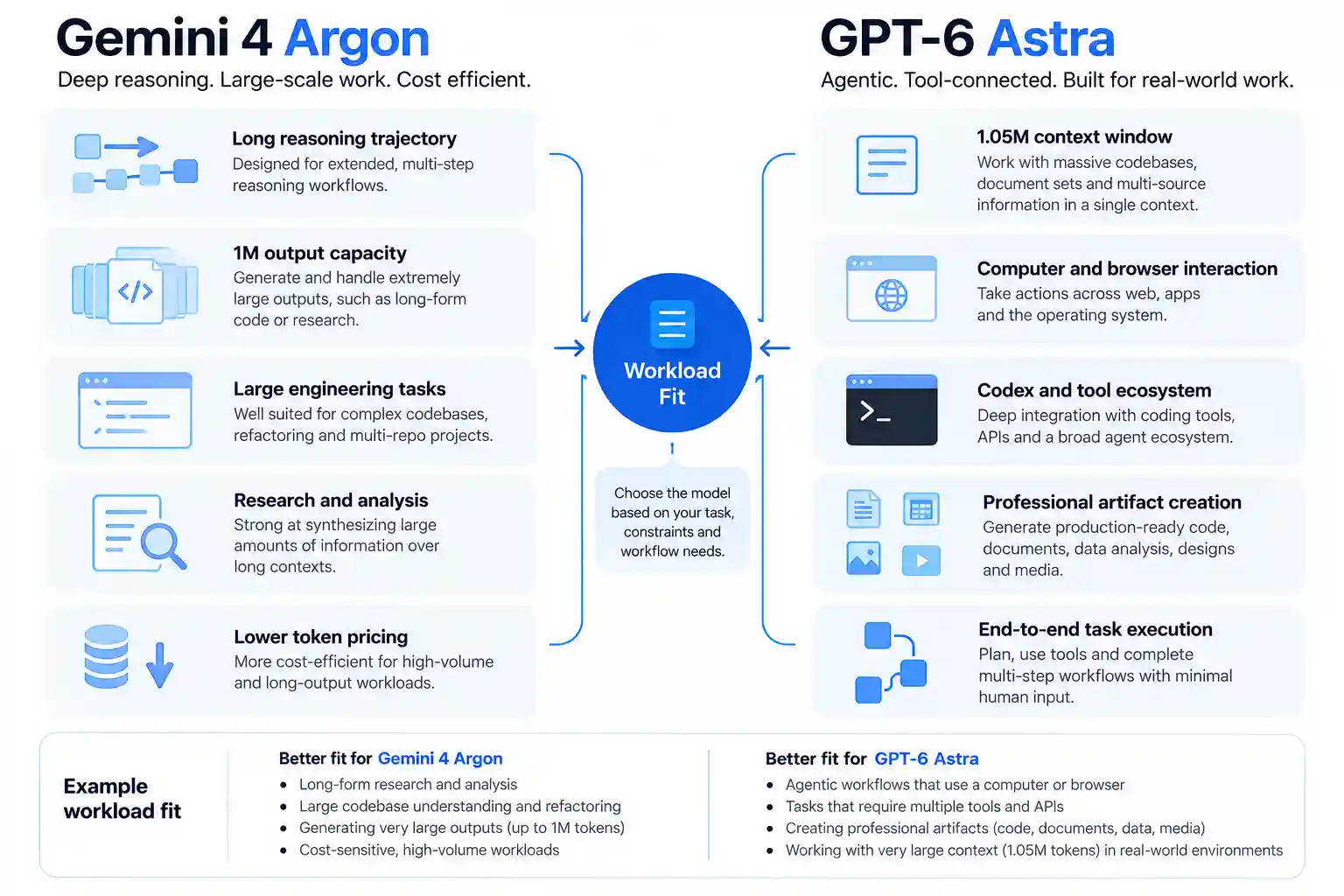
Category | Gemini 4 Argon | GPT-6 Astra |
|---|---|---|
Developer | OpenAI | |
Core positioning | Long-horizon professional reasoning and agents | Complex reasoning, coding, computer use and professional work |
Context | 1M class | 1.05M tokens |
Maximum output | Google advertises up to 1M tokens | 128K tokens |
Standard/launch input price | $2/M introductory | $10/M |
Standard/launch output price | $10/M introductory | $50/M |
Later Argon price | $4/M input, $20/M output | $10/M input, $50/M output |
Coding focus | Long-horizon engineering, migrations, optimization | Agentic coding, terminal work, software engineering |
Computer use | Less publicly established at launch | Major Astra capability |
Agent focus | Long trajectories and complex workflows | Tool use, computer use and multistep workflows |
API maturity | Phased rollout | Available through OpenAI API |
Cloud availability | Wider availability still rolling out | OpenAI API, Azure and AWS Bedrock |
Google says Argon's introductory pricing will eventually move to $4 per million input tokens and $20 per million output tokens. Even at those later rates, its published token prices remain below Astra's current standard API rates.
One caveat matters: model specifications and API behavior can change quickly during frontier-model rollouts. Production teams should verify current provider documentation before designing around a specific limit.
The Most Important Difference Is Not the Context Window
At first glance, Argon and Astra look similar because both operate around the million-token context scale.
But that hides a significant architectural difference.
OpenAI documents GPT-6 Astra with a 1,050,000-token context window and 128,000 maximum output tokens.
Google emphasizes something different with Argon: an output-token limit of up to 1 million tokens, increased from 64K.
Google says this allows Argon to generate hundreds of thousands of tokens during a single trajectory while working through difficult problems.
That distinction matters much more for agents than ordinary chatbot conversations.
Context capacity asks:
How much information can the model work with?
Output capacity asks:
How long can the model continue reasoning and generating within a trajectory?
An AI coding agent might need to:
inspect → plan → modify → compile → test → observe → debug → modify → retest → verify
If the trajectory repeatedly reaches an output boundary, the agent needs orchestration infrastructure to preserve its state and restart.
Argon's architecture potentially allows much longer uninterrupted units of work.
Astra addresses the continuity problem differently.
OpenAI has introduced an experimental Codex mechanism where Astra can preserve notes across context windows and search previous context rather than repeatedly compressing all previous work into one summary. OpenAI explicitly says this is designed for long sessions such as complex debugging and large refactors.
That creates a fascinating architectural contrast:
Argon: increase the possible trajectory.
Astra + Codex: improve continuity across trajectories.
Those approaches can lead to different agent architectures.
Gemini 4 Argon vs GPT-6 Astra for Coding
Both models are clearly designed for serious software engineering rather than simple code completion.
But their strongest evidence currently comes from different places.
Argon: strong evidence for long-horizon coding
Google reports Argon scoring 77.9% on DeepSWE v1.1, a benchmark designed around real-world long-horizon software engineering.
Google is also using Argon internally for unusually large engineering tasks.
Its agents are migrating C and C++ codebases to Rust, ranging from tens of thousands of lines to more than 800,000 lines in the Fuchsia Zircon kernel.
For Google's libgav1 video decoder, Argon agents reportedly replaced 32,000 lines of SIMD code through repeated profile-guided experiments and compiler analysis. Google says the resulting implementation ran 2.7 times faster than the previous Rust port while maintaining identical video output.
These are vendor-reported examples rather than independent case studies, but they show what Google is optimizing the model for:
long, iterative engineering work.
Astra: strong terminal and agentic development capabilities
OpenAI reports GPT-6 Astra at:
57.9% on Terminal-Bench 4.0
74.1% on DeepSWE v1.1
64.5% on FrontierCode 1.1 Extended
63.9% on OpenAI's internal database migration tasks
OpenAI also describes Astra as its strongest software-engineering model and has integrated it with Codex for long-running coding workflows.
Independent testing makes the comparison more interesting.
Artificial Analysis currently reports roughly:
Independent evaluation | Argon High | Astra Max |
|---|---|---|
Intelligence Index | 53 | 53 |
Terminal-Bench 4.0 | 57% | 59% |
SciCode | 62% | 56% |
Humanity's Last Exam | 57% | 55% |
AA Long Context Reasoning | 80% | 81% |
These tests use specific configurations and should not be treated as permanent rankings, but they illustrate why a single “coding winner” is misleading.
What kind of coding work fits each model?
Coding workload | Model characteristic worth testing |
|---|---|
Repository-wide migration | Argon's long trajectory |
Iterative optimization | Argon's trajectory + token economics |
Terminal-heavy development | Astra's demonstrated terminal capabilities |
Browser-based QA | Astra's computer-use stack |
Large refactoring | Test both approaches |
Database migration | Astra has published internal evaluation evidence |
Huge codebase exploration | Both warrant testing |
Long compile-test-debug loops | Argon's output headroom is particularly interesting |
The right coding benchmark is therefore your own repository.
A model that scores slightly higher on a public benchmark can still perform worse on your language, architecture, test suite or development workflow.
Gemini 4 Argon vs GPT-6 Astra for AI Agents
This may be the more important comparison.
Traditional model comparisons ask:
Which model produces the better answer?
Agent comparisons should ask:
Which model can reliably complete the larger unit of work?
Argon's bet: longer trajectories
Google built Argon specifically around long-horizon workflows.
Its 1M output ceiling potentially gives an agent more room to:
plan;
use tools;
inspect results;
revise its approach;
recover from failures;
test;
verify;
continue.
Google reports Argon agents already working on infrastructure optimization and code migration internally.
One example involved agents analyzing fleet-wide profiling telemetry across Google's data centers and identifying memory optimizations. Google says deployed changes have freed more than 300 TiB of memory, with total estimated savings of 500 TiB to 1 PiB.
Again, this is Google's own reporting, but it demonstrates the type of autonomous workflow the model is being designed around.
Astra's bet: strong execution across software environments
Astra places more visible emphasis on interacting with software.
OpenAI describes Astra handling tasks such as:
filling online forms;
updating CRM records;
browser research;
spreadsheet work;
frontend QA;
installing software;
troubleshooting applications;
manipulating specialized professional software.
On OSWorld 2.0, OpenAI reports Astra scoring 72.6% in its evaluation configuration.
That makes Astra particularly relevant when an agent needs to operate a computer rather than primarily reason inside a long trajectory.
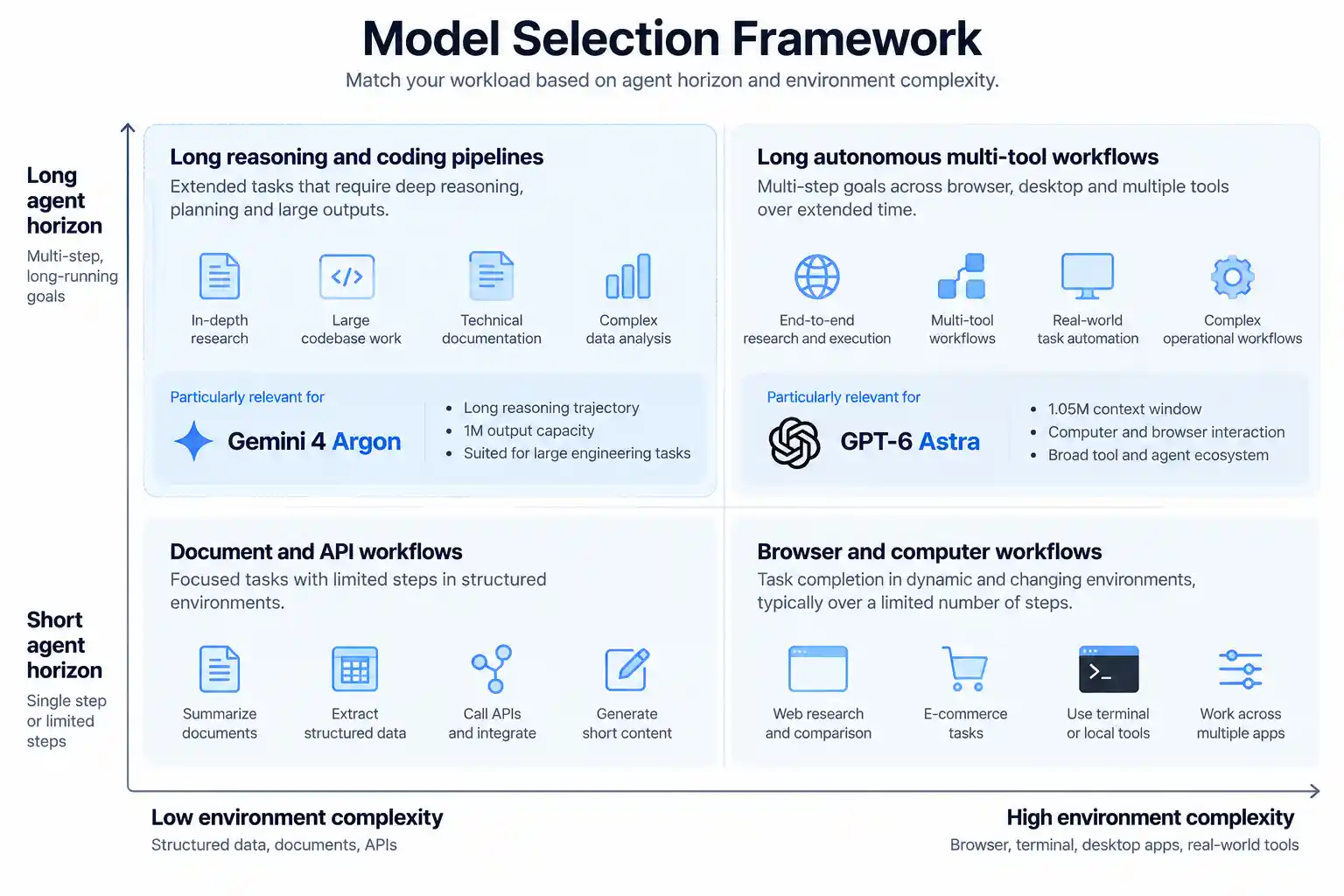
A Better Framework: Agent Horizon vs Environment Complexity
Instead of ranking the models globally, consider two dimensions.
This is an analytical framework for model selection, not a validated benchmark.
Dimension 1: Agent Horizon
How long does the agent need to continue before reaching a meaningful checkpoint?
Short: one or several tool calls.
Medium: dozens of dependent actions.
Long: extended investigation, experimentation, migration or optimization.
Dimension 2: Environment Complexity
How many external systems must the agent manipulate?
Low: documents, APIs, structured data.
Medium: repositories, databases, search and multiple APIs.
High: browsers, desktop software, terminals and changing graphical interfaces.
This produces a practical matrix:
Lower environment complexity | Higher environment complexity | |
|---|---|---|
Short horizon | Either model may be excessive | Astra deserves testing for computer use |
Medium horizon | Evaluate price and task accuracy | Strong comparison territory |
Long horizon | Argon's trajectory architecture becomes interesting | Test both carefully with checkpoints |
The hardest category is the bottom-right cell:
long-running agents operating across complex environments.
That is where model capability alone becomes insufficient.
The surrounding orchestration, memory, permissions, observability and verification architecture matter just as much.
Which Model Looks Better for Real-World Knowledge Work?
This category is harder to reduce to one number.
Astra was explicitly trained around professional work and artifact creation.
OpenAI emphasizes:
documents;
spreadsheets;
presentations;
data analysis;
legal workflows;
research;
professional software.
OpenAI says Astra was trained to follow existing templates and produce immediately usable professional artifacts while avoiding unnecessary repetition.
Argon's evidence is strongest around long, research-intensive work.
Google reports strong performance in finance and legal evaluations, including Vals Finance Agent v2 and Harvey's Legal Agent Benchmark.
Independent Vals testing currently reports Argon at 68.90% on its Vals Index, which aggregates agentic performance across economically relevant areas including finance, coding, legal and tax tasks.
Vals also reports Argon at 65.40% on Finance Agent v2.
This suggests a useful distinction:
Astra deserves attention when the output itself must become a polished professional artifact or when work occurs inside software.
Argon deserves attention when the task involves long research, analysis or iterative reasoning chains.
Actual enterprise evaluations should test both.
Pricing Changes the Comparison Dramatically
The headline API pricing difference is substantial.
Gemini 4 Argon introductory pricing
Input: $2 / 1M tokens
Cached input: approximately $0.10 / 1M
Output: $10 / 1M tokens
Google says pricing after the introductory period will become:
Input: $4 / 1M
Output: $20 / 1M.
GPT-6 Astra standard pricing
Input: $10 / 1M tokens
Cached input: $1 / 1M
Output: $50 / 1M tokens.
At headline introductory rates, Argon is therefore priced at roughly one-fifth of Astra's standard token rates for both input and output.
After Argon's announced price increase, its rates would still be lower.
But token price is not the same as task cost.
That distinction matters enormously.
Cheap Tokens Do Not Necessarily Mean Cheaper Agents
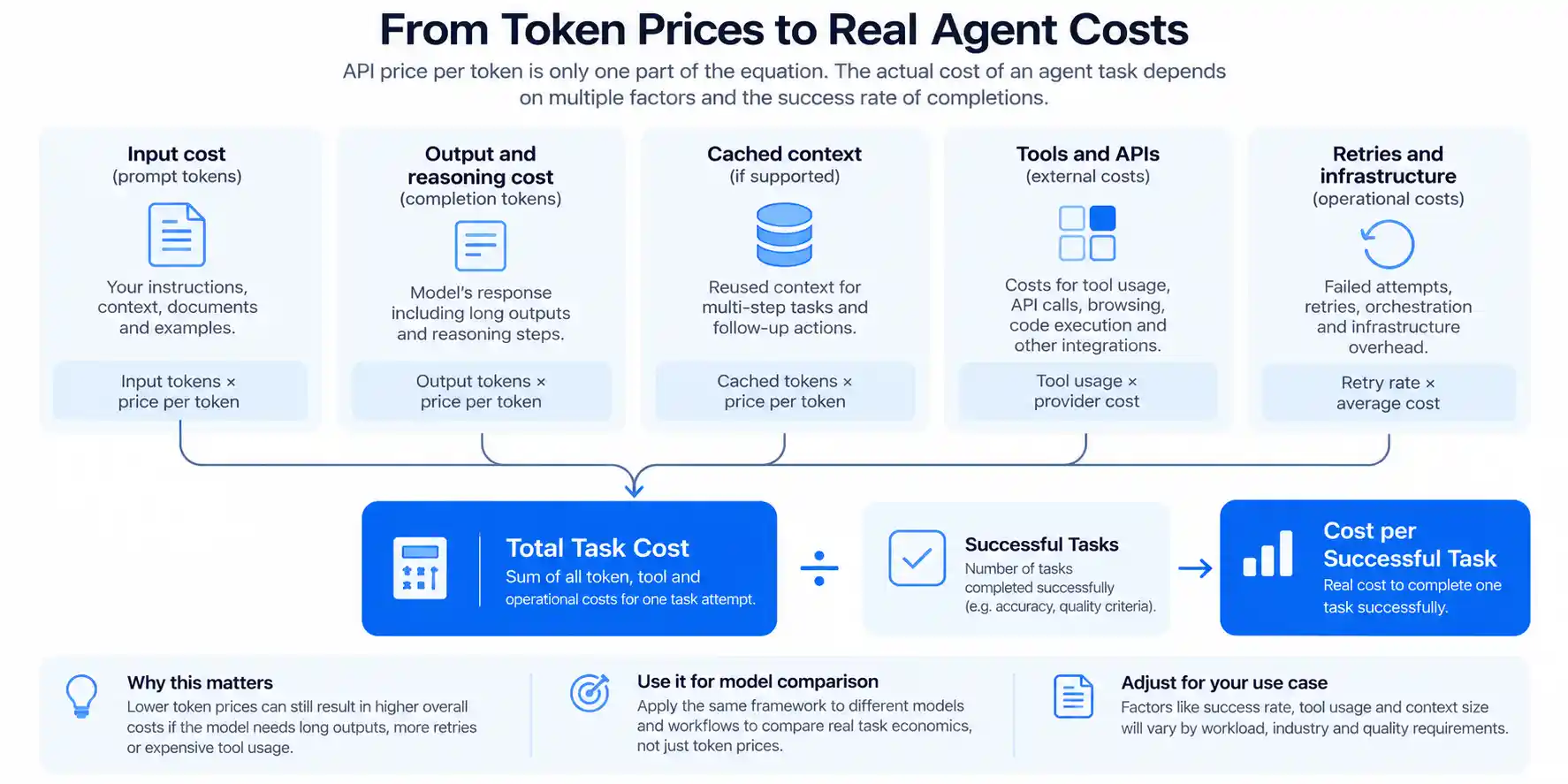
Imagine Model A costs half as much per output token but consumes four times as many tokens solving the same task.
Model B could still be cheaper.
Agent economics should therefore be calculated as:
Task Cost = Input + Cached Context + Reasoning/Output + Tool Calls + Retries + Infrastructure
Then divide that by:
Successfully completed tasks.
A better enterprise metric is:
Cost per successful task
not:
Cost per million tokens
Artificial Analysis illustrates this problem.
Its current Argon High vs Astra High comparison lists Argon with substantially cheaper headline token pricing, yet its measured cost per task is about $1.99 for Argon versus $1.73 for Astra High on that evaluation configuration.
At Astra Max, the economics change again, with Artificial Analysis reporting approximately $3.26 per task versus $1.99 for Argon High.
The lesson is not that either model is cheaper.
It is:
Model economics depend on how much reasoning the model consumes to finish your workload successfully.
Context Window vs Output Limit: Do Not Confuse Them
This comparison deserves its own clarification because the numbers can easily mislead readers.
A context window determines how much information a model can work with during a request.
A maximum output limit determines how much it can generate.
OpenAI documents Astra at:
1.05M context / 128K maximum output.
Google's launch announcement emphasizes Argon's 1M maximum output capacity, specifically describing the increase from 64K as a way to sustain much longer reasoning trajectories.
These specifications address different constraints.
For retrieval-heavy workloads, context capacity matters.
For extended autonomous reasoning, output headroom can matter.
For production agents, both interact with external memory and orchestration.
Availability Is Currently an Important Advantage for Astra
A powerful model is useful only when developers can reliably deploy it.
GPT-6 Astra is available through the OpenAI API and is also being distributed through Microsoft Azure and AWS Bedrock.
Google is taking a more phased approach with Argon.
At launch, access began with trusted cybersecurity defenders through Google's Fairwind Program. Google says broader rollout will extend to developers, enterprises and consumers, beginning with paid API customers and Google AI Ultra subscribers.
This means Astra currently has a practical maturity advantage for teams that need to build now.
That advantage may shrink as Argon's rollout expands.
What About Cybersecurity?
Both companies emphasize cybersecurity, but both also treat the capability cautiously.
Google says Argon can autonomously find, validate and patch critical vulnerabilities. Access to its unrestricted defensive cyber capabilities initially goes through Fairwind.
OpenAI says Astra crossed its Critical capability threshold for cybersecurity under its Preparedness Framework. OpenAI reports Astra reaching 100% on ExploitBench in testing without production safeguards.
For security teams, benchmark strength alone should not determine deployment.
The more capable the model becomes at autonomous cyber work, the more important sandboxing, scoped permissions, monitoring and approval controls become.
Where Independent Testing Currently Puts the Models
Vendor benchmarks are useful, but independent evaluations reduce the risk of comparing models under different internal harnesses.
Artificial Analysis currently reports Argon High and Astra Max with the same overall Intelligence Index score of 53.
Their strengths differ:
Argon High scores higher in that evaluation on AutomationBench-AA, SciCode and Humanity's Last Exam.
Astra Max scores somewhat higher on Terminal-Bench 4.0, AA-Briefcase and several other evaluations.
Vals independently reports Argon at 68.90% on its Vals Index and highlights particularly strong finance, coding and tax results.
These results will almost certainly evolve as providers update models, harnesses and reasoning configurations.
The useful conclusion is not that a permanent leaderboard has been established.
It is that frontier models increasingly have different capability shapes even when their aggregate intelligence looks similar.
When Gemini 4 Argon Makes More Sense to Test
Argon deserves serious evaluation when your workload involves:
long reasoning trajectories;
large code migrations;
repeated compile-test-debug loops;
extensive research;
large-scale analysis;
finance research agents;
long autonomous workflows;
workloads where token pricing matters materially.
The 1M output ceiling is especially interesting when the artificial boundary between model calls is currently constraining your agent architecture.
When GPT-6 Astra Makes More Sense to Test
Astra deserves serious evaluation when the workload depends heavily on:
computer use;
browser interaction;
terminal workflows;
professional documents;
spreadsheets and presentations;
existing Codex workflows;
mature API integration;
Azure or AWS Bedrock deployment;
workflows requiring a mixture of reasoning and direct software interaction.
Its established developer availability is also meaningful for teams building production systems today.
When You Should Test Both
For many valuable enterprise workloads, choosing from specifications alone would be a mistake.
Test both if you are building:
autonomous coding agents;
enterprise research agents;
complex workflow automation;
financial analysis systems;
legal research tools;
multi-tool agents;
long-running engineering workflows.
Use the same tasks, same acceptance criteria and same environment.
Then measure:
Metric | What to measure |
|---|---|
Task success | Did the model actually finish correctly? |
Human correction | How much intervention was required? |
Cost | Total cost per successful task |
Latency | Time until usable completion |
Reliability | Success across repeated runs |
Tool accuracy | Correct tool selection and execution |
Recovery | Ability to recover from failed actions |
Instruction adherence | Did it remain inside scope? |
Artifact quality | Was the result immediately usable? |
Observability | Can developers understand what happened? |
This produces much more useful information than asking which model has the higher aggregate benchmark score.
A Practical Model Selection Framework
For production use, evaluate five dimensions.
1. Work Horizon
How many dependent steps must the model complete?
Longer tasks make Argon's trajectory architecture more interesting.
2. Environment
Does the model mainly reason over information, or must it actively manipulate software?
Astra's computer-use capabilities become more relevant as environment complexity increases.
3. Verification
Can the task be automatically checked?
Code with tests can tolerate more autonomous iteration than an irreversible business decision.
4. Economics
Measure cost per successful task rather than token price.
5. Integration
The technically stronger model may still be the wrong production choice if your infrastructure cannot deploy, observe or govern it effectively.
This gives teams a simple decision sequence:
Task → Horizon → Environment → Verification → Economics → Integration
Not:
Benchmark → Model.
What Neither Model Solves
Frontier capability does not remove the surrounding engineering problems.
Neither model eliminates the need for:
persistent agent memory;
RAG when external knowledge is required;
tool permissions;
observability;
human approval;
sandboxing;
evaluation;
retry logic;
cost controls;
security boundaries.
A million-token trajectory can still be wrong.
A highly capable computer-use agent can still perform the wrong action.
The more capable these systems become, the more important their surrounding control architecture becomes.
Conclusion
Gemini 4 Argon and GPT-6 Astra illustrate two increasingly important directions in frontier AI.
Argon expands the work horizon, giving models much more room to reason and iterate within a long trajectory while offering aggressive announced token economics.
Astra combines frontier reasoning with computer use, professional software interaction, coding infrastructure and a mature deployment ecosystem.
Independent testing currently places the models close enough overall that workload characteristics matter more than a single intelligence score.
For developers and enterprises, that changes the model-selection question.
Do not ask:
Which model is better?
Ask:
Which model completes my workload more reliably, with less human correction, at an acceptable cost and inside the controls my organization requires?
That is the comparison that matters in production.
Frequently Asked Questions
Is Gemini 4 Argon better than GPT-6 Astra?
There is no universal answer across all workloads. Independent Artificial Analysis testing currently places Argon High and Astra Max at the same overall Intelligence Index score, while individual benchmark results vary. Argon's architecture is particularly notable for long reasoning trajectories and pricing, while Astra has strong computer-use capabilities and broader current deployment options.
Which is better for coding, Gemini 4 Argon or GPT-6 Astra?
Both are strong coding models with different profiles. Google reports Argon at 77.9% on DeepSWE v1.1 and has demonstrated it on large internal code migrations. OpenAI reports Astra at 57.9% on Terminal-Bench 4.0 and integrates it deeply with Codex. Repository-specific testing is more meaningful than selecting either from one benchmark.
Which model is better for AI agents?
The answer depends on the agent. Argon's 1M output capacity makes it particularly interesting for long-running reasoning trajectories. Astra is especially relevant when agents need to operate browsers, terminals and professional software. Long, multi-tool agents should generally be evaluated on both models using realistic workflows.
Is Gemini 4 Argon cheaper than GPT-6 Astra?
At published headline rates, yes. Google's introductory Argon pricing is $2 per million input tokens and $10 per million output tokens, compared with Astra's $10 input and $50 output standard API rates. However, actual economics depend on token consumption, retries, tools and task success, so cost per successful task is a better metric.
Does Gemini 4 Argon have a larger context window than GPT-6 Astra?
Do not confuse Argon's headline 1M figure with Astra's context specification. Google specifically emphasizes Argon's 1M output-token limit, while OpenAI documents Astra with a 1.05M context window and 128K maximum output. Context and maximum output measure different constraints.
Can Gemini 4 Argon generate 1 million tokens?
Google says Argon's output-token limit can reach 1M tokens and describes it as allowing hundreds of thousands of tokens within a single trajectory. That is a capacity ceiling, not a recommendation that applications should routinely generate outputs anywhere near that length.
Which model is better for enterprise work?
It depends on the workflow. Astra has strong positioning around documents, spreadsheets, presentations, computer use and professional software. Argon shows promising results in finance, legal research, coding and other long-horizon work. Enterprises should evaluate both against their actual tasks, security requirements and cost constraints.
Is Gemini 4 Argon available through an API?
Google announced a phased rollout, beginning with trusted cyber defenders and expanding toward paid API customers and Google AI Ultra subscribers. Developers should check Google's current availability before designing production systems around Argon. GPT-6 Astra is already documented through OpenAI's API.
Read Also:
Gemini 4 Argon for AI Agents: What Its 1M-Token Output Changes
Comments (0)
No comments yet. Be the first to share your thoughts!