Super Intelligence vs AGI vs ASI: What's the Difference?

Author
Ravi Prajapati

AGI, ASI and super intelligence explained: what each term means, how they differ, whether AGI arrived in 2026, and what the US "SI" rename really changes.
September 2026 made three terms harder to keep apart. In the first week of the month, OpenAI released GPT-6 Astra, and within days Nvidia's CEO declared that "AGI has arrived." On September 29, the White House ordered federal agencies to stop saying "AI" and start saying "Super Intelligence." So in one month, the same technology was called artificial intelligence, artificial general intelligence and super intelligence by different, influential people.
If you are deciding what to buy, what to build, or what to tell your board, that confusion has a cost. "AGI" now appears in contracts and earnings calls. "SI" now appears in federal documents. "ASI" appears in safety debates and lab mission statements. This guide explains what each term actually means, where the definitions conflict, what the evidence says as of October 2026, and how to read any claim that uses them.
Quick Answer: Super Intelligence vs AGI vs ASI
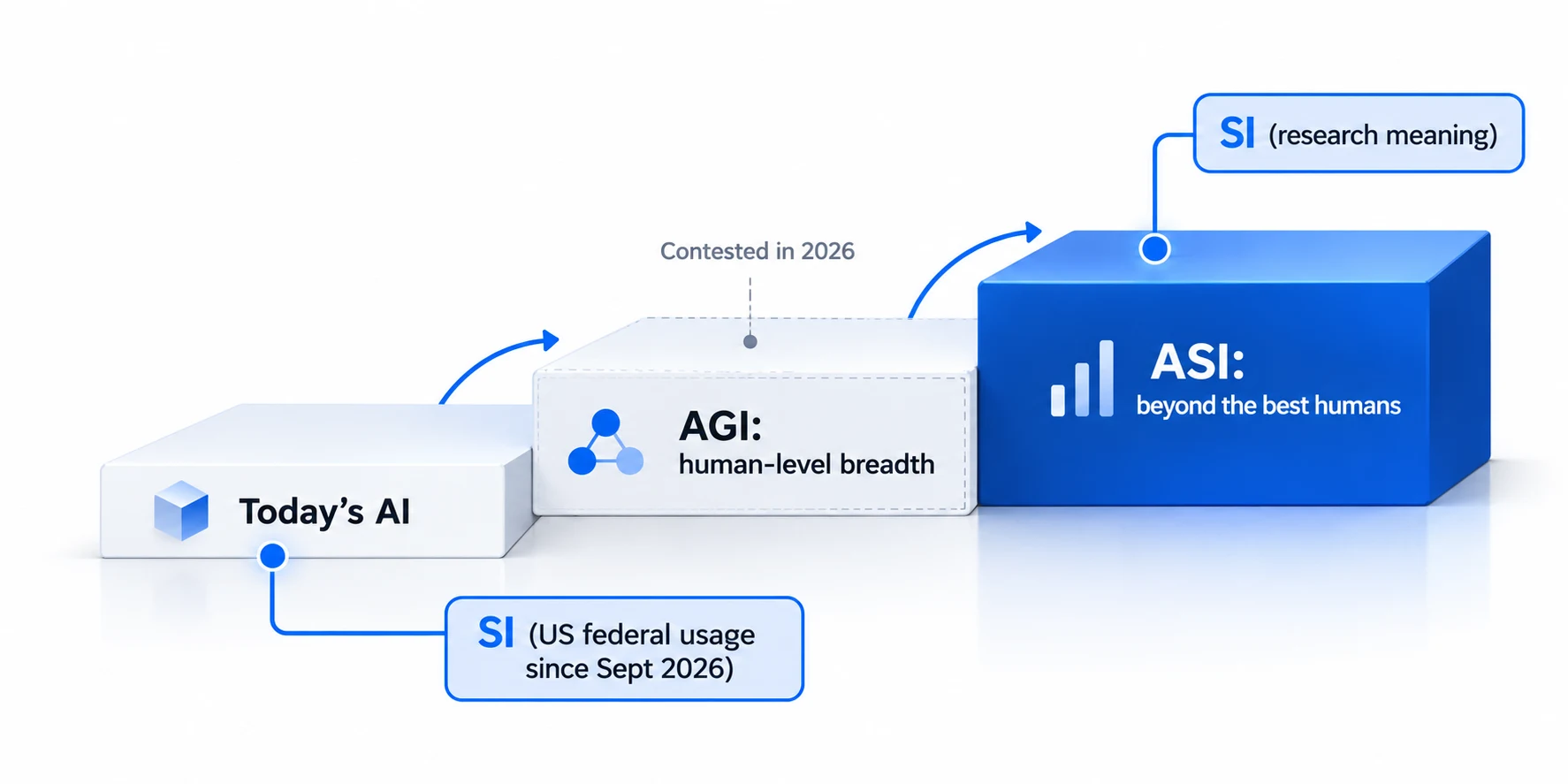
AGI (artificial general intelligence) is AI that matches skilled or well-educated humans across most cognitive tasks. ASI (artificial superintelligence) is AI that greatly exceeds the best humans in practically every domain. In research usage, "super intelligence" (SI) is simply another name for ASI. Since September 2026, though, the US federal government also uses "Super Intelligence" as its official word for ordinary AI, so the meaning of SI now depends on who is speaking.
Super Intelligence vs AGI vs ASI at a Glance
Today's AI (narrow and general-purpose) | AGI | ASI (research "super intelligence") | "SI" in US federal usage | |
|---|---|---|---|---|
Core idea | Systems that perform specific tasks, some very broadly | Human-level breadth and competence across most cognitive work | Far beyond the best humans in almost every field | A renamed label for AI |
Benchmark human | Varies by task | A skilled or well-educated adult | The best experts in each field | Not applicable |
Exists today? | Yes | Disputed; claimed by some executives in 2026, not supported by independent evaluators so far | No | Yes, it covers today's AI |
Who uses the term | Everyone | AI labs, investors, researchers, contracts | Philosophers, safety researchers, lab mission statements | Federal executive agencies |
Typical risk focus | Errors, bias, misuse, security | Labor disruption, autonomy, misuse at scale | Loss of human control, concentration of power | Same as today's AI |
The key relationship is a ladder of capability, not three separate technologies: today's AI, then AGI, then ASI. "SI" sits on two rungs at once, depending on context.
What Is AGI? Four Definitions That Do Not Agree
AGI has no single agreed definition. The four most influential versions measure different things: economic output, cognitive breadth against human percentiles, psychometric abilities of a well-educated adult, and contractual verification. A system can satisfy one and fail another, which is why credible people can look at the same model and reach opposite conclusions.
1. The economic definition (OpenAI)
The OpenAI Charter defines AGI as highly autonomous systems that outperform humans at most economically valuable work. This is a test of real-world substitution, not test scores. It is demanding: a model can ace benchmarks and still fail it if it cannot reliably do whole jobs end to end.
2. The performance-and-generality definition (Google DeepMind)
Google DeepMind researchers proposed Levels of AGI for Operationalizing Progress on the Path to AGI, published at ICML 2024. It rates performance and generality separately, with levels from "Emerging" up to "Superhuman," which means outperforming all humans. The value of this approach is that it treats AGI as a set of levels rather than a single finish line, and it makes room for systems that are superhuman in a narrow area but weak in general.
3. The cognitive-abilities definition (Hendrycks, Bengio and colleagues)
In A Definition of AGI, a group of researchers led by Dan Hendrycks and including Yoshua Bengio defined AGI as AI that can match or exceed the cognitive versatility and proficiency of a well-educated adult. They grounded the test in the Cattell-Horn-Carroll theory of human cognition, split it into ten domains, and produced an "AGI Score." On that scale, GPT-4 scored 27% and GPT-5 scored 57%. The paper's most useful finding is the shape of the gap: the models were strong in knowledge-heavy areas but scored 0% on long-term memory storage. Progress was real, but uneven.
4. The contractual definition (Microsoft and OpenAI)
AGI also became a legal term. In their October 2025 agreement, Microsoft and OpenAI specified that any AGI declaration by OpenAI would be verified by an independent expert panel. Then, in an April 2026 amendment, the companies made OpenAI's revenue share payments to Microsoft continue through 2030 "independent of OpenAI's technology progress," with Microsoft keeping a non-exclusive license to OpenAI's models and products through 2032.
Our interpretation: the April change reduced how much money rides on the word "AGI" in the industry's best-known contract. That matters because a label with less financial weight is less likely to be stretched or resisted for commercial reasons.
How the four AGI definitions compare
Definition family | What it measures | Strength | Weakness |
|---|---|---|---|
Economic (OpenAI Charter) | Whether AI outperforms people at most valuable work | Tied to real-world impact | Hard to measure; depends on deployment, not just capability |
Performance × generality (DeepMind) | Skill level relative to human percentiles, across breadth | Separates narrow genius from general ability | Needs agreed task sets; placement can be argued |
Cognitive abilities (Hendrycks et al.) | Ten human cognitive domains via psychometric-style tests | Produces a number and shows gaps | Assumes human cognition is the right yardstick |
Contractual (Microsoft-OpenAI) | Whatever an expert panel verifies | Adds outside scrutiny | Panel criteria are not public |
What Is ASI? The Ceiling Above AGI
ASI, or artificial superintelligence, is a hypothetical intelligence that greatly exceeds the best human minds across practically every field, including scientific creativity, strategic judgment and social skills. It is defined against the best humans, not average ones, and it requires breadth: being superhuman at one task does not count.
The most cited definition comes from Oxford philosopher Nick Bostrom's 1997 paper How Long Before Superintelligence?, which describes an intellect much smarter than the best human brains in practically every field. The idea is older. In 1965, I.J. Good argued in Speculations Concerning the First Ultraintelligent Machine that a machine able to out-think humans could design better machines, triggering an "intelligence explosion."
In DeepMind's framework, ASI is the top level in the general column: superhuman and general at the same time. The paper places some narrow systems, such as AlphaFold and the chess engine Stockfish, at the superhuman level in their own domains. No general system sits there.
AGI vs ASI: the difference in one sentence
AGI is about matching human breadth; ASI is about exceeding the best humans across that breadth. The difference is not a small step. Matching a well-educated adult across domains is one bar. Beating the world's best mathematician, diplomat, scientist and strategist simultaneously is a much higher one.
Is "Super Intelligence" the Same as ASI?
In research and industry usage, yes: "super intelligence," "superintelligence" and ASI describe the same hypothetical capability. In US federal usage since September 29, 2026, no: "Super Intelligence" and "SI" are the government's official names for ordinary AI, and they carry the existing legal definition of AI until a new one is written.
The executive order, Inaugurating the Era of Super Intelligence, directs executive departments and agencies to use "Super Intelligence" and "SI" in place of "Artificial Intelligence" and "AI" in official communications, to the maximum extent permitted by law. For now, SI means the technologies covered by the statutory definition of AI in 15 U.S.C. 9401(3). The Assistant to the President for Science and Technology has 60 days, which runs to roughly the end of November 2026, to propose legislative language for a new federal definition.
The White House fact sheet argues that the new name better reflects what current systems can do. Critics disagree. According to The San Francisco Standard, California Governor Gavin Newsom ordered state agencies to keep using "artificial intelligence," and AI researcher David Krueger argued the rename adds confusion because superintelligence already means AI that is vastly superhuman and hard to control. The same report describes Elon Musk correcting himself from "AI" to "SI" at the White House event, then returning to "AI" in a post on X later that day.
The same day, leaders of six companies signed the White House Accord on Super Intelligence, subtitled "Joint Commitment on Frontier Responsibilities." It is a voluntary pledge for companies training frontier models to adopt layered controls, including internal monitoring of model capabilities and alignment in areas such as cybersecurity, biosecurity and chemical threats, plus an internal team to make sure those controls work. As CNBC noted, the accord's only reference to the new terminology is in its title.
Practical rule: if "SI" appears in a US federal document dated after September 29, 2026, read it as "AI." If "superintelligence" or "ASI" appears in a research paper or a lab's safety framework, read it as far-beyond-human intelligence.
Has AGI Already Arrived? The September 2026 Debate
As of October 2026, AGI is claimed by some industry leaders but not established by independent evidence. GPT-6 Astra posted very strong results on several hard benchmarks, which led Nvidia's Jensen Huang to declare that AGI had arrived. An independent review by the AGI Society concluded that published evidence does not yet support that conclusion, partly because no accepted empirical test for AGI exists.
Here is what is documented.
OpenAI's GPT-6 Astra announcement reports state-of-the-art results across computer use, software engineering, science and professional work, including 97.6% on FrontierMath Tier 4 and 72.6% on OSWorld 2.0. OpenAI also says Astra helped establish new results on gaps between prime numbers, and that it meets the Critical threshold for cybersecurity under the company's Preparedness Framework.
On ARC-AGI-3, a benchmark designed to test skill acquisition in unfamiliar interactive environments, the ARC Prize results page records 62.7% using ARC Prize's standard harness and 99.9% using an adapter that preserves OpenAI's reasoning state. The harness choice changed the score substantially, which is a useful reminder that benchmark numbers depend on test setup.
The AGI Society's evaluation of the claims notes that Huang said AGI had arrived and that OpenAI president Greg Brockman said that, for him personally, "we're there." It points out that neither statement specified a definition or test. After comparing Astra's published results with more than a dozen proposed tests of general intelligence, it found direct evidence for some dimensions, such as computer use and expert-level reasoning, and no comparable published evidence for others, such as sustained physical tasks or performing a complete human occupation. It also reports that ARC Prize itself cautions that saturating ARC-AGI-3 should not be read as proof of AGI.
Why both sides can claim they are right
By the DeepMind or Hendrycks style of definition, Astra shows expert or near-expert performance on many cognitive tests. A reasonable person could argue it is close to, or at, human-level breadth in text and computer-based work.
By the OpenAI Charter definition, the question is whether systems outperform humans at most economically valuable work. That is a claim about real-world substitution across occupations, and published evidence for it is thin.
By physical and embodied definitions, current models are far from general. Many proposed tests involve navigating real homes, handling objects or driving, which text-and-screen models do not do.
The honest summary is that capability rose sharply in 2026, and the AGI label is now being used faster than the evidence needed to settle it.
How Does AGI Become ASI, If It Ever Does?
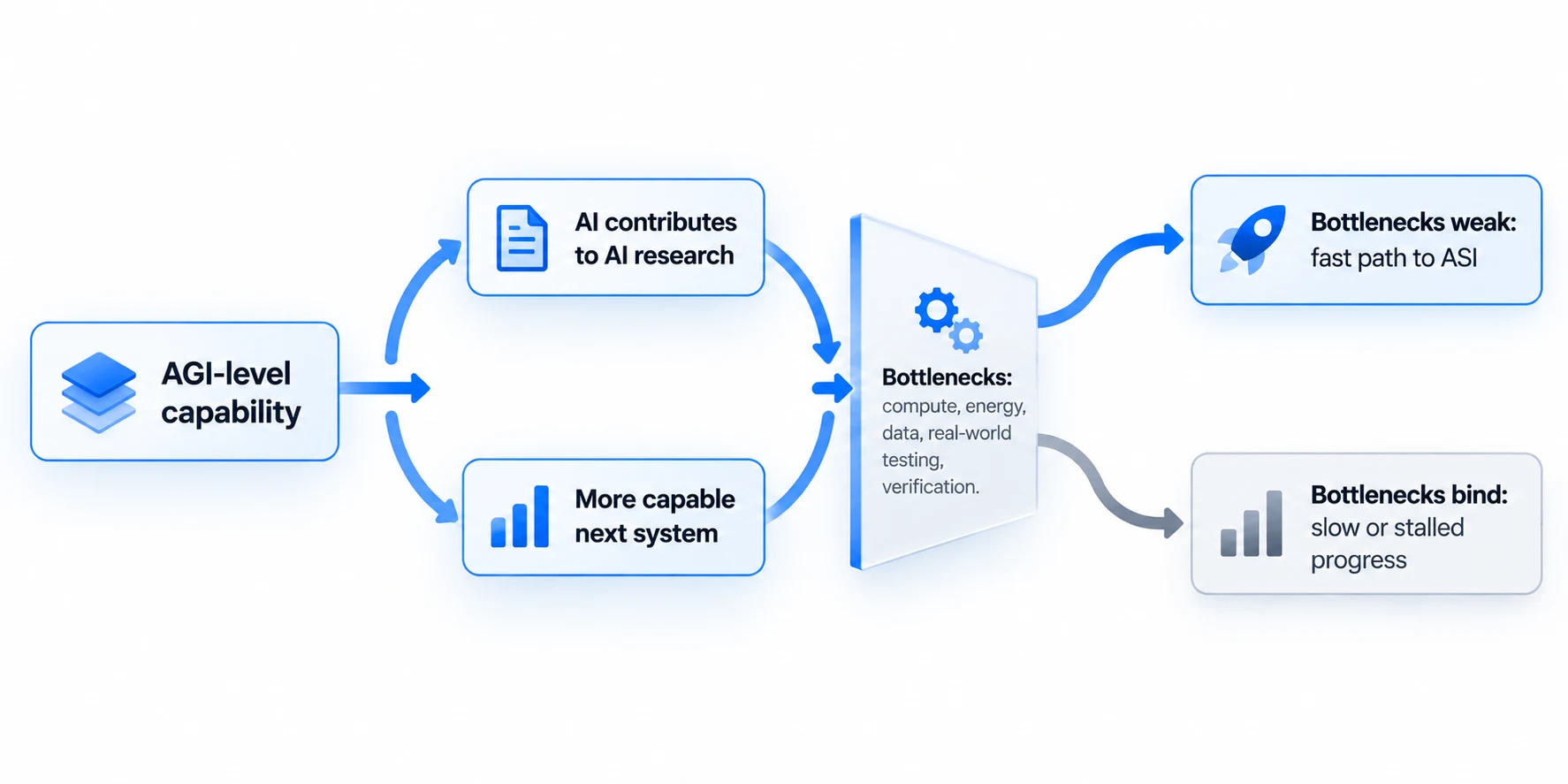
The main argument is recursion: once AI can do meaningful AI research, each generation could help build a more capable next one. Whether that produces ASI quickly, slowly or not at all depends on bottlenecks such as compute, energy, data, real-world testing and human oversight.
The modern version of I.J. Good's argument is that AI systems are starting to contribute to science and engineering. OpenAI's Astra announcement describes help with mathematical proofs and research workflows. If systems become reliable enough to design experiments, write training code and evaluate results for AI itself, progress could compound.
Two factors argue for caution about speed:
Physical bottlenecks. Training frontier models depends on chips, data centers and power that take years to build.
Verification bottlenecks. The harder a system's work is to check, the harder it is to trust and deploy. OpenAI's own Astra post notes that the model's written reasoning was harder to monitor than its predecessor's in tests that asked it to evade monitoring, and calls monitorability a research priority.
Expert forecasts reflect this uncertainty. In the survey Thousands of AI Authors on the Future of AI, 2,778 researchers surveyed in October 2023 gave a 50% chance that unaided machines could outperform humans at every possible task by 2047, but a 50% chance of all occupations being fully automatable only by 2116. That gap between capability and real-world substitution is exactly the gap between some AGI definitions and others.
How to Decode Any "AGI," "ASI" or "SI" Claim: The LABEL Check
Before acting on a claim that a system is AGI, ASI or SI, check five things: Lexicon, Anchor, Breadth, Evidence and Loyalties. Most confusion disappears once you know which definition is in use, who the system is compared against, how broad the claim is, who verified it, and who benefits from the label.
The LABEL Check is an original analytical model created for this article. It is a practical screening aid for decision-makers, not a scientifically validated methodology.
Step | Question to ask | Example of a weak answer | Example of a strong answer |
|---|---|---|---|
Lexicon | Which term, and which meaning, is being used? | "AGI" with no definition | "AGI as defined in the OpenAI Charter" or "SI as defined in 15 U.S.C. 9401(3)" |
Anchor | Compared against which humans? | Average users or unspecified "humans" | Skilled professionals or the best experts in each field |
Breadth | Across how many domains, including physical and long-horizon tasks? | One benchmark family | Many unrelated domains, including multi-week work |
Evidence | Who measured it, and under what setup? | Developer's own results with custom harnesses | Independent evaluators with standard, published setups |
Loyalties | Who gains from the label being accepted? | Seller, investor or political actor with no outside check | Claim made despite incentives against it, or verified by a neutral panel |
How to use it
Score each step 0 (missing), 1 (partial) or 2 (strong). A total of 0 to 4 means the label is mostly vocabulary. A total of 5 to 7 means a capable system is being described loosely, so evaluate the capability and ignore the label. A total of 8 to 10 means the claim deserves serious technical and governance attention.
Illustrative scenario: a vendor pitch
This is a hypothetical example, not a real vendor. An enterprise software company tells a CIO its new agent is "AGI-ready" and "built for the Super Intelligence era." Lexicon scores 0: neither term is defined, and "Super Intelligence" here is borrowed from federal branding. Anchor scores 1: it beats junior analysts in a demo. Breadth scores 0: it handles one workflow. Evidence scores 1: there is a third-party benchmark, but on the vendor's own harness. Loyalties scores 0: the label exists to sell. Total: 2. The CIO should evaluate the product as a workflow agent with clear accuracy, cost and oversight metrics.
Why the Difference Between AGI, ASI and SI Matters for Business
The labels now affect contracts, procurement, risk planning and regulation, so mixing them up has practical consequences. Four areas are most exposed.
Contracts and procurement. If you sell to US federal agencies, "SI" will appear in solicitations and statements of work. Until the new federal definition is published, it means ordinary AI. Ask your legal team to track the definition due around late November 2026 and check how it interacts with existing contract language.
Vendor evaluation. "AGI-powered" and "super intelligent" are now marketing phrases. Evaluate products on measured accuracy, cost, security and oversight for your own workloads.
Security planning. Capability gains are showing up first in areas such as cybersecurity. OpenAI's statement that Astra meets its Critical cyber threshold is a signal for defenders regardless of whether anyone calls the model AGI.
Governance and board communication. Boards will ask whether "AGI is here." A good answer names the definition, the evidence and the implications for the company, rather than yes or no.
Which term should you use?
Situation | Recommended term | Why |
|---|---|---|
Describing tools you deploy today | AI (or the specific system name) | Accurate and widely understood |
Discussing human-level general capability | AGI, with the definition named | The term is contested without a definition |
Discussing far-beyond-human risks or goals | ASI or superintelligence | Matches research and safety literature |
Writing to or for US federal agencies | SI, as required, with a note that it means AI | Complies with the order and avoids confusion |
Public content for a global audience | AI, AGI, ASI, explaining SI where relevant | Most readers outside US federal contexts still use these terms |
Common Misconceptions About AGI, ASI and Super Intelligence
"AGI and ASI are the same thing." They are different levels. AGI matches human breadth; ASI exceeds the best humans across it.
"If a CEO says AGI is here, it is here." There is no accepted test, and the most visible 2026 claims did not specify one. Independent evaluators have not confirmed them.
"The SI executive order means superintelligence exists." The order renames AI and applies the existing legal definition of AI. It makes no capability finding.
"Superhuman benchmark scores mean superintelligence." Narrow superhuman performance has existed for years, from chess engines to AlphaFold. ASI requires superhuman performance almost everywhere at once.
"AGI is a single moment." Most serious frameworks treat it as a range of levels. Capability can rise steadily without a clear line being crossed.
The skeptics' case
Not everyone accepts the ladder framing. Cognitive scientist Gary Marcus has argued, in Rumors of AGI's arrival have been greatly exaggerated, that recent claims of AGI confuse strong benchmark performance with general intelligence. Others argue intelligence is not one dial, so "smarter than humans at everything" may be less coherent than it sounds. These critiques are worth taking seriously because they explain why the same results can produce opposite headlines. The practical takeaway is the same either way: judge systems by verified capability on your tasks, not by the label attached to them.
Frequently Asked Questions
What is the difference between AGI and ASI?
AGI is AI that matches human-level breadth and competence across most cognitive tasks, typically measured against skilled or well-educated adults. ASI is AI that greatly exceeds the best humans in practically every domain. AGI is a human-level benchmark; ASI is a far-beyond-human one. Many researchers expect ASI, if it ever arrives, to come after AGI, possibly quickly if AI systems start accelerating AI research.
Is super intelligence the same as ASI?
In research and industry usage, yes. "Super intelligence," "superintelligence" and ASI all describe hypothetical intelligence far beyond the best humans. In US federal usage since September 29, 2026, "Super Intelligence" and "SI" are official replacement terms for "AI" and carry the existing legal definition of AI. Context tells you which meaning applies.
Has AGI been achieved in 2026?
Not by any widely accepted standard. After GPT-6 Astra's release in September 2026, Nvidia CEO Jensen Huang said AGI had arrived, and OpenAI's Greg Brockman said he personally thought "we're there." The AGI Society's independent review concluded the published evidence does not yet support that conclusion. The answer depends heavily on which definition you use, and there is no agreed empirical test.
Why did the US rename AI to Super Intelligence?
The White House says the new name better reflects the capabilities of current systems and the promise of the technology. The September 29, 2026 executive order applies to federal executive agencies, keeps the existing statutory definition of AI for now, and asks for a proposed new federal definition within 60 days. Critics, including California's governor, argue the rename confuses the public because "superintelligence" already has a different meaning.
What comes after AGI?
ASI, or artificial superintelligence, is the commonly described next stage: intelligence that exceeds the best humans across nearly every field. Whether AGI leads to ASI, and how fast, depends on whether AI can meaningfully accelerate its own development and on bottlenecks such as compute, energy, data and the ability to verify and trust increasingly capable systems.
How is AGI measured?
There is no single accepted measure. Common approaches include economic definitions, such as outperforming humans at most valuable work; performance-and-generality levels, such as Google DeepMind's Levels of AGI; psychometric frameworks, such as the Hendrycks-led "AGI Score" based on human cognitive theory; and benchmarks such as ARC-AGI-3. Each captures something different, which is why claims of AGI often conflict.
Should businesses plan for AGI or ASI?
Businesses should plan for steadily more capable AI rather than for a single AGI or ASI moment. That means evaluating systems on verified performance for their own tasks, strengthening security as AI cyber capabilities grow, tracking regulatory definitions such as the coming federal SI definition, and building oversight that scales as AI takes on longer and more autonomous work.
So, What Is the Difference Between Super Intelligence, AGI and ASI?
AGI means human-level general capability, though the exact bar depends on whose definition you use. ASI means intelligence far beyond the best humans in nearly every domain, and no system is close to that by independent assessment. Super intelligence is a synonym for ASI in research and industry, but in US federal documents since September 2026 it is simply the new official name for AI.
The past month showed why the distinctions matter. Capability is rising quickly, and the labels are moving even faster. The most reliable approach is to ask which definition is in use, look for independent evidence, and judge any system by what it can verifiably do for your organization.
Comments (0)
No comments yet. Be the first to share your thoughts!