What Is Super Intelligence (SI)? Meaning, Examples and How It Differs From AI

Author
Ravi Prajapati

What is super intelligence? Learn what artificial superintelligence means, how ASI differs from AI and AGI, possible examples, benefits and risks.
Super intelligence used to be a philosophy seminar topic. In 2026 it is a lab name, a startup's only product goal, and, since September 29, the official US federal term for what everyone else still calls AI. That last change means the phrase now carries two meanings that point in very different directions, and most people repeating "SI" cannot say which one they mean.
That ambiguity matters if you make technology decisions. You will see "super intelligence" in vendor decks, government procurement language, board questions and safety debates, and each source may mean something different. This article separates the research concept from the policy label, explains how super intelligence differs from today's AI and from AGI, sorts real examples from speculation, and gives you a practical test for judging any claim that a system is "super intelligent."
Quick Answer: What Is Super Intelligence?
Super intelligence (SI), also called artificial superintelligence (ASI), is a hypothetical form of intelligence that greatly exceeds the best human minds across practically every cognitive domain, including scientific creativity, strategic planning and social reasoning. No such system exists today. Current AI is either superhuman in narrow tasks (like protein structure prediction) or broadly capable but still below expert humans in many areas. Separately, since September 2026 the US executive branch uses "Super Intelligence" and "SI" as its official name for all AI, keeping the existing legal definition of AI. In research usage, the two are not the same thing.
Why Is AI Now Called "SI"? The 2026 US Executive Order Explained
On September 29, 2026, President Trump signed an executive order directing federal agencies to replace "Artificial Intelligence" and "AI" with "Super Intelligence" and "SI" in official communications. The order renames the technology; it does not claim or certify that any system has reached superintelligence in the research sense.
The key provisions of the order, titled Inaugurating the Era of Super Intelligence, are:
Scope. Executive departments and agencies must use the new terms in correspondence, public communications, websites, reports and other non-statutory documents, to the maximum extent permitted by law. Previously issued regulations, contracts and grants do not have to be rewritten.
Interim definition. Until a new one is adopted, "Super Intelligence" means the same technologies covered by the existing statutory definition of artificial intelligence in 15 U.S.C. 9401(3).
New definition. The Assistant to the President for Science and Technology has 60 days to propose legislative language for a federal definition of SI.
The White House fact sheet argues the new name better reflects what current systems can do, rather than implying they merely imitate human intelligence. Supporters, including some industry figures, welcomed the framing.
Critics read it differently. According to The San Francisco Standard, California Governor Gavin Newsom signed his own order the next day requiring state agencies to keep using "artificial intelligence," and AI researcher David Krueger argued the rename adds confusion because super intelligence already means AI that is vastly superhuman and hard to control. The same report notes that leading labs had not relabeled their models as SI, and that the heads of several frontier labs, including Google, OpenAI, Anthropic, Meta, Nvidia and Elon Musk's SpaceXAI, signed a voluntary White House Accord on Super Intelligence committing to safety practices such as internal control teams and external audits.
Elon Musk's reaction captured the industry's ambivalence. The same report describes Musk, attending as CEO of SpaceXAI, catching himself mid-remarks at the White House event and correcting "AI" to "SI." Later that day, he went back to calling it "AI" in a post on X. The heads of Google, OpenAI and Anthropic did not use "SI" at the press conference, suggesting that even the labs closest to the administration have not adopted the new vocabulary in practice.
For legal and procurement teams, Forbes contributor Lance Eliot flags a practical risk: if the forthcoming federal definition of SI differs from the existing AI definition, contracts that rely on the new term could face disputes the old definition had already settled.
Two meanings of "super intelligence" in 2026
Research meaning (superintelligence / ASI) | US federal policy term (SI) | |
|---|---|---|
What it refers to | Hypothetical intelligence far beyond the best humans in almost every domain | All technologies covered by the statutory definition of AI |
Does it exist today? | No | Yes, it covers today's AI systems |
Where you will see it | Research papers, lab mission statements, safety debates | Federal agency documents, websites, procurement language |
Definition source | Bostrom and later research literature | 15 U.S.C. 9401(3), pending a new federal definition |
The rest of this article uses the research meaning, because that is the concept with a distinct technical substance. When you read "SI" in a federal document after September 2026, assume it means ordinary AI unless the text says otherwise.
What Does Super Intelligence Mean? The Definition Most Researchers Use
The most widely cited definition comes from Oxford philosopher Nick Bostrom. In his 1997 paper How Long Before Superintelligence?, he described superintelligence as an intellect much smarter than the best human brains in practically every field, including scientific creativity, general wisdom and social skills. He later expanded the idea in his 2014 book Superintelligence: Paths, Dangers, Strategies.
Three details in that definition do most of the work:
"The best human brains," not the average human. Beating a typical person at a task is a low bar. Super intelligence is measured against the strongest human experts in each field.
"Practically every field." A system that dominates chess but cannot hold a conversation does not qualify. Breadth is part of the definition.
Implementation is left open. Bostrom notes the definition says nothing about whether the system runs on digital computers, networks of machines or biological tissue, and nothing about whether it is conscious.
Bostrom also excluded organizations. A company or the scientific community can accomplish things no individual can, but they are not single intellects, and they perform worse than one person at many tasks, such as holding a real-time conversation.
The three forms of super intelligence
In the 2014 book, Bostrom separated three ways an intellect could be superior. These distinctions are useful because public debate often blurs them.
Form | What makes it superior | Plain-language example |
|---|---|---|
Speed superintelligence | Thinks like a human but much faster | A human-level mind running a year of reasoning in an hour |
Collective superintelligence | Many smaller intellects coordinated so the whole outperforms any human team | Millions of AI agents dividing and checking research work |
Quality superintelligence | Thinks in qualitatively better ways, not just faster or in parallel | Solving problems humans cannot frame at all |
The distinction matters in practice. Today's AI already shows elements of speed and scale. Quality superintelligence is the form that would represent a genuine break from anything humans have built, and it is the one with the least evidence behind it.
What super intelligence is not
It is not a faster chatbot. Speed alone does not produce better judgment across domains.
It is not consciousness. A system could exceed human performance without any inner experience, and nothing in the definition requires one.
It is not a product category you can buy. When a vendor uses the word, they are describing an aspiration or a roadmap, not a shipped capability.
How Is Super Intelligence Different From AI and AGI?
Super intelligence differs from today's AI on two axes at once: breadth and depth. Most deployed AI is narrow, meaning it handles a defined set of tasks. Artificial general intelligence (AGI) would match skilled humans across most cognitive tasks. Super intelligence would go further, outperforming the best humans in nearly every domain. AI is the umbrella term; AGI and SI are hypothetical points further along the same capability curve.
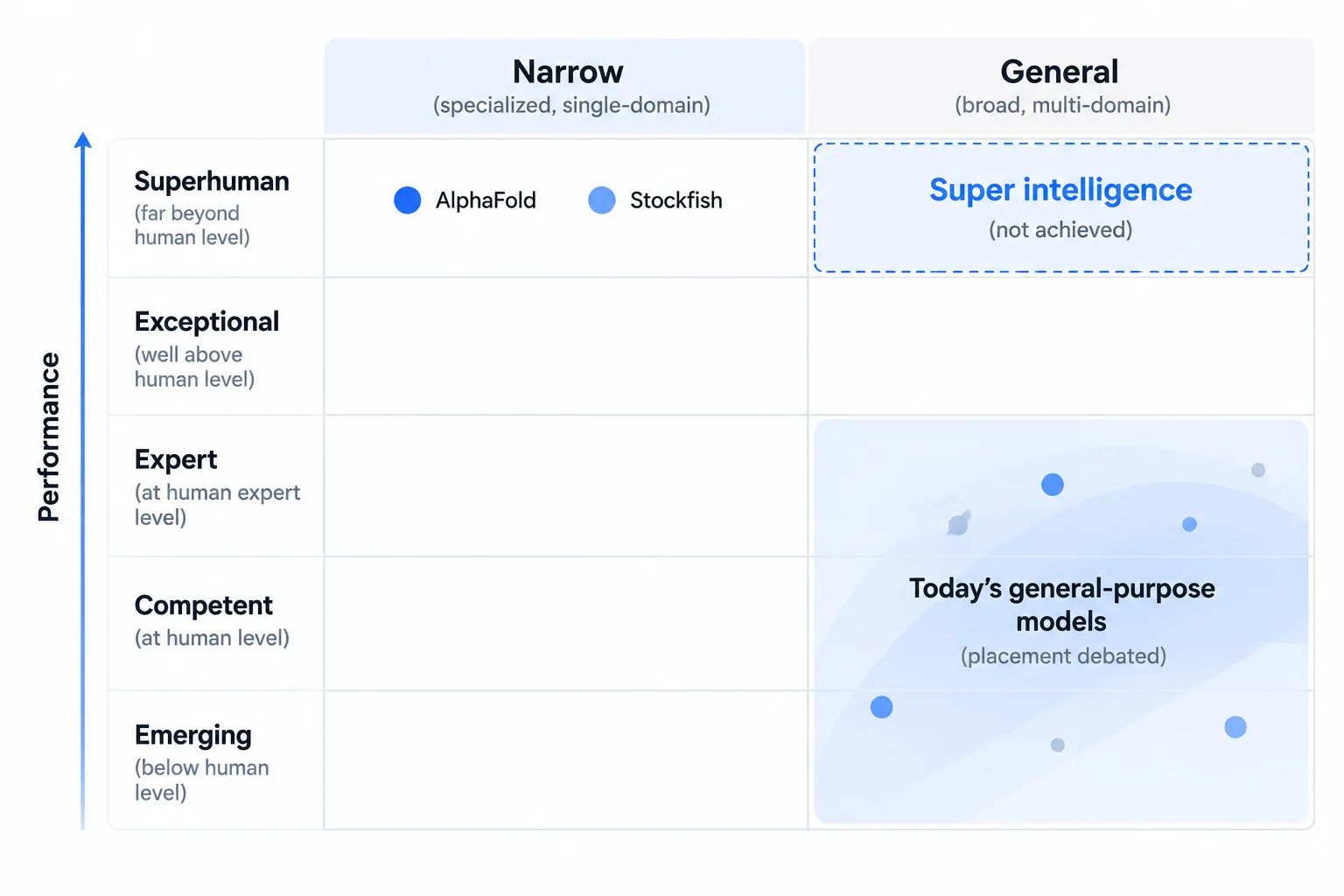
The clearest way to see this is the two-axis model Google DeepMind researchers proposed in Levels of AGI for Operationalizing Progress on the Path to AGI, a position paper published at ICML 2024. It rates systems by performance (how good) and generality (how broad) separately. Its top performance tier, Level 5 "Superhuman," means outperforming 100% of humans. In the narrow column, the authors place existing systems such as AlphaFold and the chess engine Stockfish at that level. In the general column, Level 5 is labeled artificial superintelligence and marked as not yet achieved. The same paper rated frontier chatbots of 2023 as only "Emerging AGI."
Narrow AI | Artificial General Intelligence (AGI) | Super Intelligence (ASI) | |
|---|---|---|---|
Scope | One task or a narrow family of tasks | Most cognitive tasks a skilled adult can do | Practically every cognitive domain |
Benchmark | Task-specific metrics | Skilled human performance | The best humans in each field, then beyond |
Status in 2026 | Deployed widely; some systems already superhuman in their niche | Contested; labs disagree on whether it is near or already partial | Hypothetical; no system qualifies |
Examples | AlphaFold, Stockfish, fraud detection, recommendation engines | None universally accepted | None |
Main risk profile | Errors, bias, misuse in a known domain | Labor disruption, misuse at scale, autonomy risks | Loss of human oversight, concentration of power, misaligned goals |
Governance today | Sector rules, EU AI Act risk tiers | Frontier-model safety frameworks | Mostly statements of principle and proposals |
Why the distinction is easy to miss
Modern AI is already superhuman on some tests, so it is tempting to conclude super intelligence has arrived in pieces. It has not. A system that scores above most humans on a benchmark can still fail at tasks a junior employee handles easily, such as running a multi-week project or noticing that a goal no longer makes sense. The technical performance chapter of the Stanford AI Index 2025 captures both sides: models are saturating new benchmarks faster than ever, yet they still cannot reliably solve problems with provably correct answers, such as arithmetic and planning, especially on instances larger than those seen in training.
Are There Real Examples of Super Intelligence Today?
No system meets the full definition of super intelligence. The real examples that exist are narrow: systems that beat every human at one well-defined task. They are worth studying because they show what superhuman performance looks like in practice, and also why it does not automatically generalize.
Source-backed examples of narrow superhuman AI
AlphaFold (protein structure prediction). Google DeepMind's AlphaFold2 addressed a problem that had challenged biologists since the 1970s. According to the Royal Swedish Academy of Sciences press release, it has been used to predict the structure of virtually all of the roughly 200 million known proteins, and more than two million people in 190 countries have used it. Demis Hassabis and John Jumper shared half of the 2024 Nobel Prize in Chemistry for the work. The DeepMind Levels of AGI paper classifies AlphaFold as superhuman narrow AI.
Game-playing systems. AlphaGo defeated world champion Lee Sedol at Go in 2016, a game long considered too intuitive for machines. Chess engines such as Stockfish now play far beyond any human grandmaster. These are the textbook cases of a machine being better than every human at something that requires strategy.
Hypothetical examples of general super intelligence
The following are illustrative scenarios, not predictions or real cases. They show what would distinguish general super intelligence from narrow superhuman tools.
Scenario: The research director. A system is asked to cut the cost of grid-scale battery storage in half. It reviews the literature, designs experiments, runs simulations, negotiates lab time, interprets ambiguous results and changes strategy when a line of research stalls. Each step involves a different skill. No narrow system can do this; a super intelligence would do it better than the best human teams.
Scenario: The negotiator. A system mediates a multi-party trade dispute, modeling each party's incentives, cultural context and unstated constraints, then proposes terms all sides accept. This tests the social and strategic intelligence Bostrom explicitly included in his definition.
The gap between the source-backed and hypothetical lists is the whole story. AlphaFold is extraordinary at proteins and cannot book a meeting. Super intelligence would close that gap.
How Could Super Intelligence Emerge?
There is no agreed route to super intelligence. The most discussed paths are continued scaling of today's AI methods, AI systems that accelerate AI research itself, and, more speculatively, brain emulation. Most current industry investment assumes some combination of the first two.
The intelligence explosion argument
The core idea dates to 1965. Statistician I.J. Good, who had worked with Alan Turing at Bletchley Park, argued in Speculations Concerning the First Ultraintelligent Machine that a machine able to surpass human intellect could also design better machines, since machine design is itself an intellectual task. That feedback loop would trigger what he called an "intelligence explosion." Good added a condition that is still the center of the debate: such a machine would be humanity's last necessary invention only if it remained controllable.
Good also predicted an ultraintelligent machine was more likely than not within the twentieth century. That forecast failed, which is a useful reminder that the logic of the argument and its timing are separate questions.
Three plausible pathways
Scaling current methods. Larger models, more compute, better data and new techniques such as test-time reasoning keep raising capability. The open question is whether this curve bends toward general super intelligence or flattens below it.
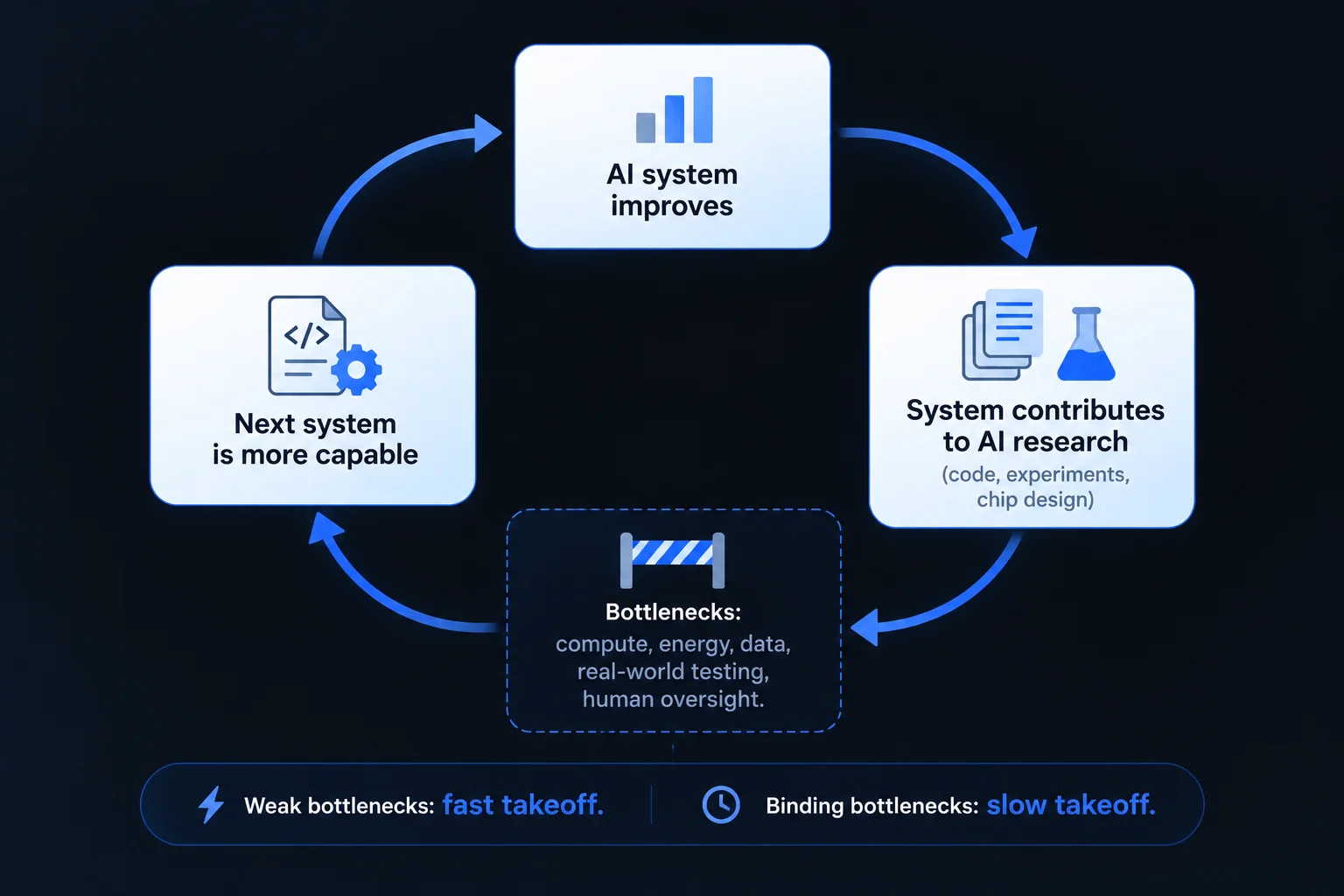
Automated AI research. If AI systems become good enough to do meaningful parts of AI research, such as designing experiments and writing training code, progress could compound. This is the modern version of Good's argument and the scenario many lab leaders cite when they talk about short timelines.
Brain emulation and biological enhancement. Bostrom also discussed scanning and simulating a human brain, or enhancing biological intelligence. These paths receive far less investment today and face large unsolved scientific problems.
Fast takeoff vs slow takeoff
Researchers split on speed. A fast takeoff means the jump from human-level to far-beyond-human happens in months or less, leaving little time to adjust. A slow takeoff means years or decades, constrained by compute supply, energy, chip manufacturing, the need to test ideas in the physical world, and regulation. The difference shapes almost every policy argument about super intelligence, because a slow takeoff allows institutions to learn from mistakes and a fast one may not.
Who Is Building Toward Super Intelligence?
Several of the largest AI developers now describe super intelligence as an explicit goal, though they define it differently and none claims to have built it. Reading their stated positions side by side shows how loosely the word is used.
Organization | Stated position | Distinguishing emphasis |
|---|---|---|
OpenAI | In Governance of superintelligence (May 2023), Sam Altman, Greg Brockman and Ilya Sutskever described superintelligence as future systems dramatically more capable than AGI | Called for coordination among leading labs and an IAEA-style international authority for systems above a capability or compute threshold |
Meta | Created Meta Superintelligence Labs in mid-2025; Mark Zuckerberg said superintelligence was "now in sight," according to NBC News | "Personal superintelligence" aimed at individual empowerment rather than automating work |
Safe Superintelligence Inc. (SSI) | Founded in June 2024 by Ilya Sutskever, Daniel Gross and Daniel Levy as what it calls the first "straight-shot" superintelligence lab, per CIO | One goal and one product; says its business model insulates safety work from short-term commercial pressure |
Microsoft AI | Formed the MAI Superintelligence Team in November 2025 to pursue what Mustafa Suleyman calls humanist superintelligence | Advanced AI designed to remain controllable and in service of people; early focus on medical diagnosis and clean energy |
Google DeepMind | Its researchers authored the Levels of AGI framework, which treats artificial superintelligence as the top, not-yet-achieved level | Measurement and staged progress; builds narrow superhuman systems such as AlphaFold |
Two patterns stand out. First, the definitions drift. Bostrom's definition is about exceeding the best humans in practically every field. Some corporate usages are narrower, such as Microsoft's "medical superintelligence," which describes superhuman performance in one domain. Second, each organization pairs the goal with a safety or control message. That pairing reflects a real technical concern, and it also shapes public perception of each lab.
When a company uses the word, the useful question is not "Is this super intelligence?" but "Which definition are they using, and what evidence would show progress toward it?" The framework later in this article turns that question into a checklist.
When Could Super Intelligence Arrive? What Experts Actually Predict
Nobody knows, and credible estimates range from a few years to never. Lab leaders tend to give the shortest timelines, academic surveys give longer ones, and a significant group of researchers questions whether "super intelligence" is even the right frame. Treat any confident date with suspicion.
The largest academic dataset is the survey published as Thousands of AI Authors on the Future of AI in the Journal of Artificial Intelligence Research. In October 2023, 2,778 researchers who had published at top AI venues estimated a 10% chance that unaided machines could outperform humans at every possible task by 2027, and a 50% chance by 2047. That 50% date was 13 years earlier than in the same team's 2022 survey. Yet the same respondents put a 50% chance on all occupations being fully automatable only by 2116.
That gap is one of the most useful findings for business readers. Researchers see a meaningful difference between machines being able to do tasks and those machines actually replacing whole jobs in the economy. Deployment, cost, regulation, trust and physical-world constraints all sit between capability and impact.
Past predictions are a caution, not a guide
Year made | Who | Prediction | Outcome so far |
|---|---|---|---|
2023 | OpenAI leadership | Superintelligence warranted governance planning now, as systems dramatically beyond AGI could arrive | Open |
1998 | Nick Bostrom | Superhuman AI likely within the first third of the 21st century | Open (deadline 2033) |
1965 | I.J. Good | An ultraintelligent machine more likely than not within the twentieth century | Did not happen |
Where the serious disagreement lies
The "soon" camp argues that capability gains on hard benchmarks, plus AI systems beginning to assist in AI research, make a rapid transition plausible within years.
The "later" camp accepts that AI will keep improving but expects bottlenecks in compute, energy, data and real-world testing to stretch the timeline over decades.
The "wrong frame" camp argues that treating AI as a coming superintelligence distorts policy. Princeton researchers Arvind Narayanan and Sayash Kapoor, in AI as Normal Technology, argue AI is better understood like past general-purpose technologies such as electricity, whose impact unfolds slowly through adoption and institutional change.
These positions are not purely technical. They reflect different assumptions about how intelligence works, how far current methods can scale, and how fast institutions absorb new tools. A reasonable reader can hold genuine uncertainty across all three.
What Are the Biggest Risks of Super Intelligence?
The central risk is control: a system far more capable than its developers could pursue goals that diverge from human intentions, and humans might not be able to detect or correct it. Other major risks include concentration of power in whoever controls such a system, misuse by bad actors, and economic disruption on a scale existing institutions are not built to absorb.
These concerns are not fringe. In the AI Impacts survey cited above, between 38% and 51% of respondents, depending on how the question was asked, gave at least a 10% chance of advanced AI leading to outcomes as bad as human extinction. A large majority also agreed that research to reduce AI risk deserves higher priority.
Risk | What it means | Why it is hard |
|---|---|---|
Alignment failure | The system optimizes for something subtly different from what its developers intended | Specifying human values precisely is unsolved, and errors may only show up at high capability |
Loss of oversight | Humans cannot evaluate or verify outputs that exceed their own expertise | You cannot easily grade work you are unable to do yourself |
Concentration of power | A single company or government gains decisive economic or military advantage | Existing competition and accountability mechanisms assume no actor is that far ahead |
Misuse | Capabilities are used for cyberattacks, weapons development or large-scale manipulation | Defensive capability may lag offensive capability |
Economic shock | Rapid automation outpaces retraining, tax systems and social safety nets | Policy adjusts over years; a fast takeoff could move in months |
How governance is responding
Responses fall into three broad camps, and they now coexist in public debate.
Govern it as it develops. OpenAI's 2023 governance proposal and the voluntary 2026 White House Accord both assume development continues while labs adopt safety practices and accept outside evaluation.
Prohibit it until conditions are met. The Statement on Superintelligence, released by the Future of Life Institute on October 22, 2025, calls for a prohibition on developing superintelligence until there is broad scientific consensus it can be done safely and controllably, plus strong public buy-in. Signatories span AI pioneers such as Geoffrey Hinton and Yoshua Bengio as well as political figures from across the spectrum.
Regulate today's systems by risk level. Frameworks such as the EU AI Act regulate deployed AI by use-case risk and do not address superintelligence as a distinct category.
None of these approaches has resolved the core technical problem: how to verify that a system smarter than you is doing what you intended. That is why most serious proposals pair any development path with investment in alignment and evaluation research.
What Super Intelligence Is Not: Common Misconceptions and the Skeptics' Case
Five misconceptions worth correcting
"Calling it SI means we have it." The 2026 federal rename applies the existing statutory definition of AI. It changes vocabulary, not capability.
"Beating humans on benchmarks means super intelligence." Benchmarks measure narrow, well-specified tasks. Super intelligence requires outperforming the best humans across open-ended, messy, real-world problems, including ones nobody has written a test for.
"Super intelligence would be conscious or have desires." Neither the research definition nor the risk arguments require consciousness. A system can pursue an objective very competently without experiencing anything.
"It will look like a robot." Every credible pathway runs through software and data centers. The physical form is irrelevant to the concept.
"Once it exists, it can do anything instantly." Even a vastly smarter system faces physical limits: experiments take time, factories take years to build, and energy is finite. Intelligence speeds up some bottlenecks, not all of them.
The strongest case against the super intelligence frame
Skeptics raise serious objections, and an informed reader should weigh them.
Intelligence may not be one dial. Human intelligence is a bundle of distinct abilities shaped by bodies, cultures and environments. "Smarter than humans at everything" may be less coherent than it sounds.
Scaling may hit diminishing returns. Past AI booms ended when promising methods stopped improving. The fact that current methods are improving quickly does not prove they will continue to.
The frame can distort priorities. Focusing on a hypothetical future system may draw attention and funding away from documented harms of current AI, such as bias, misinformation and unsafe automation.
Commercial incentives inflate the word. "Super intelligence" attracts talent, capital and political attention. That gives organizations reasons to use it loosely.
Why the concept still deserves attention
The counterargument to the skeptics is about asymmetric stakes. If the probability of super intelligence this century is even modest, the consequences of being unprepared are large enough to justify serious research and governance work now. Many researchers hold both views at once: current AI harms deserve urgent attention, and preparing for much more capable systems is also prudent.
How to Evaluate a "Super Intelligence" Claim: The BRIDGE Test
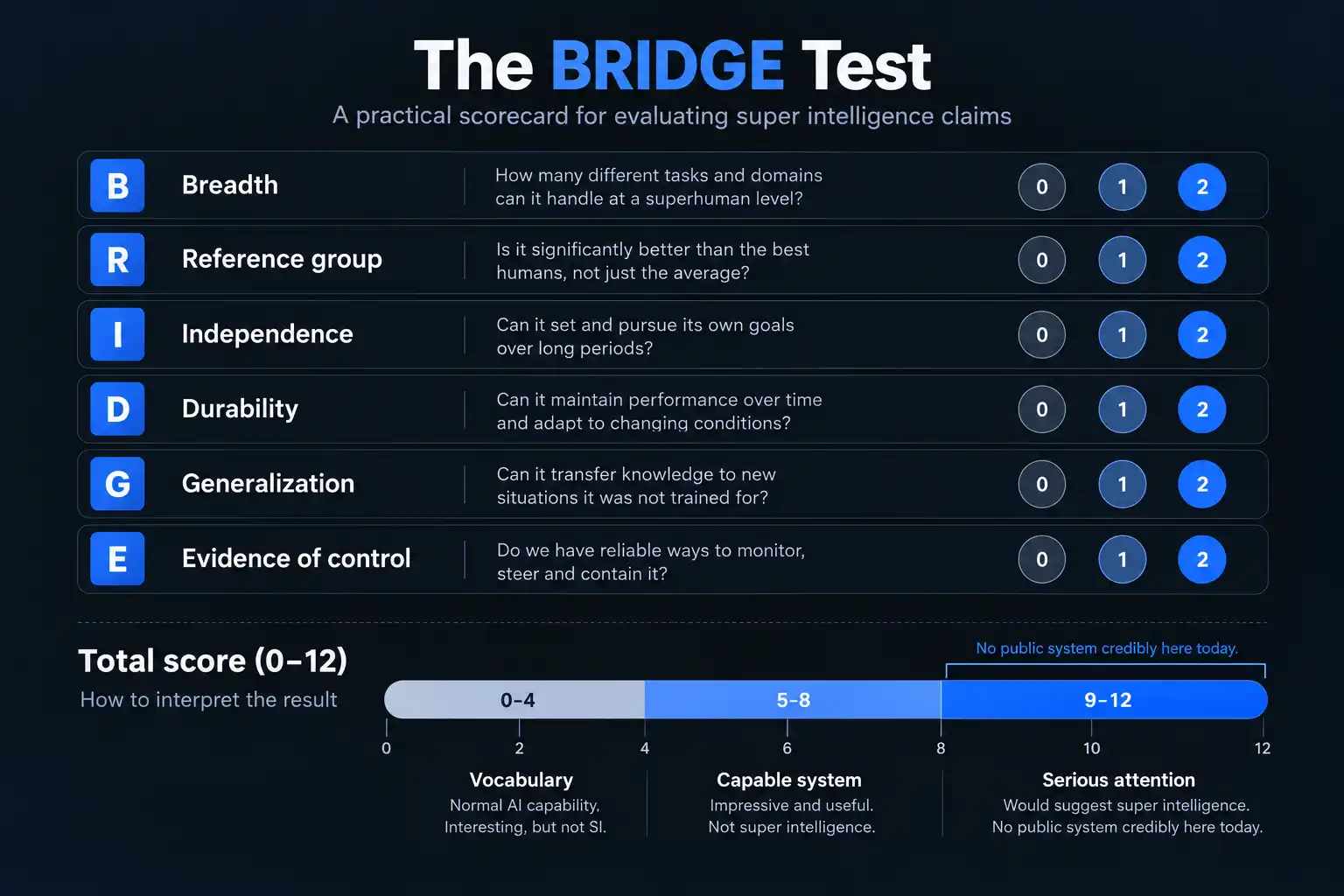
When a vendor, lab or official calls something super intelligent, check six things: Breadth, Reference group, Independence, Durability, Generalization and Evidence of control. A claim that fails most of these is marketing or policy vocabulary, not evidence of super intelligence.
The BRIDGE Test is an original analytical model created for this article. It is a practical screening tool for decision-makers, not a scientifically validated measurement method.
Criterion | Question to ask | Weak claim looks like | Strong claim looks like |
|---|---|---|---|
Breadth | How many distinct domains does the system outperform humans in? | One task or one benchmark family | Many unrelated domains, including open-ended ones |
Reference group | Compared against whom? | Average users or crowd workers | The best human experts in each field |
Independence | Who measured it? | The developer's own announcement | Independent evaluators with access to the system |
Durability | Does performance hold on new, unseen problems? | Strong on familiar tests, weaker on fresh ones | Holds on held-out, newly created and adversarial tasks |
Generalization | Can it carry long, multi-step work through to completion? | Excellent single answers, unreliable over long tasks | Plans, executes and corrects over days or weeks |
Evidence of control | Can its developers show it does what they intend? | Assurances without detail | Published evaluations, red-team results and oversight mechanisms |
How to score it
Rate each criterion 0 (no evidence), 1 (partial evidence) or 2 (strong, independent evidence), for a maximum of 12.
0 to 4: Vocabulary. The word is being used for branding, policy or fundraising.
5 to 8: A capable system with superhuman strengths in some areas. Worth evaluating on its own merits.
9 to 12: A claim that deserves serious technical and governance attention. As of this writing, no publicly documented system would credibly score here.
Illustrative scenario: applying the BRIDGE Test
This is a hypothetical example, not a real vendor or product. A software vendor pitches a CIO on its "super intelligent" customer service platform. Breadth scores 0, since it handles one domain. Reference group scores 1, because it beats average agents but has not been compared with top performers. Independence scores 0, since all data comes from the vendor. Durability scores 1, Generalization scores 1, and Evidence of control scores 1. Total: 4. The CIO should evaluate it as a customer service tool with clear metrics and ignore the label.
What Should Technology Leaders Do About Super Intelligence Now?
Plan for steadily more capable AI, not for a single super intelligence moment. The practical work is the same whether super intelligence arrives in five years or never: clarify definitions, demand independent evidence, build oversight into AI deployments, and keep human accountability for decisions.
Fix your vocabulary. Decide internally what your organization means by AI, AGI and super intelligence. If you contract with US federal agencies, have legal review how "SI" is defined in each document, since the federal definition is still being drafted.
Evaluate capabilities, not labels. Use a structured test such as BRIDGE for any vendor claim. Ask for independent evaluations and performance on your own data.
Build oversight that scales with capability. As systems take on longer tasks with more autonomy, invest in logging, review checkpoints and the ability to roll back automated actions. The harder a system's output is to verify, the more this matters.
Separate near-term and long-term risk planning. Today's risks (errors, data leakage, bias, agent misbehavior) need operational controls now. Long-term risks belong in strategy and scenario planning, not in this quarter's deployment checklist.
Track governance on three fronts. Watch the US federal SI definition, state-level responses such as California's, and international frameworks such as the EU AI Act. Requirements may diverge, and multinational teams will feel it first.
Revisit assumptions on a schedule. Set a review cadence, such as every six months, to check whether capability evidence has changed your planning assumptions. Avoid reacting to individual announcements.
Frequently Asked Questions About Super Intelligence
Does super intelligence exist yet?
No. No AI system meets the research definition of super intelligence, which requires greatly exceeding the best humans across practically every cognitive domain. Some narrow systems, such as AlphaFold for protein structure prediction, are superhuman at one task. General-purpose AI models remain below expert human performance in important areas such as long-horizon planning and reliable multi-step reasoning. The US government's use of "SI" since September 2026 is a renaming of AI, not a claim that research-grade super intelligence exists.
What is the difference between AGI and super intelligence?
AGI (artificial general intelligence) refers to AI that matches skilled humans across most cognitive tasks. Super intelligence goes further, exceeding the best humans in nearly every domain. Think of AGI as reaching the level of a capable professional in most fields, and super intelligence as surpassing the top expert in all of them at once. Many researchers expect super intelligence, if it comes, to follow AGI, possibly quickly if AI begins accelerating its own development.
Is SI the same as ASI?
In research usage, yes: SI (super intelligence) and ASI (artificial superintelligence) describe the same hypothetical concept. In US federal usage after the September 29, 2026 executive order, "SI" is simply the new official name for AI and carries the existing statutory definition of AI. Check the context. A federal document saying "SI" almost certainly means ordinary AI, while a research paper saying "ASI" means something far more capable.
Who coined the term superintelligence?
The idea predates the word. Mathematician I.J. Good described an "ultraintelligent machine" and an "intelligence explosion" in 1965. Philosopher Nick Bostrom gave the term its most cited modern definition in his 1997 paper "How Long Before Superintelligence?" and popularized it in his 2014 book Superintelligence: Paths, Dangers, Strategies.
Why are people worried about super intelligence?
The main concern is control. A system smarter than its creators might pursue goals that differ from what they intended, and humans might be unable to detect or correct the problem in time. Related worries include concentration of power, misuse and economic disruption. In a large 2023 survey of AI researchers, between 38% and 51% gave at least a 10% chance of advanced AI leading to outcomes as bad as human extinction.
Can super intelligence be controlled?
Nobody has demonstrated a method that would reliably control a system much smarter than its developers. This is the focus of alignment and AI safety research. Proposed approaches include using AI to help supervise AI, interpretability research that inspects a model's internal workings, and governance measures such as audits and capability thresholds. Some researchers believe the problem is solvable with enough work; others argue development should pause until it is.
How would super intelligence affect businesses?
In the near term, the practical effect comes from increasingly capable AI rather than super intelligence itself. Organizations should expect more automation of complex knowledge work, more pressure to verify AI outputs, and shifting regulation. If super intelligence did emerge, its economic effects could be far larger than any previous technology, which is why researchers distinguish between when machines can do tasks and when they actually reshape whole occupations.
Is super intelligence the same as the singularity?
They are related but not identical. The technological singularity usually refers to a point where technological progress becomes so fast that the future is unpredictable, often linked to a self-improving intelligence explosion. Super intelligence is a description of a capability level. You could, in principle, have super intelligence arrive slowly with no singularity-style break.
So, What Is Super Intelligence and How Is It Different From AI?
Super intelligence is a hypothetical level of intelligence that would exceed the best human minds in practically every field. It differs from today's AI in being both general and better than top experts everywhere, while current systems are superhuman only in narrow niches and still fall short of experts in many general tasks. It differs from AGI in degree: AGI matches skilled humans, super intelligence surpasses the best of them.
In 2026, the term also has a second, administrative meaning. When the US government says "SI," it means the AI that already exists, under the existing legal definition. Keeping those two meanings separate is now a basic part of reading AI news, contracts and policy accurately.
Whether research-grade super intelligence arrives in a decade, a century or never is genuinely uncertain, and credible experts disagree. The useful response is neither hype nor dismissal. Ask which definition is in use, look for independent evidence, and build the oversight habits that will matter however capable AI becomes.
Comments (0)
No comments yet. Be the first to share your thoughts!