Why Siri AI Is Not Coming to the EU and What That Means for Apple Users

Author
Ravi Prajapati
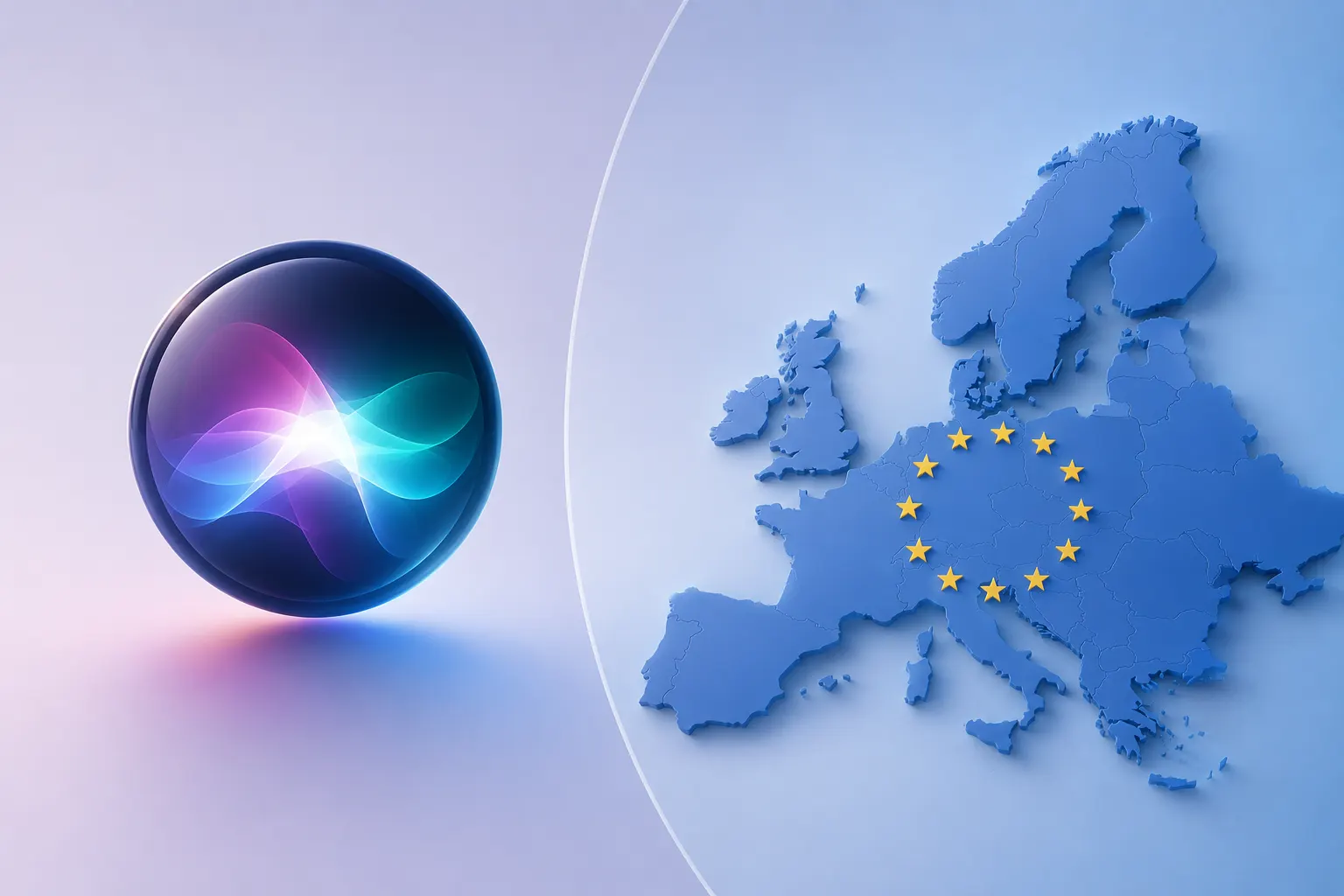
Why isn't Siri AI available in the EU? Learn how EU regulations affect Apple Intelligence, Siri AI features, privacy, and iPhone users.
Siri AI and Apple Intelligence are among Apple's biggest AI initiatives, but many of these features are not launching in the European Union. The delay is largely tied to regulatory concerns surrounding the EU's Digital Markets Act (DMA), interoperability requirements, competition rules, and user privacy obligations. This article explains why Siri AI is unavailable in Europe, what Apple has said about the situation, how EU regulations affect AI deployment, and what the delay means for iPhone users across the region.
Apple's biggest software upgrade in over a decade, Siri AI, will not launch on iPhones or iPads in the European Union when iOS 27 ships this autumn. The reason is a regulatory deadlock with the European Commission over the Digital Markets Act (DMA). Around 450 million EU Apple users are affected, and there is currently no timeline for when that changes.
What Is Siri AI and Why Does It Matter?
Siri AI is not a minor update to Apple's voice assistant. It is a ground-up rebuild announced at WWDC 2026, powered by Apple's upgraded foundation model and deeply embedded into every layer of iOS 27 and iPadOS 27.
The new Siri can read what is on your screen in real time. It can navigate across apps on your behalf, create calendar events from natural language, search your photos using conversational descriptions, and understand the full context of your messages and emails to surface relevant actions at the right moment. Apple VP Mike Rockwell described it at WWDC as "a profoundly more capable assistant that helps you find what you need and gets more done."
In short, Siri AI is the headline feature of iOS 27. For EU iPhone and iPad users, it will not be there at launch.
The Simple Explanation: What Is the DMA?
The Digital Markets Act is a law passed by the European Union that came into full force in March 2024. Its goal is to stop large technology platforms, legally called "gatekeepers," from using their dominant position to lock out competitors.
Apple is one of the named gatekeepers. Under the DMA's Article 6, gatekeepers must make their platform services interoperable with competing services on fair, reasonable, and non-discriminatory terms. In plain English, if Apple builds a powerful system-level feature into iOS, it must allow rival companies access to the same underlying capabilities under equal conditions.
That rule exists to prevent a world where Apple's own apps and services always have an unfair technical advantage over third-party alternatives on the iPhone. For years, critics argued that is exactly the world iPhone users lived in.
Why Siri AI Specifically Cannot Comply With the DMA Right Now
Here is where the technical and regulatory conflict becomes serious.
Siri AI is not just a chatbot sitting on top of iOS. It is a system layer. It can read messages, access files, make purchases, execute actions in any app, understand on-screen content, and act across the entire iPhone with persistent context. That level of access is what makes it genuinely useful.
The DMA's interoperability rules mean Apple would have to offer those exact same system-level access capabilities to any competing AI assistant that requests it. The European Commission's position, according to Apple, is that any AI system must receive "nearly unlimited access" to a user's device, including the ability to read and send messages, make purchases, access files, and execute actions across any installed app, without requiring ongoing user consent or visibility.
Apple says that is a privacy and security catastrophe waiting to happen.
Craig Federighi, Apple's senior vice president of Software Engineering, stated clearly at WWDC: "AI is incredibly powerful technology." The company argues that handing that level of autonomous system access to any third-party AI requesting it would expose users to serious risks they may not even be aware of, because the DMA's interpretation would not require users to actively approve each action a competing assistant takes.
Apple's Proposed Fix and Why It Was Rejected
Apple did not simply throw up its hands. According to Apple Insider, the company revealed its plans for Siri AI to EU regulators at the start of 2026, earlier than it has ever shared product details with any outside body, specifically to try and negotiate a DMA-compliant path.
Apple designed and proposed a mechanism called the Trusted System Agent. The idea was to allow rival AI assistants to access the same Siri AI functions under the hood, but with Apple maintaining oversight of user security and privacy at every step. Think of it as a secure, permission-gated bridge between iOS and third-party AI systems.
The European Commission rejected it.
Apple described this as "the most obvious example to date of the extreme interpretation of the DMA by the Commission." Greg Joswiak, Apple's VP of iOS, iPad and iPhone Marketing, said the complexity of Siri AI made a workable compromise harder than previous negotiations. While a compromise was eventually found for features like live translation in AirPods Pro, Siri AI is "much more complex and much more deeply integrated into the system."
As of the date of publication, the European Commission has not issued a public statement directly responding to Apple's WWDC announcement.
This Is Not the First Time the EU Has Missed an Apple AI Launch
EU iPhone users have been through this before. When Apple Intelligence first launched in the United States in October 2024, European users did not receive it until iOS 18.4 in March 2025, a gap of roughly five months.
That delay was eventually resolved through a different kind of DMA accommodation. The current situation with Siri AI appears considerably more complicated because of how much more deeply integrated the new assistant is compared to the original Apple Intelligence features.
The pattern matters. EU iPhone users are now consistently getting Apple's most advanced features later than the rest of the world, or in some cases not at all, because of an ongoing regulatory standoff that has no clear resolution in sight.
Exactly Which Features Are Blocked in the EU
To understand the full impact on everyday users, here is what EU iPhone and iPad users will not have when iOS 27 launches:
Missing from iOS 27 and iPadOS 27 in the EU:
The new Siri AI app and its conversational interface
Upgraded Visual Intelligence features via Siri
Integrated Writing Tools powered by Apple Intelligence
Siri mode in the iPhone Camera app
Cross-app context awareness and autonomous task completion
Natural language search in Photos using Siri AI
Expanded capabilities for finding information in Messages and Mail
What EU users can still access:
Siri AI will be available on macOS 27 (Golden Gate) and visionOS 27 in the EU. So if you use a Mac or an Apple Vision Pro, you will get the new assistant. iPhone and iPad are the blocked platforms.
There is also a knock-on effect worth knowing. Because Siri AI on watchOS 27 requires a paired iPhone running Siri AI, Apple Watch users in the EU will also miss out on the upgraded assistant, even if their watch hardware supports it.
What the Law Actually Requires and Where Both Sides Stand
Understanding this conflict fairly means looking at both arguments honestly.
The European Commission's position, grounded in Article 6 of the DMA, is that Apple must not use privacy and security as a blanket reason to deny rival AI assistants the same system-level access that Siri enjoys. Several tech policy analysts, including those at Neowin, have argued that a secure, permission-based framework could theoretically satisfy both interoperability and privacy requirements, and that Apple's objections, while legitimate, should not automatically override the law's intent.
The Commission has also signaled that AI assistants are becoming a priority enforcement area. Its April 2026 DMA review identified Apple's integration of Apple Intelligence into iOS as raising serious questions about whether AI is being pre-installed and made default in ways that foreclose competition from third-party alternatives.
Apple's position is that no technically safe version of the Commission's requirement currently exists. Allowing any AI system to act autonomously on a user's device without ongoing visible consent is not a privacy trade-off the company is willing to make, regardless of regulatory pressure. Apple views this as genuinely protecting users, not blocking competitors.
Neither side appears close to a compromise.
What This Means for You as an EU Apple User
If you are an iPhone or iPad user in the European Union, here is what this practically means for you:
If you have an iPhone: When iOS 27 arrives this autumn, your Siri will remain the older version. You will not get the rebuilt assistant, the camera integration, the cross-app actions, or the natural language intelligence features. Your iPhone update will otherwise include iOS 27's other changes, including the Liquid Glass refinements and speed improvements, but the defining AI feature will not be there.
If you are considering buying a new iPhone: The new Siri AI hardware requirements (iPhone Air, iPhone 17 Pro, iPhone 17 Pro Max, or later with 12GB memory) are essentially irrelevant for EU buyers for now, because the software will not ship regardless of your hardware.
If you use a Mac: You will get Siri AI on macOS 27 Golden Gate. This is the one bright spot for EU Apple users in this story.
If you have an Apple Watch: Siri AI on watchOS 27 requires a paired iPhone with Siri AI active. Because EU iPhones will not have Siri AI, EU Apple Watch users also lose the upgrade.
If you are waiting for a resolution: There is genuinely no timeline. Apple has said it hopes to eventually bring Siri AI to the EU and will continue engaging with regulators. However, given that negotiations have already stretched over several months without result, and the Commission's stated enforcement priority on AI, this could be a very long wait.
The Bigger Picture: Is the EU Falling Behind on AI?
This situation raises a question worth asking openly. The EU's Digital Markets Act was designed to protect consumers and promote competition. In practice, for Apple iPhone users in Europe, it is currently preventing them from accessing the most advanced version of their device's operating system at launch.
That tension is not unique to Apple. The Commission is also examining how Google handles Gemini on Android under the same DMA framework. The broader question is whether regulations designed to prevent Big Tech monopolies are being applied in ways that inadvertently slow down AI access for the exact consumers they are meant to protect.
It is a debate happening in policy circles across Europe right now, and the outcome of the Apple-EU standoff over Siri AI will likely shape how other technology companies approach EU launches for years to come.
Frequently Asked Questions
Will Siri AI ever come to EU iPhones?
Apple says it hopes so, but there is currently no timeline. The company will continue working with EU regulators.
Does this affect all EU countries?
Yes. All EU member states are subject to the DMA. Siri AI will not be available on iPhone or iPad in any EU country at launch.
What about China?
Siri AI will also not be available in China at launch, though for different reasons. Apple is working through separate regulatory requirements there.
Can EU users access Siri AI at all?
Yes, through macOS 27 Golden Gate and visionOS 27. The restriction applies specifically to iOS 27 and iPadOS 27.
Is this the same as what happened with Apple Intelligence in 2024?
Similar, but more severe. The 2024 Apple Intelligence features arrived in the EU about five months later via iOS 18.4. This time, Apple says there is no current path forward at all for Siri AI on iPhone and iPad in the EU.
What is the Trusted System Agent that Apple proposed?
It was a privacy-preserving mechanism designed to give rival AI assistants access to the same system-level features as Siri AI, while keeping user security under Apple's control. The European Commission rejected it.
Read Also:
Siri AI vs Google Gemini vs ChatGPT: Which AI Assistant Actually Wins
Comments (0)
No comments yet. Be the first to share your thoughts!